Uncovering Turbulent Dynamics in Stenotic Flows from 4D-flow MRI Measurements via Resolvent Analysis and Data Assimilation
Pith reviewed 2026-06-28 07:59 UTC · model grok-4.3
The pith
A hybrid MRI and physics-informed neural network framework produces a RANS-compatible mean flow that supports global linear stability and resolvent analysis of stenotic flows.
A machine-rendered reading of the paper's core claim, the machinery that carries it, and where it could break.
Core claim
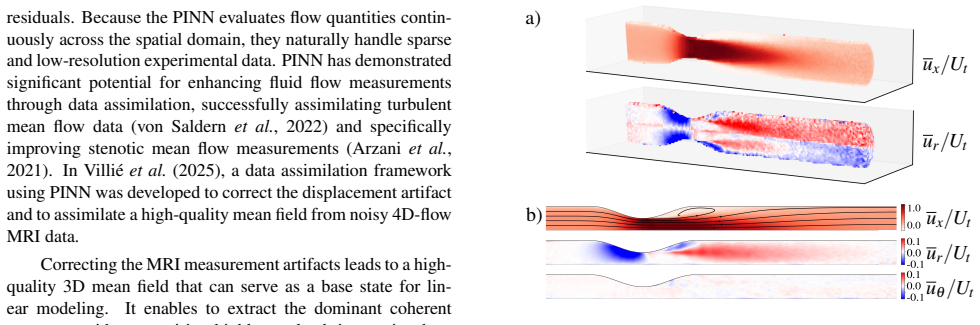
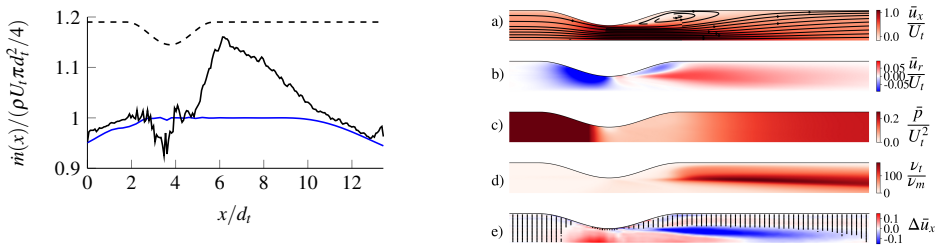
The study shows that a two-step PINN data assimilation applied to 4D-flow MRI measurements at Reynolds number 3960 yields a RANS-compatible mean flow whose global linear stability analysis reveals stationary eigenmodes in the recirculation bubble with positive growth rates for m=2 and m=3, while resolvent analysis identifies a broadband pseudo-resonance associated with the convective instability of the separated shear layer and maximal amplification for the axisymmetric mode m=0.
What carries the argument
The two-step PINN optimization that first removes the displacement artifact and then extracts the unknown mean pressure and eddy viscosity fields to produce a RANS-compatible base state for global LSA and resolvent analysis.
If this is right
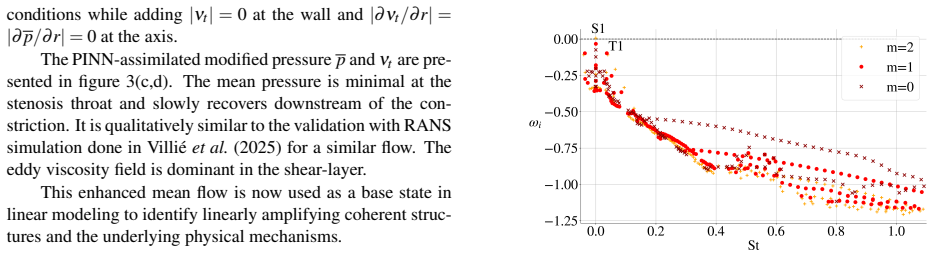
- Stationary eigenmodes located in the recirculation bubble grow for azimuthal wavenumbers m=2 and m=3 and dominate the low-frequency dynamics.
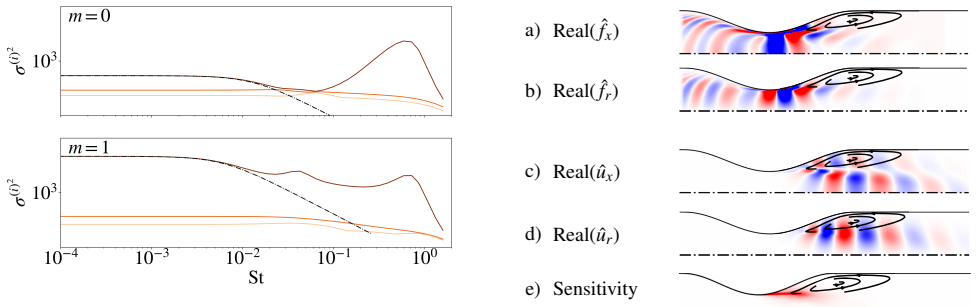
- Resolvent analysis shows a broadband pseudo-resonance from convective instability of the separated shear layer with strongest amplification at m=0.
- The recovered mean pressure and eddy viscosity fields allow linear analysis to be performed on experimentally obtained base flows.
- The framework demonstrates that sparse 4D-flow MRI data can be integrated with physics-based modeling to identify coherent structures.
Where Pith is reading between the lines
- The same pipeline could be tested on time-resolved rather than mean MRI data to check whether the identified modes persist under unsteady conditions.
- Patient-specific stenotic geometries acquired with the same MRI protocol could be analyzed to see whether the m=2 and m=3 modes appear in vivo.
- Comparison of the extracted eddy viscosity field against independent turbulence models would test how much the linear analysis depends on the RANS closure.
Load-bearing premise
The two-step PINN optimization removes the displacement artifact and yields pressure and eddy viscosity fields accurate enough that the subsequent linear stability and resolvent analyses remain meaningful.
What would settle it
Time-resolved velocity measurements in the same phantom that either confirm or contradict the predicted stationary eigenmodes inside the recirculation bubble and the dominant low-frequency response at m=2 and m=3 would directly test the claim.
Figures
read the original abstract
This study presents a hybrid experimental and computational framework that couples in vitro 4D phase-contrast magnetic resonance imaging (4D-flow MRI) measurements with data assimilation and linear modeling to characterize the flow linear amplification mechanisms. We manufacture an idealized stenosis phantom with a cosine-shaped contraction and acquire three-dimensional (3D) mean velocity measurements at Reynolds number 3960 using 4D-flow MRI. To overcome the inherent displacement artifact, we perform data assimilation via a two-step optimization strategy using physics-informed neural network (PINN). This approach first corrects measurement artifacts before extracting the unknown mean pressure and eddy viscosity fields. The RANS-compatible mean flow then serves as the base state for global linear stability analysis (LSA) and resolvent analysis. The global LSA reveals stationary eigenmodes located in the recirculation bubble that exhibit a positive growth rate for azimuthal wavenumbers m=2 and m=3. The forced dynamics of this eigenmode dominates the low-frequency dynamics. Resolvent analysis identifies a broadband pseudo-resonance associated with the convective instability of the separated shear-layer, with maximal amplification for m=0. This methodology demonstrates how integrating sparse experimental MRI data with physics-based modeling enables the identification of mean fields and coherent structures. By leveraging the capabilities of 4D-flow MRI to non-invasively measure 3D velocity fields without requiring physical or optical access, this approach is a first step in the application of linear analysis to cardiovascular flows.
Editorial analysis
A structured set of objections, weighed in public.
Referee Report
Summary. The paper claims to develop a hybrid framework that assimilates in vitro 4D-flow MRI velocity data from an idealized cosine-shaped stenosis phantom (Re=3960) via a two-step PINN optimization to correct displacement artifacts and recover mean pressure and eddy-viscosity fields. The resulting RANS-compatible base flow is then subjected to global linear stability analysis, which identifies stationary unstable eigenmodes localized in the recirculation bubble for azimuthal wavenumbers m=2 and m=3, and to resolvent analysis, which identifies a broadband pseudo-resonance linked to convective instability of the separated shear layer with peak amplification at m=0. The work positions this as a first step toward applying linear analysis tools to cardiovascular flows using non-invasive MRI measurements.
Significance. If the assimilated base flow is shown to be sufficiently accurate, the integration of sparse experimental MRI data with global LSA and resolvent analysis could enable non-invasive identification of coherent structures and amplification mechanisms in complex internal flows where optical access or full DNS is impractical. The approach has potential relevance for biomedical fluid mechanics, provided the physics-informed assimilation step is rigorously validated.
major comments (2)
- [Methods (PINN assimilation)] The two-step PINN assimilation procedure (Methods section describing the optimization strategy): the central claim that the extracted pressure and eddy-viscosity fields are suitable for global LSA and resolvent analysis is load-bearing, yet the manuscript provides no L2 error norms, no comparison against a reference RANS or DNS solution on the identical geometry, and no sensitivity study of the reported eigenmode growth rates or resolvent gains to perturbations in the base flow. Small errors in the separated shear layer are known to shift neutral curves by O(1), rendering the reported m=2,3 growth rates and m=0 pseudo-resonance difficult to interpret without such checks.
- [Results (global LSA)] Global LSA results (section presenting the eigenmodes for m=2 and m=3): the positive growth rates are stated without quantitative validation metrics, error bars, or cross-checks against known solutions for similar separated flows, which is required to establish that the modes are not artifacts of the assimilated fields.
minor comments (2)
- [Abstract] The abstract states that the forced dynamics of the eigenmode 'dominates the low-frequency dynamics' without specifying the frequency range or providing supporting spectra; this claim should be quantified or removed if unsupported.
- [Notation and equations] Notation for eddy viscosity and Reynolds stresses should be checked for consistency between the PINN formulation and the subsequent RANS-compatible base flow description.
Simulated Author's Rebuttal
We thank the referee for the constructive feedback on our manuscript. We address each major comment below, indicating revisions where appropriate to strengthen the validation of the assimilated base flow and linear analysis results.
read point-by-point responses
-
Referee: [Methods (PINN assimilation)] The two-step PINN assimilation procedure (Methods section describing the optimization strategy): the central claim that the extracted pressure and eddy-viscosity fields are suitable for global LSA and resolvent analysis is load-bearing, yet the manuscript provides no L2 error norms, no comparison against a reference RANS or DNS solution on the identical geometry, and no sensitivity study of the reported eigenmode growth rates or resolvent gains to perturbations in the base flow. Small errors in the separated shear layer are known to shift neutral curves by O(1), rendering the reported m=2,3 growth rates and m=0 pseudo-resonance difficult to interpret without such checks.
Authors: We agree that quantitative validation metrics and sensitivity checks are necessary to support the suitability of the assimilated fields for linear analysis. The two-step PINN enforces the steady RANS equations as a soft constraint, which provides physical consistency beyond pure data fitting, but this does not replace explicit error quantification. In the revised manuscript we will add: (i) L2 norms of the velocity reconstruction error relative to the raw MRI measurements, (ii) a direct comparison of the extracted mean pressure and eddy-viscosity fields against a RANS simulation performed on the identical cosine-stenosis geometry, and (iii) a sensitivity study in which the base-flow eddy viscosity is perturbed within the assimilation residual bounds and the resulting changes in growth rates and resolvent gains are quantified. These additions will allow readers to assess the robustness of the reported m=2,3 modes and m=0 pseudo-resonance. revision: yes
-
Referee: [Results (global LSA)] Global LSA results (section presenting the eigenmodes for m=2 and m=3): the positive growth rates are stated without quantitative validation metrics, error bars, or cross-checks against known solutions for similar separated flows, which is required to establish that the modes are not artifacts of the assimilated fields.
Authors: We acknowledge the need for additional cross-validation to confirm that the stationary eigenmodes are not numerical artifacts. While the modes are localized in the recirculation bubble and exhibit structures consistent with literature on separated shear-layer instabilities, the manuscript currently lacks explicit benchmarks. In the revision we will include: (i) growth-rate comparisons against published results for canonical backward-facing step or stenosis flows at comparable Reynolds numbers, (ii) error bars derived from the residual of the PINN assimilation (i.e., the magnitude of the RANS-equation violation), and (iii) a brief convergence study with respect to the PINN training tolerance. These metrics will be added to the global LSA section to substantiate the reported positive growth rates for m=2 and m=3. revision: yes
Circularity Check
No significant circularity in derivation chain
full rationale
The paper presents a workflow that acquires 4D-flow MRI velocity data, applies a two-step PINN assimilation to correct artifacts and extract pressure/eddy viscosity, then uses the resulting mean flow as input for global LSA and resolvent analysis. No quoted equations or steps in the abstract reduce any claimed prediction or eigenmode result to a fitted parameter by construction, nor do they rely on self-citation chains for uniqueness or ansatz. The assimilation step is an independent optimization against measurements and RANS equations; the subsequent linear analyses operate on that output without tautological redefinition. This is the common case of a self-contained hybrid method whose validity rests on external validation (not performed here) rather than internal reduction.
Axiom & Free-Parameter Ledger
axioms (1)
- domain assumption The two-step PINN optimization produces a mean flow compatible with RANS equations that is suitable as base state for global LSA and resolvent analysis
Reference graph
Works this paper leans on
-
[1]
N. D. Birell and P. C. W. Davies , year = 1982, title =
1982
-
[2]
R. P. Feynman. Phys.\ Rev. 1954
1954
-
[3]
Einstein and Yu Podolsky and N
A. Einstein and Yu Podolsky and N. Rosen. Phys.\ Rev. 1935
1935
-
[4]
G. P. Berman, Jr. and F. M. Izrailev, Jr. Stability of nonlinear modes. Physica D. 1983
1983
-
[5]
E. B. Davies and L. Parns. Trapped modes in acoustic waveguides. Q. J. Mech. Appl. Math. 1988
1988
-
[6]
Edward Witten. 2001. hep-th/0106109
Pith/arXiv arXiv 2001
-
[7]
E. Beutler. Williams Hematology. 1994
1994
-
[8]
Donald E. Knuth. Fundamental Algorithms. 1973b 1973
1973
-
[9]
J. S. Smith and G. W. Johnson. Philos. Trans. R. Soc. London, Ser. B. 2005
2005
-
[10]
W. J. Smith and T. J. Johnson and B. G. Miller. Surface chemistry and preferential crystal orientation on a silicon surface. 2010
2010
-
[11]
V. K. Smith and K. Johnson and M. O. Klein. Surface chemistry and preferential crystal orientation on a silicon surface. 2010
2010
-
[12]
Lower Bounds for Wishful Research Results
Ulrich \" U nderwood and Ned \ N et and Paul \= P ot. Lower Bounds for Wishful Research Results
-
[13]
M. P. Johnson and K. L. Miller and K. Smith. 2007
2007
-
[14]
AIP Conf. Proc. 2007
2007
-
[15]
Fifteenth Annual
Proc. Fifteenth Annual
-
[16]
Y. Burstyn. Proceedings of the 5th International Molecular Beam Epitaxy Conference, Santa Fe, NM. 2004
2004
-
[17]
Proceedings of the 2003 Particle Accelerator Conference, Portland, OR, 12-16 May 2005. 2001
2003
-
[18]
A. G. Agarwal. Proceedings of the Fifth Low Temperature Conference, Madison, WI, 1999. Semiconductors. 2001
1999
-
[19]
R. Smith. Hummingbirds are our friends. 2001
2001
-
[20]
An O(n n / \! n) Sorting Algorithm
Tom T \' e rrific. An O(n n / \! n) Sorting Algorithm
-
[21]
Mastering Thesis Writing
\' E douard Masterly. Mastering Thesis Writing
-
[22]
Phidias Phony-Baloney
F. Phidias Phony-Baloney. Fighting Fire with Fire: Festooning F rench Phrases
-
[23]
Donald E. Knuth. Seminumerical Algorithms. 1973c 1981
1981
-
[24]
Jill C. Knvth. The Programming of Computer Art
-
[26]
R. Ballagh and C.M. Savage. Bose-Einstein condensation: from atomic physics to quantum fluids. Proceedings of the 13th Physics Summer School. 2000. cond-mat/0008070
Pith/arXiv arXiv 2000
-
[27]
Opechowski and R
W. Opechowski and R. Guccione. Introduction to the Theory of Normal Metals. Magnetism. 1965
1965
-
[28]
J. M. Smith. Molecular Dynamics. 1980
1980
-
[29]
V. E. Zakharov and A. B. Shabat. Exact theory of two-dimensional self-focusing and one-dimensional self-modulation of waves in nonlinear media. Zh. Eksp. Teor. Fiz. 1971
1971
-
[30]
Daniel D. Lincoll. Semigroups of Recurrences. High Speed Computer and Algorithm Organization
-
[31]
Oaho and Jeffrey D
Alfred V. Oaho and Jeffrey D. Ullman and Mihalis Yannakakis. On Notions of Information Transfer in VLSI Circuits. Proc. Fifteenth Annual ACM
-
[32]
The Definitive Computer Manual
Larry Manmaker. The Definitive Computer Manual
-
[33]
Abramowitz and I
M. Abramowitz and I. Stegun , title =
-
[34]
Barker and D
T. Barker and D. G. Schaeffer and P. Boh\'orquez and J. M. N. T. Gray , title =. J. Fluid. Mech. , year =
-
[35]
Batchelor , title =
G.K. Batchelor , title =. J. Fluid Mech. , year =
-
[36]
A. V. Briukhanov and S. S. Grigorian and S. M. Miagkov and M. Y. Plam and I. E. Shurova and M. E. Eglit and Y. L. Yakimov , title =. Physics of Snow and Ice, Proceedings of the International Conference on Low Temperature Science , volume =
-
[37]
Brownell and L.K
C.J. Brownell and L.K. Su , title =. AIAA Paper 2004-2335 , year =
2004
-
[38]
Brownell and L.K
C.J. Brownell and L.K. Su , title =. AIAA Paper 2007-1314 , year =
2007
-
[39]
Dennis , title =
S.C.R. Dennis , title =. Ninth Intl Conf. on Numerical Methods in Fluid Dynamics , publisher =. 1985 , editor =
1985
-
[40]
Formation of levees, troughs and elevated channels by avalanches on erodible slopes , author =. J. Fluid Mech. , volume =
-
[41]
Hwang and E.O
L.-S. Hwang and E.O. Tuck , title =. J. Fluid Mech. , year =
-
[42]
and Saut, Jean Claude , title =
Joseph, Daniel D. and Saut, Jean Claude , title =. Theoretical and Computational Fluid Dynamics , publisher=
-
[43]
Worster , title =
M.G. Worster , title =. Interactive dynamics of convection and solidification , publisher =. 1992 , editor =
1992
-
[44]
Koch , title =
W. Koch , title =. J. Sound Vib. , year =
-
[45]
Lee , title =
J.-J. Lee , title =. J. Fluid Mech. , year =
-
[46]
Linton and D.V
C.M. Linton and D.V. Evans , title =. Phil.\ Trans.\ R. Soc.\ Lond. , year =
-
[47]
Martin , title =
P.A. Martin , title =. 1980 , journal =
1980
-
[48]
Rogallo , title =
R.S. Rogallo , title =
-
[49]
Ursell , title =
F. Ursell , title =. 1950 , journal =
1950
-
[50]
On the oscillations Near and at resonance in open pipes , year =
L. On the oscillations Near and at resonance in open pipes , year =. J. Engng Maths , volume =
-
[51]
Miller , title =
P.L. Miller , title =. 1991 , address =
1991
-
[52]
Camera Calibration Toolbox for Matlab , howpublished =
Bouguet, J.-Y , year=. Camera Calibration Toolbox for Matlab , howpublished =
-
[54]
Sallam, A. M. and Hwang, N. H. C. , urldate =. Influence of Red Blood Cell Concentrations on the Measurement of Turbulence Using Hot-Film Anemometer , volume =. Journal of Biomechanical Engineering , shortjournal =. doi:10.1115/1.3138442 , abstract =
-
[55]
Flow instabilities induced by coronary artery stents: Assessment with an in vitro pulse duplicator -
-
[56]
Three-dimensional flow field around and downstream of a subscale model rotating vertical axis wind turbine
-
[57]
In vivo assessment of wall shear stress in the atherosclerotic aorta using flow‐sensitive 4D
-
[58]
JACC: Cardiovascular Imaging , volume=
Magnetic resonance measurement of turbulent kinetic energy for the estimation of irreversible pressure loss in aortic stenosis , author=. JACC: Cardiovascular Imaging , volume=. 2013 , publisher=
2013
-
[59]
The Role of Imaging of Flow Patterns by 4D Flow
-
[60]
Inverse problems in blood flow modeling: A review - Nolte - 2022 - International Journal for Numerical Methods in Biomedical Engineering - Wiley Online Library , url =
2022
-
[61]
Dyverfeldt, P. and others , urldate =. 4D flow cardiovascular magnetic resonance consensus statement , volume =. Journal of Cardiovascular Magnetic Resonance , shortjournal =. doi:10.1186/s12968-015-0174-5 , pages =
-
[62]
Kissas, G. and others , urldate =. Machine learning in cardiovascular flows modeling: Predicting arterial blood pressure from non-invasive 4D flow. Computer Methods in Applied Mechanics and Engineering , shortjournal =. 2020 , keywords =. doi:10.1016/j.cma.2019.112623 , shorttitle =
-
[63]
Current Directions in Biomedical Engineering , author =
Computation of flow through. Current Directions in Biomedical Engineering , author =. doi:10.1515/cdbme-2022-1189 , abstract =
-
[64]
Kazemi, Amirkhosro and Stoddard, Marcus and Amini, Amir A. , editor =. Reduced-order modeling of 4D flow. Medical Imaging 2022: Biomedical Applications in Molecular, Structural, and Functional Imaging , publisher =. doi:10.1117/12.2613383 , abstract =
-
[65]
Resolvent analysis of mean Flow-
Nolte, David , langid =. Resolvent analysis of mean Flow-
-
[66]
and Kozerke, Sebastian , urldate =
Dirix, Pietro and Buoso, Stefano and Peper, Eva S. and Kozerke, Sebastian , urldate =. Synthesis of patient-specific multipoint 4D flow. Scientific Reports , shortjournal =. 2022 , langid =. doi:10.1038/s41598-022-20121-x , abstract =
-
[67]
and Pirola, Selene and Salmasi, Mohammad Yousuf and O’Regan, Declan P
Manchester, Emily L. and Pirola, Selene and Salmasi, Mohammad Yousuf and O’Regan, Declan P. and Athanasiou, Thanos and Xu, Xiao Yun , urldate =. Analysis of Turbulence Effects in a Patient-Specific Aorta with Aortic Valve Stenosis , volume =. Cardiovascular Engineering and Technology , shortjournal =. 2021 , issn =. doi:10.1007/s13239-021-00536-9 , abstract =
-
[68]
Magnetic Resonance in Medicine , author =
Assessment of Reynolds stress components and turbulent pressure loss using 4D flow. Magnetic Resonance in Medicine , author =. 2017 , issn =. doi:10.1002/mrm.26853 , abstract =
-
[69]
Validation of 4D Flow based relative pressure maps in aortic flows , volume =
Nolte, David and Urbina, Jesús and Sotelo, Julio and Sok, Leo and Montalba, Cristian and Valverde, Israel and Osses, Axel and Uribe, Sergio and Bertoglio, Cristóbal , urldate =. Validation of 4D Flow based relative pressure maps in aortic flows , volume =. Medical Image Analysis , shortjournal =. doi:10.1016/j.media.2021.102195 , abstract =
-
[70]
Fathi, Mojtaba F. and Perez-Raya, Isaac and Baghaie, Ahmadreza and Berg, Philipp and Janiga, Gabor and Arzani, Amirhossein and D’Souza, Roshan M. , urldate =. Super-resolution and denoising of 4D-Flow. Computer Methods and Programs in Biomedicine , shortjournal =. doi:10.1016/j.cmpb.2020.105729 , abstract =
-
[71]
Physics of Fluids , volume=
Dynamic mode decomposition-based surrogate modeling of wall shear stress in an aneurysm artery , author=. Physics of Fluids , volume=. 2025 , publisher=
2025
-
[72]
Coupling synthetic and real-world data for a deep learning-based segmentation process of 4D flow
Garzia, Simone and Scarpolini, Martino Andrea and Mazzoli, Marilena and Capellini, Katia and Monteleone, Angelo and Cademartiri, Filippo and Positano, Vincenzo and Celi, Simona , urldate =. Coupling synthetic and real-world data for a deep learning-based segmentation process of 4D flow. Computer Methods and Programs in Biomedicine , shortjournal =. doi:10...
-
[73]
and Raimondi, Francesca and Ait Ali, Lamia and Allen, Bradley D
Bissell, Malenka M. and Raimondi, Francesca and Ait Ali, Lamia and Allen, Bradley D. and Barker, Alex J. and Bolger, Ann and Burris, Nicholas and Carhäll, Carl-Johan and Collins, Jeremy D. and Ebbers, Tino and Francois, Christopher J. and Frydrychowicz, Alex and Garg, Pankaj and Geiger, Julia and Ha, Hojin and Hennemuth, Anja and Hope, Michael D. and Hsia...
-
[74]
Frontiers in Bioengineering and Biotechnology , author =
Calibration of patient-specific boundary conditions for coupled. Frontiers in Bioengineering and Biotechnology , author =
-
[75]
Journal of Fluid Mechanics , author =
Nonlinear evolution and acoustic radiation of coherent structures in subsonic turbulent free shear layers , volume =. Journal of Fluid Mechanics , author =. doi:10.1017/jfm.2019.909 , abstract =
-
[76]
Frontiers in Physics , author =
4DFlowNet: Super-Resolution 4D Flow. Frontiers in Physics , author =
-
[77]
Frontiers in Bioengineering and Biotechnology , author =
Medical Image-Based Computational Fluid Dynamics and Fluid-Structure Interaction Analysis in Vascular Diseases , volume =. Frontiers in Bioengineering and Biotechnology , author =
-
[78]
Journal of Fluid Mechanics , author =
Three-dimensional coherent structures in a swirling jet undergoing vortex breakdown: stability analysis and empirical mode construction , volume =. Journal of Fluid Mechanics , author =. 2011 , langid =. doi:10.1017/jfm.2011.141 , shorttitle =
-
[79]
Andersson, Magnus and Ebbers, Tino and Karlsson, Matts , urldate =. Characterization and estimation of turbulence-related wall shear stress in patient-specific pulsatile blood flow , volume =. Journal of Biomechanics , year =. doi:10.1016/j.jbiomech.2019.01.016 , pages =
-
[80]
Magnetic resonance in medicine , volume=
Assessment of turbulent flow effects on the vessel wall using four-dimensional flow MRI , author=. Magnetic resonance in medicine , volume=. 2017 , publisher=
2017
-
[81]
Characterization of anisotropic turbulence behavior in pulsatile blood flow , volume =
Andersson, Magnus and Karlsson, Matts , urldate =. Characterization of anisotropic turbulence behavior in pulsatile blood flow , volume =. Biomechanics and Modeling in Mechanobiology , shortjournal =. doi:10.1007/s10237-020-01396-3 , abstract =
-
[82]
Seikh, Asiful H. and Akinshilo, A. T. and Taheri, M. H. and Rahimi-Gorji, Mohammad and Alharthi, Nabeel and Khan, Ilyas and Khan, Amir Rahman , urldate =. Influence of the nanoparticles and uniform magnetic field on the slip blood flows in arterial vessels , volume =. Physica Scripta , shortjournal =. doi:10.1088/1402-4896/ab3490 , abstract =
discussion (0)
Sign in with ORCID, Apple, or X to comment. Anyone can read and Pith papers without signing in.