REVIEW 2 major objections 32 references
Modification of Charge and Spin Textures by Light Chemical Substitution in Eu(Al$_{1-x}$Ga$_{x}$)$_4$ ($x=0.1$)
T0 review · 2 major / 0 minor · reviewed 2026-06-28 · grok-4.3
Pith's one-line read In Eu(Al0.9Ga0.1)4 a charge density wave weakens sharply exactly when helical magnetic order appears at 14.8 K.
desk verdict 10% Ga substitution stabilizes a single helical magnetic phase below TN that coincides with a CDW amplitude drop, unlike the multi-phase x=0 case, though subdomain averaging may blur the spin texture details. read the letter →
The pith
A machine-rendered reading of the paper's core claim, the machinery that carries it, and where it could break.
The reading
What carries the argument
Resonant X-ray diffraction at the Eu L3 edge that simultaneously resolves CDW satellites and magnetic satellites, allowing direct comparison of their temperature dependences and polarization responses.
What would settle it
A measurable change with temperature in the ratio of magnetic satellite intensities measured with linear versus circularly polarized X-rays would indicate multiple magnetic phases rather than a single phase.
Extended reading notes
Core claim
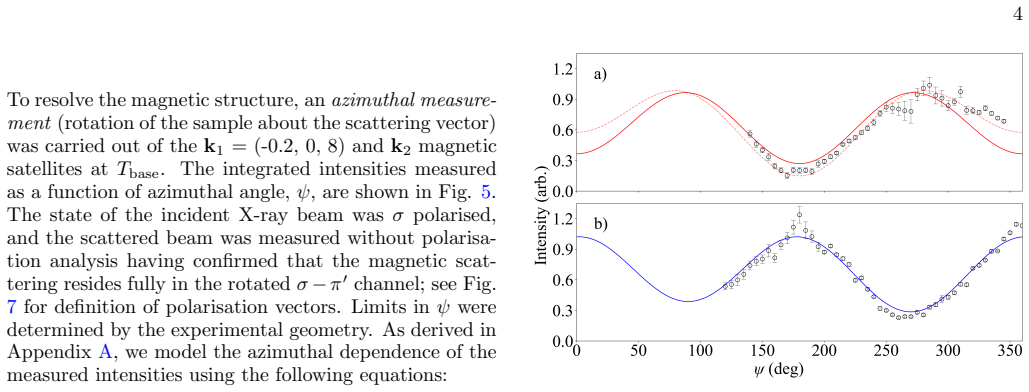
Resonant X-ray diffraction shows that the magnetic ordering temperature TN equals 14.8 K and coincides exactly with the sudden drop in CDW amplitude. The magnetic satellites correspond to two domains whose spin arrangements are helical with elliptical envelopes; one domain is tilted. The ratio of intensities in linear and circular polarization remains constant below TN, indicating a single magnetic phase. This contrasts with the x=0 compound, which passes through a spin-density-wave state before reaching a helical ground state.
Load-bearing premise
The observed azimuthal intensity patterns arise from single-domain helical or tilted-helical structures without significant masking by multiple subdomains.
Editorial extensions
If this is right
- Ga substitution at the 10 percent level suppresses the intermediate magnetic phases present in the parent compound.
- The coincidence of the CDW amplitude drop and magnetic ordering implies that the two orders are coupled strongly enough for one to influence the other directly.
- The elliptical envelope of the helix is fixed by the polarization dependence and does not evolve further below TN.
- The k1 domain shows a detectable tilt component while the k2 domain appears untilted, consistent with domain-specific geometry.
Reading between the lines
- Chemical substitution offers a route to simplify the magnetic phase sequence in this family while preserving the CDW.
- Mapping the coupling strength across a wider range of Ga concentrations could reveal a critical doping where the coincidence disappears.
- Domain-specific tilt components may be detectable in other scattering geometries or with complementary probes that average differently over subdomains.
Signed reviews
Editorial analysis
A structured set of objections, weighed in public.
Referee Report
Summary. The manuscript reports resonant X-ray diffraction results on Eu(Al_{1-x}Ga_x)_4 (x=0.1) at the Eu L3 edge. A CDW with k_CDW ≈ (0,0,0.18) develops below ~75 K and its amplitude drops suddenly near 15 K. Magnetic satellites appear below T_N=14.8 K for two domains (k1=(±δ_m,0,0), k2=(0,±δ_m,0), δ_m=0.2002(4)). Azimuthal scans assign an elliptical helical structure (μ_Y/μ_Z=1.19(6)) to k2 and a tilted helicoid (μ_Y/μ_Z=1.14(4), μ_X/μ_Z=0.20(2)) to k1. The linear-to-circular intensity ratio is temperature-invariant below T_N, indicating a single magnetic phase. The exact coincidence of T_N with the CDW amplitude drop is taken to indicate strong charge-spin coupling, in contrast to the multi-phase behavior at x=0.
Significance. If the spin-structure assignments are robust, the work shows that light Ga substitution can eliminate intermediate phases and produce a direct transition to a single helical state whose onset coincides with a CDW amplitude change. This supplies concrete experimental evidence for chemical tuning of spin-charge interplay in the Eu(Al,Ga)4 series and demonstrates the utility of resonant XRD for resolving both orders simultaneously.
major comments (2)
- [Abstract] Abstract and azimuthal-measurements discussion: the claim that Ga substitution yields a qualitatively different single-phase helical ground state (distinct from x=0) rests on the azimuthal dependence uniquely fixing a pure helical structure for the k2 domain. The text itself states that a μ_X term 'may be hidden for the k2 domain due to multiple subdomains,' rendering the extracted μ_Y/μ_Z ratio and the asserted absence of an in-plane component non-unique. This directly weakens the modification-of-spin-textures interpretation.
- [Magnetic structure determination] Magnetic-structure and temperature-evolution sections: the azimuthal intensities are fitted to yield specific ratios with quoted uncertainties (e.g., 1.19(6)), yet no full intensity tables, detailed fitting functions, or quantitative error propagation are provided. Without these, the robustness of the single-domain helical assignment against subdomain averaging cannot be evaluated, which is load-bearing for the central claim of a modified, single-phase magnetic state.
Simulated Author's Rebuttal
We thank the referee for their careful reading and constructive comments on our manuscript. We respond point-by-point to the major comments below.
read point-by-point responses
-
Referee: [Abstract] Abstract and azimuthal-measurements discussion: the claim that Ga substitution yields a qualitatively different single-phase helical ground state (distinct from x=0) rests on the azimuthal dependence uniquely fixing a pure helical structure for the k2 domain. The text itself states that a μ_X term 'may be hidden for the k2 domain due to multiple subdomains,' rendering the extracted μ_Y/μ_Z ratio and the asserted absence of an in-plane component non-unique. This directly weakens the modification-of-spin-textures interpretation.
Authors: We agree that the azimuthal data for the k2 domain cannot uniquely exclude a small μ_X component owing to possible subdomain averaging, as the manuscript already states. This limitation means the k2 structure is less definitively a pure helix than the k1 domain. The central distinction from the x=0 compound is nevertheless the direct onset of magnetic order at TN coinciding with the CDW amplitude drop and the temperature-independent linear-to-circular intensity ratio, which together indicate a single magnetic phase below TN without intermediate states. We will revise the abstract to moderate the phrasing around the k2 assignment while retaining the evidence for modified behavior relative to x=0. revision: partial
-
Referee: [Magnetic structure determination] Magnetic-structure and temperature-evolution sections: the azimuthal intensities are fitted to yield specific ratios with quoted uncertainties (e.g., 1.19(6)), yet no full intensity tables, detailed fitting functions, or quantitative error propagation are provided. Without these, the robustness of the single-domain helical assignment against subdomain averaging cannot be evaluated, which is load-bearing for the central claim of a modified, single-phase magnetic state.
Authors: We accept this point. In the revised supplementary material we will include (i) tabulated azimuthal intensities for both domains, (ii) the explicit functional form of the azimuthal dependence incorporating polarization factors, and (iii) the least-squares fitting procedure together with the method of error propagation. These additions will allow readers to assess the sensitivity of the extracted ratios to possible subdomain effects. revision: yes
Circularity Check
No significant circularity; purely experimental report with direct observations.
full rationale
This paper is a purely experimental resonant X-ray diffraction study reporting measured propagation vectors, transition temperatures, CDW amplitude changes, and azimuthal intensity dependencies in Eu(Al1-xGax)4 (x=0.1). The central observation that TN coincides exactly with the CDW amplitude drop is a direct experimental result, not derived from any model or prior fit. Azimuthal data are analyzed by fitting elliptical envelope ratios (μY/μZ etc.) to observed intensities; these fitted values are presented as extracted parameters, not as predictions. No self-citation chain, uniqueness theorem, or ansatz is invoked to justify the structures. Comparisons to the x=0 series are contextual only and do not bear the load of the reported findings. The work is self-contained against external benchmarks.
Assumptions & free parameters
Cite this review
Pith. "Pith review of Modification of Charge and Spin Textures by Light Chemical Substitution in Eu(Al$_{1-x}$Ga$_{x}$)$_4$ ($x=0.1$)." pith.science (2026). https://pith.science/paper/YXBIIHHO
@misc{pith2026260603869,
  author       = {Pith},
  title        = {Pith review of: Modification of Charge and Spin Textures by Light Chemical Substitution in Eu(Al$_1-x$Ga$_x$)$_4$ ($x=0.1$)},
  year         = {2026},
  howpublished = {\url{https://pith.science/paper/YXBIIHHO}},
  note         = {Machine review of arXiv:2606.03869}
}
abstract
We present the results of a resonant X-ray diffraction experiment, resolving both charge and spin textures in the intermetallic topological magnet Eu(Al$_{1-x}$Ga$_{x}$)$_4$, $x$ = 0.1. Below $\approx$ 75 K the system develops a charge density wave (CDW) with propagation vector kCDW ~ (0, 0, 0.18). The CDW order parameter grows monotonically on cooling until ~ 15 K, when a sudden decrease in the CDW amplitude occurs. Pairs of magnetic satellites of the (0, 0, 8) Bragg reflection corresponding to two distinct domains, k = ($\pm \delta_\text{m}$, 0, 0), k2 = (0, $\pm\delta_\text{m}$, 0), $\delta_\text{m} = 0.2002(4)$ were studied at the Eu L3 edge, appearing below TN = 14.8 K. Our measurement of TN is exactly coincident with the sudden drop in the CDW amplitude, which suggests strong coupling between the charge and spin orders, as observed in other compounds of the Eu(Al$_{1-x}$Ga$_{x}$)$_4$ series. Azimuthal measurements revealed a single helical spin arrangement with an elliptical envelope of $\mu_\text{Y}/\mu_\text{Z}$ = 1.19(6) for the k2 domain, and a tilted helical (helicoidal) spin arrangement for the k1 domain, with $\mu_\text{Y}/\mu_\text{Z}$ = 1.14(4) and $\mu_\text{X}/\mu_\text{Z}$ = 0.20(2) that may be hidden for the k2 domain due to multiple subdomains. Temperature evolution of the magnetic satellite intensities in linear and circularly polarised light found the respective ratio to be invariant with temperature, suggesting a single magnetic phase below TN. This behaviour is unlike the x = 0 material, in which a spin density wave forms first, transitioning to a helical ground state on cooling through intermediate phases. Future theoretical work on the Eu electronic ground state, supported by related experiments, will help understand the effects of Ga substitution on the evolution of the magnetic structure.
Figures


Figures from the paper (3 more)


Reference graph
Works this paper leans on
-
[1]
ψ ki kf σ π σ′ π′ x∥τ ϑ y X Z χ Y∥z FIG
Lab F rame of Reference We define a Cartesian ‘lab’ frame of reference,{x, y, z}, such thatˆzis normal to the scattering plane containing the incident and scattered X-ray wave vectorsk i andk f. ψ ki kf σ π σ′ π′ x∥τ ϑ y X Z χ Y∥z FIG. 7. Scattering geometry used in the azimuthal calcu- lations.{X, Y, Z}form a real space Cartesian coordinate system (black...
-
[2]
First, we calculate the azimuthal dependence of theτ= (±δ,0,8) magnetic reflections
Crystal F rame of Reference We define a Cartesian ‘crystal’ frame of reference {X,Y,Z}, where the Cartesian basis vectors are parallel to the tetragonala,b, andcaxes, respectively. First, we calculate the azimuthal dependence of theτ= (±δ,0,8) magnetic reflections. The geometry in which the +δre- flection is in the scattering condition at an azimuthal ang...
-
[3]
Unit cell structure factor Throughout this derivation we will adopt the conventions of reference 24. Magnetic moment components are de- scribed as the expectation value of their respective po- 7 larisation operator ˆT (K) Q , which is a tensor operator of rankKdefined in the spherical basis. Here,KandQla- bel the total angular momentum and its projection ...
-
[4]
These rotations will be performed in terms of the appropriate Wigner D-matricesD (K) m′m(α, β, γ) forK= 1, with Euler anglesα,β,γin the extrinsic z-y-z conven- tion
Rotations Next, we perform two rotations of the unit cell structure factor. These rotations will be performed in terms of the appropriate Wigner D-matricesD (K) m′m(α, β, γ) forK= 1, with Euler anglesα,β,γin the extrinsic z-y-z conven- tion. First, the crystal is rotated by−χaboutˆz, and then by the azimuthal angleψaboutˆx. Alternatively, in the passive p...
-
[5]
X-ray Polarisation Finally, we take the dot product with contra-variant spherical tensorJ Q(ϵ,ϵ ′) that depends upon the X-ray polarisation unit vectors of both the incident ( ˆϵ) and scattered ( ˆϵ′) beams, defined in a spherical basis with respect to the lab frame of reference: ˜F= X Q J Q(ˆϵ, ˆϵ′) ˜FQ = X qq ′Q J Q(ˆϵ, ˆϵ′)⟨Tq⟩Dqq ′(χ)Dq′Q(−ψ) (A11) Fo...
-
[6]
Scattering Amplitudes We are now in a position to calculate the scattering am- plitudes from dipoles in each polarisation channel for the (±δ, 0, 8) satellites: F(σ, σ ′) = 0 (A25) F(σ, π ′) = 1 2 eiϑ ˜F1 +e −iϑ ˜F−1 =− i√ 2 cos(ϑ) cos(ψ)Ωc + sin(ϑ)Ωs −cos(ϑ) sin(ψ)Ω 0 (A26) F(π, σ ′) = 1 2 e−iϑ ˜F 1 +e iϑ ˜F −1 = i√ 2 cos(ϑ) cos(ψ)Ωc −sin(ϑ)Ω s −cos(ϑ) s...
-
[7]
Given that F(σ, σ ′) = 0, the relevant diffraction intensity is defined as follows: I(σ) =|F(σ, π ′)|2 (A32) On evaluating Eq
Scattering Intensities The measured intensity was summed over all scattered polarisations, for sigma incident polarisation. Given that F(σ, σ ′) = 0, the relevant diffraction intensity is defined as follows: I(σ) =|F(σ, π ′)|2 (A32) On evaluating Eq. A32 for (−δ, 0, 8) one obtains Eq. 1. To calculate the intensity for (0,δ, 8) one adds a π 2 offset toψin ...
-
[8]
ACKNOWLEDGMENTS Z.B
magnetic satellite. ACKNOWLEDGMENTS Z.B. acknowledges Diamond Light Source for studentship funding. We acknowledge Diamond Light Source for time on beamline I16 under Proposal No. NT40456-1. The work at Rice University was primarily supported by the Robert A. Welch Foundation Grant No. C-2114 and by the U.S. DOE, BES under Grant No. DE-SC0026179. DA T A A...
Show all 32 references
-
[9]
Nagaosa and Y
N. Nagaosa and Y. Tokura, Topological properties and dynamics of magnetic skyrmions, Nature Nanotechnol- ogy8, 899 (2013)
2013
-
[10]
Tokura and N
Y. Tokura and N. Kanazawa, Magnetic skyrmion mate- rials, Chemical Reviews121, 2857 (2020)
2020
-
[11]
Y. Shen, Q. Zhang, P. Shi, L. Du, X. Yuan, and A. V. Zayats, Optical skyrmions and other topological quasi- particles of light, Nature Photonics18, 15 (2024)
2024
-
[12]
J. H. Han,Skyrmions in condensed matter, Vol. 278 (Springer, 2017)
2017
-
[13]
W. Kang, Y. Huang, X. Zhang, Y. Zhou, and W. Zhao, Skyrmion-electronics: An overview and outlook, Pro- ceedings of the IEEE104, 2040 (2016)
-
[14]
Zhang, Y
X. Zhang, Y. Zhou, K. M. Song, T.-E. Park, J. Xia, M. Ezawa, X. Liu, W. Zhao, G. Zhao, and S. Woo, Skyrmion-electronics: writing, deleting, reading and pro- cessing magnetic skyrmions toward spintronic applica- tions, Journal of Physics: Condensed Matter32, 143001 (2020)
2020
-
[15]
Q. L. He, T. L. Hughes, N. P. Armitage, Y. Tokura, and K. L. Wang, Topological spintronics and magnetoelec- tronics, Nature Materials21, 15 (2022)
2022
-
[16]
Zhang, Y
H. Zhang, Y. Zhang, Z. Hou, M. Qin, X. Gao, and J. Liu, Magnetic skyrmions: materials, manipulation, detection, and applications in spintronic devices, Materials Futures 2, 032201 (2023)
2023
-
[17]
H. Yang, J. Liang, and Q. Cui, First-principles calcula- tions for Dzyaloshinskii-Moriya interaction, Nature Re- views Physics5, 43 (2023)
2023
-
[18]
D. A. Kitchaev, I. J. Beyerlein, and A. Van der Ven, Phenomenology of chiral Dzyaloshinskii-Moriya interac- tions in strained materials, Physical Review B98, 214414 (2018)
2018
-
[19]
M¨ uhlbauer, B
S. M¨ uhlbauer, B. Binz, F. Jonietz, C. Pflei- derer, A. Rosch, A. Neubauer, R. Georgii, and P. B¨ oni, Skyrmion lattice in a chi- ral magnet, Science323, 915 (2009), https://www.science.org/doi/pdf/10.1126/science.1166767
2009 doi
-
[20]
J. M. Moya, J. Huang, S. Lei, K. Allen, Y. Gao, Y. Sun, M. Yi, and E. Morosan, Real-space and reciprocal-space topology in the Eu(Ga1−xAlx)4 square net system, Phys- ical Review B108, 064436 (2023)
2023
-
[21]
K. J. Neubauer, K. Allen, J. M. Moya, M. L. Klemm, F. Ye, Z. Morgan, L. DeBeer-Schmitt, W. Tian, E. Mo- rosan, and P. Dai, Correlation between complex spin textures and the magnetocaloric and Hall effects in Eu(Ga1−xAlx)4 (x= 0.9, 1), Physical Review B111, 165136 (2025)
2025
-
[22]
J. M. Moya, S. Lei, E. M. Clements, C. S. Kengle, S. Sun, K. Allen, Q. Li, Y. Peng, A. A. Husain, M. Mitrano, et al., Incommensurate magnetic orders and topological hall effect in the square-net centrosymmetric EuGa 2Al2 system, Physical Review Materials6, 074201 (2022)
2022
-
[23]
Nereson, C
N. Nereson, C. Olsen, and G. Arnold, Magnetic structure of europium, Physical Review 135, A176 (1964)
1964
-
[24]
H. Miao, J. Bouaziz, G. Fabbris, W. Meier, F. Z. Yang, H. X. Li, C. Nelson, E. Vescovo, S. Zhang, A. D. Chris- tianson,et al., Spontaneous chirality flipping in an or- thogonal spin-charge ordered topological magnet, Physi- cal Review X14, 011053 (2024)
2024
-
[25]
A. M. Vibhakar, D. D. Khalyavin, F. Orlandi, J. M. Moya, S. Lei, E. Morosan, and A. Bombardi, Sponta- neous reversal of spin chirality and competing phases in the topological magnet EuAl 4, Communications Physics 7, 313 (2024)
2024
-
[26]
Vibhakar, D
A. Vibhakar, D. Khalyavin, J. Moya, P. Manuel, F. Or- landi, S. Lei, E. Morosan, and A. Bombardi, Competing charge and magnetic order in the candidate centrosym- metric skyrmion host EuGa2Al2, Physical Review B108, L100404 (2023)
2023
-
[27]
Takagi, N
R. Takagi, N. Matsuyama, V. Ukleev, L. Yu, J. S. White, S. Francoual, J. R. L. Mardegan, S. Hayami, H. Saito, K. Kaneko, K. Ohishi, Y. ¯Onuki, T. Arima, Y. Tokura, T. Nakajima, and S. Seki, Square and rhombic lattices of magnetic skyrmions in a centrosymmetric binary com- poun...
2022
-
[28]
Stavinoha, J
M. Stavinoha, J. A. Cooley, S. G. Minasian, T. M. Mc- Queen, S. M. Kauzlarich, C.-L. Huang, and E. Morosan, Charge density wave behavior and order-disorder in the antiferromagnetic metallic series Eu(Ga 1−xAlx)4, Physi- cal Review B97, 195146 (2018)
2018
-
[29]
Shang, Y
T. Shang, Y. Xu, S. Gao, R. Yang, T. Shiroka, and M. Shi, Experimental progress in Eu(Al,Ga)4 topological antiferromagnets, Journal of Physics: Condensed Matter 37, 013002 (2024)
2024
-
[30]
Yang, C.-C
R. Yang, C.-C. Le, P. Zhu, Z.-W. Wang, T. Shang, Y.- M. Dai, J.-P. Hu, and M. Dressel, Charge density wave transition in the magnetic topological semimetal EuAl 4, Physical Review B109, L041113 (2024)
2024
-
[31]
S. W. Lovesey, E. Balcar, K. Knight, and J. F. Rodr´ ıguez, Electronic properties of crystalline materials observed in X-ray diffraction, Physics Reports411, 233 (2005)
2005
-
[32]
D. A. Varshalovich, A. N. Moskalev, and V. K. Kher- sonskii,Quantum theory of angular momentum(World Scientific, 1988)
1988
Reviewed June 28, 2026 · model on record in the stance chip above.
Discussion (0). Continue with ORCID to comment.