On linear k-graphs with codegree Tur\'an density arbitrarily close to zero
Pith reviewed 2026-06-28 05:52 UTC · model grok-4.3
The pith
There exist linear k-graphs with codegree Turán density positive but arbitrarily close to zero.
A machine-rendered reading of the paper's core claim, the machinery that carries it, and where it could break.
Core claim
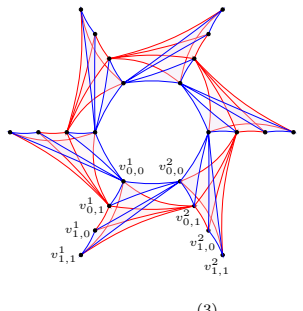
The authors prove that there is a linear k-graph F with 0 < π_co(F) < ε for any ε > 0. The construction uses an affine-plane-type incidence structure over a finite field together with elementary number-theoretic arguments to ensure linearity while making the codegree Turán density arbitrarily small.
What carries the argument
An affine-plane-type incidence structure over a finite field, which produces a linear k-graph whose codegree Turán density lies strictly between zero and any prescribed ε.
If this is right
- For every ε > 0 and every k ≥ 3 there exists at least one linear F with codegree Turán density in (0, ε).
- The k = 3 case directly resolves the question of Ding, Lamaison, Liu, Wang and Yang.
- Codegree Turán densities of linear hypergraphs are not bounded away from zero.
- The same geometric-arithmetic method yields a family of examples with successively smaller positive densities.
Where Pith is reading between the lines
- The possible values of π_co(F) for linear F may be dense in (0,1).
- One could ask whether every number in (0,1) arises as π_co(F) for some linear F.
- The construction might be adapted to control other variants of hypergraph Turán densities.
- It remains open whether the infimum of positive codegree densities over all linear F is zero or some positive constant.
Load-bearing premise
The affine-plane incidence structure over finite fields, combined with number-theoretic arguments, produces a linear hypergraph whose codegree Turán density is bounded above by any given ε.
What would settle it
An explicit computation or counter-example showing that the constructed F is either not linear or has codegree Turán density bounded away from zero by some fixed positive constant independent of ε.
Figures
read the original abstract
Let $F$ be a $k$-uniform hypergraph, abbreviated as $k$-graph. The codegree Tur\'an density $\pi_{\mathrm{co}}(F)$ is the supremum over all $\gamma \in [0,1)$ such that, for arbitrarily large $n$, there exists an $n$-vertex $F$-free $k$-graph $H$ whose every $(k-1)$-subset of vertices lies in at least $\gamma n$ edges. In this paper, we prove that there is a linear $k$-graph $F$ with $0<\pi_{co}(F) < \varepsilon$ for any $\varepsilon>0$. The special case $k=3$ solve a question proposed by Ding, Lamaison, Liu, Wang and Yang (JLMS, 2025). The main method combines an affine-plane-type incidence structure over a finite field and elementary number-theoretic arguments.
Editorial analysis
A structured set of objections, weighed in public.
Referee Report
Summary. The paper proves that for every k ≥ 3 and every ε > 0 there exists a linear k-uniform hypergraph F such that its codegree Turán density satisfies 0 < π_co(F) < ε. The construction relies on an affine-plane-type incidence structure over a finite field together with elementary number-theoretic arguments. The k = 3 case resolves a question posed by Ding, Lamaison, Liu, Wang and Yang (JLMS 2025).
Significance. If the stated construction is correct, the result shows that codegree Turán densities of linear k-graphs can be made arbitrarily small yet positive. This supplies the first examples separating the codegree density from both zero and the ordinary Turán density in a controlled way and answers an explicit open question for triple systems.
minor comments (3)
- The abstract and introduction should include a brief comparison of the new codegree densities with the known ordinary Turán densities of the same linear hypergraphs, to clarify how much the codegree version improves upon the classical bound.
- Notation for the finite-field incidence structure (e.g., the precise definition of the vertex set and edge set in terms of F_q) should be introduced once in a dedicated subsection rather than scattered across the construction argument.
- The number-theoretic estimates used to bound the codegree from below would benefit from an explicit statement of the prime-power size q that works for a given ε; a short table or corollary listing admissible q would improve readability.
Simulated Author's Rebuttal
We thank the referee for their positive summary, recognition of the significance of the result (including resolution of the k=3 case), and recommendation for minor revision. No major comments appear in the report.
Circularity Check
No significant circularity; explicit constructive existence proof
full rationale
The paper establishes an existence result for linear k-graphs F with 0 < π_co(F) < ε via an explicit construction that combines affine-plane-type incidence structures over finite fields with elementary number-theoretic arguments. No load-bearing step reduces by definition, fitting, or self-citation to the target claim itself; the derivation relies on independent external combinatorial and algebraic objects rather than internal reparameterization or prior self-referential results. The cited question from Ding et al. (JLMS 2025) is external and does not form a self-citation chain. This is a standard non-circular constructive proof.
Axiom & Free-Parameter Ledger
axioms (1)
- standard math Existence and incidence properties of affine planes over finite fields
Reference graph
Works this paper leans on
-
[1]
Andreescu, G
T. Andreescu, G. Dospinescu, O. Mushkarov, Number Theory: Concepts and Problems, XYZ Press, Plano, 2017
2017
-
[2]
G. D. Birkhoff, H. S. Vandiver, On the integral divisors ofan −b n, Ann. Math. 5 (1904) 173–180
1904
-
[3]
L. Ding, A. Lamaison, H. Liu, S. Wang, H. Yang, On 3-graphs with vanishing codegree Turán density, J. Lond. Math. Soc. 112(2) (2025) e70281
2025
- [4]
- [5]
-
[6]
Mubayi, Y
D. Mubayi, Y. Zhao, Co-degree density of hypergraphs, J. Combin. Theory Ser. A 114(6) (2007) 1118–1132
2007
-
[7]
S. Piga, B. Schülke, Hypergraphs with arbitrarily small codegree Turán density, Bull. Lond. Math. Soc. 58(4) (2026) e70348. 6
2026
discussion (0)
Sign in with ORCID, Apple, or X to comment. Anyone can read and Pith papers without signing in.