REVIEW 2 major objections 3 minor 37 references
NICER detection of a new candidate cyclotron line in the bursting X-ray pulsar GRO J1744-28
T0 review · 2 major / 3 minor · reviewed 2026-06-28 · grok-4.3
Pith's one-line read A candidate 2 keV absorption feature is detected in GRO J1744-28 and interpreted as a cyclotron line implying a magnetic field of ~1.8 × 10^11 G.
desk verdict Candidate 2 keV absorption feature reported in GRO J1744-28 from NICER, but evidence stays preliminary. read the letter →
The pith
A machine-rendered reading of the paper's core claim, the machinery that carries it, and where it could break.
The reading
What carries the argument
The 2 keV candidate absorption feature detected in the NICER spectrum of the persistent emission and confirmed around peak pulse phases, interpreted through the standard CRSF energy-to-magnetic-field relation.
What would settle it
An independent observation with NICER or another X-ray telescope that fails to recover a statistically significant absorption feature near 2 keV when the same continuum models are applied would indicate the candidate line is not real.
Extended reading notes
Core claim
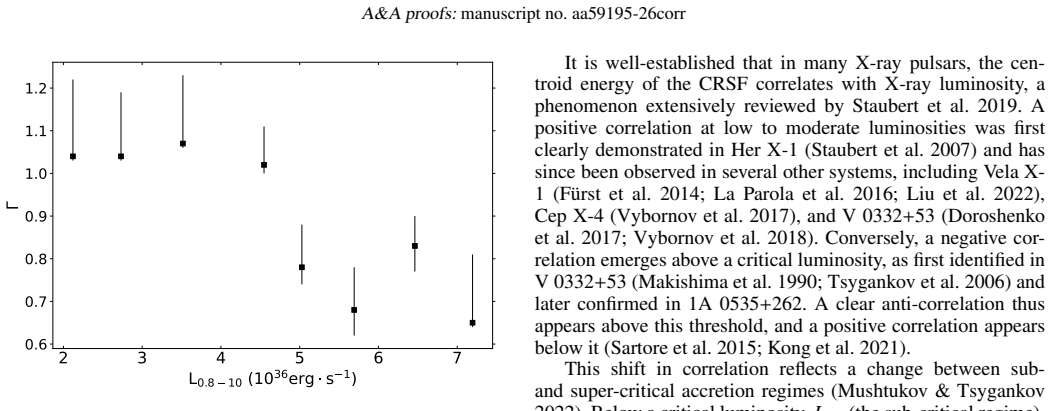
The paper reports the detection of a candidate absorption feature with centroid energy of 2 keV in addition to the known ~5 keV cyclotron line. If confirmed as a CRSF, this feature corresponds to a magnetic field of ∼1.8 × 10^{11} G. The line is seen in both the average spectrum and in pulse-phase-resolved data around peak phases, establishing GRO J1744-28 as a key laboratory for studying accretion physics in an intermediate-strength magnetic field.
Load-bearing premise
The 2 keV absorption feature is a genuine physical line produced by cyclotron resonant scattering rather than a statistical fluctuation, instrumental artifact, or artifact of the phenomenological continuum model.
Editorial analysis
A structured set of objections, weighed in public.
Referee Report
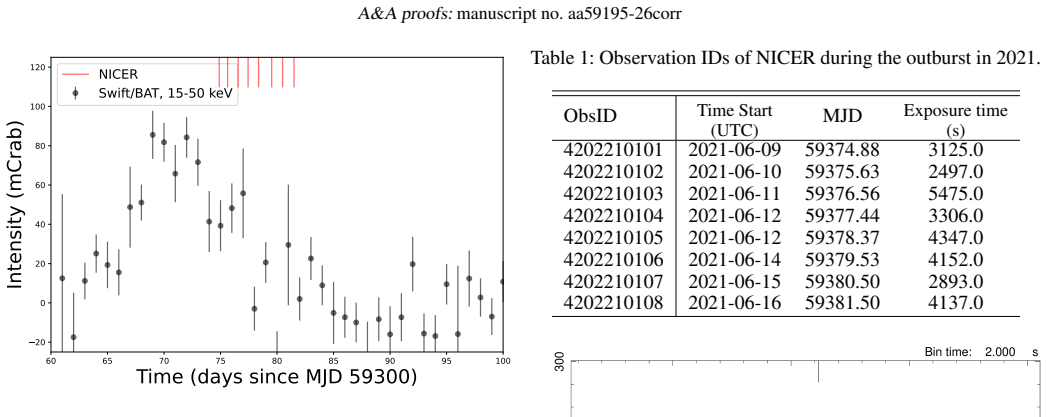
Summary. The manuscript analyzes NICER observations of GRO J1744-28 during its 2021 outburst, reporting coherent pulsations at 2.141128 Hz, Type II X-ray bursts, confirmation of the previously known ~5 keV CRSF, and the detection of a candidate absorption feature at ~2 keV. If confirmed as a CRSF, the latter implies a surface magnetic field of ~1.8 × 10^11 G. Phase-resolved spectroscopy shows the candidate feature near pulse peak phases, and the work frames the result as tentative evidence positioning the source as a laboratory for intermediate-field accretion.
Significance. If the 2 keV candidate is independently verified as a genuine CRSF, the result would add a rare example of an accreting pulsar with an intermediate magnetic field strength, bridging the gap between typical high-B and low-B systems and enabling new tests of accretion column physics and CRSF formation. The phase-resolved support and use of NICER's soft-band sensitivity constitute concrete observational strengths.
major comments (2)
- [§4] §4 (Spectral analysis): The manuscript does not report the Δχ² improvement, F-test probability, or Monte Carlo significance for the addition of the 2 keV Gaussian absorption component relative to the best-fit continuum; without this quantitative assessment the claim that the feature is a credible candidate remains difficult to evaluate against the possibility of statistical fluctuation or continuum-model artifact.
- [§4.1] §4.1 (Continuum modeling): Alternative continuum models (e.g., cutoff power-law versus Comptonization) are not shown to have been tested with the 2 keV line included or excluded; the robustness of the candidate feature against continuum choice is therefore not demonstrated, which is load-bearing for interpreting the line as physical rather than phenomenological.
minor comments (3)
- [Table 2] Table 2: The best-fit parameters for the 2 keV line (width, depth, and their uncertainties) should be listed explicitly alongside the 5 keV line parameters for direct comparison.
- [Figure 4] Figure 4 (phase-resolved spectra): The vertical scale and energy range should be identical across panels to facilitate visual assessment of the feature's phase dependence.
- [Abstract] Abstract and §5: The phrase 'if confirmed' is appropriately cautious, but a brief statement of the minimum additional observations or analysis required for confirmation would help readers gauge the next steps.
Simulated Author's Rebuttal
We thank the referee for their constructive comments and positive assessment of the potential significance of our results. We address each major comment below and have incorporated the requested additions into the revised manuscript.
read point-by-point responses
-
Referee: [§4] §4 (Spectral analysis): The manuscript does not report the Δχ² improvement, F-test probability, or Monte Carlo significance for the addition of the 2 keV Gaussian absorption component relative to the best-fit continuum; without this quantitative assessment the claim that the feature is a credible candidate remains difficult to evaluate against the possibility of statistical fluctuation or continuum-model artifact.
Authors: We agree that quantitative statistical measures are necessary to support the candidate feature. In the revised manuscript we now report the Δχ² improvement upon adding the 2 keV Gaussian absorption line, the associated F-test probability, and the significance obtained from Monte Carlo simulations. These values are included in §4 and demonstrate that the feature exceeds conventional thresholds for a credible candidate. revision: yes
-
Referee: [§4.1] §4.1 (Continuum modeling): Alternative continuum models (e.g., cutoff power-law versus Comptonization) are not shown to have been tested with the 2 keV line included or excluded; the robustness of the candidate feature against continuum choice is therefore not demonstrated, which is load-bearing for interpreting the line as physical rather than phenomenological.
Authors: We acknowledge the importance of testing robustness against continuum choice. We have now performed spectral fits with alternative models (cutoff power-law and Comptonization) both with and without the 2 keV absorption component. The candidate feature remains statistically significant in all cases. A summary of these tests and the corresponding fit parameters will be added to §4.1 of the revised manuscript. revision: yes
Circularity Check
No significant circularity
full rationale
This is an observational detection paper reporting spectral features measured directly from NICER data on GRO J1744-28. The 2 keV candidate absorption feature is identified via phenomenological continuum modeling and line fitting to the observed spectra; the associated magnetic field value follows from the standard CRSF centroid formula applied to the measured energy. Confirmation of the known ~5 keV line references prior external studies but is not load-bearing for the new candidate result. No self-definitional steps, fitted inputs renamed as predictions, self-citation chains, or ansatz smuggling occur in the derivation chain. The central claim is explicitly qualified as tentative and requires independent confirmation.
Assumptions & free parameters
free parameters (1)
- absorption line centroid energy =
2 keV
assumptions (1)
- domain assumption The 2 keV feature is a cyclotron resonant scattering feature
Cite this review
Pith. "Pith review of NICER detection of a new candidate cyclotron line in the bursting X-ray pulsar GRO J1744-28." pith.science (2026). https://pith.science/paper/W2HLFZCT
@misc{pith2026260604664,
  author       = {Pith},
  title        = {Pith review of: NICER detection of a new candidate cyclotron line in the bursting X-ray pulsar GRO J1744-28},
  year         = {2026},
  howpublished = {\url{https://pith.science/paper/W2HLFZCT}},
  note         = {Machine review of arXiv:2606.04664}
}
abstract
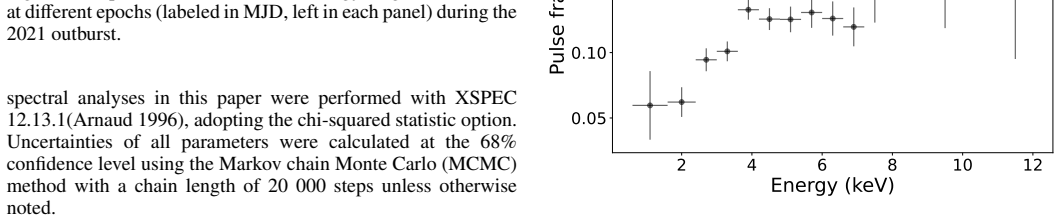
We report the detection of cyclotron resonant scattering features (CRSFs) in the spectrum of the unique bursting pulsar GRO J1744-28, observed during its recent outburst in 2021 with the Neutron Star Interior Composition Explorer (NICER). Clear pulsations at a frequency of 2.141128 Hz as well as Type II X-ray bursts were observed. The pulse profile exhibits a single-peaked shape in all energy bands, with the pulse fraction showing a positive correlation with energy. We find that the persistent X-ray continuum of the accreting pulsar is well described by typical phenomenological models, and we confirm the presence of the cyclotron line at $\sim$5 keV as reported in previous studies. In addition, we detect a candidate absorption feature with a centroid energy of 2 keV. If confirmed, this feature could be interpreted as a CRSF, which would correspond to a magnetic field of $\sim$1.8 $\times 10^{11}$ G. Pulse-phase-resolved analysis also reveals this absorption line around the peak pulse phases. These NICER observations provide tentative evidence for the cyclotron line candidate, establishing GRO J1744-28 as a key laboratory for studying accretion physics in an intermediate-strength magnetic field.
Figures


Figures from the paper (7 more)



Reference graph
Works this paper leans on
-
[1]
Arnaud, K. A. 1996, in Astronomical Society of the Pacific Conference Series, V ol. 101, Astronomical Data Analysis Software and Systems V , ed. G. H. Jacoby & J. Barnes, 17
1996
-
[2]
1997, ApJ, 486, 1013
Augusteijn, T., Greiner, J., Kouveliotou, C., et al. 1997, ApJ, 486, 1013
1997
-
[3]
Basko, M. M. & Sunyaev, R. A. 1976, MNRAS, 175, 395
1976
-
[4]
A., Klochkov, D., Schönherr, G., et al
Becker, P . A., Klochkov, D., Schönherr, G., et al. 2012, A&A, 544, A123
2012
-
[5]
& van den Heuvel, E
Bhattacharya, D. & van den Heuvel, E. P . J. 1991, Physics Reports, 203, 1
1991
-
[6]
2010, Advances in Space Research, 45, 949
Bhattacharyya, S. 2010, Advances in Space Research, 45, 949
2010
-
[7]
1997, ApJ, 482, L163 D’Aì, A., Di Salvo, T., Iaria, R., et al
Cui, W. 1997, ApJ, 482, L163 D’Aì, A., Di Salvo, T., Iaria, R., et al. 2015, Monthly Notices of the Royal As- tronomical Society, 449, 4288
1997
-
[8]
M., Harrison, F
Degenaar, N., Miller, J. M., Harrison, F. A., et al. 2014, ApJ, 796, L9
2014
Show all 37 references
-
[9]
2015, MNRAS, 452, 2490
Doroshenko, R., Santangelo, A., Doroshenko, V ., Suleimanov, V ., & Piraino, S. 2015, MNRAS, 452, 2490
2015
-
[10]
2020, A&A, 643, A62
Doroshenko, V ., Suleimanov, V ., Tsygankov, S., et al. 2020, A&A, 643, A62
2020
-
[11]
S., Mushtukov, A
Doroshenko, V ., Tsygankov, S. S., Mushtukov, A. A., et al. 2017, MNRAS, 466, 2143
2017
-
[12]
2023, A&A, 677, A103
Ferrigno, C., D’Aì, A., & Ambrosi, E. 2023, A&A, 677, A103
2023
-
[13]
J., Kouveliotou, C., Meegan, C
Fishman, G. J., Kouveliotou, C., Meegan, C. A., Paciesas, W. S., & Wilson, R. B. 1995, IAU Circular, 6272, 1 Fürst, F., Pottschmidt, K., Wilms, J., et al. 2014, ApJ, 780, 133
1995
-
[14]
C., Arzoumanian, Z., Adkins, P
Gendreau, K. C., Arzoumanian, Z., Adkins, P . W., et al. 2016, in Society of Photo-Optical Instrumentation Engineers (SPIE) Conference Series, V ol. 9905, Space Telescopes and Instrumentation 2016: Ultraviolet to Gamma Ray, ed. J.-W. A. den Herder, T. Takahashi, & M. Bautz, 99051H
2016
-
[15]
2019, MNRAS, 482, 1110
Ji, L., Santangelo, A., Zhang, S., et al. 2019, MNRAS, 482, 1110
2019
-
[16]
D., Zhang, S., Ji, L., et al
Kong, L. D., Zhang, S., Ji, L., et al. 2021, ApJ, 917, L38 König, O., Fürst, F., Kretschmar, P ., et al. 2020, A&A, 643, A128
2021
-
[17]
J., et al
Kouveliotou, C., van Paradijs, J., Fishman, G. J., et al. 1996, Nature, 379, 799 La Parola, V ., Cusumano, G., Segreto, A., & D’Aì, A. 2016, MNRAS, 463, 185
1996
-
[18]
Lewin, W. H. G., van Paradijs, J., & Taam, R. E. 1996, Space Science Reviews, 462, L39
1996
-
[19]
2022, MNRAS, 514, 2805
Liu, Q., Wang, W., Chen, X., et al. 2022, MNRAS, 514, 2805
2022
-
[20]
1990, ApJ, 365, L59
Makishima, K., Mihara, T., Ishida, M., et al. 1990, ApJ, 365, L59
1990
-
[21]
2024, in AAS/High Energy Astrophysics Division, V ol
Markwardt, C., Arzoumanian, Z., Gendreau, K., Hare, J., & Nicer Team. 2024, in AAS/High Energy Astrophysics Division, V ol. 21, AAS High Energy As- trophysics Division Meeting #21, 105.36 Mészáros, P . 1992, High-Energy Radiation from Magnetized Neutron Stars (Chicago: Univers...
2024
-
[22]
1995, PhD thesis, , Dept
Mihara, T. 1995, PhD thesis, , Dept. of Physics, Univ. of Tokyo (M95), (1995) Mönkkönen, J., Tsygankov, S. S., Mushtukov, A. A., et al. 2019, A&A, 626, A106
1995
-
[23]
& Tsygankov, S
Mushtukov, A. & Tsygankov, S. 2022, arXiv e-prints, arXiv:2204.14185
2022
-
[24]
2011, ApJ, 730, 106
Nishimura, O. 2011, ApJ, 730, 106
2011
-
[25]
1999, ApJ, 517, 436
Nishiuchi, M., Koyama, K., Maeda, Y ., et al. 1999, ApJ, 517, 436
1999
-
[26]
& Naik, S
Paul, B. & Naik, S. 2011, Bulletin of the Astronomical Society of India, 39, 429
2011
-
[27]
A., Gornostaev, M
Postnov, K. A., Gornostaev, M. I., Klochkov, D., et al. 2015, MNRAS, 452, 1601
2015
-
[28]
2017, MNRAS, 469, 2
Sanna, A., Riggio, A., Burderi, L., et al. 2017, MNRAS, 469, 2
2017
-
[29]
Sartore, N., Jourdain, E., & Roques, J. P . 2015, ApJ, 806, 193
2015
-
[30]
I., Postnov, K., et al
Staubert, R., Shakura, N. I., Postnov, K., et al. 2007, A&A, 465, L25
2007
-
[31]
2019, A&A, 622, A61
Staubert, R., Trümper, J., Kendziorra, E., et al. 2019, A&A, 622, A61
2019
-
[32]
1994, ApJ, 434, 570
Titarchuk, L. 1994, ApJ, 434, 570
1994
-
[33]
1978, ApJ, 219, L105
Truemper, J., Pietsch, W., Reppin, C., et al. 1978, ApJ, 219, L105
1978
-
[34]
S., Lutovinov, A
Tsygankov, S. S., Lutovinov, A. A., Churazov, E. M., & Sunyaev, R. A. 2006, MNRAS, 371, 19
2006
-
[35]
2018, A&A, 610, A88
Vybornov, V ., Doroshenko, V ., Staubert, R., & Santangelo, A. 2018, A&A, 610, A88
2018
-
[36]
2017, A&A, 601, A126
Vybornov, V ., Klochkov, D., Gornostaev, M., et al. 2017, A&A, 601, A126
2017
-
[37]
2000, ApJ, 542, 914 Y ounes, G., Kouveliotou, C., van der Horst, A
Wilms, J., Allen, A., & McCray, R. 2000, ApJ, 542, 914 Y ounes, G., Kouveliotou, C., van der Horst, A. J., et al. 2015, The Astrophysical Journal, 804, 43 Article number, page 9 of 9
2000
Reviewed June 28, 2026 · model on record in the stance chip above.
Discussion (0). Sign in to comment.