Improving Longitudinal Targeted Maximum Likelihood Estimation in Target Trial Emulation using Joint Calibrated Weights
Pith reviewed 2026-06-28 04:59 UTC · model grok-4.3
The pith
Joint calibrated weights improve efficiency and robustness of LTMLE for per-protocol effects in target trial emulation.
A machine-rendered reading of the paper's core claim, the machinery that carries it, and where it could break.
Core claim
The authors develop joint calibrated LTMLE by tailoring calibrated weights for per-protocol effect estimation in target trial emulation. These weights enforce covariate balance in the treatment and censoring processes at the same time. Simulations indicate the resulting estimator has improved efficiency and greater robustness to weight-model misspecification while retaining the double-robustness property of standard LTMLE.
What carries the argument
Joint calibrated weights that simultaneously enforce covariate balance for treatment and censoring processes inside the LTMLE procedure.
If this is right
- The estimator remains consistent and double-robust for marginal structural model parameters under correct specification of either the outcome or weight models.
- Finite-sample variance is reduced relative to uncalibrated LTMLE in longitudinal settings with censoring.
- Estimates become less sensitive to misspecification of the treatment or censoring models.
- The method directly supports per-protocol analyses in target trial emulation studies of time-varying treatments.
Where Pith is reading between the lines
- The same calibration idea could be adapted to other longitudinal estimators that rely on inverse-probability weights.
- Improved stability might allow reliable per-protocol analyses in smaller cohorts where standard LTMLE breaks down.
- The approach suggests a general route for embedding balance constraints into doubly robust methods without sacrificing asymptotic properties.
Load-bearing premise
Joint calibration of weights for treatment and censoring can be done while preserving double-robustness and consistency of the LTMLE estimator for per-protocol effects.
What would settle it
A simulation or data analysis in which joint calibrated LTMLE shows equal or worse efficiency and robustness than standard LTMLE when weight models are misspecified.
Figures
read the original abstract
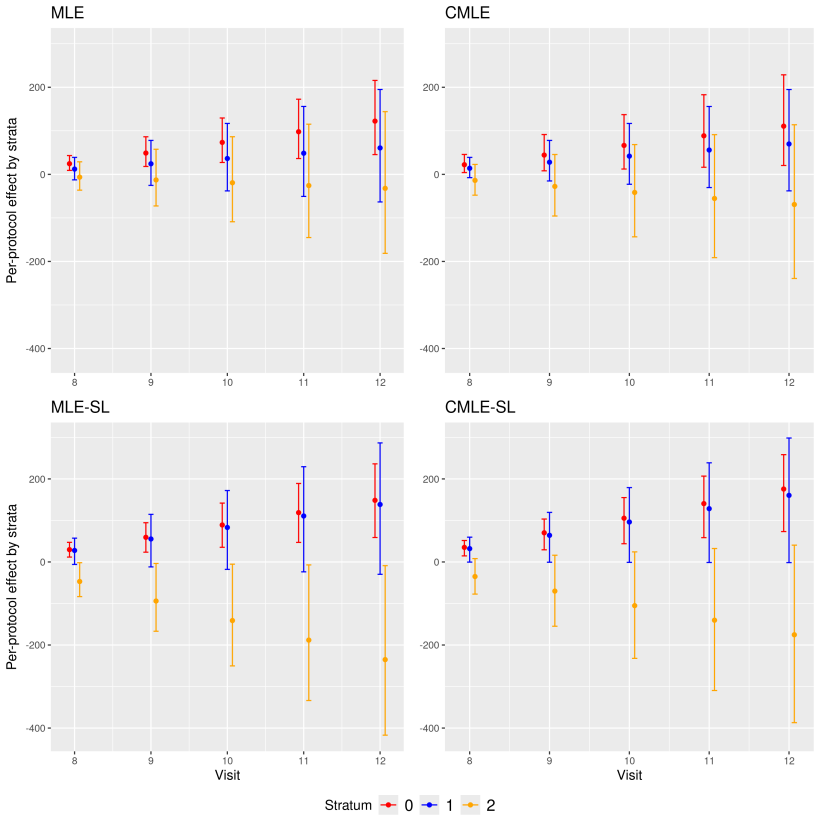
In target trial emulation (TTE), marginal structural models (MSMs) can be used to characterise per-protocol treatment effects over time. The MSM parameters are often estimated by inverse probability weighting (IPW), with weights estimated by maximum likelihood. However, IPW-based estimators can be unstable in small samples and are sensitive to misspecification of the weight models. An alternative method for estimating the MSM parameters is longitudinal targeted maximum likelihood estimation (LTMLE). LTMLE is double robust and potentially more efficient than IPW. Nevertheless, LTMLE also relies on inverse probability weights and may therefore share the instability of IPW-based estimators. We propose joint calibrated LTMLE, which integrates LTMLE with joint calibrated weights tailored for per-protocol effect estimation in TTE. This calibration of weights improves finite-sample performance by enforcing covariate balance in both the treatment and censoring processes simultaneously. Simulations show that the proposed method has improved efficiency and robustness to weight model misspecification, compared to standard LTMLE. We illustrate the method using a case study to evaluate the effect of highly active antiretroviral therapy on CD4 cell count among HIV-positive women.
Editorial analysis
A structured set of objections, weighed in public.
Referee Report
Summary. The manuscript proposes joint calibrated LTMLE for estimating per-protocol effects via marginal structural models in target trial emulation. It integrates LTMLE with simultaneous calibration of treatment and censoring weights to enforce covariate balance, claiming improved finite-sample efficiency and robustness to weight-model misspecification relative to standard LTMLE while retaining double robustness. The proposal is evaluated via simulations and illustrated on an HIV HAART case study for CD4 outcomes.
Significance. If the joint calibration is shown to preserve LTMLE's double robustness (consistency when either the outcome regression or the calibrated weight models are correct), the approach would address a practical limitation of IPW and LTMLE estimators in longitudinal TTE settings with unstable weights or small samples. The simulation-based evidence of efficiency gains would then support broader adoption for per-protocol MSM estimation.
major comments (2)
- [Abstract and §3] Abstract and §3: The central claim that joint calibration preserves double robustness and asymptotic consistency of LTMLE is not supported by an explicit derivation showing that the calibrated estimating equations remain orthogonal to the nuisance tangent space under the same conditions as standard LTMLE (i.e., the targeting step still solves the EIF when only the outcome model is correct). Without this, simulation results alone cannot establish the robustness property when weight models are misspecified.
- [§4] §4 (Simulations): The reported improvements in efficiency and robustness lack sufficient detail on the data-generating processes, sample sizes, degree of weight-model misspecification, and exact implementation of the joint calibration procedure, preventing verification that the gains are not artifacts of the chosen simulation design.
minor comments (2)
- [Methods] Clarify in the methods section how the joint calibration is implemented without altering the form of the LTMLE targeting step.
- [Case study] Add a table or figure comparing the calibrated weights to standard IPW weights in the case study to illustrate the balance achieved.
Simulated Author's Rebuttal
We thank the referee for their constructive and detailed comments, which identify key areas where the manuscript can be strengthened. We address each major comment below and will revise the paper accordingly.
read point-by-point responses
-
Referee: [Abstract and §3] Abstract and §3: The central claim that joint calibration preserves double robustness and asymptotic consistency of LTMLE is not supported by an explicit derivation showing that the calibrated estimating equations remain orthogonal to the nuisance tangent space under the same conditions as standard LTMLE (i.e., the targeting step still solves the EIF when only the outcome model is correct). Without this, simulation results alone cannot establish the robustness property when weight models are misspecified.
Authors: We acknowledge that the manuscript did not include an explicit derivation of the double-robustness property under joint calibration. While the proposal is motivated by the fact that calibration enforces covariate balance without altering the form of the targeting step, we agree that a formal proof is needed to confirm that the calibrated estimating equations remain orthogonal to the nuisance tangent space. In the revision we will add this derivation to §3, showing that consistency holds when the outcome regression is correct (even if the calibrated weight models are misspecified) and that the EIF is still solved by the targeting step. revision: yes
-
Referee: [§4] §4 (Simulations): The reported improvements in efficiency and robustness lack sufficient detail on the data-generating processes, sample sizes, degree of weight-model misspecification, and exact implementation of the joint calibration procedure, preventing verification that the gains are not artifacts of the chosen simulation design.
Authors: We agree that the simulation section requires substantially more detail for reproducibility. The revised §4 will fully specify the data-generating processes (including all functional forms, coefficients, and error distributions for treatment, censoring, and outcome models), list the exact sample sizes examined, describe the precise mechanisms of weight-model misspecification (e.g., omitted covariates or incorrect link functions), and provide a step-by-step account of the joint calibration algorithm together with pseudocode. Simulation code will be made available as supplementary material. revision: yes
Circularity Check
No significant circularity; proposal validated by simulation without self-referential reduction
full rationale
The paper proposes joint calibrated LTMLE by integrating standard LTMLE with jointly calibrated weights for treatment and censoring in per-protocol TTE settings. The abstract and description present this as a methodological innovation whose finite-sample improvements and robustness are demonstrated via simulation comparisons to standard LTMLE. No equations, derivations, or self-citations are shown that reduce any claimed result to a fitted quantity or prior result by construction. The central claims rest on the new proposal plus external simulation evidence rather than any load-bearing self-definition or ansatz smuggling, so the derivation chain is self-contained.
Axiom & Free-Parameter Ledger
axioms (2)
- domain assumption Standard identifying assumptions for target trial emulation (consistency, positivity, conditional exchangeability) hold for the per-protocol effect.
- ad hoc to paper Joint calibration of treatment and censoring weights can be achieved without violating the double-robustness or asymptotic properties of LTMLE.
Reference graph
Works this paper leans on
-
[1]
B. S. Graham, C. C. De Xavier Pinto, and D. Egel. Inverse Probability Tilting for Moment Condition Models with Missing Data.The Review of Economic Studies, 79(3):1053–1079, July 2012. ISSN 0034-6527. doi:10.1093/restud/rdr047
-
[2]
Jens Hainmueller. Entropy Balancing for Causal Effects: A Multivariate Reweighting Method to Produce Balanced Samples in Observational Studies.Political Analysis, 20(1):25–46, January 2012. ISSN 1047-1987, 1476-4989. doi:10.1093/pan/mpr025. Publisher: Cambridge University Press
-
[3]
Covariate balancing propensity score.Journal of the Royal Statistical Society: Series B: Statistical Methodology, pages 243–263, 2014
Kosuke Imai and Marc Ratkovic. Covariate balancing propensity score.Journal of the Royal Statistical Society: Series B: Statistical Methodology, pages 243–263, 2014. ISSN 1369-7412. Publisher: JSTOR
2014
-
[4]
Journal of the American Statistical Association , volume =
Kosuke Imai and Marc Ratkovic. Robust Estimation of Inverse Probability Weights for Marginal Structural Models.Journal of the American Statistical Association, 110(511):1013–1023, July 2015. ISSN 0162-1459. doi:10.1080/01621459.2014.956872
-
[5]
13 CBPS: Covariate Balancing Propensity Score, December 2025
Christian Fong, Marc Ratkovic, Kosuke Imai, Chad Hazlett, Xiaolin Yang, Sida Peng, and Inbeom Lee. 13 CBPS: Covariate Balancing Propensity Score, December 2025. URLhttps://cran.r-project.org/web/ packages/CBPS/index.html
2025
-
[6]
José R. Zubizarreta. Stable Weights that Balance Covariates for Estimation With Incomplete Outcome Data.Journal of the American Statistical Association, 110(511):910–922, July 2015. ISSN 0162-1459. doi:10.1080/01621459.2015.1023805
-
[7]
Zubizarreta, Yige Li, Kwangho Kim, Amine Allouah, and Noah Greifer
Jose R. Zubizarreta, Yige Li, Kwangho Kim, Amine Allouah, and Noah Greifer. sbw: Stable Balancing Weights for Causal Inference and Missing Data, October 2025. URLhttps://cran.r-project.org/web/ packages/sbw/index.html
2025
-
[8]
Peisong Han. Intrinsic efficiency and multiple robustness in longitudinal studies with drop-out.Biometrika, 103(3):683–700, September 2016. ISSN 0006-3444. doi:10.1093/biomet/asw024. URLhttps://doi.org/10. 1093/biomet/asw024
-
[9]
Kwun Chuen Gary Chan, Sheung Chi Phillip Yam, and Zheng Zhang. Globally Efficient Non-Parametric Inference of Average Treatment Effects by Empirical Balancing Calibration Weighting.Journal of the Royal Statistical Society Series B: Statistical Methodology, 78(3):673–700, June 2016. ISSN 1369-7412. doi:10.1111/rssb.12129
-
[10]
Curtis Huffman and Edwin van Gameren. Covariate Balancing Inverse Probability Weights for Time- Varying Continuous Interventions.Journal of Causal Inference, 6(2), September 2018. ISSN 2193-3685. doi:10.1515/jci-2017-0002
-
[11]
doi: 10.1080/01621459.2016.1211016
Fan Li, Kari Lock Morgan, and Alan M. Zaslavsky. Balancing Covariates via Propensity Score Weight- ing.Journal of the American Statistical Association, 113(521):390–400, January 2018. ISSN 0162-1459. doi:10.1080/01621459.2016.1260466. URL https://doi.org/10.1080/01621459.2016.1260466. _eprint: https://doi.org/10.1080/01621459.2016.1260466
-
[12]
Sean Yiu and Li Su. Covariate association eliminating weights: a unified weighting framework for causal effect estimation.Biometrika, 105(3):709–722, September 2018. ISSN 0006-3444. doi:10.1093/biomet/asy015
-
[13]
Yixin Wang and Jose R. Zubizarreta. Minimal dispersion approximately balancing weights: asymp- totic properties and practical considerations.Biometrika, 107(1):93–105, March 2020. ISSN 0006-3444. doi:10.1093/biomet/asz050. URLhttps://dx.doi.org/10.1093/biomet/asz050
-
[14]
optweight: Optimization-Based Stable Balancing Weights, January 2026
Noah Greifer. optweight: Optimization-Based Stable Balancing Weights, January 2026. URL https: //cran.r-project.org/web/packages/optweight/index.html
2026
-
[15]
cobalt: Covariate Balance Tables and Plots, January 2026
Noah Greifer. cobalt: Covariate Balance Tables and Plots, January 2026. URLhttps://cran.r-project. org/web/packages/cobalt/index.html
2026
-
[16]
Xiang Zhou and Geoffrey T. Wodtke. Residual Balancing: A Method of Constructing Weights for Marginal Structural Models.Political Analysis, 28(4):487–506, October 2020. ISSN 1047-1987. doi:10.1017/pan.2020.2
-
[17]
rbw: Residual Balancing Weights for Marginal Structural Models, March 2022
Xiang Zhou and Derick da Silva Baum. rbw: Residual Balancing Weights for Marginal Structural Models, March 2022. URLhttps://cran.r-project.org/web/packages/rbw/index.html
2022
-
[18]
Yang Ning, Peng Sida, and Kosuke Imai. Robust estimation of causal effects via a high-dimensional covariate balancing propensity score.Biometrika, 107(3):533–554, September 2020. ISSN 0006-3444. doi:10.1093/biomet/asaa020
-
[19]
A Balancing Weight Framework for Estimating the Causal Effect of General Treatments, February 2020
Guillaume Martinet. A Balancing Weight Framework for Estimating the Causal Effect of General Treatments, February 2020. URLhttp://arxiv.org/abs/2002.11276. arXiv:2002.11276 [math]. 14
arXiv 2020
-
[20]
Z Tan. Regularized calibrated estimation of propensity scores with model misspecification and high- dimensional data.Biometrika, 107(1):137–158, March 2020. ISSN 0006-3444. doi:10.1093/biomet/asz059
-
[21]
Nathan Kallus and Michele Santacatterina. Optimal balancing of time-dependent confounders for marginal structural models.Journal of Causal Inference, 9(1):345–369, December 2021. ISSN 2193-3685. doi:10.1515/jci-2020-0033
-
[22]
Stable inverse probability weighting estimation for lon- gitudinal studies.Scandinavian Journal of Statistics, 48(3):1046–1067, 2021
Vahe Avagyan and Stijn Vansteelandt. Stable inverse probability weighting estimation for lon- gitudinal studies.Scandinavian Journal of Statistics, 48(3):1046–1067, 2021. ISSN 1467-
2021
-
[23]
URL https://onlinelibrary.wiley.com/doi/abs/10.1111/sjos.12542
doi:10.1111/sjos.12542. URL https://onlinelibrary.wiley.com/doi/abs/10.1111/sjos.12542. _eprint: https://onlinelibrary.wiley.com/doi/pdf/10.1111/sjos.12542
-
[24]
Sean Yiu and Li Su. Joint calibrated estimation of inverse probability of treatment and censoring weights for marginal structural models.Biometrics, 78(1):115–127, March 2022. ISSN 0006-341X. doi:10.1111/biom.13411. URLhttps://onlinelibrary.wiley.com/doi/10.1111/biom.13411
-
[25]
Journal of Business & Economic Statistics , author =
Jianqing Fan, Kosuke Imai, Inbeom Lee, Han Liu, Yang Ning, and Xiaolin Yang. Optimal Covariate Balancing Conditions in Propensity Score Estimation.Journal of Business & Economic Statistics, 41(1): 97–110, January 2023. ISSN 0735-0015. doi:10.1080/07350015.2021.2002159
-
[26]
Michele Santacatterina. Robust weights that optimally balance confounders for estimating marginal hazard ratios.Statistical Methods in Medical Research, 32(3):524–538, March 2023. ISSN 0962-2802. doi:10.1177/09622802221146310
-
[27]
Yige Li, María de los Angeles Resa, and José R. Zubizarreta. Adaptive Orthogonalization for Stable Estimation of the Effects of Time-Varying Treatments, November 2025. URLhttp://arxiv.org/abs/ 2511.02971. arXiv:2511.02971 [stat]
arXiv 2025
-
[28]
Davide Viviano and Jelena Bradic. Dynamic covariate balancing: estimating treatment effects over time with potential local projections.Biometrika, page asag016, March 2026. ISSN 1464-3510. doi:10.1093/biomet/asag016. URLhttps://doi.org/10.1093/biomet/asag016. 15
discussion (0)
Sign in with ORCID, Apple, or X to comment. Anyone can read and Pith papers without signing in.