Long-term investigation of gamma Cas analogs
Pith reviewed 2026-06-28 04:31 UTC · model grok-4.3
The pith
Five gamma Cas analog Be stars are long-period binaries with low-mass companions.
A machine-rendered reading of the paper's core claim, the machinery that carries it, and where it could break.
Core claim
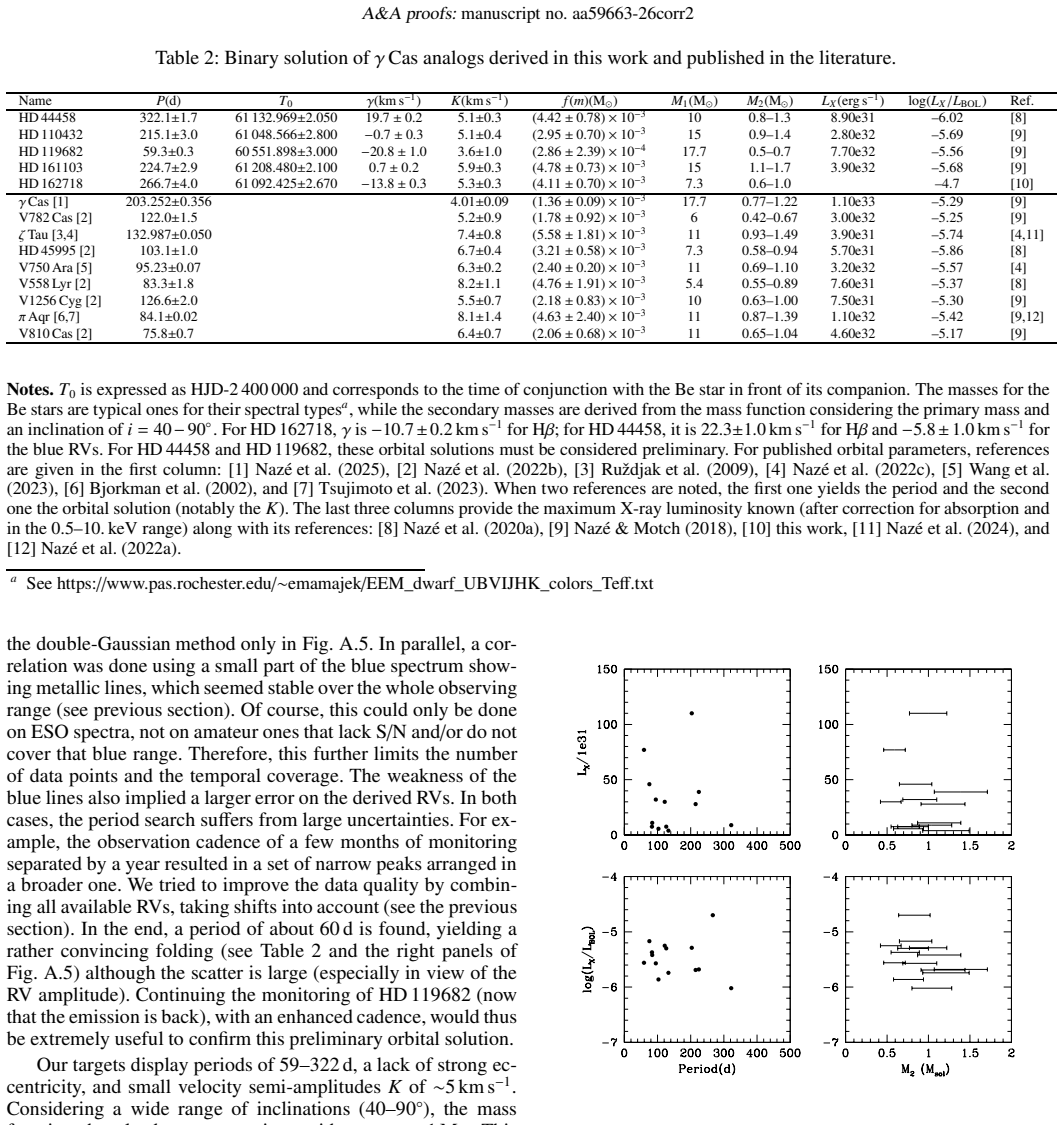
The authors confirm the binary status of HD44458, HD110432, HD119682, HD161103, and HD162718 through visible spectroscopy and derive orbital solutions for each. The long periods and small velocity amplitudes imply low-mass companions of roughly one solar mass, consistent with other Be binaries and binary interaction models. X-ray flux varies by factors of a few in two targets without clear optical correlation, while a third shows nearly one dex variation that tracks optical changes; at minimum, it retains a hard spectrum with a near-normal X-ray to bolometric luminosity ratio.
What carries the argument
Long-term radial-velocity curves from multi-site spectroscopy used to detect periodicity and fit binary orbital elements.
If this is right
- The low-mass companions align with predictions from models in which binary mass transfer creates the rapid rotation of Be stars.
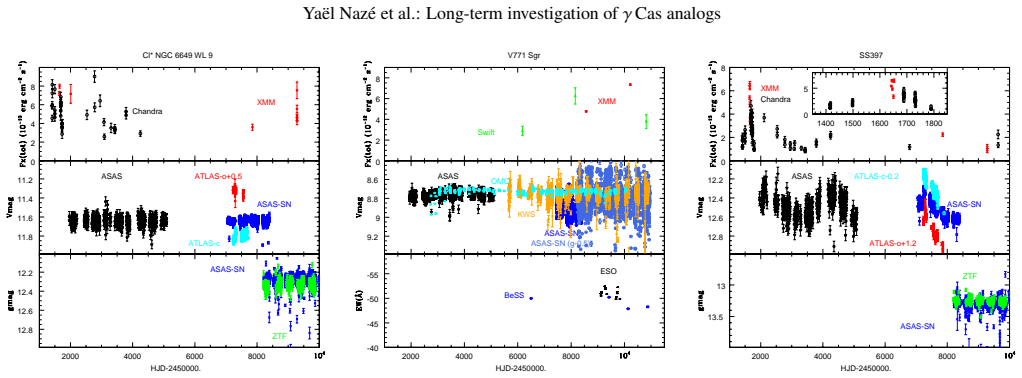
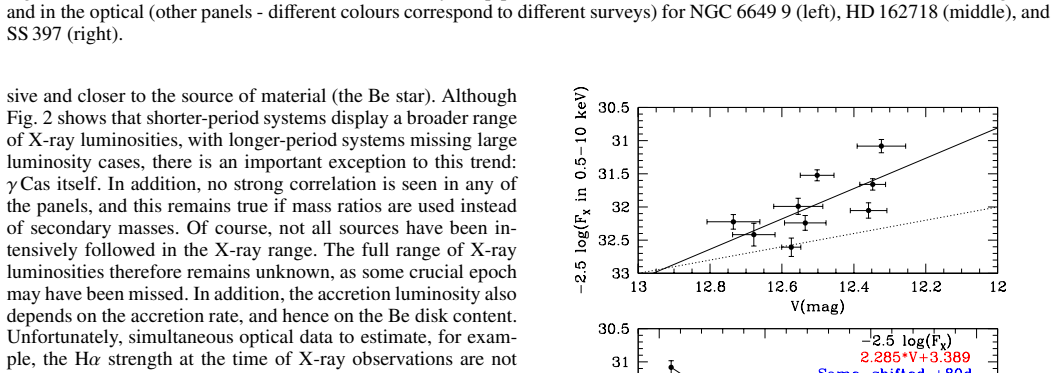
- X-ray variability is modest and often decoupled from optical photometry in most targets but can be strongly correlated in at least one case.
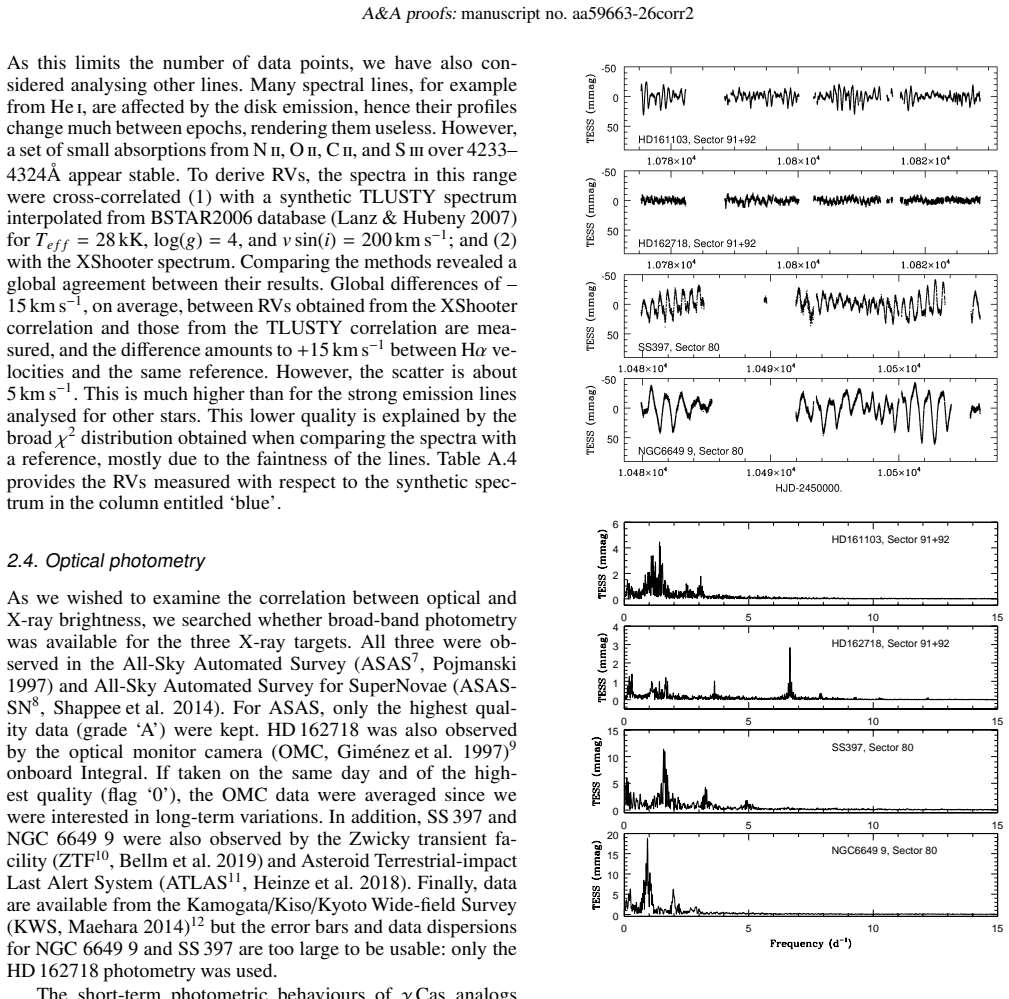
- Photometric signals in several targets match the frequency groups typical of Be-star pulsations or activity.
- One target displays a dominant high-frequency signal at 6.658 cycles per day, indicating beta Cephei-like behavior rare among gamma Cas analogs.
Where Pith is reading between the lines
- If low-mass companions prove common, the gamma Cas X-ray subclass may largely trace back to binary evolution rather than single-star processes.
- The occasional lack of X-ray/optical correlation suggests the hard X-ray source may operate independently of the Be disk in some systems.
- Similar long-term RV campaigns on other bright Be stars could test whether the binary fraction is elevated in the gamma Cas group.
Load-bearing premise
The detected radial velocity shifts arise from orbital motion around a companion rather than from pulsations, disk changes, or other intrinsic variability.
What would settle it
Radial velocity measurements that fail to repeat at the reported periods or show velocity amplitudes much larger than 5 km/s.
Figures

read the original abstract
The subcategory of gamma Cas analogs gathers Be stars with bright and hard X-ray emission. Long-term variations are expected in such objects for two reasons: their Be disk builds and dissipates, and such stars are suspected long-period binaries. Seven targets are analysed in this paper: five of them benefit from a spectroscopic monitoring in the visible (ESO, TIGRE, and amateur data) and three of them have been repeatedly observed at X-ray wavelengths (using XMM-Newton, Chandra, and Swift). Broad-band photometric data are also examined. We confirm the binary status of five targets (HD44458, HD110432, HD119682, HD161103, and HD162718) and propose first orbital solutions for all of them (they remain preliminary for two cases). Their long periods (59-322 d) and small velocity amplitudes (K~5km/s) imply low-mass (~1 M_sol) companions, as in other Be binaries and in agreement with expectations from binary interaction models. In parallel, variations of the X-ray flux are detected in all three targets with a large dataset of X-ray observations. For NGC 6649 9 and HD162718, these changes are modest (a factor of three) and uncorrelated to simultaneous optical broad-band photometry (which remains rather stable). In contrast, SS397 varies by nearly one dex and the largest and best monitored X-ray changes correlate well with optical variations. At minimum flux, SS397 keeps a hard X-ray spectrum despite a nearly normal L_X/L_BOL ratio, which has not been seen yet among gamma Cas analogs. Finally, the photometric behaviours on short timescales of HD161103, SS397, and NGC 6649 9 appear linked to broad frequency groups, as typically found for Be stars. The frequency spectrum of HD162718 displays a complex mix of (isolated) periodicities with the main one at 6.658/d. This target is thus one of the rare gamma Cas analogs to display a strong high-frequency signal typical of beta Cep activity. [summarized]
Editorial analysis
A structured set of objections, weighed in public.
Referee Report
Summary. The paper reports long-term multi-telescope spectroscopic monitoring, X-ray observations, and photometry for seven gamma Cas analog Be stars. It claims to confirm binary status for five targets (HD44458, HD110432, HD119682, HD161103, HD162718) via new radial-velocity curves, proposes first (preliminary for two) orbital solutions with periods 59-322 d and K~5 km/s implying ~1 M_sun companions, detects X-ray flux variations in three targets with varying correlation to optical photometry, and links short-term photometry to typical Be-star frequency groups or beta Cep-like signals in one case.
Significance. If the orbital solutions hold, the work enlarges the sample of gamma Cas analogs with measured long-period, low-mass companions, directly supporting binary-interaction models for Be-star formation and providing new test cases for the origin of their hard X-ray emission. The X-ray/optical correlations and the beta Cep-like signal in HD162718 are additional observables that could constrain disk or pulsation contributions to the high-energy output.
major comments (3)
- [Abstract] Abstract and spectroscopic monitoring section: the headline claim of five new orbital solutions rests on RV curves with K~5 km/s, but the text provides no error bars, reduced-chi-squared values, or description of the fitting procedure (e.g., number of epochs, period-search method, or handling of aliases).
- [Abstract] Abstract paragraph on spectroscopic monitoring and orbital solutions: no bisector-span analysis, multi-line consistency checks, or explicit comparison of the reported periods to the photometric frequency groups already noted in the same targets is described, leaving open the possibility that the RV signals arise from non-radial pulsations or disk variability rather than Keplerian motion.
- [X-ray observations] X-ray results for SS397, NGC 6649 9 and HD162718: the reported flux variations (factor of three to one dex) are stated without quoted uncertainties, exposure details, or background-subtraction methods, preventing assessment of whether the claimed correlations (or lack thereof) with optical photometry are statistically significant.
minor comments (2)
- [Abstract] The abstract states periods as '59-322 d' without individual values or uncertainties; listing the five periods with 1-sigma errors in a table would improve clarity.
- [Introduction] Notation for the targets (e.g., 'NGC 6649 9') is inconsistent with standard catalog names; a footnote or table column giving SIMBAD identifiers would aid reproducibility.
Simulated Author's Rebuttal
We thank the referee for their careful and constructive review of our manuscript. We address each of the three major comments below, agreeing that additional details will strengthen the presentation. Revisions will be made to incorporate the requested information on orbital fitting, validation checks, and X-ray methodology.
read point-by-point responses
-
Referee: [Abstract] Abstract and spectroscopic monitoring section: the headline claim of five new orbital solutions rests on RV curves with K~5 km/s, but the text provides no error bars, reduced-chi-squared values, or description of the fitting procedure (e.g., number of epochs, period-search method, or handling of aliases).
Authors: We agree that these procedural details are essential for assessing the reliability of the orbital solutions. The revised manuscript will include error bars on all RV measurements and derived parameters (including K), the reduced chi-squared values of the orbital fits, the exact number of epochs per target, the period-search algorithm employed, and the approach taken to identify and exclude aliases. These elements were part of the underlying analysis but omitted from the summary sections for conciseness. revision: yes
-
Referee: [Abstract] Abstract paragraph on spectroscopic monitoring and orbital solutions: no bisector-span analysis, multi-line consistency checks, or explicit comparison of the reported periods to the photometric frequency groups already noted in the same targets is described, leaving open the possibility that the RV signals arise from non-radial pulsations or disk variability rather than Keplerian motion.
Authors: We recognize the need to explicitly rule out non-Keplerian origins for the RV variations. The revised version will describe the bisector-span analysis performed on the spectra, the consistency of RV signals across multiple lines, and a direct comparison of the derived orbital periods against the photometric frequency groups identified in the same targets. These checks support the binary interpretation and will be added to the spectroscopic monitoring section. revision: yes
-
Referee: [X-ray observations] X-ray results for SS397, NGC 6649 9 and HD162718: the reported flux variations (factor of three to one dex) are stated without quoted uncertainties, exposure details, or background-subtraction methods, preventing assessment of whether the claimed correlations (or lack thereof) with optical photometry are statistically significant.
Authors: We concur that quantitative details on the X-ray measurements are required to evaluate the reported variations and correlations. The revised manuscript will quote uncertainties on the flux values, provide exposure times and instrument specifics for each observation, describe the background-subtraction procedure, and include a statistical evaluation (e.g., correlation coefficients or significance tests) of the X-ray/optical relationships for the three targets. revision: yes
Circularity Check
No significant circularity; purely observational analysis
full rationale
The paper reports new spectroscopic monitoring, X-ray observations, and photometry for seven gamma Cas analog targets. It confirms binary status for five objects via radial-velocity curves and proposes orbital solutions (periods 59-322 d, K~5 km/s) as direct fits to the observed data. X-ray flux variations and photometric frequencies are also reported from the datasets. No equations, derivations, fitted parameters renamed as predictions, or self-citation chains appear in the provided text; the central claims rest on external observational benchmarks rather than reducing to inputs by construction.
Axiom & Free-Parameter Ledger
axioms (2)
- standard math Radial velocity curves can be modeled with Keplerian orbits to derive periods, amplitudes, and companion masses
- domain assumption X-ray flux changes reflect intrinsic source variability rather than variable absorption or instrumental effects
Reference graph
Works this paper leans on
-
[1]
, year = 1905, month = sep, volume =
The orbit of the spectroscopic binary zeta Tauri. , year = 1905, month = sep, volume =. doi:10.1086/141246 , adsurl =
-
[2]
Three open clusters containing Cepheids: NGC 6649, NGC 6664, and Berkeley 55. , keywords =. doi:10.1051/0004-6361/202038495 , archivePrefix =. 2009.12418 , primaryClass =
-
[3]
The Chemical Composition of the Sun. , keywords =. doi:10.1146/annurev.astro.46.060407.145222 , archivePrefix =. 0909.0948 , primaryClass =
-
[4]
Estimating Distances from Parallaxes. V. Geometric and Photogeometric Distances to 1.47 Billion Stars in Gaia Early Data Release 3. , keywords =. doi:10.3847/1538-3881/abd806 , archivePrefix =. 2012.05220 , primaryClass =
work page internal anchor Pith review Pith/arXiv arXiv doi:10.3847/1538-3881/abd806 2012
-
[5]
The Zwicky Transient Facility: System Overview, Performance, and First Results
The Zwicky Transient Facility: System Overview, Performance, and First Results. , keywords =. doi:10.1088/1538-3873/aaecbe , archivePrefix =. 1902.01932 , primaryClass =
work page internal anchor Pith review Pith/arXiv arXiv doi:10.1088/1538-3873/aaecbe 1902
-
[6]
A Study of Aquarii during a Quasi-normal Star Phase: Refined Fundamental Parameters and Evidence for Binarity. , keywords =. doi:10.1086/340751 , archivePrefix =. astro-ph/0203357 , primaryClass =
work page internal anchor Pith review Pith/arXiv arXiv doi:10.1086/340751
-
[7]
2000, in Society of Photo-Optical Instrumentation Engineers (SPIE) Conference Series, Vol
Design, construction, and performance of UVES, the echelle spectrograph for the UT2 Kueyen Telescope at the ESO Paranal Observatory. Optical and IR Telescope Instrumentation and Detectors , year = 2000, editor =. doi:10.1117/12.395512 , adsurl =
-
[8]
The Transparent Universe , year = 1997, editor =
OMC: An Optical Monitoring Camera for INTEGRAL. The Transparent Universe , year = 1997, editor =
1997
-
[9]
A first detailed study of the colliding wind WR+O binary WR 30a. , keywords =. doi:10.1046/j.1365-8711.2001.04755.x , adsurl =
-
[10]
A Compilation of Interstellar Column Densities. , keywords =. doi:10.1088/0067-0049/199/1/8 , adsurl =
-
[11]
Properties and nature of Be stars. XX. Binary nature and orbital elements of gamma Cas. , keywords =. doi:10.48550/arXiv.astro-ph/0011516 , archivePrefix =. astro-ph/0011516 , primaryClass =
work page internal anchor Pith review Pith/arXiv arXiv doi:10.48550/arxiv.astro-ph/0011516
-
[12]
, keywords =
On period determination methods. , keywords =
-
[13]
A First Catalog of Variable Stars Measured by the Asteroid Terrestrial-impact Last Alert System (ATLAS). , keywords =. doi:10.3847/1538-3881/aae47f , archivePrefix =. 1804.02132 , primaryClass =
work page internal anchor Pith review Pith/arXiv arXiv doi:10.3847/1538-3881/aae47f
-
[14]
Visible and Near Infrared Atlas of the Arcturus Spectrum 3727-9300 A
-
[15]
, keywords =
Distances, reddenings and distribution of emission B-stars in the galactic centre region L <= 45. , keywords =
-
[16]
From localized ejection to circularization
The birth of Be star disks: I. From localized ejection to circularization. , keywords =. doi:10.1051/0004-6361/202453321 , archivePrefix =. 2504.07571 , primaryClass =
-
[17]
Exploring the binary origin of B and Be rapid rotators. , keywords =. doi:10.1007/s10509-025-04523-7 , archivePrefix =. 2512.08821 , primaryClass =
-
[18]
A Grid of NLTE Line-Blanketed Model Atmospheres of Early B-type Stars
A Grid of NLTE Line-blanketed Model Atmospheres of Early B-Type Stars. , keywords =. doi:10.1086/511270 , archivePrefix =. astro-ph/0611891 , primaryClass =
work page internal anchor Pith review Pith/arXiv arXiv doi:10.1086/511270
-
[19]
New Gamma Cas-like objects: X-ray and optical observations of SAO49725 and HD161103
New Cassiopeiae-like objects: X-ray and optical observations of SAO 49725 and HD 161103. , keywords =. doi:10.1051/0004-6361:20054589 , archivePrefix =. astro-ph/0603098 , primaryClass =
work page internal anchor Pith review Pith/arXiv arXiv doi:10.1051/0004-6361:20054589
-
[20]
JAXA Research and Development Report , year = 2014, volume =
Automated Wide-field Survey for Transient Objects with a Small Telescope. JAXA Research and Development Report , year = 2014, volume =
2014
-
[21]
Advances in Astronomy , year = 2010, month = jan, volume =
The Data Reduction Pipeline of the Hamburg Robotic Telescope. Advances in Astronomy , year = 2010, month = jan, volume =. doi:10.1155/2010/101502 , adsurl =
-
[22]
Active OB-Stars: Laboratories for Stellare and Circumstellar Physics , year = 2007, editor =
X-ray and Optical Properties of New gcas-Like Objects Discovered in X-ray Surveys. Active OB-Stars: Laboratories for Stellare and Circumstellar Physics , year = 2007, editor =
2007
-
[23]
The origin of the puzzling hard X-ray emission of $\gamma$ Cassiopeiae
The Origin of the Puzzling Hard-X-Ray Emission of Cassiopeiae. , keywords =. doi:10.1088/0004-637X/806/2/177 , archivePrefix =. 1504.01105 , primaryClass =
work page internal anchor Pith review Pith/arXiv arXiv doi:10.1088/0004-637x/806/2/177
-
[24]
Hot stars observed by XMM-Newton. II. A survey of Oe and Be stars. , keywords =. doi:10.1051/0004-6361/201833842 , archivePrefix =. 1809.03341 , primaryClass =
work page internal anchor Pith review Pith/arXiv arXiv doi:10.1051/0004-6361/201833842
-
[25]
Surprises in the simultaneous X-ray and optical monitoring of Aquarii. , keywords =. doi:10.1051/0004-6361/201936307 , archivePrefix =. 1910.11050 , primaryClass =
-
[26]
TESS light curves of Cas stars. , keywords =. doi:10.1093/mnras/staa2553 , archivePrefix =. 2008.08334 , primaryClass =
-
[27]
Three discoveries of Cas analogues from dedicated XMM-Newton observations of Be stars. , keywords =. doi:10.1093/mnras/staa457 , archivePrefix =. 2002.05415 , primaryClass =
-
[28]
The X-ray emission of Be+stripped star binaries★. , keywords =. doi:10.1093/mnras/stac2245 , archivePrefix =. 2208.03990 , primaryClass =
-
[29]
X-ray response to disc evolution in two Cas stars. , keywords =. doi:10.1093/mnras/stac314 , archivePrefix =. 2202.00278 , primaryClass =
-
[30]
Velocity monitoring of Cas stars reveals their binarity status. , keywords =. doi:10.1093/mnras/stab3378 , archivePrefix =. 2111.09579 , primaryClass =
-
[31]
X-raying the Tau binary system. , keywords =. doi:10.1051/0004-6361/202449737 , archivePrefix =. 2406.15161 , primaryClass =
-
[32]
Open European Journal on Variable Stars , keywords =
The recent Halpha variations of gamma Cas. Open European Journal on Variable Stars , keywords =. doi:10.5817/OEJV2025-0266 , adsurl =
-
[33]
The Be Star Spectra (BeSS) Database. , keywords =. doi:10.1088/0004-6256/142/5/149 , adsurl =
-
[34]
Properties and nature of Be stars. 29. Orbital and long-term spectral variations of Cassiopeiae. , keywords =. doi:10.1051/0004-6361/201117922 , archivePrefix =. 1111.3761 , primaryClass =
work page internal anchor Pith review Pith/arXiv arXiv doi:10.1051/0004-6361/201117922
-
[35]
The All Sky Automated Survey. , keywords =. doi:10.48550/arXiv.astro-ph/9712146 , archivePrefix =. astro-ph/9712146 , primaryClass =
work page internal anchor Pith review Pith/arXiv arXiv doi:10.48550/arxiv.astro-ph/9712146
-
[36]
Extraordinarily Hot X-ray Emission from the 09 Emission Line Star HD 119682
Extraordinarily Hot X-Ray Emission from the O9 Emission-Line Star HD 119682. , keywords =. doi:10.1086/508350 , archivePrefix =. astro-ph/0608321 , primaryClass =
work page internal anchor Pith review Pith/arXiv arXiv doi:10.1086/508350
-
[37]
Intriguing X-ray and optical variations of the gamma Cas analog HD45314
Intriguing X-ray and optical variations of the Cassiopeiae analog HD 45314. , keywords =. doi:10.1051/0004-6361/201731782 , archivePrefix =. 1802.05512 , primaryClass =
work page internal anchor Pith review Pith/arXiv arXiv doi:10.1051/0004-6361/201731782
-
[38]
The X-ray Emission of Cassiopeiae During the 2020-2021 Disc Eruption. , keywords =. doi:10.1051/0004-6361/202243679 , archivePrefix =. 2206.08730 , primaryClass =
-
[39]
Circumstellar emission in Be/X-ray binaries of the Magellanic Clouds and the Milky Way. , keywords =. doi:10.1051/0004-6361/201117738 , adsurl =
-
[40]
Classical Be Stars: Rapidly Rotating B Stars with Viscous Keplerian Decretion Disks
Classical Be stars. Rapidly rotating B stars with viscous Keplerian decretion disks. , keywords =. doi:10.1007/s00159-013-0069-0 , archivePrefix =. 1310.3962 , primaryClass =
work page internal anchor Pith review Pith/arXiv arXiv doi:10.1007/s00159-013-0069-0
-
[41]
X-ray and Optical Variations in the Classical Be Star gamma Cas
X-Ray and Optical Variations in the Classical Be Star Cassiopeia: The Discovery of a Possible Magnetic Dynamo. , keywords =. doi:10.1086/341141 , archivePrefix =. astro-ph/0205278 , primaryClass =
work page internal anchor Pith review Pith/arXiv arXiv doi:10.1086/341141
-
[42]
Properties and nature of Be stars. 26. Long-term and orbital changes of Tauri. , keywords =. doi:10.1051/0004-6361/200810526 , adsurl =
-
[43]
The Man behind the Curtain: X-Rays Drive the UV through NIR Variability in the 2013 Active Galactic Nucleus Outburst in NGC 2617. , keywords =. doi:10.1088/0004-637X/788/1/48 , archivePrefix =. 1310.2241 , primaryClass =
work page internal anchor Pith review Pith/arXiv arXiv doi:10.1088/0004-637x/788/1/48 2013
-
[44]
On the formation of Be stars through binary interaction
On the Formation of Be Stars through Binary Interaction. , keywords =. doi:10.1088/0004-637X/796/1/37 , archivePrefix =. 1410.0100 , primaryClass =
work page internal anchor Pith review Pith/arXiv arXiv doi:10.1088/0004-637x/796/1/37
-
[45]
Astronomische Nachrichten , keywords =
TIGRE: A new robotic spectroscopy telescope at Guanajuato, Mexico. Astronomische Nachrichten , keywords =. doi:10.1002/asna.201412116 , adsurl =
-
[46]
The Remarkable Be Star HD110432
The Remarkable Be Star HD 110432 (BZ Crucis). , keywords =. doi:10.1086/499936 , archivePrefix =. astro-ph/0509094 , primaryClass =
work page internal anchor Pith review Pith/arXiv arXiv doi:10.1086/499936
-
[47]
The relationship between gamma Cassiopeiae's X-ray emission and its circumstellar environment
The relationship between Cassiopeiae's X-ray emission and its circumstellar environment. , keywords =. doi:10.1051/0004-6361/201118342 , archivePrefix =. 1201.6415 , primaryClass =
work page internal anchor Pith review Pith/arXiv arXiv doi:10.1051/0004-6361/201118342
-
[48]
The X-ray emission of the gamma Cassiopeiae stars
The X-ray emission of the Cassiopeiae stars. Advances in Space Research , keywords =. doi:10.1016/j.asr.2015.12.032 , archivePrefix =. 1512.06446 , primaryClass =
work page internal anchor Pith review Pith/arXiv arXiv doi:10.1016/j.asr.2015.12.032 2015
-
[49]
X-ray and optical spectroscopic study of a Cassiopeiae analog source Aquarii. , keywords =. doi:10.1093/pasj/psac099 , archivePrefix =. 2211.10803 , primaryClass =
-
[50]
X-shooter, the new wide band intermediate resolution spectrograph at the ESO Very Large Telescope
X-shooter, the new wide band intermediate resolution spectrograph at the ESO Very Large Telescope. , keywords =. doi:10.1051/0004-6361/201117752 , archivePrefix =. 1110.1944 , primaryClass =
work page internal anchor Pith review Pith/arXiv arXiv doi:10.1051/0004-6361/201117752 1944
-
[51]
, year = 2000, month = may, volume =
Rosat All-Sky Survey Faint Source Catalogue. , year = 2000, month = may, volume =
2000
-
[52]
The Orbital and Physical Properties of Five Southern Be+sdO Binary Systems. , keywords =. doi:10.3847/1538-3881/acc6ca , archivePrefix =. 2303.12616 , primaryClass =
-
[53]
STONKS first results: Long-term transients in the XMM-Newton Galactic plane survey. , keywords =. doi:10.1051/0004-6361/202557789 , archivePrefix =. 2601.19328 , primaryClass =
discussion (0)
Sign in with ORCID, Apple, or X to comment. Anyone can read and Pith papers without signing in.