Adaptive c₂-Perturbed AFDM Waveform Design for Integrated Sensing and Communication
Pith reviewed 2026-06-28 05:15 UTC · model grok-4.3
The pith
Optimizing the pre-chirp parameter c2 in AFDM reduces PAPR and autocorrelation sidelobes to improve integrated sensing and communication trade-offs.
A machine-rendered reading of the paper's core claim, the machinery that carries it, and where it could break.
Core claim
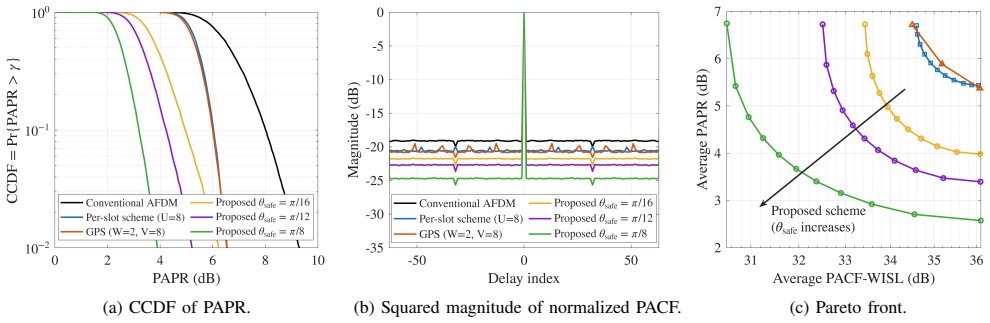
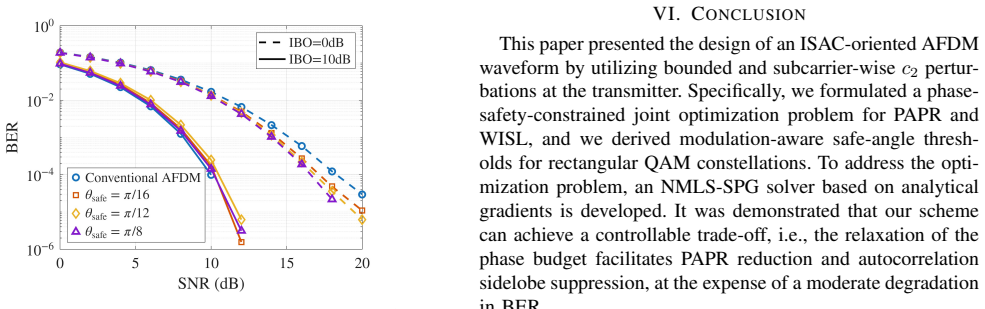
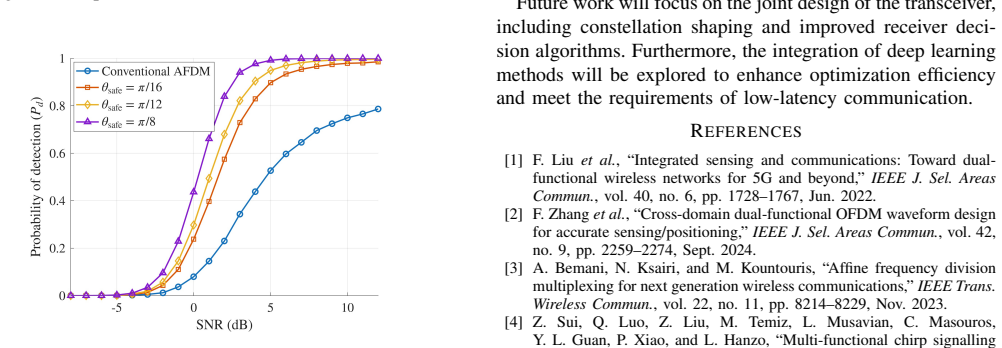
The central claim is that adaptively perturbing the pre-chirp parameter c2 via a data-driven optimization reduces PAPR and the weighted integrated sidelobe levels of aperiodic and periodic autocorrelation functions in AFDM-ISAC systems, solved by a spectral projected-gradient algorithm that maintains receiver-level complexity and yields superior sensing-communication trade-offs along with promoted bit error rate performance under power amplifier nonlinearity.
What carries the argument
A side-information-free optimization problem over the pre-chirp parameter c2, solved by a non-monotone line-search spectral projected-gradient algorithm that uses closed-form gradients.
If this is right
- The method achieves a superior sensing versus communications trade-off.
- Bit error rate performance improves in the presence of severe power amplifier nonlinearity.
- Gains remain consistent across different data symbols and channel conditions.
- Real-time operation holds with complexity matching a conventional AFDM receiver.
Where Pith is reading between the lines
- If c2 can be updated per symbol without side information, the approach could support dynamic adaptation in mobile or rapidly changing ISAC environments.
- The same gradient-based optimization structure might apply to other chirp-based waveforms facing similar PAPR and autocorrelation issues.
- Hardware validation with actual power amplifiers would be required to confirm whether simulated gains translate under real nonlinearity.
Load-bearing premise
The optimization problem can be solved in real time with complexity comparable to a conventional AFDM receiver while consistently improving performance across varying data symbols and channel conditions.
What would settle it
A test case in which the c2-optimized AFDM waveform produces higher PAPR or larger integrated sidelobe levels than standard AFDM for the same data symbols and channel.
Figures
read the original abstract
Affine frequency division multiplexing (AFDM) is a promising waveform for integrated sensing and communication (ISAC) systems owing to its superior performance in time--frequency doubly dispersive channels. However, AFDM still faces a pair of challenges: high PAPR and random data symbols produce imperfect autocorrelation sidelobes. To address these challenges, this paper proposes a real-time data-driven framework that optimizes the pre-chirp parameter $c_2$ to enhance the AFDM-ISAC performance. Specifically, a side-information-free optimization problem is formulated to reduce PAPR and the weighted integrated sidelobe levels of both aperiodic and periodic autocorrelation functions, with complexity comparable to that of the conventional AFDM receiver. Furthermore, an efficient non-monotone line-search spectral projected-gradient algorithm is developed by exploiting closed-form gradients. Simulation results demonstrate that the proposed method achieves a superior sensing vs. communications trade-off and is capable of striking a promoted bit error rate performance in the presence of severe power amplifier nonlinearity.
Editorial analysis
A structured set of objections, weighed in public.
Referee Report
Summary. The paper proposes a real-time adaptive framework for optimizing the pre-chirp parameter c₂ in AFDM waveforms for ISAC applications. It formulates a side-information-free optimization problem minimizing PAPR together with weighted integrated sidelobe levels of both aperiodic and periodic autocorrelation functions, develops a non-monotone line-search spectral projected-gradient algorithm that exploits closed-form gradients, and reports simulation results claiming a superior sensing-communication trade-off plus improved BER under severe power-amplifier nonlinearity, all with complexity comparable to a conventional AFDM receiver.
Significance. If the real-time solvability and robustness claims hold, the side-information-free formulation and closed-form gradient exploitation would constitute a practical contribution to AFDM-ISAC waveform design in doubly dispersive channels. The approach avoids reliance on data-symbol side information, which is a clear strength relative to many existing PAPR or sidelobe-reduction techniques.
major comments (2)
- [Abstract] Abstract and algorithm description: the central claim that the optimization 'has complexity comparable to that of the conventional AFDM receiver' (O(N log N) FFT operations) is unsupported by any iteration counts, convergence analysis, per-symbol flop-count comparison, or timing results. This directly undermines the real-time applicability asserted for the non-monotone line-search spectral projected-gradient method across varying data symbols and channels.
- [Simulation results] Simulation results section: the reported superior ISAC trade-off and BER improvement under PA nonlinearity rest on unspecified simulation setups (no error bars, no ablation on the sidelobe weighting coefficients, no dataset or channel-model details). Without these, the load-bearing performance claims cannot be assessed for statistical reliability or sensitivity to the free parameters listed in the axiom ledger.
minor comments (1)
- [Problem formulation] Notation for the weighting coefficients and the exact definition of the integrated sidelobe level objective should be introduced with a dedicated equation number rather than inline text.
Simulated Author's Rebuttal
We thank the referee for the constructive and detailed comments. We agree that both major points identify areas where the manuscript requires additional supporting material to substantiate its claims, and we will revise accordingly.
read point-by-point responses
-
Referee: [Abstract] Abstract and algorithm description: the central claim that the optimization 'has complexity comparable to that of the conventional AFDM receiver' (O(N log N) FFT operations) is unsupported by any iteration counts, convergence analysis, per-symbol flop-count comparison, or timing results. This directly undermines the real-time applicability asserted for the non-monotone line-search spectral projected-gradient method across varying data symbols and channels.
Authors: We agree that the complexity claim in the abstract is not adequately supported by analysis in the current manuscript. While the algorithm is built around FFT operations for gradient evaluation and projection (each O(N log N)) and the line-search procedure is intended to require only a modest number of iterations, no explicit counts, convergence curves, or flop-count comparisons appear in the text. In the revised manuscript we will add a dedicated complexity subsection that reports empirical iteration statistics across symbols and channels, a convergence analysis, and direct flop-count comparisons to a conventional AFDM receiver. This will allow the real-time claim to be properly evaluated. revision: yes
-
Referee: [Simulation results] Simulation results section: the reported superior ISAC trade-off and BER improvement under PA nonlinearity rest on unspecified simulation setups (no error bars, no ablation on the sidelobe weighting coefficients, no dataset or channel-model details). Without these, the load-bearing performance claims cannot be assessed for statistical reliability or sensitivity to the free parameters listed in the axiom ledger.
Authors: We acknowledge that the simulation section is insufficiently documented. The manuscript states the performance improvements but does not provide error bars, ablation results on the weighting coefficients, explicit channel-model parameters, or Monte-Carlo run counts. In the revision we will expand the simulation section to include: full parameter tables, doubly-dispersive channel model specifications, number of independent runs with error bars, ablation studies on the sidelobe weights, and any additional dataset details. These additions will permit assessment of statistical reliability and parameter sensitivity. revision: yes
Circularity Check
No circularity: optimization objective uses independent measurable quantities (PAPR, sidelobes)
full rationale
The paper formulates a side-information-free optimization problem whose objective is defined directly in terms of PAPR and weighted integrated sidelobe levels of autocorrelation functions. These quantities are externally measurable and not defined in terms of the optimized parameter c2 itself. The algorithm exploits closed-form gradients of this objective. No self-definitional steps, fitted-input predictions, or load-bearing self-citations appear in the derivation chain. The real-time solvability claim is an unverified assumption but does not create circularity in the mathematical formulation.
Axiom & Free-Parameter Ledger
free parameters (1)
- sidelobe weighting coefficients
Reference graph
Works this paper leans on
-
[1]
Integrated sensing and communications: Toward dual- functional wireless networks for 5G and beyond,
F. Liuet al., “Integrated sensing and communications: Toward dual- functional wireless networks for 5G and beyond,”IEEE J. Sel. Areas Commun., vol. 40, no. 6, pp. 1728–1767, Jun. 2022
2022
-
[2]
Cross-domain dual-functional OFDM waveform design for accurate sensing/positioning,
F. Zhanget al., “Cross-domain dual-functional OFDM waveform design for accurate sensing/positioning,”IEEE J. Sel. Areas Commun., vol. 42, no. 9, pp. 2259–2274, Sept. 2024
2024
-
[3]
Affine frequency division multiplexing for next generation wireless communications,
A. Bemani, N. Ksairi, and M. Kountouris, “Affine frequency division multiplexing for next generation wireless communications,”IEEE Trans. Wireless Commun., vol. 22, no. 11, pp. 8214–8229, Nov. 2023
2023
-
[4]
Z. Sui, Q. Luo, Z. Liu, M. Temiz, L. Musavian, C. Masouros, Y . L. Guan, P. Xiao, and L. Hanzo, “Multi-functional chirp signalling for next-generation multi-carrier wireless networks: Communications, sensing and ISAC perspectives,” Aug. 2025. [Online]. Available: https://arxiv.org/abs/2508.06022
-
[5]
AFDM-enabled integrated sensing and communication: Theoretical framework and pilot design,
F. Zhang, Z. Wang, T. Mao, T. Jiao, Y . Zhuo, M. Wen, W. Xiang, S. Chen, and G. K. Karagiannidis, “AFDM-enabled integrated sensing and communication: Theoretical framework and pilot design,”IEEE J. Sel. Areas Commun., vol. 44, pp. 310–324, 2026
2026
-
[6]
Generalized spatial modulation aided affine frequency division multiplexing,
Z. Suiet al., “Generalized spatial modulation aided affine frequency division multiplexing,”IEEE Trans. Wireless Commun., vol. 25, pp. 4658–4673, 2026
2026
-
[7]
Pre-chirp-domain index modulation for full-diversity affine frequency division multiplexing toward 6G,
G. Liu, T. Mao, Z. Xiao, M. Wen, R. Liu, J. Zhao, E. Basar, Z. Wang, and S. Chen, “Pre-chirp-domain index modulation for full-diversity affine frequency division multiplexing toward 6G,”IEEE Trans. Wireless Commun., vol. 24, no. 9, pp. 7331–7345, 2025
2025
-
[8]
MIMO-AFDM Outperforms MIMO-OFDM in the Face of Hardware Impairments
Z. Suiet al., “MIMO-AFDM outperforms MIMO-OFDM in the face of hardware impairments,” 2026. [Online]. Available: https://arxiv.org/abs/2601.00502
work page internal anchor Pith review Pith/arXiv arXiv 2026
-
[9]
Affine frequency division multiple access based on DAFT spreading for next- generation wireless networks,
Y . Tao, M. Wen, Y . Ge, T. Mao, Y . Tang, and A. Doosti-Aref, “Affine frequency division multiple access based on DAFT spreading for next- generation wireless networks,”IEEE Trans. Wireless Commun., vol. 25, pp. 4626–4641, 2026
2026
-
[10]
PAPR reduction with pre-chirp selection for affine frequency division multiplexing,
H. Yuanet al., “PAPR reduction with pre-chirp selection for affine frequency division multiplexing,”IEEE Wireless Commun. Lett., vol. 14, no. 3, pp. 736–740, Mar. 2025
2025
-
[11]
Low-PAPR AFDM with intrinsic SI and low complexity,
K. Choi, “Low-PAPR AFDM with intrinsic SI and low complexity,” IEEE Wireless Commun. Lett., vol. 15, pp. 1494–1498, 2026
2026
-
[12]
CP-OFDM achieves the lowest average ranging sidelobe under QAM/PSK constellations,
F. Liuet al., “CP-OFDM achieves the lowest average ranging sidelobe under QAM/PSK constellations,”IEEE Trans. Inf. Theory, vol. 71, no. 9, pp. 6950–6967, 2025
2025
-
[13]
Radar-centric AFDM waveform with chirp-domain index modulation for ISAC,
M. Ahmad, S. Baig, and N. A. Alqwaifly, “Radar-centric AFDM waveform with chirp-domain index modulation for ISAC,”IEEE Open J. Commun. Soc., vol. 7, pp. 844–857, 2026
2026
-
[14]
Realistic power amplifier model for the New Radio evaluation,
Nokia, “Realistic power amplifier model for the New Radio evaluation,” 3GPP TSG-RAN WG4 Meeting 79, R4-163314, May 2016
2016
-
[15]
The Bussgang decomposition of nonlin- ear systems: Basic theory and MIMO extensions [lecture notes],
O. T. Demir and E. Bjornson, “The Bussgang decomposition of nonlin- ear systems: Basic theory and MIMO extensions [lecture notes],”IEEE Signal Process. Mag., vol. 38, no. 1, pp. 131–136, 2021
2021
discussion (0)
Sign in with ORCID, Apple, or X to comment. Anyone can read and Pith papers without signing in.