GraphAlg Playground: An Online Platform for Learning and Experimenting with the GraphAlg Language
Pith reviewed 2026-06-28 03:50 UTC · model grok-4.3
The pith
GraphAlg language provides native support for user-defined graph analytics workloads in databases through a browser-based playground.
A machine-rendered reading of the paper's core claim, the machinery that carries it, and where it could break.
Core claim
The GraphAlg language for graph algorithms enables native support for user-defined graph analytics workloads in databases, demonstrated by a freely available web-based playground that executes programs inside the browser and supplies an interactive tutorial for its concepts.
What carries the argument
The GraphAlg language, carried by a browser-executable playground and interactive tutorial that allow writing, running, and learning graph algorithm programs without external setup.
If this is right
- New users can learn GraphAlg programming solely through the browser tutorial.
- Expert users can prototype and validate custom graph algorithms directly in the browser.
- The playground serves as a reusable library that other projects can embed without installation steps.
- Two public demonstration scenarios illustrate learning for beginners and validation for experts.
Where Pith is reading between the lines
- Widespread use of the playground could accelerate adoption of custom graph workloads in existing database systems.
- Browser execution opens the possibility of sharing runnable GraphAlg snippets across teams without environment mismatches.
- If GraphAlg integrates as described, database vendors might expose similar user-defined analytics interfaces without heavy client-side tooling.
Load-bearing premise
That the GraphAlg language actually supplies native support for user-defined graph analytics workloads inside databases.
What would settle it
A concrete test showing that GraphAlg programs require external components or cannot execute inside a standard database engine without the playground wrapper.
Figures



read the original abstract
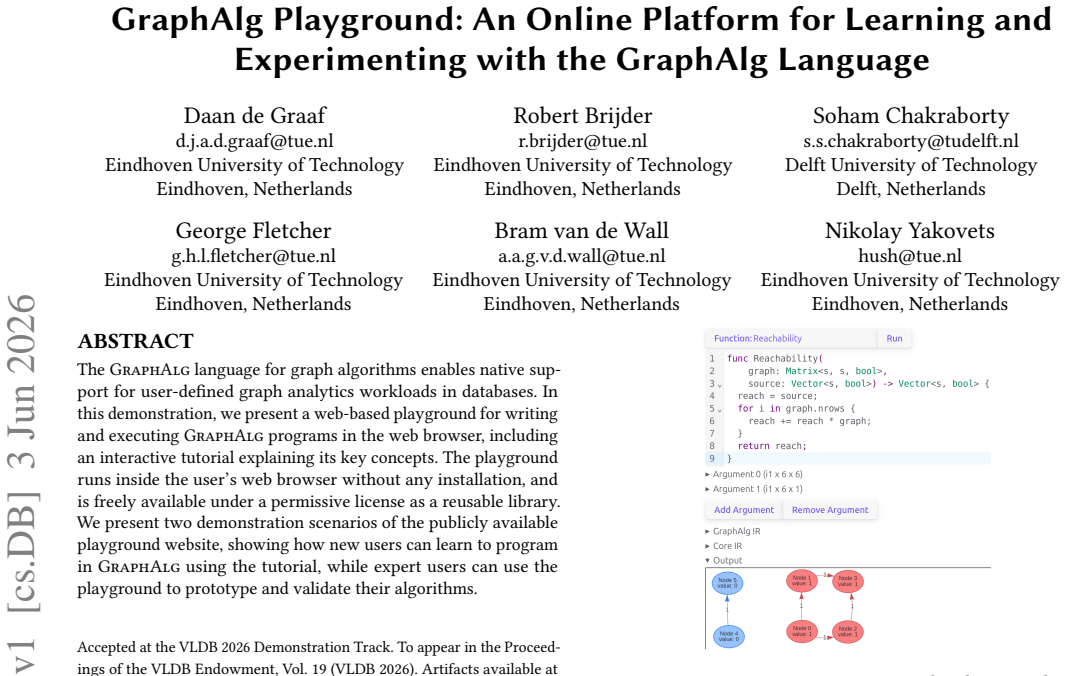
The GraphAlg language for graph algorithms enables native support for user-defined graph analytics workloads in databases. In this demonstration, we present a web-based playground for writing and executing GraphAlg programs in the web browser, including an interactive tutorial explaining its key concepts. The playground runs inside the user's web browser without any installation, and is freely available under a permissive license as a reusable library. We present two demonstration scenarios of the publicly available playground website, showing how new users can learn to program in GraphAlg using the tutorial, while expert users can use the playground to prototype and validate their algorithms.
Editorial analysis
A structured set of objections, weighed in public.
Referee Report
Summary. The manuscript claims that the GraphAlg language enables native support for user-defined graph analytics workloads in databases. It presents a web-based playground for writing and executing GraphAlg programs directly in the browser (no installation required), including an interactive tutorial on key concepts, and describes two demonstration scenarios for learning the language and prototyping algorithms. The playground is released as a freely available reusable library under a permissive license.
Significance. If the native database integration claim holds, the work could contribute to making graph analytics more accessible within database systems by supporting user-defined workloads. The playground component provides practical educational value as a zero-install tool for teaching and experimenting with graph algorithms, which may benefit database education and rapid prototyping.
major comments (1)
- [Abstract] Abstract: The central premise that 'The GraphAlg language for graph algorithms enables native support for user-defined graph analytics workloads in databases' is stated without any accompanying description of the embedding mechanism, execution engine integration, architecture, or empirical validation. The manuscript provides only a description of the browser-based playground and tutorial scenarios, leaving the native support claim as an unsupported assertion rather than a demonstrated result.
minor comments (1)
- The manuscript would benefit from explicit separation between claims about the GraphAlg language's database capabilities and the features of the presented playground tool.
Simulated Author's Rebuttal
We thank the referee for the review and the recommendation for major revision. The manuscript is a demonstration paper whose primary contribution is the publicly available GraphAlg Playground and its tutorial. We address the single major comment below.
read point-by-point responses
-
Referee: The central premise that 'The GraphAlg language for graph algorithms enables native support for user-defined graph analytics workloads in databases' is stated without any accompanying description of the embedding mechanism, execution engine integration, architecture, or empirical validation. The manuscript provides only a description of the browser-based playground and tutorial scenarios, leaving the native support claim as an unsupported assertion rather than a demonstrated result.
Authors: We agree with the observation. The opening sentence of the abstract asserts a property of the GraphAlg language that is not demonstrated or described in this manuscript; the paper is limited to the browser-based playground, tutorial, and two usage scenarios. This manuscript does not contain the embedding mechanism, execution engine details, architecture, or validation that would be required to substantiate the native-support claim. We will revise the abstract (and, if needed, the introduction) to remove or qualify the unsupported claim and to state the paper's actual scope as a demonstration of the playground tool. revision: yes
Circularity Check
No significant circularity; paper is a tool demonstration without derivations
full rationale
The manuscript is a demonstration paper describing a browser-based playground for the GraphAlg language, including a tutorial and usage scenarios. The opening sentence states that GraphAlg 'enables native support for user-defined graph analytics workloads in databases' as a premise motivating the playground, but no equations, derivation steps, fitted parameters, or self-citations appear in the abstract or demo description. No load-bearing claim reduces by construction to its own inputs, and the content contains no mathematical or logical chain that could be inspected for circularity. The paper is self-contained as a software tool description.
Axiom & Free-Parameter Ledger
Reference graph
Works this paper leans on
-
[1]
Robert Brijder, Floris Geerts, Jan Van Den Bussche, and Timmy Weerwag. 2019. On the Expressive Power of Query Languages for Matrices.ACM Trans. Database Syst.44, 4 (Oct. 2019), 15:1–15:31. https://doi.org/10.1145/3331445
-
[2]
Daan de Graaf. 2026. wildarch/graphalg. https://github.com/wildarch/graphalg original-date: 2025-10-09T14:03:07Z
2026
-
[3]
Daan de Graaf, Robert Brijder, Soham Chakraborty, George Fletcher, Bram van de Wall, and Nikolay Yakovets. 2026. Algorithm Support for Graph Databases, Done Right. https://doi.org/10.48550/arXiv.2601.06705 arXiv:2601.06705 [cs]
-
[4]
Nadime Francis, Alastair Green, Paolo Guagliardo, Leonid Libkin, Tobias Lin- daaker, Victor Marsault, Stefan Plantikow, Mats Rydberg, Petra Selmer, and Andrés Taylor. 2018. Cypher: An Evolving Query Language for Property Graphs. InProceedings of the 2018 International Conference on Management of Data (SIG- MOD ’18). Association for Computing Machinery, Ne...
-
[5]
Google Inc. [n.d.]. Go Playground - The Go Programming Language. https: //go.dev/play/
-
[6]
Surabhi Gupta and Karthik Ramachandra. 2021. Procedural extensions of SQL: understanding their usage in the wild.Proceedings of the VLDB Endowment14, 8 (April 2021), 1378–1391. https://doi.org/10.14778/3457390.3457402
-
[7]
Oleg Kiselyov and Hiromi Ishii
Andreas Haas, Andreas Rossberg, Derek L. Schuff, Ben L. Titzer, Michael Holman, Dan Gohman, Luke Wagner, Alon Zakai, and JF Bastien. 2017. Bringing the web up to speed with WebAssembly. InProceedings of the 38th ACM SIGPLAN Conference on Programming Language Design and Implementation (PLDI 2017). Association for Computing Machinery, New York, NY, USA, 185...
-
[8]
Denis Hirn and Torsten Grust. 2023. A Fix for the Fixation on Fixpoints. In Proceedings of the 13th Conference on Innovative Data Systems Research
2023
-
[9]
Aidan Hogan, Juan L. Reutter, and Adrián Soto. 2020. In-Database Graph An- alytics with Recursive SPARQL. InThe Semantic Web – ISWC 2020, Jeff Z. Pan, Valentina Tamma, Claudia d’Amato, Krzysztof Janowicz, Bo Fu, Axel Polleres, Oshani Seneviratne, and Lalana Kagal (Eds.). Springer International Publishing, Cham, 511–528. https://doi.org/10.1007/978-3-030-6...
-
[10]
Dylan Hutchison, Bill Howe, and Dan Suciu. 2017. LaraDB: A Minimalist Kernel for Linear and Relational Algebra Computation. InProceedings of the 4th ACM SIGMOD Workshop on Algorithms and Systems for MapReduce and Beyond. 1–10. https://doi.org/10.1145/3070607.3070608 arXiv:1703.07342 [cs]
-
[11]
Alexandru Iosup, Tim Hegeman, Wing Lung Ngai, Stijn Heldens, Arnau Prat- Pérez, Thomas Manhardt, Hassan Chafi, Mihai Capotă, Narayanan Sundaram, Michael Anderson, Ilie Gabriel Tănase, Yinglong Xia, Lifeng Nai, and Peter Boncz
-
[12]
LDBC graphalytics: a benchmark for large-scale graph analysis on parallel and distributed platforms.Proceedings of the VLDB Endowment9, 13 (Sept. 2016), 1317–1328. https://doi.org/10.14778/3007263.3007270
-
[13]
ISO. 2024. Information technology — Database languages — GQL. https: //www.iso.org/standard/76120.html
2024
-
[14]
2011.Graph Algorithms in the Language of Linear Algebra
Jeremy Kepner and John Gilbert (Eds.). 2011.Graph Algorithms in the Language of Linear Algebra. Society for Industrial and Applied Mathematics. https: //doi.org/10.1137/1.9780898719918
-
[15]
Hongbin Ma, Bin Shao, Yanghua Xiao, Liang Jeff Chen, and Haixun Wang. 2016. G-SQL: fast query processing via graph exploration.Proceedings of the VLDB Endowment9, 12 (Aug. 2016), 900–911. https://doi.org/10.14778/2994509.2994510
-
[16]
Neo4J inc. [n.d.]. Graph algorithms - Neo4j Graph Data Science. https://neo4j. com/docs/graph-data-science/2.17/algorithms/
-
[17]
Amir Shaikhha, Dan Suciu, Maximilian Schleich, and Hung Q. Ngo. 2024. Opti- mizing Nested Recursive Queries.Proc. ACM Manag. Data2, 1 (2024), 16:1–16:27. https://doi.org/10.1145/3639271
-
[18]
Alexander Shkapsky, Mohan Yang, and Carlo Zaniolo. 2015. Optimizing recursive queries with monotonic aggregates in DeALS. In2015 IEEE 31st International Conference on Data Engineering. 867–878. https://doi.org/10.1109/ICDE.2015. 7113340 ISSN: 2375-026X
-
[19]
Moritz Sichert and Thomas Neumann. 2022. User-defined operators: efficiently in- tegrating custom algorithms into modern databases.Proceedings of the VLDB En- dowment15, 5 (Jan. 2022), 1119–1131. https://doi.org/10.14778/3510397.3510408
-
[20]
The DuckDB Developers. [n.d.]. DuckDB Web Shell. https://shell.duckdb.org/
-
[21]
The Rust Developers. [n.d.]. Rust Playground. https://play.rust-lang.org/
-
[22]
The Umbra Developers. [n.d.]. Umbra Online Interface. https://umbra-db.com/ interface
- [23]
discussion (0)
Sign in with ORCID, Apple, or X to comment. Anyone can read and Pith papers without signing in.