Resolving the Blueshift in Calculations of the EUV Spectrum of Multiply Charged Tin Ions
Pith reviewed 2026-06-28 02:54 UTC · model grok-4.3
The pith
Saturating configuration interaction in the n=4 shell resolves the blueshift in EUV spectra of Sn^{12+} ions.
A machine-rendered reading of the paper's core claim, the machinery that carries it, and where it could break.
Core claim
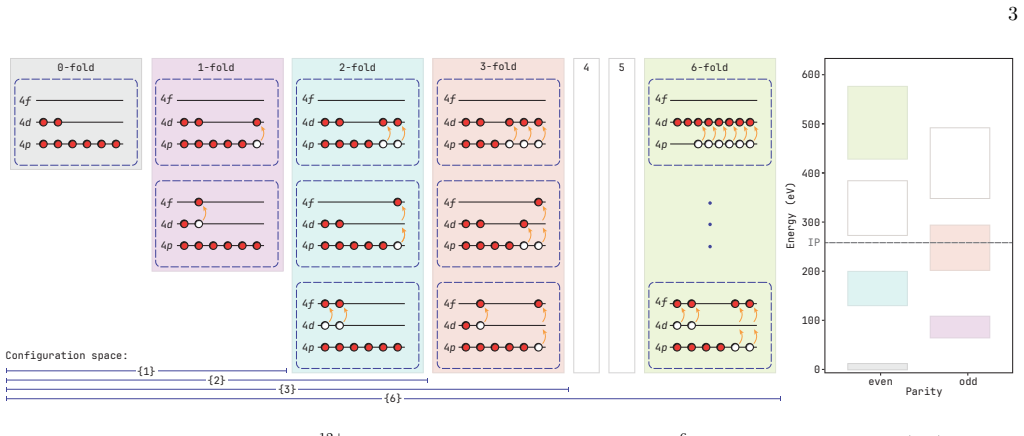
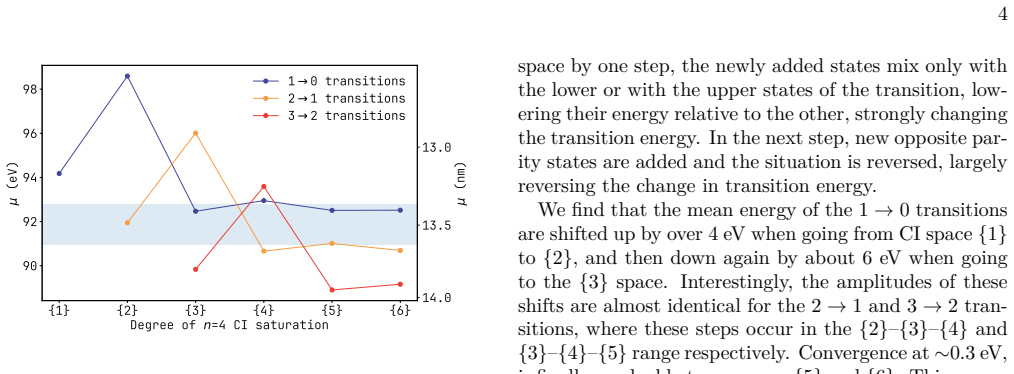
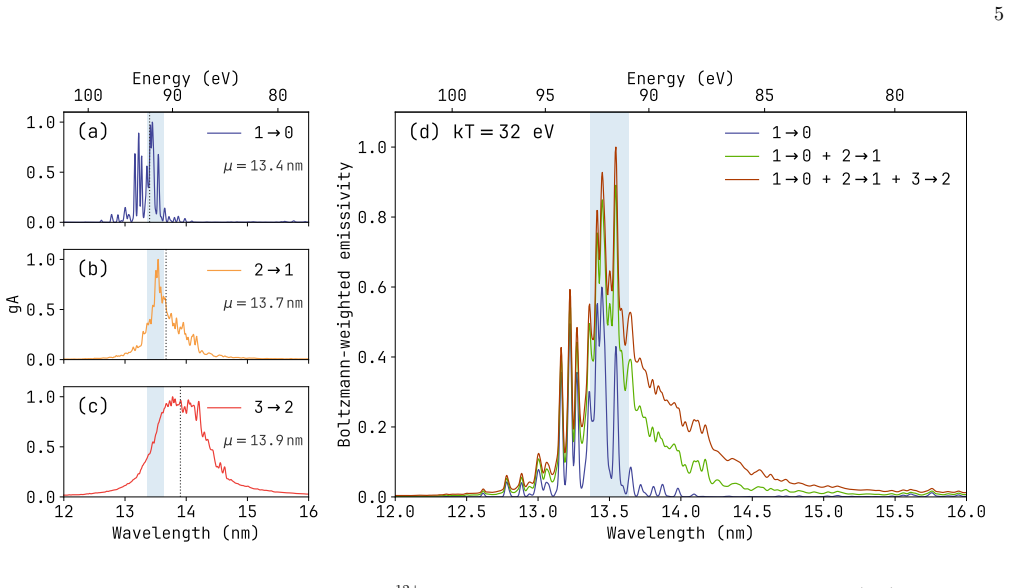
Ab initio relativistic calculations on the complex open-shell Sn^{12+} ion, after completely saturating the configuration interaction within the n=4 shell and applying a thorough treatment of core-valence correlation, produce an EUV spectrum whose region of peak emissivity matches experiment, revealing a surprisingly large influence of highly excited states on a spectrum dominated by multiply excited states.
What carries the argument
Complete saturation of configuration interaction within the n=4 shell, enabled by optimized numerical methods for high-performance CPU architectures, together with core-valence correlation treatment.
If this is right
- The calculated EUV emissivity peak position now agrees with experimental observations for tin plasmas.
- Highly excited states must be retained to obtain accurate emissivity spectra in multiply charged tin ions.
- The spectrum shape is dominated by contributions from multiply excited states rather than lower-lying configurations.
- Similar saturation of configuration interaction spaces can be used to resolve discrepancies in spectra of other highly charged ions.
Where Pith is reading between the lines
- Improved spectral models for tin plasmas may allow better optimization of light sources for semiconductor lithography.
- Other atomic calculations on open-shell systems with complex spectra may need equivalent saturation to avoid systematic wavelength errors.
- Multiply excited states could play comparable roles in opacity or emissivity calculations for ions in fusion or astrophysical contexts.
Load-bearing premise
The numerical optimizations achieve complete saturation of configuration interaction within the n=4 shell with no residual truncation or convergence errors that would affect the spectrum shape.
What would settle it
An independent calculation of the Sn^{12+} EUV spectrum using different basis sets or codes that still exhibits a blueshift after attempting full n=4 saturation would show the shift is not resolved by this approach.
Figures
read the original abstract
We report ab initio relativistic calculations on the complex open shell Sn$^{12+}$ highly charged ion, a prototypical plasma ion relevant for extreme ultraviolet (EUV) nanolithography. Previous calculations of EUV emissivity in tin plasmas consistently generate a spectrum in which the region of peak emissivity is blueshifted relative to experiment. By optimising our numerical methods to take full advantage of modern, high-performance CPU architectures, we are able to completely saturate the configuration interaction within the $n=4$ shell. Coupled with a thorough treatment of core-valence correlation we resolve the blueshift, finding a surprisingly large influence of highly excited states on the spectrum that is dominated by multiply excited states.
Editorial analysis
A structured set of objections, weighed in public.
Referee Report
Summary. The manuscript reports ab initio relativistic calculations for the EUV spectrum of Sn^{12+}. It claims that optimizing numerical methods to fully saturate configuration interaction within the n=4 shell, together with core-valence correlation, resolves the longstanding blueshift relative to experiment and shows that the spectrum is dominated by multiply excited states.
Significance. If the saturation claim holds with verifiable convergence, the work would be significant for computational modeling of complex open-shell ions in EUV nanolithography plasmas. It offers a parameter-free resolution to a persistent discrepancy and identifies the role of highly excited states, which could improve predictive accuracy in plasma simulations.
major comments (1)
- [Abstract] Abstract: The assertion of 'complete saturation' of configuration interaction within the n=4 shell (and the resulting resolution of the blueshift) is load-bearing for the central claim, yet the manuscript provides no explicit convergence verification such as spectrum or energy stability when the n=4 expansion is enlarged by additional configurations or when a higher-n shell is partially opened. Without these checks, residual truncation effects cannot be ruled out as the source of the observed shift.
Simulated Author's Rebuttal
We thank the referee for their careful review and for highlighting the importance of verifiable convergence in support of the saturation claim. We address the major comment below.
read point-by-point responses
-
Referee: [Abstract] Abstract: The assertion of 'complete saturation' of configuration interaction within the n=4 shell (and the resulting resolution of the blueshift) is load-bearing for the central claim, yet the manuscript provides no explicit convergence verification such as spectrum or energy stability when the n=4 expansion is enlarged by additional configurations or when a higher-n shell is partially opened. Without these checks, residual truncation effects cannot be ruled out as the source of the observed shift.
Authors: We agree that the manuscript would benefit from explicit convergence data to substantiate the saturation of the n=4 configuration interaction. In the revised version we will add systematic enlargements of the n=4 active space together with partial n=5 openings, reporting both the stability of the EUV peak position and the convergence of the dominant transition energies. These tests will be presented in a new subsection of the results and referenced from the abstract. revision: yes
Circularity Check
No circularity; ab initio CI saturation and core-valence treatment are independent of target spectrum
full rationale
The paper presents relativistic configuration-interaction calculations that saturate the n=4 shell via numerical optimization and add core-valence correlation to resolve the EUV blueshift. No derivation step reduces by construction to a fit against the experimental peak position, no self-citation supplies a load-bearing uniqueness theorem, and no ansatz or renaming is smuggled in. The central result is a direct numerical prediction compared to external benchmarks, satisfying the self-contained criterion for score 0.
Axiom & Free-Parameter Ledger
Reference graph
Works this paper leans on
-
[1]
Kazazis, J
D. Kazazis, J. G. Santaclara, J. van Schoot, I. Mochi, and Y. Ekinci, Extreme ultraviolet lithography, Nat. Rev. Methods Primers4, 84 (2024)
2024
-
[2]
Wagner and N
C. Wagner and N. Harned, EUV lithography: Lithogra- phy gets extreme, Nat. Photonics4, 24 (2010)
2010
-
[3]
M. M. Waldrop, The chips are down for Moore’s law, Nature News530, 144 (2016)
2016
-
[4]
V. Y. Banine, K. N. Koshelev, and G. H. P. M. Swinkels, Physical processes in EUV sources for microlithography, J. Phys. D: Appl. Phys.44, 253001 (2011)
2011
-
[5]
Fomenkov, D
I. Fomenkov, D. Brandt, A. Ershov, A. Schafgans, Y. Tao, G. Vaschenko, S. Rokitski, M. Kats, M. Vargas, M. Purvis,et al., Light sources for high-volume manufac- turing EUV lithography: technology, performance, and power scaling, Adv. Opt. Technol.6, 173 (2017)
2017
-
[6]
Kawasuji, K
Y. Kawasuji, K. M. Nowak, T. Hori, T. Okamoto, H. Tanaka, Y. Watanabe, T. Abe, T. Kodama, Y. Shi- raishi, H. Nakarai,et al., Key components technology update of the 250W high-power LPP-EUV light source, inSPIE Advanced Lithography, Vol. 10143 (International Society for Optics and Photonics, 2017) pp. 101432G– 101432G
2017
-
[7]
O. O. Versolato, Physics of laser-driven tin plasma sources of EUV radiation for nanolithography, Plasma Sources Sci. Technol.28, 083001 (2019)
2019
-
[8]
Q. Zhu, A. A. Schafgans, J. Stewart, S. Rich, M. Purvis, H. Wang, K. Hummler, A. LaForge, P. Mayer, D. Urone, O. Biabani, A. Dorobantu, Y. Ma, and B. Rollinger, Evolution of EUV light source architecture for contin- ued advancements in EUV high volume manufacturing, inOptical and EUV Nanolithography XXXVIII, Vol. 13424, edited by M. Burkhardt and C. van L...
2025
-
[9]
Torretti, J
F. Torretti, J. Sheil, R. Schupp, M. Basko, M. Bayraktar, R. Meijer, S. Witte, W. Ubachs, R. Hoekstra, O. Ver- solato,et al., Prominent radiative contributions from multiply-excited states in laser-produced tin plasma for nanolithography, Nat. Commun.11, 2334 (2020)
2020
-
[10]
Sheil, O
J. Sheil, O. O. Versolato, A. J. Neukirch, and J. Colgan, Multiply-excited states and their contribution to opacity in CO2 laser-driven tin-plasma conditions, J. Phys B: At. Mol. Opt. Phys.54, 035002 (2021)
2021
-
[11]
Sasaki, Effect of multiply excited states to the EUV emission from yttrium-like tin, Appl
A. Sasaki, Effect of multiply excited states to the EUV emission from yttrium-like tin, Appl. Phys. Lett.124, 064104 (2024)
2024
-
[12]
G. Yan, C. Gao, Y. Hou, F. Jin, Y. Li, J. Zeng, and J. Yuan, Theoretical investigations on the radiative opac- ity of Sn plasmas with an open 4d orbital using a detailed- level accounting model, Phys. Plasmas31, 093303 (2024)
2024
-
[13]
Fujioka, H
S. Fujioka, H. Nishimura, K. Nishihara, A. Sasaki, A. Sunahara, T. Okuno, N. Ueda, T. Ando, Y. Tao, Y. Shimada, K. Hashimoto, M. Yamaura, K. Shige- mori, M. Nakai, K. Nagai, T. Norimatsu, T. Nishikawa, N. Miyanaga, Y. Izawa, and K. Mima, Opacity effect on extreme ultraviolet radiation from laser-produced tin plasmas, Phys. Rev. Lett.95, 235004 (2005)
2005
-
[14]
Sheil, O
J. Sheil, O. Versolato, V. Bakshi, and H. Scott, Review of the 1st EUV light sources code comparison workshop, Atoms11, 130 (2023)
2023
-
[15]
S. Bajt, J. B. Alameda, T. W. Barbee Jr, W. M. Clift, J. A. Folta, B. Kaufmann, and E. A. Spiller, Improved reflectance and stability of Mo-Si multilayers, Opt. Eng. 41, 1797 (2002)
2002
-
[16]
M. A. Purvis, A. Schafgans, D. J. W. Brown, I. Fomenkov, R. Rafac, J. Brown, Y. Tao, S. Rokitski, M. Abraham, M. Vargas, S. Rich, T. Taylor, D. Brandt, A. Pirati, A. Fisher, H. Scott, A. Koniges, D. Eder, S. Wilks, A. Link, and S. Langer, Advancements in pre- dictive plasma formation modeling, inExtreme Ultravi- olet (EUV) Lithography VII, Vol. 9776, edit...
2016
-
[17]
Scott, S
H. Scott, S. Langer, and Y. Frank, Radiation- Hydrodynamics Modeling of LPP EUV Sources, inPho- ton Sources for Lithography and Metrology, edited by V. Bakshi (SPIE Press, Washington, 2023) pp. 71–110
2023
-
[18]
M. Su, Q. Min, S. Cao, D. Sun, P. Hayden, G. O’Sullivan, and C. Dong, Evolution analysis of EUV radiation from laser-produced tin plasmas based on a radiation hydro- dynamics model, Sci. Rep.7, 45212 (2017)
2017
-
[19]
Basko, On the maximum conversion efficiency into the 13.5-nm extreme ultraviolet emission under a steady- state laser ablation of tin microspheres, Phys
M. Basko, On the maximum conversion efficiency into the 13.5-nm extreme ultraviolet emission under a steady- state laser ablation of tin microspheres, Phys. Plasmas 23, 083114 (2016)
2016
-
[20]
R. D. Cowan,The Theory of Atomic Structure and Spec- tra(University of California Press, 1981)
1981
-
[21]
S. S. Churilov and A. N. Ryabtsev, Analyses of the Sn IX–Sn XII spectra in the EUV region, Phys. Scr.73, 614 (2006)
2006
-
[22]
S. S. Churilov and A. N. Ryabtsev, Analysis of the 4p 6 4d7 - (4p 6 4d6 4f + 4p 5 4d8) transitions in the Sn VIII spectrum, Opt. Spectrosc.100, 660 (2006)
2006
-
[23]
S. S. Churilov and A. N. Ryabtsev, Analysis of the spec- tra of In XII–XIV and Sn XIII–XV in the far-VUV re- gion, Opt. Spectrosc.101, 169 (2006)
2006
-
[24]
I. Y. Tolstikhina, S. S. Churilov, A. N. Ryabtsev, and K. N. Koshelev, Atomic tin data, inEUV sources for lithography, edited by V. Bakshi (SPIE Press, 2006) Chap. 4, pp. 113–148
2006
-
[25]
A. N. Ryabtsev, ´E. Y. Kononov, and S. S. Churilov, Spec- tra of rubidium-like Pd X-Sn XIV ions, Opt. Spectrosc. 105, 844 (2008)
2008
-
[26]
D’Arcy, H
R. D’Arcy, H. Ohashi, S. Suda, H. Tanuma, S. Fu- jioka, H. Nishimura, K. Nishihara, C. Suzuki, T. Kato, 7 F. Koike,et al., Transitions and the effects of configura- tion interaction in the spectra of Sn XV–Sn XVIII, Phys. Rev. A79, 042509 (2009)
2009
-
[27]
D’Arcy, H
R. D’Arcy, H. Ohashi, S. Suda, H. Tanuma, S. Fu- jioka, H. Nishimura, K. Nishihara, C. Suzuki, T. Kato, F. Koike,et al., Identification of 4d–5p transitions in the spectra of Sn XV–Sn XIX recorded from collisions be- tween Sn ions and He, J. Phys. B42, 165207 (2009)
2009
-
[28]
Kieft, K
E. Kieft, K. Garloff, J. Van der Mullen, and V. Banine, Comparison of experimental and simulated extreme ul- traviolet spectra of xenon and tin discharges, Phys. Rev. E71, 036402 (2005)
2005
-
[29]
Windberger, F
A. Windberger, F. Torretti, A. Borschevsky, A. Ryabt- sev, S. Dobrodey, H. Bekker, E. Eliav, U. Kaldor, W. Ubachs, R. Hoekstra, J. R. Crespo L´ opez-Urrutia, and O. O. Versolato, Analysis of the fine structure of Sn11+−Sn14+ ions by optical spectroscopy in an electron- beam ion trap, Phys. Rev. A94, 012506 (2016)
2016
-
[30]
Torretti, A
F. Torretti, A. Windberger, A. Ryabtsev, S. Dobrodey, H. Bekker, W. Ubachs, R. Hoekstra, E. V. Kahl, J. C. Berengut, J. R. Crespo L´ opez-Urrutia, and O. O. Verso- lato, Optical spectroscopy of complex open-4d-shell ions Sn7+−Sn10+, Phys. Rev. A95, 042503 (2017)
2017
-
[31]
Ryabtsev, R
A. Ryabtsev, R. Kildiyarova, and E. Kononov, Spectrum of Sn5+ in the region 500–1300 ˚A, Atoms5, 47 (2017)
2017
-
[32]
Ryabtsev and E
A. Ryabtsev and E. Kononov, The 4d75d configuration in the spectrum of six times ionized tin (Sn VII), J. Quant. Spectrosc. Radiat. Transfer226, 51 (2019)
2019
-
[33]
Colgan, D
J. Colgan, D. Kilcrease, J. Abdallah, M. Sherrill, C. Fontes, P. Hakel, and G. Armstrong, Atomic struc- ture considerations for the low-temperature opacity of Sn, High Energy Density Phys.23, 133 (2017)
2017
-
[34]
Scheers, C
J. Scheers, C. Shah, A. Ryabtsev, H. Bekker, F. Tor- retti, J. Sheil, D. Czapski, J. Berengut, W. Ubachs, J. C. L´ opez-Urrutia,et al., EUV spectroscopy of highly charged Sn13+ - Sn15+ ions in an electron-beam ion trap, Phys. Rev. A101, 062511 (2020)
2020
-
[35]
V. A. Dzuba, V. V. Flambaum, and M. G. Kozlov, Com- bination of the many-body perturbation theory with the configuration-interaction method, Phys. Rev. A54, 3948 (1996)
1996
-
[36]
V. A. Dzuba, Correlation potential and ladder diagrams, Phys. Rev. A78, 042502 (2008)
2008
-
[37]
Bar-Shalom, M
A. Bar-Shalom, M. Klapisch, and J. Oreg, HULLAC, an integrated computer package for atomic processes in plas- mas, J. Quant. Spectrosc. Radiat. Transf.71, 169 (2001)
2001
-
[38]
M. F. Gu, The flexible atomic code, Can. J. Phys.86, 675 (2008)
2008
-
[39]
Parpia, C
F. Parpia, C. Fischer, and I. Grant, GRASP92: A pack- age for large-scale relativistic atomic structure calcula- tions, Comput. Phys. Commun.94, 249 (1996)
1996
-
[40]
J¨ onsson, G
P. J¨ onsson, G. Gaigalas, J. Biero´ n, C. F. Fischer, and I. Grant, New version: Grasp2k relativistic atomic structure package, Comput. Phys. Commun.184, 2197 (2013)
2013
-
[41]
Froese Fischer, G
C. Froese Fischer, G. Gaigalas, P. J¨ onsson, and J. Biero´ n, GRASP2018—a fortran 95 version of the general rela- tivistic atomic structure package, Comput. Phys. Com- mun.237, 184 (2019)
2019
-
[42]
Koike and S
F. Koike and S. Fritzsche, Relativistic calculations for highly correlated atomic and highly charged ionic sys- tems, Radiat. Phys. Chem.76, 404 (2007), proceedings of the 3rd International Conference on Elementary Pro- cesses in Atomic Systems
2007
-
[43]
Sasaki, A
A. Sasaki, A. Sunahara, H. Furukawa, K. Nishihara, S. Fujioka, T. Nishikawa, F. Koike, H. Ohashi, and H. Tanuma, Modeling of radiative properties of Sn plas- mas for extreme-ultraviolet source, J. Appl. Phys.107, 113303 (2010)
2010
-
[44]
J. Zeng, C. Gao, and J. Yuan, Detailed investigations on radiative opacity and emissivity of tin plasmas in the extreme-ultraviolet region, Phys. Rev. E82, 026409 (2010)
2010
-
[45]
Kuˇ cas, R
S. Kuˇ cas, R. Karazija, V. Jonauskas, and A. Momkauskait˙ e, Interaction of 4p 54dN+1 and 4p64dN−14f configurations and its influence on the photoexcitation and emission spectra in the isoelectronic and isonuclear sequences, J. Phys. B42, 205001 (2009)
2009
-
[46]
O’Sullivanet al., Spectroscopy of highly charged ions and its relevance to EUV and soft x-ray source develop- ment, J
G. O’Sullivanet al., Spectroscopy of highly charged ions and its relevance to EUV and soft x-ray source develop- ment, J. Phys. B48, 144025 (2015)
2015
-
[47]
Karazija, S
R. Karazija, S. Kuˇ cas, and A. Momkauskaite, Integral characteristics of spectra of ions important for EUV lithography, J. Phys. D: Appl. Phys.39, 2973 (2006)
2006
-
[48]
de Gaufridy de Dortan, Influence of configuration in- teraction on satellite lines of xenon and tin in the EUV region, J
F. de Gaufridy de Dortan, Influence of configuration in- teraction on satellite lines of xenon and tin in the EUV region, J. Phys. B40, 599 (2007)
2007
-
[49]
Karazija and S
R. Karazija and S. Kuˇ cas, Average characteristics of the configuration interaction in atoms and their applications, J. Quant. Spectrosc. Radiat. Transf.129, 131 (2013)
2013
-
[50]
Bauche, C
J. Bauche, C. Bauche-Arnoult, M. Klapisch, P. Mandel- baum, and J. L. Schwol, Quenching of transition arrays through configuration mixing, J. Phys. B20, 1443 (1987)
1987
-
[51]
Mandelbaum, M
P. Mandelbaum, M. Finkenthal, J. L. Schwob, and M. Klapisch, Interpretation of the quasicontinuum band emitted by highly ionized rare-earth elements in the 70– 100-˚A range, Phys. Rev. A35, 5051 (1987)
1987
-
[52]
O’Sullivan, P
G. O’Sullivan, P. K. Carroll, P. Dunne, R. Faulkner, C. McGuinness, and N. Murphy, Supercomplex spectra and continuum emission from rare-earth ions: Sm, a case study, J. Phys. B32, 1893 (1999)
1999
-
[53]
J. C. Berengut, Particle-hole configuration interaction and many-body perturbation theory: Application to Hg+, Phys. Rev. A94, 012502 (2016)
2016
-
[54]
E. V. Kahl and J. C. Berengut, AMBiT: A program for high-precision relativistic atomic structure calculations, Comput. Phys. Commun.238, 232 (2019)
2019
-
[55]
Visscher and K
L. Visscher and K. G. Dyall, Dirac–Fock atomic elec- tronic structure calculations using different nuclear charge distributions, At. Data Nucl. Data Tables67, 207 (1997)
1997
-
[56]
Flambaum and J
V. Flambaum and J. Ginges, Radiative potential and cal- culations of QED radiative corrections to energy levels and electromagnetic amplitudes in many-electron atoms, Phys. Rev. A72, 052115 (2005)
2005
-
[57]
Ginges and J
J. Ginges and J. Berengut, Atomic many-body effects and lamb shifts in alkali metals, Phys. Rev. A93, 052509 (2016)
2016
-
[58]
Ginges and J
J. Ginges and J. Berengut, QED radiative corrections and many-body effects in atoms: vacuum polarization and binding energy shifts in alkali metals, J. Phys. B49, 095001 (2016)
2016
-
[59]
S. Benzaquen, A. Evlogimenos, M. Kulukundis, and R. Perepelitsa, Swiss tables and absl::Hash (2017), https://abseil.io/blog/20180927-swisstables[Ac- cessed: 2026-03-10]
arXiv 2017
-
[60]
Graefe, CPU caches, inModern B-Tree Techniques, Vol
G. Graefe, CPU caches, inModern B-Tree Techniques, Vol. 3 (Emerald Publishing, 2011) Chap. 3.6, pp. 203– 8 402
2011
-
[61]
Kilbane, J
D. Kilbane, J. Gillaspy, Y. Ralchenko, J. Reader, and G. O’Sullivan, Extreme ultraviolet spectra from N-shell ions of Gd, Dy and W, Phys. Scr.156, 014012 (2013)
2013
-
[62]
L. Liu, G. O’Sullivan, F. O’Reilly, E. Long, X. Wang, and P. Dunne, EUV spectral analysis of ns-laser produced bis- muth plasmas at 8-17 nm, Opt. Express25, 9974 (2017)
2017
-
[63]
Ohashi, T
H. Ohashi, T. Higashiguchi, Y. Suzuki, G. Arai, Y. Otani, T. Yatagai, B. Li, P. Dunne, G. O’Sullivan, W. Jiang, A. Endo, H. A. Sakaue, D. Kato, I. Murakami, N. Tamura, S. Sudo, F. Koike, and C. Suzuki, Quasi- moseley’s law for strong narrow bandwidth soft x-ray sources containing higher charge-state ions, Appl. Phys. Lett.104, 234107 (2014)
2014
-
[64]
Pawsey Supercomputing Research Centre, Setonix super- computer (2023)
2023
discussion (0)
Sign in with ORCID, Apple, or X to comment. Anyone can read and Pith papers without signing in.