Multi-objective probabilistic forecast combination for inventory demand
Pith reviewed 2026-06-28 03:52 UTC · model grok-4.3
The pith
Multi-objective optimization for probabilistic forecast combinations balances accuracy with inventory decision costs.
A machine-rendered reading of the paper's core claim, the machinery that carries it, and where it could break.
Core claim
The paper claims that formulating forecast combination weights as the solution to a multi-objective optimization problem, with one set of objectives drawn from probabilistic scoring rules and the other from inventory cost functions, produces a Pareto-optimal set of combinations that jointly improve accuracy and decision performance relative to single-objective benchmarks.
What carries the argument
Multi-objective optimization that derives the Pareto front of forecast combination weights with respect to both accuracy and inventory cost objectives.
If this is right
- A set of Pareto-optimal combinations becomes available for explicit selection according to the relative weight a practitioner assigns to accuracy versus cost.
- Performance remains more balanced across retail sales and spare-parts demand series than is obtained from individual models or single-objective optimization.
- The framework supplies a direct link between probabilistic forecast quality and the nonlinear holding and shortage costs that govern inventory policy.
Where Pith is reading between the lines
- The same multi-objective structure could be applied to other operational settings where forecast inputs feed into nonlinear costs, such as staffing or pricing.
- Automated selection rules from the Pareto front could incorporate additional criteria like risk tolerance without changing the underlying optimization.
- The results underscore the value of constructing cost functions that closely mirror the actual penalty structure faced by the inventory system.
Load-bearing premise
Inventory decision performance can be accurately quantified by explicit cost functions and that selecting from the resulting Pareto front will produce better real-world decisions.
What would settle it
A replication on new demand series in which any selected Pareto-optimal combination produces higher realized inventory costs than the best single-objective or averaging benchmark would falsify the central claim.
Figures
read the original abstract
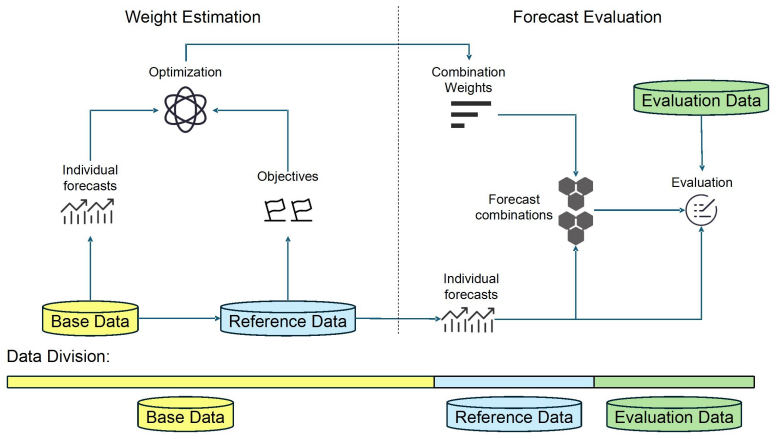
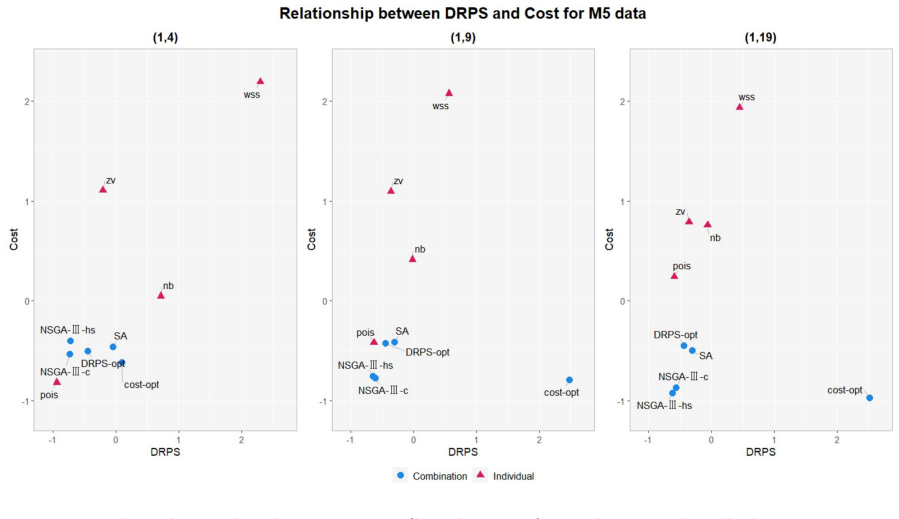
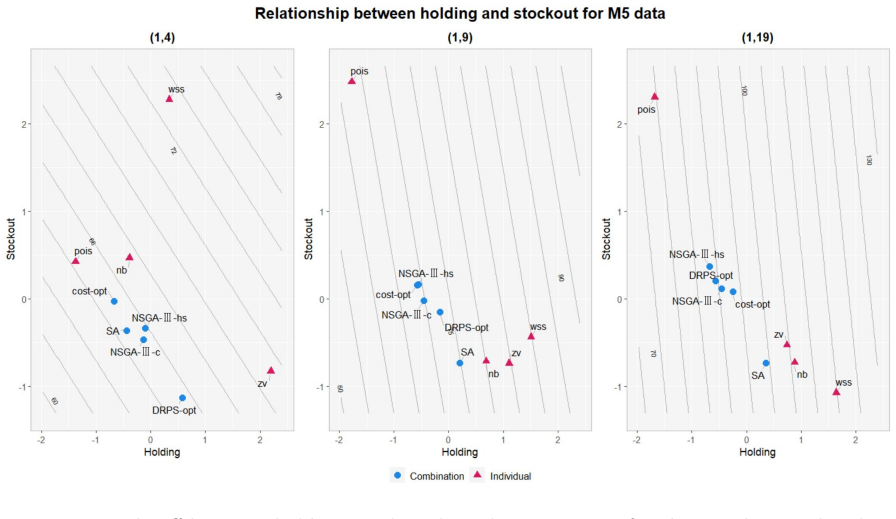
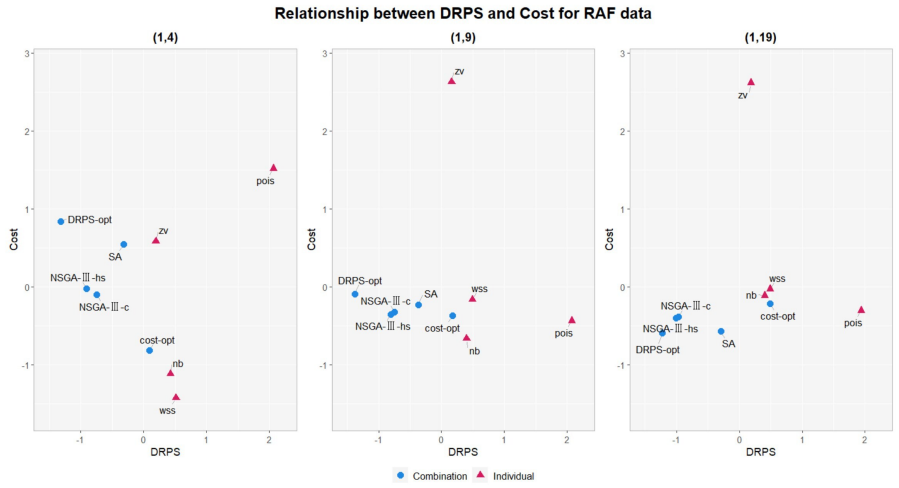
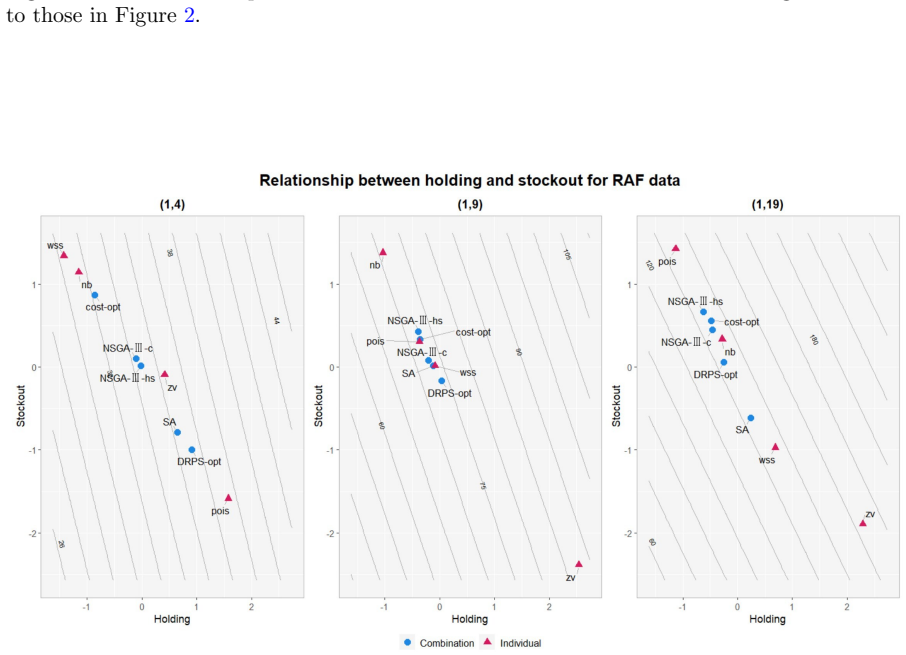
Probabilistic forecasts are essential for inventory management, where decisions depend on the full distribution of future demand. While probabilistic forecast combination is widely used to improve statistical accuracy, most existing approaches optimize statistical loss alone and overlook operational objectives. However, in inventory settings, higher forecast accuracy does not necessarily translate into better decision performance, especially under nonlinear cost structures and multiple, potentially conflicting, decision targets. To address this gap, we propose a multi-objective probabilistic forecast combination framework that simultaneously considers forecast accuracy and inventory decision performance. The framework formulates forecast combination as a multi-objective optimization problem and derives a set of Pareto-optimal combinations, enabling explicit trade-offs between forecasting and operational goals. Empirical studies using Walmart retail data and Royal Air Force spare parts data demonstrate that the proposed approach achieves more balanced and robust performance than individual models, simple averaging, and single-objective optimization. Our results provide a practical and flexible framework for aligning probabilistic forecasting with inventory decision-making.
Editorial analysis
A structured set of objections, weighed in public.
Referee Report
Summary. The paper proposes a multi-objective probabilistic forecast combination framework for inventory demand. It formulates combination weights as the solution to a multi-objective optimization problem that trades off statistical forecast accuracy against inventory decision costs (holding and shortage), generates the Pareto front of combinations, and selects points from the front. Empirical studies on Walmart retail data and Royal Air Force spare-parts data are reported to show more balanced and robust performance than individual models, simple averaging, and single-objective optimization.
Significance. If the empirical results hold under the stated cost functions, the work is significant for inventory applications because it directly incorporates operational objectives into forecast combination rather than relying on accuracy alone. Credit is due for the use of two real operational datasets and explicit comparison against relevant baselines (individual models, averaging, single-objective). The framework supplies a practical mechanism for explicit trade-offs, which is a clear advance over purely statistical combination methods when decision costs are nonlinear.
major comments (2)
- [Empirical studies] Empirical studies section: the central claim that Pareto-optimal combinations yield improved inventory decisions rests on the assumption that the embedded holding/shortage cost functions accurately proxy real operational performance. No out-of-sample validation against actual realized costs or sensitivity checks on cost-parameter misspecification is provided; this directly affects whether the reported balanced performance translates beyond the modeled objective.
- [Framework formulation] Framework formulation (optimization problem): the manuscript does not specify how the Pareto front is generated (e.g., exact scalarization method, handling of the probabilistic forecast combination weights, or solver) nor how a practitioner would select a point from the front for deployment. These details are load-bearing for reproducibility and for the robustness claim relative to single-objective baselines.
minor comments (1)
- Notation for the multi-objective objectives and the inventory cost parameters should be introduced with explicit definitions and units to improve readability.
Simulated Author's Rebuttal
We thank the referee for the constructive comments. We address each major comment below and indicate planned revisions to strengthen the manuscript.
read point-by-point responses
-
Referee: [Empirical studies] Empirical studies section: the central claim that Pareto-optimal combinations yield improved inventory decisions rests on the assumption that the embedded holding/shortage cost functions accurately proxy real operational performance. No out-of-sample validation against actual realized costs or sensitivity checks on cost-parameter misspecification is provided; this directly affects whether the reported balanced performance translates beyond the modeled objective.
Authors: The paper evaluates combinations on held-out portions of the two real datasets using the modeled holding and shortage costs as the decision metric, which is the conventional approach in this literature when separate realized operational cost records are unavailable. We agree that sensitivity analysis would improve robustness claims and will add experiments that vary the holding-to-shortage cost ratio across a range of values in the revised manuscript. revision: partial
-
Referee: [Framework formulation] Framework formulation (optimization problem): the manuscript does not specify how the Pareto front is generated (e.g., exact scalarization method, handling of the probabilistic forecast combination weights, or solver) nor how a practitioner would select a point from the front for deployment. These details are load-bearing for reproducibility and for the robustness claim relative to single-objective baselines.
Authors: We will add a dedicated subsection detailing the scalarization approach (weighted-sum method with a discrete grid of weights), the handling of combination weights on the probabilistic forecasts, the solver employed, and practical selection rules (e.g., knee-point identification or user-specified trade-off). Pseudocode and implementation notes will also be included. revision: yes
Circularity Check
No significant circularity; derivation and claims are self-contained
full rationale
The paper defines a multi-objective optimization framework that trades off statistical forecast accuracy against inventory cost functions, then reports empirical performance on two external datasets (Walmart retail and RAF spare parts). No equation or claim reduces by construction to its own inputs, no fitted parameter is relabeled as a prediction, and no load-bearing premise rests on self-citation. The Pareto front and out-of-sample comparisons are independent of the formulation itself; any performance gain is an empirical observation rather than a definitional identity. This is the normal, non-circular case for an optimization-plus-validation paper.
Axiom & Free-Parameter Ledger
free parameters (1)
- objective trade-off weights
axioms (1)
- domain assumption Inventory costs and decision targets can be accurately modeled as functions of the probabilistic forecasts for use in optimization.
Reference graph
Works this paper leans on
-
[1]
2004 , doi =
A new approach to forecasting intermittent demand for service parts inventories , journal =. 2004 , doi =
2004
-
[2]
International Journal of Production Economics , volume=
Comparison of a new bootstrapping method with parametric approaches for safety stock determination in service parts inventory systems , author=. International Journal of Production Economics , volume=. 2011 , doi=
2011
-
[3]
2012 , doi=
Snyder, Ralph D and Ord, J Keith and Beaumont, Adrian , journal=. 2012 , doi=
2012
-
[4]
European Journal of Operational Research , volume=
Combining probabilistic forecasts of intermittent demand , author=. European Journal of Operational Research , volume=. 2024 , doi=
2024
-
[5]
European Journal of Operational Research , volume=
Huber, Jakob and M. European Journal of Operational Research , volume=. 2019 , doi=
2019
-
[6]
and Eberhart, R
Kennedy, J. and Eberhart, R. , journal=. Particle swarm optimization , year=
-
[7]
Journal of the Operational Research Society , volume=
An adaptive multi-objective optimal forecast combination and its application for predicting intermittent demand , author=. Journal of the Operational Research Society , volume=. 2024 , doi=
2024
-
[8]
2024 , doi=
Yang, Wendong and Zang, Xinyi and Wu, Chunying and Hao, Yan , journal=. 2024 , doi=
2024
-
[9]
IEEE Transactions on Evolutionary Computation , volume=
An evolutionary many-objective optimization algorithm using reference-point-based nondominated sorting approach, part I: solving problems with box constraints , author=. IEEE Transactions on Evolutionary Computation , volume=. 2014 , doi=
2014
-
[10]
IEEE Transactions on Evolutionary Computation , volume=
An evolutionary many-objective optimization algorithm using reference-point based nondominated sorting approach, part II: Handling constraints and extending to an adaptive approach , author=. IEEE Transactions on Evolutionary Computation , volume=. 2014 , doi=
2014
-
[11]
IEEE Access , title=
J. IEEE Access , title=. 2020 , volume=
2020
-
[12]
2017 , doi=
Ganjehkaviri, A and Jaafar, MN Mohd and Hosseini, Seyed Ehsan and Barzegaravval, H , journal=. 2017 , doi=
2017
-
[13]
Management Science , volume =
Relatively Robust Multicriteria Decisions , author=. Management Science , volume =. 2025 , doi=
2025
-
[14]
2022 , doi=
Makridakis, S and Spiliotis, E and Assimakopoulos, V , journal=. 2022 , doi=
2022
-
[15]
2024 , doi=
Olivares-Nadal, Alba V , journal=. 2024 , doi=
2024
-
[16]
Annual Review of Statistics and Its Application , volume=
Probabilistic forecasting , author=. Annual Review of Statistics and Its Application , volume=. 2014 , publisher=
2014
-
[17]
Combining probabilistic forecasts of
Taylor, James W and Taylor, Kathryn S , journal=. Combining probabilistic forecasts of. 2023 , publisher=
2023
-
[18]
2024 , doi=
Van der Meer, Dennis and Pinson, Pierre and Camal, Simon and Kariniotakis, Georges , journal=. 2024 , doi=
2024
-
[19]
Multivariate probabilistic
Berrisch, Jonathan and Ziel, Florian , journal=. Multivariate probabilistic. 2024 , publisher=
2024
-
[20]
European Journal of Operational Research , year=
Probabilistic Forecast Aggregation with Statistical Depth , author=. European Journal of Operational Research , year=
-
[21]
2023 , doi=
Wang, Xiaoqian and Hyndman, Rob J and Li, Feng and Kang, Yanfei , journal=. 2023 , doi=
2023
-
[22]
2004 , doi=
Hora, Stephen C , journal=. 2004 , doi=
2004
-
[23]
Energy , volume=
A novel combined forecasting model based on neural networks, deep learning approaches, and multi-objective optimization for short-term wind speed forecasting , author=. Energy , volume=. 2022 , doi=
2022
-
[24]
Expert Systems with Applications , volume=
A novel multivariate combined power load forecasting system based on feature selection and multi-objective intelligent optimization , author=. Expert Systems with Applications , volume=. 2024 , doi=
2024
-
[25]
Computational Economics , volume=
A novel ensemble learning framework based on news sentiment enhancement and multi-objective optimizer for carbon price forecasting , author=. Computational Economics , volume=. 2025 , doi=
2025
-
[26]
International Journal of Production Economics , volume=
Optimising forecasting models for inventory planning , author=. International Journal of Production Economics , volume=. 2020 , doi=
2020
-
[27]
2025 , doi =
European Journal of Operational Research , volume =. 2025 , doi =
2025
-
[28]
2021 , doi =
International Journal of Production Economics , volume =. 2021 , doi =
2021
-
[29]
European Journal of Operational Research , volume=
A survey of contextual optimization methods for decision-making under uncertainty , author=. European Journal of Operational Research , volume=. 2025 , doi=
2025
-
[30]
predict, then optimize
Smart “predict, then optimize” , author=. Management Science , volume=. 2022 , doi=
2022
-
[31]
International Journal of Forecasting , volume=
Decision-focused linear pooling for probabilistic forecast combination , author=. International Journal of Forecasting , volume=. 2025 , doi=
2025
-
[32]
International Journal of Forecasting , volume=
Quantile forecast optimal combination to enhance safety stock estimation , author=. International Journal of Forecasting , volume=. 2019 , doi=
2019
-
[33]
International Journal of Forecasting , volume=
Evaluating predictive count data distributions in retail sales forecasting , author=. International Journal of Forecasting , volume=. 2016 , doi=
2016
-
[34]
International Journal of Forecasting , volume=
Combining density forecasts , author=. International Journal of Forecasting , volume=. 2007 , doi=
2007
-
[35]
Ensemble forecast of photovoltaic power with online
Thorey, Jean and Chaussin, Christophe and Mallet, Vivien , journal=. Ensemble forecast of photovoltaic power with online. 2018 , doi=
2018
-
[36]
Journal of Econometrics , volume=
Dynamic Bayesian predictive synthesis in time series forecasting , author=. Journal of Econometrics , volume=. 2019 , doi=
2019
-
[37]
2022 , doi=
Goltsos, Thanos E and Syntetos, Aris A and Glock, Christoph H and Ioannou, George , journal=. 2022 , doi=
2022
-
[38]
European Journal of Operational Research , year=
Fifty Years of Inventory Research from a Forecasting Perspective , author=. European Journal of Operational Research , year=
-
[39]
Management Science , volume=
A practical end-to-end inventory management model with deep learning , author=. Management Science , volume=. 2023 , doi=
2023
-
[40]
Management Science , volume=
Optimal robust policy for feature-based newsvendor , author=. Management Science , volume=. 2024 , doi=
2024
-
[41]
European Journal of Operational Research , year=
Integrated estimate-and-optimize decision trees learning for two-stage linear decision-making problems , author=. European Journal of Operational Research , year=
-
[42]
Omega , volume=
A simulation-based multi-objective optimization framework: A case study on inventory management , author=. Omega , volume=. 2017 , doi=
2017
-
[43]
Stone , journal =
M. Stone , journal =. The Opinion Pool , volume =. 1961 , doi=
1961
-
[44]
Oxford Bulletin of Economics and Statistics , volume=
Combining density and interval forecasts: a modest proposal , author=. Oxford Bulletin of Economics and Statistics , volume=. 2005 , doi=
2005
-
[45]
2006 , isbn=
O'Hagan, Anthony and Buck, Caitlin E and Daneshkhah, Alireza and Eiser, J Richard and Garthwaite, Paul H and Jenkinson, David J and Oakley, Jeremy E and Rakow, Tim , title=. 2006 , isbn=
2006
-
[46]
Journal of the Operational Research Society , volume=
The combination of forecasts , author=. Journal of the Operational Research Society , volume=. 1969 , doi=
1969
-
[47]
Journal of Econometrics , volume=
Optimal prediction pools , author=. Journal of Econometrics , volume=. 2011 , doi=
2011
-
[48]
International Journal of Forecasting , volume=
Optimal combination of survey forecasts , author=. International Journal of Forecasting , volume=. 2015 , doi=
2015
-
[49]
Journal of Econometrics , volume=
Generalised density forecast combinations , author=. Journal of Econometrics , volume=. 2015 , doi=
2015
-
[50]
2016 , doi=
Del Negro, Marco and Hasegawa, Raiden B and Schorfheide, Frank , journal=. 2016 , doi=
2016
-
[51]
International Journal of Forecasting , volume=
Bayesian forecast combination using time-varying features , author=. International Journal of Forecasting , volume=. 2023 , doi=
2023
-
[52]
2005 , doi=
Raftery, Adrian E and Gneiting, Tilmann and Balabdaoui, Fadoua and Polakowski, Michael , journal=. 2005 , doi=
2005
-
[53]
Quarterly Journal of the Royal Meteorological Society , volume=
Online learning with the continuous ranked probability score for ensemble forecasting , author=. Quarterly Journal of the Royal Meteorological Society , volume=. 2017 , doi=
2017
-
[54]
Journal of Applied Econometrics , volume=
Combining density forecasts using focused scoring rules , author=. Journal of Applied Econometrics , volume=. 2017 , doi=
2017
-
[55]
2023 , doi=
Diebold, Francis X and Shin, Minchul and Zhang, Boyuan , journal=. 2023 , doi=
2023
-
[56]
Electronic Journal of Statistics , volume=
Combining predictive distributions , author=. Electronic Journal of Statistics , volume=. 2013 , doi=
2013
-
[57]
Journal of the Royal Statistical Society: Series B (Statistical Methodology) , volume=
Combining probability forecasts , author=. Journal of the Royal Statistical Society: Series B (Statistical Methodology) , volume=. 2010 , doi=
2010
-
[58]
International Journal of Forecasting , volume=
Combining predictive distributions for the statistical post-processing of ensemble forecasts , author=. International Journal of Forecasting , volume=. 2018 , doi =
2018
-
[59]
2003 , doi=
Garratt, Anthony and Lee, Kevin and Pesaran, M Hashem and Shin, Yongcheol , journal=. 2003 , doi=
2003
-
[60]
Journal of Econometrics , volume=
Bayesian model averaging and exchange rate forecasts , author=. Journal of Econometrics , volume=. 2008 , doi=
2008
-
[61]
Journal of the American Statistical Association , volume=
Multivariate Bayesian predictive synthesis in macroeconomic forecasting , author=. Journal of the American Statistical Association , volume=. 2020 , doi=
2020
-
[62]
Journal of the Royal Statistical Society Series B: Statistical Methodology , volume=
Bayesian predictive decision synthesis , author=. Journal of the Royal Statistical Society Series B: Statistical Methodology , volume=. 2024 , doi=
2024
-
[63]
Management Science , volume=
Is it better to average probabilities or quantiles? , author=. Management Science , volume=. 2013 , doi=
2013
-
[64]
Management Science , volume=
Angular combining of forecasts of probability distributions , author=. Management Science , volume=. 2026 , doi=
2026
-
[65]
IISE Transactions , volume=
Applying deep learning to the newsvendor problem , author=. IISE Transactions , volume=. 2020 , doi=
2020
-
[66]
European Journal of Operational Research , volume=
Dynamic optimization with side information , author=. European Journal of Operational Research , volume=. 2023 , doi=
2023
-
[67]
2016 , doi=
Ferreira, Kris Johnson and Lee, Bin Hong Alex and Simchi-Levi, David , journal=. 2016 , doi=
2016
-
[68]
Production and Operations Management , volume=
Data-driven newsvendor problems regularized by a profit risk constraint , author=. Production and Operations Management , volume=. 2022 , doi=
2022
-
[69]
Advances in Neural Information Processing Systems , volume=
Task-based end-to-end model learning in stochastic optimization , author=. Advances in Neural Information Processing Systems , volume=
-
[70]
Zico , booktitle =
Donti, Priya and Amos, Brandon and Kolter, J. Zico , booktitle =. Task-based End-to-end Model Learning in Stochastic Optimization , url =
-
[71]
Knowledge-Based Systems , volume=
Constrained multi-objective optimization problems: Methodologies, algorithms and applications , author=. Knowledge-Based Systems , volume=. 2024 , doi=
2024
-
[72]
Journal of the Operational Research Society , volume=
Forecast combinations for intermittent demand , author=. Journal of the Operational Research Society , volume=. 2015 , doi=
2015
-
[73]
European Journal of Operational Research , volume=
Elucidate structure in intermittent demand series , author=. European Journal of Operational Research , volume=. 2021 , doi=
2021
-
[74]
Journal of the Operational Research Society , volume=
Forecasting intermittent demand: a comparative study , author=. Journal of the Operational Research Society , volume=. 2009 , doi=
2009
-
[75]
baran2018combining APACrefauthors Baran, S. \ Lerch, S. APACrefauthors \ 2018 . Combining predictive distributions for the statistical post-processing of ensemble forecasts Combining predictive distributions for the statistical post-processing of ensemble forecasts . International Journal of Forecasting 34 3 477--496 . APACrefDOI doi:10.1016/j.ijforecast....
-
[76]
bates1969combination APACrefauthors Bates, J M. \ Granger, C W. APACrefauthors \ 1969 . The combination of forecasts The combination of forecasts . Journal of the Operational Research Society 20 4 451--468 . APACrefDOI doi:10.1057/jors.1969.103 APACrefDOI
-
[77]
bertsimas2023dynamic APACrefauthors Bertsimas, D. , McCord, C. \ Sturt, B. APACrefauthors \ 2023 . Dynamic optimization with side information Dynamic optimization with side information . European Journal of Operational Research 304 2 634--651 . APACrefDOI doi:10.1016/j.ejor.2022.03.030 APACrefDOI
-
[78]
pymoo APACrefauthors Blank , J. \ Deb , K. APACrefauthors \ 2020 . Pymoo: Multi-Objective Optimization in Python Pymoo: Multi-Objective Optimization in Python . IEEE Access 8 89497-89509 . APACrefDOI doi:10.1109/ACCESS.2020.2990567 APACrefDOI
-
[79]
chen2025novel APACrefauthors Chen, Y. , Jin, M. , Zhou, Z. \ Tian, Z. APACrefauthors \ 2025 . A novel ensemble learning framework based on news sentiment enhancement and multi-objective optimizer for carbon price forecasting A novel ensemble learning framework based on news sentiment enhancement and multi-objective optimizer for carbon price forecasting ....
-
[80]
conflitti2015optimal APACrefauthors Conflitti, C. , De Mol, C. \ Giannone, D. APACrefauthors \ 2015 . Optimal combination of survey forecasts Optimal combination of survey forecasts . International Journal of Forecasting 31 4 1096--1103 . APACrefDOI doi:10.1016/j.ijforecast.2015.03.009 APACrefDOI
discussion (0)
Sign in with ORCID, Apple, or X to comment. Anyone can read and Pith papers without signing in.