REVIEW 2 major objections 3 minor 1 cited by
Partisan voter model on complex networks: Dynamics of local ordering
T0 review · 2 major / 3 minor · reviewed 2026-08-02 · deepseek-v4-flash
Pith's one-line read On random networks, partisan bias leaves the total density of active links unchanged, redistributing it among link types.
desk verdict A solid pair-approximation extension of the partisan voter model, with a clean decomposition result and a central invariance claim that needs a qualification at ε=1. read the letter →
The pith
A machine-rendered reading of the paper's core claim, the machinery that carries it, and where it could break.
The reading
What carries the argument
The machinery is a decomposition of the density of active links into four classes (ρ+, ρ−, ρs, ρu) and a pair approximation that closes the moment equations. For a randomly selected node, the neighborhood composition is assumed multinomial (Eq. 19), and among neighbors in the same state, preferences are assigned proportionally to the global class densities (Eq. A5). This closure reduces the microscopic dynamics to a closed system of six ordinary differential equations for Δ, Σ, and the four link densities, whose stable fixed point gives the ε-independent total density ξ and the explicit redistribution formulas.
What would settle it
On a configuration-model network with the same mean degree as an Erdős–Rényi graph but a strongly bimodal degree distribution (e.g., half nodes of degree 2, half of degree 100), measure the stationary total density of active links for several values of ε. The pair approximation predicts ρ_st = (μ−2)/[2(μ−1)] independent of ε and of the degree sequence; if the measured ρ_st varies with ε or departs from that value, the central claim fails.
Extended reading notes
Core claim
The central result is a pair approximation for the partisan voter model that resolves active links into four classes: links between agents both preferring +1, both preferring −1, both satisfied, and both unsatisfied. On uncorrelated networks, the stationary total density of active links is ρ_st = (μ−2)/[2(μ−1)], independent of the preference strength ε, while the class densities are ρ+_st = ρ−_st = ξ(1−ε²)/4, ρs_st = ξ(1+ε)²/4, and ρu_st = ξ(1−ε)²/4. Thus bias does not change total local disorder; it redistributes it, favoring active links between satisfied agents as ε grows. The approximation matches simulations except near ε → 1. On networks with homophilic or heterophilic attachment, stru
Load-bearing premise
The entire analytical picture rests on the pair-closure ansatz—that a node's neighbors are statistically independent and that same-state neighbors have preferences drawn from the global class densities—so the predicted ε-independence and the quantitative redistribution hold only to the extent that real networks honor this closure.
Editorial extensions
If this is right
- In uncorrelated networks, monitoring only the total density of active links is insufficient: the same ρ can hide very different organizations of disagreement depending on ε.
- The stable coexistence state has Δ = 0 and Σ = (1+ε)/2, identical to the mean-field prediction, so the global balance of opinions is robust to network sparsity.
- A reduced description tracking only the total active-link density reproduces the stationary value but misses the transient dynamics, showing that resolving link classes is needed for accurate relaxation behavior.
- The crossover in the (h, ε) plane implies that the same partisan bias can have opposite effects on local order depending on the network's homophily: it increases active links in heterophilic networks and decreases them in homophilic ones.
Reading between the lines
- The ε-independence of ρ_st is likely an artifact of the pair closure that could fail on networks with strong degree-preference correlations; a test on a configuration model with a bimodal degree distribution would reveal this.
- In real social networks with strong homophily, the model suggests that intensifying partisan preferences can reduce observable disagreement by ordering opinion clusters, even while inter-group hostility remains—an interpretation that goes beyond the paper's explicit claims.
- A natural extension is to replace the multinomial closure with a triplet-level closure near ε → 1, where the paper's own simulations show the invariance breaks down.
- The BA-homophily results are numerical; a future analytic treatment incorporating degree-preference correlations could derive the three regimes explicitly.
Editorial analysis
A structured set of objections, weighed in public.
Referee Report
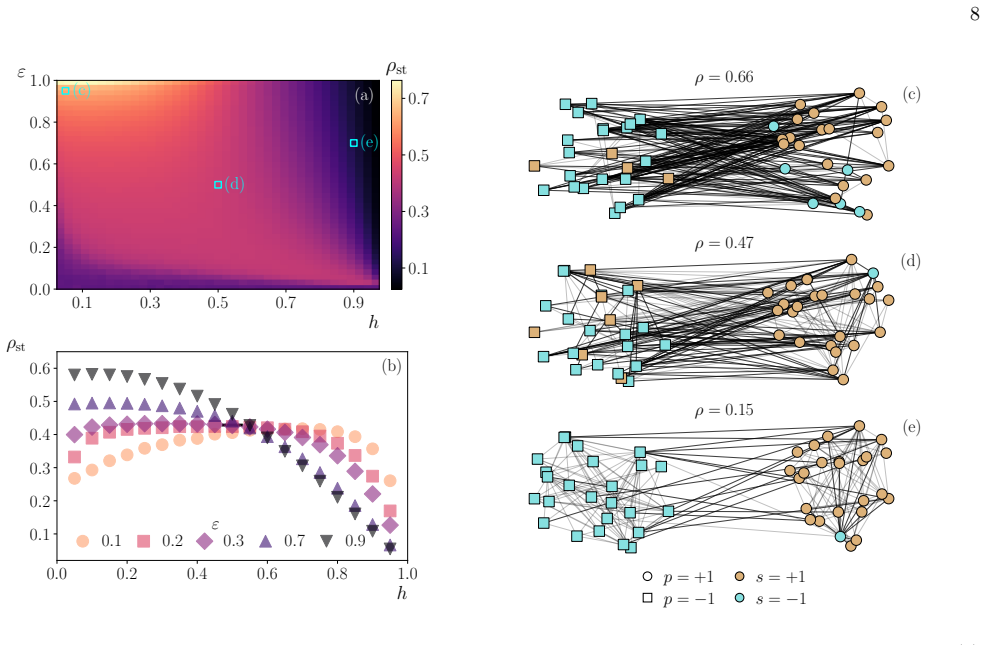
Summary. The paper studies the partisan voter model on complex networks, in which each node has a fixed binary preference that biases its update probability toward that preference. The main analytical contribution is a pair approximation that resolves active links into four classes according to the preferences and satisfaction states of the endpoints. For uncorrelated random networks, the approximation yields a closed system of ODEs whose stable coexistence fixed point has total active-link density ρst = (μ−2)/[2(μ−1)], independent of the preference strength ε, with ε-dependent redistribution among the four classes. The paper also simulates a Barabási–Albert homophily model with preference-based attachment and reports three qualitative regimes in the (h, ε) parameter plane, distinguishing the dynamical role of partisan bias from the structural role of homophily.
Significance. If the invariance result held exactly, it would be a clean and useful extension of the voter-model pair approximation to quenched-type dynamics, showing that dynamical bias reorganizes local disorder without changing its total amount. The paper provides a detailed derivation, no fitted parameters, and simulations that broadly support the approximation. The decomposition of active links into four classes is a natural and potentially transferable idea. However, the central invariance is an output of the pair closure and is contradicted at ε=1 by the model's own absorbing configurations, which tempers the significance and requires a careful restatement of the main claim.
major comments (2)
- [Sec. III, Eq. (24); abstract; Sec. II] The ε-independence of ρst is presented as a general model property ('Importantly, the stationary total density of active links ρst is independent of the strength of the preference ε'), but it is a pair-approximation result and is false at ε=1. As the paper itself notes in Sec. II, for ε=1 satisfied agents never flip, so any all-satisfied configuration is absorbing. For an Erdős–Rényi network with equal preference groups, such a frozen configuration has active-link density equal to the cross-preference link fraction, ≈1/2, whereas Eq. (23) gives ξ=(μ−2)/[2(μ−1)] (3/7≈0.4286 for μ=8). Thus Eq. (24) fails at the boundary of the stated parameter range, and the mismatch is substantial. The authors should restrict the claim to ε<1 (or ε sufficiently below 1), explicitly reconcile it with the ε=1 frozen state, and explain why the multinomial/A5 closure erases these absorbing configurations. The
- [Appendix A, Eq. (A5); Sec. III] The load-bearing assumption of the pair approximation is the closure in Eq. (A5), which distributes same-state neighbors' preferences according to global class densities. The ε→1 breakdown identified above indicates that this closure is not valid in the strong-bias regime. The paper should provide a direct test of Eq. (A5) (and of the multinomial ansatz Eq. (19)) against simulations, at least for representative parameters, to delineate where the predicted invariance holds. This is necessary because the invariance is not a general property of the model but a property of this specific closure; the agreement of the two approximations in Appendix B does not validate the closure, since both schemes share the same type of approximation.
minor comments (3)
- [Figs. 1, 2, 3, 4, 5] No error bars, run counts, or averaging procedures are reported. Since the finite system is eventually absorbed into consensus, the definition of the 'stationary' value should be specified (e.g., quasi-stationary averaging over time windows before absorption), and standard errors should be included to support 'excellent agreement' and the collapse in Fig. 1(c).
- [Fig. 4 and Sec. IV] The identification of three qualitative regimes is based on visual inspection of heat maps and representative snapshots. Please state the numerical criteria (e.g., thresholds on ρst and Σst) used to delineate 'highly disordered,' 'intermediate,' and 'strongly ordered' regimes.
- [Sec. III, Fig. 1(b)] The legend notes that ρ+ and ρ− overlap, but the symbols are not distinguished in a way that makes this visible. Consider using different marker styles or adding a note in the caption.
Circularity Check
No significant circularity: the ε-independence of ρ_st is an algebraic output of an explicitly stated pair closure, not an assumed input or fitted prediction.
full rationale
The derivation chain is self-contained and non-circular. The model and observables are defined in Sec. II; the mean-field limit (Eqs. (10)–(11)) is cited from prior work, including the authors' own [17], but it is used only as a consistency check and as context — it does not generate the network-level results. The pair approximation in Sec. III starts from the master-equation-like expression Eq. (15) and uses explicit closure assumptions, Eqs. (18), (19), and (A5), which are stated approximations rather than fitted parameters or restatements of the target. Solving the closed system of ODEs, Eqs. (20), yields the stationary solution Eq. (22); Eq. (24) is then simply the algebraic sum of the four components of Eq. (22), so the ε-independence of ρ_st is a derived consequence of the fixed point, not an input. Monte Carlo simulations in Figs. 1–2 are external checks, not fitting targets, and no parameter is tuned to reproduce them. The homophily section is explicitly numerical and acknowledges that structural correlations are not captured by the pair approximation, so its regimes are presented as simulation results rather than derived predictions. Self-citations [11,17] supply model background, the mean-field limit, and universality context; they are not load-bearing for the central network result. The acknowledged deviations as ε→1, and the exact frozen absorbing configurations at ε=1, are accuracy limitations of the pair closure, not circularity: the closure is an approximation, and its failure in a limit does not make the derivation self-referential.
Assumptions & free parameters
assumptions (4)
- ad hoc to paper Multinomial neighborhood closure (Eq. 19) and the same-state preference closure (Eq. A5): among neighbors with the same state, preferences are sampled according to global class densities.
- domain assumption Uncorrelated random network assumption for the pair approximation: degree distribution P_k with no degree correlations or preference-degree correlations.
- domain assumption Equal quenched preference split: half the agents have p = +1 and half p = −1.
- domain assumption Finite-network simulations sample a quasi-stationary coexistence state before eventual absorption.
Cite this review
Pith. "Pith review of Partisan voter model on complex networks: Dynamics of local ordering." pith.science (2026). https://pith.science/paper/G7DYG75Q
@misc{pith2026260605062,
  author       = {Pith},
  title        = {Pith review of: Partisan voter model on complex networks: Dynamics of local ordering},
  year         = {2026},
  howpublished = {\url{https://pith.science/paper/G7DYG75Q}},
  note         = {Machine review of arXiv:2606.05062}
}
read the original abstract
We investigate the processes of local ordering for the partisan voter model on complex networks. In this model, agents hold a binary opinion and a fixed preference that biases updates toward alignment with their preferred opinion. We first study the dynamics on uncorrelated random networks and derive a pair approximation that resolves the densities of links connecting different classes of agents. The analytical predictions are in excellent agreement with Monte Carlo simulations. In this setting, partisan bias leaves the total stationary density of links connecting nodes in different sates unchanged and at the same value as in the standard voter model, but redistributes it among different categories of links. We then consider preference-dependent networks with homophilic and heterophilic attachment to analyze the competition between the global bias mechanism and the local effect of preference-based connectivity. In this case, structural correlations qualitatively modify the stationary state. We identify different regimes of local ordering in the space of parameters measuring the strength of the preference and the strength of the homophilic attachment. Our work clarifies the distinct roles of dynamical partisan bias and structural assortativity, and provides an analytical framework to study partisan opinion dynamics beyond mean-field theory.
Figures


Figures from the paper (2 more)

Forward citations
Cited by 1 Pith paper
-
A model of opinion dynamics evolving via a preferential attachment mechanism involving multiple extractions
For a two-opinion preferential-attachment network with multiple sampling and general reinforcement, the normalized opinion count, influence capital and activity converge almost surely to invariant sets of a mean-field...
Reference graph
Works this paper leans on
-
[1]
Castellano, S
C. Castellano, S. Fortunato, and V. Loreto, Statistical physics of social dynamics, Rev. Mod. Phys.81, 591 (2009)
2009
-
[2]
M. Starnini, F. Baumann, T. Galla, D. Garcia, G. I˜ niguez, M. Karsai, J. Lorenz, and K. Sznajd-Weron, Opinion dynamics: Statistical physics and beyond, arXiv preprint arXiv:2507.11521 (2025)
arXiv 2025
-
[3]
Clifford and A
P. Clifford and A. Sudbury, A model for spatial conflict, Biometrika60, 581 (1973)
1973
-
[4]
R. A. Holley and T. M. Liggett, Ergodic theorems for weakly interacting infinite systems and the voter model, The Annals of Probability3, 643 (1975)
1975
-
[5]
Sood and S
V. Sood and S. Redner, Voter model on heterogeneous graphs, Phys. Rev. Lett.94, 178701 (2005)
2005
-
[6]
Suchecki, V
K. Suchecki, V. M. Egu ´ ıluz, and M. San Miguel, Voter model dynamics in complex networks: Role of dimension- ality, disorder, and degree distribution, Physical Review E72, 036132 (2005)
2005
-
[7]
V. Sood, T. Antal, and S. Redner, Voter models on het- erogeneous networks, Phys. Rev. E77, 041121 (2008)
2008
-
[8]
Vazquez and V
F. Vazquez and V. M. Egu ´ ıluz, Analytical solution of the voter model on uncorrelated networks, New Journal of Physics10, 063011 (2008)
2008
Show all 31 references
-
[9]
Fern´ andez-Gracia, K
J. Fern´ andez-Gracia, K. Suchecki, J. J. Ramasco, M. San Miguel, and V. M. Egu ´ ıluz, Is the voter model a model for voters?, Phys. Rev. Lett.112, 158701 (2014)
2014
-
[10]
Al Hammal, H
O. Al Hammal, H. Chat´ e, I. Dornic, and M. A. Mu˜ noz, Langevin description of critical phenomena with two symmetric absorbing states, Phys. Rev. Lett.94, 230601 (2005)
2005
-
[11]
Llabr´ es, M
J. Llabr´ es, M. San Miguel, and R. Toral, Universality of noise-induced transitions in nonlinear voter models, Phys. Rev. Res.8, 013015 (2026)
2026
-
[12]
Mobilia, Does a single zealot affect an infinite group of voters?, Phys
M. Mobilia, Does a single zealot affect an infinite group of voters?, Phys. Rev. Lett.91, 028701 (2003)
2003
-
[13]
Masuda, N
N. Masuda, N. Gibert, and S. Redner, Heterogeneous voter models, Phys. Rev. E82, 010103 (2010)
2010
-
[14]
Vazquez, X
F. Vazquez, X. Castell´ o, and M. San Miguel, Agent based models of language competition: macroscopic descrip- tions and order–disorder transitions, Journal of Statis- tical Mechanics: Theory and Experiment2010, P04007 (2010)
2010
-
[15]
Czaplicka, C
A. Czaplicka, C. Charalambous, R. Toral, and M. San Miguel, Biased-voter model: How persuasive a small group can be?, Chaos, Solitons & Fractals161, 112363 (2022)
2022
-
[16]
Masuda and S
N. Masuda and S. Redner, Can partisan voting lead to truth?, Journal of Statistical Mechanics: Theory and Ex- periment2011, L02002 (2011)
2011
-
[17]
Llabr´ es, M
J. Llabr´ es, M. San Miguel, and R. Toral, Partisan voter model: Stochastic description and noise-induced transi- tions, Phys. Rev. E108, 054106 (2023). 11
2023
-
[18]
Suchecki, V
K. Suchecki, V. M. Egu ´ ıluz, and M. San Miguel, Con- servation laws for the voter model in complex networks, Europhysics Letters69, 228 (2004)
2004
-
[19]
Castellano, V
C. Castellano, V. Loreto, A. Barrat, F. Cecconi, and D. Parisi, Comparison of voter and glauber ordering dy- namics on networks, Phys. Rev. E71, 066107 (2005)
2005
-
[20]
J. P. Gleeson, High-accuracy approximation of binary- state dynamics on networks, Phys. Rev. Lett.107, 068701 (2011)
2011
-
[21]
Kuehn, Moment closure—a brief review, arXiv preprint arXiv:1505.02190 (2015), arXiv:1505.02190 [math.DS]
C. Kuehn, Moment closure—a brief review, arXiv preprint arXiv:1505.02190 (2015), arXiv:1505.02190 [math.DS]
2015 arXiv
-
[22]
A. F. Peralta, A. Carro, M. San Miguel, and R. Toral, Analytical and numerical study of the non-linear noisy voter model on complex networks, Chaos: An Interdisci- plinary Journal of Nonlinear Science28, 075516 (2018)
2018
-
[23]
A. F. Peralta, A. Carro, M. San Miguel, and R. Toral, Stochastic pair approximation treatment of the noisy voter model, New Journal of Physics20, 103045 (2018)
2018
-
[24]
L. S. Ramirez, F. Vazquez, M. San Miguel, and T. Galla, Ordering dynamics of nonlinear voter models, Phys. Rev. E109, 034307 (2024)
2024
-
[25]
McPherson, L
M. McPherson, L. Smith-Lovin, and J. M. Cook, Birds of a feather: Homophily in social networks, Annual Review of Sociology27, 415 (2001)
2001
-
[26]
Flache and M
A. Flache and M. W. Macy, Small worlds and cultural polarization, The Journal of Mathematical Sociology35, 146 (2011)
2011
-
[27]
M¨ as and A
M. M¨ as and A. Flache, Differentiation without distanc- ing. explaining bi-polarization of opinions without nega- tive influence, PLOS ONE8, e74516 (2013)
2013
-
[28]
Karimi, M
F. Karimi, M. G´ enois, C. Wagner, P. Singer, and M. Strohmaier, Homophily influences ranking of minori- ties in social networks, Scientific Reports8, 11077 (2018)
2018
-
[29]
E. Lee, F. Karimi, C. Wagner, H.-H. Jo, M. Strohmaier, and M. Galesic, Homophily and minority-group size ex- plain perception biases in social networks, Nature Human Behaviour3, 1078 (2019)
2019
-
[30]
Diaz-Diaz, M
F. Diaz-Diaz, M. San Miguel, and S. Meloni, Echo cham- bers and information transmission biases in homophilic and heterophilic networks, Scientific Reports12, 9350 (2022)
2022
-
[31]
Barab´ asi and R
A.-L. Barab´ asi and R. Albert, Emergence of scaling in random networks, Science286, 509 (1999). Appendix A: Pair approximation for the partisan voter model To compute the evolution equations in the pair approximation we need to combine Eqs. (15)–(19) together with the conditi...
1999
Reviewed August 2, 2026 · model on record in the stance chip above.
Discussion (0). Sign in to comment.