Software compensation of hadronic showers in the longitudinally segmented CRILIN Cherenkov crystal calorimeter
Pith reviewed 2026-06-28 02:54 UTC · model grok-4.3
The pith
A graph neural network corrects hadronic shower energy in the CRILIN PbF2 calorimeter to reduce its contribution to combined resolution to 1 GeV/E ⊕ 12%/√E ⊕ 2.5%.
A machine-rendered reading of the paper's core claim, the machinery that carries it, and where it could break.
Core claim
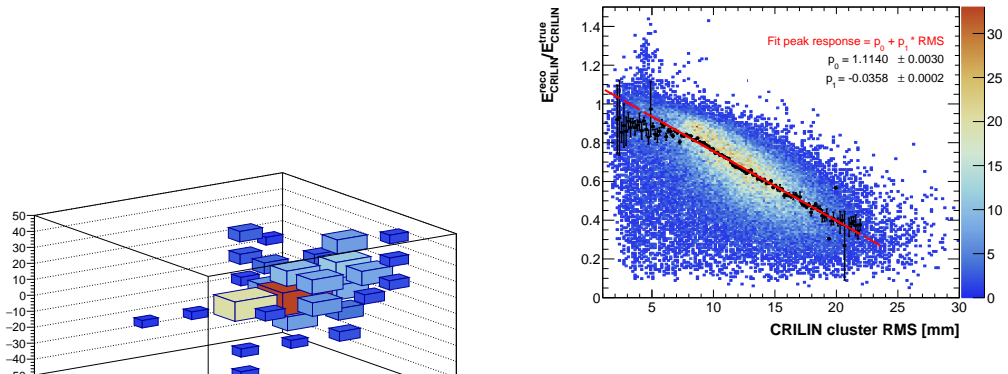
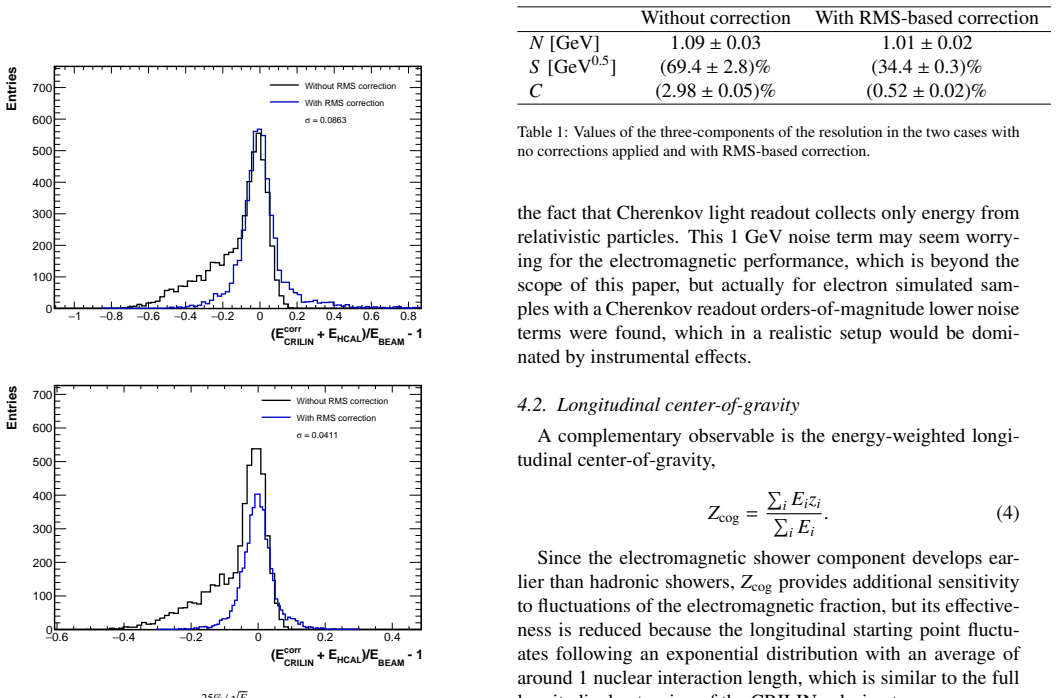
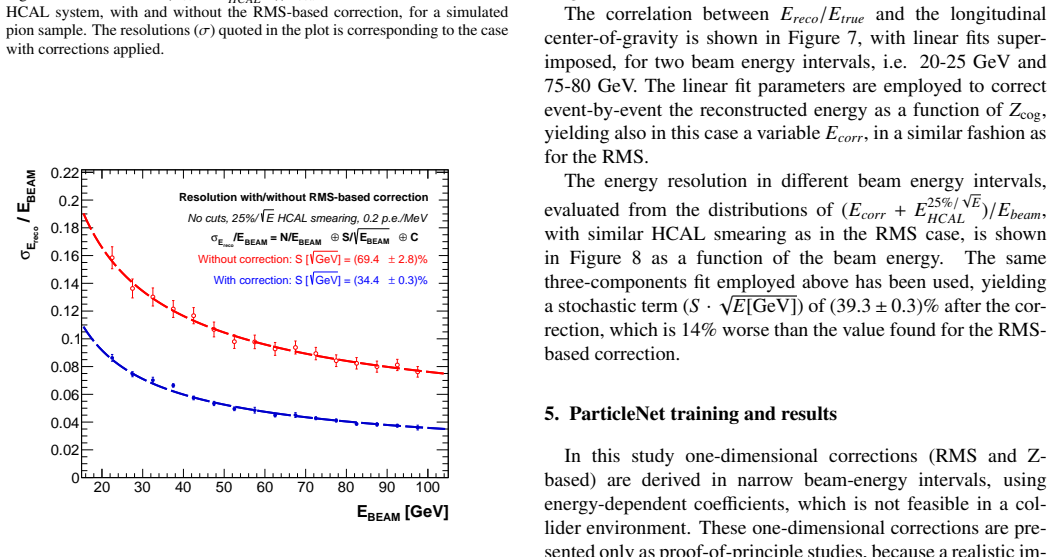
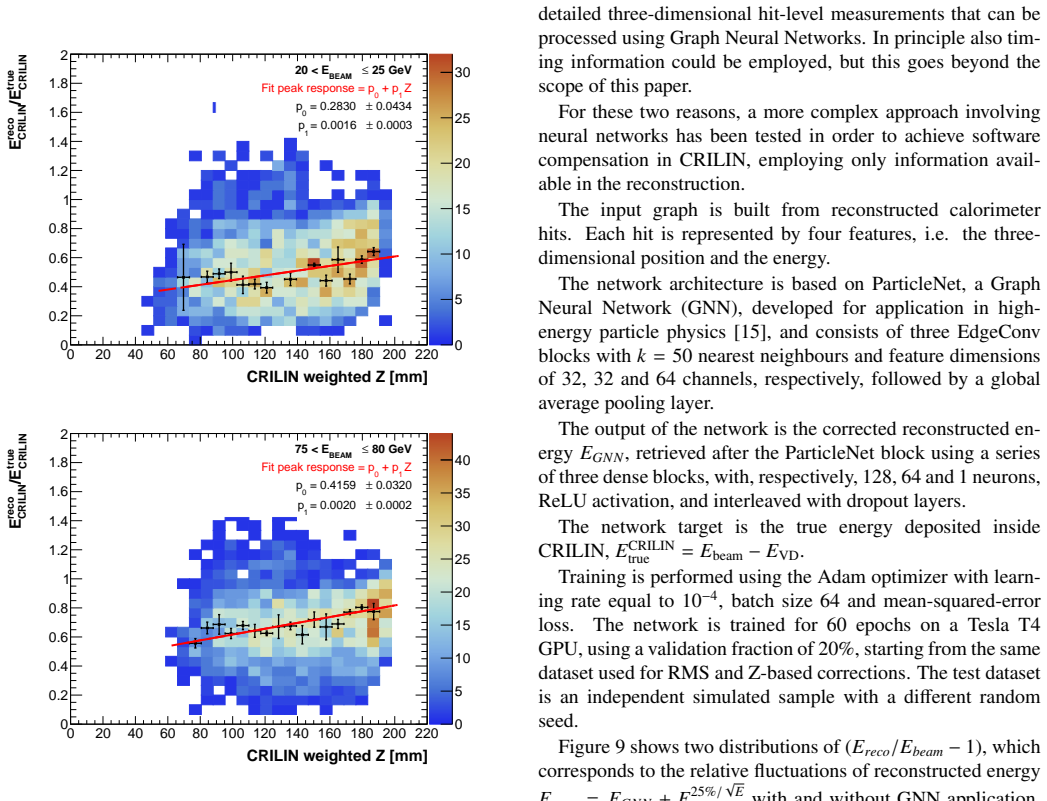
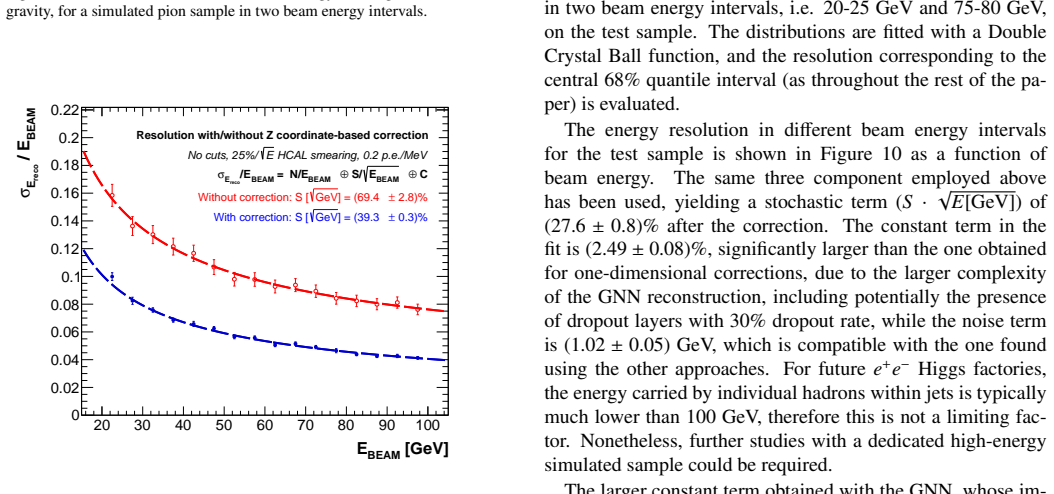
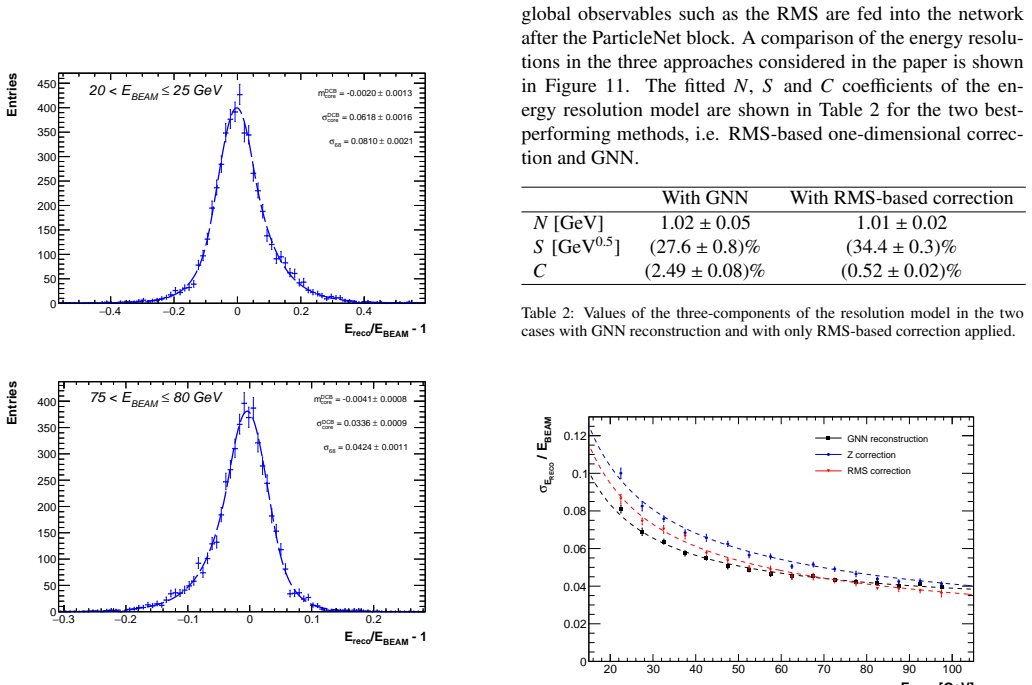
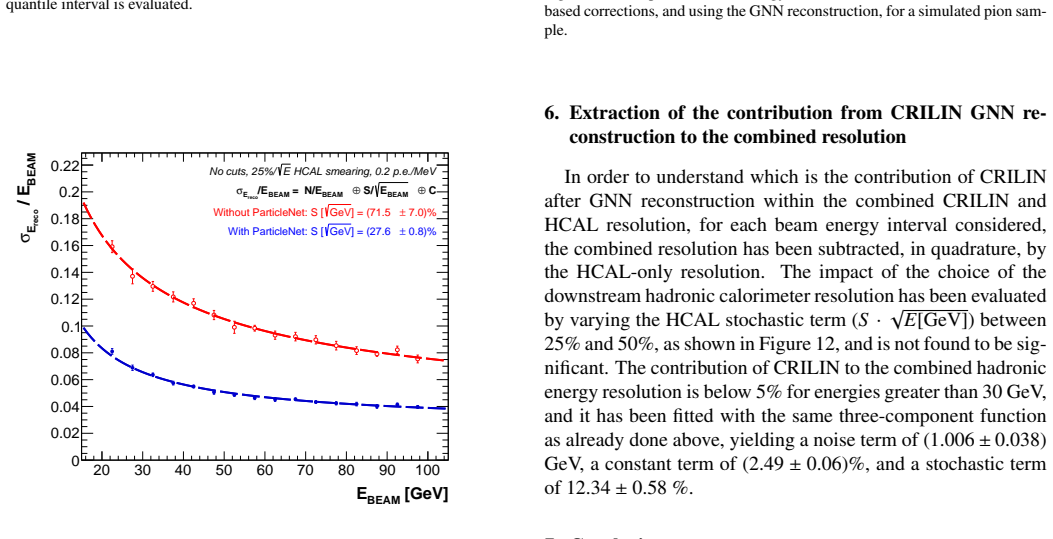
Using Geant4 simulations of pion showers, shower-shape observables are strongly correlated with the fraction of deposited energy reconstructed in a CRILIN module. Simple event-by-event corrections based on the shower transverse RMS and longitudinal center-of-gravity already yield a substantial improvement in hadronic energy reconstruction. A ParticleNet Graph Neural Network exploiting the full three-dimensional shower topology achieves significantly improved performance with respect to simple energy sum reconstruction. Under realistic assumptions for the downstream hadronic calorimeter, the GNN-based reconstruction reduces the effective CRILIN contribution to the combined calorimetric resolu
What carries the argument
The ParticleNet Graph Neural Network that takes the full three-dimensional shower topology as input to predict event-by-event corrections for the invisible energy fraction in non-compensating PbF2 crystals.
If this is right
- Event-by-event corrections using shower transverse RMS and longitudinal center-of-gravity already produce substantial gains over raw energy sum.
- The GNN method outperforms the simple corrections and maintains good performance across the studied range of HCAL resolutions.
- Highly granular crystal calorimeters can recover a large fraction of information lost to their non-compensating response via software techniques.
- Such compensation makes crystal-based ECAL designs viable options for precision jet measurements at future collider experiments.
Where Pith is reading between the lines
- The same topology-driven correction approach could be tested on other non-compensating homogeneous calorimeters.
- Direct comparison of the GNN output against real beam-test data would be required before deployment in an experiment.
- Further gains might come from combining the GNN with additional observables or with downstream HCAL information in a joint reconstruction.
Load-bearing premise
Geant4 simulations of pion showers in PbF2 crystals faithfully reproduce the real shower development and visible-energy fraction that would be observed in a physical CRILIN module.
What would settle it
A beam-test measurement of pion energy resolution in a real CRILIN prototype, after applying the trained GNN correction, that yields a combined ECAL+HCAL resolution significantly worse than the simulated 12%/√E level.
Figures
read the original abstract
Future electron-positron Higgs factories require excellent jet energy resolution to perform precision measurements of Higgs boson couplings to quarks and gluons. Although homogeneous crystal calorimeters provide remarkable electromagnetic energy resolution, their strongly non-compensating response makes hadronic energy reconstruction particularly challenging. In this work, software compensation techniques are investigated for CRILIN, a longitudinally segmented Cherenkov crystal electromagnetic calorimeter based on PbF$_2$ crystals. Using Geant4 simulations of pion showers, it is shown that shower-shape observables are strongly correlated with the fraction of deposited energy reconstructed in a CRILIN module. Simple event-by-event corrections based on the shower transverse RMS and longitudinal center-of-gravity already yield a substantial improvement in hadronic energy reconstruction. A ParticleNet Graph Neural Network exploiting the full three-dimensional shower topology achieves significantly improved performance with respect to simple energy sum reconstruction. Under realistic assumptions for the downstream hadronic calorimeter, the GNN-based reconstruction reduces the effective CRILIN contribution to the combined calorimetric resolution to approximately $(1 ~\mathrm{GeV}/E \, \oplus \, 12\%/\sqrt{E[\mathrm{GeV}]}\,\oplus\,2.5\%)$, therefore preserving an excellent combined ECAL+HCAL performance. The dependence of the result on the assumed HCAL resolution is also studied and found to be limited within the range considered. These results show that highly granular crystal calorimeters can recover a large fraction of the information lost because of their non-compensating response through software-based compensation techniques, achieving an excellent energy resolution on hadrons in a combined ECAL+HCAL system, making them promising options for future collider experiments.
Editorial analysis
A structured set of objections, weighed in public.
Referee Report
Summary. The paper investigates software compensation for hadronic showers in the longitudinally segmented CRILIN PbF2 Cherenkov crystal calorimeter using Geant4 simulations of pion showers. It shows that simple corrections based on transverse RMS and longitudinal center-of-gravity improve reconstruction, while a ParticleNet GNN exploiting 3D shower topology achieves better performance. Under assumed downstream HCAL parameters, the GNN reduces the effective CRILIN contribution to combined resolution to approximately (1 GeV/E ⊕ 12%/√E[GeV] ⊕ 2.5%), with limited dependence on the HCAL resolution assumption.
Significance. If the Geant4 modeling of PbF2 pion showers and visible-energy fractions holds, the work demonstrates that highly granular crystal calorimeters can recover substantial hadronic information via software compensation, preserving good combined ECAL+HCAL jet resolution for Higgs-factory physics. The GNN approach on full shower topology and the explicit study of HCAL dependence are positive elements; the simulation-only nature means the result is a proof-of-principle rather than a validated performance claim.
major comments (2)
- [Abstract] Abstract and simulation study: the quoted combined resolution (1 GeV/E ⊕ 12%/√E[GeV] ⊕ 2.5%) is obtained by training and evaluating the GNN exclusively on the same Geant4 pion-shower sample and then combining its output with an externally assumed HCAL term. While not forced by construction, this makes the central performance number sensitive to any mismatch between simulated and real shower shapes, e/h ratios, or visible-energy fractions in PbF2; no beam-test anchors or alternative physics-list comparisons are reported.
- [Methods] Methods (Geant4 setup): the mapping from deposited to reconstructed energy depends on the simulated longitudinal/transverse profiles and neutron-capture modeling. Because the GNN corrections are derived from these profiles, any systematic discrepancy with real PbF2 response (e.g., scintillation vs. Cherenkov yields) directly propagates into the claimed compensation gain and the final resolution formula.
minor comments (1)
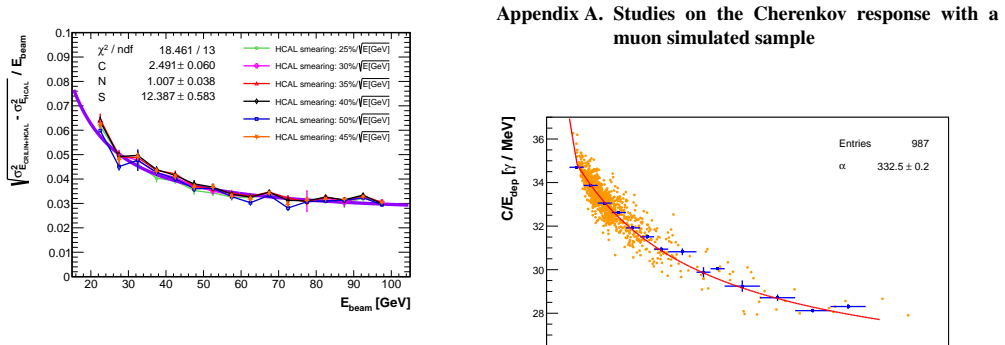
- [Results] The dependence of the result on the assumed HCAL resolution is stated to be limited, but the specific range of HCAL parameters explored and the quantitative variation in the combined resolution should be shown in a dedicated figure or table for clarity.
Simulated Author's Rebuttal
We thank the referee for the constructive comments and positive assessment of the significance of the work. We address each major comment below.
read point-by-point responses
-
Referee: [Abstract] Abstract and simulation study: the quoted combined resolution (1 GeV/E ⊕ 12%/√E[GeV] ⊕ 2.5%) is obtained by training and evaluating the GNN exclusively on the same Geant4 pion-shower sample and then combining its output with an externally assumed HCAL term. While not forced by construction, this makes the central performance number sensitive to any mismatch between simulated and real shower shapes, e/h ratios, or visible-energy fractions in PbF2; no beam-test anchors or alternative physics-list comparisons are reported.
Authors: The manuscript is presented throughout as a Geant4 simulation study of a conceptual calorimeter design, with the quoted resolution derived under those specific modeling assumptions and the stated HCAL parameters. Training and evaluation on the same sample is standard for assessing the potential of a reconstruction technique in simulation. We agree that real-data performance would depend on how accurately the simulation reproduces actual shower development and visible energy fractions in PbF2. We will add explicit wording in the abstract and conclusions to reinforce that the result is simulation-based and constitutes a proof-of-principle. No beam-test anchors exist for this design, and alternative physics lists were not compared because the focus is the compensation method rather than a full simulation validation. revision: partial
-
Referee: [Methods] Methods (Geant4 setup): the mapping from deposited to reconstructed energy depends on the simulated longitudinal/transverse profiles and neutron-capture modeling. Because the GNN corrections are derived from these profiles, any systematic discrepancy with real PbF2 response (e.g., scintillation vs. Cherenkov yields) directly propagates into the claimed compensation gain and the final resolution formula.
Authors: This dependence is inherent to any simulation-derived compensation technique. The Geant4 setup models Cherenkov photon production explicitly in PbF2, and the GNN exploits the resulting 3D topology. We will add a short paragraph in the methods section discussing the principal modeling assumptions (e.g., neutron capture and e/h ratio) and their potential influence on the reported gains. A quantitative sensitivity study to alternative physics lists or parameter variations lies beyond the present scope but is a natural direction for follow-up work once beam-test data become available. revision: partial
- Provision of beam-test anchors or real-data validation, as the study is based entirely on Geant4 simulations of a conceptual design for which no experimental data exist.
Circularity Check
No significant circularity; simulation-derived performance is not forced by construction
full rationale
The paper derives its resolution claims directly from Geant4 pion-shower simulations in PbF2, with a GNN trained on shower-shape observables to correct visible energy. The quoted combined resolution formula explicitly adds an externally assumed HCAL term and studies its variation; this is a transparent modeling step rather than a self-referential definition. No load-bearing self-citations, uniqueness theorems, or ansatzes imported from prior author work appear. The GNN output is a trained correction, not a fitted input renamed as prediction. The result is therefore self-contained within the stated simulation framework and does not reduce to its inputs by construction.
Axiom & Free-Parameter Ledger
axioms (1)
- domain assumption Geant4 accurately models the visible energy fraction and shower topology for pions in PbF2 crystals
Reference graph
Works this paper leans on
-
[1]
W. Bartmann, J.-P. Burnet, C. Carli, A. Chance, P. Craievich, M. Giovannozzi, C. Grojean, J. Gutle- ber, K. Hanke, A. Henriques, P. Janot, C. Lourenco, M. Mangano, T. Otto, J. H. Poole, S. Rajagopalan, T. Raubenheimer, E. Todesco, T. P. Watson, G. Wilkinson, Future circular collider feasibility study report volume 1: Physics and experiments (2025).doi:10....
-
[2]
S. Lee, M. Livan, R. Wigmans, Dual-readout calorime- try, Reviews of Modern Physics 90 (2) (Apr. 2018). doi:10.1103/revmodphys.90.025002. URLhttp://dx.doi.org/10.1103/RevModPhys. 90.025002
-
[3]
N. Valle, Dual readout with capillary tubes – status and prospects, EPJ Web of Conferences 320 (2025) 00054. doi:10.1051/epjconf/202532000054. URLhttp://dx.doi.org/10.1051/epjconf/ 202532000054
-
[4]
S. Lai, J. Utehs, A. Wilhahn, O. Bach, E. Brianne, A. Ebrahimi, K. Gadow, P. Göttlicher, O. Hartbrich, D. Heuchel, A. Irles, K. Krüger, J. Kvasnicka, S. Lu, C. Neubüser, A. Provenza, M. Reinecke, F. Sefkow, S. Schuwalow, M. D. Silva, Y . Sudo, H. L. Tran, E. Buh- mann, E. Garutti, S. Huck, G. Kasieczka, S. Martens, J. Rolph, J. Wellhausen, G. C. Blazey, A...
arXiv 2024
-
[5]
N. Akchurin, C. Cowden, J. Damgov, A. Hussain, S. Kunori, The (un)reasonable effectiveness of neural net- work in cherenkov calorimetry, Instruments 6 (4) (2022). doi:10.3390/instruments6040043. URLhttps://www.mdpi.com/2410-390X/6/4/43
-
[6]
S. Ceravolo, F. Colao, C. Curatolo, E. Di Meco, E. Dio- ciaiuti, D. Lucchesi, D. Paesani, N. Pastrone, A. Saputi, I. Sarra, L. Sestini, D. Tagnani, Crilin: A crystal calorimeter with longitudinal information for a future muon collider, Journal of Instrumentation 17 (09) (2022) P09033.doi:10.1088/1748-0221/17/09/P09033. URLhttps://doi.org/10.1088/1748-0221...
-
[7]
C. Cantone, A. Cemmi, S. Ceravolo, V . Ciccarella, F. Co- lao, E. Di Meco, I. Di Sarcina, E. Diociaiuti, R. Gargiulo, P. Gianotti, C. Giraldin, E. Leonardi, D. Lucchesi, M. Moulson, D. Paesani, N. Pastrone, G. Pezzullo, A. Sa- puti, I. Sarra, J. Scifo, L. Sestini, M. Soldani, D. Tagnani, A. Verna, D. Zuliani, Developing an alternative calorime- ter soluti...
-
[8]
R. Gargiulo, C. Cantone, A. Cemmi, S. Ceravolo, V . Ci- ccarella, F. Colao, E. D. Meco, E. Diociaiuti, I. D. Sarcina, P. Gianotti, C. Giraldin, E. Leonardi, D. Lucch- esi, M. Moulson, D. Paesani, N. Pastrone, G. Pezzullo, A. Saputi, I. Sarra, J. Scifo, L. Sestini, M. Soldani, D. Tag- nani, A. Verna, D. Zuliani, Crilin: a semi-homogeneous crystal calorimet...
-
[9]
A. Pellecchia, et al., Design and optimization of a hadronic calorimeter based on micropattern gaseous de- tectors for a future experiment at the muon collider, Nu- clear Instruments and Methods in Physics Research Sec- tion A (2024).arXiv:2407.10261
arXiv 2024
-
[10]
T. Basaglia, Z. W. Bell, D. D’Agostino, P. V . Dressendor- fer, S. Giani, M. G. Pia, P. Saracco, Geant4: a game changer in high energy physics and related applicative fields (2024).arXiv:2405.12159. URLhttps://arxiv.org/abs/2405.12159
arXiv 2024
-
[11]
I. Frank, I. Tamm, Coherent Visible Radiation of Fast Electrons Passing Through Matter, Springer Berlin Heidelberg, Berlin, Heidelberg, 1991, pp. 29–35. doi:10.1007/978-3-642-74626-0_2. URLhttps://doi.org/10.1007/ 978-3-642-74626-0_2
-
[12]
J. E. Gaiser, Charmonium spectroscopy from radiative de- cays of thej/ψandψ ′, Tech. rep., SLAC National Ac- celerator Laboratory (SLAC), Menlo Park, CA (United States) (08 1982).doi:10.2172/1453988. URLhttps://www.osti.gov/biblio/1453988
-
[13]
I. Sarra, Development and test of the crilin calorime- ter for the muon collider: Status and perspectives, in: 2025 IEEE Nuclear Science Symposium (NSS), Medical Imaging Conference (MIC) and Room Temperature Semi- conductor Detector Conference (RTSD), 2025, pp. 1–1. doi:10.1109/NSS/MIC/RTSD57106.2025.11287199
- [14]
-
[15]
H. Qu, L. Gouskos, Jet tagging via particle clouds, Phys- ical Review D 101 (5) (Mar. 2020).doi:10.1103/ physrevd.101.056019. URLhttp://dx.doi.org/10.1103/PhysRevD.101. 056019 10
discussion (0)
Sign in with ORCID, Apple, or X to comment. Anyone can read and Pith papers without signing in.