Little red dots as a cosmological probe: constraining H₀ with quasi-periodic pulsations
Pith reviewed 2026-06-28 05:18 UTC · model grok-4.3
The pith
Little red dots at high redshift can constrain the Hubble constant if their variability follows a derived period-luminosity-temperature relation.
A machine-rendered reading of the paper's core claim, the machinery that carries it, and where it could break.
Core claim
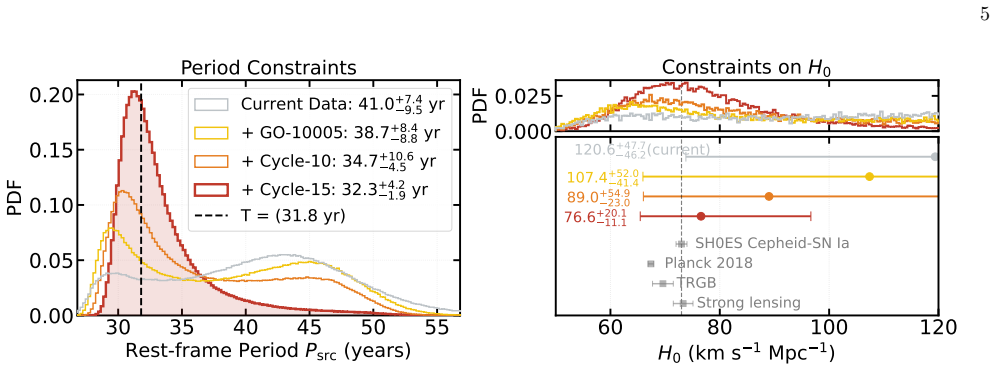
The authors derive an idealized, self-consistent P-L-T_eff relation from the hydrostatic envelope model applied to little red dots viewed as early supermassive black holes in dense gaseous envelopes. When this relation is applied to the observed variability in the lensed source RXJ2211-RX1, it yields a preliminary Hubble constant of 120.7 km s^{-1} Mpc^{-1} with errors dominated by period uncertainty. Continuous 10-year monitoring is forecast to reduce the statistical uncertainty to 3-20 percent depending on the intrinsic period, while the relation itself supplies luminosity distances at redshifts above 4.
What carries the argument
The period-luminosity-temperature (P-L-T) relation derived from the hydrostatic envelope model for little red dots.
If this is right
- Sparse sampling already returns a preliminary H0 of 120.7 km s^{-1} Mpc^{-1}.
- Ten-year continuous monitoring reduces H0 uncertainty to 3-20 percent depending on the intrinsic period.
- The relation supplies luminosity distances at z greater than 4, offering an independent early-universe distance indicator.
Where Pith is reading between the lines
- If the relation is empirically calibrated on multiple sources it could be tested for redshift evolution in envelope physics.
- The method could be cross-checked against other high-redshift distance indicators once larger samples exist.
- The dominant error from period uncertainty points to the value of long-baseline monitoring campaigns.
Load-bearing premise
The observed variability on rest-frame decade timescales in lensed little red dots is produced by quasi-periodic pulsations whose physics is captured by the hydrostatic envelope model.
What would settle it
Additional little red dots whose measured periods and temperatures fall far outside the predicted P-L-T locus would show that the relation does not hold for these objects.
Figures
read the original abstract
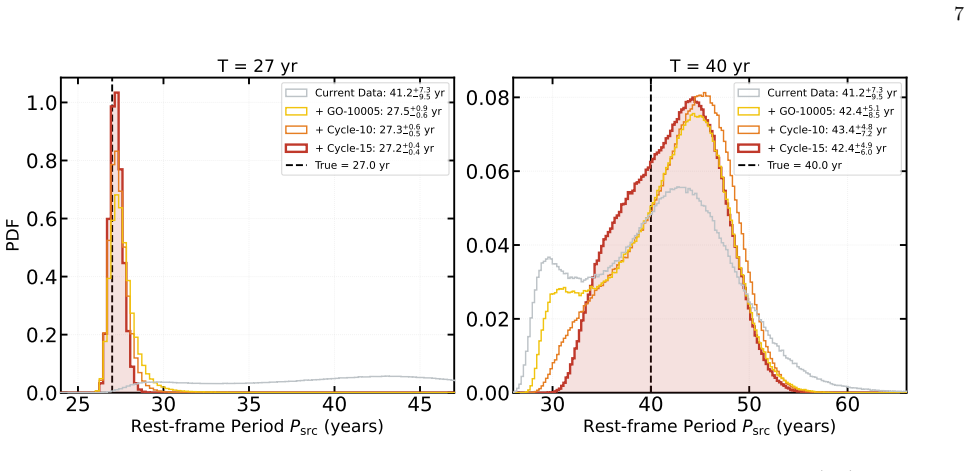
The James Webb Space Telescope (JWST) has uncovered a population of ``little red dots'' (LRDs) at $z \gtrsim 4$, potentially representing early supermassive black holes embedded in dense gaseous envelopes. The recent discovery of the lensed LRD RXJ2211-RX1 reveals significant variability on rest-frame timescales of decades, which may be interpreted as quasi-periodic variation that has a potential physical parallel to stellar pulsations. In this work, we derive an idealized, self-consistent period-luminosity-temperature ($P$-$L$-$T_{\rm eff}$) relation based on the hydrostatic envelope model. If this theoretical relation holds and can be empirically validated/calibrated, it would offer a novel framework for constraining the Hubble constant ($H_0$). The current sparse sampling of \tgta\ yields a preliminary $H_0 = 120.7_{-46.5}^{+47.0} \text{ km s}^{-1}\text{ Mpc}^{-1}$ as a proof-of-concept, with the error budget dominated by the uncertainty of the pulsation period. Our forecasting analysis shows that continuous monitoring over a 10-year baseline can reduce the $H_0$ uncertainty to 3-20\%, depending on the intrinsic pulsation period, while the systematic uncertainty floor remains to be fully characterized. This method offers a potential independent probe to measure luminosity distances in the early universe.
Editorial analysis
A structured set of objections, weighed in public.
Referee Report
Summary. The paper claims that decade-scale variability observed in the lensed little red dot RXJ2211-RX1 can be interpreted as quasi-periodic pulsations arising from a hydrostatic gaseous envelope around a supermassive black hole. It derives an idealized, self-consistent period-luminosity-effective temperature (P-L-T_eff) relation from this model and shows that, if empirically validated, the relation provides a novel route to constrain the Hubble constant H_0. Using the current sparse sampling, the manuscript reports a preliminary value H_0 = 120.7_{-46.5}^{+47.0} km s^{-1} Mpc^{-1}, with forecasts that 10-year monitoring could reduce the uncertainty to 3-20% depending on the intrinsic period.
Significance. If the hydrostatic-envelope model and its P-L-T relation can be shown to apply to LRDs, the approach would constitute a genuinely independent high-redshift distance indicator. The derivation is presented as parameter-free within the model assumptions, which is a strength, but the result remains a proof-of-concept whose error budget is entirely dominated by the period measurement of a single object and whose physical applicability to z>4 LRDs is not yet demonstrated.
major comments (2)
- [Abstract] Abstract and the derivation of the P-L-T relation: the central claim that the observed variability constitutes quasi-periodic pulsations whose physics parallels stellar pulsations is load-bearing for the entire H_0 constraint, yet the manuscript provides no empirical light-curve analysis demonstrating strict periodicity (as opposed to stochastic AGN variability) nor any theoretical justification that the adiabatic-oscillation and thermal-timescale scalings remain valid for a supermassive black hole embedded in a dense envelope at z>4.
- [Abstract] Abstract (preliminary H_0 result): the reported value and its asymmetric uncertainties are driven solely by the period uncertainty of RXJ2211-RX1; the manuscript does not present an explicit error budget that includes possible systematic contributions from the model assumptions, calibration of the P-L-T relation, or lensing magnification, nor does it compare the result against any independent distance ladder at comparable redshift.
minor comments (1)
- [Abstract] Abstract: the token "\tgta" is a clear typesetting artifact and should be replaced by the intended object or sample name.
Simulated Author's Rebuttal
We thank the referee for their constructive comments. The manuscript is framed as a proof-of-concept deriving an idealized P-L-T relation from the hydrostatic envelope model and applying it to sparse data on a single object. We address the major comments below and have revised the manuscript to clarify assumptions, expand the error budget, and better contextualize the preliminary result.
read point-by-point responses
-
Referee: [Abstract] Abstract and the derivation of the P-L-T relation: the central claim that the observed variability constitutes quasi-periodic pulsations whose physics parallels stellar pulsations is load-bearing for the entire H_0 constraint, yet the manuscript provides no empirical light-curve analysis demonstrating strict periodicity (as opposed to stochastic AGN variability) nor any theoretical justification that the adiabatic-oscillation and thermal-timescale scalings remain valid for a supermassive black hole embedded in a dense envelope at z>4.
Authors: The current sparse sampling of RXJ2211-RX1 precludes a rigorous statistical demonstration of strict periodicity versus stochastic variability, which is why the result is presented strictly as a proof-of-concept. The P-L-T relation is obtained directly from the hydrostatic envelope equations by combining the adiabatic pulsation period scaling with the thermal adjustment timescale, yielding a parameter-free relation within the model assumptions; this constitutes the theoretical justification under the idealized framework. We have added a new subsection discussing the applicability of these scalings to z>4 LRD envelopes, including the key assumptions and regimes where they may break down. revision: partial
-
Referee: [Abstract] Abstract (preliminary H_0 result): the reported value and its asymmetric uncertainties are driven solely by the period uncertainty of RXJ2211-RX1; the manuscript does not present an explicit error budget that includes possible systematic contributions from the model assumptions, calibration of the P-L-T relation, or lensing magnification, nor does it compare the result against any independent distance ladder at comparable redshift.
Authors: We agree that the quoted H_0 uncertainty is dominated by the period measurement. The revised manuscript now includes an explicit error-budget subsection that quantifies (or places upper limits on) contributions from model idealizations, the absence of empirical P-L-T calibration, and lensing magnification uncertainty. The asymmetric errors follow from propagating the asymmetric period uncertainty. At z≈4 no independent distance-ladder anchors exist, which is noted in the discussion as motivation for developing this high-redshift probe; a direct comparison is therefore not possible with present data. revision: yes
Circularity Check
No significant circularity; derivation is model-based and self-contained
full rationale
The paper derives the P-L-T relation from the hydrostatic envelope model assumptions and applies the resulting theoretical relation to an observed period and luminosity to obtain a preliminary H0 value. This chain does not reduce to fitted inputs called predictions, self-definitional loops, or load-bearing self-citations. The abstract explicitly frames the result as conditional on future empirical validation of the model for LRDs and notes the error budget is dominated by period uncertainty rather than any internal fit. No equations or steps equate the output H0 to the input assumptions by construction. The framework is presented as a proof-of-concept probe whose validity rests on external checks, not on renaming or smuggling prior results.
Axiom & Free-Parameter Ledger
axioms (2)
- domain assumption Hydrostatic envelope model applies to LRDs and yields a self-consistent P-L-T relation
- domain assumption Observed variability is quasi-periodic pulsation with physical parallel to stellar pulsations
Reference graph
Works this paper leans on
-
[1]
3 The uncertainty of the Hubble constant measurement using Eq
Direct Period Measurements The luminosity distance is related to the observed flux asD L = (L/4πFobs)1/2, and thus can be expressed as DL = κesFobs c(1−β) Psrc 2πQ0 2 σSBT 4 eff Fobs 3/2 .(6) Using the definition of the luminosity distance andPobs = (1 +z)P src, we obtain H0 = (1+z)3 c2(1−β) κes · ⟨Fobs⟩1/2 ⟨σSBT 4 eff⟩3/2 Pobs 2πQ0 −2Z z 0 dz′ E(z ′) , (...
-
[2]
Reconstruction of Pulsation Periods Long-term time-domain monitoring in a decade is fea- sible for low-redshift LRDs. For high-redshift sources, on the other hand, the observed period is further stretched by cosmic time dilation,P obs = (1 +z)P src, making di- rect period measurements extremely expensive in terms of observational baseline. An important ex...
2018
-
[3]
L. J. Furtak, A. Zitrin, A. Plat, S. Fujimoto, B. Wang, E. J. Nelson, I. Labb´ e, R. Bezanson, G. B. Brammer, P. van Dokkum, R. Endsley, K. Glazebrook, J. E. Greene, J. Leja, S. H. Price, R. Smit, D. P. Stark, J. R. Weaver, K. E. Whitaker, H. Atek, J. Chevallard, E. Curtis-Lake, P. Dayal, A. Feltre, M. Franx, Y. Fudamoto, D. March- esini, L. A. Mowla, R. ...
arXiv 2023
-
[4]
H. B. Akins, C. M. Casey, E. Lambrides, N. Allen, I. T. Andika, M. Brinch, J. B. Champagne, O. Cooper, X. Ding, N. E. Drakos, A. Faisst, S. L. Finkelstein, M. Franco, S. Fujimoto, F. Gentile, S. Gillman, G. Goza- liasl, S. Harish, C. C. Hayward, M. Hirschmann, O. Il- bert, J. S. Kartaltepe, D. D. Kocevski, A. M. Koeke- moer, V. Kokorev, D. Liu, A. S. Long...
arXiv 2025
-
[5]
G. Barro, P. G. P´ erez-Gonz´ alez, D. D. Kocevski, E. J. McGrath, J. R. Trump, R. C. Simons, R. S. Somerville, L. Y. A. Yung, P. Arrabal Haro, H. B. Akins, M. B. Bagley, N. J. Cleri, L. Costantin, K. Davis, M. Dick- inson, S. L. Finkelstein, M. Giavalisco, C. G´ omez- Guijarro, N. P. Hathi, M. Hirschmann, B. W. Holwerda, M. Huertas-Company, J. S. Kartalt...
arXiv 2024
-
[6]
J. Matthee, R. P. Naidu, G. Brammer, J. Chisholm, A.- C. Eilers, A. Goulding, J. Greene, D. Kashino, I. Labbe, S. J. Lilly, R. Mackenzie, P. A. Oesch, A. Weibel, S. Wuyts, M. Xiao, R. Bordoloi, R. Bouwens, P. van Dokkum, G. Illingworth, I. Kramarenko, M. V. Maseda, C. Mason, R. A. Meyer, E. J. Nelson, N. A. Reddy, I. Shivaei, R. A. Simcoe, and M. Yue, The...
arXiv 2024
-
[7]
I. Labbe, J. E. Greene, R. Bezanson, S. Fujimoto, L. J. Furtak, A. D. Goulding, J. Matthee, R. P. Naidu, P. A. Oesch, H. Atek, G. Brammer, I. Chemerynska, D. Coe, S. E. Cutler, P. Dayal, R. Feldmann, M. Franx, K. Glazebrook, J. Leja, M. Maseda, D. Marchesini, T. Nanayakkara, E. J. Nelson, R. Pan, C. Papovich, S. H. Price, K. A. Suess, B. Wang, J. R. Weave...
arXiv 2025
-
[8]
Y. Harikane, Y. Zhang, K. Nakajima, M. Ouchi, Y. Isobe, Y. Ono, S. Hatano, Y. Xu, and H. Umeda, The Astro- physical Journal959, 39 (2023), arXiv:2303.11946 [astro- ph.GA]
arXiv 2023
-
[9]
J. E. Greene, I. Labbe, A. D. Goulding, L. J. Fur- tak, I. Chemerynska, V. Kokorev, P. Dayal, M. Volon- teri, C. C. Williams, B. Wang, D. J. Setton, A. J. Burgasser, R. Bezanson, H. Atek, G. Brammer, S. E. Cutler, R. Feldmann, S. Fujimoto, K. Glazebrook, A. de Graaff, G. Khullar, J. Leja, D. Marchesini, M. V. Maseda, J. Matthee, T. B. Miller, R. P. Naidu,...
arXiv 2024
-
[10]
B. Wang, J. Leja, A. de Graaff, G. B. Brammer, A. Weibel, P. van Dokkum, J. F. W. Baggen, K. A. Suess, J. E. Greene, R. Bezanson, N. J. Cleri, M. Hirschmann, I. Labb´ e, J. Matthee, I. McConachie, R. P. Naidu, E. Nelson, P. A. Oesch, D. J. Setton, and C. C. Williams, The Astrophysical Journal Letter969, L13 (2024), arXiv:2405.01473 [astro-ph.GA]
arXiv 2024
-
[11]
D. D. Kocevski, S. L. Finkelstein, G. Barro, A. J. Tay- lor, A. Calabr` o, B. Laloux, J. Buchner, J. R. Trump, G. C. K. Leung, G. Yang, M. Dickinson, P. G. P´ erez- Gonz´ alez, F. Pacucci, K. Inayoshi, R. S. Somerville, E. J. McGrath, H. B. Akins, M. B. Bagley, R. A. A. Bowler, L. Bisigello, A. Carnall, C. M. Casey, Y. Cheng, N. J. Cleri, L. Costantin, F....
arXiv 2025
-
[12]
T. T. Ananna, ´A. Bogd´ an, O. E. Kov´ acs, P. Natarajan, and R. C. Hickox, The Astrophysical Journal Letter969, L18 (2024), arXiv:2404.19010 [astro-ph.GA]
arXiv 2024
- [13]
-
[14]
R. Maiolino, G. Risaliti, M. Signorini, B. Trefoloni, I. Juodˇ zbalis, J. Scholtz, H.¨Ubler, F. D’Eugenio, S. Car- niani, A. Fabian, X. Ji, G. Mazzolari, E. Bertola, M. Brusa, A. J. Bunker, S. Charlot, A. Comastri, G. Cresci, C. N. DeCoursey, E. Egami, F. Fiore, R. Gilli, M. Perna, S. Tacchella, and G. Venturi, Monthly No- tices of the Royal Astronomical ...
arXiv 1921
-
[15]
G. Mazzolari, R. Gilli, R. Maiolino, I. Prandoni, I. Delvecchio, C. Norman, E. F. Jimenez-Andrade, S. Bel- laditta, F. Vito, E. Momjian, M. Chiaberge, B. Trefoloni, M. Signorini, X. Ji, Q. D’Amato, G. Risaliti, R. D. Baldi, A. Fabian, H. ¨Ubler, F. D’Eugenio, J. Scholtz, I. Juodˇ zbalis, M. Mignoli, M. Brusa, E. Murphy, and T. W. B. Muxlow, arXiv e-prints...
arXiv 2024
-
[16]
P. G. P´ erez-Gonz´ alez, G. Barro, G. H. Rieke, J. Lyu, M. Rieke, S. Alberts, C. C. Williams, K. Hainline, F. Sun, D. Pusk´ as, M. Annunziatella, W. M. Baker, A. J. Bunker, E. Egami, Z. Ji, B. D. Johnson, B. Robert- son, B. Rodr´ ıguez Del Pino, W. Rujopakarn, I. Shiv- aei, S. Tacchella, C. N. A. Willmer, and C. Willott, The Astrophysical Journal968, 4 (...
arXiv 2024
-
[17]
C. C. Williams, S. Alberts, Z. Ji, K. N. Hainline, J. Lyu, G. Rieke, R. Endsley, K. A. Suess, F. Sun, B. D. Johnson, M. Florian, I. Shivaei, W. Rujopakarn, W. M. Baker, R. Bhatawdekar, K. Boyett, A. J. Bunker, A. J. Cameron, S. Carniani, S. Charlot, E. Curtis-Lake, C. DeCoursey, A. de Graaff, E. Egami, D. J. Eisenstein, J. L. Gibson, R. Hausen, J. M. Helt...
arXiv 2024
-
[18]
M. Kokubo and Y. Harikane, arXiv e-prints , arXiv:2407.04777 (2024), arXiv:2407.04777 [astro- ph.GA]
arXiv 2024
-
[19]
W. L. Tee, X. Fan, F. Wang, and J. Yang, The Astrophys- ical Journal Letter983, L26 (2025), arXiv:2412.05242 [astro-ph.GA]
arXiv 2025
- [20]
-
[21]
Z. Liu, R. P. Naidu, A. Secunda, J. E. Greene, J. Matthee, J. Chisholm, A. de Graaff, L. Robbins, J. Antwi-Danso, G. Brammer, W. Q. Sun, A.-C. Eil- ers, S. Fujimoto, L. J. Furtak, E. Kara, V. Kokorev, D. Marchesini, P. A. Oesch, J. D. R. Pierel, X. Shen, R. A. Simcoe, A. Torralba, and M. Vogelsberger, arXiv e-prints , arXiv:2604.13000 (2026), arXiv:2604.1...
Pith/arXiv arXiv 2026
-
[22]
Inayoshi, The Astrophysical Journal Letter988, L22 (2025), arXiv:2503.05537 [astro-ph.GA]
K. Inayoshi, The Astrophysical Journal Letter988, L22 (2025), arXiv:2503.05537 [astro-ph.GA]
arXiv 2025
-
[23]
K. Inayoshi and R. Maiolino, The Astrophysical Journal Letter980, L27 (2025), arXiv:2409.07805 [astro-ph.GA]
arXiv 2025
-
[24]
X. Ji, R. Maiolino, H. ¨Ubler, J. Scholtz, F. D’Eugenio, F. Sun, M. Perna, H. Turner, S. Arribas, J. S. Bennett, A. Bunker, S. Carniani, S. Charlot, G. Cresci, M. Curti, E. Egami, A. Fabian, K. Inayoshi, Y. Isobe, G. Jones, 9 I. Juodˇ zbalis, N. Kumari, J. Lyu, G. Mazzolari, E. Par- lanti, B. Robertson, B. Rodr´ ıguez Del Pino, R. Schnei- der, D. Sijacki,...
arXiv 2025
-
[25]
D. Kido, K. Ioka, K. Hotokezaka, K. Inayoshi, and C. M. Irwin, arXiv e-prints , arXiv:2505.06965 (2025), arXiv:2505.06965 [astro-ph.HE]
arXiv 2025
-
[26]
R. P. Naidu, J. Matthee, H. Katz, A. de Graaff, P. Oesch, A. Smith, J. E. Greene, G. Brammer, A. Weibel, R. Hvid- ing, J. Chisholm, I. Labb\’e, R. A. Simcoe, C. Wit- ten, H. Atek, J. F. W. Baggen, S. Belli, R. Bezan- son, L. A. Boogaard, S. Bose, A. Covelo-Paz, P. Dayal, Y. Fudamoto, L. J. Furtak, E. Giovinazzo, A. Gould- ing, M. Gronke, K. E. Heintz, M. ...
Pith/arXiv arXiv 2025
-
[27]
X. Lin, F. Wang, X. Fan, Z. Cai, J. B. Cham- pagne, F. Sun, M. Volonteri, J. Yang, J. F. Hennawi, E. Ba˜ nados, A. Barth, A.-C. Eilers, E. P. Farina, W. Liu, X. Jin, H. D. Jun, A. Lupi, K. Kakiichi, C. Mazzuc- chelli, M. Onoue, Z. Pan, E. Pizzati, S. Rojas-Ruiz, J.- T. Schindler, B. Trakhtenbrot, Y. Shen, M. Trebitsch, M.-Y. Zhuang, R. Endsley, R. A. Meye...
arXiv 2024
-
[28]
A. de Graaff, D. J. Setton, G. Brammer, S. Cutler, K. A. Suess, I. Labb´ e, J. Leja, A. Weibel, M. V. Maseda, K. E. Whitaker, R. Bezanson, L. A. Boogaard, N. J. Cleri, G. De Lucia, M. Franx, J. E. Greene, M. Hirschmann, J. Matthee, I. McConachie, R. P. Naidu, P. A. Oesch, S. H. Price, H.-W. Rix, F. Valentino, B. Wang, and C. C. Williams, Nature Astronomy9...
arXiv 2025
-
[29]
I. Juodˇ zbalis, X. Ji, R. Maiolino, F. D’Eugenio, J. Scholtz, G. Risaliti, A. C. Fabian, G. Mazzolari, R. Gilli, I. Prandoni, S. Arribas, A. J. Bunker, S. Carni- ani, S. Charlot, E. Curtis-Lake, A. de Graaff, K. Hainline, E. Parlanti, M. Perna, P. G. P´ erez-Gonz´ alez, B. Robert- son, S. Tacchella, H. ¨Ubler, C. C. Williams, C. Willott, and J. Witstok, ...
arXiv 2024
-
[30]
X. Ji, F. D’Eugenio, I. Juodˇ zbalis, D. J. Walton, A. C. Fabian, R. Maiolino, C. Ramos Almeida, J. A. Acosta Pulido, V. A. Belokurov, Y. Isobe, G. Jones, C. Maras- ton, J. Scholtz, C. Simmonds, S. Tacchella, E. Terlevich, and R. Terlevich, Monthly Notices of the Royal Astro- nomical Society545, staf2235 (2026), arXiv:2507.23774 [astro-ph.GA]
arXiv 2026
-
[31]
X. Lin, X. Fan, Z. Cai, F. Bian, H. Liu, F. Sun, Y. Ma, J. E. Greene, M. A. Strauss, R. Green, J. Lyu, J. B. Champagne, A. D. Goulding, K. Inayoshi, X. Jin, G. C. K. Leung, M. Li, W. Liu, Y. Liu, J. Mao, M. A. Pudoka, W. L. Tee, B. Wang, F. Wang, Y. Wu, J. Yang, H. Zhang, and Y. Zhu, The Astrophysical Journal997, 364 (2026), arXiv:2507.10659 [astro-ph.GA]
arXiv 2026
-
[32]
M. Cantiello, J. B. Hassan, R. Perna, P. J. Armitage, M. C. Begelman, Y.-F. Jiang, T. Ryu, and R. H. D. Townsend, arXiv e-prints , arXiv:2512.17997 (2025), arXiv:2512.17997 [astro-ph.HE]
arXiv 2025
-
[33]
K. Inayoshi, K. Murase, and K. Kashiyama, The As- trophysical Journal1000, 90 (2026), arXiv:2509.19422 [astro-ph.GA]
Pith/arXiv arXiv 2026
-
[34]
A. S. Eddington, The Observatory40, 290 (1917)
1917
-
[35]
J. P. Cox,Theory of Stellar Pulsation. (PSA-2), Volume 2, Vol. 2 (1980)
1980
-
[36]
Li and Z
Y. Li and Z. G. Gong, A&A289, 449 (1994)
1994
-
[37]
K. Inayoshi, K. Sugiyama, T. Hosokawa, K. Motogi, and K. E. I. Tanaka, The Astrophysical Journal Letter769, L20 (2013), arXiv:1304.5241 [astro-ph.SR]
Pith/arXiv arXiv 2013
- [38]
-
[39]
T. Hosokawa, H. W. Yorke, K. Inayoshi, K. Omukai, and N. Yoshida, The Astrophysical Journal778, 178 (2013), arXiv:1308.4457 [astro-ph.SR]
Pith/arXiv arXiv 2013
-
[40]
K. Inayoshi, T. Hosokawa, and K. Omukai, Monthly No- tices of the Royal Astronomical Society431, 3036 (2013), arXiv:1302.6065 [astro-ph.SR]
Pith/arXiv arXiv 2013
-
[41]
Z. Zhang, M. Li, M. Oguri, X. Lin, K. Inayoshi, C. Cerny, D. Coe, J. M. Diego, S. Fujimoto, L. Jiang, G. Mahler, J. Matthee, R. P. Naidu, K. Sharon, Y. Shen, A. Zitrin, Abdurro’uf, H. Akins, J. F. V. Allingham, R. Amor´ ın, Y. Asada, H. Atek, F. E. Bauer, M. Bradaˇ c, L. D. Bradley, Z. Cai, S. Cantalupo, C. Conselice, L. Dai, P. Dayal, E. Egami, D. J. Eis...
arXiv 2025
-
[42]
M. C. Begelman, M. Volonteri, and M. J. Rees, Monthly Notices of the Royal Astronomical Society370, 289 (2006), astro-ph/0602363
Pith/arXiv arXiv 2006
-
[43]
Planck Collaboration, N. Aghanim, Y. Akrami, M. Ash- down, J. Aumont, C. Baccigalupi, M. Ballardini, A. J. Banday, R. B. Barreiro, N. Bartolo, S. Basak, R. Battye, K. Benabed, J.-P. Bernard, M. Bersanelli, P. Bielewicz, J. J. Bock, J. R. Bond, J. Borrill, F. R. Bouchet, F. Boulanger, M. Bucher, C. Burigana, R. C. Butler, E. Calabrese, J.-F. Cardoso, J. Ca...
Pith/arXiv arXiv 2020
-
[44]
A. G. Riess, W. Yuan, L. M. Macri, D. Scolnic, D. Brout, S. Casertano, D. O. Jones, Y. Murakami, G. S. Anand, L. Breuval, T. G. Brink, A. V. Filippenko, S. Hoffmann, S. W. Jha, W. D’arcy Kenworthy, J. Mackenty, B. E. Stahl, and W. Zheng, The Astrophysical Journal Letter 934, L7 (2022), arXiv:2112.04510 [astro-ph.CO]
Pith/arXiv arXiv 2022
-
[45]
E. Di Valentino, O. Mena, S. Pan, L. Visinelli, W. Yang, A. Melchiorri, D. F. Mota, A. G. Riess, and J. Silk, Classical and Quantum Gravity38, 153001 (2021), arXiv:2103.01183 [astro-ph.CO]
Pith/arXiv arXiv 2021
-
[46]
H. S. Leavitt and E. C. Pickering, Harvard College Ob- servatory Circular173, 1 (1912)
1912
-
[47]
Chandrasekhar,An introduction to the study of stellar structure(1939)
S. Chandrasekhar,An introduction to the study of stellar structure(1939)
1939
-
[48]
Hoyle and W
F. Hoyle and W. A. Fowler, Monthly Notices of the Royal Astronomical Society125, 169 (1963)
1963
-
[49]
However, non-zero contributions from gas pressure maintainsγ ad −4/3≃β/6>0 and yields a finite period [38]
The pulsation period for the fundamental mode goes in- finity because the restoring force in the limit ofγ ad → 4/3. However, non-zero contributions from gas pressure maintainsγ ad −4/3≃β/6>0 and yields a finite period [38]
-
[50]
Schwarzschild, The Astrophysical Journal94, 245 (1941)
M. Schwarzschild, The Astrophysical Journal94, 245 (1941)
1941
-
[51]
J. R. Bond, S. Cole, G. Efstathiou, and N. Kaiser, The Astrophysical Journal379, 440 (1991)
1991
-
[52]
L. M. Macri, K. Z. Stanek, D. Bersier, L. J. Greenhill, and M. J. Reid, The Astrophysical Journal652, 1133 (2006), arXiv:astro-ph/0608211 [astro-ph]
Pith/arXiv arXiv 2006
-
[53]
J. F. W. Baggen, P. van Dokkum, I. Labb´ e, and G. Brammer, arXiv e-prints , arXiv:2512.03239 (2025), arXiv:2512.03239 [astro-ph.GA]
arXiv 2025
-
[54]
M. Golubchik, L. J. Furtak, J. F. V. Allingham, A. Zitrin, H. B. Akins, V. Kokorev, S. Fujimoto, Abdurro’uf, R. O. Amor´ ın, F. E. Bauer, R. Bezanson, M. Bradaˇ c, L. D. Bradley, G. B. Brammer, J. Chisholm, D. Coe, C. J. Con- selice, P. Dayal, M. Dessauges-Zavadsky, J. M. Diego, A. L. Faisst, Q. Fei, H. C. Ferguson, S. L. Finkel- stein, B. L. Frye, M. Gon...
Pith/arXiv arXiv 2025
-
[55]
W. L. Freedman, B. F. Madore, T. Hoyt, I. S. Jang, R. Beaton, M. G. Lee, A. Monson, J. Neeley, and J. Rich, The Astrophysical Journal891, 57 (2020), arXiv:2002.01550 [astro-ph.GA]
arXiv 2020
-
[56]
K. C. Wong, S. H. Suyu, G. C.-F. Chen, C. E. Rusu, M. Millon, D. Sluse, V. Bonvin, C. D. Fassnacht, S. Taubenberger, M. W. Auger, S. Birrer, J. H. H. Chan, F. Courbin, S. Hilbert, O. Tihhonova, T. Treu, A. Ag- nello, X. Ding, I. Jee, E. Komatsu, A. J. Shajib, A. Son- nenfeld, R. D. Blandford, L. V. E. Koopmans, P. J. Mar- shall, and G. Meylan, Monthly Not...
arXiv 2020
- [57]
-
[58]
E. E. Falco, M. V. Gorenstein, and I. I. Shapiro, The Astrophysical Journal Letter289, L1 (1985)
1985
-
[59]
S. H. Suyu, M. W. Auger, S. Hilbert, P. J. Marshall, M. Tewes, T. Treu, C. D. Fassnacht, L. V. E. Koop- mans, D. Sluse, R. D. Blandford, F. Courbin, and G. Meylan, The Astrophysical Journal766, 70 (2013), arXiv:1208.6010 [astro-ph.CO]
Pith/arXiv arXiv 2013
-
[60]
Z. S. Greene, S. H. Suyu, T. Treu, S. Hilbert, M. W. Auger, T. E. Collett, P. J. Marshall, C. D. Fass- nacht, R. D. Blandford, M. Bradaˇ c, and L. V. E. Koopmans, The Astrophysical Journal768, 39 (2013), arXiv:1303.3588 [astro-ph.CO]
Pith/arXiv arXiv 2013
-
[61]
A. J. Cenarro, J. Gorgas, N. Cardiel, A. Vazdekis, and R. F. Peletier, Monthly Notices of the Royal Astro- nomical Society329, 863 (2002), arXiv:astro-ph/0112448 [astro-ph]
Pith/arXiv arXiv 2002
-
[62]
D. Foreman-Mackey, D. W. Hogg, D. Lang, and J. Good- man, Publications of the Astronomical Society of the Pa- cific125, 306 (2013), arXiv:1202.3665 [astro-ph.IM]
Pith/arXiv arXiv 2013
-
[63]
J. C. B. Papaloizou, Monthly Notices of the Royal As- tronomical Society162, 143 (1973)
1973
discussion (0)
Sign in with ORCID, Apple, or X to comment. Anyone can read and Pith papers without signing in.