Strong environmental AGN enhancement among DSFGs in z > 2 protoclusters
Pith reviewed 2026-06-28 05:15 UTC · model grok-4.3
The pith
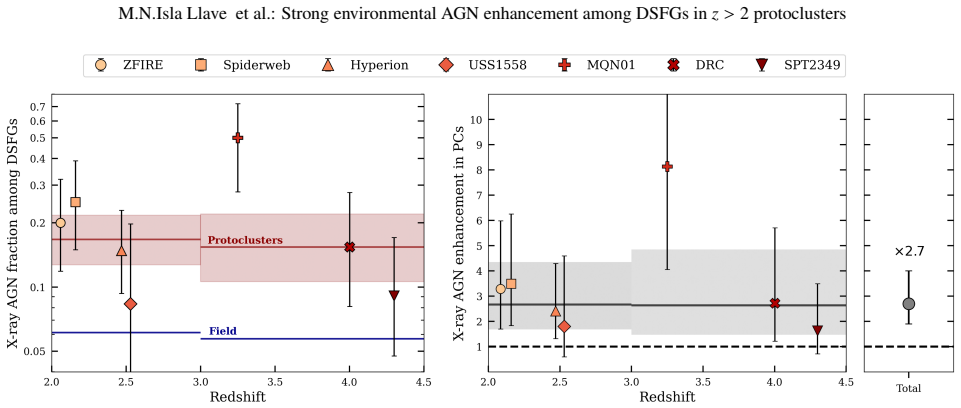
Dense protocluster environments at z>2 boost X-ray AGN incidence in DSFGs by a factor of ~2.7 compared to field galaxies.
A machine-rendered reading of the paper's core claim, the machinery that carries it, and where it could break.
Core claim
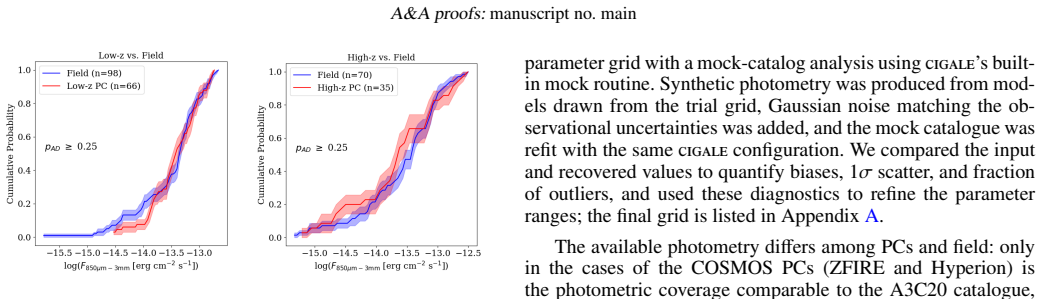
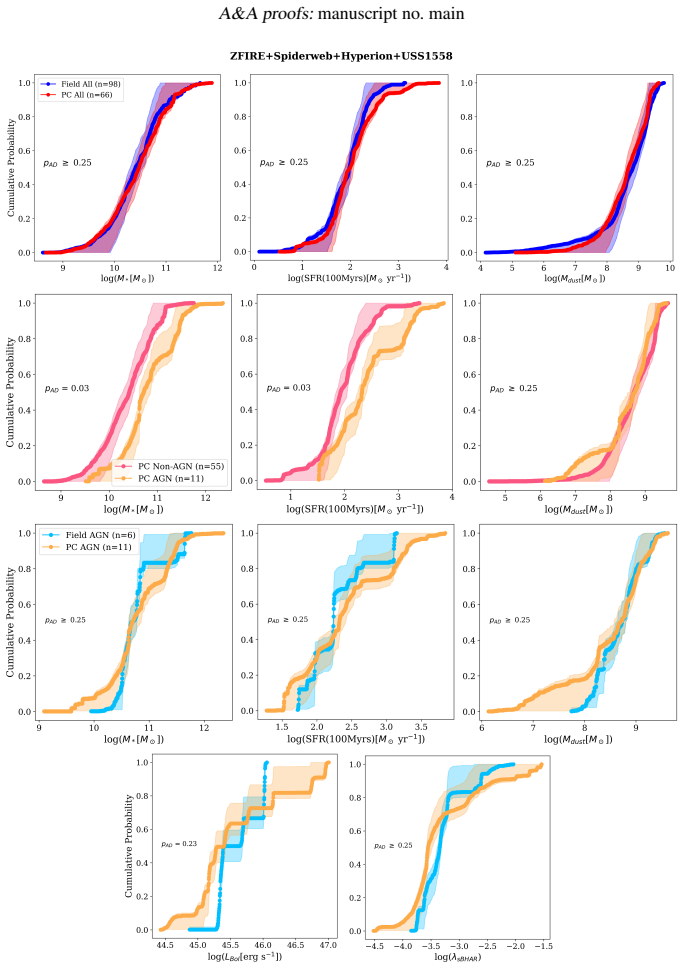
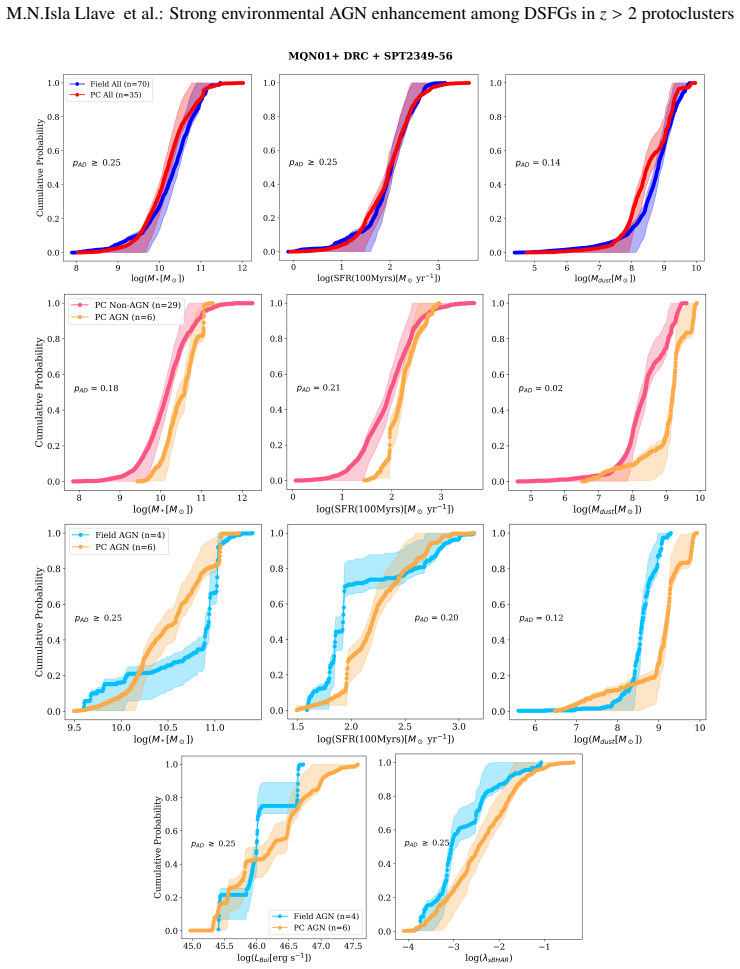
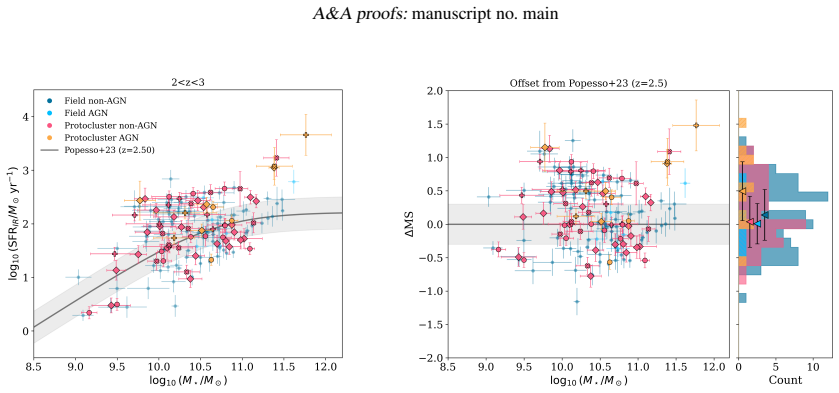
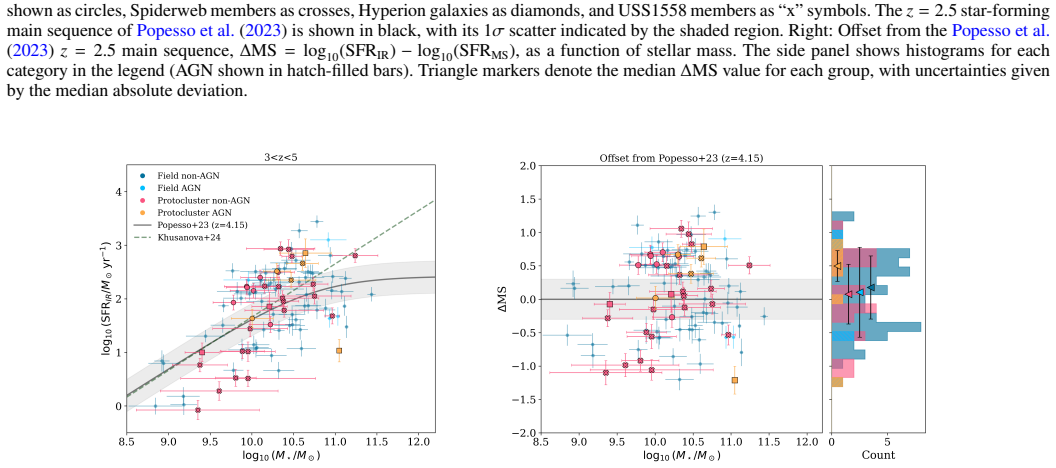
The incidence of X-ray AGN among ALMA-detected DSFGs in seven protoclusters at 2 < z < 4.5 is enhanced by a factor of ~2.7 relative to a selection-matched field sample, with the protocluster and field samples well matched in stellar mass, star-formation rate, and dust mass, providing evidence that the dense environment enhances AGN incidence and SMBH growth beyond host galaxy properties alone.
What carries the argument
Statistical comparison of X-ray AGN fractions in ALMA-detected DSFG samples from protoclusters versus a homogeneously selected COSMOS field control sample, using uniform SED-derived host properties.
If this is right
- The AGN enhancement factor remains ~2.7 in separate redshift bins at z=2-3 and z=3-4.5.
- Host galaxy stellar mass, star-formation rate, and dust mass do not account for the difference in AGN incidence.
- Increased gas availability and galaxy interactions in the dense environment are the likely drivers of the enhanced fueling.
Where Pith is reading between the lines
- The result implies that protocluster environments accelerate early supermassive black hole growth in star-forming galaxies, which could leave observable signatures in the black hole mass distributions of present-day cluster members.
- Similar environmental boosts may appear when using other AGN indicators such as infrared or radio emission, allowing tests of whether the effect is accretion-mode dependent.
- Galaxy evolution models that include environmental effects on gas dynamics at high redshift should reproduce an AGN fraction increase of this magnitude in dense regions.
Load-bearing premise
The protocluster and field DSFG samples are selected and characterized homogeneously enough that differences in X-ray AGN fraction arise from environment rather than residual biases in continuum detection, X-ray sensitivity, or SED properties.
What would settle it
Repeating the analysis after stricter matching or correction for any remaining differences in X-ray flux limits, ALMA sensitivity, or SED fitting parameters between the two samples and finding the enhancement disappears.
Figures
read the original abstract
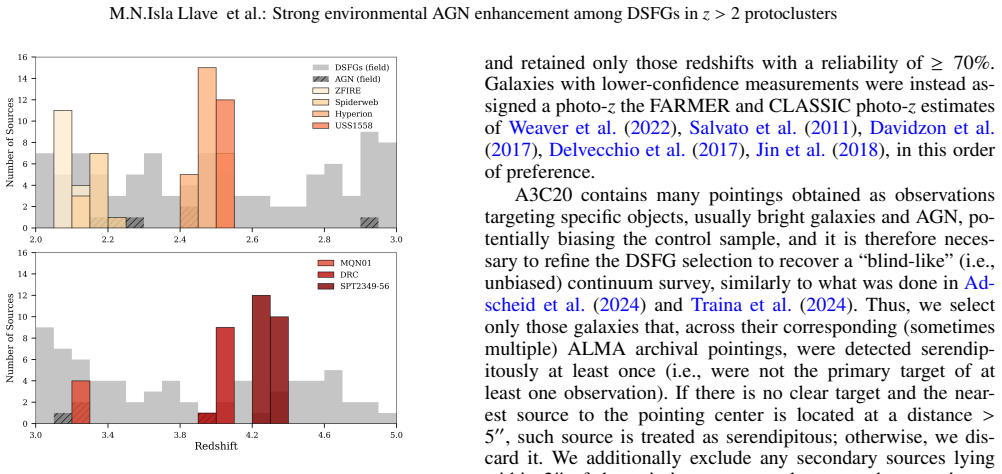
Galaxy protoclusters (PCs) at z > 2 are dense regions in which cold gas availability and elevated galaxy interaction rates trigger intense, often dust-obscured, star formation. These mechanisms are also expected to promote super-massive black hole (SMBH) growth, but this effect remains unclear, largely due to heterogeneous galaxy selections and active galactic nuclei (AGN) identification methods in previous studies. We quantitatively assess the impact of PC environment on SMBH growth by measuring the incidence of X-ray AGN among dusty star-forming galaxies (DSFGs) in PCs and in a homogeneously selected control field sample, and investigate the physical mechanisms driving any difference. We consider ALMA-detected DSFGs in sub-mm/mm continuum of seven PCs at 2 < z < 4.5, and construct a selection-matched control sample from the COSMOS survey. We statistically compare X-ray AGN incidence and host galaxy physical properties obtained through uniform spectral energy distribution fitting. We find a significant enhancement of X-ray AGN fraction in PCs by ~2.7x (Poisson significance p = 3e-4). Similar values are found in two redshift bins: ~2.7x at z = 2-3 (p = 0.003) and ~2.6x at z = 3-4.5 (p = 0.03). PC and field DSFG samples are well matched in stellar mass, star-formation rate, and dust mass, ruling out selection effects or systematically higher host masses as the driver. Our results provide quantitative evidence that the dense PC environment enhances AGN incidence and SMBH growth in DSFGs beyond what host galaxy properties alone predict, likely through increased gas availability and interaction-driven fueling. This work is a first step toward a homogeneous assessment of environmental effects on SMBH growth across cosmic time.
Editorial analysis
A structured set of objections, weighed in public.
Referee Report
Summary. The manuscript reports a ~2.7x enhancement (p=3e-4) in the X-ray AGN fraction among ALMA-detected DSFGs in seven z>2 protoclusters relative to a selection-matched COSMOS field sample. The enhancement persists in two redshift bins (~2.7x at z=2-3, ~2.6x at z=3-4.5). PC and field samples are stated to be matched in stellar mass, SFR, and dust mass via uniform SED fitting, leading to the conclusion that dense environments enhance AGN incidence and SMBH growth beyond host properties alone, likely via gas availability and interactions.
Significance. If X-ray sensitivity and completeness are shown to be equivalent, the direct count-ratio approach would supply quantitative evidence for environmental effects on AGN activity at z>2, improving on prior heterogeneous studies. The redshift-binned consistency and property matching are strengths that would support the attribution to environment rather than selection.
major comments (2)
- [Abstract] Abstract: The claim that 'PC and field DSFG samples are well matched in stellar mass, star-formation rate, and dust mass, ruling out selection effects' does not address X-ray flux limits, exposure times, or completeness corrections between the seven heterogeneous PC fields and the COSMOS control. Because the AGN fraction is measured exclusively via X-ray detections, any uncorrected sensitivity mismatch directly affects the counted fraction and is load-bearing for the environmental attribution.
- [Abstract] Abstract and results section: Sample sizes for the PC and field DSFG populations, the raw number of X-ray AGN detections in each, and the full error budget (including any completeness corrections) are not provided. These quantities are required to verify the reported Poisson significances (p=3e-4 overall, p=0.003 and p=0.03 in the bins) and to confirm that the ~2.7x factor is robust.
minor comments (1)
- [Abstract] Abstract: The exact boundary between the z=2-3 and z=3-4.5 bins and the handling of sources at z=3 should be stated explicitly.
Simulated Author's Rebuttal
We thank the referee for the constructive feedback on our manuscript. The two major comments highlight important aspects of transparency regarding X-ray observational properties and sample statistics that were not sufficiently detailed. We address each point below and will incorporate revisions to strengthen the manuscript.
read point-by-point responses
-
Referee: [Abstract] Abstract: The claim that 'PC and field DSFG samples are well matched in stellar mass, star-formation rate, and dust mass, ruling out selection effects' does not address X-ray flux limits, exposure times, or completeness corrections between the seven heterogeneous PC fields and the COSMOS control. Because the AGN fraction is measured exclusively via X-ray detections, any uncorrected sensitivity mismatch directly affects the counted fraction and is load-bearing for the environmental attribution.
Authors: We agree that the abstract's phrasing emphasizes host-galaxy property matching via SED fitting but does not explicitly discuss X-ray sensitivity. The seven protocluster fields were chosen in part because they possess deep Chandra or XMM-Newton coverage comparable to COSMOS, yet a quantitative comparison of flux limits, exposure times, and completeness is indeed required to rule out observational bias. In the revised manuscript we will add a new subsection (or expanded paragraph in Methods/Results) that tabulates the X-ray exposure times and 0.5-10 keV flux limits for each protocluster field versus the COSMOS reference, together with any completeness corrections applied to the AGN counts. This will directly address whether sensitivity differences could contribute to the observed factor of ~2.7 enhancement. revision: yes
-
Referee: [Abstract] Abstract and results section: Sample sizes for the PC and field DSFG populations, the raw number of X-ray AGN detections in each, and the full error budget (including any completeness corrections) are not provided. These quantities are required to verify the reported Poisson significances (p=3e-4 overall, p=0.003 and p=0.03 in the bins) and to confirm that the ~2.7x factor is robust.
Authors: The referee is correct that the abstract and the current results section do not present the raw counts or a complete error budget in a readily verifiable form. While the Poisson p-values are derived from the underlying counts, explicit tabulation is necessary for reproducibility. We will revise the manuscript to include (i) the total number of ALMA-detected DSFGs in the combined protocluster sample and in the COSMOS control, (ii) the number of X-ray AGN detections in each, and (iii) an expanded error analysis that incorporates Poisson uncertainties plus any completeness corrections. These numbers will be presented both in the text and in a new summary table so that readers can directly recompute the reported significances and the ~2.7 factor. revision: yes
Circularity Check
No circularity: direct observational count ratio from matched samples
full rationale
The paper's central result is an observed ~2.7x ratio in X-ray AGN fraction between protocluster and COSMOS field DSFG samples, computed directly from detections after matching on M*, SFR, and dust mass. No equations, fitted parameters, or self-citations reduce this ratio to an input quantity by construction; the enhancement is not a prediction derived from host properties but a residual difference after explicit matching. The analysis is therefore self-contained and externally falsifiable via the raw counts and selection criteria.
Axiom & Free-Parameter Ledger
axioms (2)
- domain assumption X-ray sources above a standard luminosity threshold are classified as AGN
- domain assumption ALMA sub-mm/mm continuum selection produces comparable DSFG samples across protocluster and field environments
Reference graph
Works this paper leans on
-
[1]
2024, A&A, 685, A1
Adscheid, S., Magnelli, B., Liu, D., et al. 2024, A&A, 685, A1
2024
-
[2]
L., & Georgakakis, A
Aird, J., Coil, A. L., & Georgakakis, A. 2018, MNRAS, 474, 1225
2018
-
[3]
L., Georgakakis, A., et al
Aird, J., Coil, A. L., Georgakakis, A., et al. 2015, MNRAS, 451, 1892
2015
-
[4]
& Noble, A
Alberts, S. & Noble, A. 2022, Universe, 8, 554
2022
-
[5]
2014, MNRAS, 437, 437
Alberts, S., Pope, A., Brodwin, M., et al. 2014, MNRAS, 437, 437
2014
-
[6]
Anderson, T. W. & Darling, D. A. 1952, The Annals of Mathematical Statistics, 23, 193
1952
-
[7]
L., et al
Aoyama, K., Kodama, T., Suzuki, T. L., et al. 2022, ApJ, 924, 74 Astropy Collaboration, Price-Whelan, A. M., Sip˝ocz, B. M., et al. 2018, AJ, 156, 123 Astropy Collaboration, Robitaille, T. P., Tollerud, E. J., et al. 2013, A&A, 558, A33
2022
-
[8]
A., Phillips, M
Baldwin, J. A., Phillips, M. M., & Terlevich, R. 1981, PASP, 93, 5
1981
-
[9]
N., Kauffmann, G., Heckman, T
Best, P. N., Kauffmann, G., Heckman, T. M., et al. 2005, MNRAS, 362, 25
2005
-
[10]
2012, MNRAS, 427, 3103
Bongiorno, A., Merloni, A., Brusa, M., et al. 2012, MNRAS, 427, 3103
2012
-
[11]
2019, A&A, 622, A103
Boquien, M., Burgarella, D., Roehlly, Y ., et al. 2019, A&A, 622, A103
2019
-
[12]
J., et al
Borisova, E., Cantalupo, S., Lilly, S. J., et al. 2016, ApJ, 831, 39
2016
-
[13]
Brandt, W. N. & Alexander, D. M. 2015, A&A Rev., 23, 1
2015
-
[14]
Brinchmann, J., Charlot, S., White, S. D. M., et al. 2004, MNRAS, 351, 1151
2004
-
[15]
D., Cai, T
Brown, L. D., Cai, T. T., & DasGupta, A. 2001, Statistical Science, 16, 101
2001
-
[16]
& Charlot, S
Bruzual, G. & Charlot, S. 2003, MNRAS, 344, 1000
2003
-
[17]
C., et al
Calzetti, D., Armus, L., Bohlin, R. C., et al. 2000, ApJ, 533, 682
2000
-
[18]
Casey, C. M. 2016, ApJ, 824, 36
2016
-
[19]
M., Cooray, A., Capak, P., et al
Casey, C. M., Cooray, A., Capak, P., et al. 2015, ApJ, 808, L33
2015
-
[20]
2003, PASP, 115, 763
Chabrier, G. 2003, PASP, 115, 763
2003
-
[21]
B., Casey, C
Champagne, J. B., Casey, C. M., Zavala, J. A., et al. 2021, ApJ, 913, 110
2021
-
[22]
D., et al
Chen, Z., Dannerbauer, H., Lehnert, M. D., et al. 2024, MNRAS, 527, 8950 Article number, page 13 of 21 A&A proofs:manuscript no. main
2024
-
[23]
A., Gebhardt, K., et al
Chiang, Y .-K., Overzier, R. A., Gebhardt, K., et al. 2015, ApJ, 808, 37
2015
-
[24]
A., Gebhardt, K., & Henriques, B
Chiang, Y .-K., Overzier, R. A., Gebhardt, K., & Henriques, B. 2017, ApJ, 844, L23
2017
-
[25]
2016, ApJ, 819, 62
Civano, F., Marchesi, S., Comastri, A., et al. 2016, ApJ, 819, 62
2016
-
[26]
Cruise, M. et al. 2025, Nature Astron., 9, 36
2025
-
[27]
C., Zamorani, G., et al
Cucciati, O., Lemaux, B. C., Zamorani, G., et al. 2018, A&A, 619, A49
2018
-
[28]
C., et al
Cucciati, O., Zamorani, G., Lemaux, B. C., et al. 2014, A&A, 570, A16
2014
-
[29]
M., et al
Daikuhara, K., Kodama, T., Pérez-Martínez, J. M., et al. 2024, MNRAS, 531, 2335
2024
-
[30]
D., De Breuck, C., et al
Dannerbauer, H., Kurk, J. D., De Breuck, C., et al. 2014, A&A, 570, A55
2014
-
[31]
D., Emonts, B., et al
Dannerbauer, H., Lehnert, M. D., Emonts, B., et al. 2017, A&A, 608, A48
2017
-
[32]
2017, A&A, 605, A70
Davidzon, I., Ilbert, O., Laigle, C., et al. 2017, A&A, 605, A70
2017
-
[33]
2017, A&A, 602, A3 Di Matteo, T., Springel, V ., & Hernquist, L
Delvecchio, I., Smolˇci´c, V ., Zamorani, G., et al. 2017, A&A, 602, A3 Di Matteo, T., Springel, V ., & Hernquist, L. 2005, Nature, 433, 604
2017
-
[34]
J., Knobel, C., et al
Diener, C., Lilly, S. J., Knobel, C., et al. 2013, ApJ, 765, 109
2013
-
[35]
J., Ledoux, C., et al
Diener, C., Lilly, S. J., Ledoux, C., et al. 2015, ApJ, 802, 31
2015
-
[36]
L., Koekemoer, A
Donley, J. L., Koekemoer, A. M., Brusa, M., et al. 2012, ApJ, 748, 142
2012
-
[37]
T., Aniano, G., Krause, O., et al
Draine, B. T., Aniano, G., Krause, O., et al. 2014, ApJ, 780, 172
2014
-
[38]
2016, MNRAS, 463, 3948
Dubois, Y ., Peirani, S., Pichon, C., et al. 2016, MNRAS, 463, 3948
2016
-
[39]
2010, PASP, 122, 499
Eales, S., Dunne, L., Clements, D., et al. 2010, PASP, 122, 499
2010
-
[40]
Fabian, A. C. 2012, ARA&A, 50, 455
2012
-
[41]
C., et al
Forrest, B., Shen, L., Lemaux, B. C., et al. 2025, ApJ, 985, 61
2025
-
[42]
2025, A&A, 696, A95
Galbiati, M., Cantalupo, S., Steidel, C., et al. 2025, A&A, 696, A95
2025
-
[43]
Giddings, F., Lemaux, B. C., Forrest, B., et al. 2025, arXiv e-prints, arXiv:2503.04913 Gómez-Guijarro, C., Riechers, D. A., Pavesi, R., et al. 2019, ApJ, 872, 117
-
[44]
C., et al
Gururajan, G., Cucciati, O., Lemaux, B. C., et al. 2025, A&A, 698, A312
2025
-
[45]
J., Blain, A
Hainline, L. J., Blain, A. W., Smail, I., et al. 2011, ApJ, 740, 96 Häring, N. & Rix, H.-W. 2004, ApJ, 604, L89
2011
-
[46]
2018, ApJ, 858, 77
Hasinger, G., Capak, P., Salvato, M., et al. 2018, ApJ, 858, 77
2018
-
[47]
2012, ApJ, 757, 15
Hayashi, M., Kodama, T., Tadaki, K.-i., Koyama, Y ., & Tanaka, I. 2012, ApJ, 757, 15
2012
-
[48]
2016, ApJ, 826, L28
Hayashi, M., Kodama, T., Tanaka, I., et al. 2016, ApJ, 826, L28
2016
-
[49]
A., et al
Hill, R., Chapman, S., Phadke, K. A., et al. 2022, MNRAS, 512, 4352
2022
-
[50]
2020, MNRAS, 495, 3124
Hill, R., Chapman, S., Scott, D., et al. 2020, MNRAS, 495, 3124
2020
-
[51]
Hodge, J. A. & da Cunha, E. 2020, Royal Society Open Science, 7, 200556
2020
-
[52]
F., Hernquist, L., Cox, T
Hopkins, P. F., Hernquist, L., Cox, T. J., et al. 2006, ApJS, 163, 1
2006
-
[53]
F., Kereš, D., Murray, N., Quataert, E., & Hernquist, L
Hopkins, P. F., Kereš, D., Murray, N., Quataert, E., & Hernquist, L. 2012, MN- RAS, 427, 968
2012
-
[54]
2025, A&A, 699, A324
Huang, S., Umehata, H., Smail, I., et al. 2025, A&A, 699, A324
2025
-
[55]
M., Chiang, Y .-K., et al
Hung, C.-L., Casey, C. M., Chiang, Y .-K., et al. 2016, ApJ, 826, 130
2016
-
[56]
J., Biggs, A
Ivison, R. J., Biggs, A. D., Bremer, M., Arumugam, V ., & Dunne, L. 2020, MN- RAS, 496, 4358
2020
-
[57]
J., Lewis, A
Ivison, R. J., Lewis, A. J. R., Weiss, A., et al. 2016, ApJ, 832, 78
2016
-
[58]
2018, ApJ, 864, 56
Jin, S., Daddi, E., Liu, D., et al. 2018, ApJ, 864, 56
2018
-
[59]
2021, A&A, 652, A11
Jin, S., Dannerbauer, H., Emonts, B., et al. 2021, A&A, 652, A11
2021
-
[60]
W., Brandt, W
Just, D. W., Brandt, W. N., Shemmer, O., et al. 2007, ApJ, 665, 1004
2007
-
[61]
2006, MNRAS, 371, 577
Kajisawa, M., Kodama, T., Tanaka, I., Yamada, T., & Bower, R. 2006, MNRAS, 371, 577
2006
-
[62]
M., Tremonti, C., et al
Kauffmann, G., Heckman, T. M., Tremonti, C., et al. 2003, MNRAS, 346, 1055
2003
-
[63]
Kennicutt, R. C. & Evans, N. J. 2012, ARA&A, 50, 531
2012
-
[64]
Kennicutt, Jr., R. C. 1998, ARA&A, 36, 189
1998
-
[65]
Khostovan, A. A., Kartaltepe, J. S., Salvato, M., et al. 2025, arXiv e-prints, arXiv:2503.00120
-
[66]
2021, A&A, 649, A152
Khusanova, Y ., Bethermin, M., Le Fèvre, O., et al. 2021, A&A, 649, A152
2021
-
[67]
A., Miley, G
Kuiper, E., Hatch, N. A., Miley, G. K., et al. 2011, MNRAS, 415, 2245
2011
-
[68]
2004, in Astrophysics and Space Science Library, V ol
Kurk, J., Venemans, B., Röttgering, H., Miley, G., & Pentericci, L. 2004, in Astrophysics and Space Science Library, V ol. 301, Astrophysics and Space Science Library, ed. M. Plionis, 141
2004
-
[69]
D., Röttgering, H
Kurk, J. D., Röttgering, H. J. A., Pentericci, L., et al. 2000, A&A, 358, L1
2000
-
[70]
J., Ilbert, O., et al
Laigle, C., McCracken, H. J., Ilbert, O., et al. 2016, ApJS, 224, 24
2016
-
[71]
S., Nandra, K., Hobbs, A., & Steidel, C
Laird, E. S., Nandra, K., Hobbs, A., & Steidel, C. C. 2006, MNRAS, 373, 217
2006
-
[72]
2015, A&A, 573, A137 Le Fèvre, O., Tasca, L
Lanzuisi, G., Ranalli, P., Georgantopoulos, I., et al. 2015, A&A, 573, A137 Le Fèvre, O., Tasca, L. A. M., Cassata, P., et al. 2015, A&A, 576, A79
2015
-
[73]
D., Alexander, D
Lehmer, B. D., Alexander, D. M., Geach, J. E., et al. 2009, ApJ, 691, 687
2009
-
[74]
D., Eufrasio, R
Lehmer, B. D., Eufrasio, R. T., Tzanavaris, P., et al. 2019, ApJS, 243, 3
2019
-
[75]
C., Cucciati, O., Le Fèvre, O., et al
Lemaux, B. C., Cucciati, O., Le Fèvre, O., et al. 2022, A&A, 662, A33
2022
-
[76]
J., Le Brun, V ., Maier, C., et al
Lilly, S. J., Le Brun, V ., Maier, C., et al. 2009, ApJS, 184, 218
2009
-
[77]
J., Le Fèvre, O., Renzini, A., et al
Lilly, S. J., Le Fèvre, O., Renzini, A., et al. 2007, ApJS, 172, 70
2007
-
[78]
Z., Shi, D
Liu, S., Zheng, X. Z., Shi, D. D., et al. 2023, MNRAS, 523, 2422
2023
-
[79]
S., Cooray, A., Ma, J., et al
Long, A. S., Cooray, A., Ma, J., et al. 2020, ApJ, 898, 133
2020
-
[80]
D., et al
Macuga, M., Martini, P., Miller, E. D., et al. 2019, ApJ, 874, 54
2019
discussion (0)
Sign in with ORCID, Apple, or X to comment. Anyone can read and Pith papers without signing in.