Entropy-mode imprints in the solar corona: non-exponential damping and phase shifts of compressive oscillations
Pith reviewed 2026-06-28 03:43 UTC · model grok-4.3
The pith
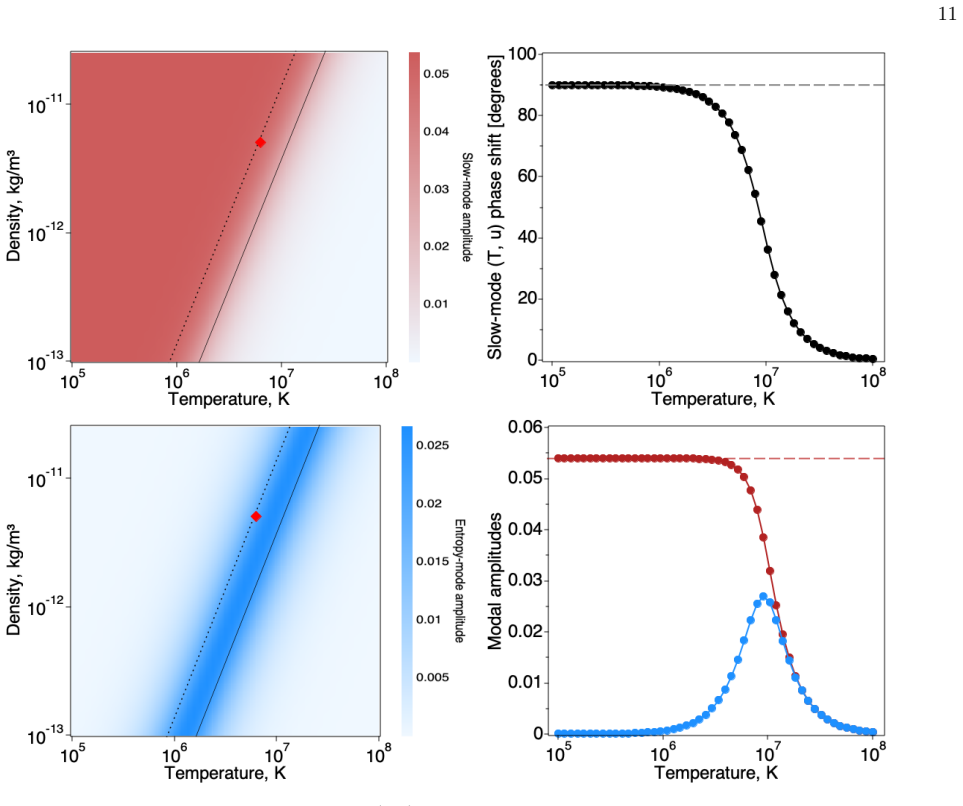
The entropy mode imprints non-exponential damping, envelope asymmetry, and phase-shift deviations on standing slow-mode oscillations in coronal loops.
A machine-rendered reading of the paper's core claim, the machinery that carries it, and where it could break.
Core claim
The entropy mode produces observable non-exponential damping, envelope asymmetry, and deviations from the canonical quarter-period phase shift in standing slow-mode oscillations through its faster decay relative to the slow mode.
What carries the argument
The entropy mode, a non-propagating eigenmode whose decay is governed by thermal conduction in the coronal plasma, superposed on the standing slow mode.
Load-bearing premise
The model assumes that standing slow and entropy modes can be simultaneously excited with independent initial amplitudes in a strictly one-dimensional field-aligned geometry with only thermal conduction as the non-adiabatic process.
What would settle it
Direct measurement of purely exponential damping with symmetric envelopes and exact quarter-period phase shifts in coronal loop oscillations would contradict the predicted entropy-mode contribution.
Figures
read the original abstract
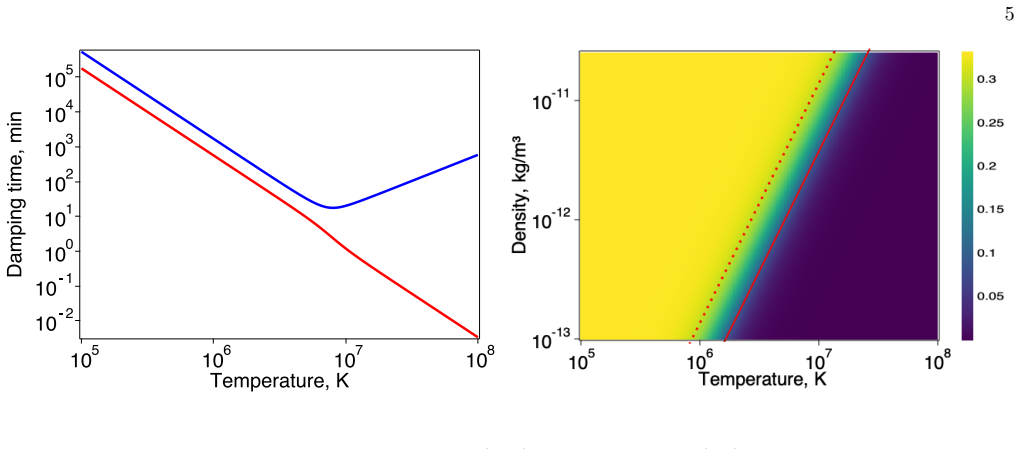
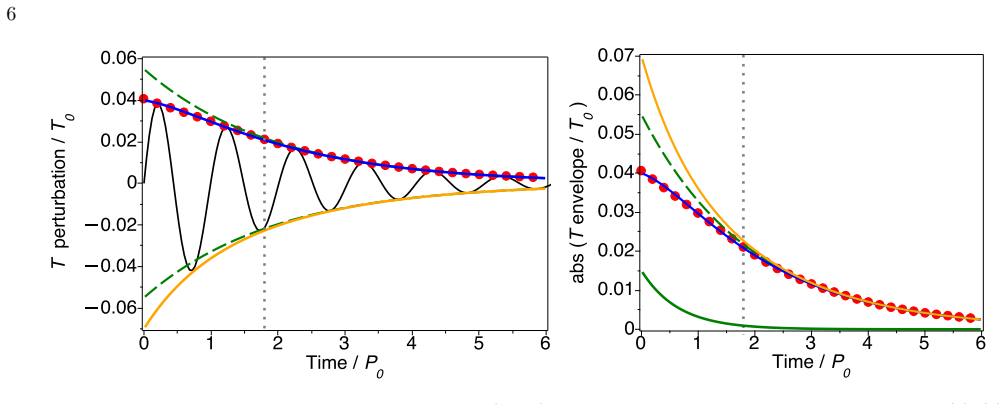
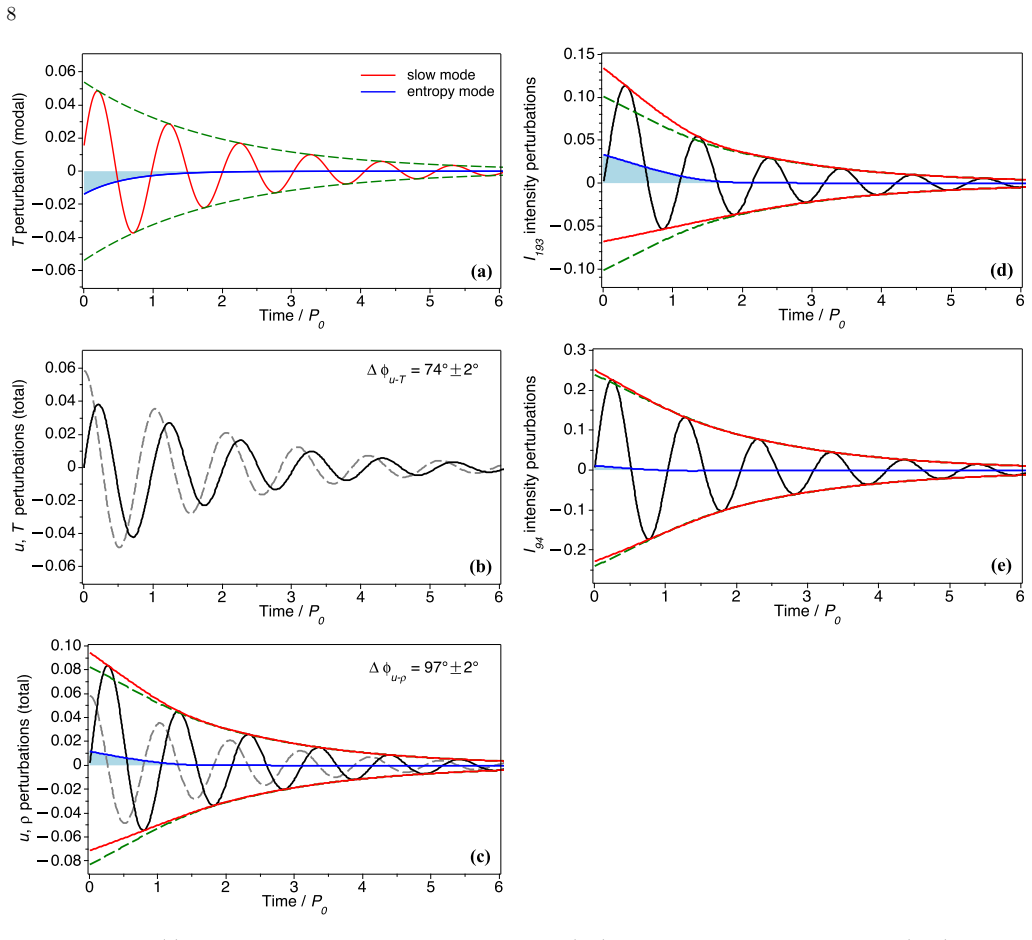
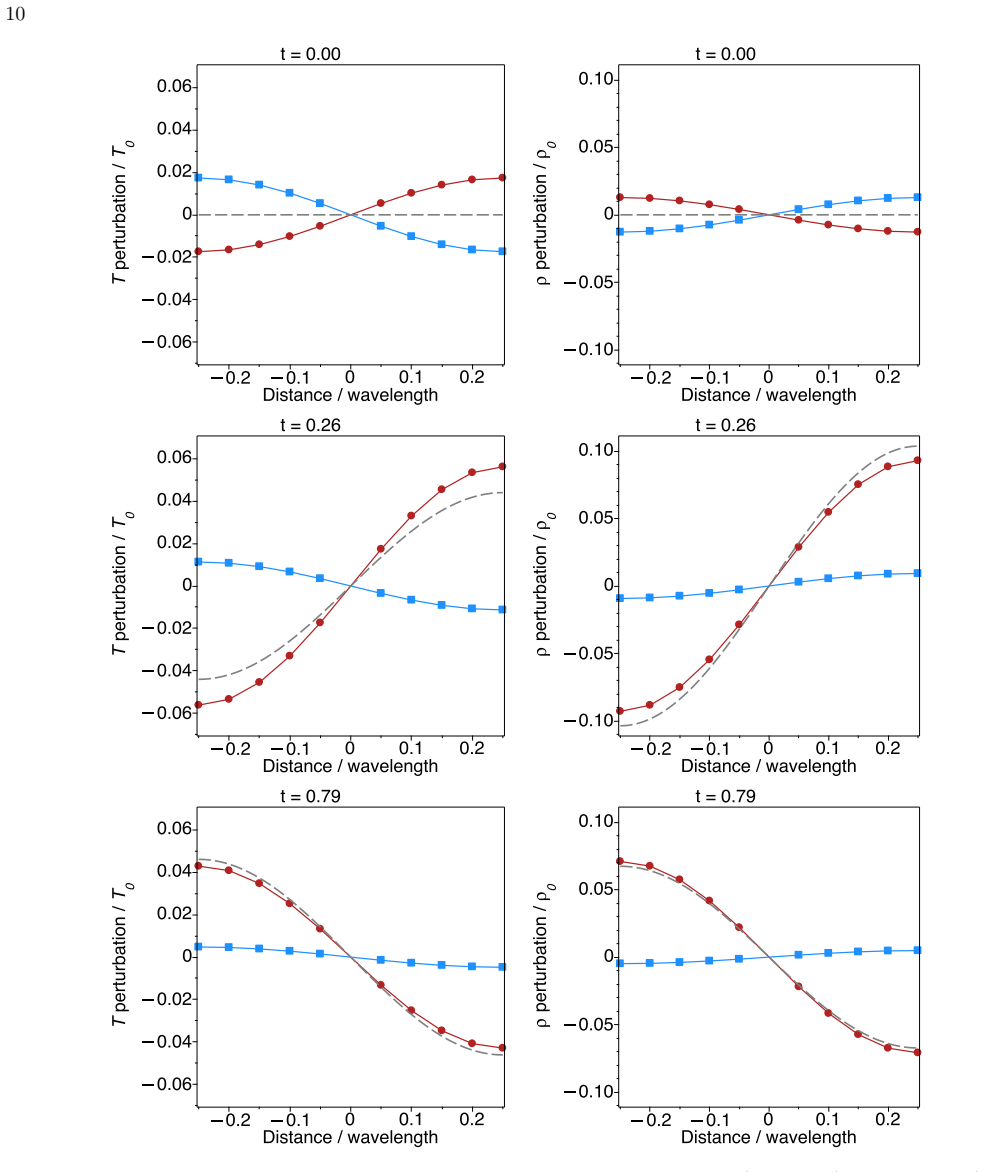
Magnetohydrodynamic (MHD) waves in coronal loops provide key seismological diagnostics through their characteristic time signatures. While fast and slow magnetoacoustic modes are routinely exploited, the entropy mode, despite being another eigenmode of the system, remains largely inaccessible due to its non-propagating and non-oscillatory nature. We identify possible observable time-domain signatures of the entropy mode and its indirect effects. Our approach exploits the intrinsically non-adiabatic conditions of the solar corona, under which the entropy mode is closely linked to the compressive slow mode. We consider a one-dimensional coronal loop model with field-aligned thermal conduction, where standing slow and entropy modes are simultaneously excited. We show that the entropy mode leaves distinct imprints on the total loop temperature and density perturbations. Specifically, its rapid decay relative to the slow mode produces a non-exponential damping profile during the initial oscillation cycles and introduces a pronounced asymmetry between the upper and lower temperature and density envelopes. These effects arise naturally from the superposition of two exponentially decaying components with different damping timescales. Furthermore, deviations from the canonical quarter-period phase shift between temperature/density and velocity perturbations in the standing slow mode are explained by the entropy-mode effect. We conclude that the entropy mode may be detected through its impact on compressive oscillations. Revealing its role in non-exponential damping, envelope asymmetry, and phase shifts of compressive oscillations makes the entropy mode potentially accessible to observations and lays the foundation for solar and stellar seismological applications.
Editorial analysis
A structured set of objections, weighed in public.
Referee Report
Summary. The manuscript claims that in a 1D field-aligned coronal loop model with thermal conduction, simultaneous excitation of standing slow and entropy eigenmodes produces observable imprints of the entropy mode on compressive oscillations: non-exponential damping and asymmetric envelopes in the initial cycles (arising from linear superposition of two exponentially decaying components with different timescales), plus deviations from the canonical quarter-period phase shift between velocity and thermodynamic variables.
Significance. If the model implementation and amplitude projections hold, the work would identify a concrete pathway to make the entropy mode accessible to observations via its indirect effects on slow-mode signatures, with potential seismological applications. The underlying linear superposition is mathematically direct once the modes coexist, which is a strength if the excitation amplitudes are shown to be realistic.
major comments (2)
- [Abstract, 1D coronal loop model paragraph] Abstract, paragraph on the 1D coronal loop model: the central claim requires that standing slow and entropy modes can be excited simultaneously with independent initial amplitudes such that the faster-decaying entropy component measurably alters damping, envelope asymmetry, and phase shifts. However, eigenmode amplitudes are fixed by projection of any physical initial condition; the manuscript does not demonstrate that realistic coronal perturbations produce an entropy-mode amplitude large enough to dominate the first few cycles or to produce phase deviations beyond those already arising from non-adiabatic effects in the slow mode alone.
- [Abstract] The abstract states that the reported effects arise from superposition of two exponentially decaying components, which is mathematically correct, but supplies no explicit equations for the eigenmodes, initial conditions, or numerical verification of the claimed non-exponential profiles and phase shifts. This leaves the load-bearing implementation unshown.
Simulated Author's Rebuttal
We thank the referee for the constructive comments on our manuscript. We address each major point below and have revised the manuscript accordingly to strengthen the presentation of initial conditions, mode projections, and references to the implementation details.
read point-by-point responses
-
Referee: [Abstract, 1D coronal loop model paragraph] Abstract, paragraph on the 1D coronal loop model: the central claim requires that standing slow and entropy modes can be excited simultaneously with independent initial amplitudes such that the faster-decaying entropy component measurably alters damping, envelope asymmetry, and phase shifts. However, eigenmode amplitudes are fixed by projection of any physical initial condition; the manuscript does not demonstrate that realistic coronal perturbations produce an entropy-mode amplitude large enough to dominate the first few cycles or to produce phase deviations beyond those already arising from non-adiabatic effects in the slow mode alone.
Authors: We agree that eigenmode amplitudes are determined by projection of the initial condition. The manuscript examines initial conditions corresponding to localized heating that project onto both modes with sufficient entropy-mode amplitude to produce the reported effects in the first few cycles, as verified by explicit decomposition in the results. We have added a new subsection on eigenmode projection with example calculations for heating-like perturbations, showing that moderate entropy-mode contributions are achievable and lead to observable modifications beyond pure slow-mode non-adiabatic damping. We have also revised the abstract to specify that the signatures are demonstrated for co-excited modes under such conditions. revision: partial
-
Referee: [Abstract] The abstract states that the reported effects arise from superposition of two exponentially decaying components, which is mathematically correct, but supplies no explicit equations for the eigenmodes, initial conditions, or numerical verification of the claimed non-exponential profiles and phase shifts. This leaves the load-bearing implementation unshown.
Authors: The abstract is a concise overview and does not contain equations, per standard journal practice. The full manuscript derives the eigenmodes in Section 2, specifies the initial conditions in Section 3, and provides numerical verification of the non-exponential damping, envelope asymmetry, and phase shifts in Section 4 with supporting figures. We have revised the abstract to reference the linear superposition explicitly and to direct readers to the relevant sections for the eigenmode equations, initial conditions, and verification. revision: yes
Circularity Check
No significant circularity detected
full rationale
The paper derives observable signatures (non-exponential damping, envelope asymmetry, phase-shift deviations) directly from linear superposition of two standing eigenmodes with distinct decay rates in the stated 1D conduction model. No parameter is fitted to data and then relabeled a prediction, no self-citation chain supplies a uniqueness theorem or ansatz, and no quantity is defined in terms of itself. The claimed effects are algebraic consequences of the assumed initial conditions and the known analytic solutions for each mode; the derivation therefore remains self-contained once the model and coexistence assumption are granted.
Axiom & Free-Parameter Ledger
axioms (2)
- domain assumption The solar corona is intrinsically non-adiabatic, allowing coupling between slow and entropy modes via field-aligned thermal conduction.
- domain assumption A one-dimensional coronal loop geometry with only field-aligned thermal conduction is sufficient to capture the relevant dynamics.
Reference graph
Works this paper leans on
-
[1]
2009, SSRv, 149, 3, doi: 10.1007/s11214-009-9561-2
Andries, J., van Doorsselaere, T., Roberts, B., et al. 2009, SSRv, 149, 3, doi: 10.1007/s11214-009-9561-2
-
[2]
Anfinogentov, S. A., Antolin, P., Inglis, A. R., et al. 2022, SSRv, 218, 9, doi: 10.1007/s11214-021-00869-w
-
[3]
2022, Frontiers in Astronomy and Space Sciences, 9, 820116, doi: 10.3389/fspas.2022.820116
Antolin, P., & Froment, C. 2022, Frontiers in Astronomy and Space Sciences, 9, 820116, doi: 10.3389/fspas.2022.820116
-
[4]
Arber, T. D., Goffrey, T., & Ridgers, C. 2023, Frontiers in Astronomy and Space Sciences, 10, 1155124, doi: 10.3389/fspas.2023.1155124
-
[5]
2018, Advances in Space Research, 61, 655, doi: 10.1016/j.asr.2017.09.031
Arregui, I. 2018, Advances in Space Research, 61, 655, doi: 10.1016/j.asr.2017.09.031
-
[6]
Arregui, I., Kolotkov, D. Y., & Nakariakov, V. M. 2023, A&A, 677, A23, doi: 10.1051/0004-6361/202346834
-
[7]
2024, in Magnetohydrodynamic Processes in Solar Plasmas, ed
Arregui, I., & Van Doorsselaere, T. 2024, in Magnetohydrodynamic Processes in Solar Plasmas, ed. A. K. Srivastava, M. Goossens, & I. Arregui, 415–450, doi: 10.1016/B978-0-32-395664-2.00015-3
-
[8]
Title, A. M. 2002, SoPh, 206, 99, doi: 10.1023/A:1014916701283
-
[9]
Banerjee, D., Gupta, G. R., & Teriaca, L. 2011, SSRv, 158, 267, doi: 10.1007/s11214-010-9698-z
-
[10]
2016, Geophysical Monograph Series, 216, 419, doi: 10.1002/9781119055006.ch24
Banerjee, D., & Krishna Prasad, S. 2016, Geophysical Monograph Series, 216, 419, doi: 10.1002/9781119055006.ch24
-
[11]
2021, SSRv, 217, 76, doi: 10.1007/s11214-021-00849-0 15
Banerjee, D., Krishna Prasad, S., Pant, V., et al. 2021, SSRv, 217, 76, doi: 10.1007/s11214-021-00849-0
-
[12]
Belov, S. A., Goffrey, T., Arber, T. D., & Kolotkov, D. Y. 2025, A&A, 693, A186, doi: 10.1051/0004-6361/202452938
-
[13]
Belov, S. A., Molevich, N. E., & Zavershinskii, D. I. 2021, SoPh, 296, 122, doi: 10.1007/s11207-021-01868-4
-
[14]
2012, SoPh, 275, 41, doi: 10.1007/s11207-011-9804-8
Boerner, P., Edwards, C., Lemen, J., et al. 2012, SoPh, 275, 41, doi: 10.1007/s11207-011-9804-8
-
[15]
Schrijver, C. J. 2014, SoPh, 289, 2377, doi: 10.1007/s11207-013-0452-z
-
[16]
The Astrophysical Journal , keywords =
Kumar, P. 2016, ApJ, 830, 110, doi: 10.3847/0004-637X/830/2/110 De Moortel, I. 2009, SSRv, 149, 65, doi: 10.1007/s11214-009-9526-5 De Moortel, I., & Hood, A. W. 2003, A&A, 408, 755, doi: 10.1051/0004-6361:20030984
-
[17]
Dolla, L., Marqué, C., Seaton, D. B., et al. 2012, ApJL, 749, L16, doi: 10.1088/2041-8205/749/1/L16
-
[18]
Nakariakov, V. M. 2018, ApJL, 854, L5, doi: 10.3847/2041-8213/aaaaeb
-
[19]
Nakariakov, V. M. 2019, A&A, 632, A64, doi: 10.1051/0004-6361/201936822
-
[20]
Duckenfield, T. J., Kolotkov, D. Y., & Nakariakov, V. M. 2021, A&A, 646, A155, doi: 10.1051/0004-6361/202039791
-
[21]
2015, ApJ, 813, 33, doi: 10.1088/0004-637X/813/1/33
Xia, C. 2015, ApJ, 813, 33, doi: 10.1088/0004-637X/813/1/33
-
[22]
Fedenev, V. V., Nakariakov, V. M., & Anfinogentov, S. A. 2024, SoPh, 299, 2, doi: 10.1007/s11207-023-02246-y
-
[23]
Goddard, C. R., & Nakariakov, V. M. 2016, A&A, 590, L5, doi: 10.1051/0004-6361/201628718
-
[24]
Goossens, M., Andries, J., & Arregui, I. 2006, Philosophical Transactions of the Royal Society of London Series A, 364, 433, doi: 10.1098/rsta.2005.1708
-
[25]
Goossens, M., Andries, J., & Aschwanden, M. J. 2002, A&A, 394, L39, doi: 10.1051/0004-6361:20021378
-
[26]
Hood, A. W., Ruderman, M., Pascoe, D. J., et al. 2013, A&A, 551, A39, doi: 10.1051/0004-6361/201220617
-
[27]
Astronomy and Astrophysics , keywords =
Inglis, A. R., & Nakariakov, V. M. 2009, A&A, 493, 259, doi: 10.1051/0004-6361:200810473 14
-
[28]
2025, Living Reviews in Solar Physics, 22, 4, doi: 10.1007/s41116-025-00043-2
Keppens, R., Zhou, Y., & Xia, C. 2025, Living Reviews in Solar Physics, 22, 4, doi: 10.1007/s41116-025-00043-2
-
[29]
Kolotkov, D. Y. 2022, Frontiers in Astronomy and Space Sciences, 9, 402, doi: 10.3389/fspas.2022.1073664
-
[30]
Kolotkov, D. Y., & Nakariakov, V. M. 2022, MNRAS, 514, L51, doi: 10.1093/mnrasl/slac054
-
[31]
Kolotkov, D. Y., Nakariakov, V. M., & Fihosy, J. B. 2023, Physics, 5, 193, doi: 10.3390/physics5010015
-
[32]
Kolotkov, D. Y., Nakariakov, V. M., Moss, G., & Shellard, P. 2021a, MNRAS, 505, 3505, doi: 10.1093/mnras/stab1587
-
[33]
Kolotkov, D. Y., Nakariakov, V. M., & Zavershinskii, D. I. 2019, A&A, 628, A133, doi: 10.1051/0004-6361/201936072
-
[34]
Kolotkov, D. Y., Zavershinskii, D. I., & Nakariakov, V. M. 2021b, Plasma Physics and Controlled Fusion, 63, 124008, doi: 10.1088/1361-6587/ac36a5 Krishna Prasad, S., Banerjee, D., & Van Doorsselaere, T. 2014, ApJ, 789, 118, doi: 10.1088/0004-637X/789/2/118 Krishna Prasad, S., & Van Doorsselaere, T. 2021, ApJ, 914, 81, doi: 10.3847/1538-4357/abfb01 —. 2024...
-
[35]
Kumar, P., Innes, D. E., & Inhester, B. 2013, ApJL, 779, L7, doi: 10.1088/2041-8205/779/1/L7
-
[36]
Kumar, P., Nakariakov, V. M., & Cho, K.-S. 2015, ApJ, 804, 4, doi: 10.1088/0004-637X/804/1/4
-
[37]
Kupriyanova, E. G., Kashapova, L. K., Van Doorsselaere, T., et al. 2019, MNRAS, 483, 5499, doi: 10.1093/mnras/sty3480
-
[38]
2020, SSRv, 216, 136, doi: 10.1007/s11214-020-00761-z
Li, B., Antolin, P., Guo, M.-Z., et al. 2020, SSRv, 216, 136, doi: 10.1007/s11214-020-00761-z
-
[39]
2017, ApJ, 842, 99, doi: 10.3847/1538-4357/aa7677
Li, H., Liu, Y., & Vai Tam, K. 2017, ApJ, 842, 99, doi: 10.3847/1538-4357/aa7677
-
[40]
2016, A&A, 595, A81, doi: 10.1051/0004-6361/201629010
Magyar, N., & Van Doorsselaere, T. 2016, A&A, 595, A81, doi: 10.1051/0004-6361/201629010
-
[41]
2018, ApJ, 853, 134, doi: 10.3847/1538-4357/aaa1a3
Mandal, S., Krishna Prasad, S., & Banerjee, D. 2018, ApJ, 853, 134, doi: 10.3847/1538-4357/aaa1a3
-
[42]
2016, ApJ, 820, 13, doi: 10.3847/0004-637X/820/1/13
Banerjee, D. 2016, ApJ, 820, 13, doi: 10.3847/0004-637X/820/1/13
-
[43]
Mariska, J. T. 2006, ApJ, 639, 484, doi: 10.1086/499296 Mendoza-Briceño, C. A., Erdélyi, R., & Sigalotti, L. D. G. 2004, ApJ, 605, 493, doi: 10.1086/382182 Mészárosová, H., Karlický, M., Jelínek, P., & Rybák, J. 2014, ApJ, 788, 44, doi: 10.1088/0004-637X/788/1/44 Mészárosová, H., Karlický, M., & Rybák, J. 2011, SoPh, 273, 393, doi: 10.1007/s11207-011-9794-6
-
[44]
Murawski, K., Zaqarashvili, T. V., & Nakariakov, V. M. 2011, A&A, 533, A18, doi: 10.1051/0004-6361/201116942
-
[45]
Nakariakov, V. M., Afanasyev, A. N., Kumar, S., & Moon, Y.-J. 2017, ApJ, 849, 62, doi: 10.3847/1538-4357/aa8ea3
-
[46]
Nakariakov, V. M., Arber, T. D., Ault, C. E., et al. 2004, MNRAS, 349, 705, doi: 10.1111/j.1365-2966.2004.07537.x
-
[47]
Nakariakov, V. M., & Kolotkov, D. Y. 2020, ARA&A, 58, 441, doi: 10.1146/annurev-astro-032320-042940
-
[48]
Nakariakov, V. M., Kosak, M. K., Kolotkov, D. Y., et al. 2019, ApJL, 874, L1, doi: 10.3847/2041-8213/ab0c9f
-
[49]
Nakariakov, V. M., Zhong, S., Kolotkov, D. Y., et al. 2024a, Reviews of Modern Plasma Physics, 8, 19, doi: 10.1007/s41614-024-00160-9
-
[50]
Nakariakov, V. M., Zhong, Y., & Kolotkov, D. Y. 2024b, MNRAS, 531, 4611, doi: 10.1093/mnras/stae1483
-
[51]
Goddard, C. R. 2019, ApJS, 241, 31, doi: 10.3847/1538-4365/ab0e86 Nisticò, G., Nakariakov, V. M., & Verwichte, E. 2013, A&A, 552, A57, doi: 10.1051/0004-6361/201220676
-
[52]
2002, ApJL, 580, L85, doi: 10.1086/345548
Ofman, L., & Wang, T. 2002, ApJL, 580, L85, doi: 10.1086/345548
-
[53]
Ofman, L., Wang, T. J., & Davila, J. M. 2012, ApJ, 754, 111, doi: 10.1088/0004-637X/754/2/111
-
[54]
Owen, N. R., De Moortel, I., & Hood, A. W. 2009, A&A, 494, 339, doi: 10.1051/0004-6361:200810828
-
[55]
2017, ApJL, 847, L5, doi: 10.3847/2041-8213/aa880f
Pant, V., Tiwari, A., Yuan, D., & Banerjee, D. 2017, ApJL, 847, L5, doi: 10.3847/2041-8213/aa880f
-
[56]
J., Anfinogentov, S., Nisticò, G., Goddard, C
Pascoe, D. J., Anfinogentov, S., Nisticò, G., Goddard, C. R., & Nakariakov, V. M. 2017, A&A, 600, A78, doi: 10.1051/0004-6361/201629702
-
[57]
Pascoe, D. J., Goddard, C. R., Nisticò, G., Anfinogentov, S., & Nakariakov, V. M. 2016, A&A, 589, A136, doi: 10.1051/0004-6361/201628255
-
[58]
Pascoe, D. J., Hood, A. W., de Moortel, I., & Wright, A. N. 2012, A&A, 539, A37, doi: 10.1051/0004-6361/201117979
-
[59]
Prasad, A., Srivastava, A. K., & Wang, T. 2021, SoPh, 296, 105, doi: 10.1007/s11207-021-01846-w
-
[60]
Prasad, A., Srivastava, A. K., Wang, T., & Sangal, K. 2022, SoPh, 297, 5, doi: 10.1007/s11207-021-01940-z
-
[61]
2014, Living Reviews in Solar Physics, 11, 4, doi: 10.12942/lrsp-2014-4 —
Reale, F. 2014, Living Reviews in Solar Physics, 11, 4, doi: 10.12942/lrsp-2014-4 —. 2016, ApJL, 826, L20, doi: 10.3847/2041-8205/826/2/L20
-
[62]
Ruderman, M. S. 2013, A&A, 553, A23, doi: 10.1051/0004-6361/201321175
-
[63]
Ruderman, M. S., Petrukhin, N. S., & Kataeva, L. Y. 2025, MNRAS, 542, 1076, doi: 10.1093/mnras/staf1310
-
[64]
Ruderman, M. S., & Roberts, B. 2002, ApJ, 577, 475, doi: 10.1086/342130
-
[65]
Sakurai, T., Ichimoto, K., Raju, K. P., & Singh, J. 2002, SoPh, 209, 265, doi: 10.1023/A:1021297313448 15
-
[66]
Schrijver, C. J., Kauristie, K., Aylward, A. D., et al. 2015, Advances in Space Research, 55, 2745, doi: 10.1016/j.asr.2015.03.023
-
[67]
Selwa, M., Murawski, K., & Solanki, S. K. 2005, A&A, 436, 701, doi: 10.1051/0004-6361:20042319
-
[68]
2007, SoPh, 246, 187, doi: 10.1007/s11207-007-9077-4
Luna-Cardozo, M. 2007, SoPh, 246, 187, doi: 10.1007/s11207-007-9077-4
-
[69]
Srivastava, A. K., & Goossens, M. 2013, ApJ, 777, 17, doi: 10.1088/0004-637X/777/1/17 Van Doorsselaere, T., Goossens, M., Magyar, N.,
-
[70]
Ruderman, M. S., & Ismayilli, R. 2021, ApJ, 910, 58, doi: 10.3847/1538-4357/abe630 Van Doorsselaere, T., Krishna Prasad, S., Pant, V.,
-
[71]
Banerjee, D., & Hood, A. 2024, A&A, 683, A109, doi: 10.1051/0004-6361/202347579 Van Doorsselaere, T., Wardle, N., Del Zanna, G., et al. 2011, ApJL, 727, L32, doi: 10.1088/2041-8205/727/2/L32 Van Doorsselaere, T., Srivastava, A. K., Antolin, P., et al. 2020, SSRv, 216, 140, doi: 10.1007/s11214-020-00770-y
-
[72]
Verwichte, E., Haynes, M., Arber, T. D., & Brady, C. S. 2008, ApJ, 685, 1286, doi: 10.1086/591077
-
[73]
2013, A&A, 552, A138, doi: 10.1051/0004-6361/201220456
Antolin, P. 2013, A&A, 552, A138, doi: 10.1051/0004-6361/201220456
-
[74]
2011, SSRv, 158, 397, doi: 10.1007/s11214-010-9716-1
Wang, T. 2011, SSRv, 158, 397, doi: 10.1007/s11214-010-9716-1
-
[75]
2019, ApJ, 886, 2, doi: 10.3847/1538-4357/ab478f
Wang, T., & Ofman, L. 2019, ApJ, 886, 2, doi: 10.3847/1538-4357/ab478f
-
[76]
Wang, T., Ofman, L., Sun, X., Provornikova, E., & Davila, J. M. 2015, ApJL, 811, L13, doi: 10.1088/2041-8205/811/1/L13
-
[77]
Wang, T., Ofman, L., Sun, X., Solanki, S. K., & Davila, J. M. 2018, ApJ, 860, 107, doi: 10.3847/1538-4357/aac38a
-
[78]
2021, SSRv, 217, 34, doi: 10.1007/s11214-021-00811-0
Wang, T., Ofman, L., Yuan, D., et al. 2021, SSRv, 217, 34, doi: 10.1007/s11214-021-00811-0
-
[79]
Wang, T. J., Solanki, S. K., Curdt, W., et al. 2003a, A&A, 406, 1105, doi: 10.1051/0004-6361:20030858
-
[80]
2003b, A&A, 402, L17, doi: 10.1051/0004-6361:20030448
Marsch, E. 2003b, A&A, 402, L17, doi: 10.1051/0004-6361:20030448
discussion (0)
Sign in with ORCID, Apple, or X to comment. Anyone can read and Pith papers without signing in.