The Double-lined Eclipsing γ Doradus System AX Draconis in a 0.568-day Orbit
Pith reviewed 2026-06-28 00:04 UTC · model grok-4.3
The pith
AX Dra is the shortest-period double-lined eclipsing binary containing a gamma Dor pulsator.
A machine-rendered reading of the paper's core claim, the machinery that carries it, and where it could break.
Core claim
AX Dra is a semi-detached eclipsing binary with masses 1.717 and 0.804 solar masses and a large primary filling factor of 92 percent; after binary-model subtraction, four frequencies are identified as independent gamma Dor pulsations of the primary via the frequency ratio method, establishing the system as the shortest-period double-lined eclipsing binary with a gamma Dor-type pulsator and implying the pulsating primary is an accretor affected by mass transfer.
What carries the argument
Binary light-curve and radial-velocity modeling combined with frequency analysis of photometric residuals to isolate and identify gamma Dor pulsations using the frequency ratio method.
If this is right
- AX Dra supplies the first double-lined eclipsing example with a gamma Dor pulsator at an orbital period below one day.
- The primary's 92 percent filling factor places it near Roche-lobe contact and consistent with ongoing mass transfer.
- The temperature difference of about 2263 K and luminosity ratio constrain the evolutionary state after mass exchange.
- Two acceptable pulsation-mode solutions exist for the primary from the frequency ratio method.
Where Pith is reading between the lines
- Mass accretion may alter the internal structure enough to sustain gamma Dor pulsations in stars that would otherwise be stable.
- Targeted searches of TESS short-cadence data on other near-contact binaries could uncover additional short-period analogs.
- Phase-resolved spectroscopy during primary eclipse could directly map the pulsation amplitudes to the primary's surface.
Load-bearing premise
The four frequencies are independent gamma Dor pulsations belonging to the primary component and not artifacts from the binary model or signals from the secondary.
What would settle it
If the frequencies appear in the secondary's radial-velocity curve or if the frequency ratio method yields no consistent mode solutions across multiple datasets, the pulsation identification would be falsified.
Figures
read the original abstract
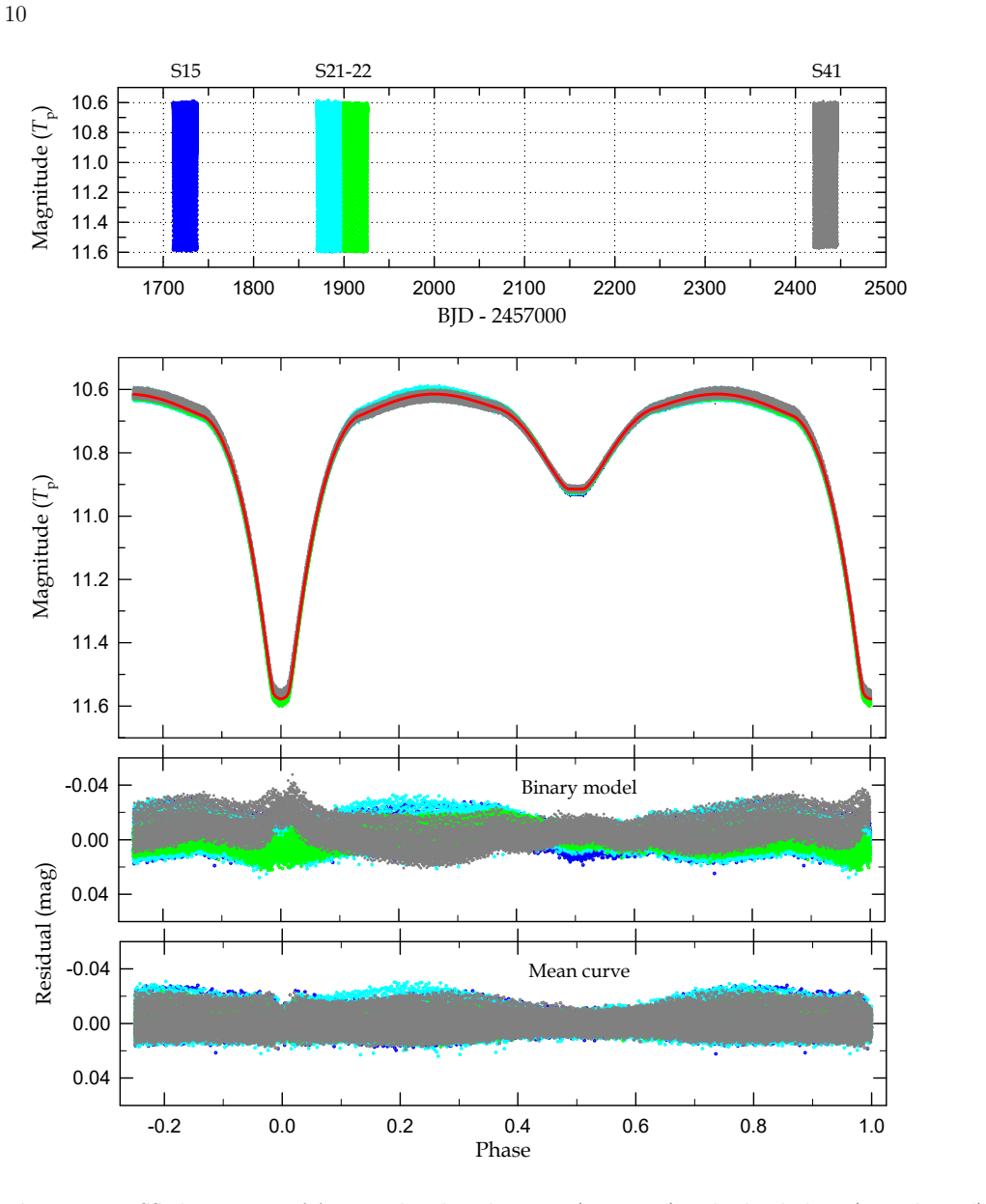
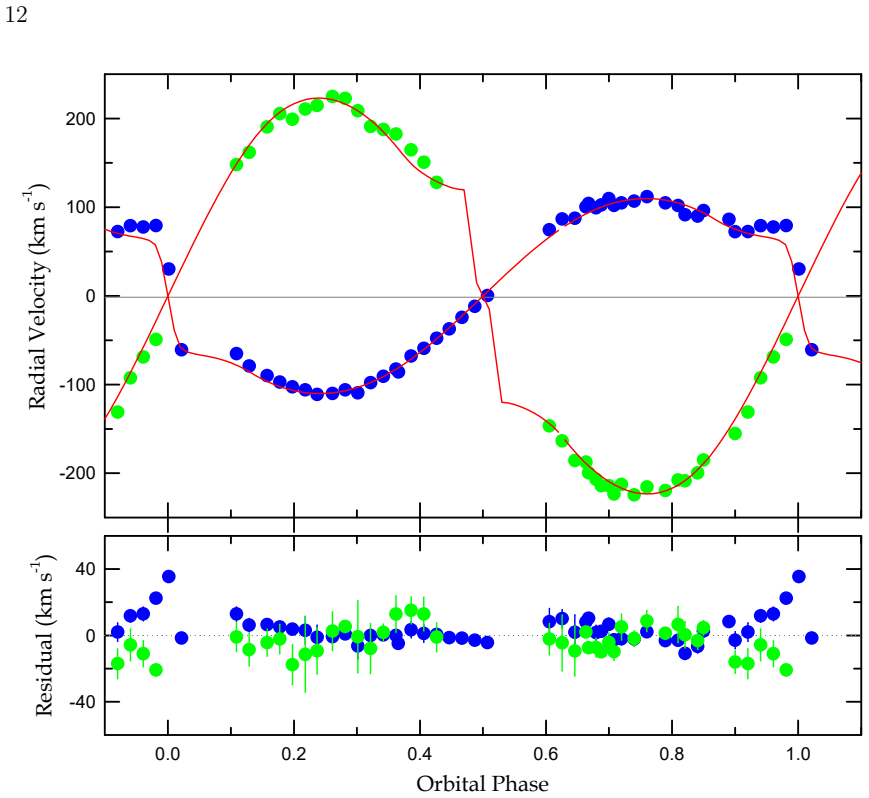
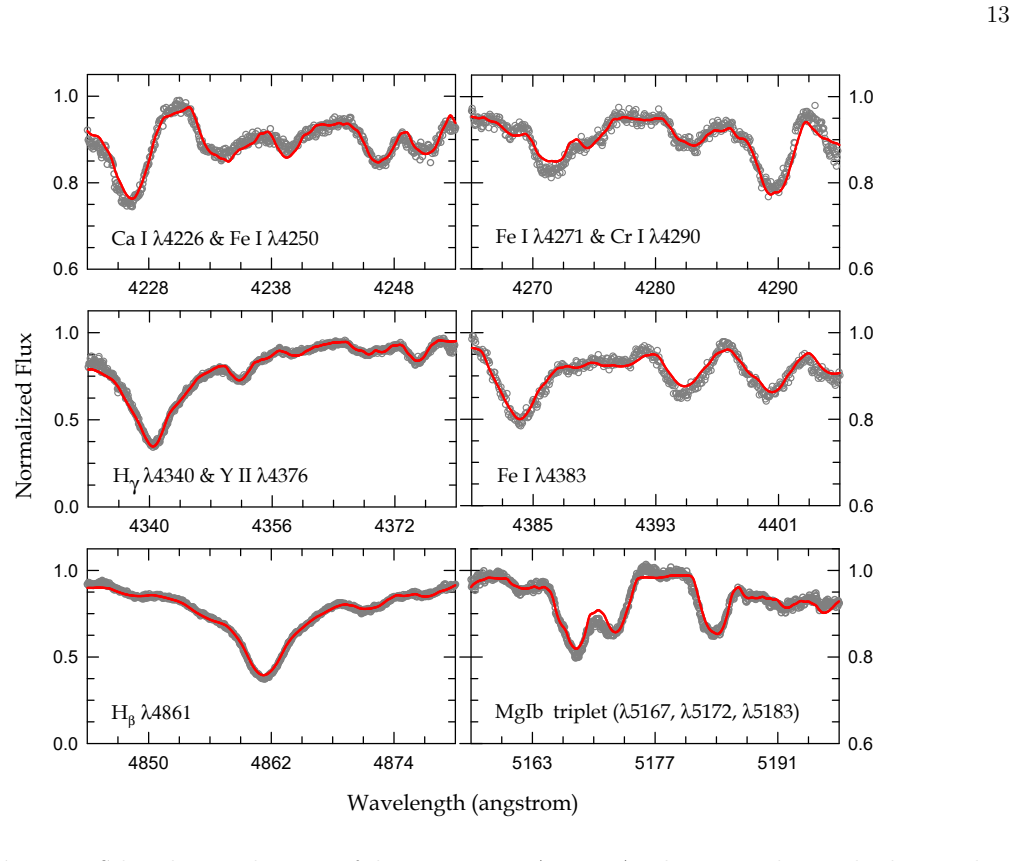
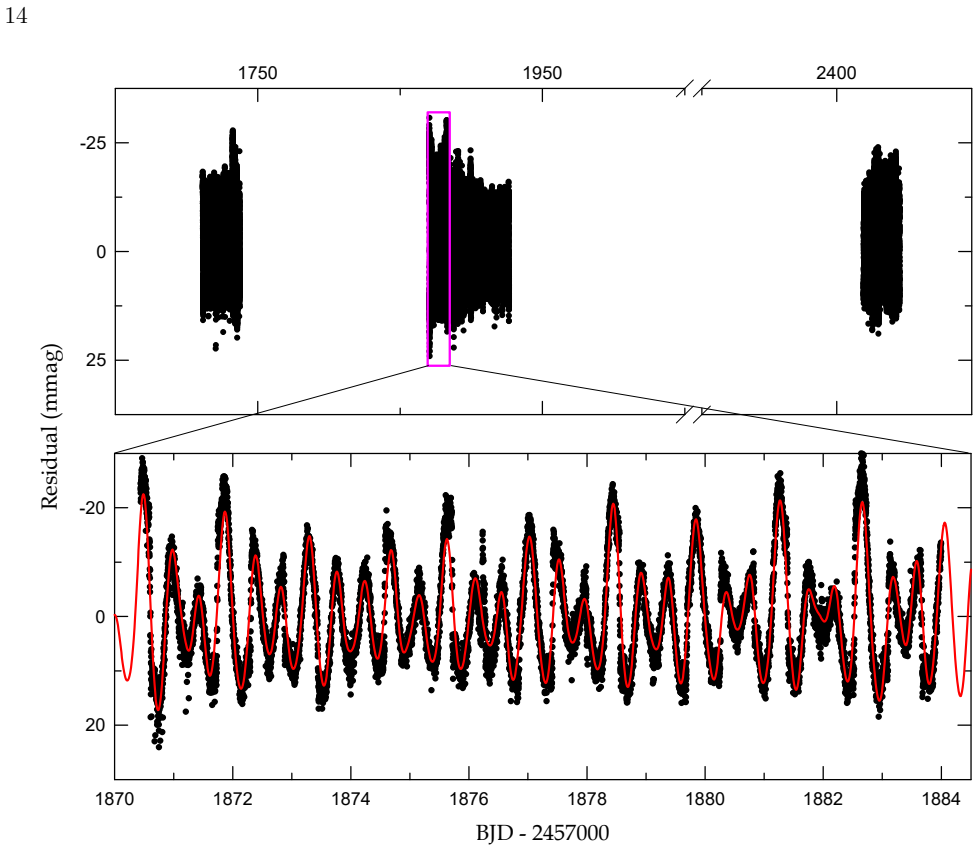
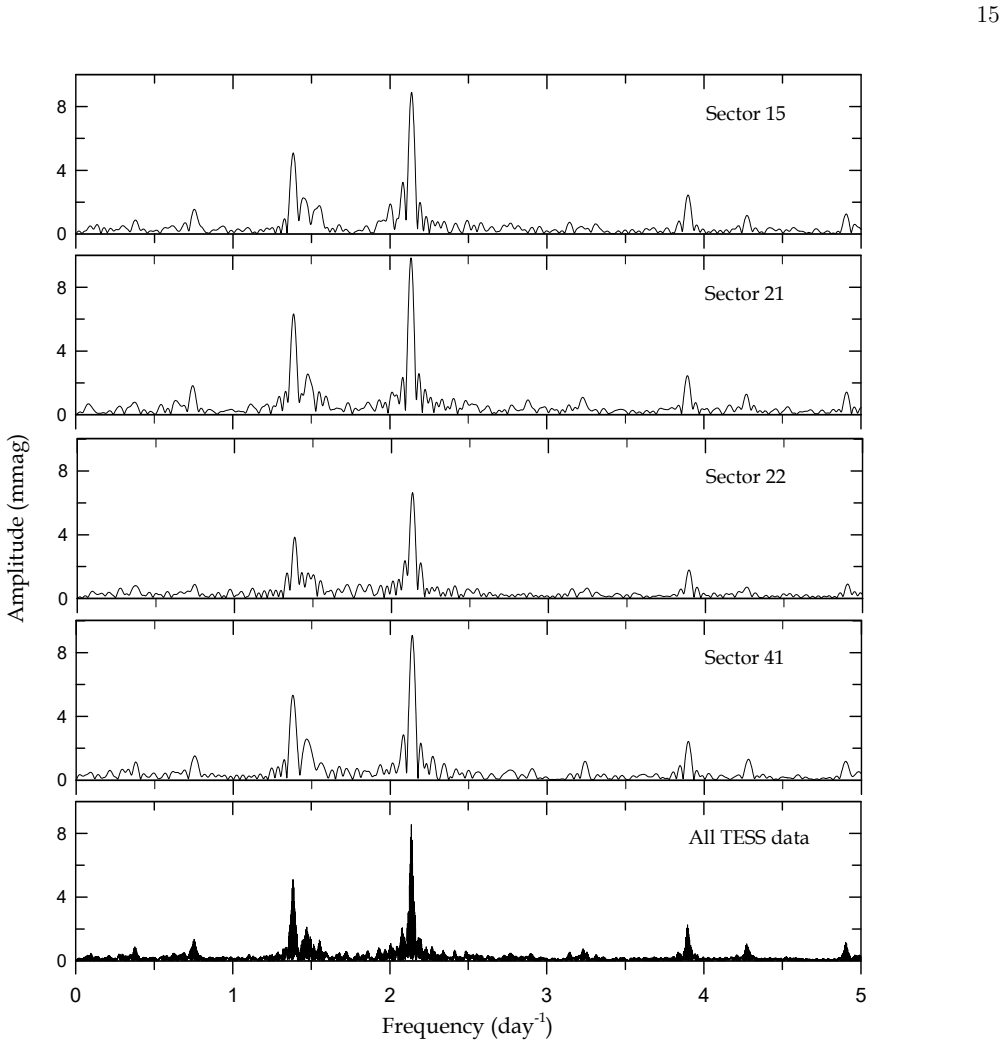
For the near-contact binary AX Dra, we present the first time-series spectroscopy collected with the echelle spectrograph BOES. From spectral analysis, we measured the projected rotation of $v_1 \sin i$ = $120\pm21$ km s$^{-1}$ and effective temperature of $T_{\rm eff,1}$ = $7220\pm150$ K for the brighter primary component, together with radial velocities (RVs) for both stars. To obtain a consistent binary model, the RV curves were analyzed by combining the 2-min cadence photometric data observed in the TESS sectors 15, 21, 22, and 41. The modeling indicates that AX Dra is a semi-detached system exhibiting a total secondary eclipse, with the detached primary component having a large filling factor of 92 \%. The system has masses of $1.717\pm0.026$ $M_\odot$ and $0.804\pm0.014$ $M_\odot$, radii of $1.541\pm0.020$ $R_\odot$ and $1.237\pm0.014$ $R_\odot$, luminosities of $5.78\pm0.50$ $L_\odot$ and $0.83\pm0.05$ $L_\odot$, and a temperature difference of $\Delta$($T_{\rm eff,1}$--$T_{\rm eff,2}$) = $2263\pm163$ K. Multi-frequency analyses of the TESS residual lights yielded 35 significant signals in the frequency range below 5 day$^{-1}$. Among them, four frequencies of $f_1$, $f_2$, $f_3$, and $f_5$ are independent $\gamma$ Dor pulsations of the primary star, for which two acceptable mode-identification solutions were obtained using the frequency ratio method. These results suggest that AX Dra is the shortest-period double-lined eclipsing binary containing a $\gamma$ Dor-type pulsator and that the pulsating primary is likely an accretor affected by mass transfer.
Editorial analysis
A structured set of objections, weighed in public.
Referee Report
Summary. The manuscript reports the first BOES echelle spectroscopy of the near-contact eclipsing binary AX Dra together with TESS photometry (sectors 15, 21, 22, 41). It derives double-lined radial velocities, effective temperature and v sin i for the primary, and a consistent semi-detached binary model yielding masses 1.717±0.026 M⊙ and 0.804±0.014 M⊙, radii 1.541±0.020 R⊙ and 1.237±0.014 R⊙, and a 92 % fill factor for the detached primary. Frequency analysis of the TESS residuals identifies 35 signals below 5 d⁻¹, of which four (f1, f2, f3, f5) are interpreted as independent γ Dor g-modes of the primary via the frequency-ratio method; the authors conclude that AX Dra is the shortest-period double-lined eclipsing system containing a γ Dor pulsator and that the primary is likely an accretor undergoing mass transfer.
Significance. If the pulsation identification is robust, the result would establish the shortest-period double-lined eclipsing γ Dor system known, supplying precise dynamical masses and radii that can test the effects of tidal distortion and mass transfer on g-mode pulsations. The combination of double-lined spectroscopy with space-based photometry is a clear strength and yields falsifiable stellar parameters.
major comments (2)
- [multi-frequency analyses of the TESS residual lights] The claim that f1, f2, f3, and f5 are independent γ Dor pulsations of the primary after binary-model subtraction is load-bearing for both the shortest-period assertion and the mass-transfer interpretation. The multi-frequency analysis section provides no residual rms, pre-whitening sequence, or power-spectrum comparison before/after subtraction that would demonstrate that low-frequency power (0.1–5 d⁻¹) is free of artifacts from imperfect eclipse, ellipsoidal, or reflection modeling.
- [multi-frequency analyses of the TESS residual lights] The frequency-ratio method is stated to yield two acceptable mode-identification solutions, yet the text does not tabulate the observed ratios, the theoretical grid used, or the goodness-of-fit metric that distinguishes the solutions from aliases or secondary-component signals.
minor comments (2)
- [Abstract] The abstract omits any mention of the number of spectra, S/N, or formal error budgets on the derived frequencies and mode identifications.
- [frequency analysis] A table listing all 35 detected frequencies together with their amplitudes, S/N, and whether they were attributed to the binary or to pulsation would improve clarity.
Simulated Author's Rebuttal
We thank the referee for the constructive comments on our manuscript. The points raised highlight areas where additional documentation of the frequency analysis would strengthen the presentation. We address each major comment below and will revise the manuscript to incorporate the requested details.
read point-by-point responses
-
Referee: The claim that f1, f2, f3, and f5 are independent γ Dor pulsations of the primary after binary-model subtraction is load-bearing for both the shortest-period assertion and the mass-transfer interpretation. The multi-frequency analysis section provides no residual rms, pre-whitening sequence, or power-spectrum comparison before/after subtraction that would demonstrate that low-frequency power (0.1–5 d⁻¹) is free of artifacts from imperfect eclipse, ellipsoidal, or reflection modeling.
Authors: We agree that explicit documentation of these quantities would better demonstrate the absence of modeling artifacts. The binary model was subtracted using the Wilson-Devinney solution with the derived parameters from the combined RV and TESS photometry fit, after which standard iterative pre-whitening was applied to the residuals with a significance threshold of S/N > 4. To address the concern, the revised manuscript will include: the rms scatter of the post-subtraction residuals, the full pre-whitening sequence with successive amplitude spectra, and a direct comparison of the low-frequency power spectrum before versus after binary-model removal. These additions will confirm that the reported signals (f1, f2, f3, f5) remain after removal of any potential eclipse or ellipsoidal residuals. revision: yes
-
Referee: The frequency-ratio method is stated to yield two acceptable mode-identification solutions, yet the text does not tabulate the observed ratios, the theoretical grid used, or the goodness-of-fit metric that distinguishes the solutions from aliases or secondary-component signals.
Authors: The frequency-ratio method compared the observed frequencies against a grid of theoretical γ Dor models that incorporated the primary's mass, radius, effective temperature, and estimated rotation rate, accounting for the effects of tidal distortion. Two solutions were retained on the basis of the smallest residuals between observed and model ratios within the frequency uncertainties. We acknowledge that the current text omits the supporting tabulation. The revised version will add a table containing the observed frequencies and ratios, the parameters of the theoretical grid (mass range, metallicity, overshooting, and rotation), and the goodness-of-fit values (e.g., reduced χ²) for each solution, together with a brief discussion excluding aliases and secondary-component contributions on the basis of the double-lined RV solution and the amplitude ratios. revision: yes
Circularity Check
No significant circularity; all claims rest on direct data reduction
full rationale
The derivation proceeds from observed RVs and TESS photometry to a fitted binary model, residual frequency extraction, and application of the frequency-ratio method to assign modes. No equation or step defines the γ Dor identification or shortest-period claim in terms of the fitted parameters themselves. The frequency-ratio method is invoked as an external technique without self-citation load-bearing. The shortest-period assertion follows from period comparison to literature systems, not from any internal redefinition. This is a standard observational pipeline with no reduction of outputs to inputs by construction.
Axiom & Free-Parameter Ledger
free parameters (2)
- primary effective temperature =
7220 K
- component masses and radii =
1.717/0.804 M_sun and 1.541/1.237 R_sun
axioms (1)
- domain assumption Standard Roche-geometry and limb-darkening prescriptions in binary modeling codes produce a unique consistent solution when RV and photometry are combined
Reference graph
Works this paper leans on
-
[1]
Antoci, V., Cunha, M. S., Bowman, D. M., et al. 2019, MNRAS, 490, 4040, doi: 10.1093/mnras/stz2787
-
[2]
2019, MNRAS, 486, 2075, doi: 10.1093/mnras/stz549
Blanco-Cuaresma, S. 2019, MNRAS, 486, 2075, doi: 10.1093/mnras/stz549
-
[3]
2014, A&A, 569, A111, doi: 10.1051/0004-6361/201423945
Blanco-Cuaresma, S., Soubiran, C., Heiter, U., et al. 2014, A&A, 569, A111, doi: 10.1051/0004-6361/201423945
-
[4]
2000, in ASP Conf
Breger, M. 2000, in ASP Conf. Ser. 210, Delta Scuti and Related Stars, ed. M. Breger, & M. H. Montgomery (San Francisco, CA: ASP), 3
2000
-
[5]
Breger, M., & Bischof, K. M. 2002, A&A, 385, 537, doi: 10.1051/0004-6361:20020124
-
[6]
Breger, M., Stich, J., Garrido, R., et al. 1993, A&A, 271, 482, doi: 10.1051/0004-6361:1993271482 C ¸ akirli,¨O., Hoyman, B., O¨ zdarcan, O., & Bilir, S. 2025, MNRAS, 533, 2058 doi: 10.1093/mnras/staf330
-
[7]
Coelho, P., Barbuy, B., Melendez, J., Sciavon, R. P., & Castilho, B. V. 2005, A&A, 443, 735, doi: 10.1051/0004-6361:20053511
-
[8]
Flower, P. J. 1996, ApJ, 469, 355, doi: 10.1086/177785
-
[9]
Fleming, D. P., Barnes, R., Davenport, J. R. A., & Luger, R. 2019, ApJ, 881, 88, doi: 10.3847/1538-4357/ab2ed2
-
[10]
2023, MNRAS, 527, L103, doi: 10.1093/mnras/stad3053 Gaia Collaboration, Vallenari A., Brown A
Fuller, J., & Felce, C. 2023, MNRAS, 527, L103, doi: 10.1093/mnras/stad3053 Gaia Collaboration, Vallenari A., Brown A. G. A., et al. 2023, A&A, 674, A1, doi: 10.1051/0004-6361/202243940
-
[11]
Gaulme, P., & Guzik, J. A. 2019, A&A, 630, A106, doi: 10.1051/0004-6361/201935821
-
[12]
Gray, R. O., & Corbally, C. J. 1994, AJ, 107, 742, doi: 10.1086/116893
-
[13]
Gray, R. O., & Corbally, C. J. 2009, Stellar Spectral Classification (Princeton, NJ: Princeton Univ. Press) Grigahc´ ene, A., Antoci, V., Balona, L., et al. 2010, ApJ, 713, L192, doi: 10.1088/2041-8205/713/2/L192
-
[14]
Handler, G., & Shobbrook, R. R. 2002, MNRAS, 333, 251, doi: 10.1046/j.1365-8711.2002.05401.x
-
[15]
2015, PhyS, 90, 054010, doi: 10.1088/0031-8949/90/5/05401
Heiter, U., Lind, K., Asplund, M., et al. 2015, PhyS, 90, 054010, doi: 10.1088/0031-8949/90/5/05401
-
[16]
Henry, G. W., Fekel, F. C., & Henry, S. M. 2005, AJ, 129, 2815, doi: 10.1086/429876
-
[17]
2025, ApJ, 990, 124, doi: 10.3847/1538-4357/adf10d Høg, E., Fabricius, C., Makarov, V
Hobson-Ritz, M., Birky, J., Peterson, L., et al. 2025, ApJ, 990, 124, doi: 10.3847/1538-4357/adf10d Høg, E., Fabricius, C., Makarov, V. V., et al. 2000, A&A, 355, 27, doi: 10.1051/0004-6361:20020249
-
[18]
Hong, K., Lee, J. W., Kim, S.-L., et al. 2015, AJ, 150, 131, doi: 10.1088/0004-6256/150/4/131 Iliji´ c, S., Hensberge, H., Pavlovski, K., &
-
[19]
Freyhammer, L. M. 2004, in ASP Conf. Ser. 318, Spectroscopically and Spatially Resolving the Components of the Close Binary Stars, ed. R. Hilditch, H. Hensberge, & K. Pavlovski (San Francisco: ASP), 111
2004
-
[20]
Ibanoglu, C., C ¸ akirli,¨O., & Sipahi, E., 2018, New Astron., 62, 70, doi: 10.1016/j.newast.2018.01.004
-
[21]
Kim, H. I., Lee, J. W., Kim, C. H., et al. 2004, PASP, 116, 931, doi: 10.1086/425606
-
[22]
Kim, K.-M., Han, I., Valyavin, G. G., et al. 2007, PASP, 119, 1052, doi: 10.1086/521959
-
[23]
1955, Kl
Kippenhahn, R. 1955, Kl. Ver¨ off
1955
-
[24]
2021, A&A, 653, A127, doi: 10.1051/0004-6361/202039369
Koenigsberger, G., Moreno, E., & Langer, N. 2021, A&A, 653, A127, doi: 10.1051/0004-6361/202039369
-
[25]
Kurtz, D. W. 2022, ARAA, 60, 31, doi: 10.1146/annurev-astro-052920-094232
-
[26]
Kurucz, R. L. 2005, MSAIS, 8, 14
2005
-
[27]
K., & Van Woerden, H
Kwee, K. K., & Van Woerden, H. 1956, Bull. Astron. Inst. Netherlands, 12, 327
1956
-
[28]
Lee, J. W. 2016, ApJ, 833, 170, doi: 10.3847/1538-4357/833/2/170
-
[29]
Lee, J. W., & Park, J.-H. 2018, MNRAS, 480, 4693, doi: 10.1093/mnras/sty2153
-
[30]
Lee, J. W., Hong, K., & Kim, H.-Y. 2021, AJ, 161, 129, doi: 10.3847/1538-3881/abd631
-
[31]
W., Hong, K., Kim, H.-Y., & Park, J.-H
Lee, J. W., Hong, K., Kim, H.-Y., & Park, J.-H. 2022, MNRAS, 515, 4702, doi: 10.1093/mnras/stac2151
-
[32]
W., Hong, K., Koo, J.-R., & Park J.-H., 2018, AJ, 155, 5, doi: 10.3847/1538-3881/aa947e
Lee, J. W., Hong, K., Koo, J.-R., & Park J.-H., 2018, AJ, 155, 5, doi: 10.3847/1538-3881/aa947e
-
[33]
2023, AJ, 165, 159, doi: 10.3847/1538-3881/acbe9d 9
Kim, D.-J. 2023, AJ, 165, 159, doi: 10.3847/1538-3881/acbe9d 9
-
[34]
2014, AJ, 148, 37, doi: 10.1088/0004-6256/148/2/37
Koo, J.-R. 2014, AJ, 148, 37, doi: 10.1088/0004-6256/148/2/37
-
[35]
W., Kristiansen, M., & Hong, K
Lee, J. W., Kristiansen, M., & Hong, K. 2019, AJ, 157, 223, doi: 10.3847/1538-3881/ab1a3b
-
[36]
Lenz, P., & Breger, M. 2005, Comm. Asteroseismology, 146, 53, doi: 10.1553/cia146s53
-
[37]
2020, MNRAS, 497, 4363, doi: 10.1093/mnras/staa2266
Li, G., Guo, Z., Fuller, J., et al. 2020, MNRAS, 497, 4363, doi: 10.1093/mnras/staa2266
-
[38]
Loumos, G. L., & Deeming, T. J. 1978, Ap&SS, 56, 285, doi: 10.1007/BF01879560
-
[39]
Lurie, J. C., Vyhmeister, K., Hawley, S. L., et al. 2017, AJ, 154, 250, doi: 10.3847/1538-3881/aa974d
-
[40]
Moya, A., Su´ arez, J. C., Amado P. J., et al. 2005, A&A, 432, 189, doi: 10.1051/0004-6361:20041752
-
[41]
G., Collins, K
Paegert, M., Stassun, K. G., Collins, K. A., et al. 2022, VizieR Online Data Catalog, IV/39
2022
-
[42]
Intrinsic Colors, Temperatures, and Bolometric Corrections of Pre-Main Sequence Stars
Pecaut, M. J., & Mamajek, E. E. 2013, ApJS, 208, 9, doi: 10.1088/0067-0049/208/1/9
work page internal anchor Pith review doi:10.1088/0067-0049/208/1/9 2013
-
[43]
2017, ApJ, 842, 110, doi: 10.3847/1538-4357/aa6ff7
Pilecki, B., Gieren, W., Smolec, S., et al. 2017, ApJ, 842, 110, doi: 10.3847/1538-4357/aa6ff7
-
[44]
Rittipruk, P., Hong, K., Lee, J. W., et al. 2025, AJ, 169, 66, doi: 10.3847/1538-3881/ad99ce
-
[45]
Determination of broadening functions using the Singular Value Decomposition (SVD) technique
Rucinski, S. 1999, in ASP Conf. Ser. 185, Precise Stellar Radial Velocities, ed. J. B. Hearnshaw & C. D. Scarfe (San Francisco, CA: ASP), 82, doi: 10.48550/arXiv.astro-ph/9807327
work page internal anchor Pith review Pith/arXiv arXiv doi:10.48550/arxiv.astro-ph/9807327 1999
-
[46]
Rucinski, S. M. 1992, AJ, 104, 1968, doi: 10.1086/181071
-
[47]
Rucinski, S. M. 2002, AJ, 124, 1746, doi: 10.1086/342342
-
[48]
Rasio, F. A. 2007, ApJ, 667, 1170, doi: 10.1086/520911
-
[49]
Rasio, F. A. 2010, ApJ, 724, 546, doi: 10.1088/0004-637X/724/1/546
-
[50]
Southworth, J., & Bowman, D. M. 2022, The Observatory, 142, 161, doi: 10.48550/arXiv.2205.08841
-
[51]
Southworth, J., & Van Reeth, T., 2022, MNRAS, 515, 2755, doi: 10.1093/mnras/stac1993
-
[52]
1961, Ver¨ off
Strohmeier, W., & Knigge, R. 1961, Ver¨ off
1961
-
[53]
Formation and Evolution of Compact Stellar X-ray Sources
Tauris, T. M., & van den Heuvel, E. P. J. 2006, in in Compact stellar X-ray sources, ed. W. H. G. Lewin & M. van der Klis (Cambridge: Cambridge Univ. Press), 623 doi: 10.48550/arXiv.astro-ph/0303456
work page internal anchor Pith review Pith/arXiv arXiv doi:10.48550/arxiv.astro-ph/0303456 2006
-
[54]
2010, A&A Rv, 18, 67, doi: 10.1007/s00159-009-0025-1 van der Walt, S., Colbert, S
Torres, G., Andersen, J., & Gim´ enez, A. 2010, A&AR, 18, 67, doi: 10.1007/s00159-009-0025-1
-
[55]
2011, A&A, 534, A125, doi: 10.1051/0004-6361/201117368 Van Hamme, W
Uytterhoeven, K., Moya, A., Grigahc´ ene, A., et al. 2011, A&A, 534, A125, doi: 10.1051/0004-6361/201117368 Van Hamme, W. 1993, AJ, 106, 209, doi: 10.1086/116788 Van Hamme, W., & Wilson, R. E. 2007, ApJ, 661, 1129, doi: 10.1086/517870
-
[56]
Wilson, R. E., & Devinney, E. J. 1971, ApJ, 166, 605, doi: 10.1086/150986
-
[57]
R., Deng, L., Zhang, C., et al
Xiong, D. R., Deng, L., Zhang, C., et al. 2016, MNRAS, 457, 3163, doi: 10.1093/mnras/stw047
-
[58]
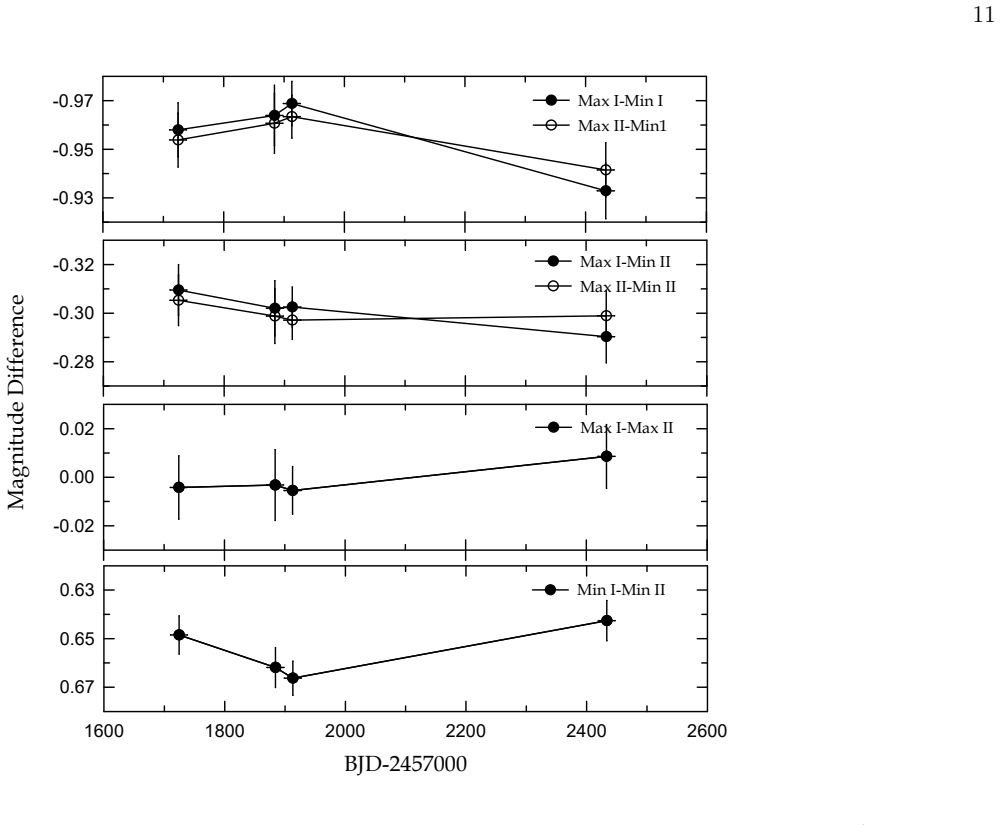
Zhang, X. B., Luo, C. Q., & Fu, J. N. 2013, ApJ, 777, 77, doi: 10.1088/0004-637X/777/1/77 10 BJD - 2457000 1700 1800 1900 2000 2100 2200 2300 2400 2500 Magnitude (Tp) 10.6 10.8 11.0 11.2 11.4 11.6 S15 S21-22 S41 Magnitude (Tp) 10.6 10.8 11.0 11.2 11.4 11.6 Residual (mag) -0.04 0.00 0.04 Phase -0.2 0.0 0.2 0.4 0.6 0.8 1.0 -0.04 0.00 0.04 Binary model Mean ...
discussion (0)
Sign in with ORCID, Apple, or X to comment. Anyone can read and Pith papers without signing in.