An automated proof that R(B₈,B₁0)=37
Pith reviewed 2026-06-28 01:12 UTC · model grok-4.3
The pith
The book Ramsey number R(B_8, B_10) equals 37.
A machine-rendered reading of the paper's core claim, the machinery that carries it, and where it could break.
Core claim
There exists no graph on 37 vertices that contains neither a copy of B_8 nor has its complement containing a copy of B_10. This rules out any counterexample to the upper bound and therefore establishes R(B_8, B_10) = 37. The proof was discovered using AutoMath and is accompanied by a Lean formalization.
What carries the argument
Exhaustive automated enumeration that rules out all 37-vertex graphs avoiding both B_8 in the graph and B_10 in the complement.
If this is right
- The exact value of the Ramsey number R(B_8, B_10) is settled at 37.
- The upper bound is established by showing the non-existence of any avoiding graph on 37 vertices.
- The combination of automated discovery and Lean formalization confirms the case analysis for this instance.
Where Pith is reading between the lines
- Automated search methods of this kind could be applied to determine other book Ramsey numbers whose values remain open.
- The availability of a Lean formalization allows independent verification of the exhaustive search steps.
- The workflow may extend to related problems in extremal graph theory that involve similar subgraph avoidance conditions.
Load-bearing premise
The automated enumeration has correctly encoded the book graphs and exhaustively checked every possible 37-vertex graph without missing cases or introducing definition errors.
What would settle it
Exhibiting one concrete 37-vertex graph that contains no B_8 and whose complement contains no B_10 would falsify the claimed equality.
Figures
read the original abstract
We present a short proof that the book Ramsey number $R(B_8,B_{10})$ equals 37. The lower bound $R(B_8,B_{10}) \ge 37$ is already available in the literature, so it is enough to rule out a 37-vertex graph containing neither a copy of $B_8$ nor a copy of $B_{10}$ in its complement. The problem as well as the proof were found with AutoMath, an AI-assisted mathematical discovery workflow developed by the first author. A Lean formalization of the upper-bound argument is available in the accompanying repository.
Editorial analysis
A structured set of objections, weighed in public.
Referee Report
Summary. The manuscript claims that the book Ramsey number R(B_8, B_10) equals 37. The lower bound is taken from the existing literature; the upper bound is established by ruling out the existence of any 37-vertex graph that contains neither a copy of B_8 nor a copy of B_10 in its complement, via an exhaustive search discovered with AutoMath and formalized in Lean.
Significance. If the formalization is faithful to the definitions, the result supplies an exact value for a book Ramsey number. The machine-checked exhaustive search is a clear strength: it is parameter-free, contains no analytic approximations, and directly verifies the non-existence claim against the external definitions of the book graphs. This combination of automated discovery and Lean formalization provides reproducible, high-assurance evidence for the upper bound.
minor comments (2)
- [Abstract] The abstract states that the Lean formalization resides in an accompanying repository; the published version should include a stable URL or DOI for the repository to ensure long-term accessibility of the machine-checked proof.
- A one-paragraph outline of the main case distinctions or search strategy used in the Lean formalization would help readers connect the informal claim to the verified code without needing to inspect the repository immediately.
Simulated Author's Rebuttal
We thank the referee for their positive evaluation of the manuscript and for recommending acceptance. Their assessment of the result's significance and the value of the Lean formalization aligns with our own view of the contribution.
Circularity Check
No circularity; machine-checked exhaustive search against external definitions
full rationale
The paper establishes the upper bound R(B_8,B_10) ≤ 37 via a Lean-formalized exhaustive case analysis that directly encodes the definitions of book graphs B_8 and B_10 and rules out all 37-vertex graphs lacking either subgraph (or its complement). The lower bound is taken from independent prior literature. No equations, parameters, or ansatzes are fitted or redefined within the paper; the formalization is parameter-free and externally verifiable. No self-citation is load-bearing for the central claim, and the argument does not reduce to any of the enumerated circular patterns. This is a standard computational Ramsey-number proof whose correctness rests on the soundness of the Lean kernel and the completeness of the search, both external to the paper's own text.
Axiom & Free-Parameter Ledger
axioms (1)
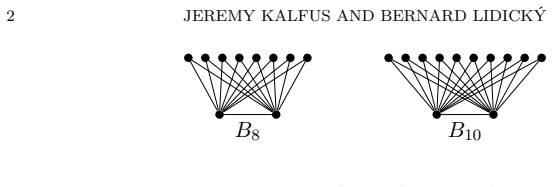
- standard math Standard axioms of graph theory and the definition of book graphs B_k as K_{1,k} plus a clique on the k leaves.
Forward citations
Cited by 1 Pith paper
-
Book Ramsey numbers via algebraic constructions
Algebraic constructions of strongly regular graphs yield R(B_n,B_n)=4n+1 for infinitely many n and R(B_{n-2},B_n)≤4n-3 for most n, with equality under Hadamard matrix conditions.
Reference graph
Works this paper leans on
-
[1]
Short proofs in combinatorics and number theory, 2026.arXiv:2603.29961
Boris Alexeev, Moe Putterman, Mehtaab Sawhney, Mark Sellke, and Gregory Valiant. Short proofs in combinatorics and number theory, 2026.arXiv:2603.29961
arXiv 2026
-
[2]
Short proofs in combinatorics, probability and number theory II, 2026.arXiv:2604
Boris Alexeev, Moe Putterman, Mehtaab Sawhney, Mark Sellke, and Gregory Valiant. Short proofs in combinatorics, probability and number theory II, 2026.arXiv:2604. 06609
2026
-
[3]
Noga Alon, Thomas F. Bloom, W. T. Gowers, Daniel Litt, Will Sawin, Arul Shankar, Jacob Tsimerman, Victor Wang, and Melanie Matchett Wood. Remarks on the disproof of the unit distance conjecture, 2026.arXiv:2605.20695
Pith/arXiv arXiv 2026
-
[4]
Axplorer
AxiomMath. Axplorer. https://github.com/AxiomMath/axplorer. [Accessed 24-04- 2026]
2026
-
[5]
Ellenberg, Adam Zsolt Wagner, and Geordie Williamson
François Charton, Jordan S. Ellenberg, Adam Zsolt Wagner, and Geordie Williamson. Patternboost: Constructions in mathematics with a little help from ai, 2024.arXiv: 2411.00566
arXiv 2024
-
[6]
doi: 10.1007/978-3-030-79876-5_37
Leonardo de Moura and Sebastian Ullrich. The lean 4 theorem prover and programming language. pages 625–635, Berlin, Heidelberg, 2021. Springer-Verlag. URL:https: //lean-lang.org,doi:10.1007/978-3-030-79876-5_37
-
[7]
Rein- forcement learning for graph theory, II
Mohammad Ghebleh, Salem Al-Yakoob, Ali Kanso, and Dragan Stevanović. Rein- forcement learning for graph theory, II. Small Ramsey numbers.Art Discrete Appl. Math., 8(1):Paper No. 1.07, 7, 2025
2025
-
[8]
Graduate Texts in Mathe- matics
Chris Godsil and Gordon Royle.Algebraic Graph Theory. Graduate Texts in Mathe- matics. Springer, New York, NY, 2001 edition, April 2001
2001
-
[9]
A. W. Goodman. On sets of acquaintances and strangers at any party.Amer. Math. Monthly, 66:778–783, 1959.doi:10.2307/2310464
-
[10]
Jeremykalfus/automath: Initial beta, 2026
Jeremy Kalfus. Jeremykalfus/automath: Initial beta, 2026. URL:https://github. com/JeremyKalfus/AutoMath,doi:10.5281/ZENODO.19712305
-
[11]
Small Ramsey numbers for books, wheels, and generalizations.Electron
Bernard Lidický, Gwen McKinley, Florian Pfender, and Steven Van Overberghe. Small Ramsey numbers for books, wheels, and generalizations.Electron. J. Combin., 32(4):Paper No. 4.64, 20, 2025.doi:10.37236/13577
-
[12]
URL https://doi.org/ 10.1145/3372885.3373824
The mathlib Community. The lean mathematical library. InProceedings of the 9th ACM SIGPLAN International Conference on Certified Programs and Proofs, POPL ’20, page 367–381. ACM, January 2020.doi:10.1145/3372885.3373824
-
[13]
Alexander Novikov, Ngân V˜ u, Marvin Eisenberger, Emilien Dupont, Po-Sen Huang, Adam Zsolt Wagner, Sergey Shirobokov, Borislav Kozlovskii, Francisco J. R. Ruiz, Abbas Mehrabian, M. Pawan Kumar, Abigail See, Swarat Chaudhuri, George Holland, Alex Davies, Sebastian Nowozin, Pushmeet Kohli, and Matej Balog. Alphaevolve: A coding agent for scientific and algo...
Pith/arXiv arXiv 2025
-
[14]
Codex.https://github.com/openai/codex
OpenAI. Codex.https://github.com/openai/codex. [Accessed 24-04-2026]. 8 JEREMY KALFUS AND BERNARD LIDICKÝ
2026
-
[15]
An openai model has disproved a central conjecture in discrete geometry
OpenAI. An openai model has disproved a central conjecture in discrete geometry. https://openai.com/index/model-disproves-discrete-geometry-conjecture/. [Accessed 20-05-2026]
2026
-
[16]
Stanisław P. Radziszowski. Small ramsey numbers.The Electronic Journal of Combi- natorics, Dynamic Surveys, DS1, 2026.doi:10.37236/21
work page doi:10.37236/21 2026
-
[17]
43 Nature625(7995), 468–475 (2024) https://doi.org/10.1038/s41586-023-06924-6
Bernardino Romera-Paredes, Mohammadamin Barekatain, Alexander Novikov, Matej Balog, M. Pawan Kumar, Emilien Dupont, Francisco J. R. Ruiz, Jordan S. Ellenberg, PengmingWang, OmarFawzi, PushmeetKohli, andAlhusseinFawzi.Mathematicaldis- coveries from program search with large language models.Nature, 625(7995):468–475, December 2023.doi:10.1038/s41586-023-06924-6
-
[18]
C. C. Rousseau and J. Sheehan. On ramsey numbers for books.Journal of Graph Theory, 2(1):77–87, 1978.doi:10.1002/jgt.3190020110
-
[19]
William J. Wesley. Lower bounds for book ramsey numbers.Discrete Mathematics, 349(5):114913, May 2026.doi:10.1016/j.disc.2025.114913. https://jeremykalfus.github.ioIndian Springs School, Indian Springs, AL Email address:jeremykalfus@gmail.com Department of Mathematics, Iowa State University, Ames, IA, USA. Email address:lidicky@iastate.edu
discussion (0)
Sign in with ORCID, Apple, or X to comment. Anyone can read and Pith papers without signing in.