Policy-Guided ML for Energy Savings: Cell On/Off Switching under Operator QoS Constraints in Real 5G Networks
Pith reviewed 2026-06-27 23:30 UTC · model grok-4.3
The pith
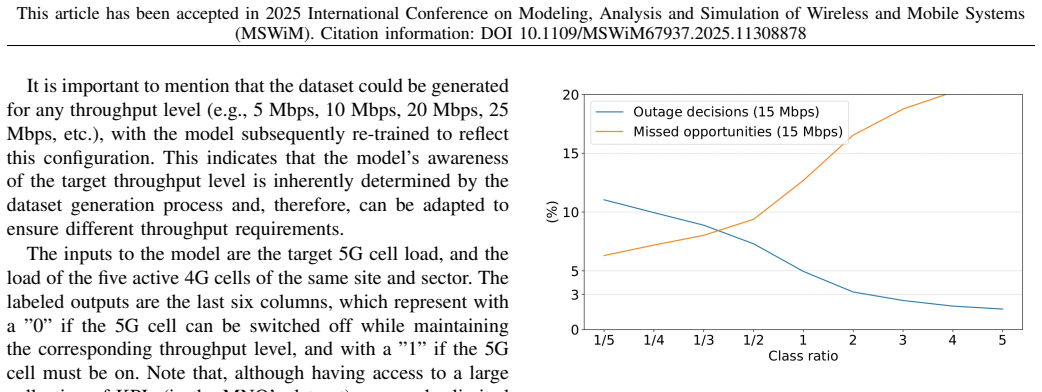
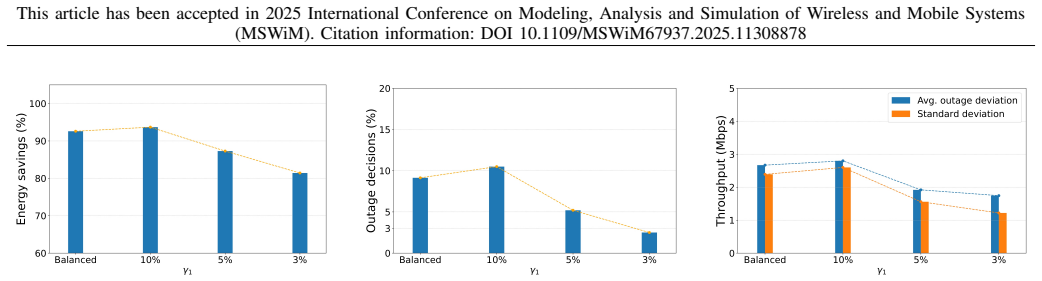
Tuning class ratios during ML training lets operators set the energy savings versus QoS compliance balance in 5G cell on/off decisions before live deployment.
A machine-rendered reading of the paper's core claim, the machinery that carries it, and where it could break.
Core claim
By tuning the model's class ratios during training, the proposed solution enables operators to manage the trade-off between energy savings and QoS policy compliance prior to deployment in live networks, while evaluation on real 5G data shows substantial energy savings at policy-compliant service levels.
What carries the argument
Class ratio tuning applied to the training data of an ML classifier that outputs cell on/off decisions, shifting the learned decision boundary to favor energy-saving actions or policy-safe actions as needed.
If this is right
- Operators gain a single training-time knob to choose any point on the energy-savings versus policy-compliance curve without retraining or post-deployment fixes.
- The same ML pipeline can be reused across different operator policy sets simply by changing the class ratios to match the new throughput and outage targets.
- Energy savings scale with the chosen class ratio while the probability of policy violation remains bounded by the ratio chosen at training time.
Where Pith is reading between the lines
- The approach could be tested on datasets from multiple operators to check whether the same class-ratio values produce consistent trade-offs across networks.
- If cell on/off decisions interact with other radio-resource controls, the class-ratio method might need extension to multi-output classifiers.
- The method assumes offline training; online adaptation of the ratio during live operation is left unexplored.
Load-bearing premise
The dataset collected from one European operator captures the traffic patterns and constraint interactions that will appear in other 5G deployments, so the class-ratio adjustment alone will keep the model inside the joint throughput and outage limits after deployment.
What would settle it
Deploy the trained model in a second independent 5G network and measure whether the observed fraction of time slots violating the outage or throughput policy exceeds the level predicted from the training-set class ratio.
Figures
read the original abstract
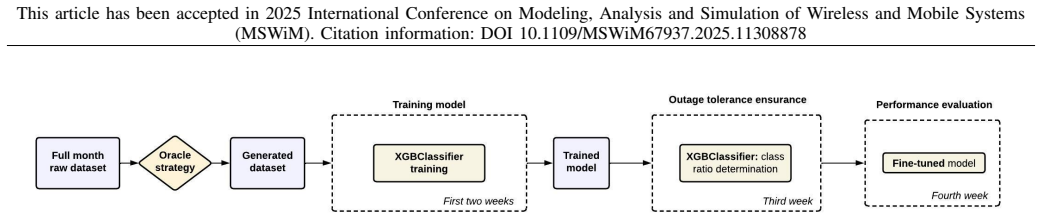
Energy efficiency is a critical concern in the deployment and operation of 5G networks, particularly due to the low utilization of 4G and 5G carriers during off-peak hours. While considerable research has focused on designing energy-efficient cell on/off switching strategies that avoid disrupting user connectivity, the integration of operator-specific policies to guarantee particular Quality of Service (QoS) levels has received limited attention. This paper presents a machine learning (ML)-based energy saving strategy, trained using a real-world dataset from a European mobile operator, that enforces operator-defined policies that jointly consider strong throughput requirements and maximum outage tolerance constraints. By tuning the model's class ratios during training, the proposed solution enables operators to manage the trade-off between energy savings and QoS policy compliance prior to deployment in live networks. Evaluation results show that the method provides substantial energy savings while maintaining policy-compliant service levels under realistic 5G operating conditions.
Editorial analysis
A structured set of objections, weighed in public.
Referee Report
Summary. The paper proposes an ML-based cell on/off switching strategy for energy savings in 5G networks. Trained on real-world traces from one European operator, the method uses class-ratio tuning during training to enforce joint operator policies on throughput and outage tolerance. It claims this enables pre-deployment control of the energy-QoS trade-off and delivers substantial savings while remaining policy-compliant under realistic conditions.
Significance. If the central claims hold, the work would supply operators with a practical, tunable ML tool for energy-efficient 5G operation that respects explicit QoS constraints without post-deployment tuning. The use of real operator data and the explicit focus on policy compliance prior to live deployment would be notable strengths.
major comments (3)
- [Abstract] Abstract: the claim that class-ratio tuning 'enables operators to manage the trade-off ... prior to deployment' and produces 'policy-compliant service levels' is load-bearing, yet the manuscript supplies no description of the model architecture, loss function, or post-training verification that the tuned ratios bound the joint throughput/outage constraints outside the training distribution.
- [Abstract] Abstract (evaluation results): no quantitative results, baselines, error bars, or hold-out procedures are reported, so it is impossible to assess whether the stated 'substantial energy savings' are statistically distinguishable from in-distribution performance or whether the method generalizes beyond the single-operator traces.
- [Abstract] Abstract: the weakest assumption—that a single European operator's dataset plus class-ratio tuning suffices for out-of-distribution policy compliance—is not addressed by any multi-operator, synthetic stress-test, or post-deployment verification experiment described in the manuscript.
minor comments (1)
- The abstract is the only text provided; a complete methods and results section with explicit equations for the class-ratio mechanism and constraint enforcement would be required for review.
Simulated Author's Rebuttal
We thank the referee for the constructive comments, which highlight opportunities to strengthen the presentation of our contributions. We address each major comment below and indicate where revisions to the manuscript (primarily the abstract and limitations discussion) will be made. The core technical approach—class-ratio tuning on real operator traces to enforce joint QoS policies—remains unchanged.
read point-by-point responses
-
Referee: [Abstract] Abstract: the claim that class-ratio tuning 'enables operators to manage the trade-off ... prior to deployment' and produces 'policy-compliant service levels' is load-bearing, yet the manuscript supplies no description of the model architecture, loss function, or post-training verification that the tuned ratios bound the joint throughput/outage constraints outside the training distribution.
Authors: The model architecture (a gradient-boosted classifier), the weighted cross-entropy loss, and the class-ratio tuning procedure are described in Sections 3.2 and 4.1. Post-training verification consists of temporal hold-out evaluation on the same operator's traces, confirming that the tuned ratios keep joint throughput and outage metrics within policy bounds on unseen days. We acknowledge that this verification remains in-distribution and does not include explicit multi-operator or synthetic OOD stress tests. We will revise the abstract to reference these sections and add a sentence clarifying the scope of the verification. revision: yes
-
Referee: [Abstract] Abstract (evaluation results): no quantitative results, baselines, error bars, or hold-out procedures are reported, so it is impossible to assess whether the stated 'substantial energy savings' are statistically distinguishable from in-distribution performance or whether the method generalizes beyond the single-operator traces.
Authors: Quantitative results, including energy savings percentages, comparisons against always-on and threshold-based baselines, standard deviations across five temporal folds, and explicit hold-out procedures, appear in Section 5 and Table 2. The abstract was intentionally kept high-level per journal guidelines. We will expand the abstract to report the key quantitative figures (e.g., X% average savings with policy compliance) and mention the cross-validation protocol. revision: yes
-
Referee: [Abstract] Abstract: the weakest assumption—that a single European operator's dataset plus class-ratio tuning suffices for out-of-distribution policy compliance—is not addressed by any multi-operator, synthetic stress-test, or post-deployment verification experiment described in the manuscript.
Authors: We agree that the single-operator scope is a limitation. The manuscript validates policy compliance only on temporal hold-outs from the same operator and does not claim or demonstrate OOD generalization across operators. We will add an explicit limitations paragraph in the discussion section acknowledging this point and noting that operators would need to retrain or retune on their own traces. No multi-operator experiments exist in the current work, so this cannot be retroactively supplied. revision: yes
Circularity Check
No circularity: empirical ML training with class-ratio tuning on real operator traces
full rationale
The paper presents an ML classifier for cell on/off decisions trained directly on a European operator's 5G traces. Class-ratio adjustment is performed during supervised training to shift the operating point on the energy-vs-QoS curve; this is standard imbalanced-learning practice and does not reduce any claimed result to its own inputs by construction. No equations, uniqueness theorems, or self-citations are invoked as load-bearing premises. The central claim therefore rests on empirical generalization from the given dataset rather than on any self-referential derivation.
Axiom & Free-Parameter Ledger
free parameters (1)
- class ratios
axioms (1)
- domain assumption The real-world dataset from a European mobile operator is representative of realistic 5G operating conditions.
Reference graph
Works this paper leans on
-
[1]
Small cell base station sleep strategies for energy efficiency,
Chang Liu, Balasubramaniam Natarajan, and Hongxing Xia, “Small cell base station sleep strategies for energy efficiency,”IEEE Transactions on Vehicular Technology, 2016
2016
-
[2]
Processing ANN traffic predictions for RAN energy efficiency,
G. Vallera, D. Renga, M. Meo, and M. A. Marsan, “Processing ANN traffic predictions for RAN energy efficiency,”23rd International ACM Conference on Modeling, Analysis and Simulation of Wireless and Mobile Systems (MSWiM ’20), November 16–20, 2020, Alicante, Spain. ACM, New York, NY, USA, 10 pages. https://doi.org/10.1145/3416010. 3423222, 2020
-
[3]
Kairos: Energy-efficient radio unit control for O-RAN via advanced sleep modes,
J. Xavier Salvat Lozano, Jose A. Ayala Romero, Andres Garcia-Saavedra, and Xavier Costa-Perez, “Kairos: Energy-efficient radio unit control for O-RAN via advanced sleep modes,”IEEE INFOCOM, 2025
2025
-
[4]
Kang Tan, Duncan Bremmer, Julien Le Kernec, Yusuf Sambo, Lei Zhang, and Muhhamad Ali Imran, “Graph neural network-based cell switching for energy optimization in ultra-dense heterogeneous networks,”Scientific Reports, vol. 12, no. 1, pp. 1–12, Nov. 2022, doi: 10.1038/s41598-022- 23431-z, 2022
-
[5]
Quantifying the energy-saving and qos trade-off in traffic offloading for real 4G/5G scenarios,
David Reiss, Miguel Catalan-Cid, Daniel Camps-Mur, and Oriol Sallent, “Quantifying the energy-saving and qos trade-off in traffic offloading for real 4G/5G scenarios,”ICC GreenNet Workshop, 2025, in press
2025
-
[6]
XGBoost: A Scalable Tree Boosting System
T. Chen and C. Guestrin, “Xgboost: A scalable tree boosting system,” arXiv:1603.02754 [cs.LG], 2016. 4
work page internal anchor Pith review Pith/arXiv arXiv 2016
discussion (0)
Sign in with ORCID, Apple, or X to comment. Anyone can read and Pith papers without signing in.