Efficient Multi-Agent Optimization of Optical Power in S+C+L-Band Systems
Pith reviewed 2026-06-28 00:14 UTC · model grok-4.3
The pith
A multi-agent AI system optimizes optical power allocation across S+C+L bands to raise total network traffic by 689 Tbps while using only 303 interactions per profile on average.
A machine-rendered reading of the paper's core claim, the machinery that carries it, and where it could break.
Core claim
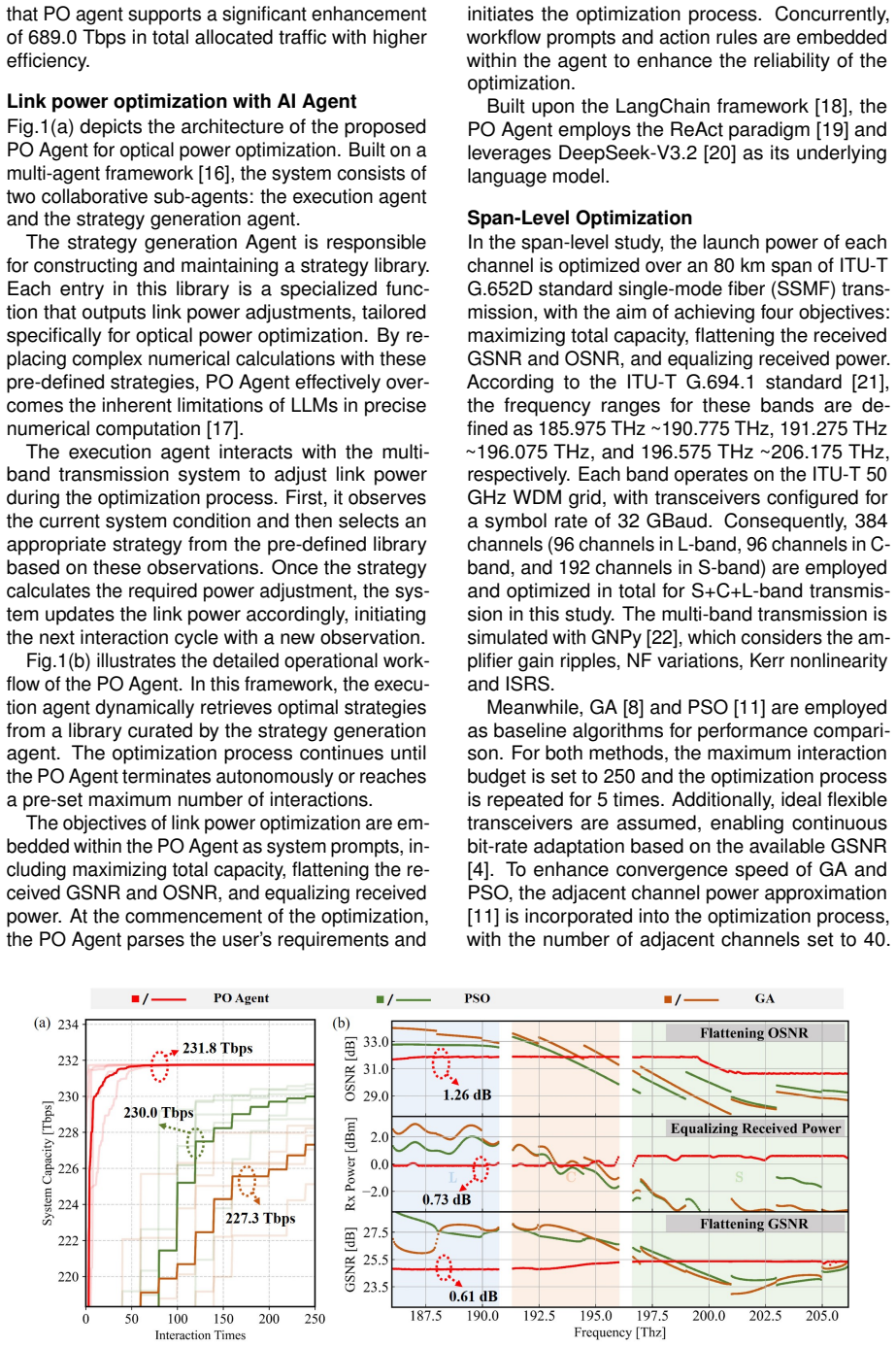
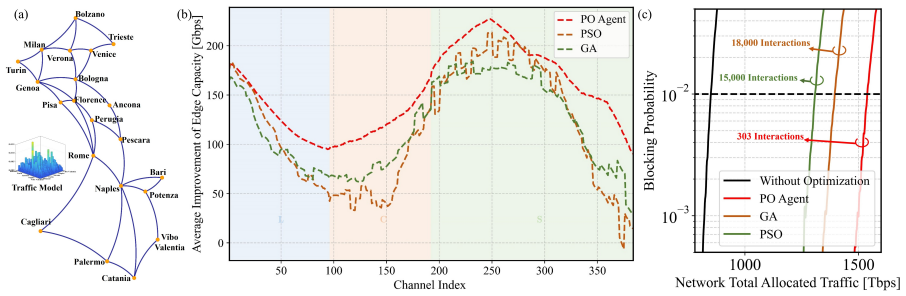
The central claim is that a purpose-built multi-agent AI agent solves link power management problems in S+C+L-band systems, delivering 689.0 Tbps additional total allocated traffic in network-wide tests while requiring only 303 average interactions per power profile.
What carries the argument
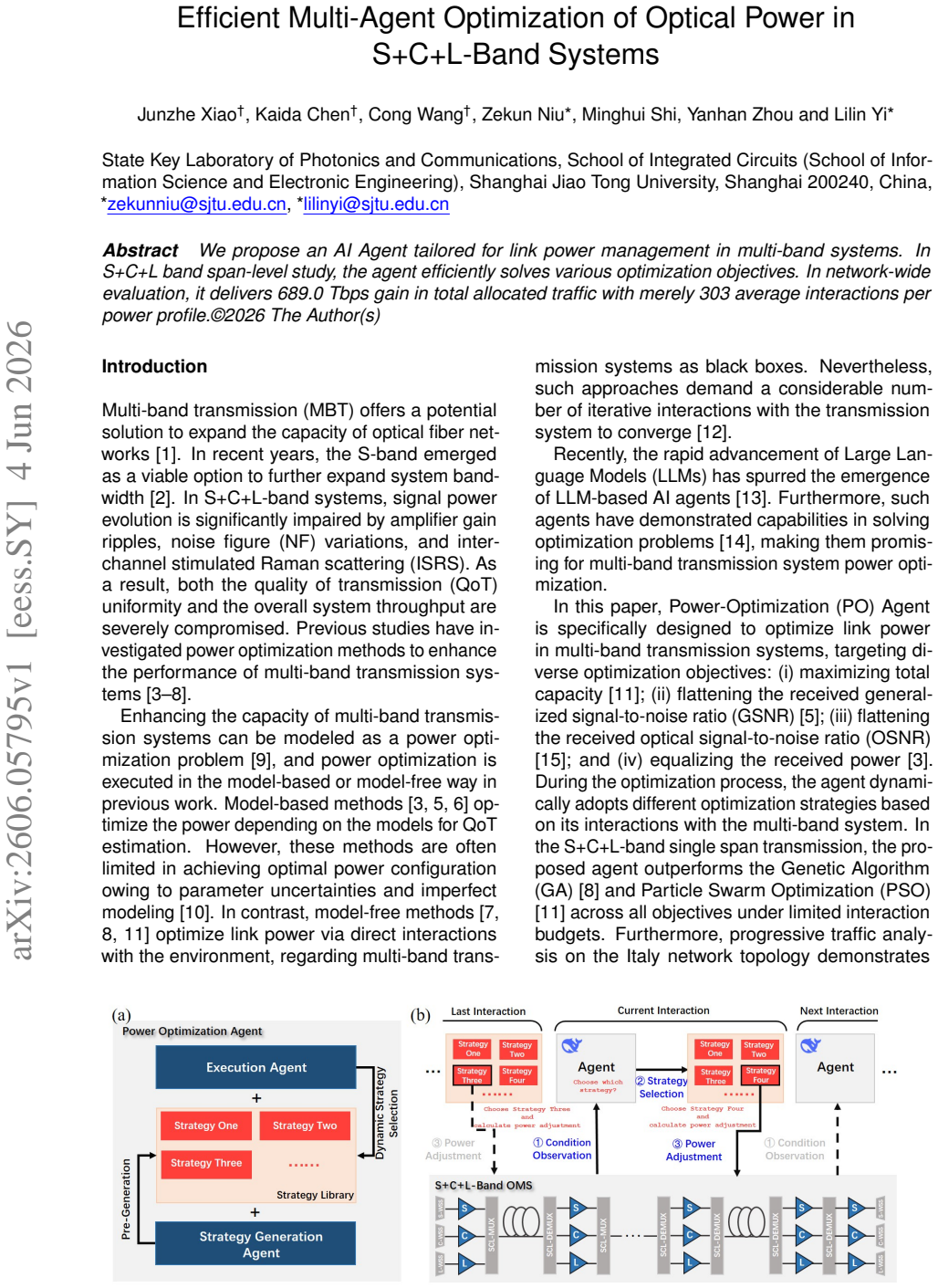
The multi-agent AI agent for link power management that learns to adjust power profiles across spans and bands.
If this is right
- Span-level power profiles can be generated for several different optimization objectives with the same agent.
- Network-wide traffic capacity rises by 689 Tbps under the reported interaction budget.
- The interaction count per profile remains near 303 even when the optimization target changes.
- Power management becomes feasible at the scale of entire multi-band networks rather than isolated spans.
Where Pith is reading between the lines
- If the interaction count stays low under changing traffic loads, the agent could support online re-optimization without disrupting live traffic.
- The same multi-agent structure might transfer to other wavelength ranges or to joint optimization of power and routing.
- Hardware vendors could embed the agent inside existing optical network controllers to reduce manual power tuning.
Load-bearing premise
The agent trained in simulation continues to deliver the reported traffic gain and interaction count when placed on physical multi-band fiber links.
What would settle it
A measurement campaign on deployed S+C+L fiber that records either less than 689 Tbps net traffic increase or more than 303 average interactions per profile would falsify the central performance claim.
Figures
read the original abstract
We propose an AI Agent tailored for link power management in multi-band systems. In S+C+L band span-level study, the agent efficiently solves various optimization objectives. In network-wide evaluation, it delivers 689.0 Tbps gain in total allocated traffic with merely 303 average interactions per power profile.
Editorial analysis
A structured set of objections, weighed in public.
Referee Report
Summary. The manuscript proposes a multi-agent AI agent for link power management and optimization in S+C+L-band optical systems. In span-level studies the agent is reported to efficiently solve various optimization objectives; in a network-wide evaluation it is claimed to deliver a 689.0 Tbps gain in total allocated traffic while requiring only 303 average interactions per power profile.
Significance. If the numerical claims can be substantiated with reproducible methodology, validation against baselines, and explicit treatment of band-specific physical effects, the work could offer a practical route to capacity gains in multi-band WDM networks. The reported interaction count is attractive for real-time control, but the current absence of these supporting elements prevents any assessment of whether the gains are robust or merely simulation artifacts.
major comments (2)
- [Abstract] Abstract: the headline claims of a 689.0 Tbps network-wide gain and 303 average interactions per profile are presented without any description of the training procedure, choice of baselines, error analysis, or definition of an 'interaction.' These omissions make the central performance assertions impossible to evaluate or reproduce.
- [Abstract] Abstract / network-wide evaluation: the reported gain presupposes successful sim-to-real transfer, yet no evidence is supplied that the agent accounts for inter-band Raman scattering, wavelength-dependent gain tilt, or amplifier saturation curves, nor that interaction counts remain low under hardware noise and latency. This is load-bearing for the claimed advantage over conventional methods.
Simulated Author's Rebuttal
We thank the referee for the constructive feedback. We agree that the abstract requires additional context to allow evaluation of the central claims and will revise it. We also address the request for explicit treatment of the underlying physical models.
read point-by-point responses
-
Referee: [Abstract] Abstract: the headline claims of a 689.0 Tbps network-wide gain and 303 average interactions per profile are presented without any description of the training procedure, choice of baselines, error analysis, or definition of an 'interaction.' These omissions make the central performance assertions impossible to evaluate or reproduce.
Authors: We agree that the abstract, due to length constraints, does not contain these details. The training procedure (multi-agent reinforcement learning with centralized training and decentralized execution), choice of baselines (including gradient-based and heuristic power allocation methods), error analysis (via Monte Carlo runs with reported standard deviations), and definition of an interaction (one agent action and environment response) are provided in Sections III and IV. We will revise the abstract to include a brief clause referencing the training framework and baseline comparisons. revision: yes
-
Referee: [Abstract] Abstract / network-wide evaluation: the reported gain presupposes successful sim-to-real transfer, yet no evidence is supplied that the agent accounts for inter-band Raman scattering, wavelength-dependent gain tilt, or amplifier saturation curves, nor that interaction counts remain low under hardware noise and latency. This is load-bearing for the claimed advantage over conventional methods.
Authors: The network-wide results are obtained from a simulation that incorporates a physics-based model including inter-band Raman scattering, wavelength-dependent gain tilt, and amplifier saturation curves; the agent is trained and evaluated inside this model. We will add an explicit subsection describing the simulator's physical layer implementation. The work is a simulation study and does not claim sim-to-real transfer; we will clarify this scope and note that robustness under hardware noise and latency remains future work. Interaction counts are reported under the simulated conditions. revision: partial
Circularity Check
No circularity: empirical performance claim with no derivation chain present
full rationale
The paper reports an empirical result (689 Tbps traffic gain, 303 interactions) obtained from network-wide evaluation of a proposed multi-agent AI optimizer. No equations, mathematical derivations, fitted parameters presented as predictions, or self-citation load-bearing steps appear in the abstract or described claims. The result is a measured outcome of running the agent rather than any reduction of inputs by construction, self-definition, or imported uniqueness theorems. This is the most common honest finding when a paper contains no visible derivation chain to inspect.
Axiom & Free-Parameter Ledger
Reference graph
Works this paper leans on
-
[1]
Assessment on the achievable through- put of multi-band itu-t g.652.d fiber transmission sys- tems
A. Ferrari et al., “Assessment on the achievable through- put of multi-band itu-t g.652.d fiber transmission sys- tems”,Journal of Lightwave Technology, vol. 38, no. 16, pp. 4279–4291, 2020.DOI: 10 . 1109 / JLT . 2020 . 2989620
2020
-
[2]
S+c+l high-capacity transmis- sion systems: Challenges and opportunities
S. Escobar-Landero, A. Lorences-Riesgo, X. Zhao, Y . Frignac, and G. Charlet, “S+c+l high-capacity transmis- sion systems: Challenges and opportunities”,Journal of Lightwave Technology, vol. 42, no. 12, pp. 4260–4270, 2024.DOI:10.1109/JLT.2024.3401540
-
[3]
F . Arpanaei et al., “Synergizing hyper-accelerated power optimization and wavelength-dependent qot- aware cross-layer design in next-generation multi-band eons”,IEEE Journal on Selected Areas in Communi- cations, vol. 43, no. 5, pp. 1840–1855, 2025.DOI: 10. 1109/JSAC.2025.3543528
arXiv 2025
-
[4]
Power control strategies and network performance assessment for c+l+s multiband optical transport
B. Correia et al., “Power control strategies and network performance assessment for c+l+s multiband optical transport”,Journal of Optical Communications and Net- working, vol. 13, no. 7, pp. 147–157, 2021.DOI: 10 . 1364/JOCN.419293
2021
-
[5]
Optical power control for gsnr optimiza- tion based on c+l-band digital twin systems
Y . Zhang et al., “Optical power control for gsnr optimiza- tion based on c+l-band digital twin systems”,Journal of Lightwave Technology, vol. 42, no. 1, pp. 95–105, 2024. DOI:10.1109/JLT.2023.3303783
-
[6]
Digital twin-assisted optical power al- location for flexible and customizable snr optimization
X. Pang et al., “Digital twin-assisted optical power al- location for flexible and customizable snr optimization”, in2022 Optical Fiber Communications Conference and Exhibition (OFC), 2022, pp. 1–3
2022
-
[7]
Optimization strategy for power control in c+l+s band transmission using particle swarm optimization
M. Ran, M. Gong, Q. Yin, M. Luo, T. Huang, and X. Li, “Optimization strategy for power control in c+l+s band transmission using particle swarm optimization”, pp. 319–323, 2025.DOI: 10 . 1109 / WOCC63563 . 2025 . 11082171
2025
-
[8]
Ultra-wideband information throughput attained via launch power allocation
N. A. Shevchenko, S. Nallaperuma, and S. J. Savory, “Ultra-wideband information throughput attained via launch power allocation”, in2021 International Confer- ence on Optical Network Design and Modeling (ONDM), 2021, pp. 1–3.DOI: 10 . 23919 / ONDM51796 . 2021 . 9492399
2021
-
[9]
Convex chan- nel power optimization in nonlinear wdm systems using gaussian noise model
I. Roberts, J. M. Kahn, and D. Boertjes, “Convex chan- nel power optimization in nonlinear wdm systems using gaussian noise model”,Journal of Lightwave Technol- ogy, vol. 34, no. 13, pp. 3212–3222, 2016.DOI: 10 . 1109/JLT.2016.2569073
arXiv 2016
-
[10]
Building a digital twin for intelligent op- tical networks [invited tutorial]
Q. Zhuge et al., “Building a digital twin for intelligent op- tical networks [invited tutorial]”,Journal of Optical Com- munications and Networking, vol. 15, no. 8, pp. C242– C262, 2023.DOI:10.1364/JOCN.483600
-
[11]
Mod- eling and mitigation of fiber nonlinearity in wideband opti- cal signal transmission [invited]
D. Semrau, E. Sillekens, P . Bayvel, and R. I. Killey, “Mod- eling and mitigation of fiber nonlinearity in wideband opti- cal signal transmission [invited]”,Journal of Optical Com- munications and Networking, vol. 12, no. 6, pp. C68– C76, 2020.DOI:10.1364/JOCN.382267
-
[12]
Y . Song, Q. Fan, C. Lu, D. Wang, and A. P . T. Lau, “Efficient three-step amplifier configuration algorithm for dynamic c+l-band links in presence of stimulated raman scattering”,Journal of Lightwave Technology, vol. 41, no. 5, pp. 1445–1453, 2023.DOI: 10.1109/JLT.2022. 3223919
-
[13]
Xi et al.,The rise and potential of large language model based agents: A survey, 2023
Z. Xi et al.,The rise and potential of large language model based agents: A survey, 2023. arXiv:2309.07864 [cs.AI]. [Online]. Available: https://arxiv.org/abs/ 2309.07864
Pith/arXiv arXiv 2023
-
[14]
AgentHPO: Large language model agent for hyper-parameter optimization
S. Liu, C. Gao, and Y . Li, “AgentHPO: Large language model agent for hyper-parameter optimization”, inThe Second Conference on Parsimony and Learning (Pro- ceedings Track), 2025. [Online]. Available: https : / / openreview.net/forum?id=HU3yfXcoKU
2025
-
[15]
Optical amplifiers for multi–band optical transmission systems
L. Rapp and M. Eiselt, “Optical amplifiers for multi–band optical transmission systems”,Journal of Lightwave Technology, vol. 40, no. 6, pp. 1579–1589, 2022.DOI: 10.1109/JLT.2021.3120944
-
[16]
Large language model based multi-agents: A survey of progress and challenges
T. Guo et al., “Large language model based multi-agents: A survey of progress and challenges”, inProceedings of the Thirty-Third International Joint Conference on Artificial Intelligence, IJCAI-24, K. Larson, Ed., Survey Track, International Joint Conferences on Artificial Intel- ligence Organization, Aug. 2024, pp. 8048–8057.DOI: 10.24963/ijcai.2024/890 ...
-
[17]
Exposing numeracy gaps: A benchmark to evaluate fundamental numerical abilities in large lan- guage models
H. Li et al., “Exposing numeracy gaps: A benchmark to evaluate fundamental numerical abilities in large lan- guage models”, inFindings of the Association for Com- putational Linguistics: ACL 2025, W. Che, J. Nabende, E. Shutova, and M. T. Pilehvar, Eds., Vienna, Austria: Association for Computational Linguistics, Jul. 2025, pp. 20 004–20 026,ISBN: 979-8-8...
2025
-
[18]
O. Topsakal and T. C. Akinci, “Creating large language model applications utilizing langchain: A primer on devel- oping llm apps fast”,International Conference on Applied Engineering and Natural Sciences, vol. 1, pp. 1050– 1056, Jul. 2023.DOI:10.59287/icaens.1127
-
[19]
Y ao et al.,React: Synergizing reasoning and acting in language models, 2023
S. Y ao et al.,React: Synergizing reasoning and acting in language models, 2023. arXiv: 2210.03629 [cs.CL]. [Online]. Available: https : / / arxiv . org / abs / 2210 . 03629
Pith/arXiv arXiv 2023
-
[20]
DeepSeek-AI et al.,Deepseek-v3.2: Pushing the fron- tier of open large language models, 2025. arXiv: 2512. 02556 [cs.CL] . [Online]. Available: https : / / arxiv . org/abs/2512.02556
Pith/arXiv arXiv 2025
-
[21]
Optimization strategy of power control for c+l+s band transmission using a simulated annealing algorithm
H. Luo, J. Lu, Z. Huang, C. Yu, and C. Lu, “Optimization strategy of power control for c+l+s band transmission using a simulated annealing algorithm”,Opt. Express, vol. 30, no. 1, pp. 664–675, Jan. 2022.DOI: 10.1364/ OE.439635 [Online]. Available: https://opg.optica. org/oe/abstract.cfm?URI=oe-30-1-664
2022
-
[22]
Gnpy: An open source application for physical layer aware open optical networks
A. Ferrari et al., “Gnpy: An open source application for physical layer aware open optical networks”,Journal of Optical Communications and Networking, vol. 12, no. 6, pp. C31–C40, 2020.DOI:10.1364/JOCN.382906
-
[23]
Topology bench: Systematic graph- based benchmarking for core optical networks
R. Matzner et al., “Topology bench: Systematic graph- based benchmarking for core optical networks”,Jour- nal of Optical Communications and Networking, vol. 17, no. 1, pp. 7–27, 2025.DOI:10.1364/JOCN.534477
-
[24]
V. Curri, M. Cantono, and R. Gaudino, “Elastic all-optical networks: A new paradigm enabled by the physical layer. how to optimize network performances?”,Journal of Lightwave Technology, vol. 35, no. 6, pp. 1211–1221, 2017.DOI:10.1109/JLT.2017.2657231
discussion (0)
Sign in with ORCID, Apple, or X to comment. Anyone can read and Pith papers without signing in.