Symmetry-Selective Stabilization of Charge-Density Wave in ScV₆Sn₆
Pith reviewed 2026-06-27 23:44 UTC · model grok-4.3
The pith
Uniaxial strain stabilizes the charge-density wave in ScV6Sn6 by lowering symmetry and ordering rattling chains.
A machine-rendered reading of the paper's core claim, the machinery that carries it, and where it could break.
Core claim
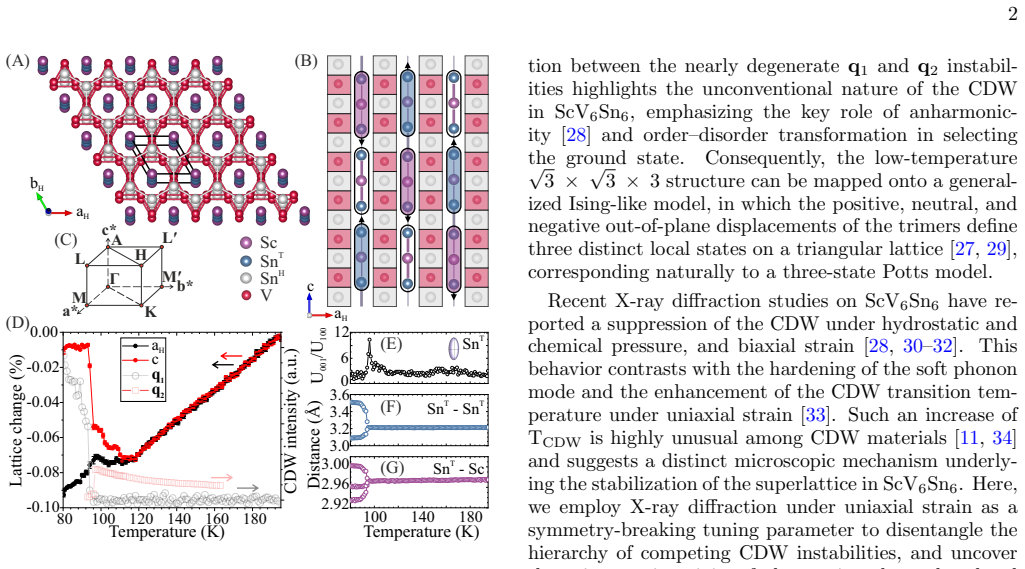
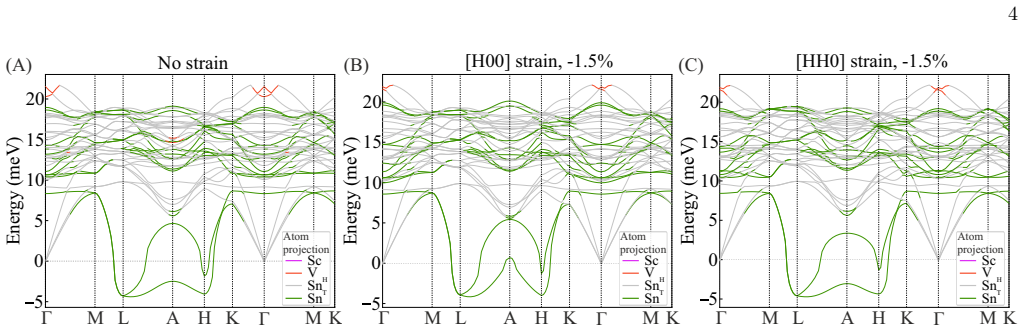
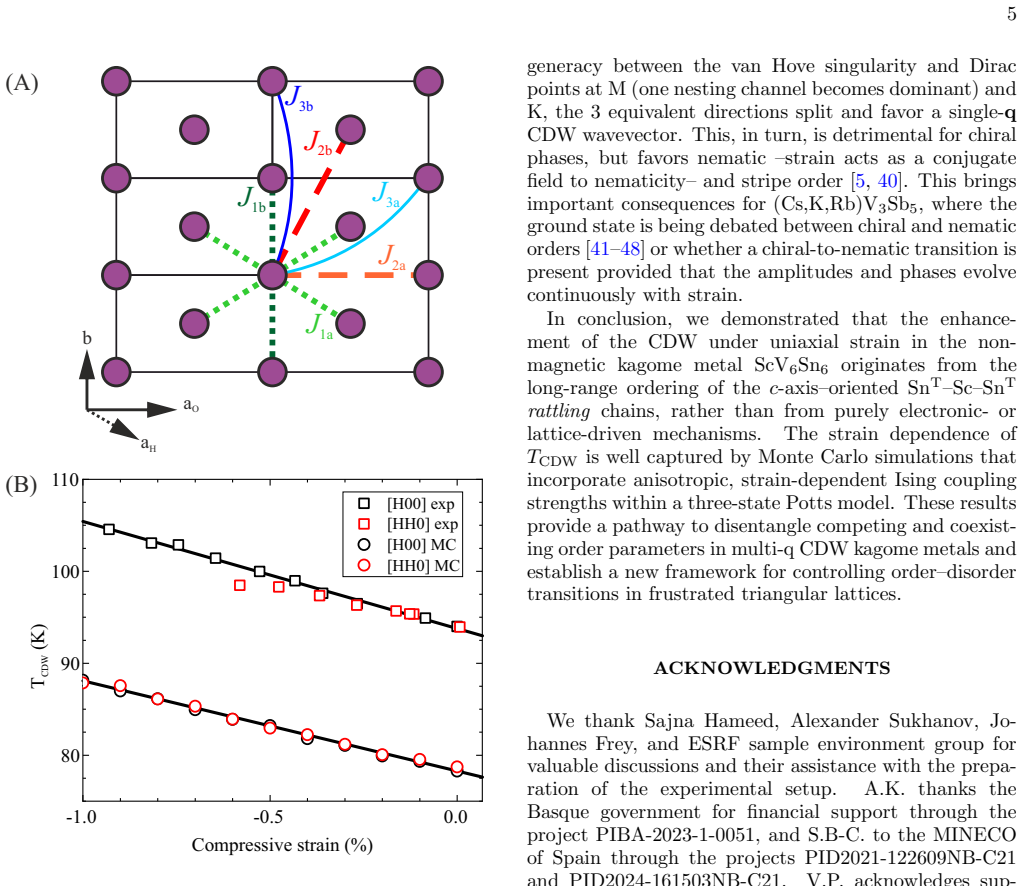
Compression along the [H00] and [HH0] directions lowers the crystal symmetry from hexagonal to orthorhombic, lifts the degeneracy between symmetry-equivalent in-plane CDW domains, and promotes long-range order while preserving the underlying trimer instability. The increase in T_CDW is primarily driven by the in-plane ordering of the Sn^T--Sc--Sn^T rattling chains within the frustrated kagome lattice, as phonon calculations indicate only moderate stabilization of the imaginary flat phonon mode. A phenomenological model incorporating strain-dependent Ising couplings within a three-state Potts framework successfully reproduces the evolution of T_CDW under compression and captures the continuou
What carries the argument
The in-plane ordering of the Sn^T--Sc--Sn^T rattling chains that drives enhancement of T_CDW under anisotropic strain, modeled via strain-dependent Ising couplings in a three-state Potts framework.
If this is right
- Uniaxial strain functions as a symmetry-selective tuning parameter for order-disorder transformations in frustrated lattices.
- Long-range CDW order can be promoted while the trimer instability is preserved.
- The CDW transition remains continuous under the applied compressions.
- The phenomenological Potts model accounts for the observed strain dependence of T_CDW.
Where Pith is reading between the lines
- Similar uniaxial strain could lift domain degeneracy and enhance CDW order in other kagome metals with equivalent in-plane frustration.
- Strain along the c-axis might produce opposite effects and suppress order, providing a directional control knob.
- The rattling-chain mechanism may explain CDW sensitivity in related compounds sharing the Sn^T--Sc--Sn^T structural motif.
- This tuning could be used to adjust competition or coexistence between CDW and superconductivity in the same class of materials.
Load-bearing premise
The increase in T_CDW is primarily driven by in-plane ordering of the Sn^T--Sc--Sn^T rattling chains rather than other strain-induced effects, resting on phonon calculations showing only moderate stabilization of the imaginary flat mode.
What would settle it
Measuring no increase (or a decrease) in the CDW transition temperature when uniaxial compression is applied along the [H00] or [HH0] directions would falsify the stabilization claim.
Figures

read the original abstract
Charge-density-wave (CDW) order in kagome metals is highly sensitive to external tuning parameters such as chemical substitution and hydrostatic pressure, which generally suppress long-range order. Here, using high-resolution X-ray diffraction under controlled uniaxial strain, we show that anisotropic lattice deformation instead stabilizes and enhances the CDW state in ScV$_6$Sn$_6$. Compression along the [H00] and [HH0] directions lowers the crystal symmetry from hexagonal to orthorhombic, lifts the degeneracy between symmetry-equivalent in-plane CDW domains, and promotes long-range order while preserving the underlying trimer instability. Phonon calculations indicate only a moderate stabilization of the imaginary flat phonon mode, demonstrating that the increase in T$_\mathrm{CDW}$ is primarily driven by the in-plane ordering of the Sn$^\mathrm{T}$--Sc--Sn$^\mathrm{T}$ \textit{rattling} chains within the frustrated kagome lattice. A phenomenological model incorporating strain-dependent Ising couplings within a three-state Potts framework successfully reproduces the evolution of T$_\mathrm{CDW}$ under compression and captures the continuous nature of the transition. Our results establish uniaxial strain as a powerful symmetry-selective tuning parameter for order-disorder transformations in frustrated lattices.
Editorial analysis
A structured set of objections, weighed in public.
Referee Report
Summary. The manuscript reports high-resolution X-ray diffraction measurements under uniaxial strain on ScV₆Sn₆, showing that compression along [H00] and [HH0] directions raises T_CDW, lowers hexagonal symmetry to orthorhombic, lifts degeneracy among in-plane CDW domains, and promotes long-range order while preserving the trimer instability. Phonon calculations are stated to show only moderate stabilization of the imaginary flat mode, leading to the conclusion that the T_CDW increase is driven primarily by in-plane ordering of Sn^T–Sc–Sn^T rattling chains. A three-state Potts model with strain-dependent Ising couplings is introduced and shown to reproduce the observed T_CDW evolution under compression.
Significance. If the central attribution holds, the work demonstrates uniaxial strain as a symmetry-selective control parameter that can enhance rather than suppress CDW order in a kagome metal, in contrast to hydrostatic pressure or doping. The combination of strain-dependent diffraction, phonon calculations, and a phenomenological Potts model provides a concrete example of how lattice anisotropy couples to frustrated order-disorder transitions. The experimental geometry and domain-lifting mechanism are clearly articulated and could be generalized to other kagome systems.
major comments (2)
- [Abstract; phonon calculations section] Abstract and phonon-calculation section: the statement that the imaginary flat phonon mode experiences 'only moderate stabilization' is used to attribute the observed ΔT_CDW primarily to rattling-chain ordering. No quantitative comparison is provided between the calculated energy lowering (in meV or implied temperature scale) and the measured increase in T_CDW; without this, the claim that phonon softening is insufficient remains interpretive rather than deductive.
- [Phenomenological model section] Phenomenological model section: the strain dependence of the Ising couplings in the three-state Potts model is introduced explicitly to reproduce the measured T_CDW(ε) curves. Because these couplings are free parameters adjusted to the data, the successful reproduction does not constitute an independent test of the rattling-chain mechanism and weakens the claim that the model 'captures the continuous nature of the transition' beyond fitting.
minor comments (2)
- [Figures 2–4; Methods] Figure captions and methods: error bars on extracted T_CDW values, details of the strain calibration, and the precise definition of the orthorhombic distortion angle are not stated; these should be added for reproducibility.
- [Abstract; introduction] Notation: the superscripts T on Sn^T are used without an initial definition in the main text; a brief parenthetical explanation on first use would improve clarity.
Simulated Author's Rebuttal
We thank the referee for their careful reading and constructive comments, which help clarify the presentation of our results. We address each major comment below and have revised the manuscript to strengthen the quantitative support and clarify the role of the model.
read point-by-point responses
-
Referee: [Abstract; phonon calculations section] Abstract and phonon-calculation section: the statement that the imaginary flat phonon mode experiences 'only moderate stabilization' is used to attribute the observed ΔT_CDW primarily to rattling-chain ordering. No quantitative comparison is provided between the calculated energy lowering (in meV or implied temperature scale) and the measured increase in T_CDW; without this, the claim that phonon softening is insufficient remains interpretive rather than deductive.
Authors: We agree that an explicit quantitative comparison would make the argument more deductive. In the revised manuscript we extract the energy lowering of the imaginary flat mode from the existing phonon calculations (approximately 2–3 meV per formula unit under 0.2% compression) and convert it to an effective temperature scale (~25–35 K). This remains substantially smaller than the measured ΔT_CDW (~80 K at the same strain), supporting the conclusion that phonon softening alone cannot account for the observed stabilization. The abstract and phonon section have been updated with this comparison. revision: yes
-
Referee: [Phenomenological model section] Phenomenological model section: the strain dependence of the Ising couplings in the three-state Potts model is introduced explicitly to reproduce the measured T_CDW(ε) curves. Because these couplings are free parameters adjusted to the data, the successful reproduction does not constitute an independent test of the rattling-chain mechanism and weakens the claim that the model 'captures the continuous nature of the transition' beyond fitting.
Authors: We acknowledge that the model is phenomenological and that the strain-dependent Ising couplings are adjusted to match the data. Its purpose is to demonstrate that a minimal three-state Potts description with physically motivated strain dependence (arising from the lifting of domain degeneracy and rattling-chain ordering) can reproduce both the magnitude and the continuous character of the transition. In the revision we have explicitly labeled the model as phenomenological, clarified that it illustrates consistency with the rattling-chain picture rather than providing an independent microscopic test, and removed the stronger phrasing about capturing the continuous nature beyond fitting. revision: yes
Circularity Check
No significant circularity detected
full rationale
The paper's chain rests on high-resolution X-ray diffraction under uniaxial strain, independent phonon calculations showing moderate stabilization of the imaginary mode, and a standard phenomenological three-state Potts model with strain-dependent couplings that reproduces observed T_CDW trends. No quoted step reduces a claimed prediction or central result to a fitted parameter or self-citation by construction; the model is presented as reproducing data rather than deriving it tautologically from the target quantities. The attribution to rattling-chain ordering follows from the phonon results as an interpretive step, not a definitional loop. The derivation remains self-contained against the reported experimental and computational benchmarks.
Axiom & Free-Parameter Ledger
free parameters (1)
- strain-dependent Ising couplings
axioms (1)
- domain assumption three-state Potts framework captures the continuous order-disorder transition
Forward citations
Cited by 1 Pith paper
-
Multiple closely spaced transitions and multi-band Hall response in clean ScV$_6$Sn$_6$
Higher-purity ScV6Sn6 crystals reveal multiple CDW transitions above an RRR threshold and attribute the Hall response to multi-band transport with high-mobility pockets rather than intrinsic anomalous Hall effect.
Reference graph
Works this paper leans on
-
[1]
Keimer, S
B. Keimer, S. A. Kivelson, M. R. Norman, S. Uchida, and J. Zaanen, From quantum matter to high-temperature superconductivity in copper oxides, Nature518, 179 (2015)
2015
-
[2]
Z. Liu, F. Liu, and Y.-S. Wu, Exotic electronic states in the world of flat bands: From theory to material, Chinese Physics B23, 077308 (2014)
2014
-
[3]
Y. Hu, X. Wu, B. R. Ortiz, S. Ju, X. Han, J. Ma, N. C. Plumb, M. Radovic, R. Thomale, S. D. Wilson,et al., Rich nature of Van Hove singularities in Kagome super- conductor CsV 3Sb5, Nature Communications13, 2220 (2022)
2022
-
[4]
Jiang, T
K. Jiang, T. Wu, J.-X. Yin, Z. Wang, M. Z. Hasan, S. D. Wilson, X. Chen, and J. Hu, Kagome superconductors AV3Sb5 (A = K, Rb, Cs), National Science Review10, nwac199 (2023)
2023
-
[5]
Farhang, W
C. Farhang, W. R. Meier, W. Lu, J. Li, Y. Wu, S. Mozaf- fari, R. P. Madhogaria, Y. Zhang, D. Mandrus, and J. Xia, Discovery of an intermediate nematic state in a bilayer kagome metal ScV6Sn6, Nature Communications 16, 7867 (2025)
2025
-
[6]
L. Nie, K. Sun, W. Ma, D. Song, L. Zheng, Z. Liang, P. Wu, F. Yu, J. Li, M. Shan,et al., Charge-density-wave- driven electronic nematicity in a kagome superconductor, Nature604, 59 (2022)
2022
-
[7]
H. Li, T. T. Zhang, T. Yilmaz, Y. Y. Pai, C. E. Marvin- ney, A. Said, Q. Yin, C. Gong, Z. Tu, E. Vescovo,et al., Observation of unconventional charge density wave with- out acoustic phonon anomaly in kagome superconductors AV3Sb5 (A= Rb, Cs), Physical Review X11, 031050 (2021)
2021
-
[8]
H.-H. Kim, S. M. Souliou, M. E. Barber, E. Lefran¸ cois, M. Minola, M. Tortora, R. Heid, N. Nandi, R. A. Borzi, G. Garbarino, A. Bosak, J. Porras, T. Loew, M. K¨ onig, P. J. W. Moll, A. P. Mackenzie, B. Keimer, C. W. Hicks, and M. L. Tacon, Uniaxial pressure control of compet- ing orders in a high-temperature superconductor, Science 362, 1040 (2018)
2018
-
[9]
Gerber, H
S. Gerber, H. Jang, H. Nojiri, S. Matsuzawa, H. Ya- sumura, D. A. Bonn, R. Liang, W. N. Hardy, Z. Islam, A. Mehta, S. Song, M. Sikorski, D. Stefanescu, Y. Feng, S. A. Kivelson, T. P. Devereaux, Z.-X. Shen, C.-C. Kao, W.-S. Lee, D. Zhu, and J.-S. Lee, Three-dimensional charge density wave order in YBa2Cu3O6.67 at high mag- netic fields, Science350, 949 (2015)
2015
-
[10]
A. J. Achkar, X. Mao, C. McMahon, R. Sutarto, F. He, R. Liang, D. A. Bonn, W. N. Hardy, and D. G. Hawthorn, Impact of Quenched Oxygen Disorder on Charge Den- sity Wave Order in YBa2Cu3O6+x, Phys. Rev. Lett.113, 107002 (2014)
2014
-
[11]
S. M. Souliou, H. Gretarsson, G. Garbarino, A. Bosak, J. Porras, T. Loew, B. Keimer, and M. Le Tacon, Rapid suppression of the charge density wave in YBa 2Cu3O6.6 under hydrostatic pressure, Phys. Rev. B97, 020503(R) (2018)
2018
-
[12]
Yamamoto, N
A. Yamamoto, N. Takeshita, C. Terakura, and Y. Tokura, High pressure effects revisited for the cuprate superconductor family with highest critical temperature, Nature Communications6, 8990 (2015)
2015
-
[13]
A. K. Kundu, A. Rajapitamahuni, E. Vescovo, I. I. Klimovskikh, H. Berger, and T. Valla, Charge density waves and the effects of uniaxial strain on the electronic structure of 2H-NbSe2, Communications Materials5, 208 (2024)
2024
-
[15]
Enting and F
I. Enting and F. Wu, Triangular lattice potts models, Journal of Statistical Physics28, 351 (1982)
1982
-
[16]
Adler, A
J. Adler, A. Brandt, W. Janke, and S. Shmulyian, Three- state potts antiferromagnet on the triangular lattice, Journal of Physics A: Mathematical and General28, 5117 (1995)
1995
-
[17]
Subires, A
D. Subires, A. Korshunov, A. Said, L. S´ anchez, B. R. Ortiz, S. D. Wilson, A. Bosak, and S. Blanco-Canosa, Order-disorder charge density wave instability in the kagome metal (Cs, Rb)V 3Sb5, Nature Communications 14, 1015 (2023)
2023
-
[18]
Subires, A
D. Subires, A. Kar, A. Korshunov, C. Fuller, Y. Jiang, H. Hu, D. C˘ alug˘ aru, C. McMonagle, C. Yi, S. Roy- chowdhury,et al., Frustrated charge density wave and quasi-long-range bond-orientational order in the mag- netic kagome FeGe, Nature communications16, 4091 (2025)
2025
-
[19]
C. Lin, A. Consiglio, O. K. Forslund, J. K¨ uspert, M. M. Denner, H. Lei, A. Louat, M. D. Watson, T. K. Kim, C. Cacho,et al., Uniaxial strain tuning of charge modula- tion and singularity in a kagome superconductor, Nature Communications15, 10466 (2024)
2024
-
[20]
Stier, A.-A
F. Stier, A.-A. Haghighirad, G. Garbarino, S. Mishra, N. Stilkerich, D. Chen, C. Shekhar, T. Lacmann, C. Felser, T. Ritschel, J. Geck, and M. Le Tacon, Pressure-Dependent Electronic Superlattice in the Kagome Superconductor CsV3Sb5, Phys. Rev. Lett.133, 236503 (2024)
2024
-
[21]
H. Li, G. Fabbris, A. H. Said, J. Sun, Y.-X. Jiang, J.- X. Yin, Y.-Y. Pai, S. Yoon, A. R. Lupini, C. S. Nel- son,et al., Discovery of conjoined charge density waves in the kagome superconductor CsV3Sb5, Nature commu- nications13, 6348 (2022)
2022
-
[22]
J. Hou, K. Y. Chen, J. P. Sun, Z. Zhao, Y. H. Zhang, P. F. Shan, N. N. Wang, H. Zhang, K. Zhu, Y. Uwa- toko, H. Chen, H. T. Yang, X. L. Dong, H.-J. Gao, and J.-G. Cheng, Effect of hydrostatic pressure on the un- conventional charge density wave and superconducting properties in two distinct phases of doped kagome su- perconductors CsV3−xTixSb5, Phys. Rev....
2023
-
[23]
H. W. S. Arachchige, W. R. Meier, M. Marshall, T. Mat- suoka, R. Xue, M. A. McGuire, R. P. Hermann, H. Cao, and D. Mandrus, Charge Density Wave in Kagome Lat- tice Intermetallic ScV6Sn6, Phys. Rev. Lett.129, 216402 (2022)
2022
-
[24]
S. Lee, C. Won, J. Kim, J. Yoo, S. Park, J. Den- linger, C. Jozwiak, A. Bostwick, E. Rotenberg, R. Comin, M. Kang, and J.-H. Park, Nature of charge density wave in kagome metal ScV6Sn6, npj Quantum Materials9, 15 (2024)
2024
-
[25]
H. Hu, Y. Jiang, D. C˘ alug˘ aru, X. Feng, D. Subires, M. G. Vergniory, C. Felser, S. Blanco-Canosa, and B. A. Bernevig, Flat phonon soft modes and unconventional charge density wave formation in ScV 6Sn6: Microscopic and effective theory, Phys. Rev. B111, 054113 (2025)
2025
-
[26]
S. Cao, C. Xu, H. Fukui, T. Manjo, Y. Dong, M. Shi, Y. Liu, C. Cao, and Y. Song, Competing charge-density wave instabilities in the kagome metal ScV 6Sn6, Nature Communications14, 7671 (2023)
2023
-
[27]
Pokharel, B
G. Pokharel, B. R. Ortiz, L. Kautzsch, S. J. Gomez Al- varado, K. Mallayya, G. Wu, E.-A. Kim, J. P. C. Ruff, S. Sarker, and S. D. Wilson, Frustrated charge order and cooperative distortions in ScV6Sn6, Phys. Rev. Mater.7, 104201 (2023)
2023
-
[28]
K. Wang, S. Chen, S.-W. Kim, and B. Monserrat, Ori- gin of competing charge density waves in kagome metal ScV6Sn6, Nature Communications15, 10428 (2024)
2024
-
[29]
S. J. G. Alvarado, G. Pokharel, B. R. Ortiz, J. A. M. Paddison, S. Sarker, J. P. C. Ruff, and S. D. Wilson, Frustrated Ising charge correlations in the kagome metal ScV6Sn6, Phys. Rev. B110, L140304 (2024)
2024
-
[30]
Zhang, J
X. Zhang, J. Hou, W. Xia, Z. Xu, P. Yang, A. Wang, Z. Liu, J. Shen, H. Zhang, X. Dong,et al., Destabiliza- tion of the charge density wave and the absence of super- conductivity in ScV 6Sn6 under high pressures up to 11 GPa, Materials15, 7372 (2022)
2022
-
[31]
W. R. Meier, R. P. Madhogaria, S. Mozaffari, M. Mar- shall, D. E. Graf, M. A. McGuire, H. W. S. Arachchige, C. L. Allen, J. Driver, H. Cao,et al., Tiny Sc allows the chains to rattle: impact of Lu and Y Doping on the charge-density wave in ScV6Sn6, Journal of the American Chemical Society145, 20943 (2023)
2023
-
[32]
W. R. Meier, D. E. Graf, B. R. Ortiz, S. Mozaffari, and D. Mandrus, Pressure suppresses the density wave order in kagome metal LuNb 6Sn6, Physical Review Materials 9, L082001 (2025)
2025
-
[33]
Tuniz, A
M. Tuniz, A. Consiglio, G. Pokharel, F. Parmigiani, T. Neupert, R. Thomale, S. K. Chaluvadi, P. Orgiani, G. Sangiovanni, S. D. Wilson, I. Vobornik, F. Salvador, F. Cilento, D. Di Sante, and F. Mazzola, Strain-Induced Enhancement of the Charge Density Wave in the Kagome Metal ScV6Sn6, Phys. Rev. Lett.134, 066501 (2025)
2025
-
[34]
Leroux, I
M. Leroux, I. Errea, M. Le Tacon, S.-M. Souliou, G. Gar- barino, L. Cario, A. Bosak, F. Mauri, M. Calandra, and P. Rodi` ere, Strong anharmonicity induces quantum melt- ing of charge density wave in 2H−NbSe2 under pressure, Phys. Rev. B92, 140303(R) (2015)
2015
-
[35]
See Supplemental Material at http://link.aps.org/supplemental/DOI for experimental details, crystal structure analysis, DFT calculations, Monte Carlo simulations, as well as additional data analysis
-
[36]
B. J. Campbell, H. T. Stokes, D. E. Tanner, and D. M. Hatch, Isodisplace: a web-based tool for explor- ing structural distortions, Applied Crystallography39, 607 (2006)
2006
-
[37]
H. T. Stokes, D. M. Hatch, and B. J. Campbell, ISODIS- TORT, isotropy software suite,https://iso.byu.edu
-
[38]
Yin, Y.-X
J.-X. Yin, Y.-X. Jiang, X. Teng, M. S. Hossain, S. Mar- danya, T.-R. Chang, Z. Ye, G. Xu, M. M. Denner, T. Ne- upert,et al., Discovery of charge order and corresponding edge state in kagome magnet FeGe, Physical review let- ters129, 166401 (2022)
2022
-
[40]
Jiang, S
Y.-X. Jiang, S. Shao, W. Xia, M. M. Denner, J. Ingham, M. S. Hossain, Q. Qiu, X. Zheng, H. Chen, Z.-J. Cheng, X. P. Yang, B. Kim, J.-X. Yin, S. Zhang, M. Litskevich, Q. Zhang, T. A. Cochran, Y. Peng, G. Chang, Y. Guo, R. Thomale, T. Neupert, and M. Z. Hasan, Van hove annihilation and nematic instability on a kagome lattice, Nature Materials23, 1214 (2024)
2024
-
[41]
C. Guo, C. Putzke, S. Konyzheva, X. Huang, M. Gutierrez-Amigo, I. Errea, D. Chen, M. G. Vergniory, C. Felser, M. H. Fischer, T. Neupert, and P. J. W. Moll, Switchable chiral transport in charge-ordered kagome metal CsV3Sb5, Nature611, 461 (2022)
2022
-
[42]
C. Guo, G. Wagner, C. Putzke, D. Chen, K. Wang, L. Zhang, M. Gutierrez-Amigo, I. Errea, M. G. Vergniory, C. Felser, M. H. Fischer, T. Neupert, and P. J. W. Moll, Correlated order at the tipping point in the kagome metal CsV3Sb5, Nature Physics20, 579 (2024)
2024
-
[43]
C. Guo, M. R. van Delft, M. Gutierrez-Amigo, D. Chen, C. Putzke, G. Wagner, M. H. Fischer, T. Neupert, I. Er- rea, M. G. Vergniory, S. Wiedmann, C. Felser, and P. J. W. Moll, Distinct switching of chiral transport in the kagome metals KV 3Sb5 and CsV3Sb5, npj Quantum Materials9, 20 (2024)
2024
-
[44]
H. J. Elmers, O. Tkach, Y. Lytvynenko, P. Yogi, M. Schmitt, D. Biswas, J. Liu, S. V. Chernov, Q. Nguyen, M. Hoesch, D. Kutnyakhov, N. Wind, L. Wenthaus, M. Scholz, K. Rossnagel, A. Gloskovskii, C. Schlueter, A. Winkelmann, A.-A. Haghighirad, T.-L. Lee, M. Sing, R. Claessen, M. Le Tacon, J. Demsar, G. Sch¨ onhense, and O. Fedchenko, Chirality in the kagome...
2025
-
[45]
Jiang, J.-X
Y.-X. Jiang, J.-X. Yin, M. M. Denner, N. Shumiya, B. R. Ortiz, G. Xu, Z. Guguchia, J. He, M. S. Hossain, X. Liu, J. Ruff, L. Kautzsch, S. S. Zhang, G. Chang, I. Belopol- ski, Q. Zhang, T. A. Cochran, D. Multer, M. Litskevich, Z.-J. Cheng, X. P. Yang, Z. Wang, R. Thomale, T. Ne- upert, S. D. Wilson, and M. Z. Hasan, Unconventional chiral charge order in ka...
2021
-
[46]
Mielke, D
C. Mielke, D. Das, J.-X. Yin, H. Liu, R. Gupta, Y.- X. Jiang, M. Medarde, X. Wu, H. C. Lei, J. Chang, P. Dai, Q. Si, H. Miao, R. Thomale, T. Neupert, Y. Shi, R. Khasanov, M. Z. Hasan, H. Luetkens, and Z. Guguchia, Time-reversal symmetry-breaking charge order in a kagome superconductor, Nature602, 245 (2022)
2022
-
[47]
E. Sadrollahi, J. A. Mendes, N. Stilkerich, A. K. Sharma, C. Shekhar, C. Felser, T. Ritschel, and J. Geck, Strain- control of electronic superlattice domains in CsV 3Sb5 (2025), arXiv:2509.05680 [cond-mat.str-el]
-
[48]
Jiang, H
Z. Jiang, H. Ma, W. Xia, Z. Liu, Q. Xiao, Z. Liu, Y. Yang, J. Ding, Z. Huang, J. Liu, Y. Qiao, J. Liu, Y. Peng, 8 S. Cho, Y. Guo, J. Liu, and D. Shen, Observation of elec- tronic nematicity driven by the three-dimensional charge density wave in kagome lattice KV3Sb5, Nano Letters23, 5625 (2023). Supplemental Material for: Symmetry-Selective Stabilization ...
2023
-
[49]
Korshunov, H
A. Korshunov, H. Hu, D. Subires, Y. Jiang, D. C˘ alug˘ aru, X. Feng, A. Rajapitamahuni, C. Yi, S. Roychowdhury, M. Vergniory,et al., Softening of a flat phonon mode in the kagome ScV 6Sn6, Nature communications14, 6646 (2023)
2023
-
[50]
Dyadkin, P
V. Dyadkin, P. Pattison, V. Dmitriev, and D. Chernyshov, A new multipurpose diffractometer PILATUS@SNBL, Journal of Synchrotron Radiation23, 825 (2016)
2016
-
[51]
G. M. Sheldrick, A short history of SHELX, Acta Crystallographica Section A64, 112 (2008)
2008
-
[52]
Garbarino, M
G. Garbarino, M. E. Hanfland, S. Gallego-Parra, A. D. Rosa, M. Mezouar, D. Duran, K. Martel, E. Papillon, T. Roth, P. Got, and J. Jacobs, Extreme conditions X-ray diffraction and imaging beamline ID15B on the ESRF extremely brilliant source, High Pressure Research44, 199 (2024)
2024
-
[53]
Petˇ r´ ıˇ cek, M
V. Petˇ r´ ıˇ cek, M. Duˇ sek, and L. Palatinus, Crystallographic Computing System JANA2006: General features, Zeitschrift f¨ ur Kristallographie - Crystalline Materials229, 345 (2014)
2014
-
[54]
Cheng, Z
S. Cheng, Z. Ren, H. Li, J. S. Oh, H. Tan, G. Pokharel, J. M. DeStefano, E. Rosenberg, Y. Guo, Y. Zhang, Z. Yue, Y. Lee, S. Gorovikov, M. Zonno, M. Hashimoto, D. Lu, L. Ke, F. Mazzola, J. Kono, R. J. Birgeneau, J.-H. Chu, S. D. Wilson, Z. Wang, B. Yan, M. Yi, and I. Zeljkovic, Nanoscale visualization and spectral fingerprints of the charge order in ScV 6S...
2024
-
[55]
Hohenberg and W
P. Hohenberg and W. Kohn, Inhomogeneous electron gas, Phys. Rev.136, B864 (1964)
1964
-
[56]
Kohn and L
W. Kohn and L. J. Sham, Self-consistent equations including exchange and correlation effects, Phys. Rev.140, A1133 (1965)
1965
-
[57]
Kresse and J
G. Kresse and J. Hafner, Ab initio molecular dynamics for liquid metals, Phys. Rev. B47, 558(R) (1993)
1993
-
[58]
Kresse and J
G. Kresse and J. Furthm¨ uller, Efficiency of ab-initio total energy calculations for metals and semiconductors using a plane-wave basis set, Computational Materials Science6, 15 (1996)
1996
-
[59]
Kresse and J
G. Kresse and J. Furthm¨ uller, Efficient iterative schemes for ab initio total-energy calculations using a plane-wave basis set, Phys. Rev. B54, 11169 (1996)
1996
-
[60]
H. W. S. Arachchige, W. R. Meier, M. Marshall, T. Matsuoka, R. Xue, M. A. McGuire, R. P. Hermann, H. Cao, and D. Mandrus, Charge Density Wave in Kagome Lattice Intermetallic ScV 6Sn6, Phys. Rev. Lett.129, 216402 (2022)
2022
-
[61]
J. P. Perdew, K. Burke, and M. Ernzerhof, Generalized gradient approximation made simple, Phys. Rev. Lett.77, 3865 (1996)
1996
-
[62]
A. Togo, L. Chaput, T. Tadano, and I. Tanaka, Implementation strategies in phonopy and phono3py, J. Phys. Condens. Matter35, 353001 (2023)
2023
-
[63]
Togo, First-principles phonon calculations with phonopy and phono3py, J
A. Togo, First-principles phonon calculations with phonopy and phono3py, J. Phys. Soc. Jpn.92, 012001 (2023)
2023
-
[64]
V. Wang, N. Xu, J.-C. Liu, G. Tang, and W.-T. Geng, VASPKIT: A user-friendly interface facilitating high-throughput computing and analysis using VASP code, Computer Physics Communications267, 108033 (2021)
2021
-
[65]
S. J. G. Alvarado, G. Pokharel, B. R. Ortiz, J. A. M. Paddison, S. Sarker, J. P. C. Ruff, and S. D. Wilson, Frustrated Ising charge correlations in the kagome metal ScV 6Sn6, Phys. Rev. B110, L140304 (2024)
2024
-
[66]
R. B. Neder and T. Proffen,Diffuse Scattering and Defect Structure Simulations: A cook book using the program DISCUS, Vol. 11 (Oxford University Press, 2008)
2008
discussion (0)
Sign in with ORCID, Apple, or X to comment. Anyone can read and Pith papers without signing in.