Auxiliary Gradient-Flow Solvers for Generalized Newtonian Models
Pith reviewed 2026-06-28 00:22 UTC · model grok-4.3
The pith
An auxiliary scalar variable for gradient magnitude turns generalized Newtonian variational problems into sequences of linear elliptic problems.
A machine-rendered reading of the paper's core claim, the machinery that carries it, and where it could break.
Core claim
By replacing the nonlinear dependence on the gradient (or symmetric gradient) with an auxiliary scalar variable that tracks its squared magnitude, the framework converts the original nonlinear problem into a sequence of linear elliptic problems while preserving the variational structure; the associated auxiliary energy on an adapted metric space satisfies the conditions for geodesic lambda-convexity, which in turn guarantees convergence of the continuous and discrete gradient-flow schemes for the indicated range of p.
What carries the argument
Auxiliary scalar variable representing the squared magnitude of the gradient (or symmetric gradient), together with the auxiliary energy constructed on a metric space adapted to the growth of the underlying N-function.
If this is right
- The operator-splitting time discretization recovers the Kac iteration as a special case.
- An adaptive pseudo-transient continuation can be implemented with scalable linear solvers and shows mesh-independent iteration counts.
- The same auxiliary construction supplies asymptotic convergence-rate estimates outside the interval 4/3 ≤ p ≤ 4.
- Numerical tests on power-law, Carreau-Yasuda, regularized Bingham, and optimal-design models show robustness comparable to or better than Newton's method.
Where Pith is reading between the lines
- The same auxiliary-variable shift may apply to other variational problems whose energy densities admit an N-function representation.
- Because the linear subproblems are uniformly elliptic, the approach could combine with existing fast solvers for linear elliptic equations to handle larger three-dimensional non-Newtonian flow simulations.
- The metric-space construction suggests possible extensions to energies with more general growth that still admit a suitable auxiliary variable.
Load-bearing premise
The auxiliary energy can be defined on a metric space whose geometry matches the growth of the N-function closely enough to guarantee lower semicontinuity and geodesic lambda-convexity.
What would settle it
Numerical or analytic evidence that the minimizing-movement scheme fails to converge for some p in [4/3,4] excluding 2, or that the semi-discrete ODE does not converge to the finite-element Euler-Lagrange solution, would disprove the claimed convergence result.
Figures
read the original abstract
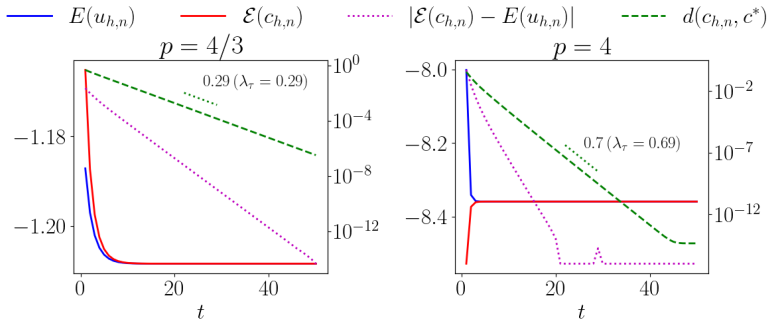
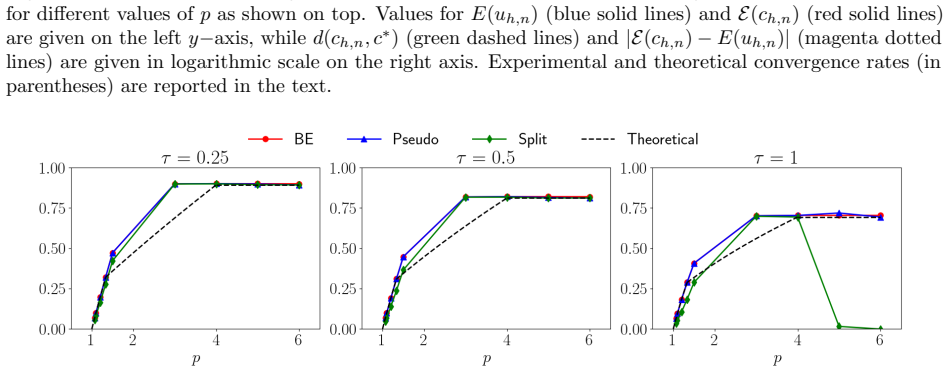
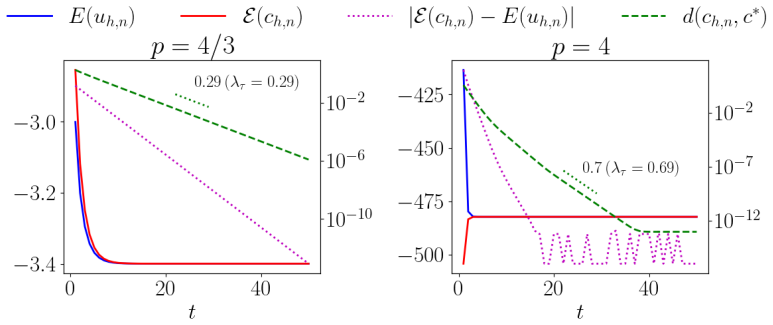
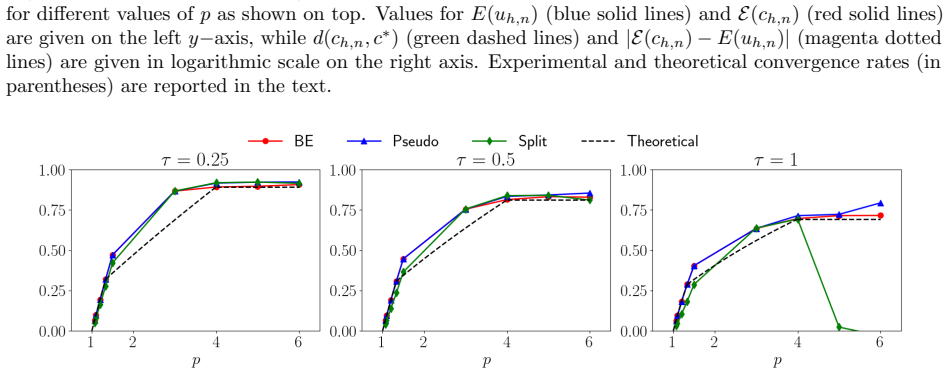
We introduce an auxiliary gradient-flow framework for variational problems with generalized Newtonian structure governed by an N-function. The key idea is to replace the nonlinear constitutive dependence on the gradient, or symmetric gradient, by an auxiliary scalar variable representing its squared magnitude. This shifts the nonlinearity from the state equation to the auxiliary variable, yielding a sequence of uniformly elliptic weighted linear problems. At the continuous level, we construct an auxiliary energy on a metric space adapted to the growth of the underlying N-function. In this topology, we prove lower semicontinuity, geodesic $\lambda$-convexity, and exponential convergence of the associated minimizing-movement scheme. At the finite element level, we derive a metric gradient flow through an explicit Riesz map, prove global well-posedness of the resulting semi-discrete ODE, and establish convergence to the finite element solution of the Euler--Lagrange equations of the generalized Newtonian energy. For the $p$-Laplacian and $p$-Stokes models, this gives a rigorous convergence result for $4/3\le p\le 4$, $p\ne2$, with asymptotic rate estimates beyond this range. We also propose practical time discretizations, including an operator-splitting scheme that gives the \kac iteration as a special case, and an adaptive pseudo-transient method that can be implemented using scalable linear solvers. Numerical experiments for power-law, Carreau--Yasuda, regularized Bingham, and optimal-design models demonstrate robustness, mesh-independent iteration counts in the tested regimes, and performance that matches or outperforms Newton's method.
Editorial analysis
A structured set of objections, weighed in public.
Referee Report
Summary. The paper introduces an auxiliary gradient-flow framework for variational problems governed by N-functions, such as generalized Newtonian models. By introducing an auxiliary scalar variable for the squared magnitude of the gradient (or symmetric gradient), the nonlinearity is shifted to the auxiliary variable, resulting in a sequence of uniformly elliptic weighted linear problems. At the continuous level, an auxiliary energy is constructed on a metric space adapted to the N-function growth, with proofs of lower semicontinuity, geodesic λ-convexity, and exponential convergence of the minimizing-movement scheme. At the finite-element level, a metric gradient flow is derived via an explicit Riesz map, with global well-posedness of the semi-discrete ODE and convergence to the FE solution of the Euler-Lagrange equations. For p-Laplacian and p-Stokes, this yields rigorous convergence for 4/3 ≤ p ≤ 4 (p ≠ 2), with asymptotic rate estimates outside this range. Practical time discretizations (including operator-splitting yielding the Kac iteration and adaptive pseudo-transient methods) are proposed and tested numerically on power-law, Carreau-Yasuda, regularized Bingham, and optimal-design models, showing robustness and performance comparable or superior to Newton's method.
Significance. If the central claims on geodesic λ-convexity and convergence hold, the work provides a mathematically rigorous alternative solver framework for a broad class of nonlinear elliptic problems in numerical analysis, with potential advantages in robustness and mesh-independent iteration counts over standard nonlinear methods. The explicit range 4/3 ≤ p ≤ 4 with rates, combined with the auxiliary construction enabling linear subproblems, represents a substantive contribution to metric-gradient-flow methods for non-quadratic energies.
major comments (2)
- [continuous level section / abstract] Continuous level analysis (as described in the abstract): the load-bearing claim of geodesic λ-convexity for the auxiliary energy in the N-function-adapted metric space requires explicit verification that the convexity constant λ remains positive and controllable at the endpoints p=4/3 and p=4; without this, the advertised rigorous convergence result for the full interval 4/3 ≤ p ≤ 4 does not follow from the minimizing-movement scheme.
- [finite element level section] Finite element level (abstract): the derivation of the metric gradient flow via the explicit Riesz map and the subsequent global well-posedness of the semi-discrete ODE must be checked for uniformity with respect to the auxiliary variable at the boundary p-values, as any p-dependent degeneration would undermine the convergence statement to the FE Euler-Lagrange solution.
minor comments (2)
- [abstract] The abstract states 'asymptotic rate estimates beyond this range' but does not specify the precise form of the rates or the extended p-interval; this should be clarified with a reference to the relevant theorem.
- [preliminaries] Notation for the adapted metric and the N-function should be introduced with a dedicated preliminary subsection to improve readability for readers unfamiliar with Orlicz-space techniques.
Simulated Author's Rebuttal
We thank the referee for the careful reading and constructive comments. We address the major points below, providing clarifications on the proofs.
read point-by-point responses
-
Referee: [continuous level section / abstract] Continuous level analysis (as described in the abstract): the load-bearing claim of geodesic λ-convexity for the auxiliary energy in the N-function-adapted metric space requires explicit verification that the convexity constant λ remains positive and controllable at the endpoints p=4/3 and p=4; without this, the advertised rigorous convergence result for the full interval 4/3 ≤ p ≤ 4 does not follow from the minimizing-movement scheme.
Authors: The geodesic λ-convexity is established in Theorem 3.4. The constant λ is derived explicitly from the N-function growth conditions and remains strictly positive on the closed interval [4/3,4], including the endpoints, with a lower bound controlled solely by the N-function constants (see the estimates after (3.15) obtained by direct substitution of the boundary values of p). This ensures the minimizing-movement scheme yields exponential convergence on the full advertised interval. We will add an explicit remark after Theorem 3.4 highlighting the endpoint verification. revision: partial
-
Referee: [finite element level section] Finite element level (abstract): the derivation of the metric gradient flow via the explicit Riesz map and the subsequent global well-posedness of the semi-discrete ODE must be checked for uniformity with respect to the auxiliary variable at the boundary p-values, as any p-dependent degeneration would undermine the convergence statement to the FE Euler-Lagrange solution.
Authors: The Riesz map and global well-posedness of the semi-discrete ODE are treated in Section 4, with existence in Theorem 4.5. The coercivity and growth estimates (Lemmas 4.2 and 4.4) are uniform in the auxiliary variable and hold without degeneration at p=4/3 and p=4 because they rely on the same N-function inequalities that are continuous in p across the closed interval. We will insert a clarifying sentence in the proof of Theorem 4.5 to emphasize uniformity at the boundary values. revision: partial
Circularity Check
No circularity: auxiliary energy construction and geodesic convexity proved from first principles
full rationale
The derivation constructs an auxiliary energy on an N-function-adapted metric space and proves lower semicontinuity plus geodesic λ-convexity via standard arguments in metric geometry and functional analysis. These properties then imply convergence of the minimizing-movement scheme. No step reduces a claimed result to a fitted parameter, self-definition, or self-citation chain; the central claims rest on independent proofs rather than renaming or importing uniqueness from prior author work. The paper is self-contained against external benchmarks.
Axiom & Free-Parameter Ledger
Reference graph
Works this paper leans on
-
[1]
Approximation theory for the hp-version finite element method and application to the non-linear Laplacian.Applied numerical mathematics, 34(4):329–344, 2000
Mark Ainsworth and David Kay. Approximation theory for the hp-version finite element method and application to the non-linear Laplacian.Applied numerical mathematics, 34(4):329–344, 2000
2000
-
[2]
Springer, 2005
Luigi Ambrosio, Nicola Gigli, and Giuseppe Savar´ e.Gradient flows: in metric spaces and in the space of probability measures. Springer, 2005
2005
-
[3]
Amestoy, I
P.R. Amestoy, I. S. Duff, J. Koster, and J.-Y. L’Excellent. A fully asynchronous multifrontal solver using distributed dynamic scheduling.SIAM Journal on Matrix Analysis and Applications, 23(1):15–41, 2001
2001
-
[4]
Mario Amrein and Thomas P Wihler. Adaptive pseudo-transient-continuation-Galerkin methods for semilinear elliptic partial differential equations.Numerical Methods for Partial Differential Equations, 33(6):2005–2022, 2017
2005
-
[5]
Paola F Antonietti, Louren¸ co Beir˜ ao da Veiga, Michele Botti, Andr´ e Harnist, Giuseppe Vacca, and Marco Verani. Virtual element methods for non-Newtonian shear-thickening fluid flow problems.arXiv preprint arXiv:2601.04866, 2026
-
[6]
A virtual element method for non-Newtonian pseudoplastic Stokes flows.Computer Methods in Applied Mechanics and Engineering, 428:117079, 2024
Paola F Antonietti, Louren¸ co Beir˜ ao da Veiga, Michele Botti, Giuseppe Vacca, and Marco Verani. A virtual element method for non-Newtonian pseudoplastic Stokes flows.Computer Methods in Applied Mechanics and Engineering, 428:117079, 2024
2024
-
[7]
Relaxed Kaˇ canov scheme for the p-Laplacian with large exponent.SIAM Journal on Numerical Analysis, 61(6):2775–2794, 2023
Anna Kh Balci, Lars Diening, and Johannes Storn. Relaxed Kaˇ canov scheme for the p-Laplacian with large exponent.SIAM Journal on Numerical Analysis, 61(6):2775–2794, 2023
2023
-
[8]
Finite element error analysis of a quasi-Newtonian flow obeying the Carreau or power law.Numerische Mathematik, 64(1):433–453, 1993
John W Barrett and WB Liu. Finite element error analysis of a quasi-Newtonian flow obeying the Carreau or power law.Numerische Mathematik, 64(1):433–453, 1993
1993
-
[9]
Quasi-norm error bounds for the finite element approximation of a non-Newtonian flow.Numerische Mathematik, 68(4):437–456, 1994
John W Barrett and WB Liu. Quasi-norm error bounds for the finite element approximation of a non-Newtonian flow.Numerische Mathematik, 68(4):437–456, 1994
1994
-
[10]
Finite element approximation of the p-Laplacian.Mathematics of computation, 61(204):523–537, 1993
John W Barrett and Wen Bin Liu. Finite element approximation of the p-Laplacian.Mathematics of computation, 61(204):523–537, 1993
1993
-
[11]
A convergent adaptive finite element method for an optimal design problem.Numerische Mathematik, 108(3):359–385, 2008
S¨ oren Bartels and Carsten Carstensen. A convergent adaptive finite element method for an optimal design problem.Numerische Mathematik, 108(3):359–385, 2008
2008
-
[12]
On the finite element approxima- tion of p-Stokes systems.SIAM Journal on Numerical Analysis, 50(2):373–397, 2012
Liudmila Belenki, Luigi C Berselli, Lars Diening, and Michael Ruˇ ziˇ cka. On the finite element approxima- tion of p-Stokes systems.SIAM Journal on Numerical Analysis, 50(2):373–397, 2012
2012
-
[13]
Optimality of an adaptive finite element method for the p-Laplacian equation.IMA Journal of Numerical Analysis, 32(2):484–510, 2012
Liudmila Belenki, Lars Diening, and Christian Kreuzer. Optimality of an adaptive finite element method for the p-Laplacian equation.IMA Journal of Numerical Analysis, 32(2):484–510, 2012
2012
-
[14]
A finite-element method for incompressible non-Newtonian flows.Journal of Computational Physics, 36(3):313–326, 1980
Michel Bercovier and Michael Engelman. A finite-element method for incompressible non-Newtonian flows.Journal of Computational Physics, 36(3):313–326, 1980. 35
1980
-
[15]
A generalization of a lemma of Bellman and its application to uniqueness problems of differential equations.Acta Mathematica Hungarica, 7(1):81–94, 1956
Imre Bihari. A generalization of a lemma of Bellman and its application to uniqueness problems of differential equations.Acta Mathematica Hungarica, 7(1):81–94, 1956
1956
-
[16]
McGraw-Hill, 1922
Eugene Cook Bingham.Fluidity and plasticity. McGraw-Hill, 1922
1922
-
[17]
Robert Byron Bird, Robert Calvin Armstrong, and Ole Hassager.Dynamics of polymeric liquids. Vol. 1: Fluid mechanics. John Wiley and Sons Inc., New York, NY, 1986
1986
-
[18]
Volume I
Vladimir I Bogachev.Measure theory. Volume I. Springer-Verlag, 2007
2007
-
[19]
A hybrid high-order method for creeping flows of non-Newtonian fluids.ESAIM: Mathematical Modelling and Numerical Analysis, 55(5):2045–2073, 2021
Michele Botti, Daniel Castanon Quiroz, Daniele A Di Pietro, and Andr´ e Harnist. A hybrid high-order method for creeping flows of non-Newtonian fluids.ESAIM: Mathematical Modelling and Numerical Analysis, 55(5):2045–2073, 2021
2045
-
[20]
Finite element approximation of the p(·)- laplacian.SIAM Journal on Numerical Analysis, 53(1):551–572, 2015
Dominic Breit, Lars Diening, and Sebastian Schwarzacher. Finite element approximation of the p(·)- laplacian.SIAM Journal on Numerical Analysis, 53(1):551–572, 2015
2015
-
[21]
A posteriori finite element error control for the p-Laplace problem
Carsten Carstensen and Roland Klose. A posteriori finite element error control for the p-Laplace problem. SIAM Journal on Scientific Computing, 25(3):792–814, 2003
2003
-
[22]
Unstabilized hybrid high-order method for a class of degenerate convex minimization problems.SIAM Journal on Numerical Analysis, 59(3):1348–1373, 2021
Carsten Carstensen and Tien Tran. Unstabilized hybrid high-order method for a class of degenerate convex minimization problems.SIAM Journal on Numerical Analysis, 59(3):1348–1373, 2021
2021
-
[23]
Global boundedness of the gradient for a class of nonlinear elliptic systems.Archive for Rational Mechanics and Analysis, 212(1):129–177, 2014
Andrea Cianchi and Vladimir Maz´ ya. Global boundedness of the gradient for a class of nonlinear elliptic systems.Archive for Rational Mechanics and Analysis, 212(1):129–177, 2014
2014
-
[24]
Second-order two-sided estimates in nonlinear elliptic problems
Andrea Cianchi and Vladimir G Maz’ya. Second-order two-sided estimates in nonlinear elliptic problems. Archive for Rational Mechanics and Analysis, 229(2):569–599, 2018
2018
-
[25]
Linear and nonlinear functional analysis with applications, 2013
Philippe G Ciarlet. Linear and nonlinear functional analysis with applications, 2013
2013
-
[26]
Pseudotransient continuation and differential-algebraic equations.SIAM Journal on Scientific Computing, 25(2):553–569, 2003
Todd S Coffey, Carl T Kelley, and David E Keyes. Pseudotransient continuation and differential-algebraic equations.SIAM Journal on Scientific Computing, 25(2):553–569, 2003
2003
-
[27]
Dalcin, Rodrigo R
Lisandro D. Dalcin, Rodrigo R. Paz, Pablo A. Kler, and Alejandro Cosimo. Parallel distributed computing using Python.Advances in Water Resources, 34(9):1124 – 1139, 2011. New Computational Methods and Software Tools
2011
-
[28]
Lecture Notes on Gradient Flows and Optimal Transport
Sara Daneri and Giuseppe Savar´ e. Lecture notes on gradient flows and optimal transport.arXiv preprint arXiv:1009.3737, 2010
work page internal anchor Pith review Pith/arXiv arXiv 2010
-
[29]
New problems on minimizing movements.Boundary Value Problems for PDE and Applications, pages 81–98, 1993
Ennio De Giorgi. New problems on minimizing movements.Boundary Value Problems for PDE and Applications, pages 81–98, 1993
1993
-
[30]
Springer Science & Business Media, 2011
Peter Deuflhard.Newton methods for nonlinear problems: affine invariance and adaptive algorithms, volume 35. Springer Science & Business Media, 2011
2011
-
[31]
A hybrid high-order method for Leray–Lions elliptic equations on general meshes.Mathematics of Computation, 86(307):2159–2191, 2017
Daniele Di Pietro and J´ erˆ ome Droniou. A hybrid high-order method for Leray–Lions elliptic equations on general meshes.Mathematics of Computation, 86(307):2159–2191, 2017
2017
-
[32]
Fractional estimates for non-differentiable elliptic systems with general growth
Lars Diening and Frank Ettwein. Fractional estimates for non-differentiable elliptic systems with general growth. InForum Mathematicum, volume 20(3), pages 523–556. Berlin; New York: De Gruyter, c1989-, 2008
2008
-
[33]
A relaxed Kaˇ canov iteration for the p-Poisson problem.Numerische Mathematik, 145(1):1–34, 2020
Lars Diening, Massimo Fornasier, Roland Tomasi, and Maximilian Wank. A relaxed Kaˇ canov iteration for the p-Poisson problem.Numerische Mathematik, 145(1):1–34, 2020
2020
-
[34]
Springer, 2011
Lars Diening, Petteri Harjulehto, Peter H¨ ast¨ o, and Michael Ruzicka.Lebesgue and Sobolev spaces with variable exponents. Springer, 2011
2011
-
[35]
Linear convergence of an adaptive finite element method for the p-Laplacian equation.SIAM Journal on Numerical Analysis, 46(2):614–638, 2008
Lars Diening and Christian Kreuzer. Linear convergence of an adaptive finite element method for the p-Laplacian equation.SIAM Journal on Numerical Analysis, 46(2):614–638, 2008. 36
2008
-
[36]
Guaranteed upper bounds for iteration errors and modified Kaˇ canov schemes via discrete duality.Computational Methods in Applied Mathematics, 25(3):587–600, 2025
Lars Diening and Johannes Storn. Guaranteed upper bounds for iteration errors and modified Kaˇ canov schemes via discrete duality.Computational Methods in Applied Mathematics, 25(3):587–600, 2025
2025
-
[37]
Orlicz-Sobolev spaces and imbedding theorems.Journal of functional analysis, 8(1):52–75, 1971
Thomas K Donaldson and Neil S Trudinger. Orlicz-Sobolev spaces and imbedding theorems.Journal of functional analysis, 8(1):52–75, 1971
1971
-
[38]
Quasi-norm interpolation error estimates for the piecewise linear finite element approximation of p-Laplacian problems.Numerische Mathematik, 100(2):233–258, 2005
Carsten Ebmeyer and WB Liu. Quasi-norm interpolation error estimates for the piecewise linear finite element approximation of p-Laplacian problems.Numerische Mathematik, 100(2):233–258, 2005
2005
-
[39]
Springer, 2021
Alexandre Ern and Jean-Luc Guermond.Finite elements, volume 1084. Springer, 2021
2021
-
[40]
Springer, 2021
Alexandre Ern, Jean-Luc Guermond, et al.Finite elements II. Springer, 2021
2021
-
[41]
Ham et al.Firedrake User Manual
David A. Ham et al.Firedrake User Manual. Imperial College London and University of Oxford and Baylor University and University of Washington, first edition edition, 5 2023
2023
-
[42]
Satish Balay et. al. PETSc Web page.https://petsc.org/, 2026
2026
-
[43]
Satish Balay et. al. PETSc/TAO users manual. Technical Report ANL-21/39 - Revision 3.25, Argonne National Laboratory, 2026
2026
-
[44]
Kaˇ canov-Galerkin method and its application.Acta Universitatis Carolinae
Svatopluk Fuˇ c´ ık, A Kratochv´ ıl, and Jindˇ rich Neˇ cas. Kaˇ canov-Galerkin method and its application.Acta Universitatis Carolinae. Mathematica et Physica, 15(1):31–33, 1974
1974
-
[45]
Fractional higher differentiability for solutions of stationary Stokes and Navier-stokes systems with Orlicz growth.Potential Analysis, 60(2):647–672, 2024
Flavia Giannetti, Antonia Passarelli di Napoli, and Christoph Scheven. Fractional higher differentiability for solutions of stationary Stokes and Navier-stokes systems with Orlicz growth.Potential Analysis, 60(2):647–672, 2024
2024
-
[46]
Roland Glowinski and Americo Marroco. Sur l’approximation, par ´ el´ ements finis d’ordre un, et la r´ esolution, par p´ enalisation-dualit´ e d’une classe de probl` emes de dirichlet non lin´ eaires.Revue fran¸ caise d’automatique, informatique, recherche op´ erationnelle. Analyse num´ erique, 9(R2):41–76, 1975
1975
-
[47]
The Kaˇ canov method for some nonlinear problems
Weimin Han, Søren Jensen, and Igor Shimansky. The Kaˇ canov method for some nonlinear problems. Applied numerical mathematics, 24(1):57–79, 1997
1997
-
[48]
Springer, 2019
Petteri Harjulehto and Peter H¨ ast¨ o.Orlicz Spaces and Generalized Orlicz Spaces. Springer, 2019
2019
-
[49]
Jan Haskovec, Peter Markowich, Simone Portaro, and Stefano Zampini. Robust and scalable non- linear solvers for finite element discretizations of biological transportation networks.arXiv preprint arXiv:2504.04447, 2025
work page internal anchor Pith review arXiv 2025
-
[50]
Gradient flows for the p-Laplacian arising from biological network models: A novel dynamical relaxation approach.Mathematics and Mechanics of Solids, 31(3):708–731, 2026
Jan Haskovec, Peter Markowich, and Stefano Zampini. Gradient flows for the p-Laplacian arising from biological network models: A novel dynamical relaxation approach.Mathematics and Mechanics of Solids, 31(3):708–731, 2026
2026
-
[51]
Pascal Heid and Endre S¨ uli. An adaptive iterative linearised finite element method for implicitly constituted incompressible fluid flow problems and its application to Bingham fluids.Applied Numerical Mathematics, 181:364–387, 2022
2022
-
[52]
On the convergence rate of the Kaˇ canov scheme for shear-thinning fluids
Pascal Heid and Endre S¨ uli. On the convergence rate of the Kaˇ canov scheme for shear-thinning fluids. Calcolo, 59(1):4, 2022
2022
-
[53]
Adaptive iterative linearization Galerkin methods for nonlinear problems.Mathematics of computation, 89(326):2707–2734, 2020
Pascal Heid and Thomas Wihler. Adaptive iterative linearization Galerkin methods for nonlinear problems.Mathematics of computation, 89(326):2707–2734, 2020
2020
-
[54]
A modified Kaˇ canov iteration scheme with application to quasilinear diffusion models.ESAIM: Mathematical Modelling and Numerical Analysis, 56(2):433–450, 2022
Pascal Heid and Thomas P Wihler. A modified Kaˇ canov iteration scheme with application to quasilinear diffusion models.ESAIM: Mathematical Modelling and Numerical Analysis, 56(2):433–450, 2022
2022
-
[55]
Mathematical Modelling: Theory and Applications
Michael Hinze, Ren´ e Pinnau, Michael Ulbrich, and Stefan Ulbrich.Optimization with PDE Constraints. Mathematical Modelling: Theory and Applications. Springer, 2009. 37
2009
-
[56]
Discontinuous Galerkin finite element approximation of quasilinear elliptic boundary value problems I: the scalar case.IMA Journal of Numerical Analysis, 25(4):726–749, 2005
Paul Houston, Janice Robson, and Endre S¨ uli. Discontinuous Galerkin finite element approximation of quasilinear elliptic boundary value problems I: the scalar case.IMA Journal of Numerical Analysis, 25(4):726–749, 2005
2005
-
[57]
Paul Houston, Endre S¨ uli, and Thomas P. Wihler. A posteriori error analysis of hp-version discontinuous Galerkin finite-element methods for second-order quasi-linear elliptic PDEs.IMA Journal of Numerical Analysis, 28(2):245–273, 2008
2008
-
[58]
Convergence of a method for solving the magnetostatic field in nonlinear media.Aplikace matematiky, 13(6):456–465, 1968
Jozef Kaˇ cur, Jindˇ rich Neˇ cas, Josef Pol´ ak, and Jiˇ r´ ı Souˇ cek. Convergence of a method for solving the magnetostatic field in nonlinear media.Aplikace matematiky, 13(6):456–465, 1968
1968
-
[59]
Convergence analysis of pseudo-transient continuation.SIAM Journal on Numerical Analysis, 35(2):508–523, 1998
Carl T Kelley and David E Keyes. Convergence analysis of pseudo-transient continuation.SIAM Journal on Numerical Analysis, 35(2):508–523, 1998
1998
-
[60]
Convex functions and Orlicz spaces.Noordhoff Ltd., New York, 1961
Rutitskiˇi Y .B Krasnoselskiˇi M.A. Convex functions and Orlicz spaces.Noordhoff Ltd., New York, 1961
1961
-
[61]
Matthias Liero and Alexander Mielke. Gradient structures and geodesic convexity for reaction–diffusion systems.Philosophical Transactions of the Royal Society A: Mathematical, Physical and Engineering Sciences, 371(2005):20120346, 2013
2005
-
[62]
An effective finite element Newton method for 2D p-Laplace equation with particular initial iterative function.Journal of Inequalities and Applications, 2016(1):281, 2016
Zhendong Luo and Fei Teng. An effective finite element Newton method for 2D p-Laplace equation with particular initial iterative function.Journal of Inequalities and Applications, 2016(1):281, 2016
2016
-
[63]
Gradient flows on nonpositively curved metric spaces and harmonic maps.Communications in Analysis and Geometry, 6:199–254, 1998
Uwe Mayer. Gradient flows on nonpositively curved metric spaces and harmonic maps.Communications in Analysis and Geometry, 6:199–254, 1998
1998
-
[64]
An introduction to the analysis of gradients systems.arXiv preprint arXiv:2306.05026, 2023
Alexander Mielke. An introduction to the analysis of gradients systems.arXiv preprint arXiv:2306.05026, 2023
-
[65]
Gradient flows and evolution variational inequalities in metric spaces
Matteo Muratori and Giuseppe Savar´ e. Gradient flows and evolution variational inequalities in metric spaces. I: Structural properties.Journal of Functional Analysis, 278(4):108347, 2020
2020
-
[66]
Orlicz spaces and modular spaces.Lecture Notes in Mathematics, 1034, 1983
Julian Musielak. Orlicz spaces and modular spaces.Lecture Notes in Mathematics, 1034, 1983
1983
-
[67]
Solution of Signorini’s contact problem in the deformation theory of plasticity by secant modules method.Aplikace matematiky, 28(3):199–214, 1983
Jindˇ rich Neˇ cas and Ivan Hlav´ aˇ cek. Solution of Signorini’s contact problem in the deformation theory of plasticity by secant modules method.Aplikace matematiky, 28(3):199–214, 1983
1983
-
[68]
Non-Newtonian fluids and function spaces.Nonlinear analysis, function spaces and applications, pages 95–143, 2007
Michael Ruˇ ziˇ cka and Lars Diening. Non-Newtonian fluids and function spaces.Nonlinear analysis, function spaces and applications, pages 95–143, 2007
2007
-
[69]
Interpolation and extrapolation of linear operators in Orlicz spaces
Igor Borisovich Simonenko. Interpolation and extrapolation of linear operators in Orlicz spaces. In Doklady Akademii Nauk, volume 151 (6), pages 1288–1291. Russian Academy of Sciences, 1963
1963
-
[70]
Andrew M. Stuart. Inverse problems: A Bayesian perspective.Acta Numerica, 19:451–559, 2010
2010
-
[71]
American Mathemat- ical Society, 2012
Gerald Teschl.Ordinary differential equations and dynamical systems, volume 140. American Mathemat- ical Society, 2012
2012
-
[72]
Finite element approximations of solutions to p-harmonic equation with Dirichlet data
Dongming Wei. Finite element approximations of solutions to p-harmonic equation with Dirichlet data. Numerical functional analysis and optimization, 10(11-12):1235–1251, 1989
1989
-
[73]
Algebraic multigrid methods.Acta Numerica, 26:591–721, 2017
Jinchao Xu and Ludmil Zikatanov. Algebraic multigrid methods.Acta Numerica, 26:591–721, 2017
2017
-
[74]
PhD thesis, Massachusetts Institute of Technology, 1979
Kenji Yasuda.Investigation of the analogies between viscometric and linear viscoelastic properties of polystyrene fluids. PhD thesis, Massachusetts Institute of Technology, 1979
1979
-
[75]
Shear flow properties of concentrated solutions of linear and star branched polystyrenes.Rheologica Acta, 20(2):163–178, 1981
KY Yasuda, RC Armstrong, and RE Cohen. Shear flow properties of concentrated solutions of linear and star branched polystyrenes.Rheologica Acta, 20(2):163–178, 1981
1981
-
[76]
PCBDDC: a class of robust dual-primal methods in PETSc.SIAM Journal on Scientific Computing, 38(5):S282–S306, 2016
Stefano Zampini. PCBDDC: a class of robust dual-primal methods in PETSc.SIAM Journal on Scientific Computing, 38(5):S282–S306, 2016
2016
-
[77]
Springer Science & Business Media, 2013
Eberhard Zeidler.Nonlinear functional analysis and its applications: II/B: nonlinear monotone operators. Springer Science & Business Media, 2013. 38 A Appendix Lemma A.1.Let0< s≤tandS − ϕ , S+ ϕ given in Assumption 2.6. Then (i)ϕ ′ satisfies the two-point growth s t S+ ϕ ≤ ϕ′(s) ϕ′(t) ≤ s t S− ϕ , (ii)µsatisfies the two-point growth s t S+ ϕ −1 2 ≤ µ(s) µ...
2013
discussion (0)
Sign in with ORCID, Apple, or X to comment. Anyone can read and Pith papers without signing in.