Weak order one convergence of structure-preserving stochastic theta methods for stochastic differential algebraic equations with time-dependent singular matrices
Pith reviewed 2026-06-28 00:11 UTC · model grok-4.3
The pith
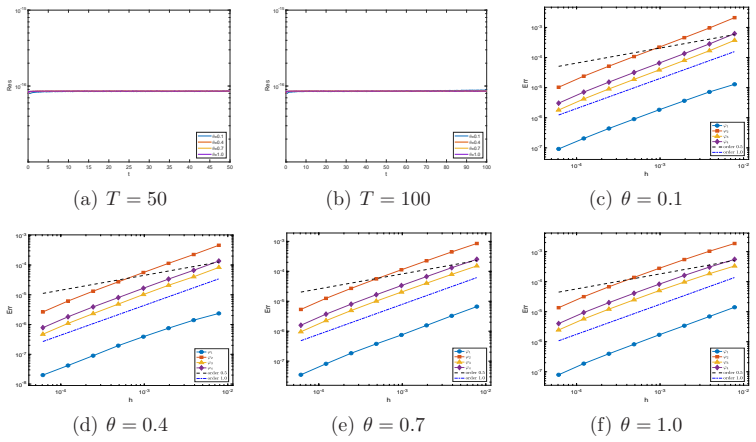
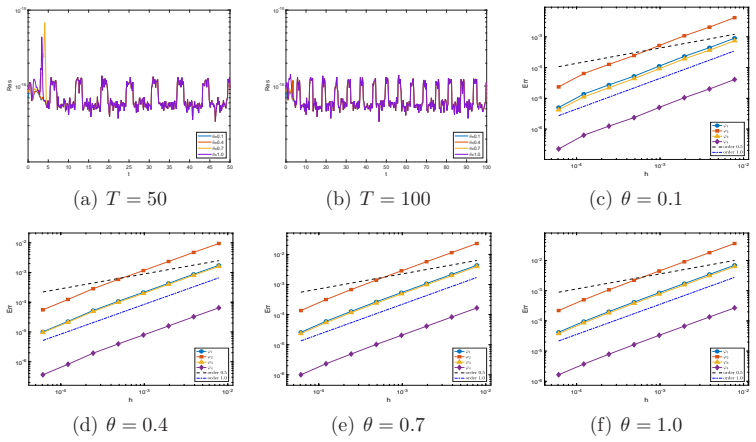
Stochastic theta methods for index-1 SDAEs with time-dependent singular matrices preserve algebraic constraints exactly and converge weakly at order one.
A machine-rendered reading of the paper's core claim, the machinery that carries it, and where it could break.
Core claim
Under global Lipschitz, linear growth, and suitable smoothness assumptions, the stochastic theta method with theta in (0,1] for index-1 SDAEs is well-posed, preserves the algebraic constraints at all time levels, and converges with weak order one; the result follows from an abstract weak convergence theorem for constraint-preserving one-step approximations once the index-1 algebraic-differential decomposition of the exact solution is used.
What carries the argument
The abstract weak convergence theorem for constraint-preserving one-step approximations, which exploits the index-1 algebraic-differential decomposition and the retained projector structure of the time-dependent singular matrix.
If this is right
- The method can be applied directly to SDAEs whose singular matrix is time-dependent without losing the exact constraint preservation property.
- Weak order one holds for expectations of sufficiently smooth test functions of the solution.
- Well-posedness of the discrete scheme follows from the same Lipschitz and growth conditions used for convergence.
- Numerical experiments can be expected to reproduce both the structure preservation and the observed order one.
Where Pith is reading between the lines
- The same abstract theorem might be reusable for other one-step schemes such as Runge-Kutta or linear multistep methods on the same class of equations.
- If the splitting condition can be relaxed or verified numerically, the range of admissible time-dependent matrices would widen further.
- Strong convergence results could follow from the same decomposition once moment bounds or additional regularity are established.
Load-bearing premise
The time-dependent singular matrix always preserves the same fixed splitting between differential and algebraic components.
What would settle it
A computed trajectory in which the algebraic constraint residual grows above machine epsilon at some step, or a weak-error plot whose slope on a log-log scale falls below one for a smooth test function.
Figures
read the original abstract
This paper studies the weak convergence order of structure-preserving stochastic theta methods for a class of index-$1$ stochastic differential algebraic equations with time-dependent singular matrices. The singular matrix is allowed to vary in time but preserves a fixed differential-algebraic splitting, thereby extending the constant singular-matrix setting while retaining the projector structure required for constraint preservation. By exploiting the index-$1$ algebraic-differential decomposition of the exact solution, we establish an abstract weak convergence theorem for constraint-preserving one-step approximations and apply it to the stochastic theta method with $\theta \in (0,1]$. Under global Lipschitz, linear growth, and suitable smoothness assumptions, the considered method is proved to be well posed, to preserve the algebraic constraints at all time levels, and to converge with weak order one. Numerical experiments are finally presented to confirm the structure-preserving property and the theoretical convergence order.
Editorial analysis
A structured set of objections, weighed in public.
Referee Report
Summary. The paper claims that, under global Lipschitz, linear growth and suitable smoothness assumptions, stochastic theta methods (θ ∈ (0,1]) for index-1 SDAEs with time-dependent singular matrices that preserve a fixed differential-algebraic splitting are well-posed, preserve the algebraic constraints at every time level, and converge weakly with order one. The argument proceeds by establishing an abstract weak-convergence theorem for constraint-preserving one-step methods and then specializing it to the theta scheme via Itô-Taylor expansion and projector arguments; numerical experiments are included to illustrate constraint preservation and the observed order.
Significance. If the central claims hold, the work supplies a non-trivial extension of structure-preserving integrators from the constant-matrix to the time-dependent singular-matrix setting while retaining the projector structure needed for exact constraint preservation. The abstract-theorem route and the explicit verification of well-posedness plus order one are useful contributions to the numerical analysis of SDAEs; the numerical confirmation of both properties adds practical value.
minor comments (3)
- The statement of the abstract weak-convergence theorem (presumably in the section following the introduction) would benefit from an explicit list of the hypotheses that must be verified for the stochastic theta method; this would make the subsequent specialization easier to follow.
- Notation for the time-dependent singular matrix and its associated projectors is introduced early but reused without repeated reminders; a short table or reminder paragraph in the numerical-experiments section would improve readability.
- The linear-growth and smoothness assumptions are stated globally; a brief remark on whether local versions could be substituted (via standard localization arguments) would clarify the scope of the result.
Simulated Author's Rebuttal
We thank the referee for the careful reading and positive assessment of the manuscript, including the accurate summary of the claims on well-posedness, constraint preservation, and weak order-one convergence of the stochastic theta methods for index-1 SDAEs with time-dependent singular matrices. We note the recommendation for minor revision.
Circularity Check
No significant circularity; derivation is self-contained
full rationale
The paper first derives an abstract weak-convergence theorem for any constraint-preserving one-step method by exploiting the index-1 algebraic-differential decomposition of the exact solution, then specializes the theorem to the stochastic theta scheme. The well-posedness, constraint preservation, and weak order-one claims follow directly from standard Itô-Taylor expansion and projector arguments under the global Lipschitz, linear-growth, and smoothness hypotheses together with the fixed differential-algebraic splitting. No step reduces a prediction to a fitted quantity by construction, invokes a self-citation as the sole justification for a load-bearing uniqueness claim, or renames an input as an output. The argument is therefore independent of its own fitted values or prior author results.
Axiom & Free-Parameter Ledger
axioms (4)
- domain assumption Global Lipschitz condition on coefficients
- domain assumption Linear growth condition
- domain assumption Suitable smoothness assumptions
- domain assumption Time-dependent singular matrix preserves fixed differential-algebraic splitting and projector structure
Reference graph
Works this paper leans on
-
[1]
Linear stochastic different ial-algebraic equations with constant coefficients
Aureli Alabert and Marco Ferrante. Linear stochastic different ial-algebraic equations with constant coefficients. Electron. Comm. Probab. , 11:316–335, 2006
2006
-
[2]
Index of differential-algebraic equations gover ning the dynamics of con- strained mechanical systems
Wojciech Blajer. Index of differential-algebraic equations gover ning the dynamics of con- strained mechanical systems. Appl. Math. Modelling , 16(2):70–77, 1992
1992
-
[3]
Lin Chen, Ziheng Chen, and Jing Zhao. Strong convergence rate s of stochastic theta methods for index 1 stochastic differential algebraic equations under non-g lobally Lipschitz conditions. arXiv:2509.11618, 2025
-
[4]
Weak convergence order of s tochastic theta method for SDEs driven by time-changed L´ evy noise
Ziheng Chen, Jiao Liu, and Meng Cai. Weak convergence order of s tochastic theta method for SDEs driven by time-changed L´ evy noise. arXiv:2603.27078, 2026
-
[5]
Stochastic differential equations and applications , volume Vol
Avner Friedman. Stochastic differential equations and applications , volume Vol. 28 of Proba- bility and Mathematical Statistics . Academic Press, New York, 1975
1975
-
[6]
H. Kunita. Stochastic differential equations and stochastic flow s of diffeomorphisms. In ´Ecole d’´ et´ e de probabilit´ es de Saint-Flour, XII—1982, volume 1097 of Lecture Notes in Math. , pages 143–303. Springer, Berlin, 1984
1982
-
[7]
A Runge -Kutta method for index 1 stochastic differential-algebraic equations with scalar noise
Dominique K¨ upper, Anne Kvæ rnø, and Andreas R¨ oß ler. A Runge -Kutta method for index 1 stochastic differential-algebraic equations with scalar noise. BIT, 52(2):437–455, 2012
2012
-
[8]
Stochastic differential equations and applications
Xuerong Mao. Stochastic differential equations and applications . Horwood Publishing Lim- ited, Chichester, second edition, 2008
2008
-
[9]
A systematic method to model power systems as stochastic differential algebraic equations
Federico Milano and Rafael Z´ arate-Mi˜ nano. A systematic method to model power systems as stochastic differential algebraic equations. IEEE Trans. Power Syst. , 28(4):4537–4544, 2013
2013
-
[10]
G. N. Milstein and M. V. Tretyakov. Stochastic numerics for mathematical physics . Scientific Computation. Springer-Verlag, Berlin, 2004
2004
-
[11]
Molecular modeling of proteins and mathematica l prediction of protein structure
Arnold Neumaier. Molecular modeling of proteins and mathematica l prediction of protein structure. SIAM Rev. , 39(3):407–460, 1997
1997
-
[12]
Improved structural methods for nonlinear differe ntial-algebraic equations via combinatorial relaxation
Taihei Oki. Improved structural methods for nonlinear differe ntial-algebraic equations via combinatorial relaxation. IMA J. Numer. Anal. , 43(1):357–386, 2023
2023
-
[13]
A general class of one-step a pproximation for index-1 stochastic delay-differential-algebraic equations
Tingting Qin and Chengjian Zhang. A general class of one-step a pproximation for index-1 stochastic delay-differential-algebraic equations. J. Comput. Math. , 37(2):151–169, 2019
2019
-
[14]
Confined diffusio n in periodic porous nanostructures
Riccardo Raccis, Arash Nikoubashman, Markus Retsch, Ulrich J onas, Kaloian Koynov, Hans- Jurgen Butt, Christos N Likos, and George Fytas. Confined diffusio n in periodic porous nanostructures. Acs Nano , 5(6):4607–4616, 2011. 34
2011
-
[15]
Stochastic DAEs in circuit s imulation
Werner R¨ omisch and Renate Winkler. Stochastic DAEs in circuit s imulation. In Model- ing, simulation, and optimization of integrated circuits ( Oberwolfach, 2001) , volume 146 of Internat. Ser. Numer. Math. , pages 303–318. Birkh¨ auser, Basel, 2003
2001
-
[16]
Sauer, M
Peter W. Sauer, M. A. Pai, and Joe H. Chow. Power System Dynamics and Stability: With Synchrophasor Measurement and Power System Toolbox . Wiley-IEEE Press, 2017
2017
-
[17]
Existenc e and uniqueness for the solutions of non-autonomous stochastic differential algebraic equ ations with locally Lipschitz coefficients
Oana-Silvia Serea, Antoine Tambue, and Guy Tsafack. Existenc e and uniqueness for the solutions of non-autonomous stochastic differential algebraic equ ations with locally Lipschitz coefficients. NoDEA Nonlinear Differential Equations Appl. , 32(4):Paper No. 69, 27, 2025
2025
-
[18]
L ocal error estimates for moderately smooth problems
Thorsten Sickenberger, Ewa Weinm¨ uller, and Renate Winkler. L ocal error estimates for moderately smooth problems. II. SDEs and SDAEs with small noise. BIT, 49(1):217–245, 2009
2009
-
[19]
Guy Tsafack and Antoine Tambue. Pathwise convergence of a n ovel numerical scheme based on semi-implicit method for stochastic differential-algebraic equation s with non-global lips- chitz coefficients. arXiv:2506.15627, 2025
-
[20]
Guy Tsafack and Antoine Tambue. Strong convergence of a se mi tamed scheme for stochastic differential algebraic equation under non-global Lipschitz coefficien ts. arXiv:2509.09032, 2025
-
[21]
Guy Tsafack and Antoine Tambue. Pathwise convergence of a lin earization scheme for stochas- tic differential-algebraic equations under the local Lipschitz coefficie nts. arXiv:2604.13785, 2026
work page internal anchor Pith review Pith/arXiv arXiv 2026
-
[22]
Weak error a nalysis for strong approx- imation schemes of SDEs with super-linear coefficients
Xiaojie Wang, Yuying Zhao, and Zhongqiang Zhang. Weak error a nalysis for strong approx- imation schemes of SDEs with super-linear coefficients. IMA J. Numer. Anal. , 44(5):3153– 3185, 2024
2024
-
[23]
Numeric al simulations for stochastic differential equations on manifolds by stochastic symme tric projection method
Zhenyu Wang, Chenke Wang, Qiang Ma, and Xiaohua Ding. Numeric al simulations for stochastic differential equations on manifolds by stochastic symme tric projection method. Phys. A , 541:123305, 12, 2020
2020
-
[24]
Stochastic differential algebraic equations of in dex 1 and applications in circuit simulation
Renate Winkler. Stochastic differential algebraic equations of in dex 1 and applications in circuit simulation. J. Comput. Appl. Math. , 157(2):477–505, 2003
2003
-
[25]
Weak error a nalysis for strong approxi- mation schemes of SDEs with super-linear coefficients II finitely many bounded moments and higher-order schemes
Yuying Zhao, Xiaojie Wang, and Zhongqiang Zhang. Weak error a nalysis for strong approxi- mation schemes of SDEs with super-linear coefficients II finitely many bounded moments and higher-order schemes. J. Sci. Comput. , 105(2):Paper No. 58, 39, 2025. 35
2025
discussion (0)
Sign in with ORCID, Apple, or X to comment. Anyone can read and Pith papers without signing in.