A microscopic design rule for spin supersolids in triangular-lattice magnets
Pith reviewed 2026-06-27 23:43 UTC · model grok-4.3
The pith
The ratio of trigonal crystal field to spin-orbit coupling sets exchange anisotropy Δ in triangular-lattice cobaltates.
A machine-rendered reading of the paper's core claim, the machinery that carries it, and where it could break.
Core claim
We show that Δ is determined by the ratio of trigonal crystal field to spin-orbit coupling strength. This framework explains contrasting anisotropies in these families, predicts systematic trends in Δ across X/Y-substitutions, and identifies candidate materials for spin supersolids. Our results establish trigonal field engineering as a microscopic route toward the design of spin supersolids.
What carries the argument
The ratio of trigonal crystal field strength to spin-orbit coupling strength, which fixes the exchange anisotropy Δ.
If this is right
- Contrasting anisotropies observed in the phosphate and selenite families arise from different values of this ratio.
- Systematic trends in Δ follow from changes in X or Y ions.
- Specific substituted compounds emerge as candidates for spin supersolids.
- Trigonal field engineering supplies a microscopic design route for spin supersolids.
Where Pith is reading between the lines
- The same model-tailoring approach could be applied to other frustrated magnets to locate additional supersolid candidates.
- External tuning of the crystal field via strain might allow experimental control over the anisotropy and the supersolid regime.
- The ratio-based rule may extend to other cases where spin-orbit and crystal-field effects compete in quantum magnets.
Load-bearing premise
The tailored realistic spin models isolate the trigonal crystal field versus spin-orbit coupling contribution and omit no other mechanisms that could dominate the anisotropy.
What would settle it
Measuring Δ across a series of X- and Y-substituted compounds and checking whether the values track the predicted dependence on the trigonal-field to spin-orbit ratio.
Figures
read the original abstract
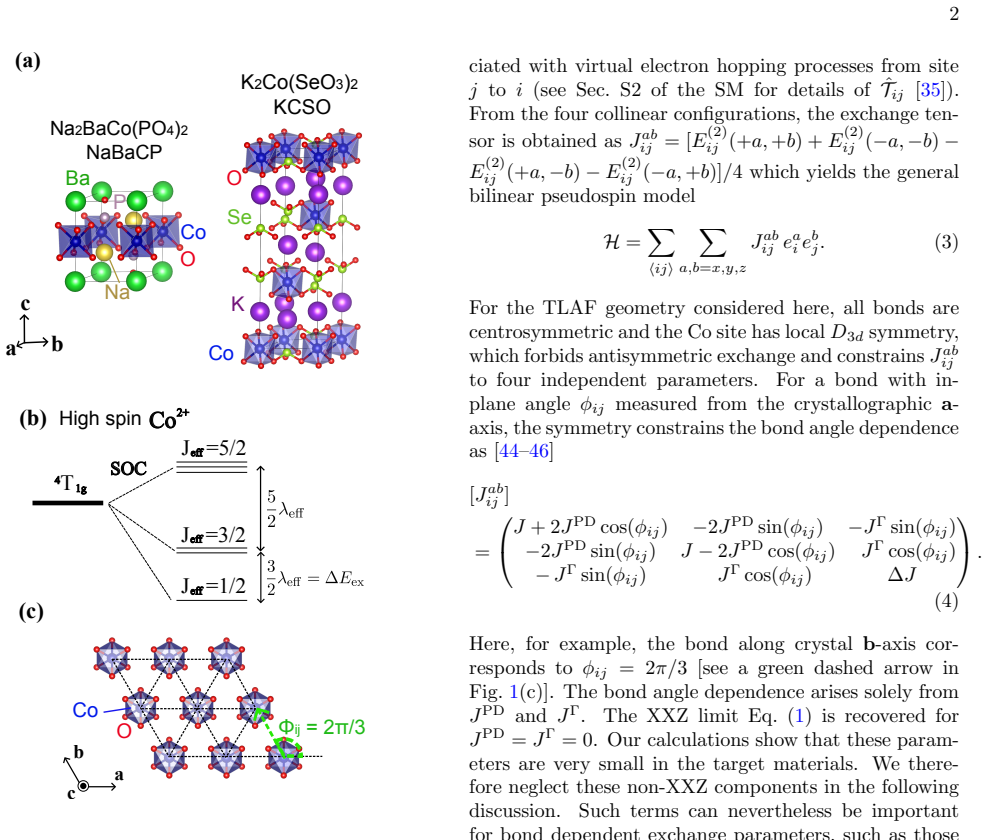
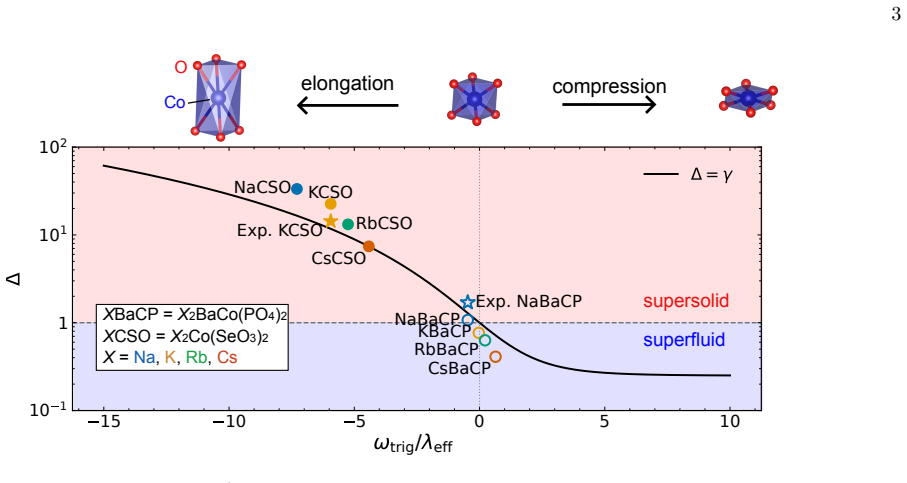
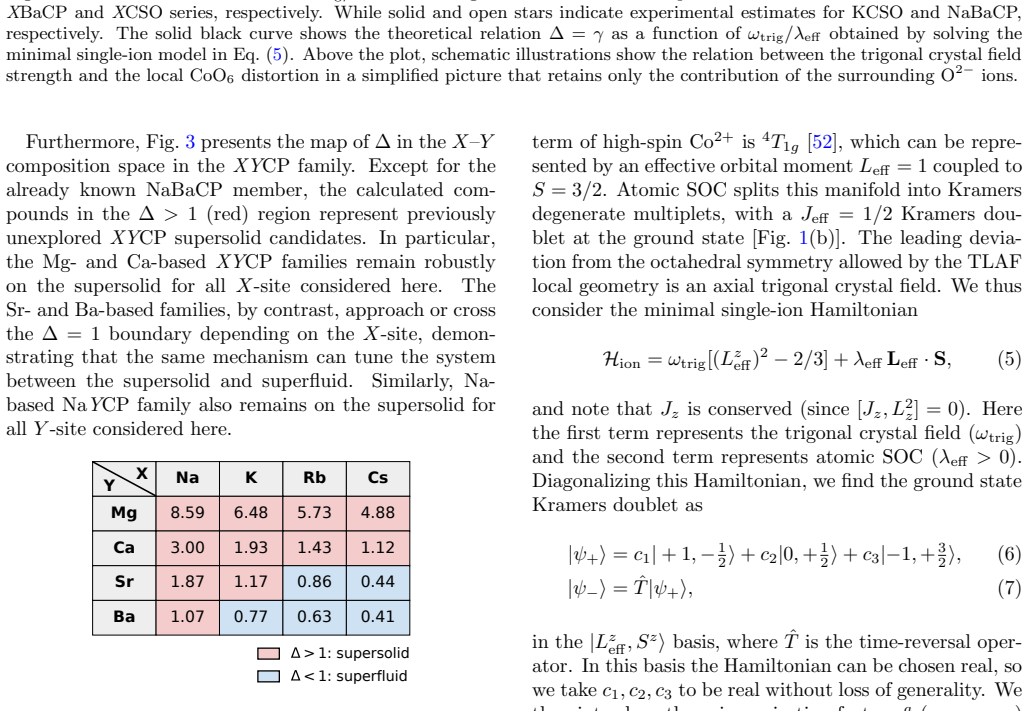
Spin supersolids emerge as a central topic in frustrated magnetism, motivating the search for realization in quantum materials. To this end, we study the origin of exchange anisotropy, $\Delta$, in triangular-lattice cobaltate families $X_2$$Y$Co(PO$_4$)$_2$ and $X_2$Co(SeO$_3$)$_2$ ($X$ = Na, K, Rb, Cs; $Y$ = Mg, Ca, Sr, Ba) by tailoring realistic spin models. We show that $\Delta$ is determined by the ratio of trigonal crystal field to spin-orbit coupling strength. This framework explains contrasting anisotropies in these families, predicts systematic trends in $\Delta$ across $X/Y$-substitutions, and identifies candidate materials for spin supersolids. Our results establish trigonal field engineering as a microscopic route toward the design of spin supersolids.
Editorial analysis
A structured set of objections, weighed in public.
Referee Report
Summary. The manuscript claims to establish a microscopic design rule for spin supersolids by studying the origin of exchange anisotropy Δ in the triangular-lattice cobaltate families X₂YCo(PO₄)₂ and X₂Co(SeO₃)₂ (X = Na, K, Rb, Cs; Y = Mg, Ca, Sr, Ba). Using tailored realistic spin models, it asserts that Δ is fixed by the ratio of trigonal crystal field to spin-orbit coupling strength; this is said to explain family-dependent anisotropies, predict substitution trends, and identify supersolid candidates.
Significance. If the central claim is supported by the model construction and extractions, the result would supply a concrete microscopic route (trigonal-field engineering) for realizing spin supersolids, which is of clear interest to the frustrated-magnetism community.
major comments (1)
- [Abstract] Abstract: the claim that Δ is determined by the trigonal-crystal-field / spin-orbit ratio is presented without any equations, model Hamiltonians, or extraction procedure; it is therefore impossible to verify whether the tailored spin models isolate this ratio or whether other anisotropy mechanisms have been omitted.
Simulated Author's Rebuttal
We thank the referee for their careful reading and the comment on the abstract. We address the point below and clarify how the full manuscript supports the central claim.
read point-by-point responses
-
Referee: [Abstract] Abstract: the claim that Δ is determined by the trigonal-crystal-field / spin-orbit ratio is presented without any equations, model Hamiltonians, or extraction procedure; it is therefore impossible to verify whether the tailored spin models isolate this ratio or whether other anisotropy mechanisms have been omitted.
Authors: We agree that the abstract, as a concise summary, contains no equations or technical details; this is standard for abstracts. The full manuscript (Sections II and III) constructs the tailored spin models from the crystal structures of the two families, writes the explicit spin Hamiltonian including single-ion anisotropy, exchange terms, and the trigonal-field contribution to the effective Δ, and details the numerical extraction procedure (exact diagonalization on finite clusters combined with perturbative analysis). These steps isolate the trigonal-crystal-field / spin-orbit ratio as the dominant control parameter while showing that other anisotropy channels (e.g., dipolar, higher-order crystal-field terms) are either symmetry-forbidden or numerically sub-dominant in the studied compounds. We can add one sentence to the abstract summarizing the model construction if the editor permits, but we maintain that the verifiability of the claim rests on the main text rather than the abstract. revision: partial
Circularity Check
No significant circularity identified
full rationale
The provided abstract claims that exchange anisotropy Δ is determined by the ratio of trigonal crystal field to spin-orbit coupling strength via tailored realistic spin models, explaining anisotropies and predicting trends. No equations, parameter-fitting procedures, self-citations, or ansatzes are visible that would reduce this claim to a self-definitional input or fitted quantity by construction. The derivation appears self-contained against external benchmarks with no load-bearing circular steps detectable in the given text.
Axiom & Free-Parameter Ledger
Reference graph
Works this paper leans on
-
[1]
Matsuda and T
H. Matsuda and T. Tsuneto, Off-Diagonal Long-Range Order in Solids, Progress of Theoretical Physics Supple- ment46, 411 (1970)
1970
-
[2]
Liu and M
K.-S. Liu and M. E. Fisher, Quantum lattice gas and the existence of a supersolid, Journal of Low Temperature Physics10, 655 (1973)
1973
-
[3]
Wessel and M
S. Wessel and M. Troyer, Supersolid hard-core bosons on 5 the triangular lattice, Phys. Rev. Lett.95, 127205 (2005)
2005
-
[4]
Heidarian and K
D. Heidarian and K. Damle, Persistent supersolid phase of hard-core bosons on the triangular lattice, Phys. Rev. Lett.95, 127206 (2005)
2005
-
[5]
R. G. Melko, A. Paramekanti, A. A. Burkov, A. Vish- wanath, D. N. Sheng, and L. Balents, Supersolid order from disorder: Hard-core bosons on the triangular lattice, Phys. Rev. Lett.95, 127207 (2005)
2005
-
[6]
Boninsegni and N
M. Boninsegni and N. Prokof’ev, Supersolid Phase of Hard-Core Bosons on a Triangular Lattice, Phys. Rev. Lett.95, 237204 (2005)
2005
-
[7]
Heidarian and A
D. Heidarian and A. Paramekanti, Supersolidity in the Triangular Lattice Spin-1/2XXZModel: A Variational Perspective, Phys. Rev. Lett.104, 015301 (2010)
2010
-
[8]
Yamamoto, G
D. Yamamoto, G. Marmorini, and I. Danshita, Quantum Phase Diagram of the Triangular-LatticeXXZModel in a Magnetic Field, Phys. Rev. Lett.112, 127203 (2014)
2014
-
[9]
Huang, S
Y. Huang, S. Yunoki, and S. Maekawa, Emergent Spin Supersolids in Frustrated Quantum Materials, Advanced Materialsn/a, e00005
-
[10]
Xiang, C
J. Xiang, C. Zhang, Y. Gao, W. Schmidt, K. Schmalzl, C.-W. Wang, B. Li, N. Xi, X.-Y. Liu, H. Jin, G. Li, J. Shen, Z. Chen, Y. Qi, Y. Wan, W. Jin, W. Li, P. Sun, and G. Su, Giant magnetocaloric effect in spin supersolid candidate Na2BaCo(PO4)2, Nature625, 270 (2024)
2024
-
[11]
K¨ onig, M
J. K¨ onig, M. C. Bønsager, and A. H. MacDonald, Dissi- pationless spin transport in thin film ferromagnets, Phys. Rev. Lett.87, 187202 (2001)
2001
-
[12]
Takei and Y
S. Takei and Y. Tserkovnyak, Superfluid spin transport through easy-plane ferromagnetic insulators, Phys. Rev. Lett.112, 227201 (2014)
2014
-
[13]
Qaiumzadeh, H
A. Qaiumzadeh, H. Skarsv˚ ag, C. Holmqvist, and A. Brataas, Spin Superfluidity in Biaxial Antiferromag- netic Insulators, Phys. Rev. Lett.118, 137201 (2017)
2017
-
[14]
Y. Gao, Y. Huang, S. Maekawa, and W. Li, Spin Seebeck Effect of Triangular Lattice Spin Supersolid, Phys. Rev. Lett.135, 236504 (2025)
2025
- [15]
-
[16]
X. Xu, Z. Wu, Y. Chen, Q. Huang, Z. Hu, X. Shi, K. Du, S. Li, R. Bian, R. Yu, Y. Cui, H. Zhou, and W. Yu, NMR study of spin supersolid phases in the triangular- lattice antiferromagnet Na 2BaCo(PO4)2, Phys. Rev. B 112, 125163 (2025)
2025
-
[17]
M. Zhu, V. Romerio, N. Steiger, S. D. Nabi, N. Mu- rai, S. Ohira-Kawamura, K. Y. Povarov, Y. Skourski, R. Sibille, L. Keller, Z. Yan, S. Gvasaliya, and A. Zhe- ludev, Continuum excitations in a spin supersolid on a triangular lattice, Phys. Rev. Lett.133, 186704 (2024)
2024
-
[18]
M. Zhu, L. M. Chinellato, V. Romerio, N. Murai, S. Ohira-Kawamura, C. Balz, Z. Yan, S. Gvasaliya, Y. Kato, C. D. Batista, and A. Zheludev, Wannier states and spin supersolid physics in the triangular antiferro- magnet K 2Co(SeO3)2, npj Quantum Materials10, 74 (2025)
2025
-
[19]
T. Chen, A. Ghasemi, J. Zhang, L. Shi, Z. Tagay, Y. Chen, L. Chen, E. S. Choi, M. Jaime, M. Lee, Y. Hao, H. Cao, B. L. Winn, A. A. Podlesnyak, D. M. Pa- jerowski, R. Zhong, X. Xu, N. P. Armitage, R. Cava, and C. Broholm, Phase diagram and spectroscopic sig- natures of a supersolid in the quantum ising magnet K2Co(SeO3)2, Nature Communications 10.1038/s414...
-
[20]
Y. Cui, Z. Wu, Z. Sun, K. Du, J. Luo, S. Li, J. Yang, J. Wang, R. Zhou, Q. Chen, Y. Kohama, A. Miyata, Z. Yang, R. Yu, and W. Yu, Spin-supersolidity induced quantum criticality and magnetocaloric effect in the triangular-lattice antiferromagnet Rb2Co(SeO3)2 (2025), arXiv:2509.26151 [cond-mat.str-el]
work page internal anchor Pith review Pith/arXiv arXiv 2025
- [21]
-
[22]
Zhong, S
R. Zhong, S. Guo, G. Xu, Z. Xu, and R. J. Cava, Strong quantum fluctuations in a quantum spin liquid candidate with a Co-based triangular lattice, Proceedings of the National Academy of Sciences116, 14505 (2019)
2019
-
[23]
Zhong, S
R. Zhong, S. Guo, and R. J. Cava, Frustrated magnetism in the layered triangular lattice materials K 2Co(SeO3)2 and Rb2Co(SeO3)2, Phys. Rev. Mater.4, 084406 (2020)
2020
-
[24]
N. Li, Q. Huang, X. Y. Yue, W. J. Chu, Q. Chen, E. S. Choi, X. Zhao, H. D. Zhou, and X. F. Sun, Possible itinerant excitations and quantum spin state transitions in the effective spin-1/2 triangular-lattice antiferromag- net Na2BaCo(PO4)2, Nature Communications11, 4216 (2020)
2020
-
[25]
T. Momoi and M. Suzuki, Ground-State Proper- ties and Phase Diagram of the Quantum XXZ An- tiferromagnet on a Triangular Lattice, Journal of the Physical Society of Japan61, 3732 (1992), https://doi.org/10.1143/JPSJ.61.3732
-
[26]
Yamamoto, G
D. Yamamoto, G. Marmorini, and I. Danshita, Micro- scopic Model Calculations for the Magnetization Process of Layered Triangular-Lattice Quantum Antiferromag- nets, Phys. Rev. Lett.114, 027201 (2015)
2015
-
[27]
Sellmann, X.-F
D. Sellmann, X.-F. Zhang, and S. Eggert, Phase diagram of the antiferromagnetic XXZ model on the triangular lattice, Phys. Rev. B91, 081104 (2015)
2015
-
[28]
Sheng, L
J. Sheng, L. Wang, A. Candini, W. Jiang, L. Huang, B. Xi, J. Zhao, H. Ge, N. Zhao, Y. Fu, J. Ren, J. Yang, P. Miao, X. Tong, D. Yu, S. Wang, Q. Liu, M. Kofu, R. Mole, G. Biasiol, D. Yu, I. A. Zaliznyak, J.-W. Mei, and L. Wu, Two-dimensional quantum universality in the spin-1/2 triangular-lattice quantum antiferromagnet Na2BaCo(PO4)2, Proceedings of the Na...
2022
-
[29]
Gao, Y.-C
Y. Gao, Y.-C. Fan, H. Li, F. Yang, X.-T. Zeng, X.-L. Sheng, R. Zhong, Y. Qi, Y. Wan, and W. Li, Spin su- persolidity in nearly ideal easy-axis triangular quantum antiferromagnet Na2BaCo(PO4)2, npj Quantum Materi- als7, 89 (2022)
2022
-
[30]
R. Zhong, S. Guo, G. Xu, Z. Xu, and R. J. Cava, Strong quantum fluctuations in a quantum spin liquid candi- date with a Co-based triangular lattice, Proceedings of the National Academy of Sciences116, 14505 (2019), https://www.pnas.org/doi/pdf/10.1073/pnas.1906483116
-
[31]
Kajita, T
Y. Kajita, T. Nagai, S. Yamagishi, K. Kimura, M. Hagi- hala, and T. Kimura, Ferroaxial transitions in glaserite- type Na2BaM(PO4)2 (M = Mg, Mn, Co, and Ni), Chem- istry of Materials36, 7451 (2024)
2024
-
[32]
Wildner, Isotypism of a selenite with a car- bonate: Structure of the buetschliite-type compound K2Co(SeO3)2, Acta Crystallographica
M. Wildner, Isotypism of a selenite with a car- bonate: Structure of the buetschliite-type compound K2Co(SeO3)2, Acta Crystallographica. Section C: Crys- tal Structure Communications48(2025)
2025
-
[33]
J. P. Perdew, K. Burke, and M. Ernzerhof, Generalized 6 gradient approximation made simple, Phys. Rev. Lett. 77, 3865 (1996)
1996
-
[34]
Giannozzi, S
P. Giannozzi, S. Baroni, N. Bonini, M. Calandra, R. Car, C. Cavazzoni, D. Ceresoli, G. L. Chiarotti, M. Cococ- cioni, I. Dabo, A. D. Corso, S. de Gironcoli, S. Fabris, G. Fratesi, R. Gebauer, U. Gerstmann, C. Gougoussis, A. Kokalj, M. Lazzeri, L. Martin-Samos, N. Marzari, F. Mauri, R. Mazzarello, S. Paolini, A. Pasquarello, L. Paulatto, C. Sbraccia, S. Sc...
2009
-
[35]
The Supplementary Material in- cludes Refs
See Supplementary Material for details of calculations and extended discussions, including (S1) first-principles calculations and low energy Hubbard model, (S2) su- perexchange theory, (S3) exchange interactions further than nearest neighbor, (S4) single-ion spin-orbit entan- glement in Kramers doublet (S5) validity of the Kramers- doublet (pseudospin-1/2...
-
[36]
Marzari and D
N. Marzari and D. Vanderbilt, Maximally localized gen- eralized wannier functions for composite energy bands, Phys. Rev. B56, 12847 (1997)
1997
-
[37]
Marzari, A
N. Marzari, A. A. Mostofi, J. R. Yates, I. Souza, and D. Vanderbilt, Maximally localized wannier functions: Theory and applications, Rev. Mod. Phys.84, 1419 (2012)
2012
-
[38]
Aryasetiawan, K
F. Aryasetiawan, K. Karlsson, O. Jepsen, and U. Sch¨ onberger, Calculations of HubbardUfrom first- principles, Phys. Rev. B74, 125106 (2006)
2006
-
[39]
P. W. Anderson, Antiferromagnetism. theory of superex- change interaction, Phys. Rev.79, 350 (1950)
1950
-
[40]
I. V. Solovyev, Combining DFT and many-body methods to understand correlated materials, Journal of Physics: Condensed Matter20, 293201 (2008)
2008
-
[41]
I. V. Solovyev, Superexchange interactions in orthorhom- bically distorted titanates RTiO 3 (R=Y, Gd, Sm and La), New Journal of Physics11, 093003 (2009)
2009
-
[42]
S. A. Nikolaev and I. V. Solovyev, Microscopic theory of electric polarization induced by skyrmionic order in GaV4S8, Phys. Rev. B99, 100401 (2019)
2019
-
[43]
R. Ono, S. Nikolaev, and I. Solovyev, Fingerprints of spin-current physics on magnetoelectric response in the spin- 1 2 magnet Ba2CuGe2O7, Phys. Rev. B102, 064422 (2020)
2020
-
[44]
Y. Li, G. Chen, W. Tong, L. Pi, J. Liu, Z. Yang, X. Wang, and Q. Zhang, Rare-Earth Triangular Lattice Spin Liq- uid: A Single-Crystal Study of YbMgGaO 4, Phys. Rev. Lett.115, 167203 (2015)
2015
-
[45]
Y.-D. Li, X. Wang, and G. Chen, Anisotropic spin model of strong spin-orbit-coupled triangular antiferromagnets, Phys. Rev. B94, 035107 (2016)
2016
-
[46]
Z. Zhu, P. A. Maksimov, S. R. White, and A. L. Cherny- shev, Topography of spin liquids on a triangular lattice, Phys. Rev. Lett.120, 207203 (2018)
2018
-
[47]
Jackeli and G
G. Jackeli and G. Khaliullin, Mott Insulators in the Strong Spin-Orbit Coupling Limit: From Heisenberg to a Quantum Compass and Kitaev Models, Phys. Rev. Lett. 102, 017205 (2009)
2009
-
[48]
J. G. Rau, E. K.-H. Lee, and H.-Y. Kee, Generic Spin Model for the Honeycomb Iridates beyond the Kitaev Limit, Phys. Rev. Lett.112, 077204 (2014)
2014
-
[49]
S. M. Winter, A. A. Tsirlin, M. Daghofer, J. van den Brink, Y. Singh, P. Gegenwart, and R. Valent´ ı, Models and materials for generalized Kitaev magnetism, Journal of Physics: Condensed Matter29, 493002 (2017)
2017
-
[50]
J. V. Jos´ e, L. P. Kadanoff, S. Kirkpatrick, and D. R. Nel- son, Renormalization, vortices, and symmetry-breaking perturbations in the two-dimensional planar model, Phys. Rev. B16, 1217 (1977)
1977
-
[51]
S. Park, S.-M. Park, Y.-T. Oh, H.-Y. Lee, and E.- G. Moon, Spin-orbit-induced instability and finite- temperature stabilization of a triangular-lattice super- solid (2026), arXiv:2601.20963 [cond-mat.str-el]
-
[52]
Tanabe and S
Y. Tanabe and S. Sugano, On the Absorption Spectra of Complex Ions, III The Calculation of the Crystalline Field Strength, Journal of the Physical Society of Japan 11, 864 (1956)
1956
-
[53]
Oguchi, Theory of Magnetism in CoCl2·2H2O, Journal of the Physical Society of Japan20, 2236 (1965)
T. Oguchi, Theory of Magnetism in CoCl2·2H2O, Journal of the Physical Society of Japan20, 2236 (1965)
1965
-
[54]
V. V. Men’shikov, V. V. Rudenko, V. I. Tugarinov, A. M. Vorotynov, and S. G. Ovchinnikov, Uniaxial magnetic anisotropy of rhombohedral CoCO 3 crystals at T = 0 K, Physics of the Solid State56, 468 (2014)
2014
-
[55]
Difference between ∆ andγindicates effects from higher- order crystal field and anisotropic part ofJ ab ij
-
[57]
C. J. Ballhausen,Introduction to Ligand Field Theory (McGraw-Hill, New York, 1962)
1962
-
[58]
Georges, L
A. Georges, L. d. Medici, and J. Mravlje, Strong Cor- relations from Hund’s Coupling, Annual Review of Con- densed Matter Physics4, 137 (2013)
2013
-
[59]
Ribic, E
T. Ribic, E. Assmann, A. T´ oth, and K. Held, Cubic in- teraction parameters fort 2g Wannier orbitals, Phys. Rev. B90, 165105 (2014)
2014
-
[60]
M. M. Ferreira-Carvalho, S. H. Chen, Y. C. Ku, A. Jose, R. Morrow, C. Y. Kuo, C. F. Chang, Z. Hu, M. W. Haverkort, and L. H. Tjeng, Direct evidence of a near- idealJ eff = 1/2 ground state in triangular-lattice Na2BaCo(PO4)2, Phys. Rev. Mater.10, 025004 (2026)
2026
-
[61]
K. W. H. Stevens, Matrix Elements and Operator Equiv- alents Connected with the Magnetic Properties of Rare Earth Ions, Proceedings of the Physical Society. Section A65, 209 (1952). Supplementary Materials: A microscopic design rule for spin supersolids in triangular-lattice magnets Ryota Ono, 1,∗ Jun’ichi Ieda, 1 Michiyasu Mori,1 and Sadamichi Maekawa 1,...
1952
-
[62]
Giannozzi, S
P. Giannozzi, S. Baroni, N. Bonini, M. Calandra, R. Car, C. Cavazzoni, D. Ceresoli, G. L. Chiarotti, M. Cococcioni, I. Dabo, A. D. Corso, S. de Gironcoli, S. Fabris, G. Fratesi, R. Gebauer, U. Gerstmann, C. Gougoussis, A. Kokalj, M. Lazzeri, L. Martin-Samos, N. Marzari, F. Mauri, R. Mazzarello, S. Paolini, A. Pasquarello, L. Paulatto, C. Sbraccia, S. Scan...
2009
-
[63]
D. R. Hamann, Optimized norm-conserving Vanderbilt pseudopotentials, Phys. Rev. B88, 085117 (2013)
2013
-
[64]
J. P. Perdew, K. Burke, and M. Ernzerhof, Generalized gradient approximation made simple, Phys. Rev. Lett.77, 3865 (1996)
1996
-
[65]
I. V. Solovyev, Combining DFT and many-body methods to understand correlated materials, Journal of Physics: Condensed Table S5. Trigonal distortion parameterrforXBaCP andXCSO. Experimental structural values are shown in parentheses, while the other values are obtained from theoretical structural relaxation. XXBaCPXCSO Na (1.088) 1.220 K 1.109 (1.175) Rb 1...
2008
-
[66]
S. A. Nikolaev and I. V. Solovyev, Microscopic theory of electric polarization induced by skyrmionic order in GaV 4S8, Phys. Rev. B99, 100401 (2019)
2019
-
[67]
R. Ono, S. Nikolaev, and I. Solovyev, Fingerprints of spin-current physics on magnetoelectric response in the spin-1 2 magnet Ba2CuGe2O7, Phys. Rev. B102, 064422 (2020)
2020
-
[68]
Marzari and D
N. Marzari and D. Vanderbilt, Maximally localized generalized Wannier functions for composite energy bands, Phys. Rev. B56, 12847 (1997)
1997
-
[69]
Marzari, A
N. Marzari, A. A. Mostofi, J. R. Yates, I. Souza, and D. Vanderbilt, Maximally localized Wannier functions: Theory and applications, Rev. Mod. Phys.84, 1419 (2012)
2012
-
[70]
Aryasetiawan, K
F. Aryasetiawan, K. Karlsson, O. Jepsen, and U. Sch¨ onberger, Calculations of HubbardUfrom first-principles, Phys. Rev. B74, 125106 (2006)
2006
-
[71]
C. J. Ballhausen,Introduction to Ligand Field Theory(McGraw-Hill, New York, 1962)
1962
-
[72]
Georges, L
A. Georges, L. d. Medici, and J. Mravlje, Strong Correlations from Hund’s Coupling, Annual Review of Condensed Matter Physics4, 137 (2013)
2013
-
[73]
Ribic, E
T. Ribic, E. Assmann, A. T´ oth, and K. Held, Cubic interaction parameters fort 2g Wannier orbitals, Phys. Rev. B90, 165105 (2014)
2014
-
[74]
Sheng, L
J. Sheng, L. Wang, A. Candini, W. Jiang, L. Huang, B. Xi, J. Zhao, H. Ge, N. Zhao, Y. Fu, J. Ren, J. Yang, P. Miao, X. Tong, D. Yu, S. Wang, Q. Liu, M. Kofu, R. Mole, G. Biasiol, D. Yu, I. A. Zaliznyak, J.-W. Mei, and L. Wu, Two- dimensional quantum universality in the spin-1/2 triangular-lattice quantum antiferromagnet Na 2BaCo(PO4)2, Proceed- ings of th...
2022
-
[75]
Gao, Y.-C
Y. Gao, Y.-C. Fan, H. Li, F. Yang, X.-T. Zeng, X.-L. Sheng, R. Zhong, Y. Qi, Y. Wan, and W. Li, Spin supersolidity in nearly ideal easy-axis triangular quantum antiferromagnet Na 2BaCo(PO4)2, npj Quantum Materials7, 89 (2022)
2022
-
[76]
M. Zhu, L. M. Chinellato, V. Romerio, N. Murai, S. Ohira-Kawamura, C. Balz, Z. Yan, S. Gvasaliya, Y. Kato, C. D. Batista, and A. Zheludev, Wannier states and spin supersolid physics in the triangular antiferromagnet K 2Co(SeO3)2, npj Quantum Materials10, 74 (2025)
2025
-
[77]
M. M. Ferreira-Carvalho, S. H. Chen, Y. C. Ku, A. Jose, R. Morrow, C. Y. Kuo, C. F. Chang, Z. Hu, M. W. Haverkort, and L. H. Tjeng, Direct evidence of a near-idealJ eff = 1/2 ground state in triangular-lattice Na 2BaCo(PO4)2, Phys. Rev. Mater.10, 025004 (2026)
2026
-
[78]
K. W. H. Stevens, Matrix Elements and Operator Equivalents Connected with the Magnetic Properties of Rare Earth Ions, Proceedings of the Physical Society. Section A65, 209 (1952)
1952
discussion (0)
Sign in with ORCID, Apple, or X to comment. Anyone can read and Pith papers without signing in.