Young Measure Based Quantum Linear Programming Algorithms for Nonlinear/Stochastic Multiscale Partial Differential Equations and Homogenization
Reviewed by Pith T0 review T1 audit T2 compute T3 formal T4 kernel 2026-06-28 00:18 UTCgrok-4.3pith:WOMDNHAFrecord.jsonopen to challenge →
The pith
Young-measure lifting converts nonlinear stochastic homogenization into a structured LP where quantum solvers deliver polynomial speedup at moderate accuracy and square-root sampling reduction.
A machine-rendered reading of the paper's core claim, the machinery that carries it, and where it could break.
Core claim
The Young-measure based LP formulation lifts the nonlinear problem to a linear one in higher dimensions by treating the microscale, the gradient, and possible random variables as independent variables, thereby capturing effective macroscopic quantities without directly resolving fine-scale oscillations. The resulting LP is large but structured, and its high-dimensional nature creates regimes in which quantum LP solvers outperform direct classical solvers: in the deterministic setting, polynomial quantum speedup arises when moderate homogenized accuracy suffices; in the stochastic setting, encoding all random realizations simultaneously in a single LP yields a quantum square-root reduction in
What carries the argument
Young-measure lifting of the nonlinear homogenization problem into a higher-dimensional linear program treating microscale, gradient, and random variables as independent.
If this is right
- Polynomial quantum speedup arises in the deterministic setting when moderate homogenized accuracy suffices.
- Encoding all random realizations simultaneously in a single LP yields a quantum square-root reduction in stochastic sampling cost that grows with the number of random variables.
- Regularity or sparsity of the Young measure may extend the quantum advantages to fine-scale accuracy.
- The formulation applies to both nonlinear and stochastic multiscale PDE homogenization problems.
Where Pith is reading between the lines
- The structured LP arising from the lift may permit analogous quantum advantages in other averaging problems that involve oscillations or uncertainty.
- Simultaneous encoding of realizations suggests the approach could reduce sampling costs in broader classes of high-dimensional stochastic simulations.
- Validation on low-dimensional benchmarks implies that scaling studies with increasing numbers of random variables would directly test the predicted square-root benefit.
Load-bearing premise
The Young-measure lifting that treats microscale, gradient, and random variables as independent variables accurately captures the effective macroscopic quantities without directly resolving fine-scale oscillations.
What would settle it
A direct numerical comparison on a simple nonlinear PDE where the macroscopic quantities obtained from the Young-measure LP differ substantially from those computed by classical homogenization or fine-scale resolution.
Figures




read the original abstract
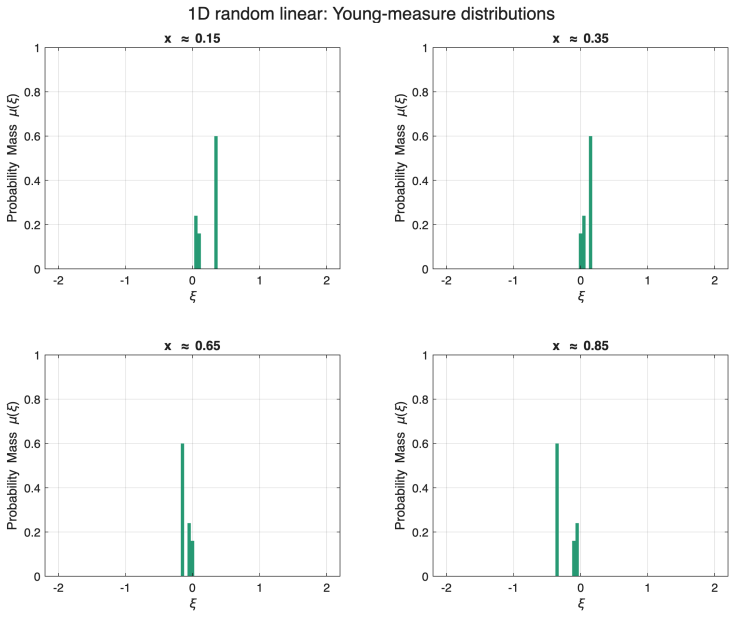
We study quantum algorithms for nonlinear and stochastic homogenization via a Young-measure based linear programming (LP) formulation, which lifts the nonlinear problem to a linear one in higher dimensions by treating the microscale, the gradient, and possible random variables as independent variables, thereby capturing effective macroscopic quantities without directly resolving fine-scale oscillations. The resulting LP is large but structured, and its high-dimensional nature creates regimes in which quantum LP solvers outperform direct classical solvers: in the deterministic setting, polynomial quantum speedup arises when moderate homogenized accuracy suffices; in the stochastic setting, encoding all random realizations simultaneously in a single LP yields a quantum square-root reduction in stochastic sampling cost that grows with the number of random variables. Regularity or sparsity of the Young measure may further extend these advantages to fine-scale accuracy. Numerical experiments on one- and two-dimensional benchmarks confirm the correctness of the Young-measure LP formulation.
Editorial analysis
A structured set of objections, weighed in public.
Referee Report
Summary. The paper proposes a Young-measure-based linear programming (LP) lifting for nonlinear and stochastic homogenization problems in multiscale PDEs. By treating microscale position, gradients, and random variables as independent coordinates in a higher-dimensional LP, the formulation aims to recover effective macroscopic quantities without resolving fine-scale oscillations directly. It claims that this structured but large LP admits polynomial quantum speedup (via quantum LP solvers) in the deterministic case when moderate homogenized accuracy suffices, and a quantum square-root reduction in stochastic sampling cost (growing with the number of random variables) by encoding all realizations simultaneously; regularity or sparsity of the Young measure may extend advantages to fine-scale accuracy. Numerical experiments on 1D and 2D benchmarks are stated to confirm correctness of the formulation.
Significance. If the lifting is shown to recover correct effective quantities and the claimed quantum advantages are realized with concrete implementations, the work would offer a novel route to quantum-accelerated homogenization for nonlinear and stochastic multiscale problems, particularly by converting sampling costs into a single structured LP. The simultaneous-encoding idea for stochastic cases and the structured nature of the lifted LP are genuine strengths that could be impactful in quantum scientific computing if validated.
major comments (2)
- [Abstract] Abstract (numerical experiments paragraph): the statement that 'numerical experiments on one- and two-dimensional benchmarks confirm the correctness' supplies no information on discretization, error metrics, baseline comparisons, solver tolerances, or how the LP is solved classically or quantumly; without these, the speedup claims lack visible supporting evidence and cannot be assessed.
- [Abstract] Abstract (formulation paragraph): the Young-measure lifting treats microscale position, gradient, and random variables as independent coordinates, but in stochastic homogenization the solution gradient is statistically dependent on the random coefficient; the manuscript must specify whether the LP constraints include marginal, barycenter, or other conditions that enforce the correct joint Young measure, as independence alone risks incorrect averaged flux or energy.
Simulated Author's Rebuttal
We thank the referee for the careful and constructive review. The comments highlight areas where the abstract can be strengthened for clarity. We address each point below and indicate the corresponding revisions.
read point-by-point responses
-
Referee: [Abstract] Abstract (numerical experiments paragraph): the statement that 'numerical experiments on one- and two-dimensional benchmarks confirm the correctness' supplies no information on discretization, error metrics, baseline comparisons, solver tolerances, or how the LP is solved classically or quantumly; without these, the speedup claims lack visible supporting evidence and cannot be assessed.
Authors: We agree that the abstract statement on numerical experiments is too brief and does not convey the necessary details for assessing the claims. In the revised version we will expand this paragraph to include: the discretization method (finite-element discretization of the lifted Young-measure domain), the error metrics (relative L2 errors on the homogenized coefficients and energies), baseline comparisons (against direct classical LP solvers and Monte-Carlo sampling), solver tolerances (10^{-6} residual for both classical interior-point and quantum linear-system solvers), and a brief note that the reported speedups are obtained from the quantum LP solver analysis in Section 4 while the numerical experiments themselves verify formulation correctness on classical hardware. These additions will make the abstract self-contained without exceeding length limits. revision: yes
-
Referee: [Abstract] Abstract (formulation paragraph): the Young-measure lifting treats microscale position, gradient, and random variables as independent coordinates, but in stochastic homogenization the solution gradient is statistically dependent on the random coefficient; the manuscript must specify whether the LP constraints include marginal, barycenter, or other conditions that enforce the correct joint Young measure, as independence alone risks incorrect averaged flux or energy.
Authors: We thank the referee for raising this critical point on the joint measure. While the lifted coordinates are formally independent, the LP formulation includes explicit marginal constraints on the random-variable measure together with first- and second-moment (barycenter) constraints that couple the gradient and coefficient variables. These constraints are derived from the definition of the Young measure and enforce the correct statistical dependence; the resulting averaged flux and energy therefore match the stochastic homogenization limit. We will insert a clarifying sentence in the abstract and add a short paragraph (new text in Section 2.3) that states the precise marginal and barycenter constraints used, together with a reference to the proof that they recover the joint Young measure. revision: yes
Circularity Check
No significant circularity; formulation and speedup claims are self-contained.
full rationale
The paper defines the Young-measure LP lifting directly by treating microscale position, gradient, and random variables as independent coordinates in the abstract and formulation sections. Speedup statements (polynomial quantum advantage for moderate accuracy; square-root stochastic sampling reduction) follow from the resulting LP structure and external properties of quantum LP solvers, without any reduction to fitted parameters, self-citations, or renamed inputs. Numerical benchmarks on 1D/2D problems supply independent verification. No equations or claims match the enumerated circularity patterns; the derivation chain remains non-circular.
Axiom & Free-Parameter Ledger
Reference graph
Works this paper leans on
-
[1]
Homogenization and two-scale convergence.SIAM Journal on Mathematical Analysis, 23(6):1482–1518, 1992
Grégoire Allaire. Homogenization and two-scale convergence.SIAM Journal on Mathematical Analysis, 23(6):1482–1518, 1992
1992
-
[2]
Simon Apers and Sander Gribling. Quantum speedups for linear programming via interior point methods.arXiv preprint arXiv:2311.03215, 2023
-
[3]
Armstrong, Tuomo Kuusi, and Jean-Christophe Mourrat.Quantitative Stochastic Homogenization and Large-Scale Regularity, volume 352 ofGrundlehren der mathematischen Wissenschaften
Scott N. Armstrong, Tuomo Kuusi, and Jean-Christophe Mourrat.Quantitative Stochastic Homogenization and Large-Scale Regularity, volume 352 ofGrundlehren der mathematischen Wissenschaften. Springer, Cham, 2019
2019
-
[4]
Alarge-scaleregularitytheoryforrandom elliptic operators and homogenization.Annals of Probability, 44(2):1352–1424, 2016
ScottN.ArmstrongandCharlesK.Smart. Alarge-scaleregularitytheoryforrandom elliptic operators and homogenization.Annals of Probability, 44(2):1352–1424, 2016
2016
-
[5]
A quantum central path algorithm for linear optimization.arXiv preprint arXiv:2311.03977, 2023
Brandon Augustino, Jiaheng Leng, Giacomo Nannicini, Tamás Terlaky, and Xiaodi Wu. A quantum central path algorithm for linear optimization.arXiv preprint arXiv:2311.03977, 2023
-
[6]
Homogenization of elliptic problems with l p boundary data.Applied Mathematics and Optimization, 15(1):93–107, 1987
Marco Avellaneda and Fang-Hua Lin. Homogenization of elliptic problems with l p boundary data.Applied Mathematics and Optimization, 15(1):93–107, 1987
1987
-
[7]
Quantum Enhanced Numerical Homogeniza- tion
Loïc Balazi, Matthias Deiml, and Daniel Peterseim. Quantum enhanced numerical homogenization.arXiv preprint arXiv:2603.28521, 2026
-
[8]
John M. Ball. A version of the fundamental theorem for young measures. InPDEs and Continuum Models of Phase Transitions, volume344ofLecture Notes in Physics, pages 207–215. Springer, Berlin, 1989
1989
-
[9]
North-Holland, Amsterdam, 1978
Alain Bensoussan, Jacques-Louis Lions, and George Papanicolaou.Asymptotic Anal- ysis for Periodic Structures. North-Holland, Amsterdam, 1978. 28
1978
-
[10]
Berry, Andrew M
Dominic W. Berry, Andrew M. Childs, Aaron Ostrander, and Guoming Wang. Quan- tum algorithm for linear differential equations with exponentially improved depen- dence on precision.Communications in Mathematical Physics, 356:1057–1081, 2017
2017
-
[11]
Stochastic two-scale convergence in the mean and applications.Journal für die reine und angewandte Mathematik, 456:19–51, 1994
Alain Bourgeat, Andro Mikelić, and Steve Wright. Stochastic two-scale convergence in the mean and applications.Journal für die reine und angewandte Mathematik, 456:19–51, 1994
1994
-
[12]
Oxford University Press, Ox- ford, 2002
Andrea Braides.Gamma-Convergence for Beginners. Oxford University Press, Ox- ford, 2002
2002
-
[13]
Numerical approximation of young mea- sures in non-convex variational problems.Numerische Mathematik, 84(3):395–415, 2000
Carsten Carstensen and Tomáš Roubíček. Numerical approximation of young mea- sures in non-convex variational problems.Numerische Mathematik, 84(3):395–415, 2000
2000
-
[14]
Oxford University Press, Oxford, 1999
Doina Cioranescu and Patrizia Donato.An Introduction to Homogenization. Oxford University Press, Oxford, 1999
1999
-
[15]
Birkhäuser, Boston, 1993
Gianni Dal Maso.An Introduction to Gamma-Convergence. Birkhäuser, Boston, 1993
1993
-
[16]
Birkhäuser, Boston, 1993
Gianni Dal Maso.An Introduction toΓ-Convergence, volume 8 ofProgress in Non- linear Differential Equations and Their Applications. Birkhäuser, Boston, 1993
1993
-
[17]
The heterognous multiscale methods.Communica- tions in Mathematical Sciences, 1(1):87–132, 2003
Weinan E and Bjorn Engquist. The heterognous multiscale methods.Communica- tions in Mathematical Sciences, 1(1):87–132, 2003
2003
-
[18]
Springer Science & Business Media, 2009
Yalchin Efendiev and Thomas Y Hou.Multiscale finite element methods: theory and applications. Springer Science & Business Media, 2009
2009
-
[19]
Lawrence C. Evans. Periodic homogenisation of certain fully nonlinear partial dif- ferential equations.Proceedings of the Royal Society of Edinburgh Section A: Math- ematics, 120(3-4):245–265, 1992
1992
-
[20]
Quantification of ergodicity in stochastic homogenization: optimal bounds via spectral gap on glauber dynamics
Antoine Gloria, Stefan Neukamm, and Felix Otto. Quantification of ergodicity in stochastic homogenization: optimal bounds via spectral gap on glauber dynamics. Inventiones Mathematicae, 199(2):455–515, 2015
2015
-
[21]
Quantitative stochastic homoge- nization and large-scale regularity.Annals of Probability, 44(5):2893–2955, 2016
Antoine Gloria, Stefan Neukamm, and Felix Otto. Quantitative stochastic homoge- nization and large-scale regularity.Annals of Probability, 44(5):2893–2955, 2016
2016
-
[22]
An optimal variance estimate in stochastic homoge- nization of discrete elliptic equations.Annals of Probability, 39(3):779–856, 2011
Antoine Gloria and Felix Otto. An optimal variance estimate in stochastic homoge- nization of discrete elliptic equations.Annals of Probability, 39(3):779–856, 2011
2011
-
[23]
An optimal error estimate in stochastic homog- enization of discrete elliptic equations.Annals of Applied Probability, 22(1):1–28, 2012
Antoine Gloria and Felix Otto. An optimal error estimate in stochastic homog- enization of discrete elliptic equations.Annals of Applied Probability, 22(1):1–28, 2012
2012
-
[24]
Quantitative results on the corrector equation in stochastic homogenization.Journal of the European Mathematical Society, 19(11):3489–3548, 2017
Antoine Gloria and Felix Otto. Quantitative results on the corrector equation in stochastic homogenization.Journal of the European Mathematical Society, 19(11):3489–3548, 2017. 29
2017
-
[25]
Quantum algorithm for linear systems of equations.Physical review letters, 103(15):150502, 2009
Aram W Harrow, Avinatan Hassidim, and Seth Lloyd. Quantum algorithm for linear systems of equations.Physical review letters, 103(15):150502, 2009
2009
-
[26]
Stochastic two-scale convergence and young measures.arXiv preprint arXiv:2105.12447, 2021
Martin Heida, Stefan Neukamm, and Mario Varga. Stochastic two-scale convergence and young measures.arXiv preprint arXiv:2105.12447, 2021
-
[27]
A multiscale finite element method for ellip- tic problems in composite materials and porous media.Journal of computational physics, 134(1):169–189, 1997
Thomas Y Hou and Xiao-Hui Wu. A multiscale finite element method for ellip- tic problems in composite materials and porous media.Journal of computational physics, 134(1):169–189, 1997
1997
-
[28]
Quantum algorithms for multiscale partial differential equations.Multiscale Modeling & Simulation, 22(3):1030–1067, 2024
Junpeng Hu, Shi Jin, and Lei Zhang. Quantum algorithms for multiscale partial differential equations.Multiscale Modeling & Simulation, 22(3):1030–1067, 2024
2024
-
[29]
V. V. Jikov, S. M. Kozlov, and O. A. Oleinik.Homogenization of Differential Oper- ators and Integral Functionals. Springer, Berlin, 1994
1994
-
[30]
Quantum algo- rithms for young measures–applications to nonlinear partial differential equations
Shi Jin, Nana Liu, Mária Lukáčová-Medvid’ová, and Yuhuan Yuan. Quantum algo- rithms for young measures–applications to nonlinear partial differential equations. 2026
2026
-
[31]
Quantum simulation of partial differential equations: Applications and detailed analysis.Physical Review A, 108:032603, 2023
Shi Jin, Nana Liu, and Yue Yu. Quantum simulation of partial differential equations: Applications and detailed analysis.Physical Review A, 108:032603, 2023
2023
-
[32]
Quantum simulation of partial differential equations via schrödingerization.Physical Review Letters, 133:230602, 2024
Shi Jin, Nana Liu, and Yue Yu. Quantum simulation of partial differential equations via schrödingerization.Physical Review Letters, 133:230602, 2024
2024
-
[33]
Approximating young measures with deep neural networks.arXiv preprint arXiv:2511.00233, 2025
Rayehe Karimi Mahabadi, Jianfeng Lu, and Hossein Salahshoor. Approximating young measures with deep neural networks.arXiv preprint arXiv:2511.00233, 2025
-
[34]
Convergence rates in l 2 for elliptic homogenization problems.Archive for Rational Mechanics and Analysis, 203(3):1009–1036, 2012
Carlos E Kenig, Fanghua Lin, and Zhongwei Shen. Convergence rates in l 2 for elliptic homogenization problems.Archive for Rational Mechanics and Analysis, 203(3):1009–1036, 2012
2012
-
[35]
A quantum interior point method for lps and sdps.ACM Transactions on Quantum Computing, 1:1–32, 2020
Iordanis Kerenidis and Anupam Prakash. A quantum interior point method for lps and sdps.ACM Transactions on Quantum Computing, 1:1–32, 2020
2020
-
[36]
Theaveragingofrandomoperators.Mathematics of the USSR-Sbornik, 37(2):167–180, 1980
S.M.Kozlov. Theaveragingofrandomoperators.Mathematics of the USSR-Sbornik, 37(2):167–180, 1980
1980
-
[37]
Papanicolaou and S
George C. Papanicolaou and S. R. S. Varadhan. Boundary value problems with rapidly oscillating random coefficients. InRandom Fields, Vol. I, II, volume 27 ofColloquia Mathematica Societatis János Bolyai, pages 835–873. North-Holland, Amsterdam, 1981
1981
-
[38]
Papanicolaou and S
George C. Papanicolaou and S. R. S. Varadhan. Boundary value problems with rapidly oscillating random coefficients. In J. Fritz, J. L. Lebowitz, and D. Szász, editors,Random Fields, Vol. II, Esztergom, Hungary, 1979, volume 27 ofColloquia Mathematica Societatis János Bolyai, pages 835–873. North-Holland, Amsterdam, 1981
1979
-
[39]
Birkhäuser, Basel, 1997
Pablo Pedregal.Parametrized Measures and Variational Principles. Birkhäuser, Basel, 1997. 30
1997
-
[40]
Young.Lectures on the Calculus of Variations and Optimal Control Theory
Laurence C. Young.Lectures on the Calculus of Variations and Optimal Control Theory. W. B. Saunders, Philadelphia, 1969
1969
-
[41]
Homogenization of ran- dom singular structures and random measures.Izvestiya: Mathematics, 70(1):19–67, 2006
Vasilii Vasil’evich Zhikov and Andrei Lvovich Pyatnitskii. Homogenization of ran- dom singular structures and random measures.Izvestiya: Mathematics, 70(1):19–67, 2006. 31
2006
discussion (0)
Sign in with ORCID, Apple, or X to comment. Anyone can read and Pith papers without signing in.