Research Note: Ghostly DLAs in SDSS DR16
Pith reviewed 2026-06-28 00:30 UTC · model grok-4.3
The pith
Updated classification doubles known ghostly proximate damped Lyman-alpha systems and shows most but not all are bona fide DLAs.
A machine-rendered reading of the paper's core claim, the machinery that carries it, and where it could break.
Core claim
The paper provides an updated classification of PDLAs, including a revised catalogue of ghostly systems that more than doubles the number of previously known detections. It shows that although most ghostly systems are bona fide DLAs, this is not always the case. Ghostly systems arise in dense, compact gas that partially covers the quasar emission regions, with most linked to outflows up to -2000 km/s and some to inflows up to +1200 km/s.
What carries the argument
Ghostly systems, identified by strong absorption from excited levels of atomic ground states in dense, compact gas that partially covers the quasar emission regions.
If this is right
- Most PDLAs trace gas in the AGN environment or quasar host galaxy rather than unrelated intervening material.
- The majority of ghostly systems participate in outflows reaching velocities of -2000 km/s.
- A minority of systems trace inflowing clouds extending to +1200 km/s.
- Equivalent width measurements from stacked and individual spectra can distinguish true DLAs from other ghostly absorbers.
Where Pith is reading between the lines
- The doubled sample size enables tighter constraints on the covering fraction and density distribution of gas near quasars.
- Systems that fail to qualify as DLAs may trace lower-column-density gas with different excitation conditions.
- The partial-covering geometry could be tested directly with high-resolution spectra that resolve velocity structure across the quasar emission regions.
Load-bearing premise
The classification treats detection of absorption from excited levels of atomic ground states as evidence that the gas is dense and compact enough to partially cover the quasar emission regions.
What would settle it
A spectroscopic follow-up that finds a system classified as ghostly yet shows no partial coverage of the quasar continuum or broad emission lines would challenge its placement in the catalogue.
Figures
read the original abstract
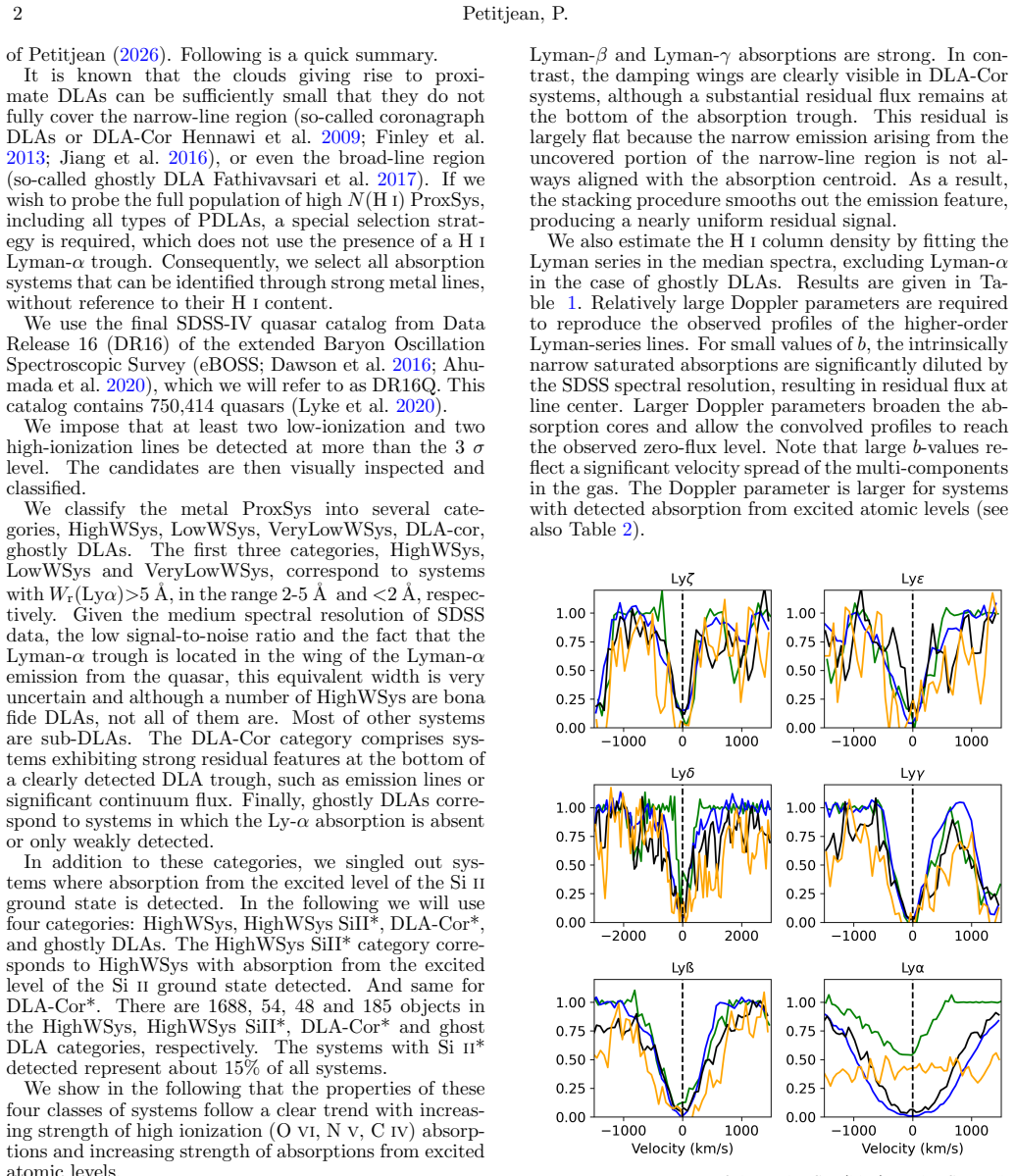
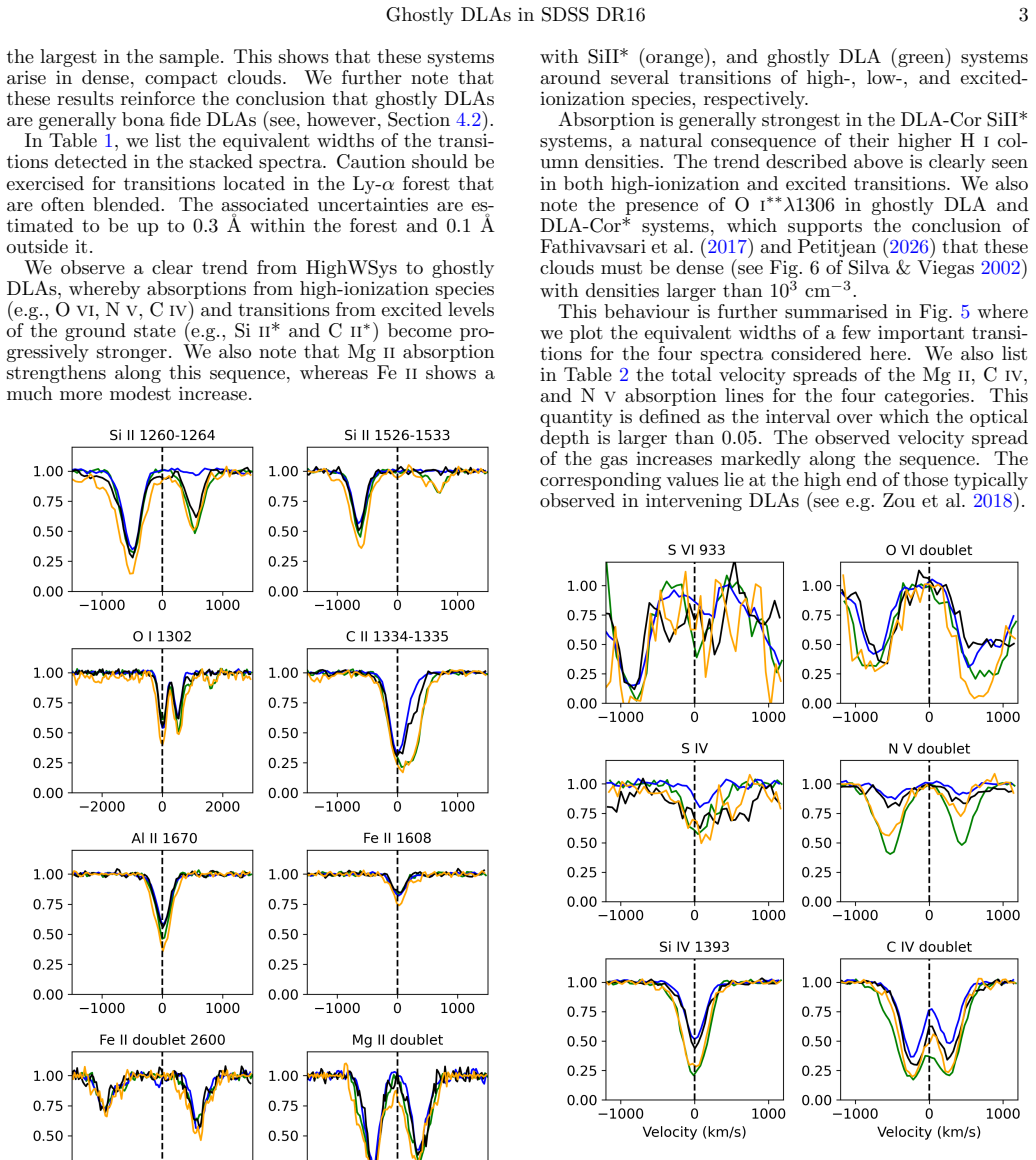
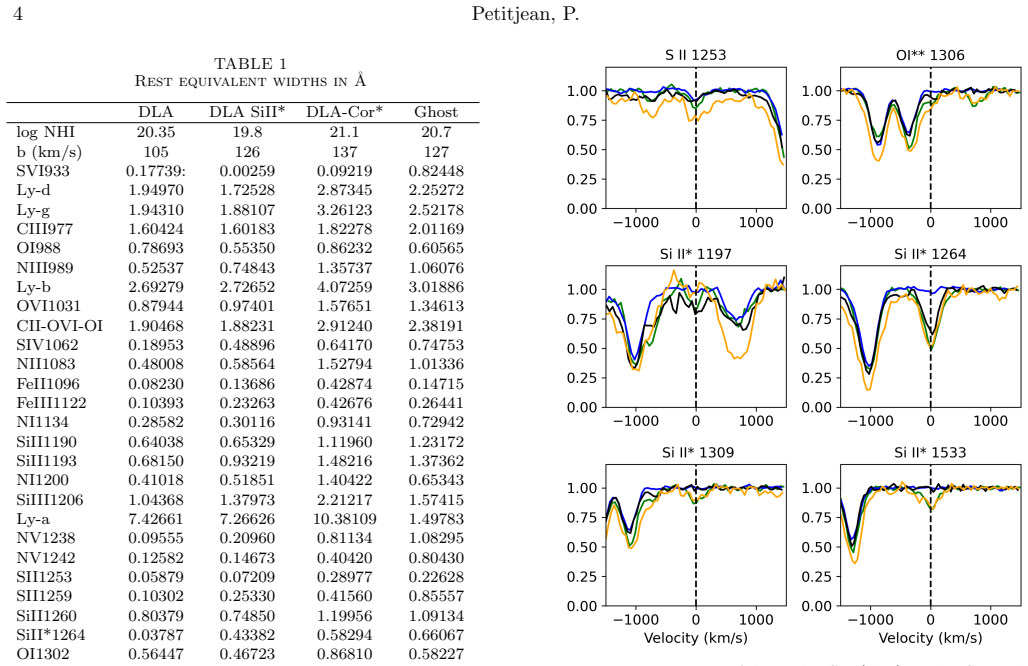
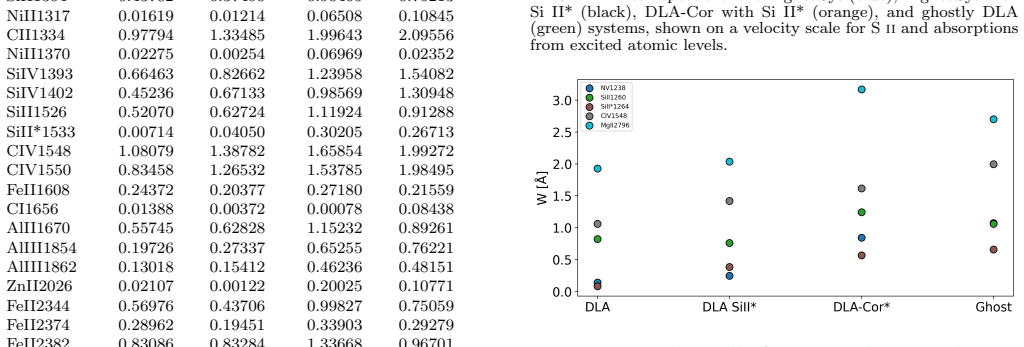
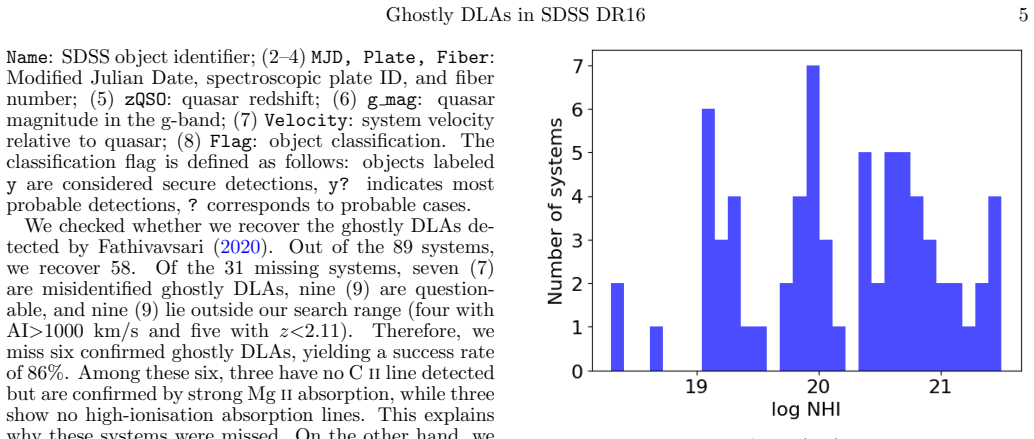
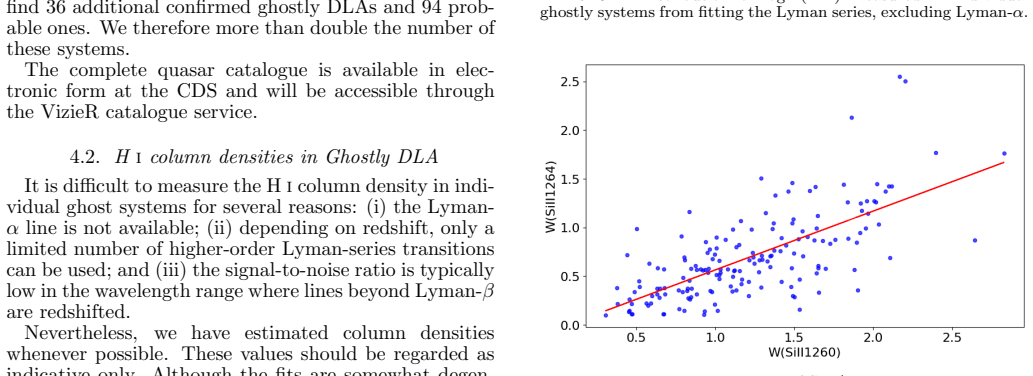
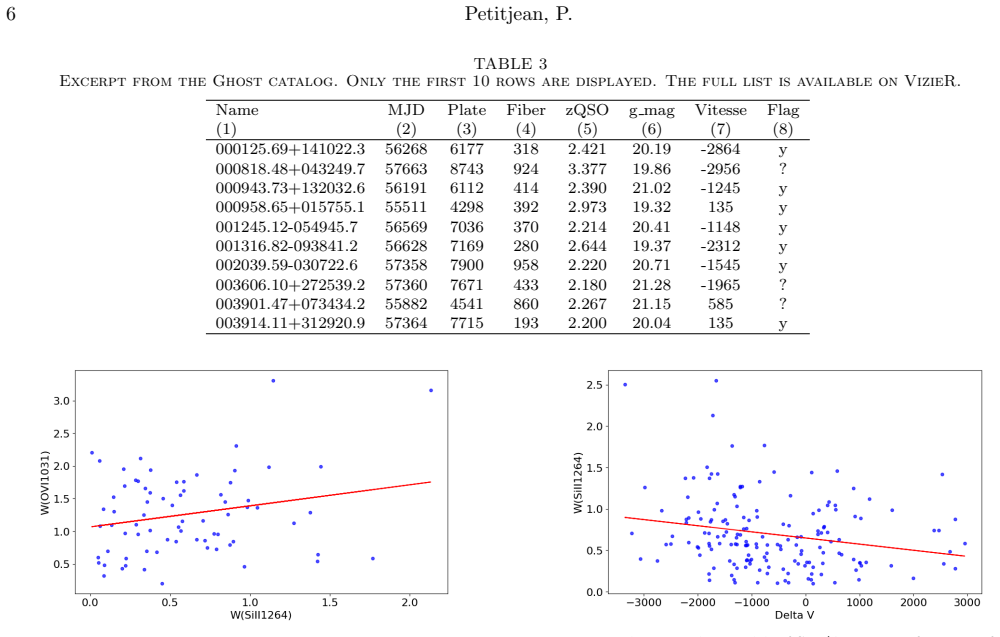
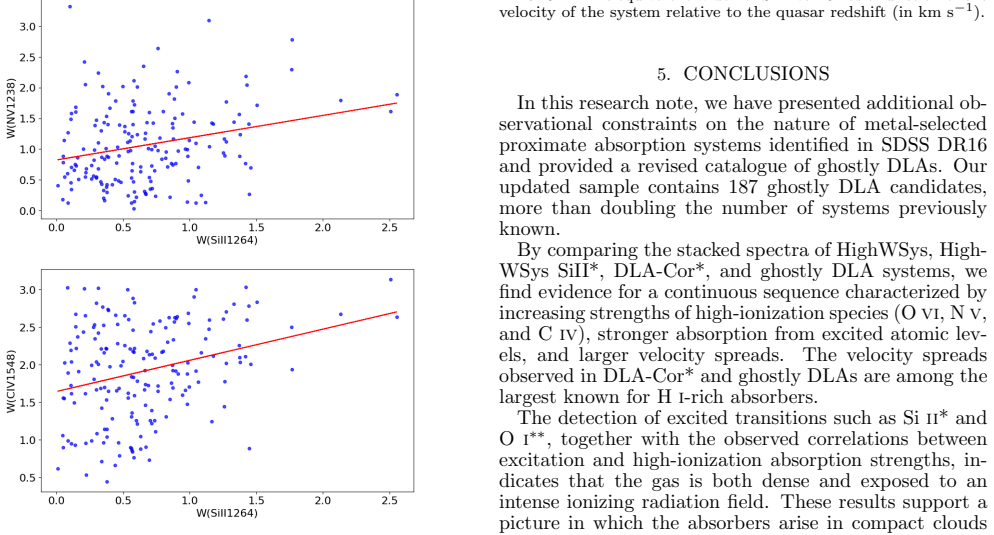
In Petitjean (2026, arXiv:2605.12188)), we revisited the origin of proximate damped Lyman-alpha absorbers (PDLAs), which trace cold gas within 3000 km/s of the quasar redshift, and interpreted their kinematics and physical properties within a unified framework. We showed that most PDLAs are associated with the environment of the AGN and/or the quasar host galaxy. We also provided the first census and characterization of absorption systems exhibiting strong absorption from excited levels of atomic ground states among quasar-associated absorbers. Among these, ghostly and coronagraphic systems arise in dense, compact gas that partially covers the quasar emission regions. Most systems are associated with outflows reaching velocities up to -2000 km/s, while a smaller fraction of inflowing clouds extends to velocities of up to +1200 km/s. In the present work, we provide an updated classification of PDLAs, including a revised catalogue of ghostly systems that more than doubles the number of previously known detections. We investigate the properties of these systems by measuring and discussing the equivalent widths of the detected absorption lines in both stacked spectra and individual ghostly systems. In particular, we show that although most ghostly systems are bona fide DLAs, this is not always the case.
Editorial analysis
A structured set of objections, weighed in public.
Referee Report
Summary. The manuscript is a Research Note updating the classification of proximate damped Lyman-alpha absorbers (PDLAs) from SDSS DR16. It presents a revised catalogue of ghostly systems (more than doubling prior detections), measures equivalent widths of absorption lines (including from excited levels) in both stacked and individual spectra, and concludes that most ghostly systems are bona fide DLAs while noting that this is not always the case.
Significance. If the DLA classifications hold after proper accounting for partial covering, the expanded catalogue of these rare systems (associated with dense, compact gas in AGN outflows or inflows) would provide a substantially larger sample for studying cold gas kinematics and physical conditions near quasars, extending the unified framework from the companion paper (Petitjean 2026).
major comments (1)
- [Abstract] Abstract: The central claim that 'most ghostly systems are bona fide DLAs, this is not always the case' requires reliable N(HI) >= 2e20 cm^-2 determinations. Ghostly systems are defined by partial covering, so equivalent-width measurements (the only analysis method described) do not suffice; Voigt-profile fits to the Ly-alpha damping wings will underestimate column density unless the covering fraction is modeled explicitly in the fits. No indication is given that such corrections were applied when classifying the newly added systems.
Simulated Author's Rebuttal
We thank the referee for their detailed review and constructive feedback on our Research Note. We address the single major comment below regarding the robustness of our DLA classifications.
read point-by-point responses
-
Referee: [Abstract] Abstract: The central claim that 'most ghostly systems are bona fide DLAs, this is not always the case' requires reliable N(HI) >= 2e20 cm^-2 determinations. Ghostly systems are defined by partial covering, so equivalent-width measurements (the only analysis method described) do not suffice; Voigt-profile fits to the Ly-alpha damping wings will underestimate column density unless the covering fraction is modeled explicitly in the fits. No indication is given that such corrections were applied when classifying the newly added systems.
Authors: We agree that equivalent-width measurements provide only an indirect indication of column density and that partial covering must be explicitly modeled to obtain reliable N(HI) values from the damping wings. The present Research Note relies on equivalent widths measured in stacked and individual spectra (as described in the text) together with the detection of excited-level lines to classify systems, following the approach of earlier studies. However, this does not constitute a full Voigt-profile analysis that accounts for covering fraction. We will therefore add such modeling for the Ly-alpha profiles of the newly catalogued systems in the revised version to confirm which meet the bona-fide DLA threshold after correction. revision: yes
Circularity Check
No significant circularity; observational catalogue extension
full rationale
The paper performs an observational extension of a PDLA catalogue by measuring equivalent widths in stacked and individual SDSS spectra and applying an updated classification. It cites prior work (Petitjean 2026) only for the initial definition of ghostly systems and their physical interpretation; the new results consist of direct measurements on fresh data that do not reduce to those inputs by construction. No equations, fitted parameters, predictions, or self-referential derivations appear. The claim that most systems are bona fide DLAs rests on the new equivalent-width data rather than tautology.
Axiom & Free-Parameter Ledger
Reference graph
Works this paper leans on
-
[1]
2020, ApJS, 249, 3
Ahumada, R., Allende Prieto, C., Almeida, A., et al. 2020, ApJS, 249, 3
2020
-
[2]
A., & Plesha, R
Arav, N., Xu, X., Miller, T., Kriss, G. A., & Plesha, R. 2020, ApJS, 247, 37
2020
-
[3]
2024, MNRAS, 527, 12298
Aromal, P., Srianand, R., & Petitjean, P. 2024, MNRAS, 527, 12298
2024
-
[4]
Bluck, A. F. L., Piotrowska, J. M., & Maiolino, R. 2023, ApJ, 944, 108
2023
-
[5]
& Yang, X.-H
Bu, D.-F. & Yang, X.-H. 2021, ApJ, 921, 100
2021
-
[6]
M., Binney, J., et al
Cattaneo, A., Faber, S. M., Binney, J., et al. 2009, Nature, 460, 213
2009
-
[7]
S., Kneib, J.-P., Percival, W
Dawson, K. S., Kneib, J.-P., Percival, W. J., et al. 2016, AJ, 151, 44
2016
-
[8]
2016, MNRAS, 463, 3948
Dubois, Y., Peirani, S., Pichon, C., et al. 2016, MNRAS, 463, 3948
2016
-
[9]
L., Yan, L., Hook, I
Ellison, S. L., Yan, L., Hook, I. M., et al. 2002, A&A, 383, 91
2002
-
[10]
2020, ApJ, 901, 123
Fathivavsari, H. 2020, ApJ, 901, 123
2020
-
[11]
2017, MNRAS, 466, L58 Faucher-Gigu` ere, C.-A
Fathivavsari, H., Petitjean, P., Zou, S., et al. 2017, MNRAS, 466, L58 Faucher-Gigu` ere, C.-A. & Quataert, E. 2012, MNRAS, 425, 605 Filiz Ak, N., Brandt, W. N., Hall, P. B., et al. 2012, ApJ, 757, 114
2017
-
[12]
2013, A&A, 558, A111 F¨ orster Schreiber, N
Finley, H., Petitjean, P., Pˆ aris, I., et al. 2013, A&A, 558, A111 F¨ orster Schreiber, N. M.,¨Ubler, H., Davies, R. L., et al. 2019, ApJ, 875, 21
2013
-
[13]
R., Jiang, L., Brandt, W
Gibson, R. R., Jiang, L., Brandt, W. N., et al. 2009, ApJ, 692, 758
2009
-
[14]
N., McLaughlin, D
Gofford, J., Reeves, J. N., McLaughlin, D. E., et al. 2015, MNRAS, 451, 4169
2015
-
[15]
F., Prochaska, J
Hennawi, J. F., Prochaska, J. X., Kollmeier, J., & Zheng, Z. 2009, ApJ, 693, L49
2009
-
[16]
2016, ApJ, 821, 1
Jiang, P., Zhou, H., Pan, X., et al. 2016, ApJ, 821, 1
2016
-
[17]
Kembhavi, A. K. 2014, MNRAS, 441, 2613
2014
-
[18]
S., Reeves, J., et al
Laha, S., Reynolds, C. S., Reeves, J., et al. 2021, Nature Astronomy, 5, 13
2021
-
[19]
& Petitjean, P
Laloux, B. & Petitjean, P. 2021, MNRAS, 502, 3855 Lauˇ zikas, M. & Zubovas, K. 2024, A&A, 690, A396
2021
-
[20]
Leung, G. C. K., Coil, A. L., Aird, J., et al. 2019, ApJ, 886, 11
2019
-
[21]
W., Higley, A
Lyke, B. W., Higley, A. N., McLane, J. N., et al. 2020, ApJS, 250, 8
2020
-
[22]
2019, A&A, 627, A32
Noterdaeme, P., Balashev, S., Krogager, J.-K., et al. 2019, A&A, 627, A32
2019
-
[23]
2026, arXiv e-prints, arXiv:2605.12188
Petitjean, P. 2026, arXiv e-prints, arXiv:2605.12188
Pith/arXiv arXiv 2026
-
[24]
M., Bluck, A
Piotrowska, J. M., Bluck, A. F. L., Maiolino, R., & Peng, Y. 2022, MNRAS, 512, 1052
2022
-
[25]
Prochaska, J. X. & Hennawi, J. F. 2009, ApJ, 690, 1558
2009
-
[26]
A., Bower, R
Schaye, J., Crain, R. A., Bower, R. G., et al. 2015, MNRAS, 446, 521
2015
-
[27]
Silva, A. I. & Viegas, S. M. 2002, MNRAS, 329, 135
2002
-
[28]
2005, MNRAS, 361, 776
Springel, V., Di Matteo, T., & Hernquist, L. 2005, MNRAS, 361, 776
2005
-
[29]
N., et al
Tombesi, F., Cappi, M., Reeves, J. N., et al. 2011, ApJ, 742, 44
2011
-
[30]
J., Carswell, R
Weymann, R. J., Carswell, R. F., & Smith, M. G. 1981, ARA&A, 19, 41
1981
-
[31]
L., Hamann, F., Pˆ aris, I., et al
Zakamska, N. L., Hamann, F., Pˆ aris, I., et al. 2016, MNRAS, 459, 3144
2016
-
[32]
2018, A&A, 616, A158 This paper was built using the Open Journal of As- trophysics LATEX template
Zou, S., Petitjean, P., Noterdaeme, P., et al. 2018, A&A, 616, A158 This paper was built using the Open Journal of As- trophysics LATEX template. The OJA is a journal which provides fast and easy peer review for new papers in the astro-phsection of the arXiv, making the reviewing pro- cess simpler for authors and referees alike. Learn more athttp://astro....
2018
discussion (0)
Sign in with ORCID, Apple, or X to comment. Anyone can read and Pith papers without signing in.