The density of k-cacti via excluding minors
Pith reviewed 2026-06-28 00:20 UTC · model grok-4.3
The pith
A k-cactus excludes a large complete minor and therefore has at most O((log k / sqrt(log log k)) n) edges.
A machine-rendered reading of the paper's core claim, the machinery that carries it, and where it could break.
Core claim
Every n-vertex k-cactus has O((log k / sqrt(log log k)) n) edges for sufficiently large k, obtained by proving that the bounded number of cycles per edge forces the exclusion of a large complete minor and therefore places k-cacti inside a minor-closed class whose extremal density is already known.
What carries the argument
The implication that an upper bound of k on the number of cycles through any edge forces the graph to exclude a sufficiently large complete minor, which establishes that the class of k-cacti is minor-closed.
If this is right
- The maximum number of edges in any n-vertex k-cactus is O((log k / sqrt(log log k)) n) for large k.
- The class of k-cacti is minor-closed.
- A construction achieves a matching lower bound up to a factor of sqrt(log log k).
- The same density bound applies uniformly to all sufficiently large k.
Where Pith is reading between the lines
- The same cycle-to-minor argument may extend to other graph families defined by local cycle restrictions.
- A more precise quantification of the excluded minor size could tighten the leading constant in the density bound.
- The result connects k-cacti to the broader theory of sparse minor-closed classes such as planar graphs or bounded-treewidth graphs.
Load-bearing premise
A bound on the number of cycles through each edge forces every k-cactus to exclude a large complete minor.
What would settle it
An n-vertex k-cactus containing more than C (log k / sqrt(log log k)) n edges for large k, or a k-cactus that contains a complete minor larger than the size implied by the cycle bound, would falsify the claim.
Figures
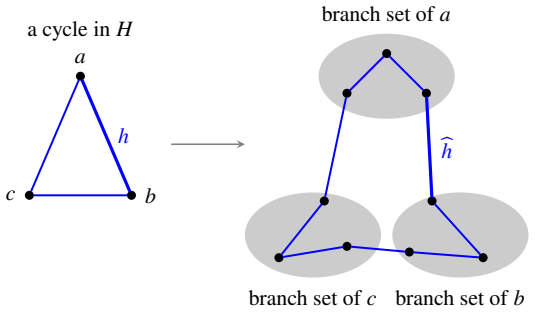
read the original abstract
A \emph{$k$-cactus} generalizes forests and cacti by allowing each edge to lie on at most $k$ cycles. The maximum number of edges is classical for forests and cacti, but for $k$-cacti was known only for $k\le 4$. In this note we treat general $k$. The key idea is that bounding the cycles through each edge forces a $k$-cactus to exclude a large complete minor; in particular, the class of $k$-cacti is minor-closed. From this we prove that every $n$-vertex $k$-cactus has $O\!\left(\frac{\log k}{\sqrt{\log\log k}}\,n\right)$ edges for all sufficiently large $k$, and a construction shows this is optimal up to a factor of $\sqrt{\log\log k}$.
Editorial analysis
A structured set of objections, weighed in public.
Referee Report
Summary. The paper defines a k-cactus as a graph in which every edge lies on at most k cycles. It asserts that this class is minor-closed (because the per-edge cycle bound forces exclusion of large complete minors) and therefore, by the known extremal function for K_r-minor-free graphs, every n-vertex k-cactus has O((log k / sqrt(log log k)) n) edges for all sufficiently large k. A construction is given showing that the bound is optimal up to a sqrt(log log k) factor.
Significance. If the minor-closed claim is established, the result supplies the first general upper bound on the density of k-cacti for arbitrary k, extending the classical cases k=0,1 and linking the problem to the extremal theory of minor-closed families. The explicit construction achieving the matching lower bound (up to the stated factor) is a concrete strength.
major comments (1)
- [Abstract] Abstract (and the central argument): the reduction to the O(r sqrt(log r) n) bound for K_r-minor-free graphs requires that the class of k-cacti is minor-closed. While the manuscript correctly notes that edge/vertex deletion cannot increase the number of cycles through any edge, no argument, lemma, or verification is supplied showing that edge contraction preserves the property (i.e., that identifying vertices cannot create additional cycles through a remaining edge f and push its cycle count above k). This step is load-bearing for the entire density claim.
Simulated Author's Rebuttal
We thank the referee for the careful reading and for identifying the missing verification that k-cacti are closed under contraction. We agree that the current manuscript only treats deletions explicitly and will add a complete argument for the minor-closed property.
read point-by-point responses
-
Referee: [Abstract] Abstract (and the central argument): the reduction to the O(r sqrt(log r) n) bound for K_r-minor-free graphs requires that the class of k-cacti is minor-closed. While the manuscript correctly notes that edge/vertex deletion cannot increase the number of cycles through any edge, no argument, lemma, or verification is supplied showing that edge contraction preserves the property (i.e., that identifying vertices cannot create additional cycles through a remaining edge f and push its cycle count above k). This step is load-bearing for the entire density claim.
Authors: We acknowledge the gap: the manuscript notes the effect of deletions but supplies no separate argument or lemma for contractions. The property is nevertheless preserved. Any cycle through a remaining edge f in a contraction of G corresponds to (the image of) a cycle through f in G itself, since the contraction homomorphism maps closed walks to closed walks and cycles to cycles. Hence the number of cycles through f cannot increase. We will insert a short new lemma (with proof) establishing that the class of k-cacti is minor-closed; the revised manuscript will therefore justify the appeal to the extremal function for K_r-minor-free graphs. revision: yes
Circularity Check
No significant circularity; external theorems invoked as independent input
full rationale
The derivation defines k-cacti via the per-edge cycle bound, asserts that this forces exclusion of large complete minors (hence minor-closed), and invokes the known O(r sqrt(log r) n) edge bound for K_r-minor-free graphs to obtain the stated density. No self-citation chain, no parameter fitted to a subset then renamed as prediction, no ansatz smuggled via prior work, and no definitional loop appear. The minor-closed claim is presented as a direct consequence of the cycle bound rather than presupposing the target density result. Reliance on standard external minor-density theorems constitutes normal use of independent benchmarks, not circularity.
Axiom & Free-Parameter Ledger
axioms (2)
- domain assumption The class of k-cacti is minor-closed.
- standard math Standard density bounds for minor-closed graph classes apply directly.
Reference graph
Works this paper leans on
-
[1]
Diestel,Graph theory, 6th ed., Graduate Texts in Mathematics, vol
R. Diestel,Graph theory, 6th ed., Graduate Texts in Mathematics, vol. 173, Springer, Berlin, [2025]©2025. MR4874150
2025
-
[2]
E. El-Mallah and C. J. Colbourn,The complexity of some edge deletion problems, IEEE Transactions on Circuits and Systems35(1988), no. 3, 354–362, DOI 10.1109/31.1748
-
[3]
C. Geniet and U. Giocanti,Basis number of graphs excluding minors, posted on 2026, DOI 10.48550/arXiv.2601.05195, available at2601.05195
-
[4]
A. V. Kostochka,Lower bound of the Hadwiger number of graphs by their average degree, Combinatorica4 (1984), no. 4, 307–316, DOI 10.1007/BF02579141. MR779891
-
[5]
Mac Lane,A structural characterization of planar combinatorial graphs, Duke Math
S. Mac Lane,A structural characterization of planar combinatorial graphs, Duke Math. J.3(1937), no. 3, 460–472, DOI 10.1215/S0012-7094-37-00336-3. MR1546002
-
[6]
Mader,Homomorphiesätze für Graphen, Math
W. Mader,Homomorphiesätze für Graphen, Math. Ann.178(1968), 154–168, DOI 10.1007/BF01350657 (German). MR0229550
-
[7]
Thomason,An extremal function for contractions of graphs, Math
A. Thomason,An extremal function for contractions of graphs, Math. Proc. Cambridge Philos. Soc.95(1984), no. 2, 261–265, DOI 10.1017/S0305004100061521. MR735367
-
[8]
A.Thomason,Theextremalfunctionforcompleteminors,J.Combin.TheorySer.B81(2001),no.2,318–338, DOI 10.1006/jctb.2000.2013. MR1814910
-
[9]
MR0332580
S.Toida,PropertiesofaEulergraph,J.FranklinInst.295(1973),343–345,DOI10.1016/0016-0032(73)90046- X. MR0332580
1973
-
[10]
V.A.Voblyi,EnumerationoflabeledEulerian 3-cacti,J.Math.Sci.293(2025),673–677,DOI10.1007/s10958- 025-08041-3
2025
-
[11]
D. B. West,Introduction to Graph Theory, 2nd ed., Prentice Hall, Upper Saddle River, NJ, 2001. MR1367739
2001
-
[12]
Z. Wu, H. Chen, and J. Li,Maximizing the spectral radius of generalized cactus graphs, RAIRO Oper. Res.60 (2026), no. 3, 1407–1418, DOI 10.1051/ro/2026035
-
[13]
L. Zhang and Y. Huang,On the sizes of generalized cactus graphs, Discrete Appl. Math.348(2024), 184–191, DOI 10.1016/j.dam.2024.01.043. MR4700794 9
discussion (0)
Sign in with ORCID, Apple, or X to comment. Anyone can read and Pith papers without signing in.