RedZeD: Computing persistent homology by Reduction to Zero Differentials
Pith reviewed 2026-06-27 22:34 UTC · model grok-4.3
The pith
RedZeD reformulates persistent homology as reduction to zero differentials to enable faster active enumeration on Vietoris-Rips filtrations.
A machine-rendered reading of the paper's core claim, the machinery that carries it, and where it could break.
Core claim
Persistent homology of a Vietoris-Rips filtration can be computed by successively reducing differentials to zero; the resulting RedZeD framework makes an active enumeration algorithm possible that returns exactly the same birth-death pairs as the classical persistence pairing algorithm yet runs faster on many inputs.
What carries the argument
The Reduction to Zero Differentials (RedZeD) framework, which recasts the boundary matrix operations of persistent homology so that active enumeration can locate the necessary reductions without exhaustive search.
If this is right
- The computed persistence diagrams are identical to those produced by the classical algorithm.
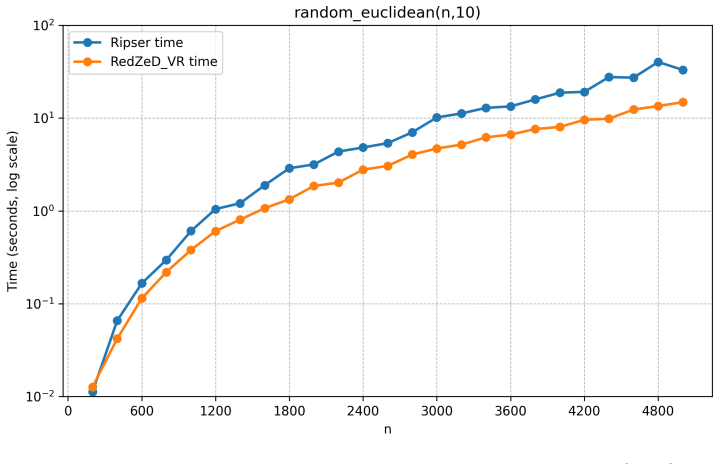
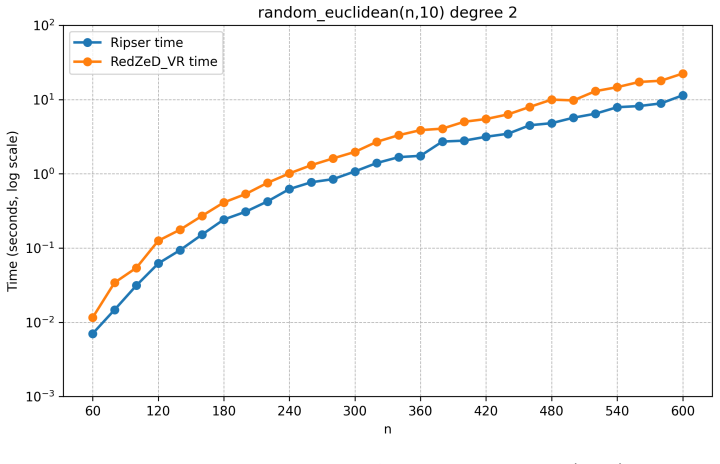
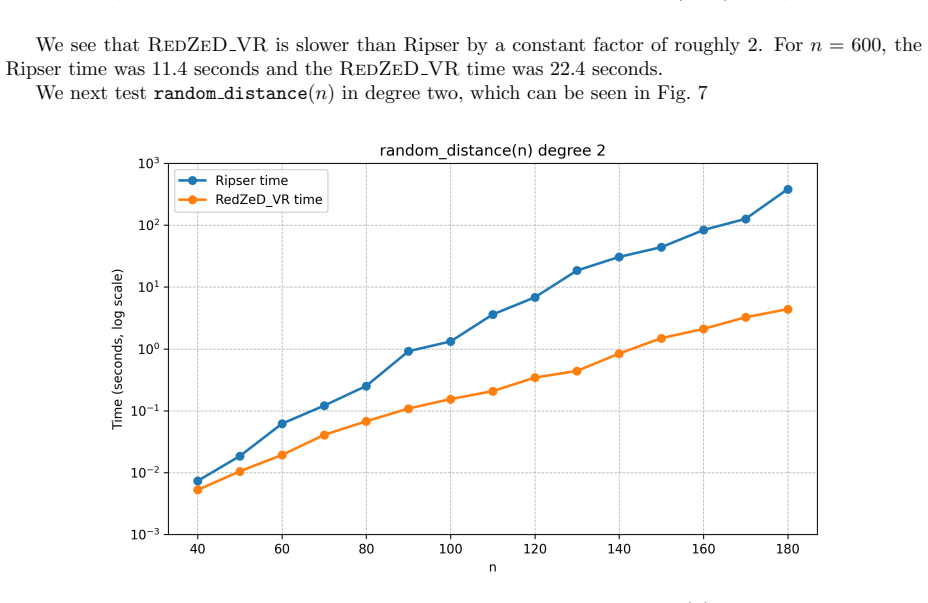
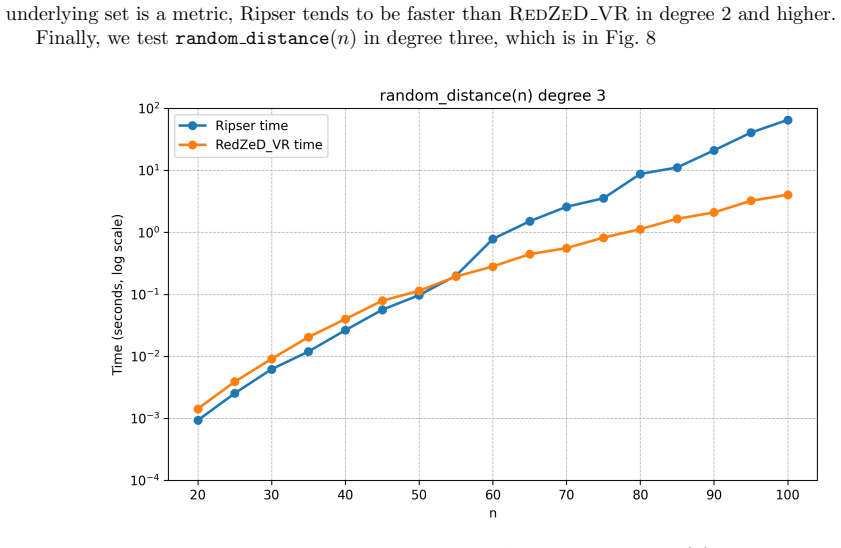
- Running time improves over the existing implementation for many Vietoris-Rips inputs.
- Active enumeration becomes a viable replacement for the standard pairing step once the RedZeD view is adopted.
Where Pith is reading between the lines
- The same reduction perspective could be tested on filtrations other than Vietoris-Rips to check whether the speedup generalizes.
- An implementation of active enumeration might be combined with existing matrix-reduction libraries to measure concrete wall-clock gains on benchmark data sets.
- If the framework extends cleanly, it could reduce the memory footprint required for large-scale topological data analysis pipelines.
Load-bearing premise
The RedZeD reformulation produces exactly the same persistence pairs as the standard algorithm without omitting cases or introducing algebraic errors.
What would settle it
A concrete Vietoris-Rips filtration on which the active enumeration algorithm reports a different set of birth-death pairs than the standard persistence pairing algorithm.
Figures
read the original abstract
We introduce a new algorithm for computing persistent homology of Vietoris--Rips filtrations, which in many cases offers a considerable speedup over the existing implementation of the persistence pairing algorithm. The key innovation, called active enumeration, is made possible by a new theoretical framework of Reduction to Zero Differentials (hence RedZeD) in which to view persistent homology.
Editorial analysis
A structured set of objections, weighed in public.
Referee Report
Summary. The manuscript introduces RedZeD, a new theoretical framework for persistent homology based on reduction to zero differentials, which enables an active enumeration algorithm for computing the persistence pairing on Vietoris-Rips filtrations. The central claim is that this approach yields identical results to the standard persistence pairing algorithm while providing considerable speedup in many cases.
Significance. If the reformulation is correct and the speedup holds under standard validation, the work could offer a practical improvement for persistent homology computations, which are widely used in topological data analysis. The new framework provides an alternative perspective on the problem that directly supports the algorithmic innovation.
minor comments (1)
- The abstract and introduction would benefit from explicit cross-references to the sections containing the formal definition of the RedZeD framework and the pseudocode for active enumeration to improve readability.
Simulated Author's Rebuttal
We thank the referee for their positive summary, significance assessment, and recommendation of minor revision. No specific major comments were raised in the report.
Circularity Check
No significant circularity identified
full rationale
The provided abstract and context describe the introduction of a new theoretical framework (RedZeD) and algorithm (active enumeration) for persistent homology computation. No equations, derivations, self-citations, or reformulations are quoted that reduce a claimed result to its own inputs by construction, fitted parameters renamed as predictions, or load-bearing self-citations. The central claim is presented as a novel reformulation enabling speedup, with no evidence of circular steps in the available text; the derivation chain is therefore self-contained against external benchmarks.
Axiom & Free-Parameter Ledger
Reference graph
Works this paper leans on
-
[1]
Asao, Yasuhiko , TITLE =. Bull. Lond. Math. Soc. , FJOURNAL =. 2023 , NUMBER =
2023
-
[2]
Atkin, R. H. , TITLE =. Internat. J. Man-Mach. Stud. , FJOURNAL =. 1974 , PAGES =. doi:10.1016/S0020-7373(74)80024-6 , URL =
-
[3]
Atkin, R. H. , TITLE =. Internat. J. Man-Mach. Stud. , FJOURNAL =. 1976 , NUMBER =. doi:10.1016/s0020-7373(76)80015-6 , URL =
-
[4]
Homology groups of cubical sets with connections , JOURNAL =
Barcelo, H\'. Homology groups of cubical sets with connections , JOURNAL =. 2021 , NUMBER =. doi:10.1007/s10485-020-09621-x , URL =
-
[6]
Homotopy theory of graphs , JOURNAL =
Babson, Eric and Barcelo, H\'. Homotopy theory of graphs , JOURNAL =. 2006 , NUMBER =. doi:10.1007/s10801-006-9100-0 , URL =
-
[7]
Discrete homology theory for metric spaces , JOURNAL =
Barcelo, H\'. Discrete homology theory for metric spaces , JOURNAL =. 2014 , NUMBER =. doi:10.1112/blms/bdu043 , URL =
-
[8]
Discrete cubical and path homologies of graphs , JOURNAL =
Barcelo, H\'. Discrete cubical and path homologies of graphs , JOURNAL =. 2019 , NUMBER =. doi:10.5802/alco.49 , URL =
-
[9]
On the vanishing of discrete singular cubical homology for graphs , JOURNAL =
Barcelo, H\'. On the vanishing of discrete singular cubical homology for graphs , JOURNAL =. 2021 , NUMBER =. doi:10.1137/20M1338484 , URL =
-
[10]
Barcelo, H\'. Perspectives on. Discrete Math. , FJOURNAL =. 2005 , NUMBER =. doi:10.1016/j.disc.2004.03.016 , URL =
-
[11]
Surveys on discrete and computational geometry , SERIES =
Bandelt, Hans-J\"urgen and Chepoi, Victor , TITLE =. Surveys on discrete and computational geometry , SERIES =. 2008 , ISBN =. doi:10.1090/conm/453/08795 , URL =
-
[12]
Bauer, Ulrich and Kerber, Michael and Reininghaus, Jan and Wagner, Hubert , TITLE =. J. Symbolic Comput. , FJOURNAL =. 2017 , PAGES =. doi:10.1016/j.jsc.2016.03.008 , URL =
-
[13]
Bauer, Ulrich and Kerber, Michael and Reininghaus, Jan and Wagner, Hubert , TITLE =. Mathematical software---. 2014 , ISBN =. doi:10.1007/978-3-662-44199-2\_24 , URL =
-
[14]
Clear and Compress: Computing Persistent Homology in Chunks
Bauer, Ulrich and Kerber, Michael and Reininghaus, Jan. Clear and Compress: Computing Persistent Homology in Chunks. Topological Methods in Data Analysis and Visualization III. 2014
2014
-
[15]
Brown, Kenneth S. , TITLE =. Trans. Amer. Math. Soc. , FJOURNAL =. 1973 , PAGES =. doi:10.2307/1996573 , URL =
-
[16]
Homotopy, homology, and persistent homology using closure spaces , JOURNAL =
Bubenik, Peter and Mili\'. Homotopy, homology, and persistent homology using closure spaces , JOURNAL =. 2024 , NUMBER =. doi:10.1007/s41468-024-00183-8 , URL =
-
[17]
Carlsson, Gunnar , TITLE =. Bull. Amer. Math. Soc. (N.S.) , FJOURNAL =. 2009 , NUMBER =. doi:10.1090/S0273-0979-09-01249-X , URL =
-
[18]
Zomorodian, Afra and Carlsson, Gunnar , TITLE =. Discrete Comput. Geom. , FJOURNAL =. 2005 , NUMBER =. doi:10.1007/s00454-004-1146-y , URL =
-
[19]
2022 , note =
Carranza, Daniel and Kapulkin, Krzysztof , title =. 2022 , note =
2022
-
[20]
Carranza, Daniel and Kapulkin, Krzysztof , TITLE =. Compos. Math. , FJOURNAL =. 2024 , NUMBER =. doi:10.1112/S0010437X24007486 , URL =
-
[21]
2022 , note =
Carranza, Daniel and Kapulkin, Krzysztof and Tonks, Andrew , title =. 2022 , note =
2022
-
[22]
Chih, Tien and Scull, Laura , TITLE =. J. Algebraic Combin. , FJOURNAL =. 2021 , NUMBER =
2021
-
[23]
Cisinski, Denis-Charles , TITLE =. Ast\'. 2006 , PAGES =
2006
-
[24]
Reports of the
Day, Brian , TITLE =. Reports of the. 1970 , MRCLASS =
1970
-
[25]
Day, Brian , TITLE =. J. Pure Appl. Algebra , FJOURNAL =. 1972 , NUMBER =. doi:10.1016/0022-4049(72)90021-7 , URL =
-
[26]
Day, Brian , TITLE =. Bull. Austral. Math. Soc. , FJOURNAL =. 1973 , PAGES =. doi:10.1017/S0004972700045433 , URL =
-
[27]
and Fan, Fengtao and Wang, Yusu , TITLE =
Dey, Tamal K. and Fan, Fengtao and Wang, Yusu , TITLE =. Computational geometry (. 2014 , ISBN =
2014
-
[28]
European J
Dochtermann, Anton , TITLE =. European J. Combin. , FJOURNAL =. 2009 , NUMBER =
2009
-
[29]
2020 , eprint =
Doherty, Brandon and Kapulkin, Krzysztof and Lindsey, Zachery and Sattler, Christian , title =. 2020 , eprint =
2020
-
[30]
Bauer, Ulrich and Masood, Talha Bin and Giunti, Barbara and Houry, Guillaume and Kerber, Michael and Rathod, Abhishek , TITLE =. Comput. Geom. Topol. , FJOURNAL =. 2024 , NUMBER =. doi:10.57717/cgt.v3i1.50 , URL =
-
[31]
Edelsbrunner, Herbert and \"Olsb\"ock, Katharina , TITLE =. Discrete Comput. Geom. , FJOURNAL =. 2020 , NUMBER =. doi:10.1007/s00454-020-00188-x , URL =
-
[32]
Homology Homotopy Appl
Edelsbrunner, Herbert and Zomorodian, Afra , TITLE =. Homology Homotopy Appl. , FJOURNAL =. 2003 , NUMBER =
2003
-
[33]
Gabriel, Peter , TITLE =. Manuscripta Math. , FJOURNAL =. 1972 , PAGES =. doi:10.1007/BF01298413 , URL =
-
[34]
Greene, Curtis and Welker, Volkmar and Wille, Georg , title =
-
[35]
Grigor'yan, Alexander and Lin, Yong and Muranov, Yuri and Yau, Shing-Tung , TITLE =. Pure Appl. Math. Q. , FJOURNAL =. 2014 , NUMBER =. doi:10.4310/PAMQ.2014.v10.n4.a2 , URL =
-
[36]
Hepworth, Richard and Willerton, Simon , TITLE =. Homology Homotopy Appl. , FJOURNAL =. 2017 , NUMBER =. doi:10.4310/HHA.2017.v19.n2.a3 , URL =
-
[37]
1999 , PAGES =
Hovey, Mark , TITLE =. 1999 , PAGES =
1999
-
[38]
Product graphs , SERIES =
Imrich, Wilfried and Klav. Product graphs , SERIES =. 2000 , PAGES =
2000
-
[39]
The fundamental group(oid) in discrete homotopy theory , author=. 2023 , note =. 2303.06029 , archivePrefix=
arXiv 2023
-
[40]
Kapulkin, Krzysztof and Voevodsky, Vladimir , TITLE =. J. Topol. , FJOURNAL =. 2020 , NUMBER =
2020
-
[41]
and Laubenbacher, Reinhard C
Kramer, Xenia H. and Laubenbacher, Reinhard C. , TITLE =. Applications of computational algebraic geometry (. 1998 , MRCLASS =
1998
-
[42]
Princeton University Press, Princeton, NJ, xviii+925.doi: 10.1515/9781400830558
Lurie, Jacob , TITLE =. 2009 , PAGES =. doi:10.1515/9781400830558 , URL =
-
[43]
Lutz, Bob , TITLE =. Algebr. Comb. , FJOURNAL =. 2021 , NUMBER =. doi:10.5802/alco.151 , URL =
-
[44]
1998 , PAGES =
Mac Lane, Saunders , TITLE =. 1998 , PAGES =
1998
-
[45]
Persistent homotopy groups of metric spaces , journal =
M\'. Persistent homotopy groups of metric spaces , journal =
-
[46]
Riehl, Emily , TITLE =. 2014 , PAGES =. doi:10.1017/CBO9781107261457 , URL =
-
[47]
2016 , pages =
Riehl, Emily , title =. 2016 , pages =
2016
-
[48]
Homotopy theory of cofibration categories , JOURNAL =
Szumi. Homotopy theory of cofibration categories , JOURNAL =. 2016 , NUMBER =. doi:10.4310/HHA.2016.v18.n2.a19 , URL =
-
[49]
Learnable latent embeddings for joint behavioural and neural analysis , volume =
Schneider, Steffen and Lee, Jin Hwa and Mathis, Mackenzie Weygandt , journal =. Learnable latent embeddings for joint behavioural and neural analysis , volume =
-
[50]
and Hermansen, Erik and Pachitariu, Marius and Burak, Yoram and Baas, Nils A
Gardner, Richard J. and Hermansen, Erik and Pachitariu, Marius and Burak, Yoram and Baas, Nils A. and Dunn, Benjamin A. and Moser, May-Britt and Moser, Edvard I. , journal =. Toroidal topology of population activity in grid cells , volume =
-
[51]
International Conference on Artificial Intelligence and Statistics , pages=
Atol: measure vectorization for automatic topologically-oriented learning , author=. International Conference on Artificial Intelligence and Statistics , pages=. 2021 , organization=
2021
-
[52]
Information and Media Technologies , volume=
Time series classification via topological data analysis , author=. Information and Media Technologies , volume=. 2017 , publisher=
2017
-
[53]
and Qi, Rui and Shang, Zhouchun and Xing, Yanan and An, Yanru and Zhang, Nannan and Hou, Yong and Crockford, Tanya L
Benjamin, Katherine and Bhandari, Aneesha and Kepple, Jessica D. and Qi, Rui and Shang, Zhouchun and Xing, Yanan and An, Yanru and Zhang, Nannan and Hou, Yong and Crockford, Tanya L. and McCallion, Oliver and Issa, Fadi and Hester, Joanna and Tillmann, Ulrike and Harrington, Heather A. and Bull, Katherine R. , journal =. Multiscale topology classifies cel...
-
[54]
Probing center vortices and deconfinement in SU(2) lattice gauge theory with persistent homology , author =. Phys. Rev. D , volume =. 2023 , month =. doi:10.1103/PhysRevD.107.034501 , url =
-
[55]
Scoville, Nicholas A. , TITLE =. 2019 , PAGES =. doi:10.1090/stml/090 , URL =
-
[56]
Advances in Artificial Intelligence: 33rd Canadian Conference on Artificial Intelligence, Canadian AI 2020, Ottawa, ON, Canada, May 13--15, 2020, Proceedings 33 , pages=
Topological data analysis for arrhythmia detection through modular neural networks , author=. Advances in Artificial Intelligence: 33rd Canadian Conference on Artificial Intelligence, Canadian AI 2020, Ottawa, ON, Canada, May 13--15, 2020, Proceedings 33 , pages=. 2020 , organization=
2020
-
[57]
and Ray, Ron and Applequist, Scott and Korzeniewski, Bryant and Menne, Matthew J
Lawrimore, Jay H. and Ray, Ron and Applequist, Scott and Korzeniewski, Bryant and Menne, Matthew J. , title =. 2016 , publisher =
2016
-
[58]
Journal of Machine Learning Research , year =
Alexander Rolle and Luis Scoccola , title =. Journal of Machine Learning Research , year =
-
[59]
arXiv preprint arXiv:1802.03426 , year=
Umap: Uniform manifold approximation and projection for dimension reduction , author=. arXiv preprint arXiv:1802.03426 , year=
-
[60]
2017 IEEE international conference on data mining workshops (ICDMW) , pages=
Accelerated hierarchical density based clustering , author=. 2017 IEEE international conference on data mining workshops (ICDMW) , pages=. 2017 , organization=
2017
-
[61]
Bauer, Ulrich , TITLE =. J. Appl. Comput. Topol. , FJOURNAL =. 2021 , NUMBER =. doi:10.1007/s41468-021-00071-5 , URL =
-
[62]
de Silva, Vin and Morozov, Dmitriy and Vejdemo-Johansson, Mikael , TITLE =. Inverse Problems , FJOURNAL =. 2011 , NUMBER =. doi:10.1088/0266-5611/27/12/124003 , URL =
-
[63]
Mischaikow, Konstantin and Nanda, Vidit , TITLE =. Discrete Comput. Geom. , FJOURNAL =. 2013 , NUMBER =. doi:10.1007/s00454-013-9529-6 , URL =
-
[64]
Forman, Robin , TITLE =. Adv. Math. , FJOURNAL =. 1998 , NUMBER =. doi:10.1006/aima.1997.1650 , URL =
-
[65]
Computational geometry (
Bauer, Ulrich and Edelsbrunner, Herbert , TITLE =. Computational geometry (. 2014 , ISBN =
2014
-
[66]
Three-dimensional alpha shapes , year =
Edelsbrunner, Herbert and M\". Three-dimensional alpha shapes , year =. doi:10.1145/174462.156635 , journal =
-
[67]
Hirschhorn, Philip S. , TITLE =. 2003 , PAGES =. doi:10.1090/surv/099 , URL =
-
[68]
Kapulkin, Chris and Kershaw, Nathan , title =. 2025 , eprint =. doi:10.48550/arXiv.2506.15020 , url =
-
[69]
Edelsbrunner, Herbert and Letscher, David and Zomorodian, Afra , TITLE =. Discrete Comput. Geom. , FJOURNAL =. 2002 , NUMBER =. doi:10.1007/s00454-002-2885-2 , URL =
-
[70]
and Tillmann, Ulrike and Grindrod, Peter and Harrington, Heather A
Otter, Nina and Porter, Mason A. and Tillmann, Ulrike and Grindrod, Peter and Harrington, Heather A. , title =. EPJ Data Science , volume =. 2017 , doi =
2017
-
[71]
and Maria, Cl\'ement , TITLE =
Boissonnat, Jean-Daniel and Dey, Tamal K. and Maria, Cl\'ement , TITLE =. Algorithmica , FJOURNAL =. 2015 , NUMBER =. doi:10.1007/s00453-015-9999-4 , URL =
-
[72]
Kaczynski, Tomasz and Mischaikow, Konstantin and Mrozek, Marian. Cubical Homology. Computational Homology. 2004. doi:10.1007/0-387-21597-2_2
-
[73]
Proceedings of the 27th European Workshop on Computational Geometry (EuroCG) , pages =
Chen, Chao and Kerber, Michael , title =. Proceedings of the 27th European Workshop on Computational Geometry (EuroCG) , pages =
discussion (0)
Sign in with ORCID, Apple, or X to comment. Anyone can read and Pith papers without signing in.