Data valuation model for non-monetary exchanges
Pith reviewed 2026-06-27 22:55 UTC · model grok-4.3
The pith
A choice-based metric for data products in non-monetary exchanges admits a closed-form Shapley value for fair allocation.
A machine-rendered reading of the paper's core claim, the machinery that carries it, and where it could break.
Core claim
The paper claims that a normative metric derived from observed user selections of data products can be represented exactly as the value function of a cooperative game, allowing computation of a closed-form Shapley value that distributes the total value fairly across offerings according to their marginal contributions to user choices.
What carries the argument
The choice-based valuation metric formalized as a cooperative game whose Shapley value is computable in closed form and rewards uniqueness in selection patterns.
If this is right
- The metric assigns higher value to offerings chosen in distinctive patterns, reducing the dominance of popular items.
- Value can be allocated across offerings without collecting cost or competitive price data.
- The approach supplies an explicit fairness criterion through the Shapley axioms for credit in internal exchanges.
- Incentives shift toward long-tail data products that exhibit discriminative consumption.
Where Pith is reading between the lines
- Internal funding or staffing decisions could be tied directly to the computed Shapley shares rather than to usage counts.
- The same selection data might be reused to test bundling strategies by checking whether joint selections produce super-additive value.
- Repeated application of the metric over time would produce a trackable index of how the relative value of data assets changes.
Load-bearing premise
That patterns of user selection alone are enough to quantify the value of data offerings without any information on costs, demand, or external prices.
What would settle it
Collect selection data from an internal platform, compute the closed-form Shapley allocations, then compare them against an independent measure of value such as reported usefulness or downstream usage hours; systematic divergence would falsify the claim that selection behavior suffices.
Figures
read the original abstract
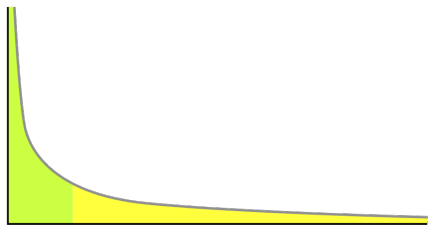
In the evolving landscape of data product exchange platforms, traditional economic valuation models fall short due to the non-rival nature of data and the prevalence of non-monetary data product exchanges. This paper introduces a normative, choice-based metric for valuing data products within intracompany exchanges, where conventional pricing mechanisms are absent. By modeling consumer attention and preferences, the proposed metric quantifies the value of data offerings based solely on user selection behavior, without relying on cost, demand, or competitive pricing data. We show that this metric can be formally cast as a cooperative game with a closed-form Shapley value, providing a principled and fairness-based allocation of value across offerings. The model rewards uniqueness and discriminative consumption, effectively addressing the limitations of popularity-based metrics and incentivizing the creation of high-value, long-tail data products. Through theoretical analysis and illustrative examples, the metric is shown to align with economic principles, support equitable valuation, and contribute to a robust framework for measuring gross data product value. Future research directions include exploring bundling strategies and quantifying product complementarity.
Editorial analysis
A structured set of objections, weighed in public.
Referee Report
Summary. The paper introduces a normative, choice-based metric for valuing data products in non-monetary intracompany exchanges. It models consumer attention and preferences from observed user selection behavior to quantify value without relying on cost, demand, or pricing data. The central claim is that this metric can be formally represented as a cooperative game possessing a closed-form Shapley value, which rewards uniqueness and discriminative consumption while aligning with economic principles.
Significance. If the cooperative-game representation and closed-form result hold, the metric would supply a theoretically grounded, fairness-oriented alternative to popularity-based heuristics for data valuation in settings where conventional pricing is absent. This could support equitable internal allocation and incentivize long-tail data products on exchange platforms.
major comments (1)
- [Abstract] Abstract (and the central claim): The assertion that the metric 'can be formally cast as a cooperative game with a closed-form Shapley value' requires an explicit definition of the characteristic function v(S) for every coalition S ⊆ N. The description supplies user selection data only for the full offering set and gives no functional form showing how the attention/preference model extends to proper subsets (e.g., whether attention weights remain additive, unavailable offerings are dropped, or a new equilibrium is solved). Without this mapping the game is under-specified and the closed-form claim cannot be verified.
Simulated Author's Rebuttal
We thank the referee for the careful reading and for identifying a key point of under-specification in our central claim. We address the major comment below and will revise the manuscript to make the cooperative-game representation fully explicit.
read point-by-point responses
-
Referee: [Abstract] Abstract (and the central claim): The assertion that the metric 'can be formally cast as a cooperative game with a closed-form Shapley value' requires an explicit definition of the characteristic function v(S) for every coalition S ⊆ N. The description supplies user selection data only for the full offering set and gives no functional form showing how the attention/preference model extends to proper subsets (e.g., whether attention weights remain additive, unavailable offerings are dropped, or a new equilibrium is solved). Without this mapping the game is under-specified and the closed-form claim cannot be verified.
Authors: We agree that the manuscript as currently written does not supply an explicit functional form for the characteristic function v(S) when S is a proper subset of the full offering set N. The value metric is derived from observed selection probabilities over the complete menu, but the extension to coalitions is left implicit. In the revision we will add a dedicated subsection that defines v(S) by restricting the attention and preference model to the offerings in S and renormalizing the attention weights over the reduced menu (i.e., unavailable offerings are simply dropped and the remaining attention mass is re-proportioned). With this definition the cooperative game is fully specified, the Shapley-value formula can be verified directly, and the closed-form result follows from the standard axioms. We will also include a short proof sketch confirming that the resulting v satisfies the necessary properties for the closed-form expression to hold. revision: yes
Circularity Check
No circularity: derivation builds metric from selection data then maps to game form without reduction by construction
full rationale
The abstract states the metric is built from user selection behavior and then shown to admit a cooperative-game representation with closed-form Shapley value. No equations, definitions of v(S), or self-citations appear in the supplied text that would allow exhibiting Eq. X = Eq. Y by construction, a fitted parameter renamed as prediction, or a load-bearing self-citation chain. The mapping from observed selections to the characteristic function is presented as a modeling step rather than presupposed, leaving the central claim independent of its inputs on the evidence given.
Axiom & Free-Parameter Ledger
axioms (1)
- domain assumption User selection behavior directly encodes the value of data offerings independent of cost or external pricing signals.
Reference graph
Works this paper leans on
-
[1]
Equilibrium Pricing of Digital Goods via a New Market Model , volume =
Jain, Kamal and Vazirani, Vijay , year =. Equilibrium Pricing of Digital Goods via a New Market Model , volume =
-
[2]
Ecole Politechnique Federale de Lausanne, Tech
Chen, Li and Pu, Pearl , biburl =. Ecole Politechnique Federale de Lausanne, Tech. Rep. IC/2004/67 , keywords =
2004
-
[3]
Greenwade
George D. Greenwade. The C omprehensive T ex A rchive N etwork ( CTAN ). TUGBoat. 1993
1993
-
[4]
and Raghavan, Prabhakar , title =
Kleinberg, Jon and Papadimitriou, Christos H. and Raghavan, Prabhakar , title =. Proceedings of the 8th Conference on Theoretical Aspects of Rationality and Knowledge , pages =. 2001 , isbn =
2001
-
[5]
Equilibrium Pricing of Semantically Substitutable Digital Goods
Jain, Kamal and Vazirani, Vijay , month = jul, year =. Equilibrium. doi:10.48550/arxiv.1007.4586 , abstract =
work page internal anchor Pith review Pith/arXiv arXiv doi:10.48550/arxiv.1007.4586
-
[6]
Innovation Policy and the Economy, Volume 7 , editor =
Brynjolfsson, Erik and Zhang, Xiaoquan (Michael) , title =. Innovation Policy and the Economy, Volume 7 , editor =. 2007 , pages =
2007
-
[7]
Proceedings of the third ACM international conference on Web search and data mining , pages=
Anatomy of the long tail: Ordinary people with extraordinary tastes , author=. Proceedings of the third ACM international conference on Web search and data mining , pages=. 2009 , organization=
2009
-
[8]
Management Science , volume=
Bundling Information Goods: Pricing, Profits, and Efficiency , author=. Management Science , volume=. 1999 , publisher=
1999
-
[9]
Interacting with Computers , volume=
The Second Wave of Attention Economics: Attention as a Universal Symbolic Currency on Social Media and Beyond , author=. Interacting with Computers , volume=. 2025 , publisher=
2025
-
[10]
Contributions to the Theory of Games II , editor =
A Value for n-Person Games , author =. Contributions to the Theory of Games II , editor =. 1953 , publisher =
1953
-
[11]
2025 , url =
Long Tail ---. 2025 , url =
2025
-
[12]
2025 , url =
Supply and Demand ---. 2025 , url =
2025
-
[13]
Perfectly Elastic Demand.GIF , year =
-
[14]
Harsanyi , title =
John C. Harsanyi , title =. Contributions to the Theory of Games IV , editor =. 1959 , publisher =
1959
-
[15]
Market Saturation , author =. n.d. , note =
discussion (0)
Sign in with ORCID, Apple, or X to comment. Anyone can read and Pith papers without signing in.