CarbonSim: A Lifecycle-Aware Framework for Evaluating Carbon Tradeoffs in Hardware Upgrade Decisions
Pith reviewed 2026-06-27 23:29 UTC · model grok-4.3
The pith
Newer hardware does not always minimize total carbon emissions when full lifecycle costs are considered.
A machine-rendered reading of the paper's core claim, the machinery that carries it, and where it could break.
Core claim
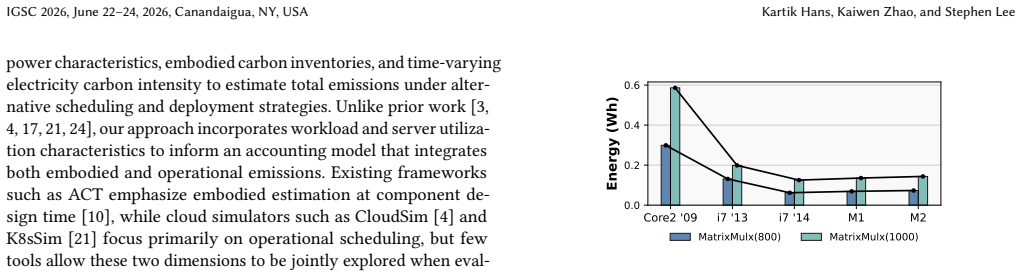
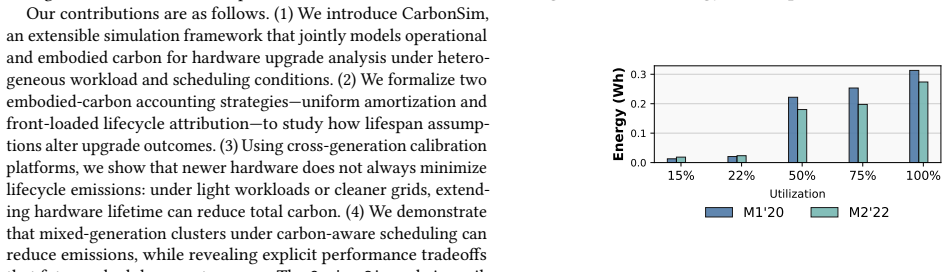
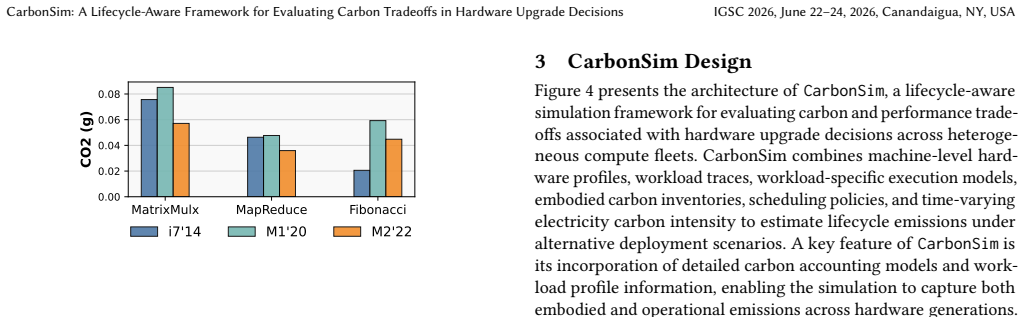
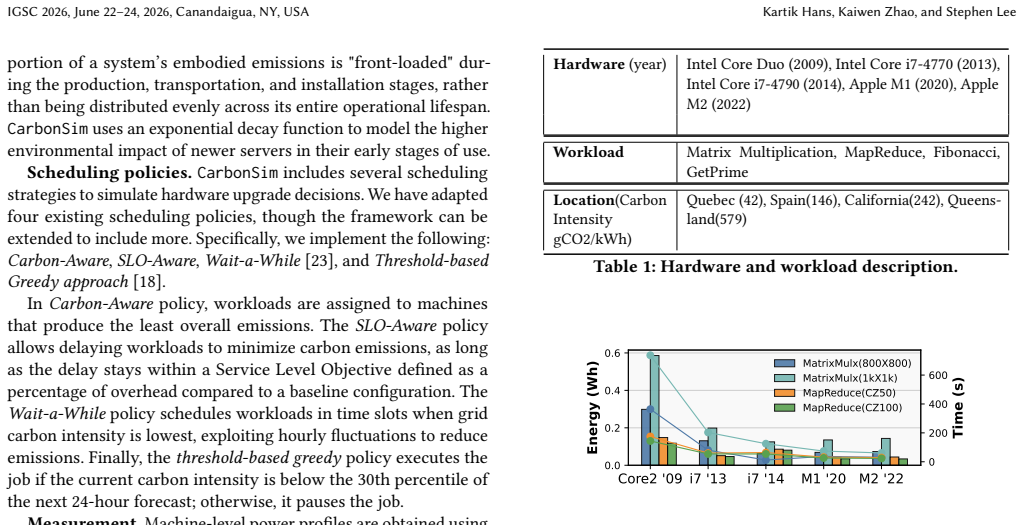
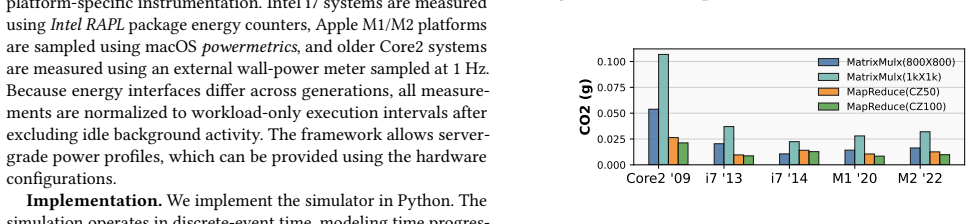
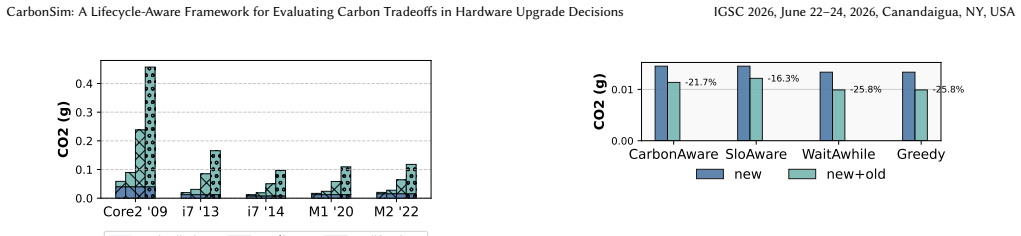
CarbonSim combines workload execution profiles, machine-level power characteristics, embodied carbon inventories, scheduling policies, and time-varying grid carbon intensity to estimate total emissions under alternative deployment scenarios. Using heterogeneous CPU generations as calibration platforms, the framework demonstrates that newer machines do not always minimize total emissions: under lightly loaded workloads or cleaner electricity mixes, extending the useful life of existing hardware can reduce lifecycle carbon despite lower operational efficiency. The framework supports multiple embodied-carbon accounting strategies, including uniform amortization and front-loaded lifecycle attrib
What carries the argument
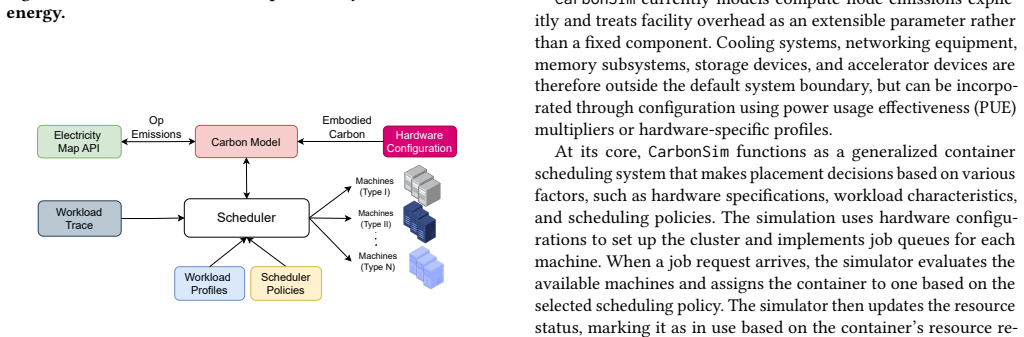
CarbonSim, a lifecycle-aware simulation framework that integrates workload execution profiles, machine-level power characteristics, embodied carbon inventories, scheduling policies, and time-varying grid carbon intensity to compare emissions across upgrade scenarios.
If this is right
- Hardware refresh decisions should be workload-aware, location-aware, and lifecycle-aware.
- Extending the useful life of existing hardware can reduce total emissions under lightly loaded workloads or cleaner electricity mixes.
- Multiple accounting strategies for embodied carbon, such as uniform amortization and front-loaded attribution, support analysis under varying lifespan assumptions.
Where Pith is reading between the lines
- Procurement policies could incorporate real-time grid carbon data to time hardware replacements dynamically.
- The approach could be extended to storage or network equipment where similar embodied-versus-operational tradeoffs exist.
- Operators might run internal simulations with their own power and utilization data before committing to fleet-wide refreshes.
Load-bearing premise
The embodied carbon inventories and machine-level power characteristics supplied to the simulator accurately represent real hardware and manufacturing processes.
What would settle it
A direct measurement campaign on the same CPU generations that supplies embodied carbon values differing enough from the simulator inputs to make total emissions always lower for newer machines under the paper's tested light-load and clean-grid conditions.
Figures
read the original abstract
As the demand for information and communication technologies (ICT) continues to rise, the environmental impact of computing systems is becoming an increasingly critical concern. Although newer hardware often improves performance and energy efficiency, these gains do not always offset the carbon cost of premature replacement, particularly under low-utilization workloads or low-carbon electricity grids. We present CarbonSim, a lifecycle-aware simulation framework for evaluating carbon tradeoffs in hardware upgrade decisions. CarbonSim combines workload execution profiles, machine-level power characteristics, embodied carbon inventories, scheduling policies, and time-varying grid carbon intensity to estimate total emissions under alternative deployment scenarios. The framework supports multiple embodied-carbon accounting strategies, including uniform amortization and front-loaded lifecycle attribution, enabling analysis under different hardware lifespan assumptions. Using heterogeneous CPU generations as calibration platforms, we demonstrate that newer machines do not always minimize total emissions: under lightly loaded workloads or cleaner electricity mixes, extending the useful life of existing hardware can reduce lifecycle carbon despite lower operational efficiency. These results highlight that hardware refresh decisions should be workload-aware, location-aware, and lifecycle-aware.
Editorial analysis
A structured set of objections, weighed in public.
Referee Report
Summary. The paper presents CarbonSim, a lifecycle-aware simulation framework that integrates workload execution profiles, machine-level power characteristics, embodied carbon inventories, scheduling policies, and time-varying grid carbon intensity to estimate total emissions under alternative hardware deployment scenarios. It supports multiple embodied-carbon accounting strategies and uses heterogeneous CPU generations as calibration platforms to demonstrate that newer machines do not always minimize total emissions: under lightly loaded workloads or cleaner electricity mixes, extending the useful life of existing hardware can reduce lifecycle carbon despite lower operational efficiency.
Significance. If the input inventories and power data hold, the framework supplies a practical tool for workload-aware and location-aware hardware refresh decisions in ICT, with explicit support for different lifecycle attribution methods as a clear strength. The result challenges the default preference for frequent upgrades and supplies a falsifiable simulation approach that could be extended to other hardware classes.
major comments (1)
- [Abstract (framework description)] The embodied carbon inventories and machine-level power characteristics are ingested as exogenous inputs with no reported validation against LCA databases, cross-checks, uncertainty bounds, or sensitivity analysis. This is load-bearing for the central claim, because the quantitative demonstration that extending hardware life reduces emissions requires these values to exceed operational savings under light load or clean grids; a 30-50% overstatement in embodied numbers would eliminate the reported scenarios.
minor comments (1)
- [Abstract] The abstract states the framework 'combines' the listed inputs but does not indicate which sections detail the scheduling policies or the two accounting strategies; adding explicit section references would improve traceability.
Simulated Author's Rebuttal
We thank the referee for their constructive review and positive assessment of the framework's potential. We respond to the single major comment below.
read point-by-point responses
-
Referee: The embodied carbon inventories and machine-level power characteristics are ingested as exogenous inputs with no reported validation against LCA databases, cross-checks, uncertainty bounds, or sensitivity analysis. This is load-bearing for the central claim, because the quantitative demonstration that extending hardware life reduces emissions requires these values to exceed operational savings under light load or clean grids; a 30-50% overstatement in embodied numbers would eliminate the reported scenarios.
Authors: We agree that the manuscript presents embodied carbon inventories and machine-level power characteristics as exogenous inputs and does not include dedicated validation against LCA databases, cross-checks, uncertainty quantification, or sensitivity analysis. The framework is designed to accept such inputs from users, but the specific numerical demonstrations rely on the chosen values. To strengthen the central claim, the revised version will add a new subsection on data provenance that references the original sources, notes any available LCA alignments, and reports a sensitivity analysis on embodied-carbon values (varying them by ±30-50 %). This will explicitly show the range of conditions under which the reported scenarios remain valid. revision: yes
Circularity Check
No circularity: forward simulation with exogenous inputs
full rationale
CarbonSim is presented as a simulation framework that ingests external inputs (workload execution profiles, machine-level power characteristics, embodied carbon inventories, scheduling policies, and grid carbon intensity) and computes total emissions under alternative scenarios. The central demonstration uses heterogeneous CPU generations as calibration platforms to illustrate that newer hardware does not always minimize emissions under light load or clean grids. No equations, fitted parameters, or self-citations are described that would make any output equivalent to its inputs by construction; the model remains a forward computation whose results depend on the supplied inventories and profiles rather than re-deriving them.
Axiom & Free-Parameter Ledger
Reference graph
Works this paper leans on
-
[1]
Bilge Acun, Benjamin Lee, Fiodar Kazhamiaka, Kiwan Maeng, Udit Gupta, Manoj Chakkaravarthy, David Brooks, and Carole-Jean Wu. 2023. Carbon explorer: A holistic framework for designing carbon aware datacenters. InProceedings of the 28th ACM International Conference on Architectural Support for Programming Languages and Operating Systems, Volume 2. 118–132
2023
-
[2]
Anders SG Andrae and Tomas Edler. 2015. On global electricity usage of commu- nication technology: trends to 2030.Challenges6, 1 (2015), 117–157
2015
-
[3]
Noman Bashir, David Irwin, and Prashant Shenoy. 2024. On the promise and pitfalls of optimizing embodied carbon.ACM SIGENERGY Energy Informatics Review4, 3 (2024), 94–99
2024
-
[4]
Rodrigo N Calheiros, Rajiv Ranjan, Anton Beloglazov, César AF De Rose, and Rajkumar Buyya. 2011. CloudSim: a toolkit for modeling and simulation of cloud computing environments and evaluation of resource provisioning algorithms. Software: Practice and experience41, 1 (2011), 23–50
2011
-
[5]
Andrew A Chien. 2021. Driving the cloud to true zero carbon. , 5–5 pages
2021
-
[6]
Daniel Bizo. 2023. Server efficiency increases again — but so do the caveats. https://journal.uptimeinstitute.com/server-efficiency-increases-again- but-so-do-the-caveats/
2023
-
[7]
Nan Deng, Christopher Stewart, Daniel Gmach, and Martin Arlitt. 2012. Pol- icy and mechanism for carbon-aware cloud applications. In2012 IEEE network operations and management symposium. IEEE, 590–594
2012
-
[8]
Electricity Map API
elecmap 2024. Electricity Map API. https://www.electricitymaps.com/[Date Accessed (Dec 20, 2024)]
2024
-
[9]
Mariam Elgamal, Doug Carmean, Elnaz Ansari, Okay Zed, Ramesh Peri, Srilatha Manne, Udit Gupta, Gu-Yeon Wei, David Brooks, Gage Hills, et al. 2023. Carbon- Efficient Design Optimization for Computing Systems. InProceedings of the 2nd Workshop on Sustainable Computer Systems. 1–7
2023
-
[10]
Udit Gupta, Mariam Elgamal, Gage Hills, Gu-Yeon Wei, Hsien-Hsin S Lee, David Brooks, and Carole-Jean Wu. 2022. ACT: Designing sustainable computer systems with an architectural carbon modeling tool. InProceedings of the 49th Annual International Symposium on Computer Architecture. 784–799
2022
-
[11]
Udit Gupta, Young Geun Kim, Sylvia Lee, Jordan Tse, Hsien-Hsin S Lee, Gu-Yeon Wei, David Brooks, and Carole-Jean Wu. 2021. Chasing carbon: The elusive environmental footprint of computing. In2021 IEEE International Symposium on High-Performance Computer Architecture (HPCA). IEEE, 854–867
2021
- [12]
-
[13]
David Patterson, Joseph Gonzalez, Quoc Le, Chen Liang, Lluis-Miquel Munguia, Daniel Rothchild, David So, Maud Texier, and Jeff Dean. 2021. Carbon emissions and large neural network training.arXiv preprint arXiv:2104.10350(2021)
work page internal anchor Pith review Pith/arXiv arXiv 2021
-
[14]
Alberto Prieto, Beatriz Prieto, Juan José Escobar, and Thomas Lampert. 2025. Evo- lution of computing energy efficiency: Koomey’s law revisited.Cluster Computing 28, 1 (2025), 42
2025
-
[15]
Rabih Bashroush. 2020. Optimizing server refresh cycles with an aging Moore’s law. https://journal.uptimeinstitute.com/optimizing-server-refresh-cycles-with- an-aging-moores-law/
2020
-
[16]
Ana Radovanović, Ross Koningstein, Ian Schneider, Bokan Chen, Alexandre Duarte, Binz Roy, Diyue Xiao, Maya Haridasan, Patrick Hung, Nick Care, et al
-
[17]
Carbon-aware computing for datacenters.IEEE Transactions on Power Systems38, 2 (2022), 1270–1280
2022
-
[18]
Philipp Raith, Thomas Rausch, Alireza Furutanpey, and Schahram Dustdar. 2023. faas-sim: A trace-driven simulation framework for serverless edge computing platforms.Software: Practice and Experience53, 12 (2023), 2327–2361
2023
-
[19]
Abel Souza, Noman Bashir, Jorge Murillo, Walid Hanafy, Qianlin Liang, David Irwin, and Prashant Shenoy. 2023. Ecovisor: A virtual energy system for carbon- efficient applications. InProceedings of the 28th ACM International Conference on Architectural Support for Programming Languages and Operating Systems, Volume
2023
-
[20]
Jennifer Switzer, Gabriel Marcano, Ryan Kastner, and Pat Pannuto. 2023. Junk- yard computing: Repurposing discarded smartphones to minimize carbon. In Proceedings of the 28th ACM International Conference on Architectural Support for Programming Languages and Operating Systems, Volume 2. 400–412
2023
-
[21]
Jaylen Wang, Daniel S Berger, Fiodar Kazhamiaka, Celine Irvene, Chaojie Zhang, Esha Choukse, Kali Frost, Rodrigo Fonseca, Brijesh Warrier, Chetan Bansal, et al
-
[22]
In2024 ACM/IEEE 51st Annual International Symposium on Computer Architecture (ISCA)
Designing cloud servers for lower carbon. In2024 ACM/IEEE 51st Annual International Symposium on Computer Architecture (ISCA). IEEE, 452–470
-
[23]
Shilin Wen, Rui Han, Ke Qiu, Xiaoxin Ma, Zeqing Li, Hongjie Deng, and Chi Harold Liu. 2023. K8sSim: A Simulation Tool for Kubernetes Schedulers and Its Applications in Scheduling Algorithm Optimization.Micromachines14, 3 (2023), 651
2023
-
[24]
Philipp Wiesner, Ilja Behnke, Paul Kilian, Marvin Steinke, and Odej Kao. 2024. Ves- sim: A testbed for carbon-aware applications and systems.Technische Universität Berlin: Berlin, Germany(2024)
2024
-
[25]
Philipp Wiesner, Ilja Behnke, Dominik Scheinert, Kordian Gontarska, and Lauritz Thamsen. 2021. Let’s wait awhile: How temporal workload shifting can reduce carbon emissions in the cloud. InProceedings of the 22nd International Middleware Conference. 260–272
2021
-
[26]
Chenhan Xu, Kun Wang, Peng Li, Rui Xia, Song Guo, and Minyi Guo. 2018. Renewable energy-aware big data analytics in geo-distributed data centers with reinforcement learning.IEEE Transactions on Network Science and Engineering7, 1 (2018), 205–215
2018
discussion (0)
Sign in with ORCID, Apple, or X to comment. Anyone can read and Pith papers without signing in.