What it takes to solve the Hubble tension through Modifications of Cosmological Recombination II: in light of ACT DR6 and DESI DR2
Pith reviewed 2026-06-27 23:45 UTC · model grok-4.3
The pith
A time-varying electron mass during recombination resolves the Hubble tension with Planck and ACT data but cannot when DESI BAO measurements are included.
A machine-rendered reading of the paper's core claim, the machinery that carries it, and where it could break.
Core claim
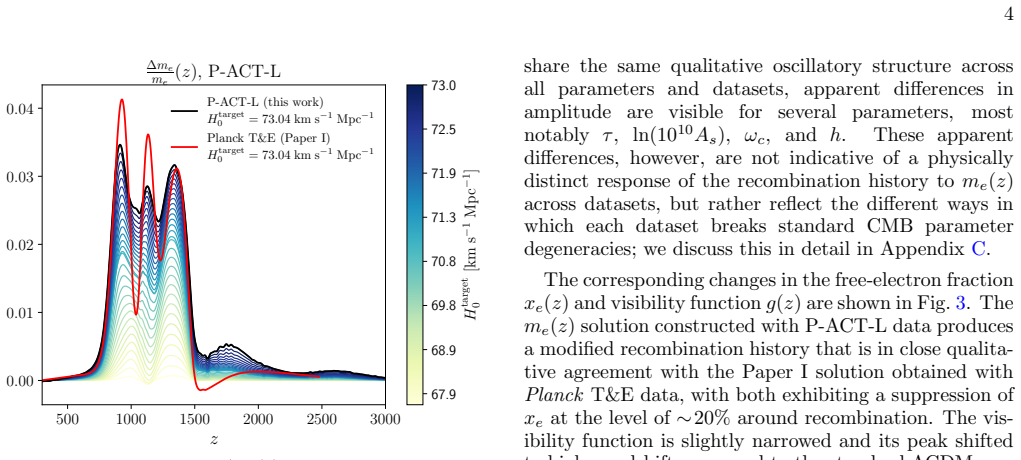
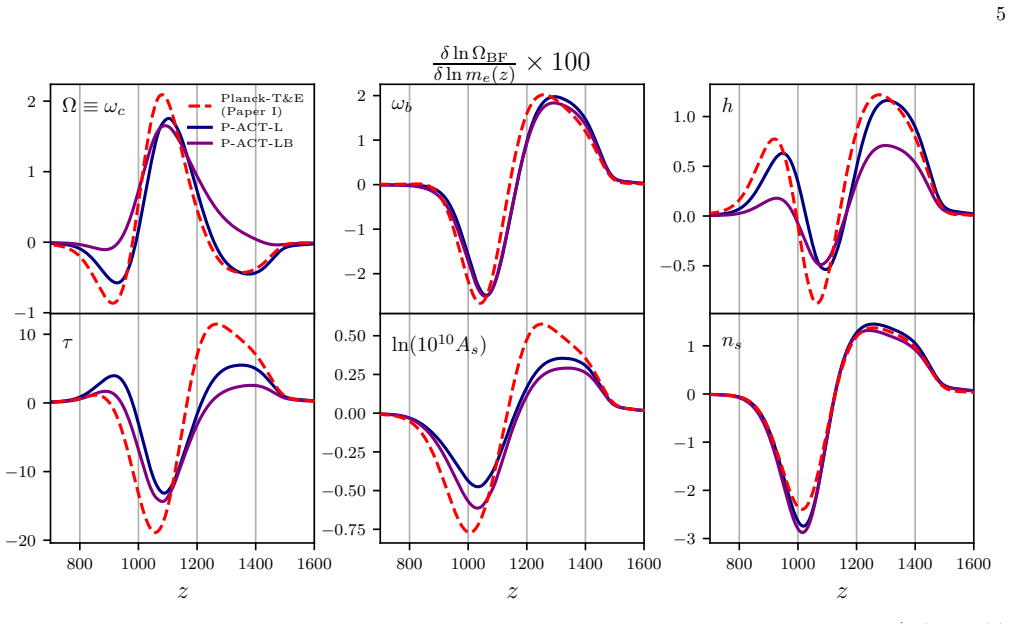
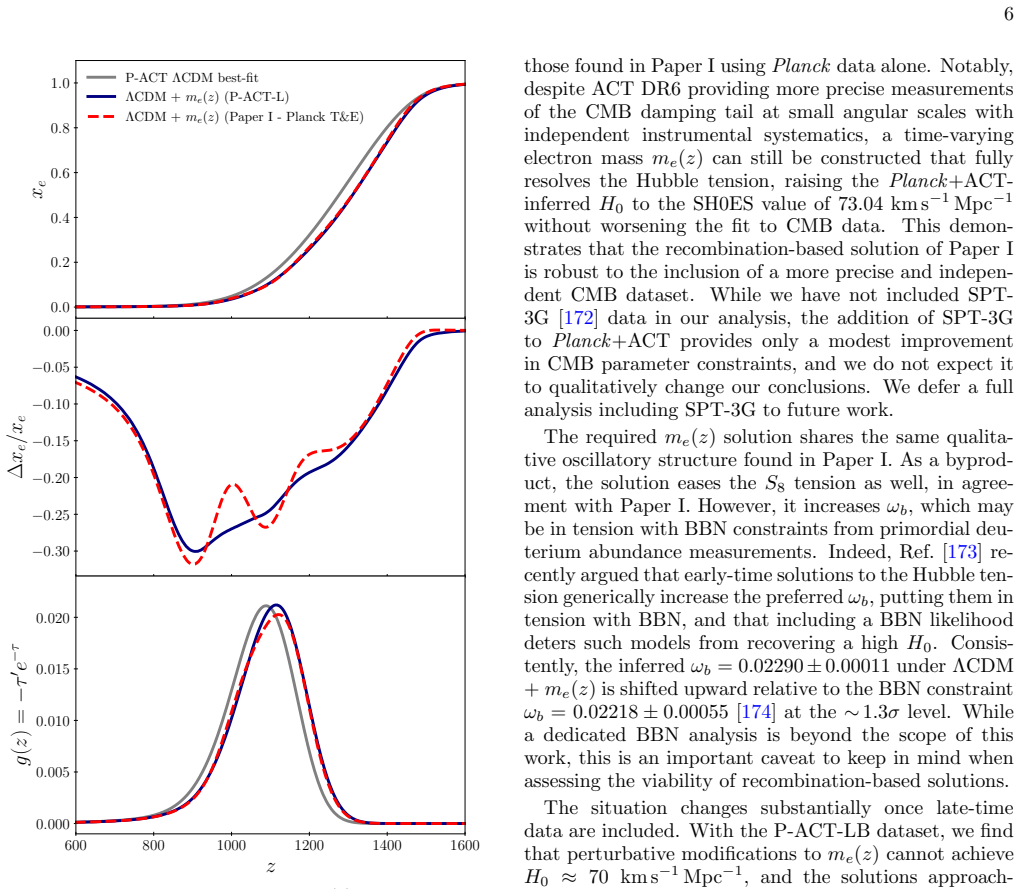
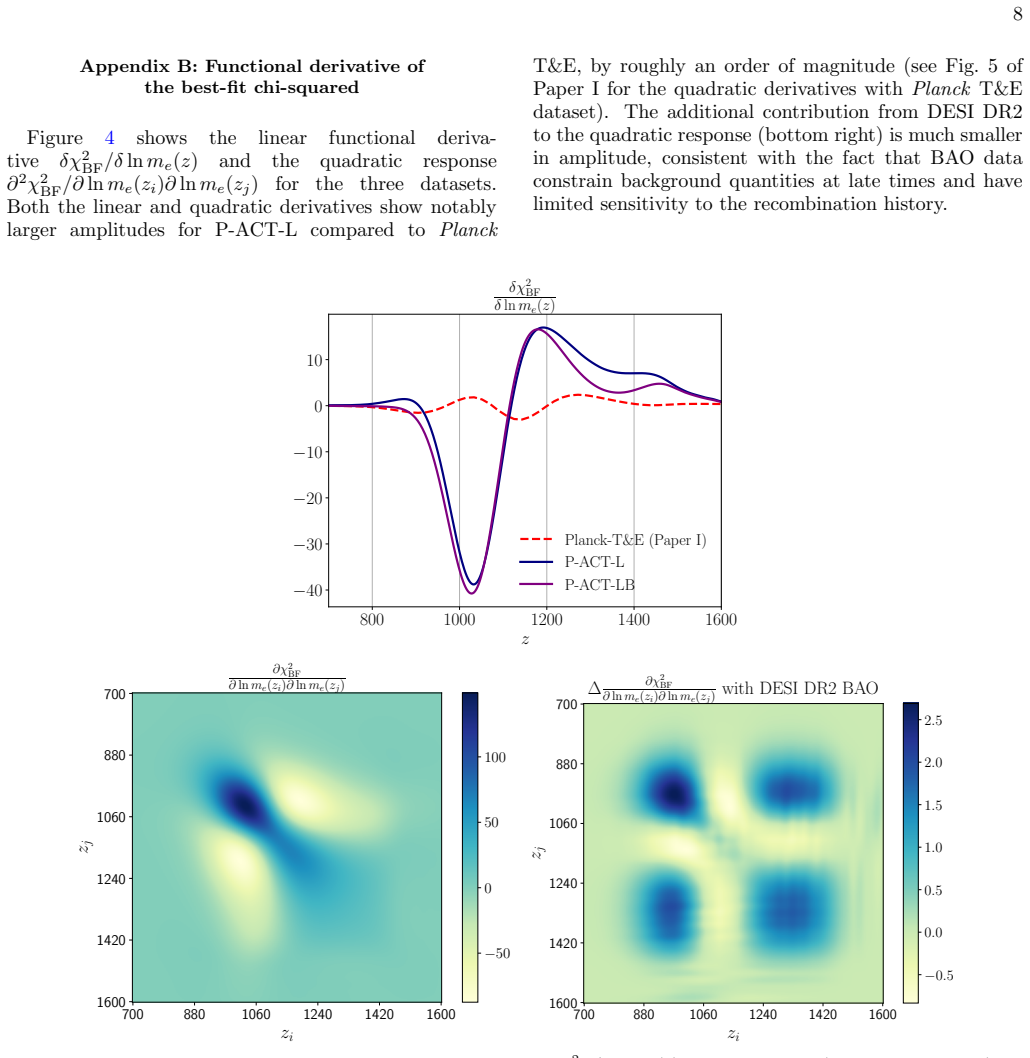
Using Planck and ACT data including lensing, a perturbative modification to m_e(z) fully resolves the Hubble tension, sharing the same qualitative oscillatory structure as in previous work using Planck data alone. Once DESI DR2 BAO data are added, however, perturbative modifications to m_e(z) cannot fully resolve the Hubble tension. This reflects the fundamental limitation that raising H0 by modifying recombination generically lowers Omega_m, being inconsistent with late-time cosmological observations.
What carries the argument
The perturbative time-varying electron mass m_e(z) that alters the recombination history and thereby changes the sound horizon scale inferred from CMB data.
If this is right
- A perturbative modification to m_e(z) fully resolves the Hubble tension with Planck and ACT data including lensing.
- The same modification eases the S8 tension.
- The solution shares the same qualitative oscillatory structure found with Planck data alone.
- Inclusion of DESI DR2 BAO data prevents perturbative m_e(z) modifications from fully resolving the Hubble tension due to lowered Omega_m.
Where Pith is reading between the lines
- The robustness across Planck and ACT datasets indicates the required m_e(z) pattern is unlikely to be driven by instrument-specific features in one experiment.
- The persistent H0-Omega_m correlation suggests that recombination-only adjustments will require coordinated late-time modifications to remain viable against combined datasets.
- Future work could test whether non-perturbative forms of m_e(z) variation avoid the Omega_m reduction that conflicts with BAO.
Load-bearing premise
Raising the Hubble constant by modifying recombination necessarily lowers the matter density in a way inconsistent with baryon acoustic oscillation data.
What would settle it
A measurement of the matter density parameter from BAO or other late-time probes that remains high even when the Hubble constant is raised to the local value.
Figures
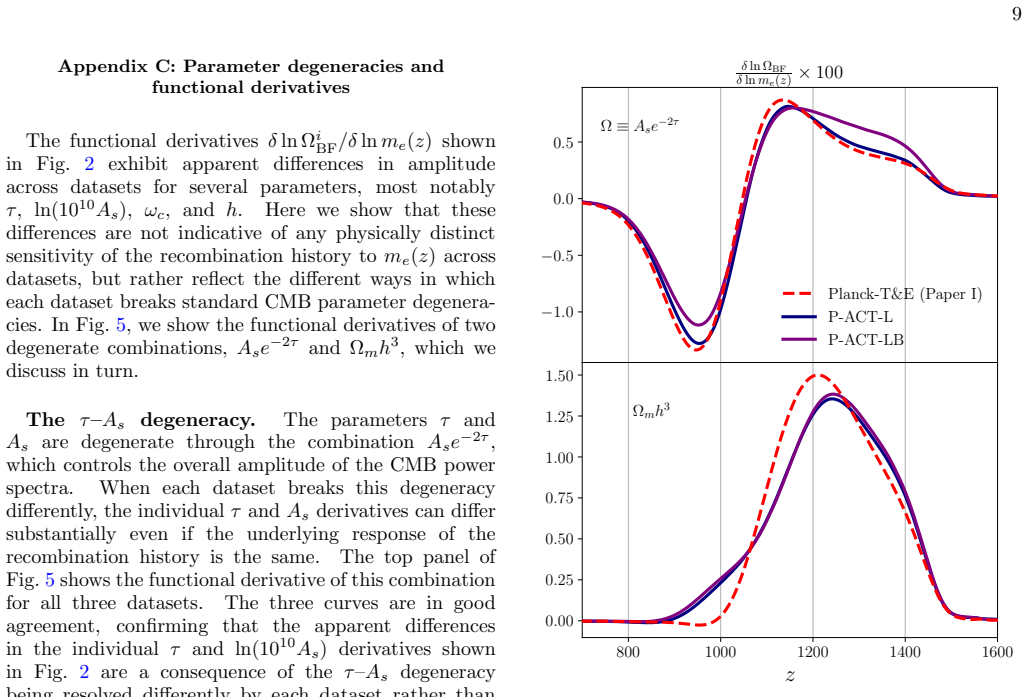
read the original abstract
We construct data-driven solutions to the Hubble tension, in light of recent data from the Atacama Cosmology Telescope (ACT DR6) and the Dark Energy Spectroscopic Instrument (DESI DR2). We search for the minimal modification to the recombination history through a time-varying electron mass $m_e(z)$ that increases the best-fit $H_0$ inferred from CMB data toward the SH0ES value, without worsening the fit to the data. Using Planck and ACT data including lensing, we find a perturbative modification to $m_e(z)$ that fully resolves the Hubble tension, with the solution sharing the same qualitative oscillatory structure as in previous work using Planck data alone, demonstrating its robustness to the inclusion of more precise and independent CMB data. As a byproduct, the solution also eases the $S_8$ tension. Once DESI DR2 BAO data are added, however, perturbative modifications to $m_e(z)$ cannot fully resolve the Hubble tension. This reflects the same fundamental limitation: raising $H_0$ by modifying recombination generically lowers $\Omega_m$, being inconsistent with late-time cosmological observations.
Editorial analysis
A structured set of objections, weighed in public.
Referee Report
Summary. The manuscript constructs data-driven perturbative modifications to the recombination history via a time-varying electron mass m_e(z) that increase the best-fit H_0 from CMB data toward the SH0ES value. Using Planck and ACT DR6 data (including lensing), it identifies a solution that fully resolves the Hubble tension while sharing the same qualitative oscillatory structure as prior Planck-only results; this solution also eases the S_8 tension. However, once DESI DR2 BAO data are included, no such perturbative m_e(z) modification can simultaneously resolve the tension, because raising H_0 generically lowers Ω_m in a manner inconsistent with late-time BAO observations.
Significance. If the central results hold, the work provides evidence that recombination modifications remain viable for addressing the Hubble tension under updated, independent CMB datasets and highlights a robust limitation imposed by BAO constraints. The data-driven approach and demonstration of structural robustness across CMB datasets are strengths that could inform targeted early-universe model building.
major comments (2)
- [Abstract, §4] Abstract and §4: the claim that the m_e(z) solution 'fully resolves' the Hubble tension with Planck+ACT data requires explicit reporting of the Δχ^{2} improvement, the resulting H_0 posterior with uncertainties, and the precise exclusion criteria used in the data-driven search; without these, the quantitative support for resolution versus marginal improvement remains unclear.
- [§3] §3 (parameterization): the perturbative expansion of m_e(z) is described as 'minimal' but the manuscript does not specify the basis functions, the number of free coefficients retained after the search, or the regularization that prevents overfitting to the same CMB datasets used to define the tension; this detail is load-bearing for assessing whether the oscillatory structure is a genuine feature or an artifact of the search procedure.
minor comments (2)
- [Figure 2] Figure 2 (or equivalent): the plotted m_e(z) modification should include uncertainty bands derived from the posterior of the fitted coefficients to allow visual assessment of robustness.
- [Table 1] Table 1: the best-fit cosmological parameters for the modified model versus Λ CDM should report both CMB-only and CMB+BAO fits side-by-side with full covariance information for H_0 and Ω_m.
Simulated Author's Rebuttal
We thank the referee for their careful review and positive assessment of the manuscript. We address each major comment below and will revise the text accordingly to improve clarity and quantitative support.
read point-by-point responses
-
Referee: [Abstract, §4] Abstract and §4: the claim that the m_e(z) solution 'fully resolves' the Hubble tension with Planck+ACT data requires explicit reporting of the Δχ^{2} improvement, the resulting H_0 posterior with uncertainties, and the precise exclusion criteria used in the data-driven search; without these, the quantitative support for resolution versus marginal improvement remains unclear.
Authors: We agree that explicit quantitative metrics will strengthen the claim. The data-driven search yields a modification that shifts the CMB-inferred H_0 into agreement with the SH0ES value while maintaining or improving the fit quality. In the revised manuscript we will add the Δχ² improvement relative to ΛCDM, the marginalized H_0 posterior (with uncertainties) under the modified recombination history, and a clear statement of the exclusion criteria (no degradation of the CMB fit and H_0 within ~1σ of the SH0ES central value). These additions will be placed in both the abstract and §4. revision: yes
-
Referee: [§3] §3 (parameterization): the perturbative expansion of m_e(z) is described as 'minimal' but the manuscript does not specify the basis functions, the number of free coefficients retained after the search, or the regularization that prevents overfitting to the same CMB datasets used to define the tension; this detail is load-bearing for assessing whether the oscillatory structure is a genuine feature or an artifact of the search procedure.
Authors: We acknowledge that these technical details are important for reproducibility and for assessing robustness. In the revised §3 we will explicitly describe the basis functions employed in the perturbative expansion, state the number of coefficients retained after the search, and outline the regularization procedure (including any penalties or cross-validation steps) used to guard against overfitting. This will allow readers to evaluate whether the reported oscillatory structure is a genuine data-driven feature. revision: yes
Circularity Check
No significant circularity; data-driven search is self-contained
full rationale
The paper explicitly frames its approach as a data-driven search for the minimal m_e(z) modification that raises the CMB-inferred H0 toward the SH0ES value while preserving fit quality to Planck+ACT (including lensing). This is presented as an empirical exploration rather than a first-principles derivation or prediction. The oscillatory structure is noted as consistent with prior work, but the new results are obtained independently from the additional datasets. The reported limitation with DESI DR2 BAO follows directly from performing the same search on the extended dataset and is not imported via self-citation or definition. No load-bearing step reduces by construction to fitted inputs or self-referential assumptions; the analysis remains an honest fitting exercise against external benchmarks.
Axiom & Free-Parameter Ledger
free parameters (1)
- coefficients in perturbative m_e(z) expansion
axioms (1)
- domain assumption Standard LCDM recombination physics with perturbative modification only
invented entities (1)
-
time-varying electron mass m_e(z)
no independent evidence
Reference graph
Works this paper leans on
-
[1]
This is the same fundamental limitation identified in Paper I, and motivates the inclu- sion of BAO data in the following subsection
and inconsistent with the PantheonPlus constraint Ωm = 0.334±0.018 [171]. This is the same fundamental limitation identified in Paper I, and motivates the inclu- sion of BAO data in the following subsection. 6 SinceS 8 is a derived parameter, its uncertainty is estimated via linear error propagation through the Fisher matrix, as described in Appendix D. 7...
-
[3]
A. G. Riesset al., Astrophys. J. Lett.934, L7 (2022), arXiv:2112.04510 [astro-ph.CO]
Pith/arXiv arXiv 2022
-
[4]
L. Breuval, A. G. Riess, S. Casertano, W. Yuan, L. M. Macri, M. Romaniello, Y. S. Murakami, D. Scolnic, G. S. Anand, and I. Soszy´ nski, Astrophys. J.973, 30 (2024), arXiv:2404.08038 [astro-ph.CO]
arXiv 2024
-
[5]
L. Verde, T. Treu, and A. G. Riess, Nature Astron.3, 891 (2019), arXiv:1907.10625 [astro-ph.CO]
Pith/arXiv arXiv 2019
-
[6]
R. Murgia, S. Gariazzo, and N. Fornengo, JCAP04, 014 (2016), arXiv:1602.01765 [astro-ph.CO]
Pith/arXiv arXiv 2016
-
[7]
A. Pourtsidou and T. Tram, Phys. Rev. D94, 043518 (2016), arXiv:1604.04222 [astro-ph.CO]
Pith/arXiv arXiv 2016
-
[8]
R. C. Nunes, S. Pan, and E. N. Saridakis, Phys. Rev. D94, 023508 (2016), arXiv:1605.01712 [astro-ph.CO]
Pith/arXiv arXiv 2016
-
[9]
E. Di Valentino, A. Melchiorri, and J. Silk, Phys. Lett. B761, 242 (2016), arXiv:1606.00634 [astro-ph.CO]
Pith/arXiv arXiv 2016
-
[10]
S. Kumar and R. C. Nunes, Phys. Rev. D94, 123511 (2016), arXiv:1608.02454 [astro-ph.CO]
Pith/arXiv arXiv 2016
-
[11]
T. Karwal and M. Kamionkowski, Phys. Rev. D94, 103523 (2016), arXiv:1608.01309 [astro-ph.CO]
Pith/arXiv arXiv 2016
-
[12]
S. Kumar and R. C. Nunes, Phys. Rev. D96, 103511 (2017), arXiv:1702.02143 [astro-ph.CO]
Pith/arXiv arXiv 2017
-
[13]
E. Di Valentino, A. Melchiorri, and O. Mena, Phys. Rev. D96, 043503 (2017), arXiv:1704.08342 [astro- ph.CO]
Pith/arXiv arXiv 2017
-
[14]
E. Di Valentino, E. V. Linder, and A. Melchiorri, Phys. Rev. D97, 043528 (2018), arXiv:1710.02153 [astro- ph.CO]
Pith/arXiv arXiv 2018
-
[15]
E. Di Valentino, C. Bøehm, E. Hivon, and F. R. Bouchet, Phys. Rev. D97, 043513 (2018), arXiv:1710.02559 [astro-ph.CO]
Pith/arXiv arXiv 2018
-
[16]
K. Dutta, Ruchika, A. Roy, A. A. Sen, and M. M. Sheikh-Jabbari, Gen. Rel. Grav.52, 15 (2020), arXiv:1808.06623 [astro-ph.CO]
arXiv 2020
-
[17]
W. Yang, A. Mukherjee, E. Di Valentino, and S. Pan, Phys. Rev. D98, 123527 (2018), arXiv:1809.06883 [astro-ph.CO]
Pith/arXiv arXiv 2018
-
[18]
V. Poulin, T. L. Smith, T. Karwal, and M. Kamionkowski, Phys. Rev. Lett.122, 221301 (2019), arXiv:1811.04083 [astro-ph.CO]
Pith/arXiv arXiv 2019
-
[19]
E. Di Valentino, R. Z. Ferreira, L. Visinelli, and U. Danielsson, Phys. Dark Univ.26, 100385 (2019), arXiv:1906.11255 [astro-ph.CO]
arXiv 2019
-
[20]
L. Visinelli, S. Vagnozzi, and U. Danielsson, Symmetry 11, 1035 (2019), arXiv:1907.07953 [astro-ph.CO]
arXiv 2019
-
[21]
S. Pan, W. Yang, E. Di Valentino, A. Shafieloo, and S. Chakraborty, JCAP06, 062 (2020), arXiv:1907.12551 [astro-ph.CO]
arXiv 2020
-
[22]
E. Di Valentino, A. Melchiorri, O. Mena, and S. Vagnozzi, Phys. Dark Univ.30, 100666 (2020), arXiv:1908.04281 [astro-ph.CO]
arXiv 2020
-
[23]
T. L. Smith, V. Poulin, and M. A. Amin, Phys. Rev. D101, 063523 (2020), arXiv:1908.06995 [astro-ph.CO]
arXiv 2020
-
[24]
L. Knox and M. Millea, Phys. Rev. D101, 043533 (2020), arXiv:1908.03663 [astro-ph.CO]
arXiv 2020
-
[25]
N. Arendseet al., Astron. Astrophys.639, A57 (2020), arXiv:1909.07986 [astro-ph.CO]
arXiv 2020
-
[26]
F. Niedermann and M. S. Sloth, Phys. Rev. D103, L041303 (2021), arXiv:1910.10739 [astro-ph.CO]
arXiv 2021
-
[27]
R. von Marttens, L. Lombriser, M. Kunz, V. Marra, L. Casarini, and J. Alcaniz, Phys. Dark Univ.28, 100490 (2020), arXiv:1911.02618 [astro-ph.CO]
arXiv 2020
- [28]
-
[29]
W. Yang, E. Di Valentino, O. Mena, S. Pan, and R. C. Nunes, Phys. Rev. D101, 083509 (2020), arXiv:2001.10852 [astro-ph.CO]. 11
arXiv 2020
- [30]
-
[31]
G. Ye and Y.-S. Piao, Phys. Rev. D101, 083507 (2020), arXiv:2001.02451 [astro-ph.CO]
arXiv 2020
-
[32]
W. Yang, E. Di Valentino, S. Pan, S. Basilakos, and A. Paliathanasis, Phys. Rev. D102, 063503 (2020), arXiv:2001.04307 [astro-ph.CO]
arXiv 2020
-
[33]
M. Lucca and D. C. Hooper, Phys. Rev. D102, 123502 (2020), arXiv:2002.06127 [astro-ph.CO]
arXiv 2020
-
[34]
C. Krishnan, E. ´O. Colg´ ain, Ruchika, A. A. Sen, M. M. Sheikh-Jabbari, and T. Yang, Phys. Rev. D102, 103525 (2020), arXiv:2002.06044 [astro-ph.CO]
arXiv 2020
-
[35]
N. Blinov and G. Marques-Tavares, JCAP09, 029 (2020), arXiv:2003.08387 [astro-ph.CO]
arXiv 2020
-
[36]
K. Jedamzik and L. Pogosian, Phys. Rev. Lett.125, 181302 (2020), arXiv:2004.09487 [astro-ph.CO]
arXiv 2020
-
[37]
E. Di Valentino, A. Mukherjee, and A. A. Sen, Entropy 23, 404 (2021), arXiv:2005.12587 [astro-ph.CO]
arXiv 2021
-
[38]
R. Calder´ on, R. Gannouji, B. L’Huillier, and D. Polarski, Phys. Rev. D103, 023526 (2021), arXiv:2008.10237 [astro-ph.CO]
arXiv 2021
-
[39]
E. Di Valentino and O. Mena, Mon. Not. Roy. Astron. Soc.500, L22 (2020), arXiv:2009.12620 [astro-ph.CO]
arXiv 2020
-
[40]
E. Di Valentino, Mon. Not. Roy. Astron. Soc.502, 2065 (2021), arXiv:2011.00246 [astro-ph.CO]
arXiv 2065
-
[41]
W. Yang, E. Di Valentino, S. Pan, Y. Wu, and J. Lu, Mon. Not. Roy. Astron. Soc.501, 5845 (2021), arXiv:2101.02168 [astro-ph.CO]
arXiv 2021
- [42]
-
[43]
W. Yang, E. Di Valentino, S. Pan, A. Shafieloo, and X. Li, Phys. Rev. D104, 063521 (2021), arXiv:2103.03815 [astro-ph.CO]
arXiv 2021
-
[44]
R. C. Nunes and E. Di Valentino, Phys. Rev. D104, 063529 (2021), arXiv:2107.09151 [astro-ph.CO]
arXiv 2021
-
[45]
G. Ye, J. Zhang, and Y.-S. Piao, Phys. Lett. B839, 137770 (2023), arXiv:2107.13391 [astro-ph.CO]
arXiv 2023
- [46]
- [47]
-
[48]
E. Di Valentino, S. Gariazzo, C. Giunti, O. Mena, S. Pan, and W. Yang, Phys. Rev. D105, 103511 (2022), arXiv:2110.03990 [astro-ph.CO]
arXiv 2022
-
[49]
G. Alestas, D. Camarena, E. Di Valentino, L. Kazantzidis, V. Marra, S. Nesseris, and L. Perivolaropoulos, Phys. Rev. D105, 063538 (2022), arXiv:2110.04336 [astro-ph.CO]
arXiv 2022
-
[50]
S. Gariazzo, E. Di Valentino, O. Mena, and R. C. Nunes, Phys. Rev. D106, 023530 (2022), arXiv:2111.03152 [astro-ph.CO]
arXiv 2022
-
[51]
F. Niedermann and M. S. Sloth, Phys. Rev. D105, 063509 (2022), arXiv:2112.00770 [hep-ph]
arXiv 2022
-
[52]
A. A. Sen, S. A. Adil, and S. Sen, Mon. Not. Roy. Astron. Soc.518, 1098 (2022), arXiv:2112.10641 [astro- ph.CO]
arXiv 2022
-
[53]
L. Heisenberg, H. Villarrubia-Rojo, and J. Zosso, Phys. Dark Univ.39, 101163 (2023), arXiv:2201.11623 [astro- ph.CO]
arXiv 2023
-
[54]
L. A. Anchordoqui, V. Barger, D. Marfatia, and J. F. Soriano, Phys. Rev. D105, 103512 (2022), arXiv:2203.04818 [astro-ph.CO]
arXiv 2022
-
[55]
S. Di Gennaro and Y. C. Ong, Universe8, 541 (2022), arXiv:2205.09311 [gr-qc]
arXiv 2022
-
[56]
N. Sch¨ oneberg and G. Franco Abell´ an, JCAP12, 001 (2022), arXiv:2206.11276 [astro-ph.CO]
arXiv 2022
-
[57]
Y.-H. Yao and X.-H. Meng, Phys. Dark Univ.39, 101165 (2023), arXiv:2207.05955 [astro-ph.CO]
arXiv 2023
- [58]
-
[59]
Y. C. Ong, Universe9, 437 (2023), arXiv:2212.04429 [gr-qc]
arXiv 2023
-
[60]
N. Lee, Y. Ali-Ha¨ ımoud, N. Sch¨ oneberg, and V. Poulin, Phys. Rev. Lett.130, 161003 (2023), arXiv:2212.04494 [astro-ph.CO]
arXiv 2023
- [61]
-
[62]
K. R. Mishra, S. K. J. Pacif, R. Kumar, and K. Bamba, Phys. Dark Univ.40, 101211 (2023), arXiv:2301.08743 [gr-qc]
arXiv 2023
-
[63]
M. A. van der Westhuizen and A. Abebe, JCAP01, 048 (2024), arXiv:2302.11949 [gr-qc]
arXiv 2024
-
[64]
D. H. F. de Souza and R. Rosenfeld, Phys. Rev. D108, 083512 (2023), arXiv:2302.04644 [astro-ph.CO]
arXiv 2023
- [65]
-
[66]
Y. Zhai, W. Giar` e, C. van de Bruck, E. Di Valentino, O. Mena, and R. C. Nunes, JCAP07, 032 (2023), arXiv:2303.08201 [astro-ph.CO]
arXiv 2023
-
[67]
Giar` e, (2023), 10.1007/978-981-99-0177-7 36, arXiv:2305.16919 [astro-ph.CO]
W. Giar` e, (2023), 10.1007/978-981-99-0177-7 36, arXiv:2305.16919 [astro-ph.CO]
-
[68]
J. S. Cruz, F. Niedermann, and M. S. Sloth, JCAP11, 033 (2023), arXiv:2305.08895 [astro-ph.CO]
arXiv 2023
-
[69]
S. A. Adil, ¨O. Akarsu, E. Di Valentino, R. C. Nunes, E. ¨Oz¨ ulker, A. A. Sen, and E. Specogna, Phys. Rev. D 109, 023527 (2024), arXiv:2306.08046 [astro-ph.CO]
arXiv 2024
-
[70]
Ruchika, H. Rathore, S. Roy Choudhury, and V. Rentala, JCAP06, 056 (2024), arXiv:2306.05450 [astro-ph.CO]
arXiv 2024
-
[71]
K. L. Greene and F.-Y. Cyr-Racine, JCAP10, 065 (2023), arXiv:2306.06165 [astro-ph.CO]
arXiv 2023
-
[72]
G. Liu, Z. Zhou, Y. Mu, and L. Xu, Phys. Rev. D108, 083523 (2023), arXiv:2307.07228 [astro-ph.CO]
arXiv 2023
-
[73]
Phase-field Approaches to Structural Topology Optimization
F. Niedermann and M. S. Sloth, (2023), 10.1007/978- 981-99-0177-7 23, arXiv:2307.03481 [hep-ph]
-
[74]
E. Frion, D. Camarena, L. Giani, T. Miranda, D. Bertacca, V. Marra, and O. F. Piattella, (2023), 10.21105/astro.2307.06320, arXiv:2307.06320 [astro-ph.CO]
- [75]
-
[76]
G. A. Hoerning, R. G. Landim, L. O. Ponte, R. P. Rolim, F. B. Abdalla, and E. Abdalla, Phys. Rev. D 112, 023523 (2025), arXiv:2308.05807 [astro-ph.CO]
arXiv 2025
-
[77]
Vagnozzi, Universe9, 393 (2023), arXiv:2308.16628 [astro-ph.CO]
S. Vagnozzi, Universe9, 393 (2023), arXiv:2308.16628 [astro-ph.CO]
arXiv 2023
-
[78]
A. G´ omez-Valent, A. Favale, M. Migliaccio, and A. A. Sen, Phys. Rev. D109, 023525 (2024), arXiv:2309.07795 [astro-ph.CO]
arXiv 2024
-
[79]
S. Pan and W. Yang, (2023), 10.1007/978-981-99-0177- 7 29, arXiv:2310.07260 [astro-ph.CO]. 12
-
[80]
A. Lapi, L. Boco, M. M. Cueli, B. S. Haridasu, T. Ron- coni, C. Baccigalupi, and L. Danese, Astrophys. J.959, 83 (2023), arXiv:2310.06028 [astro-ph.CO]
arXiv 2023
-
[81]
S. Castello, M. Mancarella, N. Grimm, D. Sobral- Blanco, I. Tutusaus, and C. Bonvin, JCAP05, 003 (2024), arXiv:2311.14425 [astro-ph.CO]
arXiv 2024
discussion (0)
Sign in with ORCID, Apple, or X to comment. Anyone can read and Pith papers without signing in.