pith. sign in

arxiv: 2606.06817 · v1 · pith:5ZQEJKOVnew · submitted 2026-06-05 · 🧮 math.CO

C4-face-magic labeling on a 4x4 Klein bottle grid graph

Pith reviewed 2026-06-27 22:06 UTC · model grok-4.3

classification 🧮 math.CO
keywords C4-face-magic labelingKlein bottle grid graphvertex bijectionsface sum constantpairwise balanced labelingsgraph symmetriessurface embeddingscombinatorial enumeration
0
0 comments X

The pith

The 4x4 Klein bottle grid graph has exactly 192 C4-face-magic labelings up to symmetries.

A machine-rendered reading of the paper's core claim, the machinery that carries it, and where it could break.

The paper counts the bijections from the 16 vertices of a 4x4 grid on the Klein bottle to the numbers 1 through 16 such that every four-cycle face sums to one fixed constant. After reducing by the symmetries of the surface, exactly 192 such assignments remain. The authors divide these into two classes according to whether the labeling meets a horizontal pairwise balance condition or a vertical one, where paired vertices sum to 17. A reader would care because the result gives a precise enumeration of constant-sum arrangements on a non-orientable surface and extends prior counts for other grid sizes.

Core claim

A C4-face-magic Klein bottle labeling is a bijection f from vertices to 1 through 16 such that every face isomorphic to C4 has the same vertex-label sum. The authors prove the 4x4 grid graph embedded on the Klein bottle admits exactly 192 such labelings up to symmetries. They classify the labelings into two categories according to whether a symmetry-preserving permutation of the labels is horizontally pairwise balanced (paired rows sum to 17) or vertically pairwise balanced (paired columns sum to 17).

What carries the argument

The C4-face-magic labeling defined by constant sums on every C4 face, partitioned by the horizontal or vertical pairwise balance condition that forces certain pairs of vertices to sum to 17.

If this is right

  • The 192 labelings split evenly or unequally into the horizontal-balance class and the vertical-balance class.
  • The same counting method applies to mxn Klein bottle grids of other dimensions.
  • Any C4-face-magic labeling on this graph must satisfy one of the two pairwise balance conditions after a suitable symmetry.
  • The total count is obtained by first finding all valid bijections and then quotienting by the action of the Klein bottle symmetry group.

Where Pith is reading between the lines

These are editorial extensions of the paper, not claims the author makes directly.

  • The pairwise balance conditions may correspond to decompositions of the labeling into two interleaved 2x2 blocks or similar modular patterns.
  • Analogous counts for the torus (orientable counterpart) could be compared directly to isolate the effect of non-orientability.
  • The 192 figure supplies a concrete test case for any general formula that might later be proposed for face-magic labelings on surfaces of genus 2.

Load-bearing premise

That the 4x4 grid embedding on the Klein bottle has all faces as C4 cycles and that its symmetries reduce the set of valid number assignments to precisely 192 distinct cases without overcounting or undercounting.

What would settle it

An exhaustive enumeration of all 16! assignments, verification that each satisfies the constant face-sum condition on every C4, followed by division by the order of the symmetry group of the embedded graph, would either confirm or refute the total of 192.

Figures
Figures reproduced from arXiv: 2606.06817 by Stephen J. Curran, Timothy Myers.
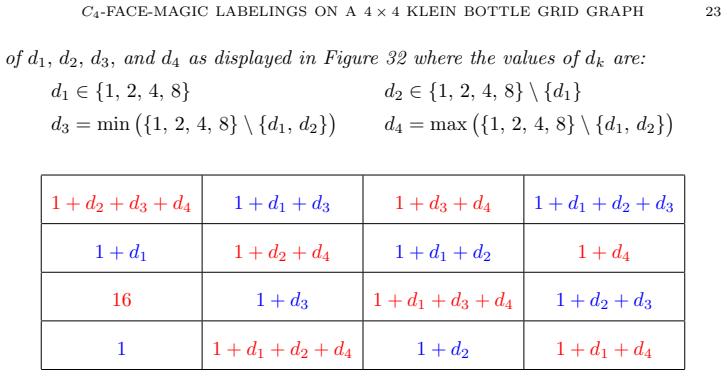
Figure 1
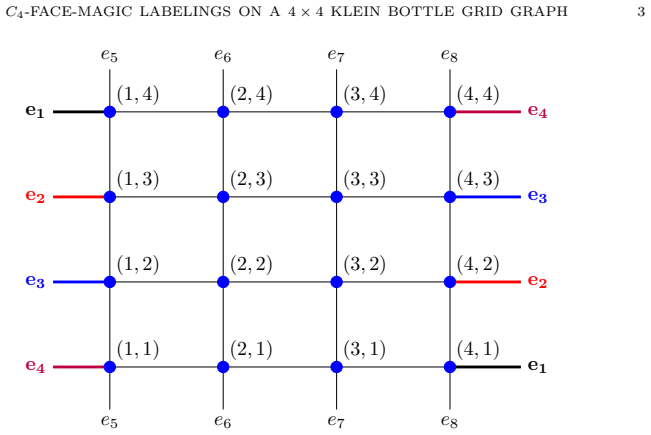
Figure 1. Figure 1: The grid graph K4,4. Let m0, n0 ∈ Z such that m = 2m0 and n = 2n0. Then mnS = 4m0n0S = 4Xm0 i=1 Xn0 j=1 S = 4Xm0 i=1 Xn0 j=1 [PITH_FULL_IMAGE:figures/full_fig_p003_1.png] view at source ↗
Figure 2
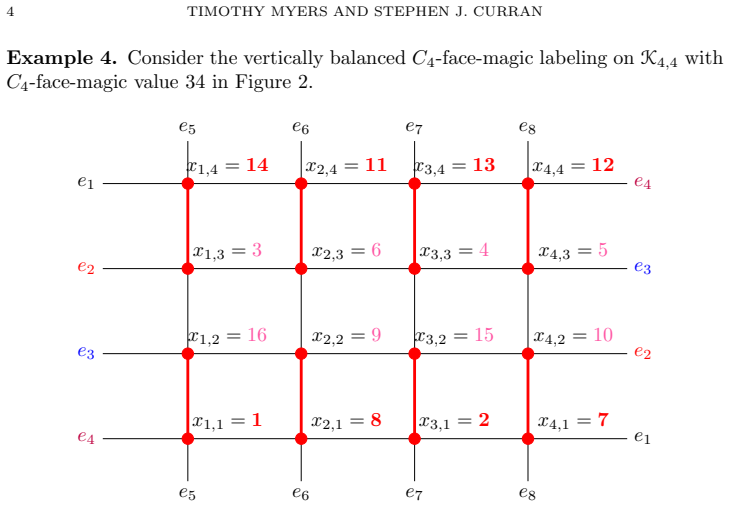
Figure 2. Figure 2: C4-face-magic vertically pairwise balanced labeling on K4,4. Example 5. Consider the horizontally pairwise balanced C4-face-magic labeling on K4,4 with C4-face-magic value 34 in [PITH_FULL_IMAGE:figures/full_fig_p004_2.png] view at source ↗
Figure 3
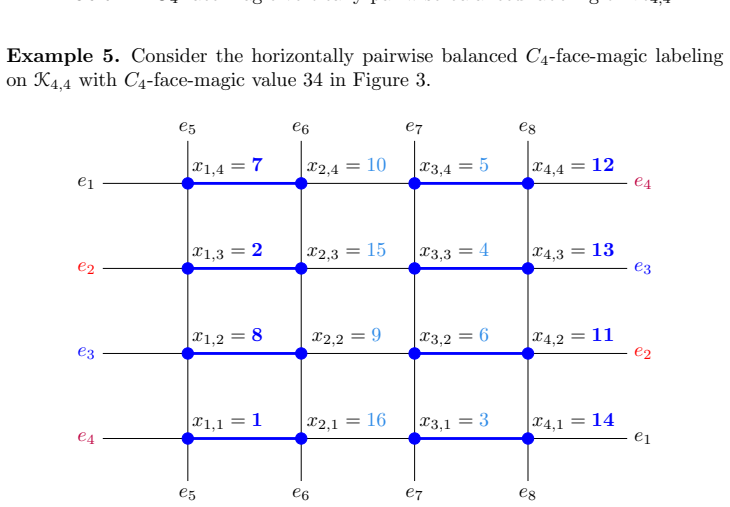
Figure 3. Figure 3: C4-face-magic horizontally pairwise balanced labeling on K4,4. Definition 6. Let X = {xi,j : (i, j) ∈ V (K4,4)} and Y = {yi,j : (i, j) ∈ V (K4,4)} be C4-face magic labelings on K4,4. We say that X is Klein bottle labeling equivalent [PITH_FULL_IMAGE:figures/full_fig_p004_3.png] view at source ↗
Figure 4
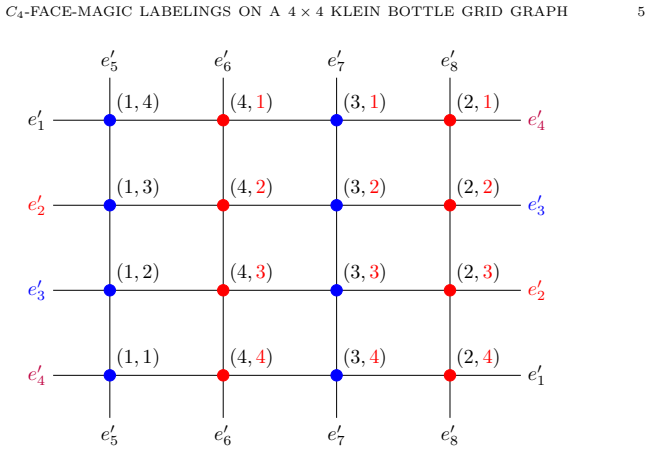
Figure 4. Figure 4: The transform V on the grid graph K4,4. to Y if there exists a graph isomorphism φ induced by a homeomorphism on the Klein bottle grid such that xi,j = yφ(i,j) for all (i, j) ∈ V (K4,4). In particular, the four symmetries given in Definition 7 generate all the graph isomorphisms on K4,4 that are induced by a homeomorphism on the Klein bottle. Definition 7. We define the following graph isomorphisms of K4,4… view at source ↗
Figure 5
Figure 5. Figure 5: The properly symmetrized labeling obtained by the sequence of symmetries listed in Proposition 9. We say that two properly symmetrized C4-face-magic labelings X and Y on K4,4 are vertical cycle equivalent if there exists a sequence of of elementary vertical cycle operations that transforms X to Y . Since each elementary cycle operation Vbk is an involution, vertical cycle equivalence is an equivalence rela… view at source ↗
Figure 6
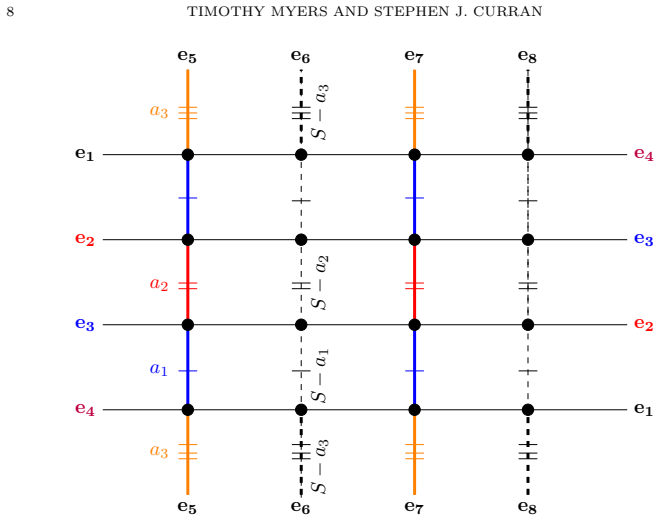
Figure 6. Figure 6: The structure of edge sums in a C4-face-magic labeling on K4,4 (Proposition 14). Furthermore, 2a1 = a2 + a3. In addition, for 1 ≤ i ≤ 4, xi,1 + xi,2 = xi,3 + xi,4. (7) Proof. As shown in [PITH_FULL_IMAGE:figures/full_fig_p008_6.png] view at source ↗
Figure 7
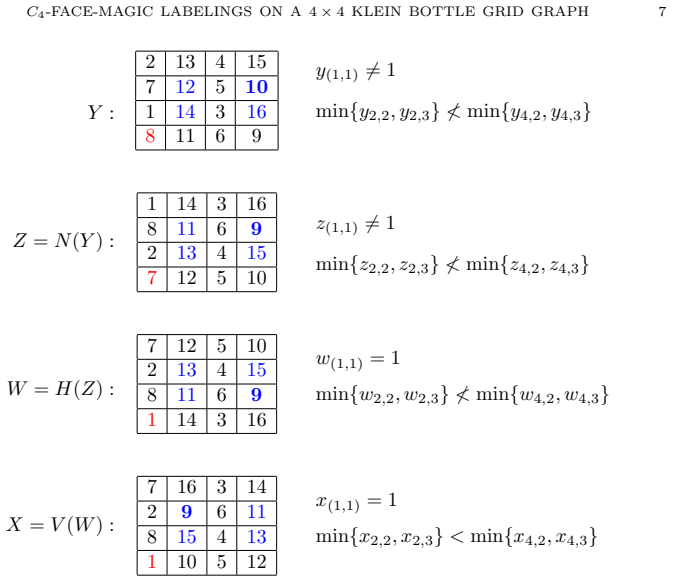
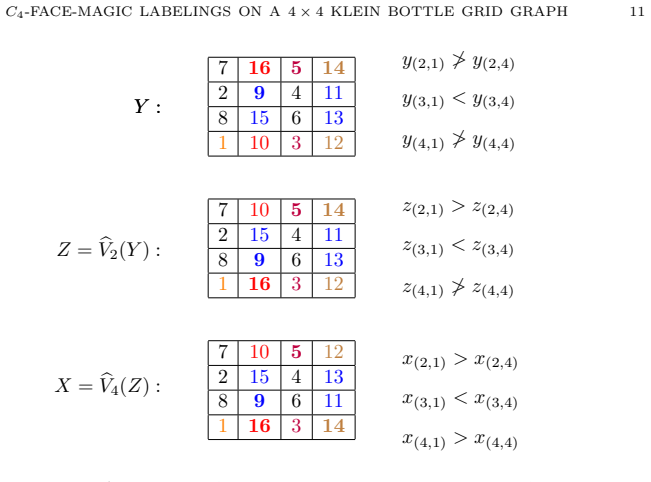
Figure 7. Figure 7: A sequence of vertical cycle operations that transforms the properly symmetrized C4-face-magic labeling Y into the stan￾dard labeling X. is a partition of the set {1, 2, . . . , 16} such that x2i−1,2j−1 + x2i−1,2j = a1 and x2i,2j−1 +x2i,2j = S −a1. Thus, we need to partition the set C = {1, 2, . . . , 16} into eight 2-element sets of distinct elements such that (i) the sum of the elements of a set is a1 fo… view at source ↗
Figure 8
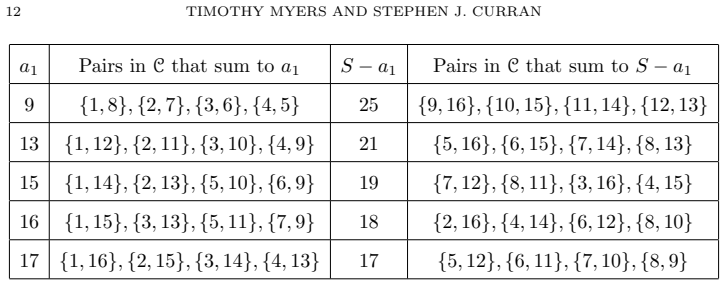
Figure 8. Figure 8: The four pairs of elements in C that sum to a1 and S − a1. To show that a1 ̸= 11 we will establish a contradiction by assuming a1 = 11. The pairs of distinct elements in C that sum to a1 = 11 are {1, 10}, {2, 9}, {3, 8}, {4, 7}, and {5, 6}; (12) and the pairs of elements in C that sum to S − a1 = 23 are {7, 16}, {8, 15}, {9, 14}, {10, 13}, and {11, 12}. (13) By (11) we need to choose four pairs from (12) a… view at source ↗
Figure 9
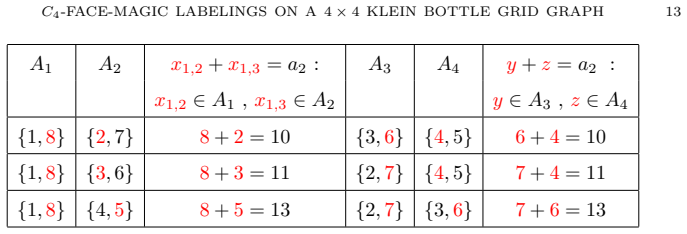
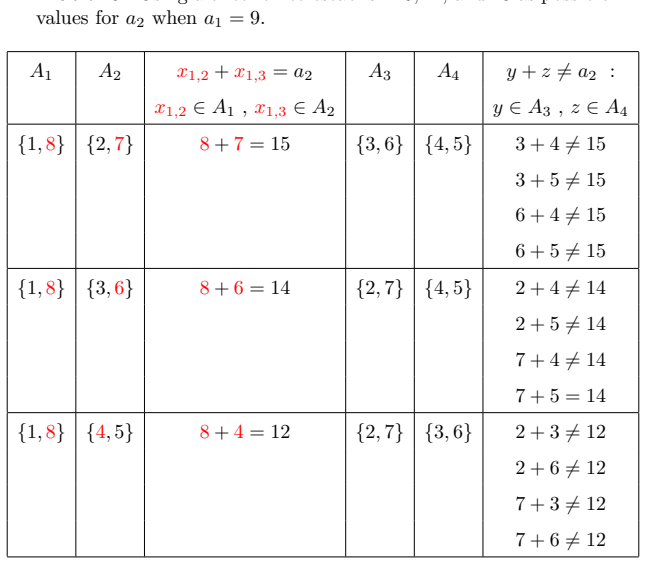
Figure 9. Figure 9: Using a criterion to establish 10, 11, and 13 as possible values for a2 when a1 = 9. A1 A2 x1,2 + x1,3 = a2 A3 A4 y + z ̸= a2 : x1,2 ∈ A1 , x1,3 ∈ A2 y ∈ A3 , z ∈ A4 {1, 8} {2, 7} 8 + 7 = 15 {3, 6} {4, 5} 3 + 4 ̸= 15 3 + 5 ̸= 15 6 + 4 ̸= 15 6 + 5 ̸= 15 {1, 8} {3, 6} 8 + 6 = 14 {2, 7} {4, 5} 2 + 4 ̸= 14 2 + 5 ̸= 14 7 + 4 ̸= 14 7 + 5 = 14 {1, 8} {4, 5} 8 + 4 = 12 {2, 7} {3, 6} 2 + 3 ̸= 12 2 + 6 ̸= 12 7 + 3 ̸… view at source ↗
Figure 10
Figure 10. Figure 10: Using a criterion to eliminate 15, 14 and 12 as possible values for a2 when a1 = 9 by summing all possible values for y and z. A1 = {1, 16}. Then A2 is the set that contains the element x ∈ A2 for which x + 16 = a2. Since x1,2 = 16 and x1,3 ≥ 2, we have a2 − x1,2 + x1,3 ≥ 18. By (14), we have 4a2 = X 2 i=1 (x2i−1,2 + x2i−1,3 + x2i,1 + x2i,4) ≤ X 16 k=9 k = 100. Hence, a2 ≤ 25. Consider a2 = 18. Since x1,1… view at source ↗
Figure 11
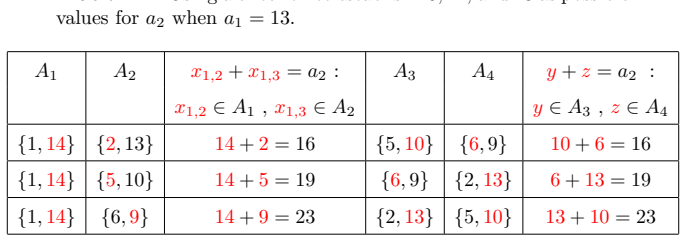
Figure 11. Figure 11: Using a criterion to establish 10, 11, and 13 as possible values for a2 when a1 = 13. A1 A2 x1,2 + x1,3 = a2 : A3 A4 y + z = a2 : x1,2 ∈ A1 , x1,3 ∈ A2 y ∈ A3 , z ∈ A4 {1, 14} {2, 13} 14 + 2 = 16 {5, 10} {6, 9} 10 + 6 = 16 {1, 14} {5, 10} 14 + 5 = 19 {6, 9} {2, 13} 6 + 13 = 19 {1, 14} {6, 9} 14 + 9 = 23 {2, 13} {5, 10} 13 + 10 = 23 [PITH_FULL_IMAGE:figures/full_fig_p014_11.png] view at source ↗
Figure 12
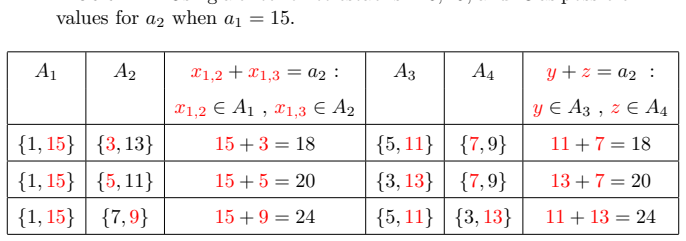
Figure 12. Figure 12: Using a criterion to establish 16, 19, and 23 as possible values for a2 when a1 = 15. A1 A2 x1,2 + x1,3 = a2 : A3 A4 y + z = a2 : x1,2 ∈ A1 , x1,3 ∈ A2 y ∈ A3 , z ∈ A4 {1, 15} {3, 13} 15 + 3 = 18 {5, 11} {7, 9} 11 + 7 = 18 {1, 15} {5, 11} 15 + 5 = 20 {3, 13} {7, 9} 13 + 7 = 20 {1, 15} {7, 9} 15 + 9 = 24 {5, 11} {3, 13} 11 + 13 = 24 [PITH_FULL_IMAGE:figures/full_fig_p014_12.png] view at source ↗
Figure 13
Figure 13. Figure 13: Using a criterion to establish 18, 20, and 24 as possible values for a2 when a1 = 16. Let A7 = {7, 10}. Since 7 cannot match with 11 to add to a2 = 18, 10 must match with 8. Thus, A8 = {8, 6}. See line 2 of [PITH_FULL_IMAGE:figures/full_fig_p014_13.png] view at source ↗
Figure 14
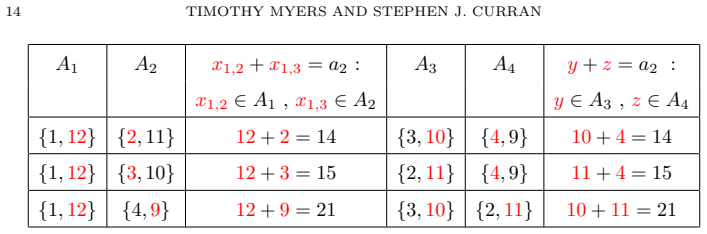
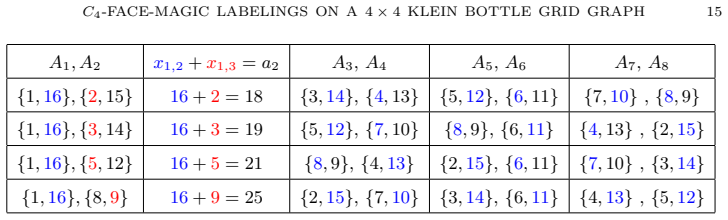
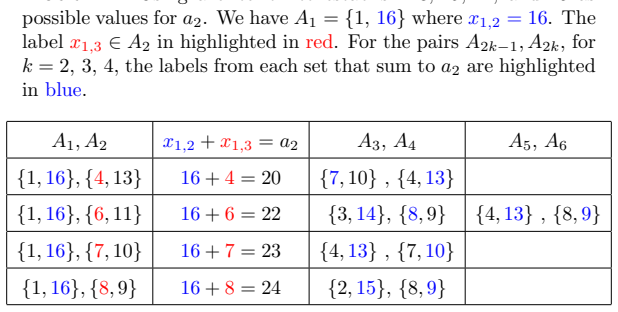
Figure 14. Figure 14: Using a criterion to establish 18, 19, 21, and 25 as possible values for a2. We have A1 = {1, 16} where x1,2 = 16. The label x1,3 ∈ A2 in highlighted in red. For the pairs A2k−1, A2k, for k = 2, 3, 4, the labels from each set that sum to a2 are highlighted in blue. A1, A2 x1,2 + x1,3 = a2 A3, A4 A5, A6 {1, 16}, {4, 13} 16 + 4 = 20 {7, 10} , {4, 13} {1, 16}, {6, 11} 16 + 6 = 22 {3, 14}, {8, 9} {4, 13} , {8… view at source ↗
Figure 15
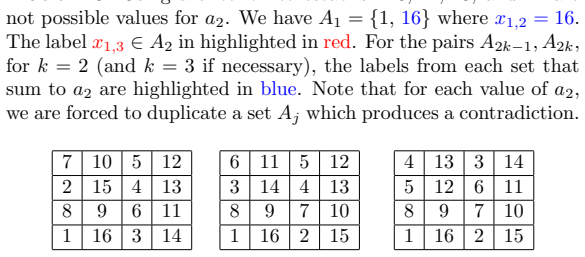
Figure 15. Figure 15: Using a criterion to establish 20, 22, 23, and 24 are not possible values for a2. We have A1 = {1, 16} where x1,2 = 16. The label x1,3 ∈ A2 in highlighted in red. For the pairs A2k−1, A2k, for k = 2 (and k = 3 if necessary), the labels from each set that sum to a2 are highlighted in blue. Note that for each value of a2, we are forced to duplicate a set Aj which produces a contradiction. 7 10 5 12 2 15 4 1… view at source ↗
Figure 16
Figure 16. Figure 16: The standard horizontally pairwise balanced labelings on K4,4 with a1 = 9. Proof. By Proposition 14, the collection  {x2i−1,2j−1, x2i−1,2j} : 1 ≤ i, j ≤ 2 [PITH_FULL_IMAGE:figures/full_fig_p015_16.png] view at source ↗
Figure 17
Figure 17. Figure 17: Edges with edge sum a1 = 9. ✈ 9 ✈ 16 ✈ 10 ✈ 15 ✈ 11 ✈ 14 ✈ 12 ✈ 13 [PITH_FULL_IMAGE:figures/full_fig_p016_17.png] view at source ↗
Figure 19
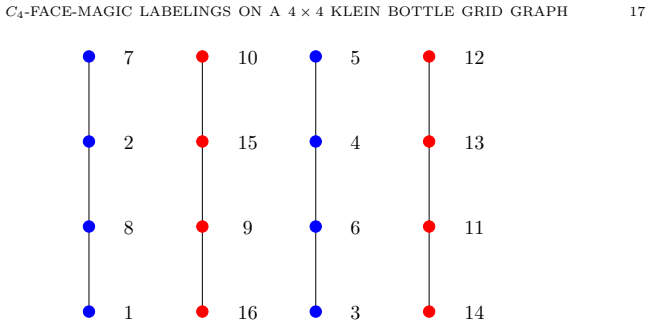
Figure 19. Figure 19: By Proposition 9, the path with labels 1, 8, 2, 7 appears in column 1, [PITH_FULL_IMAGE:figures/full_fig_p016_19.png] view at source ↗
Figure 19
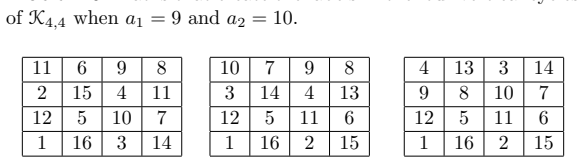
Figure 19. Figure 19: Paths that create the labels in the four vertical cycles of K4,4 when a1 = 9 and a2 = 10. 11 6 9 8 2 15 4 11 12 5 10 7 1 16 3 14 10 7 9 8 3 14 4 13 12 5 11 6 1 16 2 15 4 13 3 14 9 8 10 7 12 5 11 6 1 16 2 15 [PITH_FULL_IMAGE:figures/full_fig_p017_19.png] view at source ↗
Figure 20
Figure 20. Figure 20: The standard horizontally pairwise balanced labelings on K4,4 with a1 = 13. analysis similar to that given in the proof of Proposition 19 demonstrates that the labelings in [PITH_FULL_IMAGE:figures/full_fig_p017_20.png] view at source ↗
Figure 21
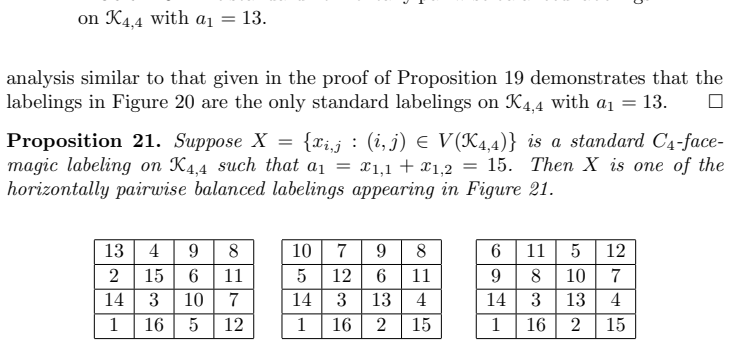
Figure 21. Figure 21: The standard horizontally pairwise balanced labelings on K4,4 with a1 = 15. Proof. By Proposition 18, the only permissible values of a2 are 16, 19, and 23, and the corresponding permissible values of S − a2 are 18, 15, and 11, respectively. An analysis similar to that given in the proof of Proposition 19 demonstrates that the labelings in [PITH_FULL_IMAGE:figures/full_fig_p017_21.png] view at source ↗
Figure 22
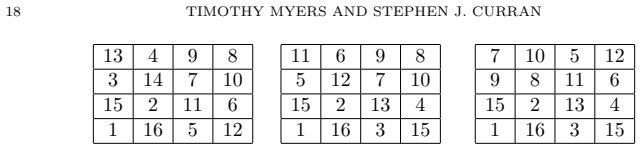
Figure 22. Figure 22: The standard horizontally pairwise balanced labelings on K4,4 with a1 = 16. Proof. By Proposition 18, the only permissible values of a2 are 18, 20, and 24, and the corresponding permissible values of S − a2 are 16, 14, and 10, respectively. An analysis similar to that given in the proof of Proposition 19 demonstrates that the labelings in [PITH_FULL_IMAGE:figures/full_fig_p018_22.png] view at source ↗
Figure 23
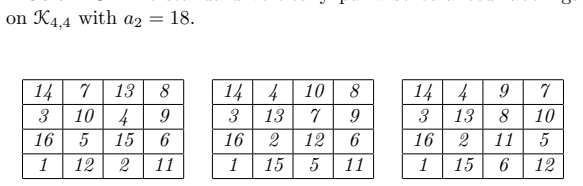
Figure 23. Figure 23: The standard vertically pairwise balanced labelings on K4,4 with a2 = 18. 14 7 13 8 3 10 4 9 16 5 15 6 1 12 2 11 14 4 10 8 3 13 7 9 16 2 12 6 1 15 5 11 14 4 9 7 3 13 8 10 16 2 11 5 1 15 6 12 [PITH_FULL_IMAGE:figures/full_fig_p018_23.png] view at source ↗
Figure 24
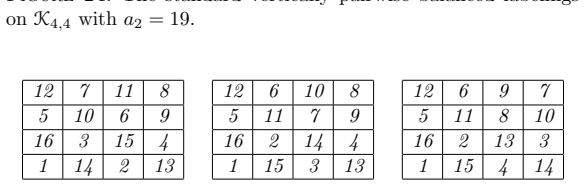
Figure 24. Figure 24: The standard vertically pairwise balanced labelings on K4,4 with a2 = 19. 12 7 11 8 5 10 6 9 16 3 15 4 1 14 2 13 12 6 10 8 5 11 7 9 16 2 14 4 1 15 3 13 12 6 9 7 5 11 8 10 16 2 13 3 1 15 4 14 [PITH_FULL_IMAGE:figures/full_fig_p018_24.png] view at source ↗
Figure 25
Figure 25. Figure 25: The standard vertically pairwise balanced labelings on K4,4 with a2 = 21. Proof. By Proposition 18, the only permissible values of a2 are a2 ∈ {18, 19, 21, 25}. Also, for each permissible value of a2, there is only one way to choose a label from [PITH_FULL_IMAGE:figures/full_fig_p018_25.png] view at source ↗
Figure 26
Figure 26. Figure 26: The standard vertically pairwise balanced labelings on K4,4 with a2 = 25. each set {i, 17 − i}, for 1 ≤ i ≤ 8, so that there are labels from a pair of these sets that add to a2; these labels are highlighted in blue and red in [PITH_FULL_IMAGE:figures/full_fig_p019_26.png] view at source ↗
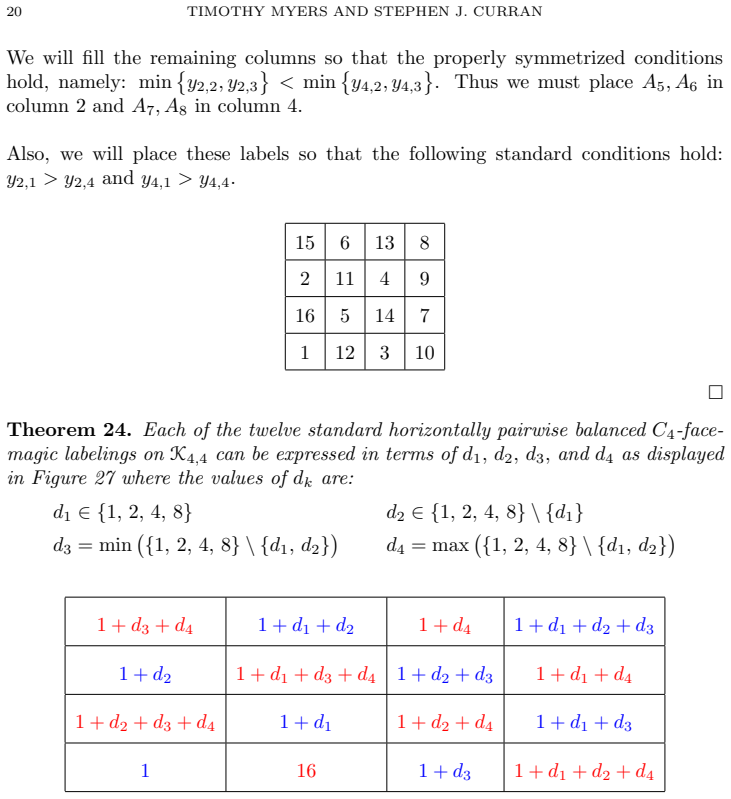
Figure 27
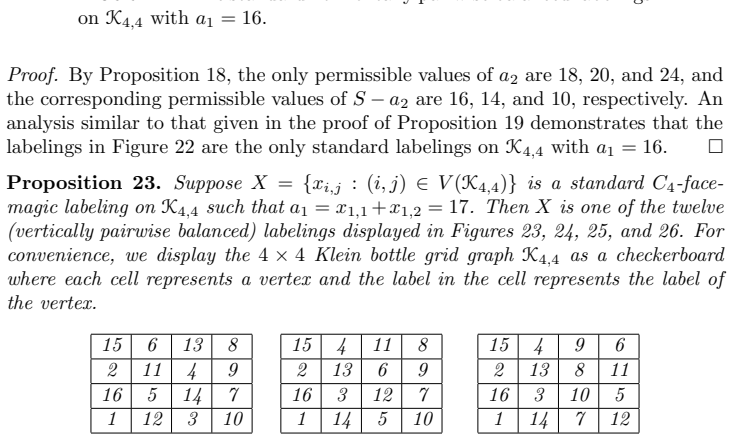
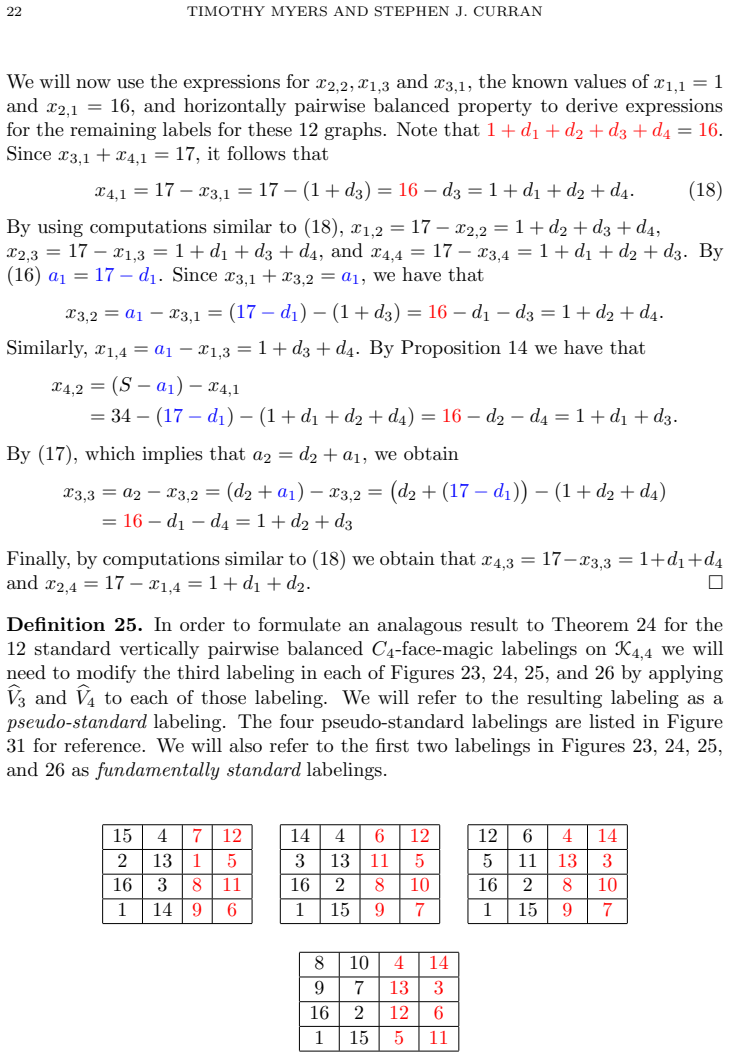
Figure 27. Figure 27: The twelve standard horizontally pairwise balanced C4-face-magic labelings on K4,4. Proof. In this proof we will define d1, d2, d3, and d4 and verify that the labelings {xi,j : 1 ≤ i ≤ 4, 1 ≤ j ≤ 4} have the expressions indicated in [PITH_FULL_IMAGE:figures/full_fig_p020_27.png] view at source ↗
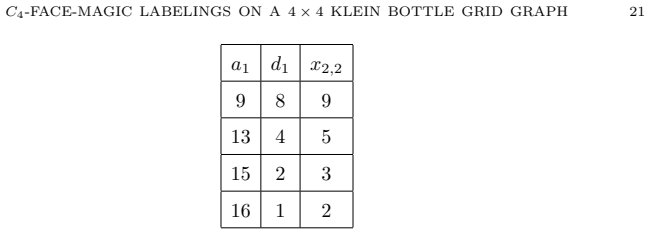
Figure 28
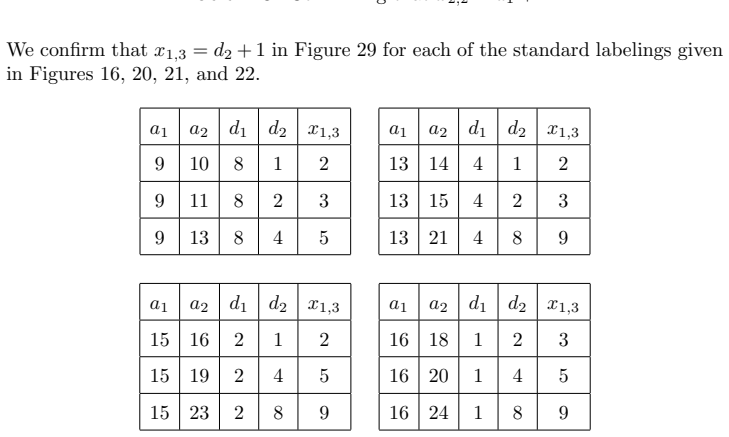
Figure 28. Figure 28: Confirming that x2,2 = d1 + 1. We confirm that x1,3 = d2 + 1 in [PITH_FULL_IMAGE:figures/full_fig_p021_28.png] view at source ↗
Figure 29
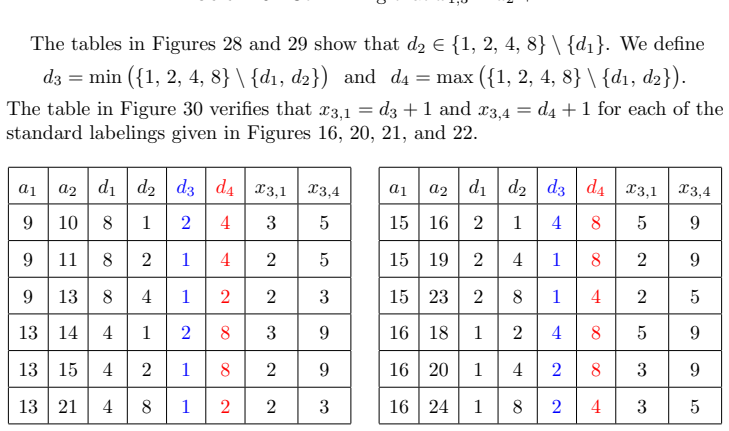
Figure 29. Figure 29: Confirming that x1,3 = d2 + 1. The tables in Figures 28 and 29 show that d2 ∈ {1, 2, 4, 8} \ {d1}. We define d3 = min {1, 2, 4, 8} \ {d1, d2}  and d4 = max {1, 2, 4, 8} \ {d1, d2}  . The table in [PITH_FULL_IMAGE:figures/full_fig_p021_29.png] view at source ↗
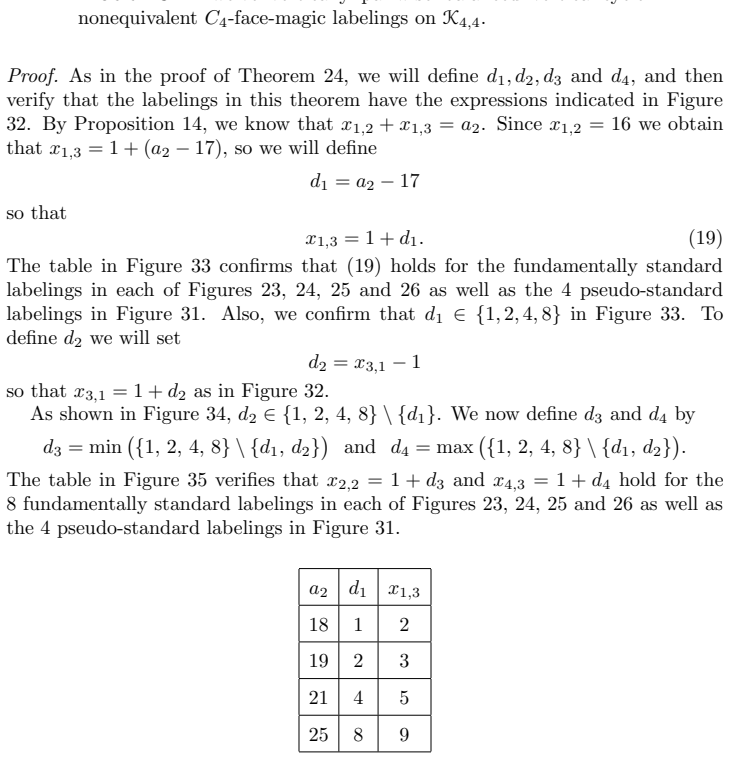
Figure 30
Figure 30. Figure 30: Confirming that x3,1 = d3 + 1 and x4 = d4 + 1 [PITH_FULL_IMAGE:figures/full_fig_p021_30.png] view at source ↗
Figure 31
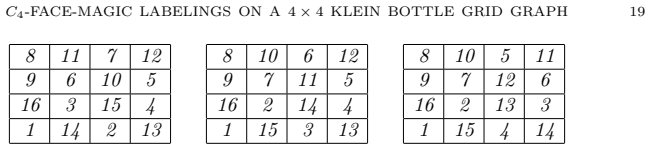
Figure 31. Figure 31: The four pseudo-standard vertically pairwise bal￾anced C4-face-magic labelings for a2 = 18, 19, 21, 25, respectively. Theorem 26. Each of the 8 fundamentally standard and 4 pseudo-standard ver￾tically pairwise balanced C4-face-magic labelings on K4,4 can be expressed in terms [PITH_FULL_IMAGE:figures/full_fig_p022_31.png] view at source ↗
Figure 32
Figure 32. Figure 32: Twelve vertically pairwise balanced vertical-cycle￾nonequivalent C4-face-magic labelings on K4,4. Proof. As in the proof of Theorem 24, we will define d1, d2, d3 and d4, and then verify that the labelings in this theorem have the expressions indicated in [PITH_FULL_IMAGE:figures/full_fig_p023_32.png] view at source ↗
Figure 33
Figure 33. Figure 33: Confirming that x1,3 = 1 + d1 [PITH_FULL_IMAGE:figures/full_fig_p023_33.png] view at source ↗
Figure 34
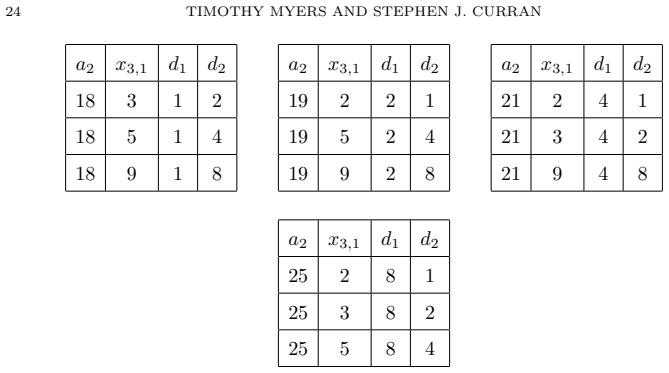
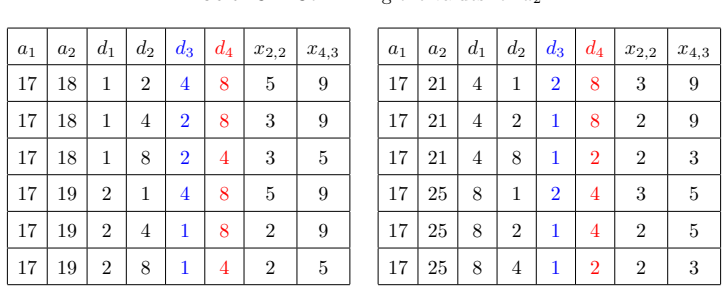
Figure 34. Figure 34: Confirming the values for d2. a1 a2 d1 d2 d3 d4 x2,2 x4,3 17 18 1 2 4 8 5 9 17 18 1 4 2 8 3 9 17 18 1 8 2 4 3 5 17 19 2 1 4 8 5 9 17 19 2 4 1 8 2 9 17 19 2 8 1 4 2 5 a1 a2 d1 d2 d3 d4 x2,2 x4,3 17 21 4 1 2 8 3 9 17 21 4 2 1 8 2 9 17 21 4 8 1 2 2 3 17 25 8 1 2 4 3 5 17 25 8 2 1 4 2 5 17 25 8 4 1 2 2 3 [PITH_FULL_IMAGE:figures/full_fig_p024_34.png] view at source ↗
Figure 35
Figure 35. Figure 35: Confirming that x2,2 = 1 + d3 and x4,3 = 1 + d4. We will now use the expressions for x1.3, x3,1 and x2,2, and the known values of x1,1 = 1 and x1,2 = 16, to derive expressions for the remaining labels for these 12 labelings. Recall that 1 + d1 + d2 + d3 + d4 = 16. By the vertically pairwise balanced property, x2,1 + x2,2 = 17, so that x2,1 = 17 − x2,2 = 17 − (1 + d3) = 16 − d3 = 1 + d1 + d2 + d4. (20) By … view at source ↗
read the original abstract

For a graph G = (V, E) embedded in the Klein bottle, let F(G) denote the set of faces of G. A C_4-face-magic Klein bottle labeling on G is a bijection f: V(G) to {1, 2,..., |V(G)|} such that for any F in F(G) with F isomorphic C_4, the sum of all the vertex labelings along C_4 is a constant. We say that a C_4-face-magic labeling X={x_{i,j} : 0< i,j< 5} on the 4x4 Klein bottle grid graph is horizontally (or vertically) pairwise balanced if x_{2i-1,j} + x_{2i,j}=17 for 0< i <3 and 0< j \le <5 (or x_{i,2j-1} + x_{i2,j}=17 for 0< i <5 and 0< j <3). We show that the 4x4 Klein bottle grid graph has 192 C_4-face-magic labelings up to symmetries on a Klein bottle. We classify these labelings into two categories depending on whether a C_4-face-magic label preserving permutation of the labeling is either horizontally pairwise balanced or vertically pairwise balanced. These results extend known results on C_4-face-magic labelings on an mxn Klein bottle grid graph.

Editorial analysis

A structured set of objections, weighed in public.

Desk editor's note, referee report, simulated authors' rebuttal, and a circularity audit. Tearing a paper down is the easy half of reading it; the pith above is the substance, this is the friction.

Referee Report

2 major / 2 minor

Summary. The paper defines a C_4-face-magic Klein bottle labeling as a bijection from vertices to {1,...,|V|} such that every C_4 face sums to the same constant. For the 4x4 grid embedded on the Klein bottle it asserts the existence of exactly 192 such labelings up to symmetries and partitions them into two classes (horizontally pairwise balanced versus vertically pairwise balanced) according to the existence of a label-preserving permutation satisfying the pairwise-sum condition x_{2i-1,j}+x_{2i,j}=17 (or the vertical analogue). The definitions of horizontal and vertical pairwise balance are given explicitly in the abstract.

Significance. If the enumeration and orbit count are correct, the result supplies a concrete, small-case verification of C_4-face-magic labelings on a non-orientable surface and extends the existing literature on mxn Klein-bottle grids. The explicit classification into two disjoint families may also be useful for subsequent computational or algebraic work on magic labelings.

major comments (2)
  1. [Abstract] Abstract: the headline claim of exactly 192 labelings up to symmetries is stated without any description of the automorphism group of the embedded graph (order, generators, or action on labelings), without orbit-stabilizer calculations, and without indication that Burnside's lemma was applied. If any labeling is fixed by a non-identity symmetry or if orbit sizes are not uniform, simply dividing a raw count by |G| yields an incorrect integer; this gap directly affects the central numerical claim.
  2. [Abstract] Abstract: the classification into horizontally versus vertically pairwise-balanced labelings is asserted to partition the 192 orbits, yet the manuscript supplies no argument that the two categories are disjoint, that every orbit falls into exactly one category, or that the label-preserving permutations used to define the categories commute with the symmetry group action. Without these verifications the partition is not known to be well-defined on the set of orbits.
minor comments (2)
  1. [Abstract] Abstract, definition of horizontal balance: the interval "0< j ≤ <5" is syntactically malformed and should be corrected to a standard range such as 1 ≤ j ≤ 4.
  2. [Abstract] Abstract: the vertical-balance formula contains the typographical error "x_{i2,j}" (missing comma or subscript) and should be written consistently with the horizontal case.

Simulated Author's Rebuttal

2 responses · 0 unresolved

We thank the referee for the careful reading and for identifying gaps in the presentation of the enumeration method and the classification. We will revise the manuscript to supply the requested details and arguments.

read point-by-point responses
  1. Referee: [Abstract] Abstract: the headline claim of exactly 192 labelings up to symmetries is stated without any description of the automorphism group of the embedded graph (order, generators, or action on labelings), without orbit-stabilizer calculations, and without indication that Burnside's lemma was applied. If any labeling is fixed by a non-identity symmetry or if orbit sizes are not uniform, simply dividing a raw count by |G| yields an incorrect integer; this gap directly affects the central numerical claim.

    Authors: We agree that the abstract omits these details. The 192 orbits were obtained by exhaustive computational enumeration of magic labelings followed by application of Burnside's lemma to the action of the automorphism group of the 4x4 Klein-bottle grid. We will revise the abstract to reference the group and the use of Burnside's lemma, and add a short subsection describing the group order, generators, and verification that orbit sizes are uniform. revision: yes

  2. Referee: [Abstract] Abstract: the classification into horizontally versus vertically pairwise-balanced labelings is asserted to partition the 192 orbits, yet the manuscript supplies no argument that the two categories are disjoint, that every orbit falls into exactly one category, or that the label-preserving permutations used to define the categories commute with the symmetry group action. Without these verifications the partition is not known to be well-defined on the set of orbits.

    Authors: We acknowledge that the manuscript does not explicitly verify that the two categories form a well-defined partition of the orbits. We will add a dedicated paragraph proving that the categories are disjoint and exhaustive, and that the defining label-preserving permutations commute with the group action, so that the classification is invariant under symmetries. revision: yes

Circularity Check

0 steps flagged

No circularity detected; result is an explicit enumeration

full rationale

The paper defines C4-face-magic labelings via the constant-sum condition on faces, introduces the auxiliary notions of horizontally and vertically pairwise balanced labelings by explicit equations on the 4x4 grid, and states that exactly 192 such labelings exist up to the symmetries of the Klein-bottle embedding. These definitions and the final count are presented as direct combinatorial classification rather than any fitted parameter, self-referential equation, or load-bearing self-citation. No derivation step reduces the claimed total to its own inputs by construction.

Axiom & Free-Parameter Ledger

0 free parameters · 2 axioms · 0 invented entities

The result rests on standard graph-theoretic definitions of embeddings, faces, and bijections; no free parameters, invented entities, or ad-hoc axioms are introduced in the abstract.

axioms (2)
  • standard math Standard definition of a graph embedding on the Klein bottle with C4 faces.
    Invoked to define the faces whose label sums must be constant.
  • domain assumption Symmetries of the Klein bottle grid can be used to quotient the set of labelings.
    Used to reduce the total to 192 up to symmetry.

pith-pipeline@v0.9.1-grok · 5796 in / 1140 out tokens · 24168 ms · 2026-06-27T22:06:09.006076+00:00 · methodology

discussion (0)

Sign in with ORCID, Apple, or X to comment. Anyone can read and Pith papers without signing in.

Reference graph

Works this paper leans on

19 extracted references · 10 canonical work pages

  1. [1]

    Baˇ ca, On magic labelings of Mobius ladders.J

    M. Baˇ ca, On magic labelings of Mobius ladders.J. Franklin Inst.326(1989), 885–888, doi:10.1016/0016-0032(89)90010-0

  2. [2]

    Baˇ ca, On magic labelings of honeycomb.Discrete Math.105(1992), 305–311, doi:10.1016/0012-365X(92)90153-7

    M. Baˇ ca, On magic labelings of honeycomb.Discrete Math.105(1992), 305–311, doi:10.1016/0012-365X(92)90153-7

  3. [3]

    Baˇ ca, On magic labelings of grid graphs.Ars Combin.33(1992), 295–299

    M. Baˇ ca, On magic labelings of grid graphs.Ars Combin.33(1992), 295–299

  4. [4]

    J. A. Bondy, and U. S. R. Murty,Graph Theory with Applications, MacMillan, New York, (1976)

  5. [5]

    S. I. Butt, M. Numan, S. Ali and A. Semaniˇ cov´ a-Feˇ novˇ c´ ıkov´ a, Face antimagic label- ings of toroidal and Klein bottle grid graphs.AKCE Int. J. Graphs Comb.(2020), 1–9, doi:10.1016/j.akcej.2018.09.005

  6. [6]

    S. J. Curran and R. M. Low,C 4-face-magic torus labelings onC 4 ×C 4,Cong. Numer.233 (2019), 79–94

  7. [7]

    S. J. Curran, R. M. Low, and S. C. Locke,C 4-face-magic toroidal labelings onC m ×C n,Art Discrete Appl. Math., 4 (2021), no. 1, #P1.04, 33 pp

  8. [8]

    S. J. Curran, R. M. Low and S. C. Locke, Equatorially balanced C4-face-magic labelings on Klein bottle grid graphs, arXiv:2206.02028 [math.CO].doi.org/10.48550/arXiv.2206.02028

  9. [9]

    S. J. Curran,C 4-face-magic labelings on odd order projective grid graphs, Australas. J. Combin.83(3)(2022), 361—396.https://ajc.maths.uq.edu.au/pdf/83/ajc_v83_p361.pdf

  10. [10]

    Curran and S.C

    S.J. Curran and S.C. Locke,C 4-face-magic labelings on even order projective grid graphs. In: F. Hoffman, S. Holliday, Z. Rosen, F. Shahrokhi, J. Wierman (eds)Combinatorics, Graph Theory and Computing. SEICCGTC 2021. Springer Proceedings in Mathematics & Statistics, vol 448. Springer, Cham. (2024), 177-–201.doi.org/10.1007/978-3-031-52969-6_17

  11. [11]

    S. J. Curran, Odd orderC 4-face-magic projective grid graphs, Electron. J. Graph Theory Appl.14(1) (2026), 153—178.http://dx.doi.org/10.5614/ejgta.2026.14.1.10

  12. [12]

    J. A. Gallian, A dynamic survey of graph labeling.Electron. J. Combin.22(2019), #DS6, doi:10.37236/27, https://www.combinatorics.org/ojs/index.php/eljc/issue/view/Surveys

  13. [13]

    Hsieh, S-M

    J. Hsieh, S-M. Lee, P-J. Liang, and R. M. Low, OnC 4 face-(1,0,0) magic polyomino graphs and their related graphs., manuscript

  14. [14]

    Kasif, H

    A. Kasif, H. Muhammad, A. Ali, and M. Miller, Magic labeling of type (a, b, c) of families of wheels.Math. Comput. Sci.7(2013), 315–319, doi:10.1007/s11786-013-0162-9

  15. [15]

    Kathiresan and S

    K. Kathiresan and S. Gokulakrishnan, On magic labelings of type (1,1,1) for the special classes of plane graphs.Util. Math.63(2003), 25–32

  16. [16]

    Kotzig and A

    A. Kotzig and A. Rosa, Magic valuations of finite graphs.Canad. Math. Bull.13(1970), 451–461, doi:10.4153/CMB-1970-084-1

  17. [17]

    Lih, On magic and consecutive labelings of plane graphs.Util

    K-W. Lih, On magic and consecutive labelings of plane graphs.Util. Math.24(1983), 165– 197

  18. [18]

    Saviyo, J

    L. Saviyo, J. John, and D. Jose, A Study on Graph Labelling and Its Applications.In- ternational Journal of Scientific Development and Research.8Issue 3 (2023), 1328–1330, https://ijsdr.org/papers/IJSDR2303218.pdf

  19. [19]

    Wang, Toroidal grids are anti-magic

    T-M. Wang, Toroidal grids are anti-magic. In: Wang L. (eds)Computing and Combinatorics. COCOON 2005. Lecture Notes in Computer Science, vol 3595. Springer, Berlin, Heidelberg, (2005), 671–679, doi:10.1007/11533719 68 Department of Mathematics, Howard University, W ashington, DC 20059 USA Email address:timyers@howard.edu Department of Mathematics, Universi...