Learning Dynamic Aperture from One-turn Maps
Pith reviewed 2026-06-27 20:29 UTC · model grok-4.3
The pith
Coarse-grained dynamic aperture can be learned directly from suitably encoded one-turn maps using a deep surrogate model.
A machine-rendered reading of the paper's core claim, the machinery that carries it, and where it could break.
Core claim
Coarse-grained dynamic aperture can be learned directly from suitably encoded one-turn maps. By reformulating dynamic-aperture prediction as an image segmentation problem, a deep surrogate model captures the long-term stability topology and transfers to realistic multidimensional Electron-Ion Collider Electron Storage Ring tracking. Failure analysis identifies a challenging resonant regime in which invariant tori are strongly deformed yet remain unbroken.
What carries the argument
A deep neural network surrogate trained on encoded one-turn maps to perform image segmentation of long-term stability regions.
If this is right
- Dynamic aperture evaluation no longer requires explicit long-term tracking for each candidate design once the surrogate is trained.
- The surrogate captures stability topology that generalizes across different machine configurations within the training distribution.
- A resonant regime exists in which invariant tori deform strongly but do not break, creating a difficult test case for the model.
- Practical surrogate models for accelerator design can be constructed from one-turn transport information alone.
Where Pith is reading between the lines
- If the encoding proves sufficiently general, the same segmentation approach could be tested on other nonlinear map-based systems such as beam-beam or synchrotron motion models.
- The method could shorten iterative lattice optimization loops by supplying rapid stability estimates before any long-term tracking is performed.
- Extending the training set to include more varied resonance conditions might improve performance in the identified difficult regime.
Load-bearing premise
A suitably chosen encoding of the one-turn map contains sufficient information to reconstruct the long-term stability boundary without explicit long-term tracking data or additional machine-specific tuning beyond the training set.
What would settle it
Run the trained surrogate on a new accelerator lattice outside the training distribution and compare its predicted stability boundary against full long-term tracking; a systematic mismatch would falsify the claim.
Figures
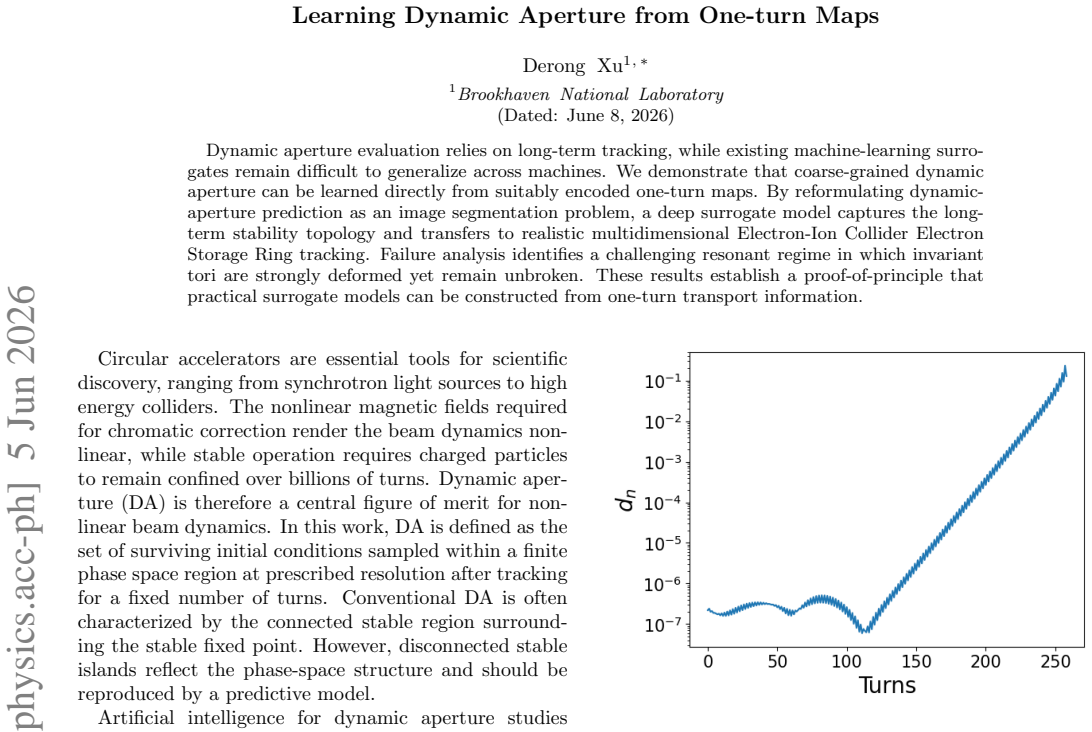
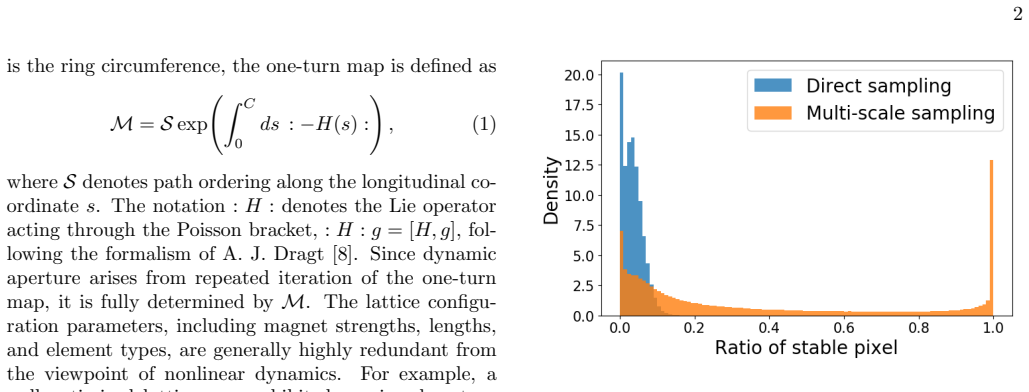
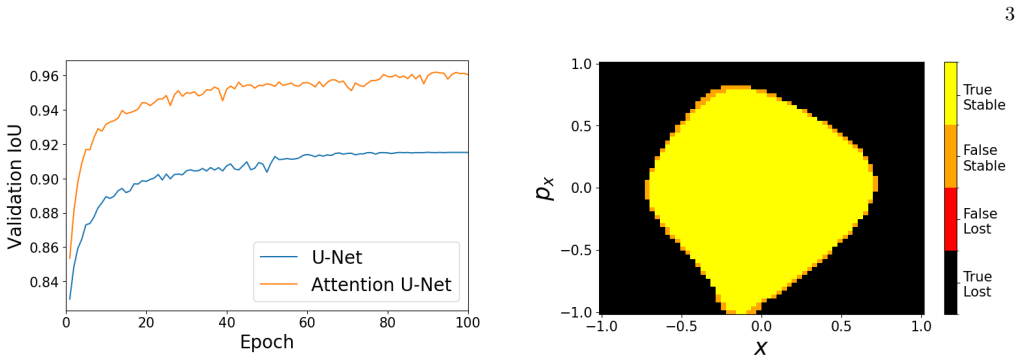
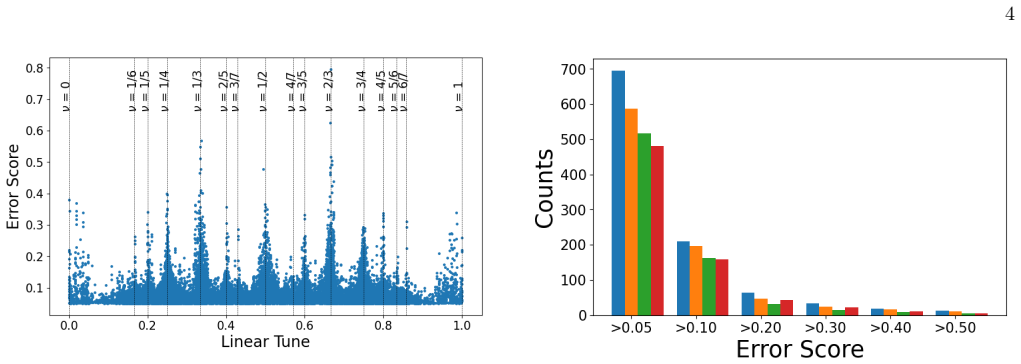
read the original abstract
Dynamic aperture evaluation relies on long-term tracking, while existing machine-learning surrogates remain difficult to generalize across machines. We demonstrate that coarse-grained dynamic aperture can be learned directly from suitably encoded one-turn maps. By reformulating dynamic-aperture prediction as an image segmentation problem, a deep surrogate model captures the long-term stability topology and transfers to realistic multidimensional Electron-Ion Collider Electron Storage Ring tracking. Failure analysis identifies a challenging resonant regime in which invariant tori are strongly deformed yet remain unbroken. These results establish a proof-of-principle that practical surrogate models can be constructed from one-turn transport information.
Editorial analysis
A structured set of objections, weighed in public.
Referee Report
Summary. The manuscript claims that coarse-grained dynamic aperture can be learned directly from suitably encoded one-turn maps by reformulating the task as an image-segmentation problem for a deep neural network; the resulting surrogate captures long-term stability topology and transfers successfully to realistic multidimensional tracking in the Electron-Ion Collider Electron Storage Ring, while failure analysis identifies a resonant regime of strongly deformed but unbroken invariant tori.
Significance. If validated, the result would offer a machine-agnostic surrogate that bypasses expensive long-term tracking for dynamic-aperture evaluation, which is computationally intensive in accelerator design. The reformulation as image segmentation and the explicit identification of the resonant failure regime are constructive contributions that could guide future work on generalization. No parameter-free derivations or machine-checked proofs are present; the contribution is empirical.
major comments (2)
- [Abstract] Abstract: the claim of successful transfer to EIC tracking is stated without any quantitative metrics (accuracy, IoU, false-positive rate on stable/unstable classification), error bars, training-set statistics, or ablation results on the map encoding; these omissions are load-bearing because the central claim is an empirical demonstration whose robustness cannot be assessed.
- [Abstract] Abstract / failure-analysis paragraph: the noted failure regime (strongly deformed but unbroken tori) is described qualitatively, yet no quantitative characterization is given (e.g., resonance orders, number of turns to loss, or sampling density of this regime in the training distribution); this directly bears on the weakest assumption that a fixed one-turn encoding suffices to recover long-term boundaries without slow-diffusion or high-order effects.
minor comments (1)
- The manuscript would benefit from a dedicated methods subsection that reports network architecture, optimizer, loss function, data-augmentation choices, and the precise encoding procedure for the one-turn map.
Simulated Author's Rebuttal
We thank the referee for the constructive and detailed report. The comments highlight important aspects of how the empirical claims are presented. We address each major comment below and indicate the revisions we will make.
read point-by-point responses
-
Referee: [Abstract] Abstract: the claim of successful transfer to EIC tracking is stated without any quantitative metrics (accuracy, IoU, false-positive rate on stable/unstable classification), error bars, training-set statistics, or ablation results on the map encoding; these omissions are load-bearing because the central claim is an empirical demonstration whose robustness cannot be assessed.
Authors: We agree that the abstract should include representative quantitative metrics to support the transfer claim. The body of the manuscript reports these results (accuracy, IoU, false-positive rates on stable/unstable regions, error bars from multiple runs, training-set sizes, and ablation studies on map encoding) in the results and supplementary sections. We will revise the abstract to incorporate a concise summary of the key metrics with error bars. revision: yes
-
Referee: [Abstract] Abstract / failure-analysis paragraph: the noted failure regime (strongly deformed but unbroken tori) is described qualitatively, yet no quantitative characterization is given (e.g., resonance orders, number of turns to loss, or sampling density of this regime in the training distribution); this directly bears on the weakest assumption that a fixed one-turn encoding suffices to recover long-term boundaries without slow-diffusion or high-order effects.
Authors: The failure regime is examined in the results section with qualitative description of the resonant behavior. We acknowledge that adding quantitative details would better address the concern about slow-diffusion and high-order effects. We will revise the failure-analysis paragraph to include resonance orders identified in the analysis, the number of turns to loss for representative cases, and the sampling density of this regime within the training distribution. revision: yes
Circularity Check
No circularity; empirical ML surrogate trained on one-turn map encodings
full rationale
The paper reports an empirical result: one-turn maps are encoded as inputs to an image-segmentation network whose output is compared against long-term tracking labels. No equations, fitted parameters, or self-citations are presented that would make the reported transfer performance equivalent to the training inputs by construction. The central claim is a data-driven observation rather than a self-referential derivation, so the derivation chain contains no load-bearing reductions of the enumerated kinds.
Axiom & Free-Parameter Ledger
Reference graph
Works this paper leans on
-
[1]
Wan and Y
J. Wan and Y. Jiao, Machine learning enabled fast eval- uation of dynamic aperture for storage ring accelerators, New Journal of Physics24, 063030 (2022)
2022
-
[2]
D. Di Croce, M. Giovannozzi, C. E. Montanari, T. Pieloni, S. Redaelli, and F. F. Van der Veken, As- sessing the performance of deep learning predictions for 7 dynamic aperture of a hadron circular particle accelera- tor, Instruments8, 10.3390/instruments8040050 (2024)
-
[3]
Kranjˇ cevi´ c, B
M. Kranjˇ cevi´ c, B. Riemann, A. Adelmann, and A. Streun, Multiobjective optimization of the dynamic aperture using surrogate models based on artificial neu- ral networks, Phys. Rev. Accel. Beams24, 014601 (2021)
2021
-
[4]
Z. Zhang, I. Agapov, S. Gasiorowski, T. Hellert, W. Neiswanger, X. Huang, and D. Ratner, Effi- cient dynamic and momentum aperture optimization for lattice design using multipoint bayesian algorithm execution, arXiv preprint arXiv:2511.17850 (2025), arXiv:2511.17850 [physics.acc-ph]
arXiv 2025
-
[5]
Boull´ e, V
N. Boull´ e, V. Dallas, Y. Nakatsukasa, and D. Samaddar, Classification of chaotic time series with deep learning, Physica D: Nonlinear Phenomena403, 132261 (2020)
2020
-
[6]
Celletti, C
A. Celletti, C. Gales, V. Rodriguez-Fernandez, and M. Vasile, Classification of regular and chaotic motions in hamiltonian systems with deep learning, Scientific Re- ports12, 1890 (2022)
2022
-
[7]
Aguirre, R
J. Aguirre, R. L. Viana, and M. A. F. Sanju´ an, Fractal structures in nonlinear dynamics, Rev. Mod. Phys.81, 333 (2009)
2009
-
[8]
A. J. Dragt and E. Forest, Computation of nonlinear be- havior of Hamiltonian systems using Lie algebraic meth- ods, Journal of Mathematical Physics24, 2734 (1983)
1983
-
[9]
A. J. Dragt and J. M. Finn, Lie series and invariant func- tions for analytic symplectic maps, Journal of Mathemat- ical Physics17, 2215 (1976)
1976
-
[10]
Litjens, T
G. Litjens, T. Kooi, B. E. Bejnordi,et al., A survey on deep learning in medical image analysis, Medical Image Analysis42, 60 (2017)
2017
-
[11]
LeCun, Y
Y. LeCun, Y. Bengio, and G. Hinton, Deep learning, Na- ture521, 436 (2015)
2015
-
[12]
Ronneberger, P
O. Ronneberger, P. Fischer, and T. Brox, U-net: Convo- lutional networks for biomedical image segmentation, in MICCAI(2015) pp. 234–241
2015
-
[13]
O. O. et al., Attention u-net: Learning where to look for the pancreas, arXiv preprint arXiv:1804.03999 (2018)
Pith/arXiv arXiv 2018
-
[14]
Willeke and J
F. Willeke and J. Beebe-Wang,Electron Ion Collider Conceptual Design Report 2021, Tech. Rep. (Brookhaven National Lab. (BNL), Upton, NY (United States); Thomas Jefferson National Accelerator Facility (TJ- NAF), Newport News, VA (United States), 2021)
2021
-
[15]
Y. Cai, Y. Nosochkov, J. S. Berg, J. Kewisch, Y. Li, D. Marx, C. Montag, S. Tepikian, F. Willeke, G. Hoffs- taetter, and J. Unger, Optimization of chromatic optics in the electron storage ring of the electron-ion collider, Phys. Rev. Accel. Beams25, 071001 (2022)
2022
-
[16]
G. Iadarolaet al., Xsuite: An Integrated Beam Physics Simulation Framework, JACoWHB2023, TUA2I1 (2024), arXiv:2310.00317 [physics.acc-ph]
arXiv 2024
-
[17]
Dumas,The KAM Story: A Friendly Introduction To The Content, History, And Significance Of Classi- cal Kolmogorov-Arnold-Moser Theory(World Scientific Publishing Company, 2014)
H. Dumas,The KAM Story: A Friendly Introduction To The Content, History, And Significance Of Classi- cal Kolmogorov-Arnold-Moser Theory(World Scientific Publishing Company, 2014)
2014
-
[18]
Gjaja, Monomial factorization of symplectic maps, Part
I. Gjaja, Monomial factorization of symplectic maps, Part. Accel.43, 133 (1994)
1994
-
[19]
Strang, On the construction and comparison of differ- ence schemes, SIAM Journal on Numerical Analysis5, 506 (1968)
G. Strang, On the construction and comparison of differ- ence schemes, SIAM Journal on Numerical Analysis5, 506 (1968)
1968
-
[20]
Yoshida, Construction of higher order symplectic in- tegrators, Physics Letters A150, 262 (1990)
H. Yoshida, Construction of higher order symplectic in- tegrators, Physics Letters A150, 262 (1990)
1990
discussion (0)
Sign in with ORCID, Apple, or X to comment. Anyone can read and Pith papers without signing in.