A Unified DeepONet Framework for Logarithmically Stable Infinite-Dimensional Inverse Problems
Pith reviewed 2026-06-27 21:26 UTC · model grok-4.3
The pith
DeepONet framework decomposes inverse maps into encoding, neural approximation and reconstruction to derive separate quantitative error bounds under logarithmic stability.
A machine-rendered reading of the paper's core claim, the machinery that carries it, and where it could break.
Core claim
The framework establishes quantitative a priori error bounds for logarithmically stable infinite-dimensional inverse problems by decomposing the learned inverse map into encoder, neural approximator, and reconstructor parts, thereby characterizing how total error depends separately on encoder dimension, network size, and reconstruction dimension; the same decomposition produces corresponding Lipschitz-stable estimates.
What carries the argument
The three-part decomposition of the inverse map (measurement encoding, finite-dimensional neural approximation, functional reconstruction) combined with the logarithmic stability estimate to bound each error term.
If this is right
- Encoder dimension, network size, and reconstruction dimension can be chosen independently to control their respective error contributions.
- The framework specializes to stable recovery of medium contrast from fixed-frequency far-field scattering data.
- The same error decomposition produces Lipschitz-stable bounds as a direct comparison case.
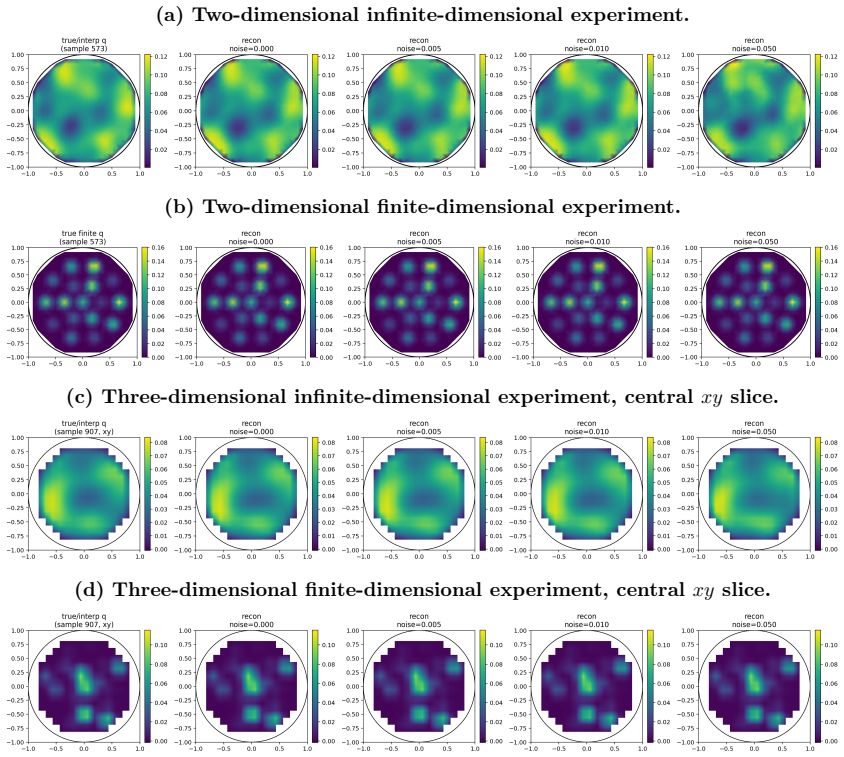
- Numerical experiments confirm stable reconstructions in two and three dimensions under added measurement noise.
Where Pith is reading between the lines
- The separation into three components may allow targeted improvements to one part without redesigning the others for related inverse problems.
- The explicit dependence on dimensions could inform practical hyperparameter selection when applying operator networks to other logarithmically stable settings.
- Testing the bounds on problems with different stability classes would clarify where the logarithmic assumption is essential versus when stronger stability yields tighter rates.
Load-bearing premise
The inverse maps under consideration satisfy a logarithmic stability estimate.
What would settle it
Numerical computation of total reconstruction error for a logarithmically stable problem that fails to exhibit the predicted separate scaling with encoder dimension, network width, or reconstruction dimension.
Figures
read the original abstract
We develop a unified DeepONet framework for logarithmically stable infinite-dimensional inverse problems, with inverse acoustic scattering as a model application. The framework is formulated at the operator level by separating the learned inverse map into measurement encoding, finite-dimensional neural approximation, and functional reconstruction components. For inverse maps satisfying a logarithmic stability estimate, we establish quantitative a priori error bounds giving separate estimates for the encoder error, the neural approximation error, and the reconstruction error, thereby characterizing the dependence on the encoder dimension, the network size, and the reconstruction dimension. For comparison, we also record the corresponding Lipschitz-stable estimate arising from the same error decomposition. The abstract theory is then specialized to the recovery of a medium contrast from fixed-frequency far-field measurements. Numerical experiments in two and three dimensions illustrate stable reconstructions under measurement noise.
Editorial analysis
A structured set of objections, weighed in public.
Referee Report
Summary. The manuscript develops a unified DeepONet framework for logarithmically stable infinite-dimensional inverse problems by decomposing the learned inverse map into measurement encoding, finite-dimensional neural approximation, and functional reconstruction components. For maps satisfying a logarithmic stability estimate, it derives quantitative a priori error bounds separating the encoder error, neural approximation error, and reconstruction error, with explicit dependence on encoder dimension, network size, and reconstruction dimension. A parallel Lipschitz-stable estimate is recorded for comparison. The theory is specialized to recovering a medium contrast from fixed-frequency far-field measurements in inverse acoustic scattering, with numerical experiments in two and three dimensions illustrating stable reconstructions under noise.
Significance. If the derivations hold, the work supplies a rigorous operator-level error analysis for DeepONet-based solvers of logarithmically ill-posed inverse problems, allowing separate control of the three error sources. This decomposition and the resulting parameter dependence constitute a concrete advance over purely empirical operator-learning studies, particularly for PDE inverse problems where logarithmic stability is the typical modulus. The acoustic-scattering specialization and accompanying numerics provide a direct test case.
major comments (2)
- [Specialization to acoustic scattering] The specialization section (acoustic scattering application): the manuscript invokes the logarithmic stability estimate to transfer the abstract bounds, but does not explicitly confirm that the far-field map for the medium-contrast problem satisfies the required modulus with constants independent of the contrast; this verification is load-bearing for the claim that the framework applies to the model problem.
- [Numerical experiments] Numerical experiments section: the reported reconstructions demonstrate stability under noise, yet no quantitative comparison is given between observed errors and the predicted scaling with encoder dimension, network width, or reconstruction dimension; without this, the practical utility of the a priori bounds remains untested.
minor comments (2)
- Notation for the encoder, approximant, and reconstructor operators should be introduced once with a single consistent symbol set and reused verbatim in all subsequent error statements.
- [Abstract] The abstract states that 'error bounds are derived'; a parenthetical reference to the specific theorem numbers containing the three-term decomposition would improve readability.
Simulated Author's Rebuttal
We thank the referee for the positive evaluation and the detailed comments. We respond to each major comment below.
read point-by-point responses
-
Referee: [Specialization to acoustic scattering] The manuscript invokes the logarithmic stability estimate to transfer the abstract bounds, but does not explicitly confirm that the far-field map for the medium-contrast problem satisfies the required modulus with constants independent of the contrast; this verification is load-bearing for the claim that the framework applies to the model problem.
Authors: We agree that an explicit confirmation is desirable for rigor. The logarithmic stability of the far-field map for the medium-contrast inverse scattering problem at fixed frequency is a classical result in the literature, with constants independent of the contrast when the contrast is taken from a bounded set in an appropriate Sobolev space (see, e.g., Alessandrini-type estimates). We will insert a clarifying sentence with the appropriate reference in the specialization section of the revised manuscript. revision: yes
-
Referee: [Numerical experiments] Numerical experiments section: the reported reconstructions demonstrate stability under noise, yet no quantitative comparison is given between observed errors and the predicted scaling with encoder dimension, network width, or reconstruction dimension; without this, the practical utility of the a priori bounds remains untested.
Authors: The numerical experiments are designed to demonstrate stable recovery under noise rather than to perform a systematic parameter study of the error scalings. A quantitative verification of the precise dependence on encoder dimension, network width, and reconstruction dimension would require an additional, computationally intensive set of experiments that lies outside the present scope. We will add a short paragraph in the revised numerical section noting the qualitative agreement between observed behavior and the theoretical predictions. revision: partial
Circularity Check
No significant circularity
full rationale
The derivation decomposes the learned inverse into encoder, neural approximant, and reconstructor, then applies the logarithmic stability modulus directly to the composed operator to bound total error by the sum of the three component errors. This step uses an external stability assumption and standard operator continuity without any fitted parameters, self-citations, or ansatzes that reduce the claimed bounds to the inputs by construction. The same decomposition is reused for the Lipschitz case, confirming internal consistency rather than circularity. The framework rests on the standard DeepONet architecture and the given stability estimate, making the quantitative a priori bounds self-contained against external benchmarks.
Axiom & Free-Parameter Ledger
axioms (1)
- domain assumption Inverse maps satisfy a logarithmic stability estimate
Reference graph
Works this paper leans on
-
[1]
Anuj Abhishek and Thilo Strauss. A DeepONet for inverting the Neumann-to-Dirichlet operator in electrical impedance tomography: an approximation theoretic perspective and numerical results. arXiv preprint arXiv:2407.17182, 2024
work page internal anchor Pith review Pith/arXiv arXiv 2024
-
[2]
Solving ill-posed inverse problems using iterative deep neural networks
Jonas Adler and Ozan \"Oktem. Solving ill-posed inverse problems using iterative deep neural networks. Inverse Problems, 33(12):124007, 2017
2017
-
[3]
Learned primal-dual reconstruction
Jonas Adler and Ozan \"Oktem. Learned primal-dual reconstruction. IEEE Transactions on Medical Imaging, 37(6):1322--1332, 2018
2018
-
[4]
Alberti and Matteo Santacesaria
Giovanni S. Alberti and Matteo Santacesaria. Infinite-dimensional inverse problems with finite measurements. Archive for Rational Mechanics and Analysis, 243:1--31, 2022
2022
-
[5]
Stable determination of conductivity by boundary measurements
Giovanni Alessandrini. Stable determination of conductivity by boundary measurements. Applicable Analysis, 27(1--3):153--172, 1988
1988
-
[6]
Lipschitz stability for the inverse conductivity problem
Giovanni Alessandrini and Sergio Vessella. Lipschitz stability for the inverse conductivity problem. Advances in Applied Mathematics, 35(2):207--241, 2005
2005
-
[7]
Oktem, and Carola-Bibiane Sch\
Simon Arridge, Peter Maass, Ozan \"Oktem, and Carola-Bibiane Sch\"onlieb. Solving inverse problems using data-driven models. Acta Numerica, 28:1--174, 2019
2019
-
[8]
A remark on Lipschitz stability for inverse problems
Laurent Bourgeois. A remark on Lipschitz stability for inverse problems. Comptes Rendus Mathematique, 351(5--6):187--190, 2013
2013
-
[9]
A. L. Bukhgeim. Recovering a potential from Cauchy data in the two-dimensional case. Journal of Inverse and Ill-Posed Problems, 16(1):19--33, 2008
2008
-
[10]
Fioralba Cakoni and David L. Colton. A Qualitative Approach to Inverse Scattering Theory, volume 767. Springer, 2014
2014
-
[11]
Inverse Scattering Theory and Transmission Eigenvalues
Fioralba Cakoni, David Colton, and Houssem Haddar. Inverse Scattering Theory and Transmission Eigenvalues. SIAM, 2022
2022
-
[12]
The Calder\'on's problem via DeepONets
Javier Castro, Claudio Mu\ noz, and Nicol\'as Valenzuela. The Calder\'on's problem via DeepONets. Vietnam Journal of Mathematics, 52(3):775--806, 2024
2024
-
[13]
Approximations of continuous functionals by neural networks with application to dynamic systems
Tianping Chen and Hong Chen. Approximations of continuous functionals by neural networks with application to dynamic systems. IEEE Transactions on Neural Networks, 4(6):910--918, 1993
1993
-
[14]
Universal approximation to nonlinear operators by neural networks with arbitrary activation functions and its application to dynamical systems
Tianping Chen and Hong Chen. Universal approximation to nonlinear operators by neural networks with arbitrary activation functions and its application to dynamical systems. IEEE Transactions on Neural Networks, 6(4):911--917, 1995
1995
-
[15]
Computational Methods for Electromagnetic Inverse Scattering
Xudong Chen. Computational Methods for Electromagnetic Inverse Scattering. John Wiley & Sons, 2018
2018
-
[16]
Inverse Acoustic and Electromagnetic Scattering Theory, volume 93
David Colton and Rainer Kress. Inverse Acoustic and Electromagnetic Scattering Theory, volume 93. Springer, 2019
2019
-
[17]
Approximation Theory and Harmonic Analysis on Spheres and Balls
Feng Dai and Yuan Xu. Approximation Theory and Harmonic Analysis on Spheres and Balls. Springer, New York, 2013
2013
-
[18]
Approximation rates of DeepONets for learning operators arising from advection-diffusion equations
Beichuan Deng, Yeonjong Shin, Lu Lu, Zhongqiang Zhang, and George Em Karniadakis. Approximation rates of DeepONets for learning operators arising from advection-diffusion equations. Neural Networks, 153:411--426, 2022
2022
-
[19]
DeVore and George G
Ronald A. DeVore and George G. Lorentz. Constructive Approximation. Springer, 1993
1993
-
[20]
An extension of Tietze's theorem
James Dugundji. An extension of Tietze's theorem. Pacific Journal of Mathematics, 1(3):353--367, 1951
1951
-
[21]
New stability estimates for the inverse acoustic inhomogeneous medium problem and applications
Peter H\"ahner and Thorsten Hohage. New stability estimates for the inverse acoustic inhomogeneous medium problem and applications. SIAM Journal on Mathematical Analysis, 33(3):670--685, 2001
2001
-
[22]
de Hoop, Matti Lassas, and Christopher A
Maarten V. de Hoop, Matti Lassas, and Christopher A. Wong. Deep learning architectures for nonlinear operator functions and nonlinear inverse problems. Mathematical Statistics and Learning, 4(1--2):1--86, 2021
2021
-
[23]
Verification of a variational source condition for acoustic inverse medium scattering problems
Thorsten Hohage and Frank Weidling. Verification of a variational source condition for acoustic inverse medium scattering problems. Inverse Problems, 31(7):075006, 2015
2015
-
[24]
Stability estimates for obstacles in inverse scattering
Victor Isakov. Stability estimates for obstacles in inverse scattering. Journal of Computational and Applied Mathematics, 42(1):79--88, 1992
1992
-
[25]
Inverse Problems for Partial Differential Equations
Victor Isakov. Inverse Problems for Partial Differential Equations. 2nd ed. Springer, 2006
2006
-
[26]
The Factorization Method for Inverse Problems, volume 36
Andreas Kirsch and Natalia Grinberg. The Factorization Method for Inverse Problems, volume 36. Oxford University Press, 2007
2007
-
[27]
Neural operator: Learning maps between function spaces with applications to PDEs
Nikola Kovachki, Zongyi Li, Burigede Liu, Kamyar Azizzadenesheli, Kaushik Bhattacharya, Andrew Stuart, and Anima Anandkumar. Neural operator: Learning maps between function spaces with applications to PDEs. Journal of Machine Learning Research, 24(89):1--97, 2023
2023
-
[28]
Karniadakis
Samuel Lanthaler, Siddhartha Mishra, and George E. Karniadakis. Error estimates for DeepONets: A deep learning framework in infinite dimensions. Transactions of Mathematics and Its Applications, 6(1):tnac001, 2022
2022
-
[29]
Lu Lu, Pengzhan Jin, and George Em Karniadakis. DeepONet: Learning nonlinear operators for identifying differential equations based on the universal approximation theorem of operators. arXiv preprint arXiv:1910.03193, 2019
work page internal anchor Pith review Pith/arXiv arXiv 1910
-
[30]
Learning nonlinear operators via DeepONet based on the universal approximation theorem of operators
Lu Lu, Pengzhan Jin, Guofei Pang, Zhongqiang Zhang, and George Em Karniadakis. Learning nonlinear operators via DeepONet based on the universal approximation theorem of operators. Nature Machine Intelligence, 3(3):218--229, 2021
2021
-
[31]
Mandache
N. Mandache. Exponential instability in an inverse problem for the Schr\"odinger equation. Inverse Problems, 17(5):1435--1444, 2001
2001
-
[32]
Exponential convergence of deep operator networks for elliptic partial differential equations
Carlo Marcati and Christoph Schwab. Exponential convergence of deep operator networks for elliptic partial differential equations. SIAM Journal on Numerical Analysis, 61(3):1513--1545, 2023
2023
-
[33]
Neural inverse operators for solving PDE inverse problems
Roberto Molinaro, Yunan Yang, Bj\"orn Engquist, and Siddhartha Mishra. Neural inverse operators for solving PDE inverse problems. In Proceedings of the 40th International Conference on Machine Learning, PMLR 202:25105--25139, 2023
2023
-
[34]
Adrian I. Nachman. Reconstructions from boundary measurements. Annals of Mathematics, 128(3):531--576, 1988
1988
-
[35]
Inverse Modeling
Gen Nakamura and Roland Potthast. Inverse Modeling. IOP Publishing, 2015
2015
-
[36]
Roman G. Novikov. New global stability estimates for the Gel'fand-Calderon inverse problem. Inverse Problems, 27(1):015001, 2011
2011
-
[37]
Physics-informed neural networks: A deep learning framework for solving forward and inverse problems involving nonlinear partial differential equations
Maziar Raissi, Paris Perdikaris, and George Em Karniadakis. Physics-informed neural networks: A deep learning framework for solving forward and inverse problems involving nonlinear partial differential equations. Journal of Computational Physics, 378:686--707, 2019
2019
-
[38]
Fourier Series, Fourier Transform and Their Applications to Mathematical Physics, volume 197
Valery Serov. Fourier Series, Fourier Transform and Their Applications to Mathematical Physics, volume 197. Springer, 2017
2017
-
[39]
Stable determination of the surface impedance of an obstacle by far field measurements
Eva Sincich. Stable determination of the surface impedance of an obstacle by far field measurements. SIAM Journal on Mathematical Analysis, 38(2):434--451, 2006
2006
-
[40]
Stability of the inverse problem in potential scattering at fixed energy
Plamen Stefanov. Stability of the inverse problem in potential scattering at fixed energy. Annales de l'Institut Fourier, 40(4):867--884, 1990
1990
-
[41]
A global uniqueness theorem for an inverse boundary value problem
John Sylvester and Gunther Uhlmann. A global uniqueness theorem for an inverse boundary value problem. Annals of Mathematics, 125(1):153--169, 1987
1987
-
[42]
Ultradistributional boundary values of harmonic functions on the sphere
Djordje Vuckovic and Jasson Vindas. Ultradistributional boundary values of harmonic functions on the sphere. Journal of Mathematical Analysis and Applications, 457(1):533--550, 2018
2018
-
[43]
Error bounds for approximations with deep ReLU networks
Dmitry Yarotsky. Error bounds for approximations with deep ReLU networks. Neural Networks, 94:103--114, 2017
2017
-
[44]
Fourier-DeepONet: Fourier-enhanced deep operator networks for full waveform inversion with improved accuracy, generalizability, and robustness
Min Zhu, Shihang Feng, Youzuo Lin, and Lu Lu. Fourier-DeepONet: Fourier-enhanced deep operator networks for full waveform inversion with improved accuracy, generalizability, and robustness. Computer Methods in Applied Mechanics and Engineering, 416:116300, 2023
2023
discussion (0)
Sign in with ORCID, Apple, or X to comment. Anyone can read and Pith papers without signing in.