Anomalous Autler-Townes Splitting in Resonant Multiphoton Ionization Driven by Bright Squeezed Vacuum
Pith reviewed 2026-06-27 20:07 UTC · model grok-4.3
The pith
Bright squeezed vacuum produces Autler-Townes splitting in photoelectron spectra that increases with ATI order.
A machine-rendered reading of the paper's core claim, the machinery that carries it, and where it could break.
Core claim
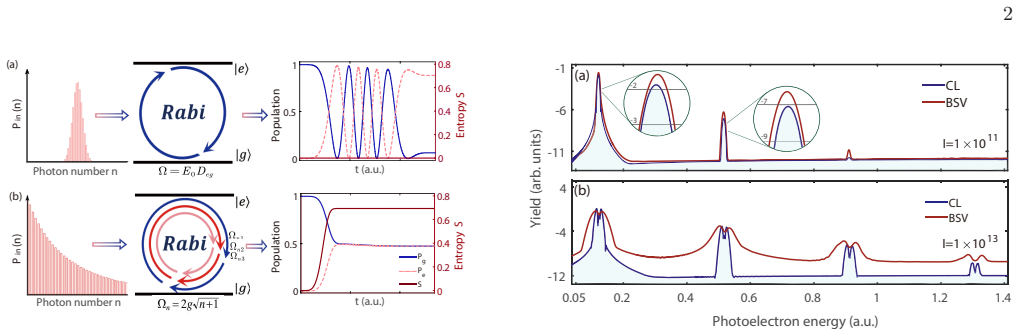
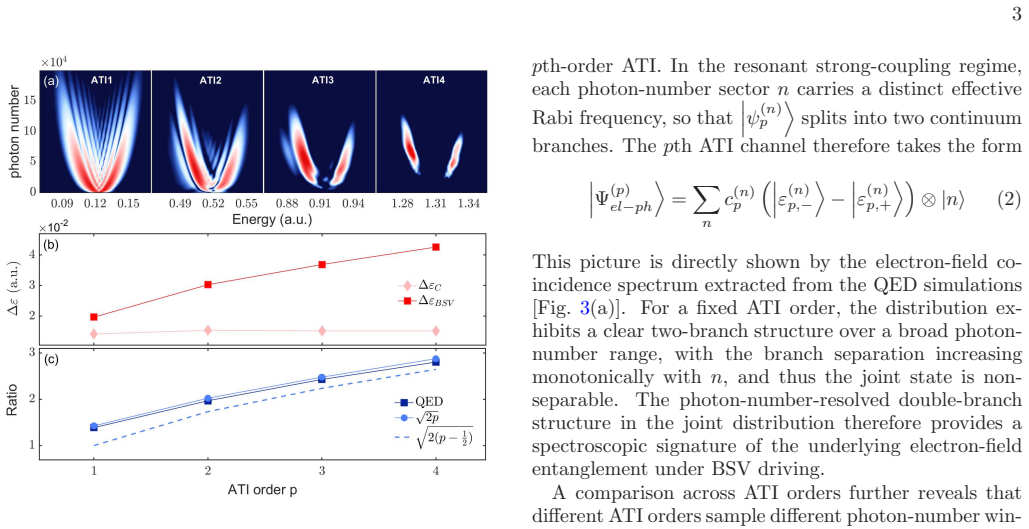
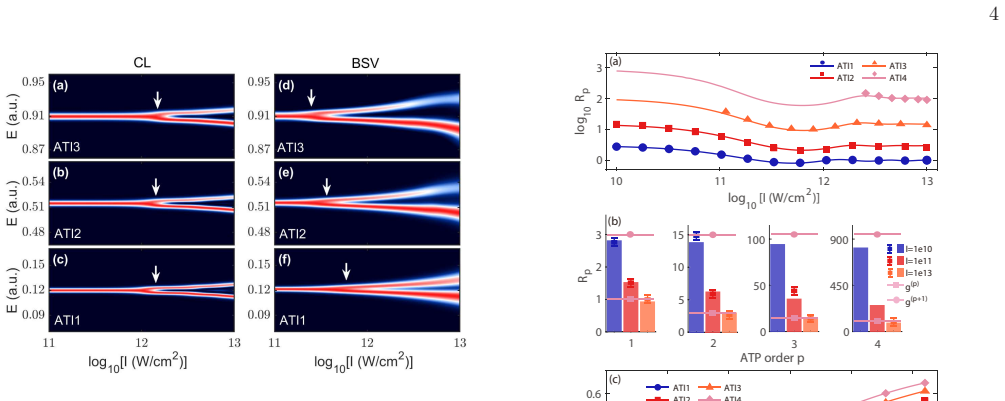
In resonant multiphoton ionization of atoms driven by bright squeezed vacuum, the photoelectron energy spectrum shows an anomalous Autler-Townes splitting whose magnitude grows with the ATI order. This scaling with the number of absorbed photons originates from the broad photon-number fluctuations of the driving field and the resulting electron-field entanglement. The ionization yield enhancement transitions from the g^(p+1) limit to the g^(p) limit as intensity rises and Rabi oscillations establish.
What carries the argument
Anomalous Autler-Townes splitting that scales with absorbed photon number, driven by photon-number fluctuations and electron-field entanglement in the fully quantum light-matter treatment.
If this is right
- The magnitude of the splitting scales with the total number of photons absorbed in the process.
- Ionization yields exhibit a crossover in their dependence on the second-order correlation function g as intensity increases.
- Standard treatments assuming coherent or classical fields miss the order-dependent splitting.
- Electron-field entanglement plays a key role in shaping the energy spectrum.
Where Pith is reading between the lines
- This could be tested in other strong-field processes involving nonclassical light such as high-harmonic generation.
- Similar anomalous splitting might appear in molecular systems or other multiphoton transitions.
- Measuring the splitting at different ATI peaks could serve as a probe of the photon statistics of the driving field.
- The effect suggests that light-matter entanglement can be used to control ionization outcomes.
Load-bearing premise
A fully quantum description of the electron and the field without additional decoherence or classical approximations captures the main dynamics of the ionization process.
What would settle it
Observe whether the width of the Autler-Townes splitting in the photoelectron spectrum increases proportionally with the ATI order when using bright squeezed vacuum, as opposed to remaining constant.
Figures
read the original abstract
Bright squeezed vacuum (BSV) light has a vanishing mean optical electric field yet can strongly enhance strong-field nonlinear responses beyond the conventional semiclassical paradigm. Here we examine this scenario in the light-matter strong-coupling regime by investigating resonant multiphoton ionization of atoms driven by BSV, using a fully quantum treatment of both the electron and the field. Our results show that the photoelectron energy spectrum exhibits an anomalous Autler-Townes splitting whose magnitude grows with the Above-threshold-ionization (ATI) order, rather than remaining essentially ATI-order independent as in the case of coherent driving. This behavior reflects a general scaling with the number of absorbed photons and originates from the broad photon-number fluctuations of the driving field together with the resulting electron-field entanglement. We further show that the BSV-induced enhancement of ionization yields evolves with intensity, crossing over from the $g^{(p+1)}$ limit to the $g^{(p)}$ limit as Rabi oscillations become established. These results identify a quantum regime of strong-field ionization governed by the interplay of photon statistics, nonlinear transitions, strong coupling, and nonseparable light-matter dynamics.
Editorial analysis
A structured set of objections, weighed in public.
Referee Report
Summary. The manuscript claims that bright squeezed vacuum (BSV) light, despite having vanishing mean electric field, can drive resonant multiphoton ionization in a fully quantum treatment of electron and field, leading to an anomalous Autler-Townes splitting in the photoelectron spectrum whose magnitude grows with ATI order, in contrast to the ATI-order independent splitting for coherent driving. This is attributed to broad photon-number fluctuations and electron-field entanglement. The paper further claims that the BSV-induced enhancement of ionization yields crosses over from the g^{(p+1)} to the g^{(p)} limit as intensity increases and Rabi oscillations establish.
Significance. If these results hold, they are significant in identifying a quantum regime of strong-field ionization governed by photon statistics, nonlinear transitions, strong coupling, and nonseparable light-matter dynamics. The reported scaling with the number of absorbed photons is a falsifiable prediction that could be tested experimentally, providing a clear strength of the work.
major comments (1)
- [Abstract] The central claim requires that the electron-field entanglement from BSV photon-number fluctuations produces an ATI-order-dependent Autler-Townes splitting that survives the full ionization dynamics. This holds only if no additional decoherence, loss, or classical-field-like averaging is present. The abstract states a fully quantum treatment is used, but without reported checks on master-equation terms, environmental coupling, or convergence of the joint Hilbert space, it is unclear whether the reported scaling is robust or an artifact of the closed-system assumption.
Simulated Author's Rebuttal
We thank the referee for their careful reading of the manuscript and for raising an important point about the robustness of the reported scaling under the closed-system assumption. We address the comment below.
read point-by-point responses
-
Referee: [Abstract] The central claim requires that the electron-field entanglement from BSV photon-number fluctuations produces an ATI-order-dependent Autler-Townes splitting that survives the full ionization dynamics. This holds only if no additional decoherence, loss, or classical-field-like averaging is present. The abstract states a fully quantum treatment is used, but without reported checks on master-equation terms, environmental coupling, or convergence of the joint Hilbert space, it is unclear whether the reported scaling is robust or an artifact of the closed-system assumption.
Authors: Our treatment is a closed-system, fully quantum model of the joint electron-field Hilbert space chosen specifically to isolate the consequences of photon-number fluctuations and entanglement without classical averaging or environmental terms. We agree that real experiments would include decoherence and loss, which could modify the observed ATI-order dependence; this is a genuine limitation of the idealization. Within the model, the joint Hilbert space is truncated at a photon-number cutoff chosen such that populations in the highest included states remain negligible for the intensities studied. We will add an explicit statement in the revised manuscript (and, if space permits, a short supplementary note) reporting these truncation checks together with a brief discussion of how weak phenomenological decay would affect the scaling. This revision directly addresses the concern that the scaling might be an artifact. revision: yes
Circularity Check
No circularity in derivation chain
full rationale
The provided abstract and context describe results from a fully quantum treatment of light-matter interaction in BSV-driven ionization, attributing the ATI-order-dependent Autler-Townes splitting to photon-number fluctuations and electron-field entanglement. No equations, parameter-fitting procedures, self-citations, or ansatzes are exhibited that would reduce any claimed prediction or scaling to an input quantity by construction. The central claims rest on the numerical or analytical outcomes of the joint Hilbert-space dynamics rather than on self-referential definitions or fitted inputs renamed as predictions. This is the normal case of a self-contained theoretical result.
Axiom & Free-Parameter Ledger
Reference graph
Works this paper leans on
-
[1]
4(a)- 4(c)], consistent with a single effec- 5 tive Rabi frequency governing all channels
Un- der coherent driving, resolvable AT doublets appear at nearly the same intensity for different ATI orders [white arrows in Figs. 4(a)- 4(c)], consistent with a single effec- 5 tive Rabi frequency governing all channels. Under BSV driving, by contrast, the onset of resolvable AT splitting shifts systematically to lower intensity with increasing ATI order...
-
[2]
(9) As a result, the ratio approaches g(p)
dominates instead, giving Y R p ∝ g(p)⟨n⟩p. (9) As a result, the ratio approaches g(p). The monotonic decrease of Rp(I) in Fig. 5(a) therefore reflects a con- tinuous transfer from direct ground-state ionization to resonant ionization, driving the effective BSV enhance- ment from g(p+1) to g(p). Note that this transition itself is ATI-order dependent. Under...
-
[3]
Observation of a train of at- 6 tosecond pulses from high harmonic generation,
Pierre-Mary Paul, E Toma, P Breger, Genevive Mullot, F Auge, Ph Balcou, H Muller, and Pierre Agostini, “Observation of a train of at- 6 tosecond pulses from high harmonic generation,” Science (New York, N.Y.) 292, 1689–92 (2001)
2001
-
[4]
The physics of attosecond light pulses,
Pierre Agostini and Louis F. DiMauro, “The physics of attosecond light pulses,” Reports on Progress in Physics 67, 813–855 (2004)
2004
-
[5]
Topics on mul- tiphoton processes in atoms,
Peter Lambropoulos, “Topics on mul- tiphoton processes in atoms,” in Advances in Atomic and Molecular Physics , Advances in Atomic and Molecular Physics, Vol. 12, edited by D.R. Bates and Benjamin Bederson (Academic Press,
-
[6]
Multiphoton ionization of atoms,
Charles K Rhodes, “Multiphoton ionization of atoms,” Science 229, 1345–1351 (1985)
1985
-
[7]
Free-free transi- tions following six-photon ionization of xenon atoms,
Pierre Agostini, F Fabre, G´ erard Mainfray, Guil- laume Petite, and N Ko Rahman, “Free-free transi- tions following six-photon ionization of xenon atoms,” Physical Review Letters 42, 1127–1130 (1979)
1979
-
[8]
Above- threshold ionization with subpicosecond laser pulses,
RR Freeman, PH Bucksbaum, H Milchberg, S Darack, D Schumacher, and ME Geusic, “Above- threshold ionization with subpicosecond laser pulses,” Physical Review Letters 59, 1092–1095 (1987)
1987
-
[9]
High-order harmonics measured by the photon statistics of the infrared driving-field exiting the atomic medium,
N Tsatrafyllis, IK Kominis, IA Gonoskov, and P Tzallas, “High-order harmonics measured by the photon statistics of the infrared driving-field exiting the atomic medium,” Nature Communications 8, 15170 (2017)
2017
-
[10]
High-order harmonic generation as in- duced by a quantized field: Phase-space picture,
´Akos Gombk¨ ot¨ o, S´ andor Varr´ o, P´ eter Mati, and P´ eter F¨ oldi, “High-order harmonic generation as in- duced by a quantized field: Phase-space picture,” Physical Review A 101, 013418 (2020)
2020
-
[11]
The quantum- optical nature of high harmonic generation,
Alexey Gorlach, Ofer Neufeld, Nicholas Rivera, Oren Cohen, and Ido Kaminer, “The quantum- optical nature of high harmonic generation,” Nature Communications 11, 4598 (2020)
2020
-
[12]
Describing high-order har- monic generation using quantum optical models,
P´ eter F¨ oldi, Istv´ an Magashegyi, ´Akos Gombk¨ ot¨ o, and S´ andor Varr´ o, “Describing high-order har- monic generation using quantum optical models,” Photonics 8, 263 (2021)
2021
-
[13]
Generation of optical schr¨ odinger cat states in intense laser–matter interac- tions,
Maciej Lewenstein, Marcelo F Ciappina, Emilio Pisanty , Javier Rivera-Dean, Philipp Stammer, Th Lam- prou, and Paraskevas Tzallas, “Generation of optical schr¨ odinger cat states in intense laser–matter interac- tions,” Nature Physics 17, 1104–1108 (2021)
2021
-
[14]
Light-matter entanglement after above-threshold ionization processes in atoms,
Javier Rivera-Dean, Philipp Stammer, Andrew S. Maxwell, Theocharis Lamprou, Paraskevas Tzallas, Ma- ciej Lewenstein, and Marcelo F. Ciappina, “Light-matter entanglement after above-threshold ionization processes in atoms,” Physical Review A 106, 063705 (2022)
2022
-
[15]
Theory of entanglement and measurement in high-order harmonic generation,
Philipp Stammer, “Theory of entanglement and measurement in high-order harmonic generation,” Physical Review A 106, L050402 (2022)
2022
-
[16]
High photon num- ber entangled states and coherent state superposi- tion from the extreme ultraviolet to the far infrared,
Philipp Stammer, Javier Rivera-Dean, Theocharis Lam- prou, Emilio Pisanty, Marcelo F. Ciappina, Paraskevas Tzallas, and Maciej Lewenstein, “High photon num- ber entangled states and coherent state superposi- tion from the extreme ultraviolet to the far infrared,” Physical Review Letters 128, 123603 (2022)
2022
-
[17]
Strong–laser–field physics, non–classical light states and quantum information science,
Utso Bhattacharya, Th Lamprou, Andrew S Maxwell, Andres Ordonez, Emilio Pisanty, Javier Rivera-Dean, Philipp Stammer, Marcelo F Ciap- pina, Maciej Lewenstein, and Paraskevas Tza- llas, “Strong–laser–field physics, non–classical light states and quantum information science,” Reports on Progress in Physics 86, 094401 (2023)
2023
-
[18]
Quan- tum phenomena in attosecond science,
Lidice Cruz-Rodriguez, Diptesh Dey, Anto- nia Freibert, and Philipp Stammer, “Quan- tum phenomena in attosecond science,” Nature Reviews Physics 6, 691–704 (2024)
2024
-
[19]
Optical time-domain quan- tum state tomography on a subcycle scale,
Emanuel Hubenschmid, Thiago LM Guedes, and Guido Burkard, “Optical time-domain quan- tum state tomography on a subcycle scale,” Physical Review X 14, 041032 (2024)
2024
-
[20]
Electron-correlation-induced non- classicality of light from high-order harmonic genera- tion,
Christian Saugbjerg Lange, Thomas Hansen, and Lars Bojer Madsen, “Electron-correlation-induced non- classicality of light from high-order harmonic genera- tion,” Physical Review A 109, 033110 (2024)
2024
-
[21]
Light emission from strongly driven many-body systems,
Andrea Pizzi, Alexey Gorlach, Nicholas Rivera, An- dreas Nunnenkamp, and Ido Kaminer, “Light emission from strongly driven many-body systems,” Nature Physics 19, 551–561 (2023)
2023
-
[22]
Evidence of the quantum optical nature of high-harmonic generation,
David Theidel, Viviane Cotte, Ren´ e Sondenheimer, Vik - toriia Shiriaeva, Marie Froidevaux, Vladislav Severin, Adam Merdji-Larue, Philip Mosel, Sven Fr¨ ohlich, Kim- Alessandro Weber, Uwe Morgner, Milutin Kovacev, Jens Biegert, and Hamed Merdji, “Evidence of the quantum optical nature of high-harmonic generation,” PRX Quantum 5, 040319 (2024)
2024
-
[23]
Entanglement and squeezing of the optical field modes in high harmonic generation,
Philipp Stammer, Javier Rivera-Dean, Andrew S. Maxwell, Theocharis Lamprou, Javier Arg¨ uello-Luengo, Paraskevas Tzallas, Marcelo F. Ciappina, and Ma- ciej Lewenstein, “Entanglement and squeezing of the optical field modes in high harmonic generation,” Physical Review Letters 132, 143603 (2024)
2024
-
[24]
Squeezed states of light after high- order harmonic generation in excited atomic systems,
Javier Rivera-Dean, H. B. Crispin, Philipp Stam- mer, Theocharis Lamprou, Emilio Pisanty, Martin Kr¨ uger, Paraskevas Tzallas, Maciej Lewenstein, and Marcelo F. Ciappina, “Squeezed states of light after high- order harmonic generation in excited atomic systems,” Physical Review A 110, 063118 (2024)
2024
-
[25]
High-order harmonic gen- eration in a crystal driven by quantum light,
Rasmus Vesterager Gothelf, Christian Saugbjerg Lange , and Lars Bojer Madsen, “High-order harmonic gen- eration in a crystal driven by quantum light,” Physical Review A 111, 063105 (2025)
2025
-
[26]
Quantum path control in high- order harmonic generation via squeezed light,
Feng Wang, Chunhui Yang, Xinyi Cui, Lixin He, Tianxin Ou, Rui-Bo Jin, Qing Liao, Pengfei Lan, and Peixiang Lu, “Quantum path control in high- order harmonic generation via squeezed light,” Phys. Rev. A 112, 043119 (2025)
2025
-
[27]
High-order harmonic generation in quantum light by a generalized von neumann lattice method,
Yi-Ben Wang and Xue-Bin Bian, “High-order harmonic generation in quantum light by a generalized von neumann lattice method,” Physical Review A 111, 043111 (2025)
2025
-
[28]
Attosecond pulse synthesis from high-order harmonic generation in intense squeezed light,
ShiJun Wang, XuanYang Lai, and XiaoJun Liu, “Attosecond pulse synthesis from high-order harmonic generation in intense squeezed light,” Phys. Rev. A 112, L011102 (2025)
2025
-
[29]
Generation of massively entangled bright states of light during harmonic generation in res- onant media,
Sili Yi, Nikolai D. Klimkin, Graham Gardiner Brown, Olga Smirnova, Serguei Patchkovskii, Ihar Babushkin, and Misha Ivanov, “Generation of massively entangled bright states of light during harmonic generation in res- onant media,” Physical Review X 15, 011023 (2025)
2025
-
[30]
Multiphoton effects en- hanced due to ultrafast photon-number fluctuations,
Kirill Yu. Spasibko, Denis A. Kopylov, Victor L. Krutyanskiy, Tatiana V. Murzina, Gerd Leuchs, and Maria V. Chekhova, “Multiphoton effects en- hanced due to ultrafast photon-number fluctuations,” Physical Review Letters 119, 223603 (2017)
2017
-
[31]
Compton scattering driven by intense quantum light,
Majed Khalaf and Ido Kaminer, “Compton scattering driven by intense quantum light,” 7 Science Advances 9, eade0932 (2023)
2023
-
[32]
Generation of squeezed high-order harmonics,
Matan Even Tzur, Michael Birk, Alexey Gorlach, Ido Kaminer, Michael Kr¨ uger, and Oren Co- hen, “Generation of squeezed high-order harmonics,” Physical Review Research 6, 033079 (2024)
2024
-
[33]
Hy- drogen molecular dissociation driven by quantum light,
Xiaoxiao Long, Peizeng Li, and Yunquan Liu, “Hy- drogen molecular dissociation driven by quantum light,” Phys. Rev. Lett. 135, 153201 (2025)
2025
-
[34]
Photon bunching in high-harmonic emission controlled by quantum light,
Samuel Lemieux, Sohail A. Jalil, David N. Purschke, Neda Boroumand, David Villeneuve, Andrei Naumov, Thomas Brabec, and Giulio Vampa, “Photon bunching in high-harmonic emission controlled by quantum light,” Nature Photonics 19, 767–771 (2025)
2025
-
[35]
High-harmonic generation driven by quantum light,
Alexey Gorlach, Matan Even Tzur, Michael Birk, Michael Kr¨ uger, Nicholas Rivera, Oren Cohen, and Ido Kaminer, “High-harmonic generation driven by quantum light,” Nature Physics 19, 1689–1696 (2023)
2023
-
[36]
High- harmonic generation by a bright squeezed vacuum,
Andrei Rasputnyi, Zhaopin Chen, Michael Birk, Oren Cohen, Ido Kaminer, Michael Kr¨ uger, Denis Selet- skiy, Maria Chekhova, and Francesco Tani, “High- harmonic generation by a bright squeezed vacuum,” Nature Physics 20, 1960–1965 (2024)
1960
-
[37]
Multiphoton electron emission with non- classical light,
Jonas Heimerl, Alexander Mikhaylov, Stefan Meier, Hen - rick H¨ ollerer, Ido Kaminer, Maria Chekhova, and Peter Hommelhoff, “Multiphoton electron emission with non- classical light,” Nature Physics 20, 945–950 (2024)
2024
-
[38]
Quantum light drives electrons strongly at metal nee- dle tips,
Jonas Heimerl, Andrei Rasputnyi, Jonathan P¨ olloth, Ste- fan Meier, Maria Chekhova, and Peter Hommelhoff, “Quantum light drives electrons strongly at metal nee- dle tips,” Nature Physics 21, 1899–1904 (2025)
1904
-
[39]
Motion of charged particles in bright squeezed vacuum,
Matan Even Tzur and Oren Cohen, “Motion of charged particles in bright squeezed vacuum,” Light: Science & Applications 13, 41 (2024)
2024
-
[40]
Strong-field ionization of hydrogen atoms with quantum light,
Yiqi Fang, Fengxiao Sun, Qiongyi He, and Yunquan Liu, “Strong-field ionization of hydrogen atoms with quantum light,” Physical Review Letters 130, 253201 (2023)
2023
-
[41]
Atomic double ionization with quantum light,
Haoyu Liu, Hanxu Zhang, Xu Wang, and Jianmin Yuan, “Atomic double ionization with quantum light,” Physical Review Letters 134, 123202 (2025)
2025
-
[42]
Su- perbunched bright squeezed vacuum state,
T Sh. Iskhakov, AM P´ erez, K Yu. Spasi- bko, MV Chekhova, and G Leuchs, “Su- perbunched bright squeezed vacuum state,” Optics Letters 37, 1919–1921 (2012)
1919
-
[43]
Raman- free, noble-gas-filled photonic-crystal fiber source for ultrafast, very bright twin-beam squeezed vacuum,
Martin A Finger, Timur Sh Iskhakov, Nicolas Y Joly, Maria V Chekhova, and Philip St J Russell, “Raman- free, noble-gas-filled photonic-crystal fiber source for ultrafast, very bright twin-beam squeezed vacuum,” Physical Review Letters 115, 143602 (2015)
2015
-
[44]
Schleich, Quantum Optics in Phase Space (Wiley-VCH, Berlin, 2001)
Wolfgang P. Schleich, Quantum Optics in Phase Space (Wiley-VCH, Berlin, 2001)
2001
-
[45]
Single- shot pulse retrieval of femtosecond bright squeezed vac- uum,
Yuval Kern, Ido Nisim, Michael Birk, Andrei Rasput- nyi, Doron Behar, Zhaopin Chen, Ido Kaminer, Pavel Sidorenko, Oren Cohen, and Michael Kr¨ uger, “Single- shot pulse retrieval of femtosecond bright squeezed vac- uum,” Optica 13, 395–399 (2026)
2026
-
[46]
Space quantization in a gyrating magnetic field,
I. I. Rabi, “Space quantization in a gyrating magnetic field,” Phys. Rev. 51, 652–654 (1937)
1937
-
[47]
The rabi frequency in optical spectra,
P.L. Knight and P.W. Milonni, “The rabi frequency in optical spectra,” Physics Reports 66, 21–107 (1980)
1980
-
[48]
Observation of continuum-continuum autler-townes splitting,
Barry Walker, M. Kaluˇ za, B. Sheehy, P. Agos- tini, and L. F. DiMauro, “Observation of continuum-continuum autler-townes splitting,” Phys. Rev. Lett. 75, 633–636 (1995)
1995
-
[49]
Autler-townes split- ting in the multiphoton resonance ionization spec- trum of molecules produced by ultrashort laser pulses,
Zhigang Sun and Nanquan Lou, “Autler-townes split- ting in the multiphoton resonance ionization spec- trum of molecules produced by ultrashort laser pulses,” Phys. Rev. Lett. 91, 023002 (2003)
2003
-
[50]
Control of interferences in an autler- townes doublet: Symmetry of control parameters,
M. Wollenhaupt, A. Assion, O. Bazhan, Ch. Horn, D. Liese, Ch. Sarpe-Tudoran, M. Winter, and T. Baumert, “Control of interferences in an autler- townes doublet: Symmetry of control parameters,” Physical Review A 68, 015401 (2003)
2003
-
[51]
Photoionization of resonantly driven atomic states by an extreme ultraviolet-free-electron laser: in- tensity dependence and renormalization of rabi frequen- cies,
B Kaiser, A Brand, M Gl¨ assl, A Vagov, V M Axt, and U Pietsch, “Photoionization of resonantly driven atomic states by an extreme ultraviolet-free-electron laser: in- tensity dependence and renormalization of rabi frequen- cies,” New Journal of Physics 15, 093016 (2013)
2013
-
[52]
Carrier-wave rabi-flopping signatures in high-order harmonic generation for alkali atoms,
M. F. Ciappina, J. A. P´ erez-Hern´ andez, A. S. Lands- man, T. Zimmermann, M. Lewenstein, L. Roso, and F. Krausz, “Carrier-wave rabi-flopping signatures in high-order harmonic generation for alkali atoms,” Physical Review Letters 114, 143902 (2015)
2015
-
[53]
Femtosecond two-photon rabi os- cillations in excited he driven by ultrashort intense laser fields,
M Fushitani, C-N Liu, A Matsuda, T Endo, Y Toida, M Nagasono, T Togashi, M Yabashi, T Ishikawa, Y Hikosaka, et al. , “Femtosecond two-photon rabi os- cillations in excited he driven by ultrashort intense laser fields,” Nature Photonics 10, 102–105 (2016)
2016
-
[54]
Photoelectron spectra after multipho- ton ionization of li atoms in the one-photon rabi-flopping regime,
D. A. Tumakov, Dmitry A. Telnov, G. Plunien, and V. M. Shabaev, “Photoelectron spectra after multipho- ton ionization of li atoms in the one-photon rabi-flopping regime,” Phys. Rev. A 100, 023407 (2019)
2019
-
[55]
New source for tuning the effective rabi frequency discovered in multiphoton ionization,
Wankai Li, Yue Lei, Xing Li, Tao Yang, Mei Du, Ying Jiang, Jialong Li, Aihua Liu, Lanhai He, Pan Ma, et al. , “New source for tuning the effective rabi frequency discovered in multiphoton ionization,” arXiv preprint arXiv:2112.13096 (2021)
arXiv 2021
-
[56]
Probing strong-field two-photon transitions through dynamic interference,
Attila T´ oth and Andr´ as Csehi, “Probing strong-field two-photon transitions through dynamic interference,” Journal of Physics B: Atomic, Molecular and Optical Physics 54, 035005
-
[57]
Enhanc- ing autler-townes splittings by ultrafast xuv pulses,
Wei-Chao Jiang, Hao Liang, Shun Wang, Liang- You Peng, and Joachim Burgd¨ orfer, “Enhanc- ing autler-townes splittings by ultrafast xuv pulses,” Phys. Rev. Research 3, L032052 (2021)
2021
-
[58]
Effect of nonresonant states in near-resonant two-photon ionization of hydrogen,
Xu Zhang, Yueming Zhou, Yijie Liao, Yongkun Chen, Jintai Liang, Qinghua Ke, Min Li, Andr´ as Csehi, and Peixiang Lu, “Effect of nonresonant states in near-resonant two-photon ionization of hydrogen,” Phys. Rev. A 106, 063114 (2022)
2022
-
[59]
Observation of rabi dy- namics with a short-wavelength free-electron laser,
Saikat Nandi, Edvin Olofsson, Mattias Bertolino, Stefanos Carlstr¨ om, Felipe Zapata, David Busto, Carlo Callegari, Michele Di Fraia, Per Eng-Johnsson, Raimund Feifel, et al. , “Observation of rabi dy- namics with a short-wavelength free-electron laser,” Nature 608, 488–493 (2022)
2022
-
[60]
Re- construction of attosecond beating by interference of two- photon transitions on the lithium atom with rabi oscilla- tions,
Yijie Liao, Yueming Zhou, Liang-Wen Pi, Jintai Liang, Qinghua Ke, Yong Zhao, Min Li, and Peixiang Lu, “Re- construction of attosecond beating by interference of two- photon transitions on the lithium atom with rabi oscilla- tions,” Phys. Rev. A 105, 063110 (2022)
2022
-
[61]
Photoelec- tron signature of dressed-atom stabilization in an intense xuv field,
Edvin Olofsson and Jan Marcus Dahlstr¨ om, “Photoelec- tron signature of dressed-atom stabilization in an intense xuv field,” Physical Review Research 5, 043017 (2023)
2023
-
[62]
Phase control of the autler-townes doublet in multistate systems,
T. Bayer, K. Eickhoff, D. K¨ ohnke, and M. Wollenhaupt, “Phase control of the autler-townes doublet in multistate systems,” Physical Review A 108, 033111 (2023)
2023
-
[63]
Proposal for observing xuv-induced 8 rabi oscillation using superfluorescent emission,
Jun Jie Cui, Yongjun Cheng, Xin Wang, Zheng Li, Nina Rohringer, Victor Kimberg, and Song Bin Zhang, “Proposal for observing xuv-induced 8 rabi oscillation using superfluorescent emission,” Physical Review Letters 131, 043201 (2023)
2023
-
[64]
Rabi oscillations in a stretching molecule,
Shengzhe Pan, Chenxi Hu, Wenbin Zhang, Zhao- han Zhang, Lianrong Zhou, Chenxu Lu, Peifen Lu, Hongcheng Ni, Jian Wu, and Feng He, “Rabi oscillations in a stretching molecule,” Light: Science & Applications 12, 35 (2023)
2023
-
[65]
Control of ion-photoelectron en- tanglement and coherence via rabi oscillations,
Kenichi L Ishikawa, Kevin C Prince, and Kiyoshi Ueda, “Control of ion-photoelectron en- tanglement and coherence via rabi oscillations,” The Journal of Physical Chemistry A 127, 10638–10646 (2023)
2023
-
[66]
Generation of entanglement using a short-wavelength seeded free-electron laser,
Saikat Nandi, Axel Stenquist, Asimina Papoulia, Ed- vin Olofsson, Laura Badano, Mattias Bertolino, David Busto, Carlo Callegari, Stefanos Carlstr¨ om, Miltcho B. Danailov, Philipp V. Demekhin, Michele Di Fraia, Per Eng-Johnsson, Raimund Feifel, Guillaume Gallician, Luca Giannessi, Mathieu Gisselbrecht, Michele Man- fredda, Michael Meyer, Catalin Miron, Ja...
2024
-
[67]
Spectral evidence of vibronic rabi oscil- lations in the resonance-enhanced photodissociation of mgh+,
Dilfuza Umarova, Otabek Umarov, Attila T´ oth, and Andr´ as Csehi, “Spectral evidence of vibronic rabi oscil- lations in the resonance-enhanced photodissociation of mgh+,” Physical Review A 110, 033112 (2024)
2024
-
[68]
Attosecond rabi oscillations in high harmonic generation reso- nantly driven by extreme ultraviolet laser fields,
Alba de las Heras, Carlos Hern´ andez-Garc ´ ıa, Javier Serrano, Aleksandar Prodanov, Dimitar Popmintchev, Tenio Popmintchev, and Luis Plaja, “Attosecond rabi oscillations in high harmonic generation reso- nantly driven by extreme ultraviolet laser fields,” Physical Review Research 7, 023268 (2025)
2025
-
[69]
Quantum electrodynamics of intense laser-matter in- teractions: A tool for quantum state engineering,
Philipp Stammer, Javier Rivera-Dean, Andrew Maxwell, Theocharis Lamprou, Andr´ es Ord´ o˜ nez, Marcelo F Ciap- pina, Paraskevas Tzallas, and Maciej Lewenstein, “Quantum electrodynamics of intense laser-matter in- teractions: A tool for quantum state engineering,” PRX Quantum 4, 010201 (2023)
2023
-
[70]
Quan- tum electrodynamics in high-harmonic generation: Multitrajectory ehrenfest and exact quantum analysis,
Sebasti´ an de-la Pe˜ na, Ofer Neufeld, Matan Even Tzur, Oren Cohen, Heiko Appel, and Angel Rubio, “Quan- tum electrodynamics in high-harmonic generation: Multitrajectory ehrenfest and exact quantum analysis,” Journal of Chemical Theory and Computation 21, 283–290 (2025)
2025
-
[71]
See Supplemental Material for details of the QED frame- work, the extended JC model, and the analytical deriva- tions of the ATI-order-dependent AT splitting and yield scaling during Rabi oscillations
-
[72]
Indefinite- mean pareto photon distribution from amplified quantum noise,
Mathieu Manceau, Kirill Yu Spasibko, Gerd Leuchs, Radim Filip, and Maria V Chekhova, “Indefinite- mean pareto photon distribution from amplified quantum noise,” Physical Review Letters 123, 123606 (2019)
2019
-
[73]
Scully and M
Marlan O. Scully and M. Suhail Zubairy, Quantum Optics (Cambridge University Press, Cam- bridge, 1997)
1997
discussion (0)
Sign in with ORCID, Apple, or X to comment. Anyone can read and Pith papers without signing in.