CSI Phase Averaging for High-Sensitivity Wi-Fi Sensing in Low-Multipath Environments
Pith reviewed 2026-06-27 21:05 UTC · model grok-4.3
The pith
CSI phase averaging mitigates device errors to detect motion several meters off the direct path in low-multipath settings.
A machine-rendered reading of the paper's core claim, the machinery that carries it, and where it could break.
Core claim
In low-multipath propagation environments the structural characteristics of CSI phase components permit model-driven averaging that removes phase offset errors from wireless devices while supplying processing gain against quantization and thermal noise, thereby enabling detection of birds flying several meters away from the direct line-of-sight path between transmitter and receiver antennas.
What carries the argument
Model-driven averaging of CSI phase components that exploits the structural regularity of low-multipath environments to correct device phase offsets and suppress noise.
If this is right
- Birds can be detected several meters away from the direct transmitter-receiver path.
- Vegetation fluctuations remain negligible at wind speeds below 3 m/s.
- The method works with unmodified commercial IEEE 802.11ac devices.
- The same approach applies to other outdoor sensing tasks in low-multipath settings.
Where Pith is reading between the lines
- The phase-averaging step could be combined with existing amplitude-based CSI methods to increase robustness in mixed environments.
- Similar averaging might support detection of slower or larger targets such as vehicles or people in open outdoor areas.
- Deployment in additional low-multipath sites such as open fields or along roads would test whether the reported performance generalizes.
Load-bearing premise
Low-multipath propagation environments produce consistent structural features in the CSI phase that can be modeled and averaged to correct device-induced phase offsets.
What would settle it
Measurements in the same orchard setup showing that phase offsets remain after averaging or that birds several meters off the line-of-sight path are no longer detected would falsify the claim.
Figures
read the original abstract
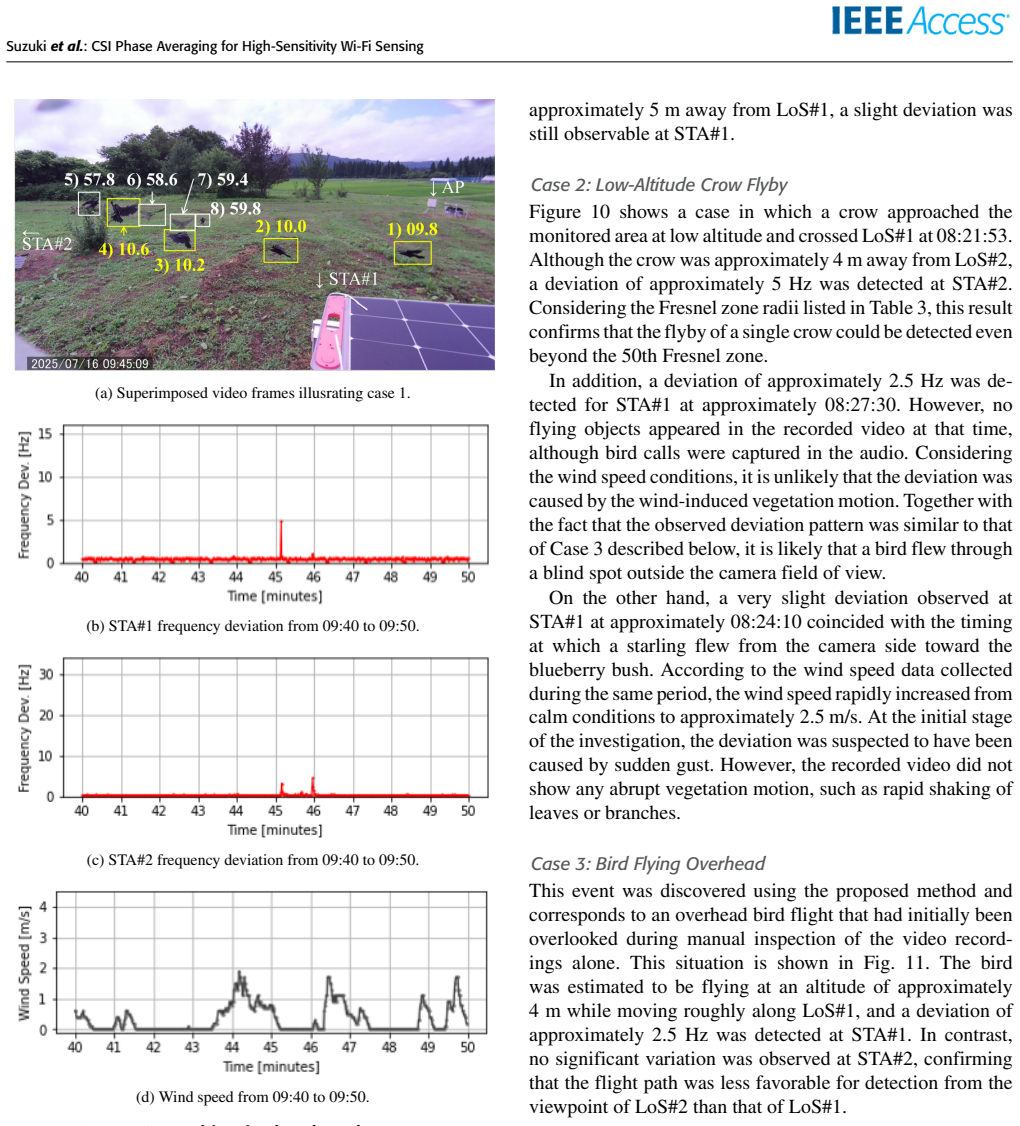
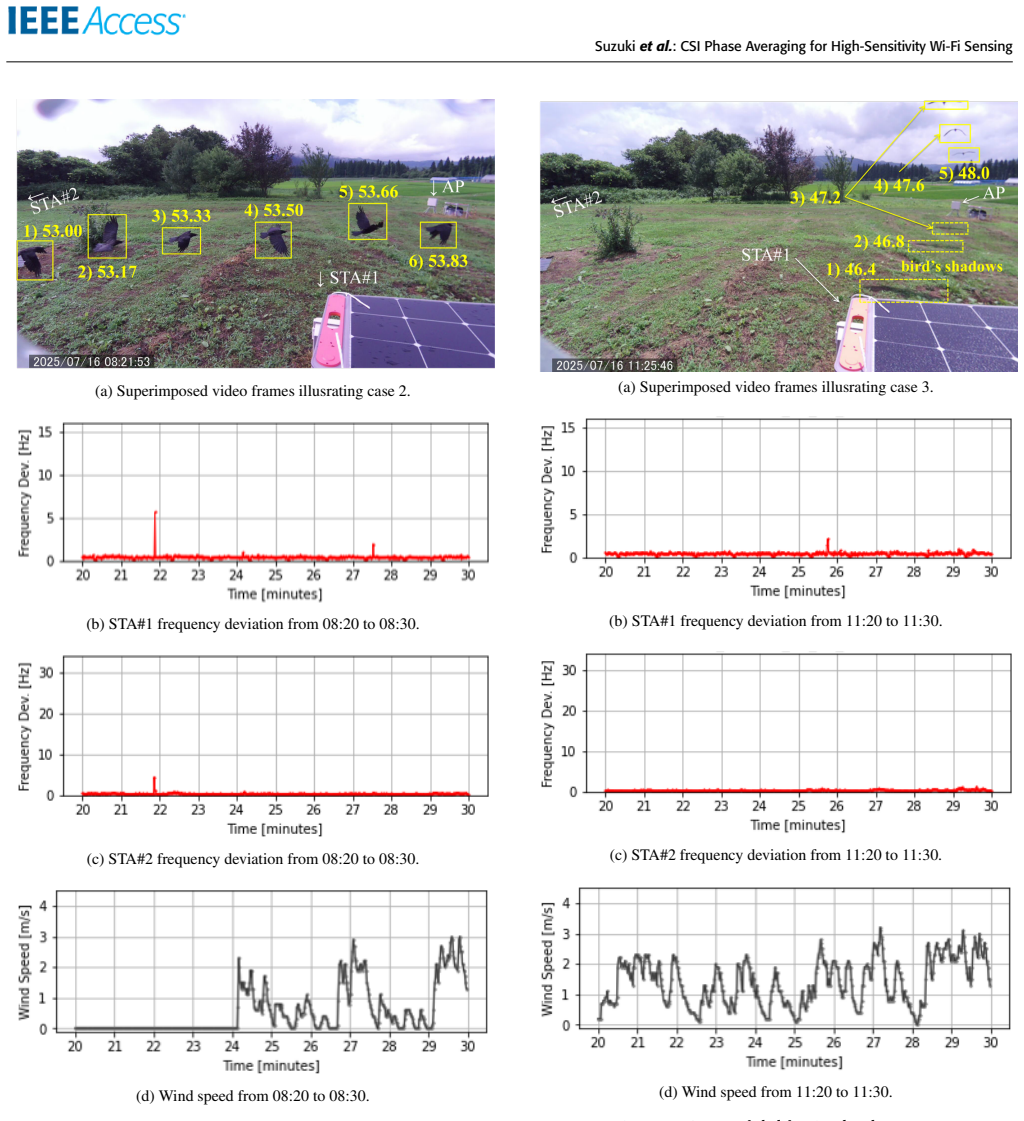
This paper presents a low-complexity motion detection method for outdoor Wi-Fi sensing based on a model-driven approach. The method exploits the structural characteristics of the phase components in channel state information (CSI) for low-multipath propagation environments, which are generally considered disadvantageous for Wi-Fi sensing, to mitigate the phase offset errors originating from wireless devices. In addition, phase averaging provides a processing gain that reduces the random noise components, including quantization and thermal noise. The theoretical basis of the method is described and its effectiveness is experimentally evaluated using Compressed Beamforming frames obtained from commercial IEEE 802.11ac devices. The experiments primarily focus wild crows flying in an outdoor orchard environment. The experimental results demonstrate that the method can detect birds even when they fly several meters away from the direct line-of-sight path between the transmitter and receiver antennas. Furthermore, the results indicated that fluctuations caused by vegetation movement were negligible when the wind speed was less than 3~m/s. The proposed approach is expected to be applicable not only to orchard monitoring but also to other outdoor Wi-Fi sensing applications in low-multipath environments.
Editorial analysis
A structured set of objections, weighed in public.
Referee Report
Summary. The paper proposes a low-complexity, model-driven CSI phase averaging technique for motion detection in low-multipath outdoor Wi-Fi environments. It exploits structural properties of CSI phase components to mitigate device phase offsets and applies averaging for processing gain against noise. The central experimental claim is that the method detects wild crows flying several meters off the direct LOS path between commercial 802.11ac transmitter and receiver antennas in an orchard setting, while vegetation motion effects remain negligible below 3 m/s wind speed.
Significance. If validated, the approach would provide a practical, hardware-friendly sensing solution for low-multipath outdoor scenarios (e.g., orchard monitoring) where conventional Wi-Fi sensing is considered disadvantageous. The use of real Compressed Beamforming frames from commercial devices and explicit focus on off-LOS targets constitutes a concrete experimental contribution.
major comments (2)
- [Abstract / Theoretical basis] Abstract and theoretical basis section: the off-LOS detection claim (birds several meters laterally from the direct path) is load-bearing for the paper's contribution, yet no link-budget calculation, expected differential phase shift from the scattered component, or comparison of scattered-path power to residual noise floor after averaging is supplied; in a low-multipath regime the direct path dominates and the diffracted amplitude set by RCS and extra path loss may fall below detectability even after averaging.
- [Experimental evaluation] Experimental evaluation: the abstract states detection success with real devices but supplies no quantitative metrics (detection probability, ROC curves, SNR improvement, error bars, or number of trials), leaving the performance outcome only moderately supported and preventing assessment of whether phase averaging actually overcomes the weak scattered-signal regime.
minor comments (2)
- [Theoretical basis] Notation for CSI phase components and the exact averaging operation should be defined with equations early in the theoretical section to allow readers to reproduce the claimed processing gain.
- [Experimental setup] The manuscript should clarify the precise distance range and geometry of the off-LOS flights (e.g., minimum lateral separation) in the experimental setup description.
Simulated Author's Rebuttal
We thank the referee for the thoughtful comments on our manuscript. We provide point-by-point responses to the major comments below and indicate the revisions we will make.
read point-by-point responses
-
Referee: [Abstract / Theoretical basis] Abstract and theoretical basis section: the off-LOS detection claim (birds several meters laterally from the direct path) is load-bearing for the paper's contribution, yet no link-budget calculation, expected differential phase shift from the scattered component, or comparison of scattered-path power to residual noise floor after averaging is supplied; in a low-multipath regime the direct path dominates and the diffracted amplitude set by RCS and extra path loss may fall below detectability even after averaging.
Authors: We agree that a quantitative link-budget analysis would help support the off-LOS detection claim in the low-multipath setting. Although the primary contribution is the model-driven phase averaging technique and its experimental validation, we will add a new subsection in the theoretical basis section providing an order-of-magnitude link budget. This will include estimates of bird RCS, extra path loss for lateral scattering, and the noise reduction factor from averaging multiple CSI samples. This addition will clarify why the scattered component remains detectable despite the dominant direct path. revision: yes
-
Referee: [Experimental evaluation] Experimental evaluation: the abstract states detection success with real devices but supplies no quantitative metrics (detection probability, ROC curves, SNR improvement, error bars, or number of trials), leaving the performance outcome only moderately supported and preventing assessment of whether phase averaging actually overcomes the weak scattered-signal regime.
Authors: The experiments rely on opportunistic observations of wild bird flights in an orchard, which limits the ability to generate full statistical metrics such as ROC curves that would require a large number of controlled trials. The manuscript includes multiple example time series demonstrating detection of off-LOS motion and negligible vegetation effects. In the revision, we will add the number of observed events, estimates of SNR improvement due to averaging, and error bars on relevant plots. We believe this will better support the claims while remaining faithful to the experimental constraints. revision: partial
Circularity Check
No circularity: experimental method validated on external data
full rationale
The paper proposes a model-driven CSI phase averaging technique that exploits phase structure in low-multipath settings to reduce device offsets and noise. Its central claims rest on a described theoretical basis followed by direct experimental evaluation using commercial 802.11ac devices and real-world crow flights in an orchard. No equations, fitted parameters, or self-citations are shown that would reduce the reported detection performance to a quantity defined by the method itself. The off-LOS detection result is assessed against independent external observations rather than being forced by construction from the inputs.
Axiom & Free-Parameter Ledger
Reference graph
Works this paper leans on
-
[1]
Cost benefit analysis of a netting technology package in real farming conditions among smallholder farmers in Kenya,
E. Mujuka, L. Parrot, W. Baird, E. Delettre, J. Simon, J. Mburu and T. Mar- tin, "Cost benefit analysis of a netting technology package in real farming conditions among smallholder farmers in Kenya," inXXXI International Horticultural Congress (IHC2022), Angers, France, Oct. 2023, pp. 153- 158
2023
-
[2]
Bird Deterrent Solutions for Crop Protection: Approaches, Challenges, and Opportunities,
Eduardo B. Micaelo, Leonardo G. P . S. Lourenço, Pedro D. Gaspar, João M. L. P . Caldeira and V asco N. G. J. Soares, "Bird Deterrent Solutions for Crop Protection: Approaches, Challenges, and Opportunities,"Agriculture, vol. 13, no. 4:774, pp. 1-29, Feb. 2023, DOI: 10.3390/agriculture13040774
-
[3]
Current status of bird damage on crop and four new countermeasures,
Y . Y amaguchi, "Current status of bird damage on crop and four new countermeasures,"Japanese Journal of Farm Work Research, vol. 52, no. 2, pp. 65-74, June 2019, DOI: 10.4035/jsfwr.54.65
-
[4]
A survey on CSI-based Wi-Fi sensing datasets and models with a focus on reproducibility,
I. Guarino, D. Carra, M. Cominelli, F. Gringoli and R. L. Cigno, "A survey on CSI-based Wi-Fi sensing datasets and models with a focus on reproducibility," inComputer Communications, vol. 249, (2026)108431, pp. 1-18, Jan 2026, DOI: 10.1016/j.comcom.2026.108431
-
[5]
Commodity Wi-Fi-Based Wireless Sensing Advancements over the Past Five Y ears,
H. Zhu, E. Dong, M. Xu, H. Lv and F. Wu, "Commodity Wi-Fi-Based Wireless Sensing Advancements over the Past Five Y ears," inSensorsV ol. 24, Issue 22, Mar 2023, DOI: 10.3390/s24227195
-
[6]
J. A. Armenta-Garcia, F. F. Gonzalez-Navarro and J. Caro-Gutierrez, "Wireless sensing applications with Wi-Fi Channel State Informa- tion, preprocessing techniques, and detection algorithms: A survey," in Computer Communicationsvol. 224, pp. 254-–274, June 2024, DOI: 10.1016/j.comcom.2024.06.011
-
[7]
WiFi Sensing on the Edge: Signal Pro- cessing Techniques and Challenges for Real-World Systems,
S. M. Hernandez and E. Bulut, "WiFi Sensing on the Edge: Signal Pro- cessing Techniques and Challenges for Real-World Systems," inIEEE Communications Surveys Tuts, vol. 25, no. 1, pp. 46-76, 1Q 2023, DOI: 10.1109/COMST.2022.3209144
-
[8]
Commodity WiFi Sens- ing in Ten Y ears: Status, Challenges, and Opportunities,
S. Tan, Y . Ren, J. Y ang and Y . Chen, "Commodity WiFi Sens- ing in Ten Y ears: Status, Challenges, and Opportunities,"IEEE In- ternet of Things Journal, vol. 9, no. 18, pp. 17832—17843. DOI: 10.1109/JIOT.2022.3164569
-
[9]
CSI-based human sensing using model-based approaches: A survey,
Z. Wang, Z. Huang, C. Zhang, W. Dou, Y . Guo and D. Chen, "CSI-based human sensing using model-based approaches: A survey," inJournal of Computational Design and Engineeringvol. 8, issue 2, pp. 510—523. Oxford University Press. DOI: 10.1093/jcde/qwab003
-
[10]
Context Recog- nition by Wireless Sensing: A Comprehensive Survey,
A. Uchiyama, S. Saruwatari, T. Maekawa and K. Ohara, "Context Recog- nition by Wireless Sensing: A Comprehensive Survey,"Journal of Infor- mation Processing, vol. 29, pp. 1—12. DOI: 10.2197/ipsjjip.29.1
-
[11]
WiFi Vision: Sensing, Recog- nition, and Detection with Commodity MIMO-OFDM WiFi,
Y . He, Y . Chen, Y . Hu and B. Zeng, "WiFi Vision: Sensing, Recog- nition, and Detection with Commodity MIMO-OFDM WiFi,"IEEE Internet of Things Journal, vol. 7, no. 9, pp. 8296-–8317. DOI: 10.1109/JIOT.2020.2989426
-
[12]
Y . Ma, G. Zhou and S. Wang,‘‘Wi-Fi sensing with channel state informa- tion: A survey,’’ACM Comput. Surveys, vol. 52, no. 3, pp. 1-36, Jun. 2019, DOI: 10.1145/3310194
-
[13]
Widar3.0: Zero-Effort Cross-Domain Gesture Recognition With Wi-Fi,
Y . Zhang, Y . Zheng, K. Qian, G. Zhang, Y . Liu, C. Wu and Z. Y ang, "Widar3.0: Zero-Effort Cross-Domain Gesture Recognition With Wi-Fi," IEEE Transactions on Pattern Analysis and Machine Intelligence, vol. 44, no. 11, pp. 8671-–8688, Nov. 2022, DOI :10.1109/TPAMI.2021.3105387
-
[14]
S. Shimizu, O. Muta, T. Murakami, S. Otsuki and R. Otani, "Experimental Evaluation of WLAN-based Object Detection Using CSI in Outdoor and Large-scale Indoor Environments,"IEEE V ehicular Technology Confer- ence.DOI: 10.1109/VTC2024-Fall63153.2024.10757785
-
[15]
WiFi Sensing for Outdoor Surveillance,
J. Li, A. Sharma, D. Mishra, J. G. Davis and A. Seneviratne, "WiFi Sensing for Outdoor Surveillance," in2022 56th Asilomar Conference on Signals, Systems, and Computers, Pacific Grove, CA, USA, Oct. 2022, pp. 834-836, DOI: 10.1109/IEEECONF56349.2022.10051917
-
[16]
Initial At- tempt on Outdoor Human Detection using IEEE 802.11ac WLAN Signal,
M. Miyazaki, S. Ishida, A. Fukuda, T. Murakami and S. Otsuki, "Initial At- tempt on Outdoor Human Detection using IEEE 802.11ac WLAN Signal," inIEEE Sensors Applications Symposium (SAS), Sophia Antipolis, France, Mar. 2019, pp. 1—6, DOI: 10.1109/SAS.2019.8706126
-
[17]
WiHunter: Enabling Real- time Small Object Detection via Wireless Sensing,
X. Zou, J. Liu, J. Han, W. Xi and Z. Wang, "WiHunter: Enabling Real- time Small Object Detection via Wireless Sensing," in2023 IEEE/ACM 31st International Symposium on Quality of Service (IWQoS), Orlando, FL, USA, 2023, pp. 01-10, DOI: 10.1109/IWQoS57198.2023.10188701
-
[18]
Sensing Fruit Ripeness Using Wireless Signals,
S. Tan, L. Zhang and J. Y ang, "Sensing Fruit Ripeness Using Wireless Signals," in2018 27th International Conference on Computer Commu- nication and Networks, Hangzhou, China, Oct. 2018, DOI: 10.1109/IC- CCN.2018.8487344
work page doi:10.1109/ic- 2018
-
[19]
On Multipath Link Characterization and Adaptation for Device-Free Human Detec- tion,
Z. Zhou, Z. Y ang, C. Wu, Y . Liu and L. M. Ni, "On Multipath Link Characterization and Adaptation for Device-Free Human Detec- tion," inProceedings - International Conference on Distributed Com- puting Systems, Columbus, OH, USA, July 2015, pp. 389-398. DOI: 10.1109/ICDCS.2015.47
-
[20]
A Survey on Green Wireless Sensing: Energy-Efficient Sensing via WiFi CSI and Lightweight Learning,
R. Koo, X. Liang, D. Mishra and A. Seneviratne, "A Survey on Green Wireless Sensing: Energy-Efficient Sensing via WiFi CSI and Lightweight Learning,"MDPI Energiesvol. 19, issue 2, DOI: 10.3390/en19020573
-
[21]
WiCPD: Wireless Child Presence Detection System for Smart Cars,
X. Zeng, B. Wang, C. Wu, S. D. Regani and K. J. R. Liu, "WiCPD: Wireless Child Presence Detection System for Smart Cars," inIEEE In- ternet of Things Journal, vol. 9, no. 24, pp. 24866-24881, Dec. 2022, DOI: 10.1109/JIOT.2022.3194873
-
[22]
WiFi-CSI Difference Paradigm: Achieving Efficient Doppler Speed Esti- mation for Passive Tracking,
W. Li, R. Gao, J. Xiong, J. Zhou, L. Wang, X. Mao, E. Yi and D. Zhang, "WiFi-CSI Difference Paradigm: Achieving Efficient Doppler Speed Esti- mation for Passive Tracking," inProceedings of the ACM on Interactive, Mobile, Wearable and Ubiquitous Technologies, vol. 8, no. 2, May 2024, DOI: 10.1145/3659608
-
[23]
MoSeFi: Duration Estimation Robust Human Motion Sensing via Commodity WiFi Device,
X. Wang, L. Zhang, Q. Cheng and F. Shu, "MoSeFi: Duration Estimation Robust Human Motion Sensing via Commodity WiFi Device,"Wiley Wire- less Communications and Mobile Computing, vol. 2022, art. 1690602, Nov. 2022, DOI: 10.1155/2022/1690602
-
[24]
Practical Issues and Challenges in CSI-based Integrated Sensing and Communication,
D. Zhang, D. Wu, K. Niu, X. Wang, F. Zhang, J. Y ao, D. Jiang and F. Qin, "Practical Issues and Challenges in CSI-based Integrated Sensing and Communication," in2022 IEEE International Conference on Communica- tions Workshops (ICC Workshops), Seoul, Korea, May 2022, pp. 836-841, DOI: 10.1109/ICCWorkshops53468.2022.9814523. VOLUME 11, 2023 11 Suzukiet al.:...
-
[25]
Finger- Draw: Sub-wavelength level finger motion tracking with wifi signals,
D. Wu, R. Gao, Y . Zeng, J. Liu, L. Wang, T. Gu and D. Zhang, "Finger- Draw: Sub-wavelength level finger motion tracking with wifi signals," in Proceedings of the ACM on Interactive, Mobile, Wearable and Ubiquitous Technologies, vol. 4, no. 1, art. 31, Mar. 2020, DOI: 10.1145/3380981
-
[26]
FarSense: Pushing the range limit of Wi-Fi-based respiration sensing with CSI ratio of two antennas,
Y . Zeng, D. Wu, J. Xiong, E. Yi, R. Gao and D. Zhang, “FarSense: Pushing the range limit of Wi-Fi-based respiration sensing with CSI ratio of two antennas,” inProceedings of the ACM on Interactive, Mobile, Wearable and Ubiquitous Technologies, vol. 3, issue 3, Sept. 2019, pp. 1-26, DOI: 10.1145/3351279
-
[27]
A Survey on Human Behavior Recognition Using Channel State In- formation,
Z. Wang, K. Jiang, Y . Hou, W. Dou, C. Zhang, Z. Huang and Y . Guo, "A Survey on Human Behavior Recognition Using Channel State In- formation,"IEEE Access, vol. 7, pp. 155986-156024, Oct. 2019, DOI: 10.1109/ACCESS.2019.2949123
-
[28]
Understanding and modeling of Wi-Fi signal based human activity recognition,
W. Wang, A. X. Liu and M. Shahzad, "Understanding and modeling of Wi-Fi signal based human activity recognition," inProceedings of the Annual International Conference on Mobile Computing and Networking, MOBICOM, Sept. 2015, pp. 65-76, DOI: 10.1145/2789168.2790093
-
[29]
Z. Dong, F. Li, J. Ying and K. Pahlavan, “Indoor motion detection using Wi- Fi channel state information in flat floor environments versus in staircase environments”,MDPI Sensors, vol. 18, no. 7, pp. 1-17, July 2018, DOI: 10.3390/s18072177
-
[30]
Accessed: May 18, 2026
Field Science Center, Graduate School of Agricultural Science, Tohoku University. Accessed: May 18, 2026. [Online]. Available: https://tohoku.ac.jp
2026
-
[31]
[Online]
Japan Meteorological Agency, ‘‘Historical Weather Data Search: Kawatabi, Miyagi Prefecture.’’ Accessed: May 18, 2026. [Online]. Available: https://www.data.jma.go.jp/stats/etrn/index.php
2026
-
[32]
[Online]
Japan Meteorological Agency, ‘‘List of Automated Me- teorological Data Acquisition System (AMeDAS) Sta- tions,’’ Accessed: May 18, 2026. [Online]. Available: https://www.jma.go.jp/jma/en/Activities/amedas/amedas.html
2026
-
[33]
IEEE Standard for Information Technology—Telecommunications and Information Exchange Between Systems Local and Metropolitan Area Networks—Specific Requirements Part 11: Wireless LAN Medium Access Control (MAC) and Physical Layer (PHY) Specifications Amendment 4: Enhancements for V ery High Throughput for Operation in Bands below 6 GHz, IEEE Std 802.11ac-2...
2013
-
[34]
Z. Jiang, T. H. Luan, X. Ren, D. Lv, H. Hao, J. Wang, K. Zhao, W. Xi, Y Xu and R. Li, "Eliminating the Barriers: Demystifying Wi-Fi Base- band Design and Introducing the PicoScenes Wi-Fi Sensing Platform," inIEEE Internet of Things Journal, vol. 9, no. 6, Mar. 2022, DOI: 10.1109/JIOT.2021.3104666
-
[35]
Y . Naohiro and N. Kanako, “Development of Teaching Materials Visu- alaizing Relationships between Rainfall Intensity and Raindrop Size,” in Memoirs of Osaka Kyoiku University, Ser .V School Subjects and Allied Problems, Sept. 2013, DOI: 10.32287/td00027667
-
[36]
The terminal velocity of fall for water droplets in stagnant air,
R. Gunn and G. D. Kinzer, “The terminal velocity of fall for water droplets in stagnant air,”Journal of Meteorology, vol. 6, no. 4, pp. 243—248, Aug. 1949, DOI: 10.1175/1520-0469(1949)006<0243:TTVOFF>2.0.CO;2. TOSHINORI SUZUKI(M’00) received the B.E., M.E., and Ph.D. degrees in electrical engineering from Tohoku University, Sendai, Japan, in 1987, 1989, a...
discussion (0)
Sign in with ORCID, Apple, or X to comment. Anyone can read and Pith papers without signing in.