A 65 nm Multi-Modal Bayesian Inference Engine with 16.3 fJ/Sample Calibration-Free GRNG for Risk-Aware At-Home Skin Lesion Screening
Pith reviewed 2026-07-04 00:07 UTC · model grok-4.3
The pith
A 65 nm compute-in-memory engine with in-word Mixture-of-Gaussian sampling raises equal-risk coverage 1.4x and process-variation resilience 5.5x for on-device skin lesion screening.
A machine-rendered reading of the paper's core claim, the machinery that carries it, and where it could break.
Core claim
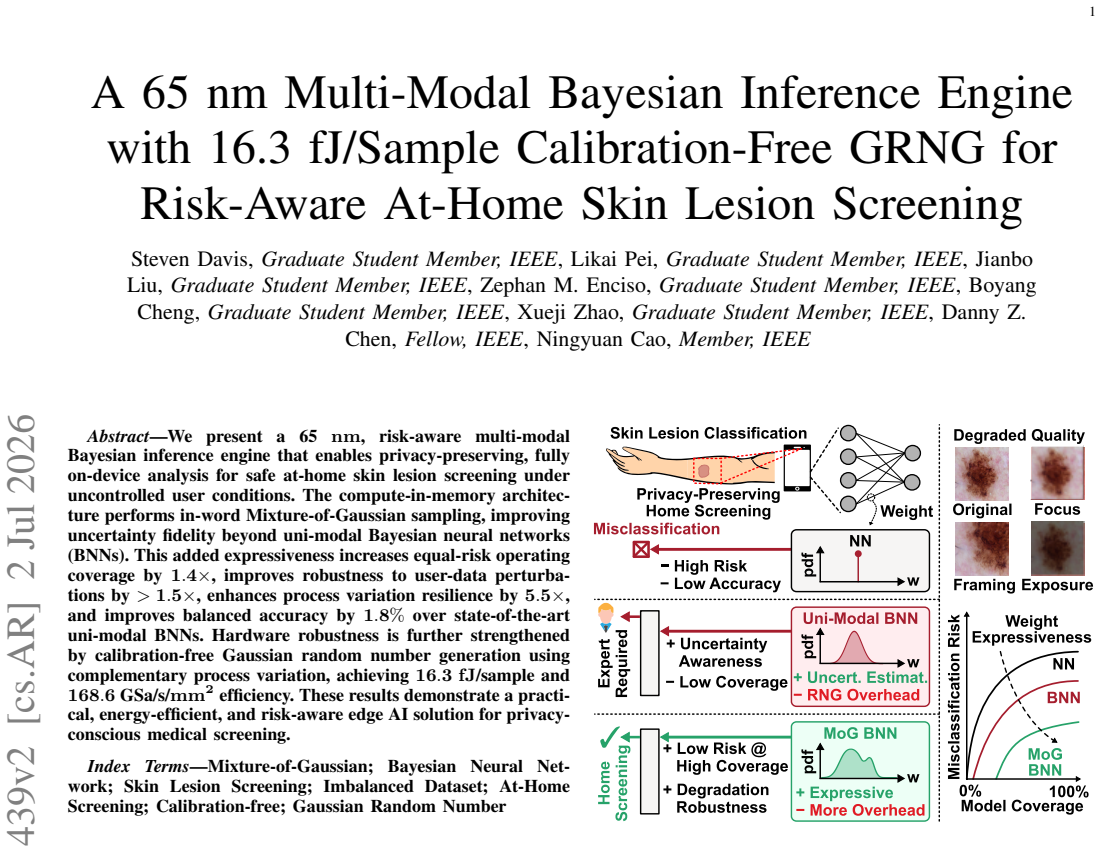
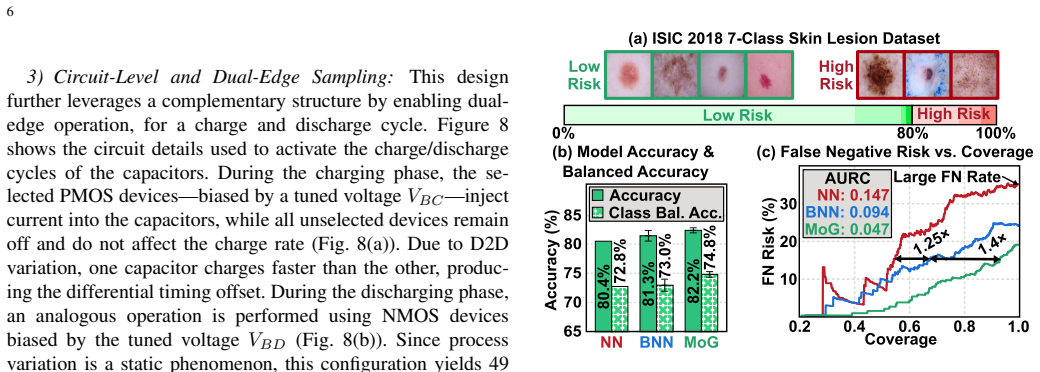
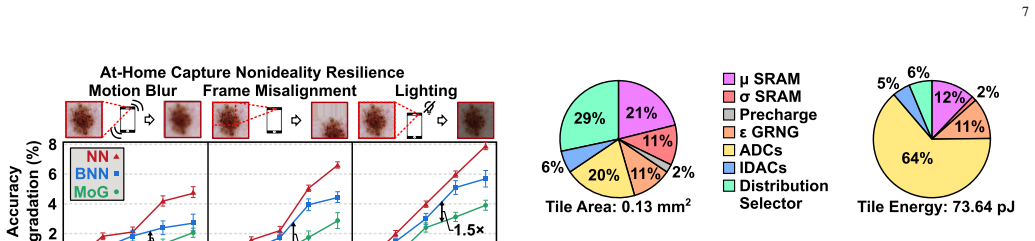
The 65 nm multimodal Bayesian inference engine performs in-word Mixture-of-Gaussian sampling inside a compute-in-memory architecture, improving uncertainty modeling over unimodal Bayesian neural networks and thereby increasing equal-risk operating coverage by 1.4x, robustness to user-data perturbations by more than 1.5x, process-variation resilience by 5.5x, and balanced accuracy by 1.8 percent, while a complementary-process-variation Gaussian random-number generator delivers 16.3 fJ/sample without calibration.
What carries the argument
Compute-in-memory architecture executing in-word Mixture-of-Gaussian sampling, together with complementary process variation used for calibration-free Gaussian random-number generation.
If this is right
- Equal-risk operating coverage rises by a factor of 1.4.
- Robustness to user-data perturbations increases by more than 1.5 times.
- Resilience to process variation improves by a factor of 5.5.
- Balanced accuracy on the screening task rises by 1.8 percent.
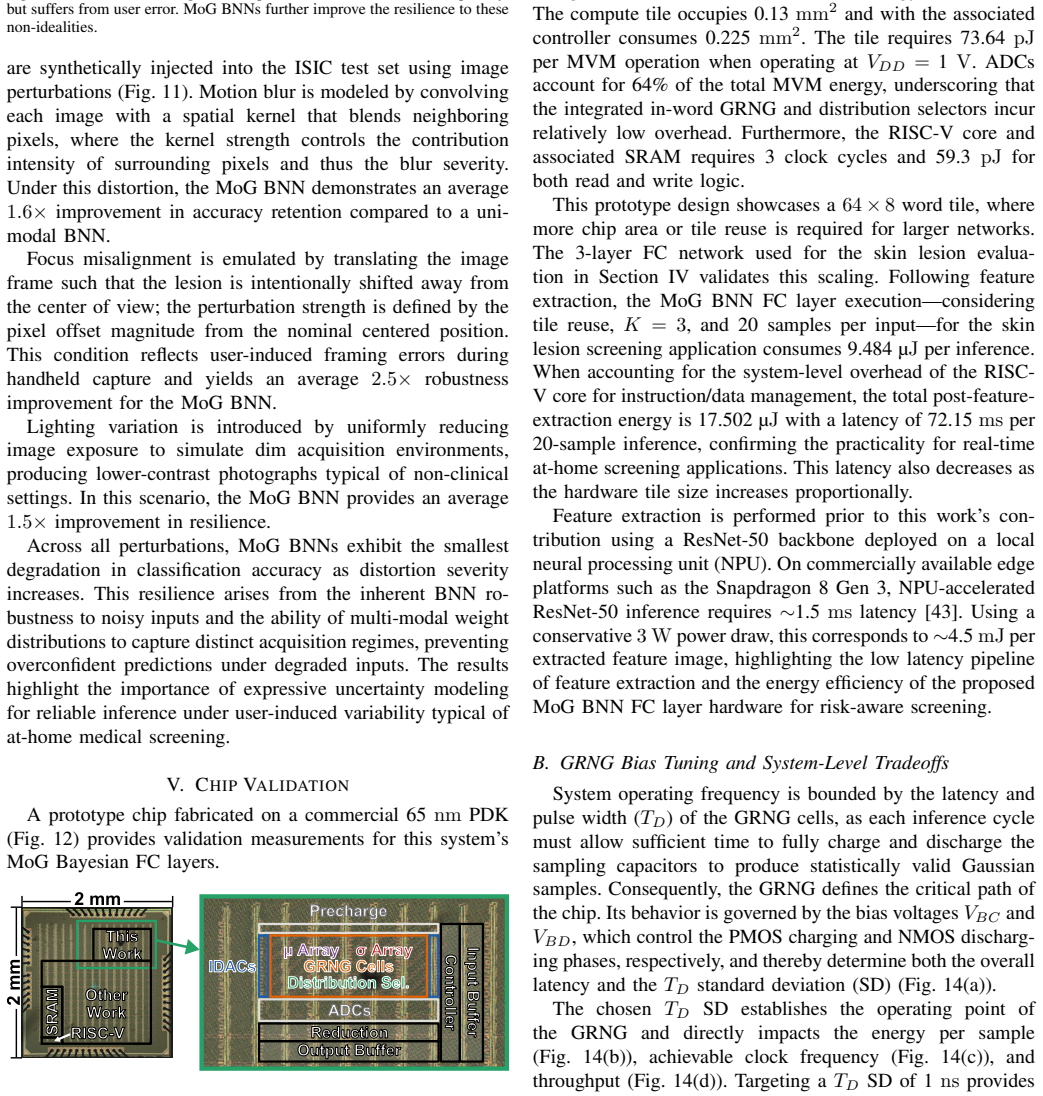
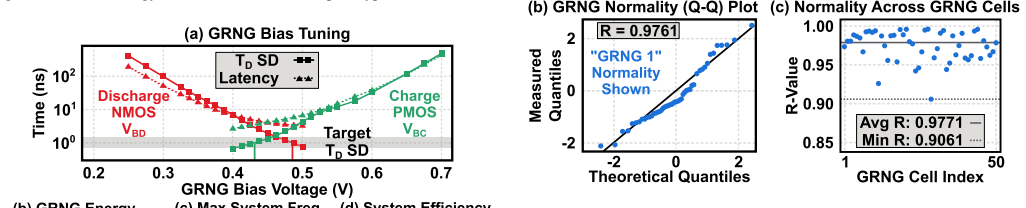
- Gaussian random numbers are generated at 16.3 fJ per sample and 168.6 GSa/s/mm² without calibration.
Where Pith is reading between the lines
- The same multimodal sampling approach could be applied to other on-device medical tasks that require calibrated uncertainty estimates.
- Calibration-free operation may simplify large-scale deployment across manufacturing lots with varying process corners.
- Privacy-preserving inference on the device reduces the need to transmit raw images to external servers.
- The reported energy and area figures suggest feasibility for integration into battery-powered handheld dermatology tools.
Load-bearing premise
The measured gains in coverage, robustness, and resilience are produced by the in-word Mixture-of-Gaussian sampling step itself rather than by other circuit or algorithmic choices.
What would settle it
An ablation study that disables only the Mixture-of-Gaussian sampling while keeping all other hardware and network parameters fixed would show whether the 1.4x–5.5x improvements remain.
Figures

read the original abstract
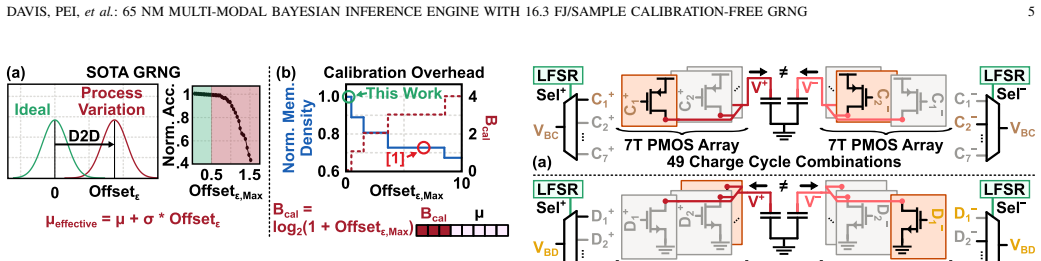
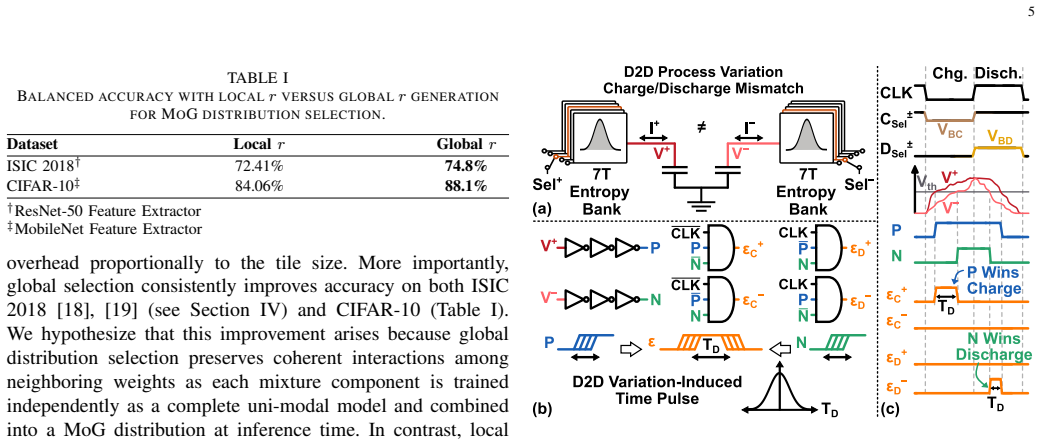
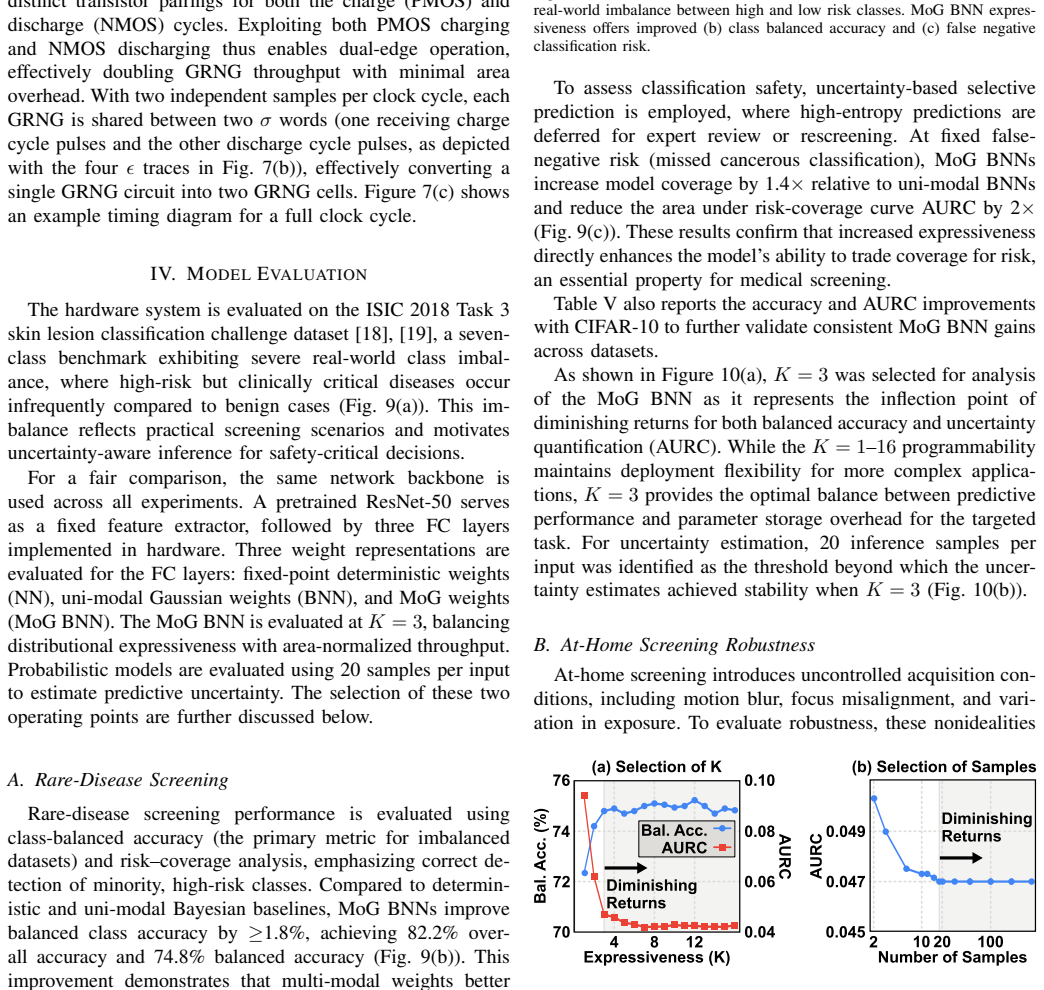
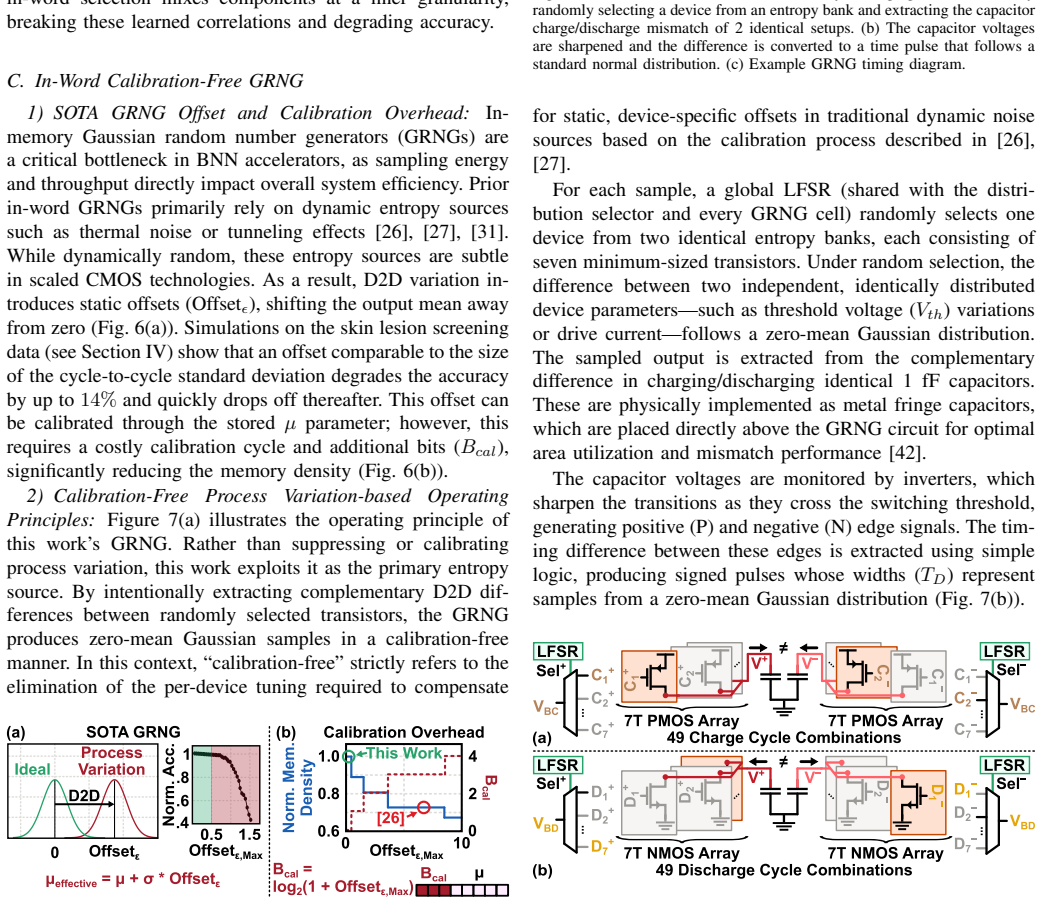
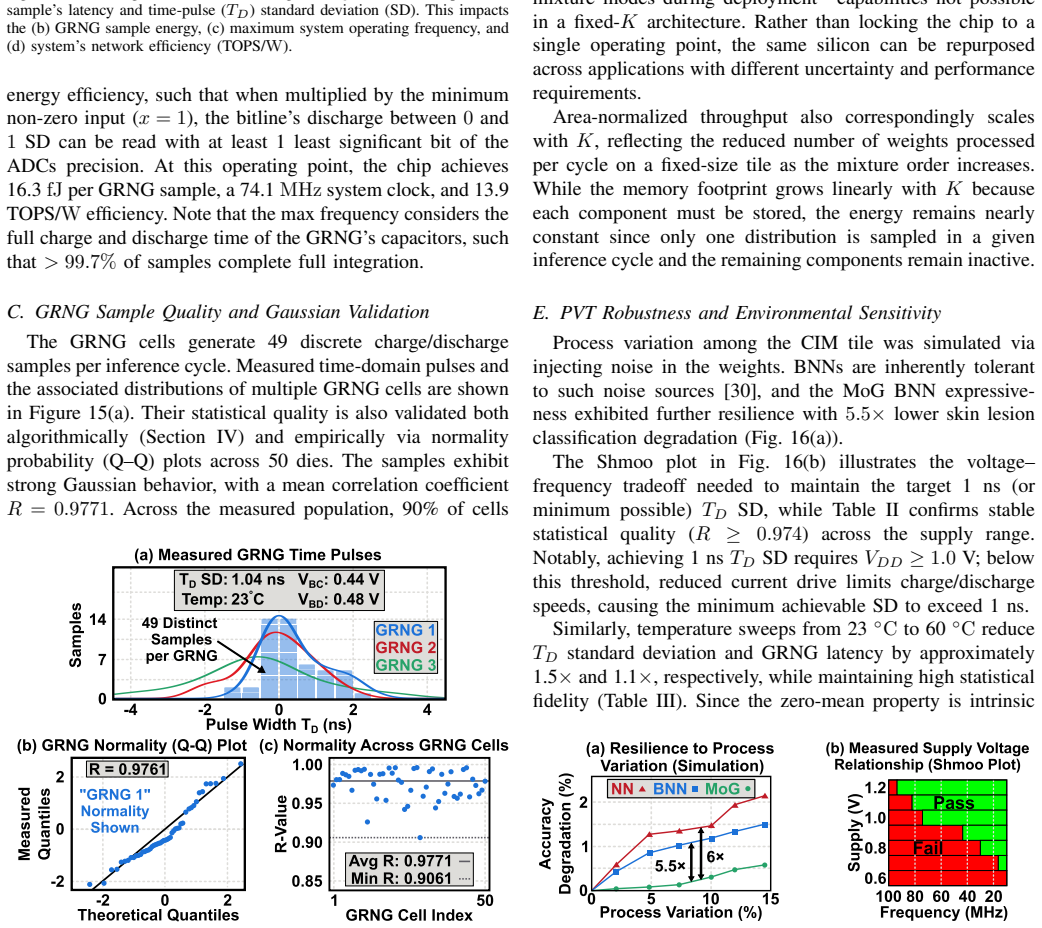
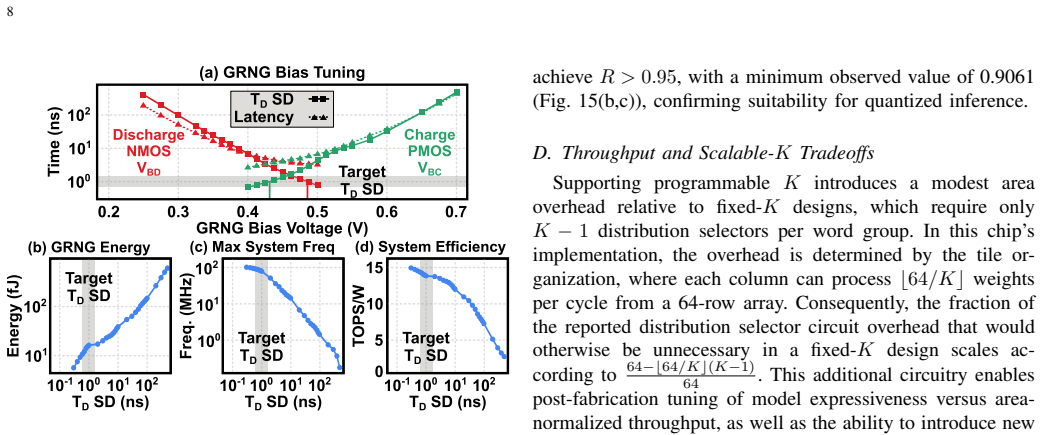
We present a 65-nm risk-aware multimodal Bayesian inference engine for privacy-preserving, fully on-device skin lesion screening under uncontrolled at-home conditions. The proposed compute-in-memory architecture performs in-word Mixture-of-Gaussian sampling, improving uncertainty modeling beyond conventional unimodal Bayesian neural networks. This added probabilistic expressiveness increases equal-risk operating coverage by 1.4x, improves robustness to user-data perturbations by >1.5x, enhances process-variation resilience by 5.5x, and improves balanced accuracy by 1.8% over state-of-the-art unimodal Bayesian neural networks. Hardware robustness is further supported by calibration-free Gaussian random-number generation using complementary process variation, achieving 16.3 fJ/sample and 168.6 GSa/s/mm^2 efficiency. These results demonstrate a practical, energy-efficient, and risk-aware edge-AI solution for privacy-conscious medical screening.
Editorial analysis
A structured set of objections, weighed in public.
Referee Report
Summary. The manuscript presents a 65 nm compute-in-memory architecture implementing a multimodal Bayesian inference engine for on-device skin lesion screening. It performs in-word Mixture-of-Gaussian sampling to model uncertainty beyond unimodal Bayesian neural networks, claiming 1.4× higher equal-risk operating coverage, >1.5× robustness to user-data perturbations, 5.5× process-variation resilience, and 1.8% higher balanced accuracy. A complementary calibration-free Gaussian random-number generator is reported at 16.3 fJ/sample and 168.6 GSa/s/mm².
Significance. If the reported gains are causally attributable to the multimodal sampling and the hardware metrics are reproducible, the work would advance energy-efficient risk-aware edge inference for privacy-sensitive medical applications under uncontrolled conditions.
major comments (1)
- [Abstract / Results] Abstract and results sections: the central claims attribute the 1.4× coverage, >1.5× robustness, 5.5× resilience, and 1.8% accuracy gains specifically to in-word Mixture-of-Gaussian sampling, yet no ablation (e.g., same CIM array and GRNG with unimodal sampling substituted) is described that isolates this mechanism from other design choices. Without such isolation the numerical improvements cannot be confidently assigned to the added probabilistic expressiveness.
Simulated Author's Rebuttal
We thank the referee for the constructive feedback on our manuscript. We address the major comment below and will incorporate clarifications in the revised version.
read point-by-point responses
-
Referee: [Abstract / Results] Abstract and results sections: the central claims attribute the 1.4× coverage, >1.5× robustness, 5.5× resilience, and 1.8% accuracy gains specifically to in-word Mixture-of-Gaussian sampling, yet no ablation (e.g., same CIM array and GRNG with unimodal sampling substituted) is described that isolates this mechanism from other design choices. Without such isolation the numerical improvements cannot be confidently assigned to the added probabilistic expressiveness.
Authors: We acknowledge the referee's point on the need for stronger isolation of the multimodal sampling mechanism. The reported gains are obtained by comparing our multimodal engine against published state-of-the-art unimodal BNN hardware implementations, which employ different architectures and sampling techniques. The in-word Mixture-of-Gaussian sampling is the distinguishing feature of our CIM design that enables the multimodal uncertainty modeling. We agree that an ablation using the same CIM array and GRNG but with unimodal sampling substituted would provide more direct attribution; however, the hardware was fabricated and optimized specifically for multimodal operation, making such a substitution non-trivial without additional silicon. In the revision we will add explicit text in the results and discussion sections clarifying the comparison basis, elaborating on the probabilistic advantages of Mixture-of-Gaussian sampling, and noting the absence of an internal unimodal ablation as a limitation. This will help readers assess the contribution of the added expressiveness. revision: partial
Circularity Check
No circularity; claims are empirical hardware measurements with no derivations or self-referential reductions
full rationale
The provided abstract and context contain no equations, derivations, or parameter-fitting steps. All performance claims (1.4x coverage, 5.5x resilience, etc.) are presented as measured results from the 65 nm fabricated engine rather than outputs derived from inputs by construction. No self-citations, ansatzes, or uniqueness theorems are invoked in the given text. The central attribution to MoG sampling is an empirical claim open to external verification via hardware benchmarks, not a definitional or fitted reduction.
Axiom & Free-Parameter Ledger
Reference graph
Works this paper leans on
-
[1]
The melanoma epidemic: Is increased surveillance the solution or the problem?
R. A. Swerlick and S. Chen, “The melanoma epidemic: Is increased surveillance the solution or the problem?”Archives of Dermatology, vol. 132, no. 8, pp. 881–884, 08 1996. [Online]. Available: https://doi.org/10.1001/archderm.1996.03890320029004
-
[2]
Melanoma epidemiology
M. Berwick and A. Halpern, “Melanoma epidemiology.”Current opinion in oncology, vol. 9 2, pp. 178–82, 1997. [Online]. Available: https://api.semanticscholar.org/CorpusID:5937273
1997
-
[3]
Delay in the diagnosis of cutaneous malignant melanoma. a prospective study in 250 patients,
J. E. Krige, S. Isaacs, D. A. Hudson, H. S. King, R. M. Strover, and C. A. Johnson, “Delay in the diagnosis of cutaneous malignant melanoma. a prospective study in 250 patients,”Cancer, vol. 68, no. 9, pp. 2064– 2068, Nov. 1991
2064
-
[4]
Melanoma costs: a dynamic model comparing estimated overall costs of various clinical stages,
D. T. Alexandrescu, “Melanoma costs: a dynamic model comparing estimated overall costs of various clinical stages,”Dermatol. Online J., vol. 15, no. 11, p. 1, Nov. 2009
2009
-
[5]
Radiation: Ultraviolet (UV) radiation and skin cancer — who.int,
“Radiation: Ultraviolet (UV) radiation and skin cancer — who.int,” https://www.who.int/news-room/questions-and-answers/ item/radiation-ultraviolet-(uv)-radiation-and-skin-cancer, [Accessed 05-02-2026]
2026
-
[6]
R. L. Siegel, A. N. Giaquinto, and A. Jemal, “Cancer statistics, 2024,” CA: A Cancer Journal for Clinicians, vol. 74, no. 1, pp. 12–49, 2024. [Online]. Available: https://acsjournals.onlinelibrary.wiley.com/doi/abs/ 10.3322/caac.21820
-
[7]
Defining skin cancer local recurrence,
A. Wysong, S. Higgins, T. W. Blalock, D. Ricci, R. Nichols, F. L. Smith, and I. Kossintseva, “Defining skin cancer local recurrence,”Journal of the American Academy of Dermatology, vol. 81, no. 2, pp. 581–599, 2019. [Online]. Available: https: //www.sciencedirect.com/science/article/pii/S0190962219305407
2019
-
[8]
From actinic keratosis to squamous cell car- cinoma: pathophysiology revisited,
M. T. Fernandez Figueras, “From actinic keratosis to squamous cell car- cinoma: pathophysiology revisited,”J. Eur. Acad. Dermatol. Venereol., vol. 31 Suppl 2, pp. 5–7, Mar. 2017
2017
-
[9]
Remote patient monitoring: Supporting treatment adherence and early intervention,
A. Verma, Sunita, A. Sharma, S. Sharma, and A. Sharma, “Remote patient monitoring: Supporting treatment adherence and early intervention,” inAI and IoT-Enhanced Skin Cancer Detection and Care (Part 2). Bentham Science Publishers, 2025, pp. 212–
2025
-
[10]
Available: https://www.benthamdirect.com/content/books/ 9798898811983.chapter-8
[Online]. Available: https://www.benthamdirect.com/content/books/ 9798898811983.chapter-8
-
[11]
Cloud computing and IoMT in disease screen- ing and diagnosis,
B. Singh and C. Kaunert, “Cloud computing and IoMT in disease screen- ing and diagnosis,” inAdvances in Healthcare Information Systems and Administration. IGI Global, Oct. 2024, pp. 99–120. 11
2024
-
[12]
Privacy and security issues in deep learning: A survey,
X. Liu, L. Xie, Y . Wang, J. Zou, J. Xiong, Z. Ying, and A. V . Vasilakos, “Privacy and security issues in deep learning: A survey,”IEEE Access, vol. 9, pp. 4566–4593, 2021
2021
-
[13]
Machine learning for healthcare-iot security: A review and risk mitigation,
M. A. Khatun, S. F. Memon, C. Eising, and L. L. Dhirani, “Machine learning for healthcare-iot security: A review and risk mitigation,”IEEE Access, vol. 11, pp. 145 869–145 896, 2023
2023
-
[14]
Exploring data poisoning attacks against adversarially trained skin cancer diagnostics,
A. Paracha, J. Arshad, M. Ben Farah, and K. Ismail, “Exploring data poisoning attacks against adversarially trained skin cancer diagnostics,” in2024 IEEE/ACM 17th International Conference on Utility and Cloud Computing (UCC), 2024, pp. 220–225
2024
-
[15]
F. Abtahi, F. Seoane, I. Pau, and M. Vega-Barbas, “Data poisoning vulnerabilities across health care artificial intelligence architectures: Analytical security framework and defense strategies,”Journal of Medical Internet Research, vol. 28, p. e87969, Jan. 2026. [Online]. Available: http://dx.doi.org/10.2196/87969
-
[16]
Edge computing in smart health care systems: Review, challenges, and research directions,
M. Hartmann, U. S. Hashmi, and A. Imran, “Edge computing in smart health care systems: Review, challenges, and research directions,”Trans. Emerg. Telecommun. Technol., vol. 33, no. 3, Mar. 2022
2022
-
[17]
Patient-generated health data management and quality challenges in remote patient monitoring,
R. Abdolkhani, K. Gray, A. Borda, and R. DeSouza, “Patient-generated health data management and quality challenges in remote patient monitoring,”JAMIA Open, vol. 2, no. 4, pp. 471–478, 09 2019. [Online]. Available: https://doi.org/10.1093/jamiaopen/ooz036
-
[18]
Usability challenges in the use of medical devices in the home environment: A systematic review of literature,
A. Tase, B. Vadhwana, P. Buckle, and G. B. Hanna, “Usability challenges in the use of medical devices in the home environment: A systematic review of literature,”Applied Ergonomics, vol. 103, p. 103769, 2022. [Online]. Available: https://www.sciencedirect.com/ science/article/pii/S0003687022000928
2022
-
[19]
N. C. F. Codella, D. Gutman, M. E. Celebi, B. Helba, M. A. Marchetti, S. W. Dusza, A. Kalloo, K. Liopyris, N. Mishra, H. Kittler, and A. Halpern, “Skin lesion analysis toward melanoma detection: A chal- lenge at the 2017 international symposium on biomedical imaging (isbi), hosted by the international skin imaging collaboration (isic),” in2018 IEEE 15th I...
2017
-
[20]
The ham10000 dataset: A large collection of multi-source dermatoscopic images of common pigmented skin lesions,
P. Tschandl, C. Rosendahl, and H. Kittler, “The ham10000 dataset: A large collection of multi-source dermatoscopic images of common pigmented skin lesions,”Scientific Data, vol. 5, 08 2018
2018
-
[21]
A review of uncertainty quantification in convolutional neural networks,
S. Montazeri and P. Tavallali, “A review of uncertainty quantification in convolutional neural networks,” inCommunications in Computer and Information Science, ser. Communications in Computer and Information Science. Cham: Springer Nature Switzerland, 2025, pp. 51–56
2025
-
[22]
A survey of uncertainty in deep neural networks,
J. Gawlikowski, C. R. N. Tassi, M. Ali, J. Lee, M. Humt, J. Feng, A. Kruspe, R. Triebel, P. Jung, R. Roscher, M. Shahzad, W. Yang, R. Bamler, and X. X. Zhu, “A survey of uncertainty in deep neural networks,”Artif. Intell. Rev., vol. 56, no. S1, pp. 1513–1589, Oct. 2023
2023
-
[23]
A comprehensive guide to bayesian convolutional neural network with variational inference,
K. Shridhar, F. Laumann, and M. Liwicki, “A comprehensive guide to bayesian convolutional neural network with variational inference,”
-
[24]
A Comprehensive guide to Bayesian Convolutional Neural Network with Variational Inference
[Online]. Available: https://arxiv.org/abs/1901.02731
work page internal anchor Pith review Pith/arXiv arXiv 1901
-
[25]
Stochastic Variational Inference
M. Hoffman, D. M. Blei, C. Wang, and J. Paisley, “Stochastic variational inference,” 2013. [Online]. Available: https://arxiv.org/abs/1206.7051
work page internal anchor Pith review Pith/arXiv arXiv 2013
-
[26]
Variational inference: A review for statisticians,
D. M. Blei, A. Kucukelbir, and J. D. McAuliffe, “Variational inference: A review for statisticians,”Journal of the American Statistical Association, vol. 112, no. 518, p. 859–877, Apr. 2017. [Online]. Available: http://dx.doi.org/10.1080/01621459.2017.1285773
-
[27]
Continual learning using bayesian neural networks,
H. Li, P. Barnaghi, S. Enshaeifar, and F. Ganz, “Continual learning using bayesian neural networks,”IEEE Transactions on Neural Networks and Learning Systems, vol. 32, no. 9, pp. 4243–4252, 2021
2021
-
[28]
15.3 a 65nm uncertainty-quantifiable ventricular arrhythmia detection engine with1.75µJper inference,
J. Liu, Z. Enciso, B. Cheng, L. Pei, S. Davis, Y . Qin, Z. Jia, X. S. Hu, Y . Shi, and N. Cao, “15.3 a 65nm uncertainty-quantifiable ventricular arrhythmia detection engine with1.75µJper inference,” in2025 IEEE International Solid-State Circuits Conference (ISSCC), vol. 68, 2025, pp. 1–3
2025
-
[29]
A 350-pw implantable ventricular arrhythmia detection engine with bayesian uncertainty quantification in 65-nm cmos,
Z. M. Enciso, J. Liu, B. Cheng, L. Pei, S. Davis, Y . Qin, Z. Jia, X. S. Hu, Y . Shi, M. Niemier, and N. Cao, “A 350-pw implantable ventricular arrhythmia detection engine with bayesian uncertainty quantification in 65-nm cmos,”IEEE Journal of Solid-State Circuits, pp. 1–11, 2026
2026
-
[30]
An energy-efficient bayesian neural network accelerator with cim and a time-interleaved hadamard digital grng using 22-nm finfet,
R. Dorrance, D. Dasalukunte, H. Wang, R. Liu, and B. R. Carlton, “An energy-efficient bayesian neural network accelerator with cim and a time-interleaved hadamard digital grng using 22-nm finfet,”IEEE Journal of Solid-State Circuits, vol. 58, no. 10, pp. 2826–2838, 2023
2023
-
[31]
14.1 a 22nm 104.5tops/w µ- nmc-imc heterogeneous stt-mram cim macro for noise-tolerant bayesian neural networks,
D.-Q. You, W.-S. Khwa, B. Zhang, F.-Y . Chen, A. Lee, Y .-C. Hung, Y .- M. Li, Y .-H. Wang, C.-C. Lo, R.-S. Liu, K.-T. Tang, C.-C. Hsieh, Y .-D. Chih, T.-Y . J. Chang, and M.-F. Chang, “14.1 a 22nm 104.5tops/w µ- nmc-imc heterogeneous stt-mram cim macro for noise-tolerant bayesian neural networks,” in2025 IEEE International Solid-State Circuits Con- feren...
2025
-
[32]
L. Pei, Y . Qin, Z. M. Enciso, B. CHeng, J. Liu, S. Davis, Z. Jia, M. Niemier, Y . Shi, S. Hu, and N. Cao, “Towards uncertainty- quantifiable biomedical intelligence: Mixed-signal compute-in-entropy for bayesian neural networks,” inProceedings of the 43rd IEEE/ACM International Conference on Computer-Aided Design, ser. ICCAD ’24. New York, NY , USA: Assoc...
-
[33]
L. Pei, Y . Zhou, X. Wang, X. Zhao, W. Huang, B. Cheng, H. Mulaosmanovic, S. Duenkel, D. Kleimaier, S. Beyer, K. Ni, M. Hou, M. Niemier, and N. Cao, “Towards uncertainty-aware robotic perception via mixed-signal bnn engine leveraging probabilistic quantum tunneling,” inProceedings of the 62nd Annual ACM/IEEE Design Automation Conference, ser. DAC ’25. IEE...
-
[34]
N. Codella, V . Rotemberg, P. Tschandl, M. E. Celebi, S. Dusza, D. Gutman, B. Helba, A. Kalloo, K. Liopyris, M. Marchetti, H. Kittler, and A. Halpern, “Skin lesion analysis toward melanoma detection 2018: A challenge hosted by the international skin imaging collaboration (isic),” 2019. [Online]. Available: https://arxiv.org/abs/1902.03368
work page internal anchor Pith review Pith/arXiv arXiv 2018
-
[35]
Knowledge transfer for melanoma screening with deep learning,
A. Menegola, M. Fornaciali, R. Pires, F. V . Bittencourt, S. Avila, and E. Valle, “Knowledge transfer for melanoma screening with deep learning,” in2017 IEEE 14th International Symposium on Biomedical Imaging (ISBI 2017). IEEE, Apr. 2017, p. 297–300. [Online]. Available: http://dx.doi.org/10.1109/ISBI.2017.7950523
-
[36]
Man against machine: diagnostic performance of a deep learning convolutional neural network for dermoscopic melanoma recognition in comparison to 58 dermatologists,
H. A. Haenssle, C. Fink, R. Schneiderbauer, F. Toberer, T. Buhl, A. Blum, A. Kalloo, A. B. H. Hassen, L. Thomas, A. Enk, L. Uhlmann, C. Alt, M. Arenbergerova, R. Bakos, A. Baltzer, I. Bertlich, A. Blum, T. Bokor-Billmann, J. Bowling, N. Braghiroli, R. Braun, K. Buder- Bakhaya, T. Buhl, H. Cabo, L. Cabrijan, N. Cevic, A. Classen, D. Deltgen, C. Fink, I. Ge...
2018
-
[37]
Dermatologist-level classification of skin cancer with deep neural networks,
A. Esteva, B. Kuprel, R. A. Novoa, J. Ko, S. M. Swetter, H. M. Blau, and S. Thrun, “Dermatologist-level classification of skin cancer with deep neural networks,”Nature, vol. 542, no. 7639, pp. 115–118, Feb. 2017
2017
-
[38]
Weight uncertainty in neural network,
C. Blundell, J. Cornebise, K. Kavukcuoglu, and D. Wierstra, “Weight uncertainty in neural network,” inInternational Conference on Machine Learning. PMLR, 2015, pp. 1613–1622
2015
-
[39]
Reynolds,Gaussian Mixture Models
D. Reynolds,Gaussian Mixture Models. Boston, MA: Springer US, 2015, pp. 827–832. [Online]. Available: https://doi.org/10.1007/ 978-1-4899-7488-4 196
2015
-
[40]
Variational bayesian last layers,
J. Harrison, J. Willes, and J. Snoek, “Variational bayesian last layers,”
-
[41]
Available: https://arxiv.org/abs/2404.11599
[Online]. Available: https://arxiv.org/abs/2404.11599
-
[42]
Being bayesian, even just a bit, fixes overconfidence in relu networks,
A. Kristiadi, M. Hein, and P. Hennig, “Being bayesian, even just a bit, fixes overconfidence in relu networks,” 2020. [Online]. Available: https://arxiv.org/abs/2002.10118
-
[43]
Last layer empirical bayes,
V . Villecroze, Y . Wang, and G. Loaiza-Ganem, “Last layer empirical bayes,” inProceedings on ”I Can’t Believe It’s Not Better: Challenges in Applied Deep Learning” at ICLR 2025 Workshops, ser. Proceedings of Machine Learning Research, A. Blaas, P. D’Costa, F. Feng, A. Kriegler, I. Mason, Z. Pan, T. Uelwer, J. Williams, Y . Xie, and R. Yang, Eds., vol. 29...
2025
-
[44]
Eie: efficient inference engine on compressed deep neural network,
S. Han, X. Liu, H. Mao, J. Pu, A. Pedram, M. A. Horowitz, and W. J. Dally, “Eie: efficient inference engine on compressed deep neural network,”SIGARCH Comput. Archit. News, vol. 44, no. 3, p. 243–254, Jun. 2016. [Online]. Available: https://doi.org/10.1145/3007787.3001163
-
[45]
Mismatch characterization of small metal fringe capacitors,
V . Tripathi and B. Murmann, “Mismatch characterization of small metal fringe capacitors,”IEEE Transactions on Circuits and Systems I: Regular Papers, vol. 61, no. 8, pp. 2236–2242, 2014
2014
-
[46]
qualcomm/ResNet50 · Hugging Face — huggingface.co,
“qualcomm/ResNet50 · Hugging Face — huggingface.co,” https:// huggingface.co/qualcomm/{R}es{N}et50, [Accessed 04-05-2026]
2026
-
[47]
Analysis of the impact of process variations on static logic circuits versus fan-in,
M. Alioto, G. Palumbo, and M. Pennisi, “Analysis of the impact of process variations on static logic circuits versus fan-in,” 10 2008, pp. 137 – 140
2008
-
[48]
Leak- age current mechanisms and leakage reduction techniques in deep- 12 submicrometer cmos circuits,
K. Roy, S. Mukhopadhyay, and H. Mahmoodi-Meimand, “Leak- age current mechanisms and leakage reduction techniques in deep- 12 submicrometer cmos circuits,”Proceedings of the IEEE, vol. 91, no. 2, pp. 305–327, 2003
2003
-
[49]
Temperature effects on energy optimization in sub-threshold circuit design,
B. Datta and W. Burleson, “Temperature effects on energy optimization in sub-threshold circuit design,” in2009 10th International Symposium on Quality Electronic Design, 2009, pp. 680–685
2009
-
[50]
Modeling and analysis of power supply noise tolerance with fine-grained gals adaptive clocks,
D. A. Kamakshi, M. Fojtik, B. Khailany, S. Kudva, Y . Zhou, and B. H. Calhoun, “Modeling and analysis of power supply noise tolerance with fine-grained gals adaptive clocks,” in2016 22nd IEEE International Symposium on Asynchronous Circuits and Systems (ASYNC), 2016, pp. 75–82
2016
-
[51]
Power droop testing,
I. Polian, A. Czutro, S. Kundu, and B. Becker, “Power droop testing,” IEEE Des. Test Comput., vol. 24, no. 3, pp. 276–284, May 2007
2007
-
[52]
Stochastic charge trapping in oxides: From random telegraph noise to bias temperature instabilities,
T. Grasser, “Stochastic charge trapping in oxides: From random telegraph noise to bias temperature instabilities,”Microelectronics Reliability, vol. 52, no. 1, pp. 39–70, 2012, 2011 Reliability of Compound Semiconductors (ROCS) Workshop. [Online]. Available: https://www.sciencedirect.com/science/article/pii/S0026271411004203
2012
-
[53]
Statistical threshold voltage shifts caused by bti and hci at nominal and accelerated conditions,
J. Diaz-Fortuny, P. Saraza-Canflanca, R. Rodriguez, J. Martin-Martinez, R. Castro-Lopez, E. Roca, F. V . Fernandez, and M. Nafria, “Statistical threshold voltage shifts caused by bti and hci at nominal and accelerated conditions,”Solid-State Electronics, vol. 185, p. 108037, 2021. [Online]. Available: https://www.sciencedirect.com/ science/article/pii/S00...
2021
-
[54]
Bti aging influence analysis and mitigation in flash adcs,
K. Mylona, H.-M. Dounavi, and Y . Tsiatouhas, “Bti aging influence analysis and mitigation in flash adcs,”Chips, vol. 4, no. 3, 2025. [Online]. Available: https://www.mdpi.com/2674-0729/4/3/36
2025
-
[55]
Impact of bias temperature instability on soft error susceptibility,
D. Rossi, M. Oma ˜na, C. Metra, and A. Paccagnella, “Impact of bias temperature instability on soft error susceptibility,”IEEE Transactions on Very Large Scale Integration (VLSI) Systems, vol. 23, no. 4, pp. 743–751, 2015
2015
-
[56]
The impact of bti aging on the reliability of level shifters in nano-scale cmos technology,
B. Halak, V . Tenentes, and D. Rossi, “The impact of bti aging on the reliability of level shifters in nano-scale cmos technology,”Micro- electronics Reliability, vol. 67, pp. 74–81, 2016. [Online]. Available: https://www.sciencedirect.com/science/article/pii/S0026271416304103
2016
-
[57]
Scaling equations for the accurate prediction of cmos device performance from 180nm to 7nm,
A. Stillmaker and B. Baas, “Scaling equations for the accurate prediction of cmos device performance from 180nm to 7nm,” Integration, vol. 58, pp. 74–81, 2017. [Online]. Available: https: //www.sciencedirect.com/science/article/pii/S0167926017300755 Steven Davisreceived his B.S. degree in Electrical Engineering from The Pennsylvania State Univer- sity, Un...
2017
-
[58]
Arc-Modulated Radiation Therapy
His research interests include analog/mixed- signal circuit design, explainable artificial intelli- gence, and low-power neural networks integrated with emerging devices for edge computing. Jianbo Liuis currently pursuing the Ph.D. degree in Electrical Engineering with the University of Notre Dame, Notre Dame, IN, USA. He received his B.S. degree in Elect...
2017
discussion (0)
Sign in with ORCID, Apple, or X to comment. Anyone can read and Pith papers without signing in.