On the non-uniqueness of solutions of the axi-symmetric swirl-free Navier-Stokes equations, I
Pith reviewed 2026-06-27 21:18 UTC · model grok-4.3
The pith
New unstable self-similar solutions to the 3D Navier-Stokes equations exist in the axially symmetric swirl-free class.
A machine-rendered reading of the paper's core claim, the machinery that carries it, and where it could break.
Core claim
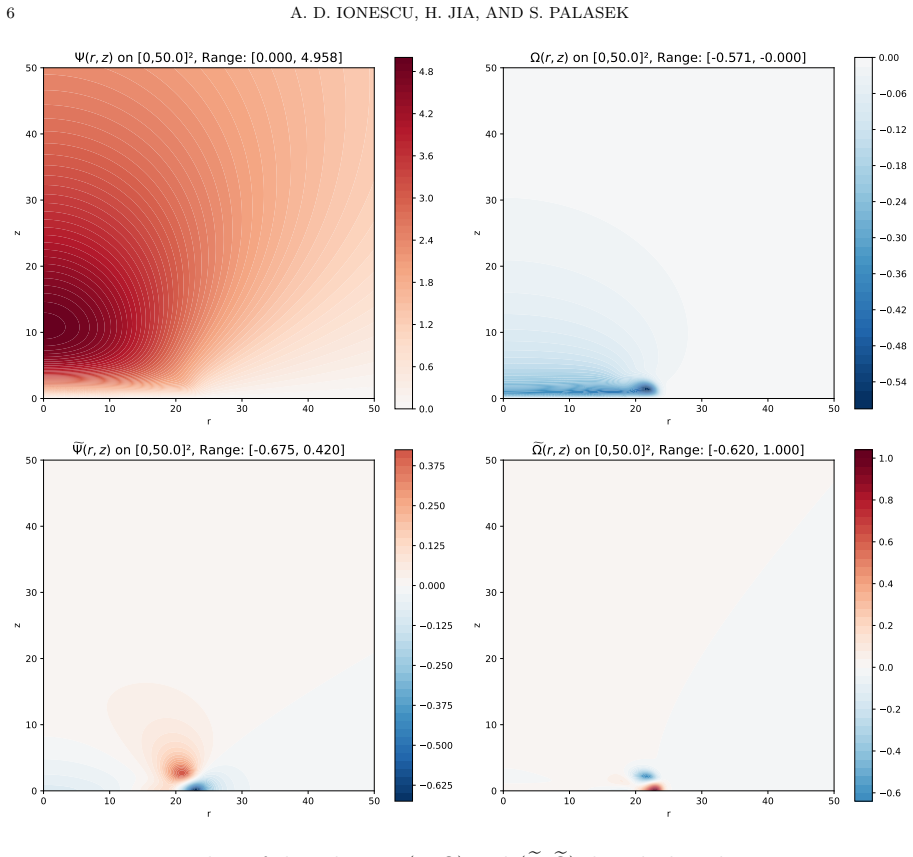
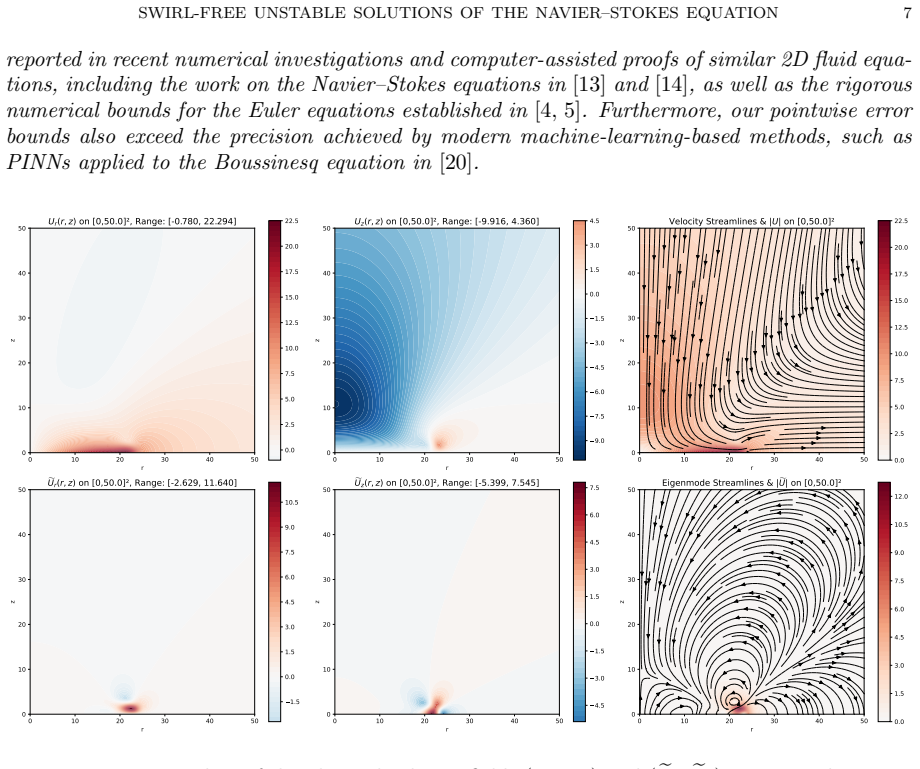
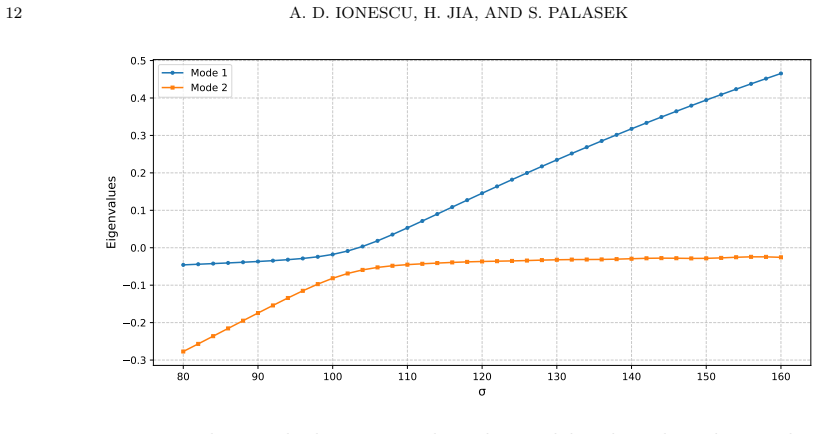
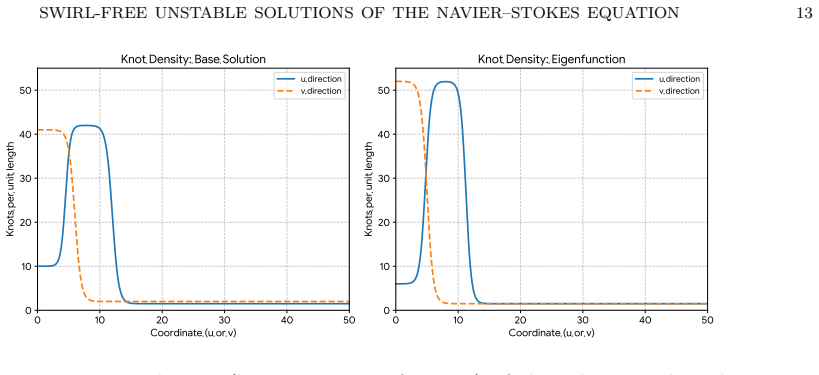
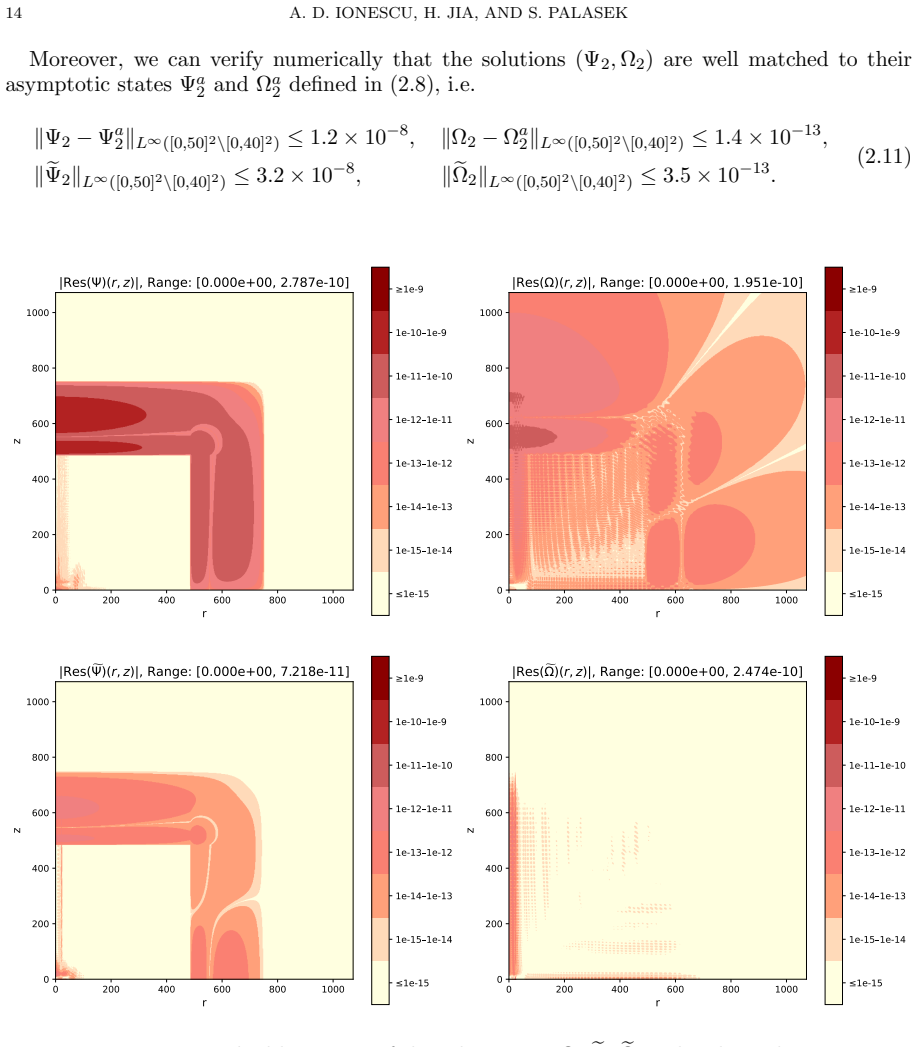
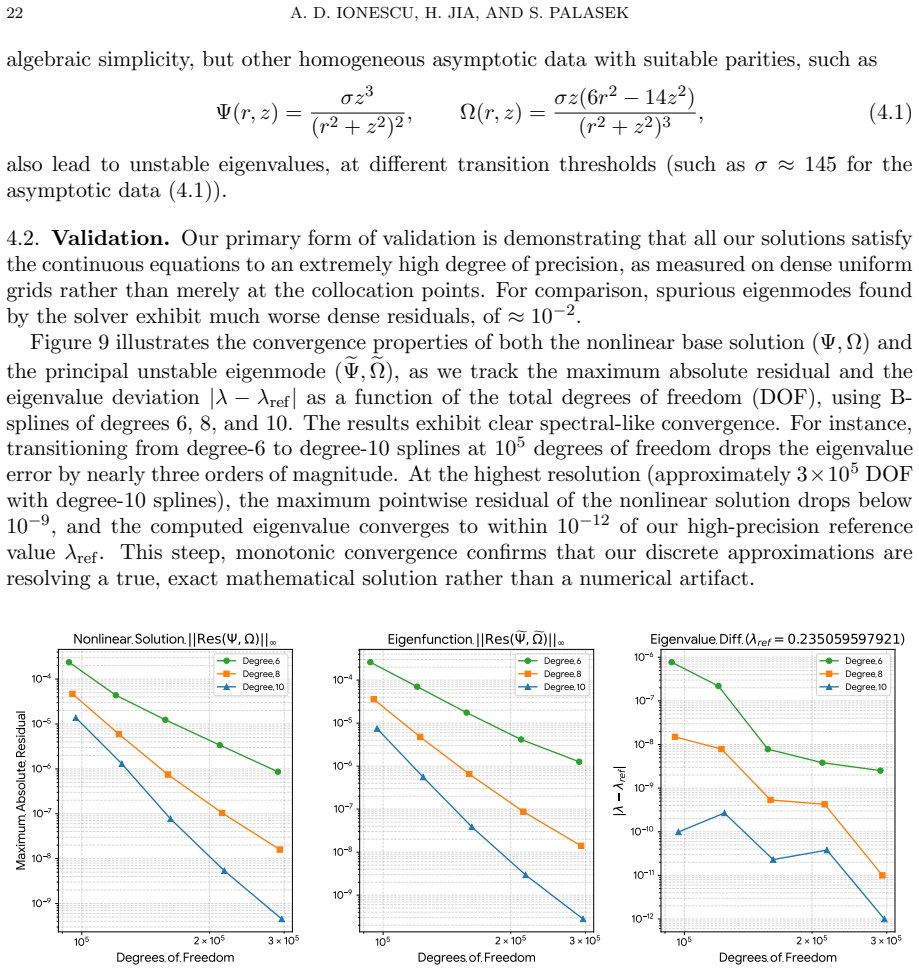
In this paper we construct numerically a new class of unstable self-similar solutions of the incompressible Navier-Stokes equations in R^3. Our solutions are axially symmetric and homogeneous of degree -1 at infinity, and are unstable in the sense that the linearization around these solutions contains unstable modes. The main novelty is that we discover the existence of such solutions in the space of axially symmetric swirl-free vector fields. These approximate solutions are defined on all of R^3 and achieve global pointwise residuals of order 10^{-10}.
What carries the argument
Numerically constructed approximate solutions in the axially symmetric swirl-free class together with the spectrum of the linearized operator around them.
If this is right
- The new solutions supply candidates for proving non-uniqueness of Navier-Stokes solutions inside the axially symmetric swirl-free class.
- The presence of unstable modes indicates that these profiles can serve as building blocks for non-uniqueness constructions analogous to those based on earlier numerically discovered solutions.
- The construction demonstrates that such solutions can be found without swirl, narrowing the function space in which non-uniqueness may hold.
Where Pith is reading between the lines
- Confirmation that the profiles are exact would allow a direct route to non-uniqueness statements that avoid additional symmetry assumptions.
- The same numerical approach could be tested on solutions with different homogeneity degrees or in spaces that include swirl to map the boundary between uniqueness and non-uniqueness.
- If the unstable modes survive rigorous analysis, they may connect to questions about possible singularity formation in the swirl-free setting.
Load-bearing premise
The functions computed with pointwise residuals of order 10^{-10} are close enough to exact solutions that the spectrum of the linearized operator around them correctly identifies genuine unstable modes of the nonlinear problem.
What would settle it
A higher-precision numerical refinement or rigorous existence proof that removes the unstable modes from the spectrum while keeping the residual below 10^{-10}.
Figures
read the original abstract
In this paper we construct numerically a new class of unstable self-similar solutions of the incompressible Navier-Stokes equations in $\mathbb{R}^3$. Our solutions are axially symmetric and homogeneous of degree $-1$ at $\infty$, and are unstable in the sense that the linearization around these solutions contains unstable modes. Solutions of this type have been discovered numerically by Guillod and \v{S}ver\'ak and Hou, Wang, and Yang, and have applications to proving non-uniqueness results. The main novelty in this paper is that we discover the existence of such solutions in the space of axially symmetric swirl-free (ASSF) vector fields. These approximate solutions are defined on all of $\mathbb R^3$ and achieve global pointwise residuals of order $10^{-10}$. We discuss the numerical construction of these solutions in detail, as well as their relevance to the problem of non-uniqueness of solutions of the incompressible Navier-Stokes equations in 3D, in the space of ASSF solutions.
Editorial analysis
A structured set of objections, weighed in public.
Referee Report
Summary. The paper claims to numerically construct a new class of axially symmetric swirl-free (ASSF) self-similar solutions to the 3D incompressible Navier-Stokes equations that are homogeneous of degree -1 at infinity. These approximate solutions are defined on all of R^3, achieve global pointwise residuals of order 10^{-10}, and the linearization around them is shown to contain unstable modes; the work discusses the numerical construction in detail and its relevance to non-uniqueness results in the ASSF class, extending prior numerical examples by Guillod-Šverák and Hou-Wang-Yang.
Significance. If the approximations are close enough to exact solutions that the reported unstable modes persist for the true linearization, the result would supply the first explicit numerical examples of unstable ASSF self-similar profiles, furnishing concrete candidates that could be used in future analytic arguments for non-uniqueness of weak solutions to the axi-symmetric swirl-free Navier-Stokes system.
major comments (1)
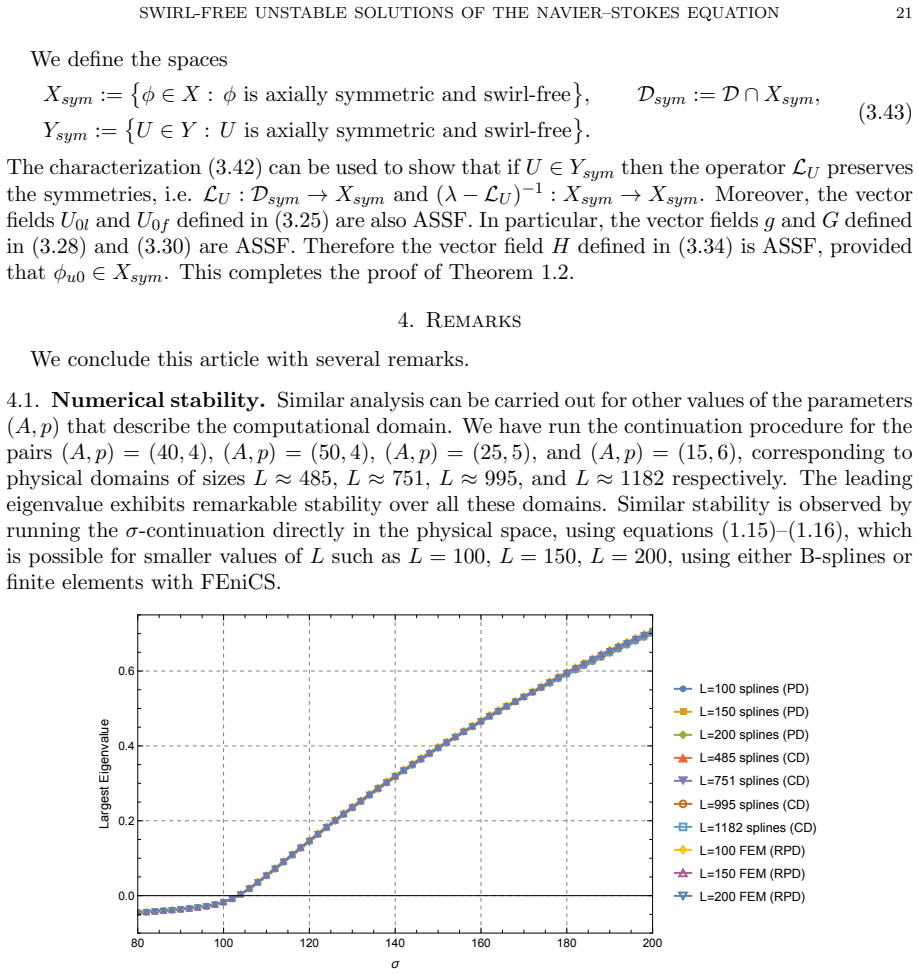
- [Abstract and numerical-construction section] Abstract and numerical-construction section: the central claim that the linearization around the computed profiles contains unstable modes rests on the assumption that pointwise residuals of order 10^{-10} produce only negligible perturbations to the spectrum. No a-posteriori eigenvalue error bound, resolvent estimate, or mesh-refinement/continuation argument is supplied to control the distance between the spectrum of the discrete linearized operator and that of the exact (unknown) solution; because eigenvalues near the imaginary axis can shift by O(1) under small but structured perturbations when the resolvent is ill-conditioned, this gap directly affects the reliability of the instability conclusion.
minor comments (2)
- [Linearization discussion] The manuscript should clarify the precise function space in which the linearization is considered (e.g., weighted Sobolev spaces adapted to the homogeneity -1 decay) and state the precise definition of “unstable mode” (growth rate, multiplicity, etc.).
- [Numerical results] Figure captions and tables reporting residuals should include the precise discretization parameters (mesh size, truncation radius, solver tolerance) so that the 10^{-10} figure can be reproduced.
Simulated Author's Rebuttal
We thank the referee for the careful and constructive report. The single major comment is addressed point-by-point below.
read point-by-point responses
-
Referee: [Abstract and numerical-construction section] Abstract and numerical-construction section: the central claim that the linearization around the computed profiles contains unstable modes rests on the assumption that pointwise residuals of order 10^{-10} produce only negligible perturbations to the spectrum. No a-posteriori eigenvalue error bound, resolvent estimate, or mesh-refinement/continuation argument is supplied to control the distance between the spectrum of the discrete linearized operator and that of the exact (unknown) solution; because eigenvalues near the imaginary axis can shift by O(1) under small but structured perturbations when the resolvent is ill-conditioned, this gap directly affects the reliability of the instability conclusion.
Authors: The referee is correct that the manuscript supplies no explicit a-posteriori eigenvalue error bound, resolvent estimate, or quantitative mesh-refinement/continuation argument controlling the distance between the discrete and exact spectra. While the reported pointwise residuals of order 10^{-10} and our internal mesh-refinement checks indicate robustness of the observed unstable eigenvalues, these checks are not presented in a form that rigorously bounds possible O(1) shifts. We will therefore revise the numerical-construction section to include a perturbation analysis that uses the residual size together with a numerical estimate of the resolvent norm on a contour separating the unstable eigenvalues from the rest of the spectrum. revision: yes
Circularity Check
No circularity: direct numerical construction of approximate solutions
full rationale
The paper reports a numerical search for approximate self-similar ASSF solutions of the Navier-Stokes equations, achieving pointwise residuals of order 10^{-10} on all of R^3, followed by linearization to detect unstable modes. No derivation chain, equation, or claim reduces a result to a fitted parameter defined from the same data, a self-citation load-bearing premise, or any of the enumerated circular patterns. The central output is the computed profiles themselves; the instability statement is an analysis performed on those profiles rather than a prediction forced by construction. This is a standard numerical existence result with no self-referential reduction.
Axiom & Free-Parameter Ledger
Reference graph
Works this paper leans on
-
[1]
Albritton, E
D. Albritton, E. Bru´ e, and M. Colombo, Non-uniqueness of Leray solutions of the forced Navier–Stokes equations. Ann. of Math. (2)196(2022), no. 1, 415–455
2022
-
[2]
D. Albritton, J. Guillod, M. Korobkov, and X. Ren, Forward self-similar solutions to the 2D Navier–Stokes equations. Preprint (2026), arXiv:2601.03161
-
[3]
Buckmaster and V
T. Buckmaster and V. Vicol, Nonuniqueness of weak solutions to the Navier–Stokes equation. Ann. of Math. (2)189(2019), no. 1, 101–144
2019
-
[4]
J. Chen and T. Y. Hou, Stable nearly self-similar blowup of the 2D Boussinesq and 3D Euler equations with smooth data I: Analysis. Preprint (2022), arXiv:2210.07191
-
[5]
J. Chen and T. Y. Hou, Stable nearly self-similar blowup of the 2D Boussinesq and 3D Euler equations with smooth data II: Rigorous Numerics. Preprint (2023), arXiv:2305.05660
-
[6]
A. Cheskidov, M. Dai, and S. Palasek, Instantaneous Type I blow-up and non-uniqueness of smooth solutions of the Navier–Stokes equations. Preprint (2025), arXiv:2511.09556
-
[7]
Cheskidov and X
A. Cheskidov and X. Luo. Sharp nonuniqueness for the Navier–Stokes equations. Invent. Math.229(2022), no. 3, 987-1054
2022
-
[8]
Cheskidov and X
A. Cheskidov and X. Luo.L 2-critical nonuniqueness for the 2D Navier–Stokes equations. Ann. PDE9 (2023), no. 2, Paper No. 13, 56 pp
2023
-
[9]
Coiculescu and S
M. Coiculescu and S. Palasek, Non-uniqueness of smooth solutions of the Navier–Stokes equations from critical data. Invent. Math. (to appear)
-
[10]
Gallay and C
T. Gallay and C. E. Wayne, Invariant manifolds and the long-time asymptotics of the Navier–Stokes and vorticity equations onR 2, Archive for Rational Mechanics and Analysis 163 (3), 209-258
-
[11]
Gallay and V
T. Gallay and V. ˇSver´ ak, Remarks on the Cauchy problem for the axisymmetric Navier–Stokes equations. Confluentes Math.7(2015), no. 2, 67–92
2015
- [12]
-
[13]
Guillod and V
J. Guillod and V. ˇSver´ ak, Numerical investigations of non-uniqueness for the Navier–Stokes initial value problem in borderline spaces. J. Math. Fluid Mech.25(2023), no. 3, Paper No. 46, 25 pp
2023
- [14]
-
[15]
Jia and V
H. Jia and V. ˇSver´ ak, Local-in-space estimates near initial time for weak solutions of the Navier–Stokes equations and forward self-similar solutions. Invent. Math.196(2014), no. 1, 233–265
2014
-
[16]
Jia and V
H. Jia and V. ˇSver´ ak, Are the incompressible 3d Navier–Stokes equations locally ill-posed in the natural energy space? J. Funct. Anal.268(2015), no. 12, 3734–3766
2015
-
[17]
Ladyzhenskaya, Unique solvability in the large of the three-dimensional Cauchy problem for the Navier– Stokes equations in the presence of axial symmetry
O. Ladyzhenskaya, Unique solvability in the large of the three-dimensional Cauchy problem for the Navier– Stokes equations in the presence of axial symmetry. Zap. Nauchn. Semin. Leningr. Otd. Mat. Inst. Steklova 7(1968), 155–177 (in Russian)
1968
-
[18]
Leray, Sur le mouvement d’un liquide visqueux emplissant l’espace, Acta Math.63(1934), no
J. Leray, Sur le mouvement d’un liquide visqueux emplissant l’espace, Acta Math.63(1934), no. 1, 193–248
1934
-
[19]
Ukhovskii and V
M. Ukhovskii and V. Yudovich, Axially symmetric flows of ideal and viscous fluids filling the whole space. J. Appl. Math. Mech.32(1968), 52–61
1968
-
[20]
Y. Wang, M. Bennani, J. Martens, S. Racani´ ere, S. Blackwell, A. Matthews, S. Nikolov, G. Cao-Labora, D. S. Park, M. Arjovsky, D. Worrall, C. Qin, F. Alet, B. Kozlovskii, N. Tomaˇ sev, A. Davies, P. Kohli, T. Buckmaster, B. Georgiev, J. G´ omez-Serrano, R. Jiang, C.-Y. Lai, Discovery of unstable singularities. Preprint (2025), arXiv:2509.14185. Princeton...
discussion (0)
Sign in with ORCID, Apple, or X to comment. Anyone can read and Pith papers without signing in.