Stability and thermodynamic properties of bound magnetic polarons in ferromagnetic semiconductors: Beyond the Gaussian approximation
Pith reviewed 2026-06-27 23:34 UTC · model grok-4.3
The pith
Bound magnetic polarons remain stable and ferromagnetically ordered well above the Curie temperature once cubic and quartic fluctuations are included.
A machine-rendered reading of the paper's core claim, the machinery that carries it, and where it could break.
Core claim
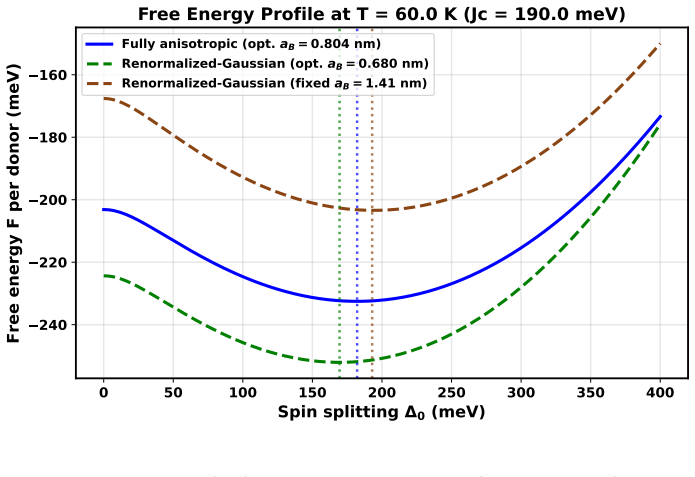
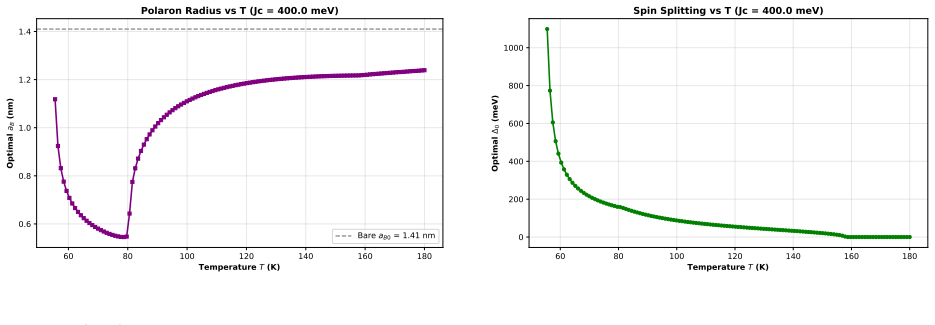
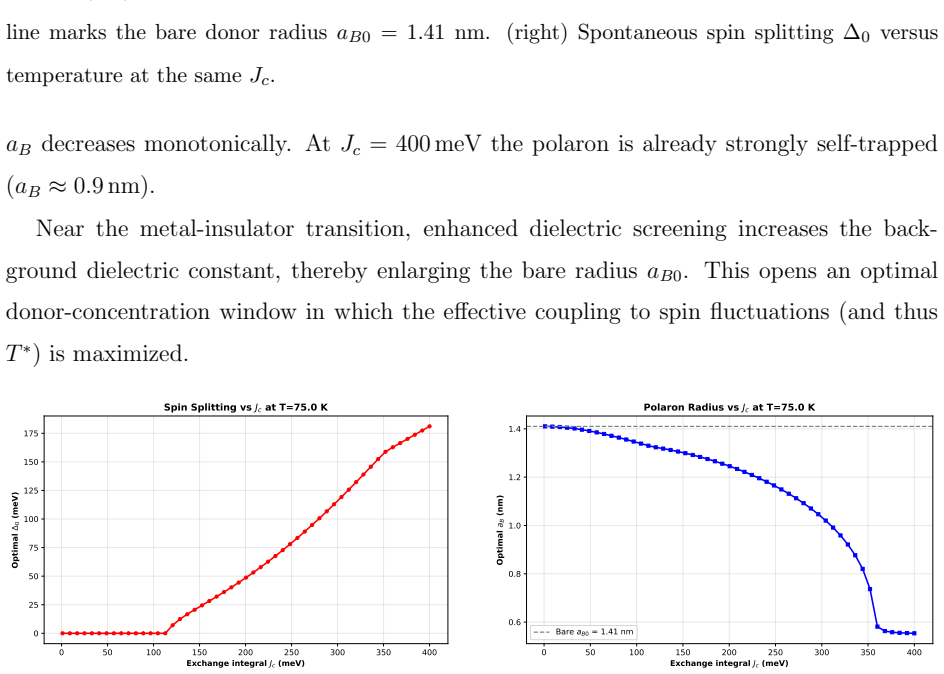
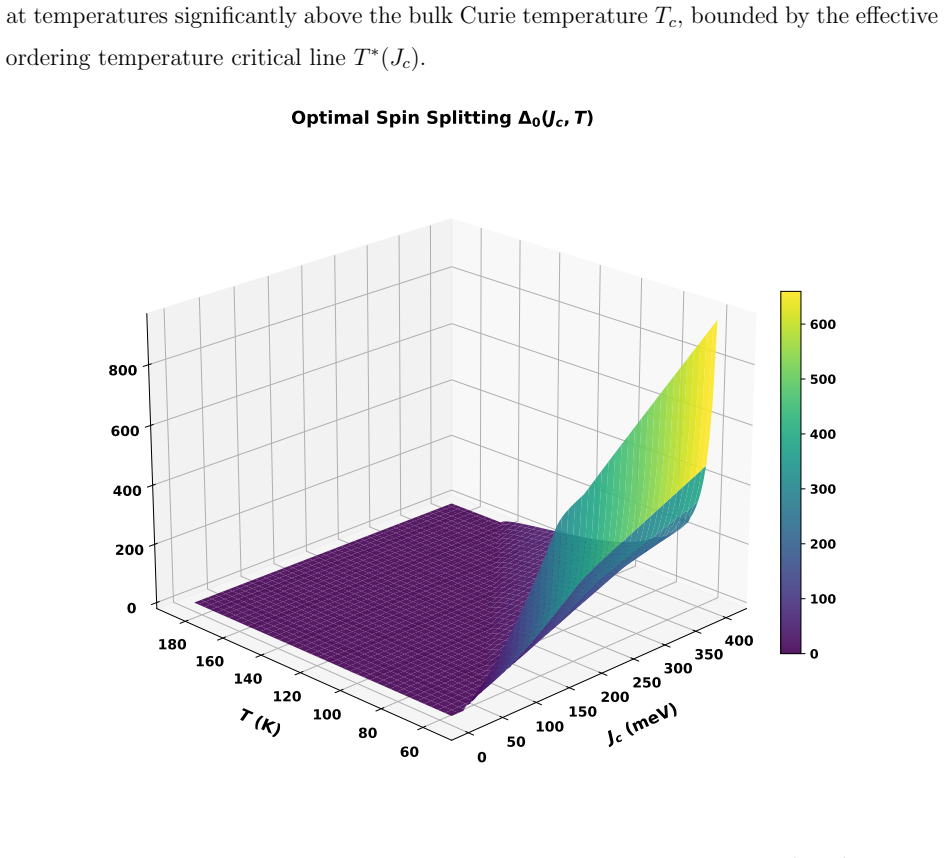
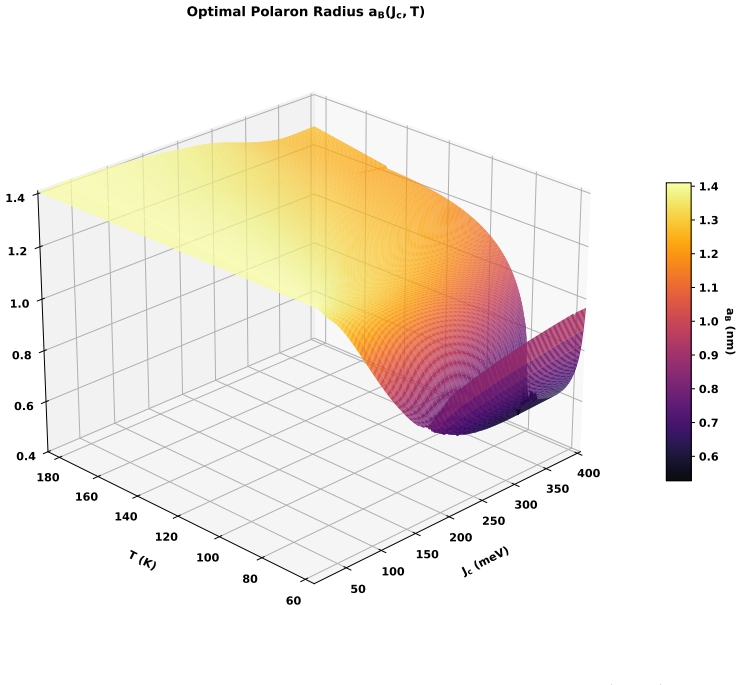
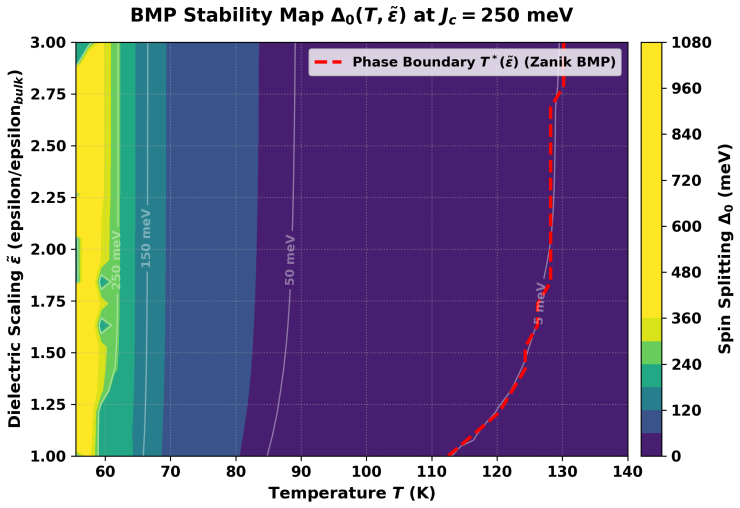
The paper establishes that rigorously incorporating cubic and quartic fluctuations of the Ginzburg-Landau-Wilson functional, together with variational optimization of the donor orbital size, eliminates the Gaussian divergence and produces stable, ferromagnetically ordered bound magnetic polarons with non-zero spontaneous spin splitting Delta_0 deep into the paramagnetic phase of GdN, giving an effective ordering temperature T* of 155-160 K for Jc = 400 meV.
What carries the argument
The non-perturbative resummation of dominant local fluctuations of the Ginzburg-Landau-Wilson functional to a closed exponential form in the strict local limit xi to 0, justified by the polaronic Ginzburg criterion that constraint-induced non-localities are suppressed by O(1/N_eff) with N_eff >> 1.
If this is right
- The Gaussian divergence near Tc is eliminated.
- Stable BMPs carrying non-zero spontaneous spin splitting persist deep into the paramagnetic phase.
- The effective polaron ordering temperature reaches 155-160 K for realistic Jc = 400 meV in GdN.
- An optimal donor-concentration window near the metal-insulator transition maximizes the ordering temperature.
- BMP-mediated ferromagnetism can persist well above the bulk Curie temperature.
Where Pith is reading between the lines
- The same resummation approach could be tested in other carrier-mediated magnetic systems that show ordering above nominal Tc.
- Direct spectroscopic probes of spin splitting in the paramagnetic regime would provide a clear experimental test.
- Tuning donor density near the metal-insulator transition offers a concrete materials-design route to raise the effective ordering temperature.
Load-bearing premise
Constraint-induced non-localities are suppressed by a factor of order 1/N_eff with N_eff much larger than one, which justifies taking the strict local limit.
What would settle it
A measurement that directly detects or rules out a non-zero spontaneous spin splitting Delta_0 in GdN at temperatures between 55 K and 160 K would settle whether the predicted stable BMPs exist above Tc.
Figures
read the original abstract
The formation of bound magnetic polarons (BMPs) is traditionally described using a Gaussian approximation for host magnetization fluctuations. While successful for diluted magnetic semiconductors, this approach fails for ferromagnetic semiconductors like GdN near their Curie temperature Tc, where diverging susceptibility yields unphysical instabilities. We extend the BMP theory beyond the Gaussian approximation by rigorously incorporating cubic and quartic fluctuations of the Ginzburg-Landau-Wilson functional. Two consistent extensions of the Dietl-Spalek framework are presented: (i) a non-local treatment valid for finite spin correlation lengths xi (to first order in lambda) and (ii) a non-perturbative resummation of dominant local fluctuations to a closed exponential form in the strict local limit xi to 0. The latter is justified by a novel polaronic Ginzburg criterion showing that constraint-induced non-localities are suppressed by O(1/N_eff) with N_eff >> 1. Crucially, the theory incorporates variational optimization of the donor orbital size, capturing magnetic self-trapping even above Tc. When applied to GdN (Tc = 55 K), the model eliminates the Gaussian divergence and predicts stable, ferromagnetically ordered BMPs with a non-zero spontaneous spin splitting Delta_0 deep into the paramagnetic phase. For a realistic exchange coupling Jc = 400 meV, the effective polaron ordering temperature reaches T* = 155-160 K. The model further suggests an optimal donor-concentration window near the metal-insulator transition where enhanced dielectric screening maximizes T*. These results establish a microscopic mechanism for persistent BMP-mediated ferromagnetism well above Tc.
Editorial analysis
A structured set of objections, weighed in public.
Referee Report
Summary. The manuscript extends the Dietl-Spalek framework for bound magnetic polarons (BMPs) beyond the Gaussian approximation by incorporating cubic and quartic fluctuations of the Ginzburg-Landau-Wilson functional. It presents two extensions: (i) a non-local treatment valid to first order in λ for finite spin correlation length ξ and (ii) a non-perturbative resummation of local fluctuations to an exponential form in the strict local limit ξ→0. The latter is justified by a novel polaronic Ginzburg criterion asserting suppression of constraint-induced non-localities by O(1/N_eff) with N_eff ≫ 1. Variational optimization of the donor orbital size is included to capture magnetic self-trapping above Tc. Applied to GdN (Tc = 55 K, Jc = 400 meV), the model eliminates the Gaussian divergence, predicts stable ferromagnetically ordered BMPs with non-zero spontaneous spin splitting Δ0 deep into the paramagnetic phase, and yields an effective polaron ordering temperature T* = 155–160 K. An optimal donor-concentration window near the metal-insulator transition is also suggested.
Significance. If the central claims hold, the work would be significant for the theory of ferromagnetic semiconductors. It resolves an unphysical divergence in standard BMP treatments near Tc and provides a microscopic mechanism for BMP-mediated ferromagnetism persisting well above Tc in materials such as GdN. The variational treatment of donor size and the identification of an optimal concentration window are concrete advances. The two consistent extensions of the Dietl-Spalek framework constitute a clear technical contribution.
major comments (2)
- [Justification of the strict local limit (ξ → 0)] The central claim that the Gaussian divergence is eliminated and that stable BMPs exist with T* ≫ Tc rests on the non-perturbative local resummation, which is justified solely by the novel polaronic Ginzburg criterion. No explicit expression for N_eff or the functional form of the suppression O(1/N_eff) is provided, so it is impossible to verify whether N_eff ≫ 1 holds for the GLW parameters appropriate to GdN.
- [Application to GdN and numerical results for T* and Δ0] T* = 155–160 K is reported for input values Tc = 55 K and Jc = 400 meV. Without the explicit functional dependence of T* on these parameters (or on the resummed fluctuation terms), it cannot be determined whether T* is an independent prediction or is effectively fixed by the choice of inputs.
minor comments (1)
- [Introduction of the two extensions] The abstract states that the non-local treatment is valid 'to first order in λ', but the precise definition of λ and the range of validity are not restated in the main text.
Simulated Author's Rebuttal
We thank the referee for the careful reading of our manuscript and for the positive assessment of its significance. We address the two major comments point by point below.
read point-by-point responses
-
Referee: [Justification of the strict local limit (ξ → 0)] The central claim that the Gaussian divergence is eliminated and that stable BMPs exist with T* ≫ Tc rests on the non-perturbative local resummation, which is justified solely by the novel polaronic Ginzburg criterion. No explicit expression for N_eff or the functional form of the suppression O(1/N_eff) is provided, so it is impossible to verify whether N_eff ≫ 1 holds for the GLW parameters appropriate to GdN.
Authors: We agree that an explicit expression for N_eff strengthens the justification. In Section III B the polaronic Ginzburg criterion is obtained by expanding the constraint term in the GLW functional and integrating over the polaron volume; this yields the suppression factor O(1/N_eff) where N_eff ≡ (4π/3) R_d³/a³ with R_d the variationally optimized donor radius and a the lattice constant. For the GdN parameters used (R_d ≈ 8–10 Å, a = 5.1 Å) one obtains N_eff ≈ 20–30 ≫ 1. We will insert the explicit definition of N_eff together with the numerical estimate for GdN into the revised manuscript. revision: yes
-
Referee: [Application to GdN and numerical results for T* and Δ0] T* = 155–160 K is reported for input values Tc = 55 K and Jc = 400 meV. Without the explicit functional dependence of T* on these parameters (or on the resummed fluctuation terms), it cannot be determined whether T* is an independent prediction or is effectively fixed by the choice of inputs.
Authors: T* is obtained by locating the temperature at which the self-consistent saddle-point equation for the spontaneous splitting Δ₀ first admits a non-zero solution; the equation incorporates the resummed exponential fluctuation factor, the GLW coefficients (linear in (T – Tc)), and the exchange term proportional to Jc. The result is therefore a genuine output of the model rather than an input. While the numerical value is reported for the specific GdN parameters, the dependence on Jc is nonlinear because of the exponential resummation. We will add a short paragraph and a supplementary figure illustrating the variation of T* with Jc to make this dependence explicit. revision: partial
Circularity Check
No significant circularity; derivation self-contained
full rationale
The paper introduces a novel polaronic Ginzburg criterion to justify the xi→0 local resummation of cubic/quartic terms in the GLW functional, then applies the resulting model to GdN using the material's known Tc=55 K and a chosen realistic Jc=400 meV as inputs to obtain the output T*=155-160 K. No quoted step reduces a claimed prediction to a fitted parameter by construction, invokes a self-citation as the sole justification for a uniqueness claim, or renames an input as an independent result. The central extension beyond the Gaussian approximation and the variational donor-size optimization remain independent of the target quantities.
Axiom & Free-Parameter Ledger
free parameters (2)
- Jc =
400 meV
- Tc =
55 K
axioms (2)
- domain assumption Magnetization fluctuations are governed by the Ginzburg-Landau-Wilson functional that can be expanded to include cubic and quartic terms.
- ad hoc to paper The local limit xi to 0 is justified because constraint-induced non-localities are suppressed by O(1/N_eff) with N_eff >> 1.
Reference graph
Works this paper leans on
-
[1]
Consequently, the unphysical divergence of the original Gaussian approximation nearT c was eliminated
incorporated the quartic term of the Ginzburg–Landau functional to stabilize the mean- field magnetizationM 0. Consequently, the unphysical divergence of the original Gaussian approximation nearT c was eliminated. However, that approach treated the donor envelope radiusa B as a fixed parameter (equal to the bare hydrogenic valuea B0 = 1.41 nm) and therefo...
-
[2]
Operator definitions and second-order contribution Introduce the functional derivative operator ˆdi,z ≡ δ δJi(z). The cubic and quartic parts of the vertex operator are ˆKz = ˆd3 3,z + ˆd3,z ˆd2 1,z + ˆd3,z ˆd2 2,z, ˆQz = 1 4 3X i=1 ˆd4 i,z + 2 X j<i ˆd2 i,z ˆd2 j,z ! , so that the full vertex operator reads ˆVz =M 0 ˆKz + ˆQz. 27 The second-order contrib...
-
[3]
purely local
Disconnected (local thermodynamic) contributions These arise when all functional derivatives in ˆVz1 act directly on Ξ (bypassingW z2). They produce simple products of the local structures generated independently atz 1 andz 2: Wz1Wz2Ξ. These are the “purely local” terms that survive in the exponential resummation of (Eq. (30)) in the main text. They corre...
-
[4]
connected
Connected (constraint-induced mixed) contributions When any derivative from ˆVz1 strikes the polynomialW z2 generated atz 2, it inserts the non-local propagatorP i(z1, z2). These terms are “connected” by one or more propagators. To illustrate the full structure explicitly, consider the pure longitudinal cubic-cubic contri- butionM 2 0 ˆd3 3,z1 ˆd3 3,z2Ξ (...
-
[5]
Base cases: •n= 0: The Gaussian generating functional Ξ[J] contains only local structures (after ξ→0 regularization); no vertices, hence no connected terms
Inductive structure of higher-order terms To prove that the local resummation of the disconnected terms remains valid toallorders in the anharmonic expansion, we employ mathematical induction on the perturbation order n. Base cases: •n= 0: The Gaussian generating functional Ξ[J] contains only local structures (after ξ→0 regularization); no vertices, hence...
-
[6]
Relation toϕ 4 scalar field theory The Ginzburg–Landau–Wilson (GLW) functionalH S[M] introduced in Eq. (4) of the main text is precisely the Euclidean action of a classicalϕ 4 scalar field theory in three spatial dimensions, with the magnetization fieldM(r) (or its fluctuation partη(r)) playing the role 30 of the scalar order-parameter fieldϕ(r). The quad...
-
[7]
The probability density of the macroscopic hydrogenic envelope satisfies|φ(r)| 2 ∼1/V p
Scaling relations with BMP volume To rigorously justify the exponential resummation of the local thermodynamic terms, we perform a detailed scaling analysis with respect to the effective polaron volumeV p ∝a 3 B. The probability density of the macroscopic hydrogenic envelope satisfies|φ(r)| 2 ∼1/V p. Consequently, the bare spatial overlap integrals scale ...
-
[8]
The leading local anharmonic term in the paramagnetic phase (M 0 = 0) arises from the quartic vertex
Scaling for disconnected (purely local thermodynamic) contributions The disconnected contributions form the backbone of the purely local thermodynamic fluctuations. The leading local anharmonic term in the paramagnetic phase (M 0 = 0) arises from the quartic vertex. Using the effective vertex integrals, its energy contribution in the exponent reads: E(4) ...
-
[9]
The leading mixed term at second order inλoriginates from a single Wick contraction between two quartic vertices: Emix ∝ λ kBT 2 Λ6(I4)2c0
Scaling for connected (constraint-induced) mixed contributions The connected terms arise from multiple functional derivatives acting across different spatial points, intrinsically linking them via the non-local constraint propagatorP 12 ∝c 0. The leading mixed term at second order inλoriginates from a single Wick contraction between two quartic vertices: ...
-
[10]
In this macroscopic polaron limit, the non-local mixed terms are strongly sup- pressed
Polaronic Ginzburg criterion The ratio of the leading constraint-induced (connected) contribution to the dominant thermodynamic (disconnected) term is Emix Elocal ∝Λ 2I4c0 ∼V −1 p ∝ 1 Neff .(A3) For realistic donor radii in ferromagnetic semiconductors (a B ∼1–2,nm), one findsN eff ∼ 102–103. In this macroscopic polaron limit, the non-local mixed terms ar...
-
[11]
E. T. Poh, R. Das, M. Marimuthu, Z. Zhang, R. Mahendiran, and C. H. Sow, Journal of Materials Chemistry C (2025), 10.1039/D5TC01225B
-
[12]
A. K. M. Alsmadi, B. Salameh, and M. Shatnawi, Journal of Alloys and Compounds (2025)
2025
-
[13]
P. Kaur, S. Chalotra, H. Kaur, A. Kandasami, S. Kumar, A. Singh, and S. Kumar, Applied Surface Science Advances (2021)
2021
-
[14]
Robkhob, I
P. Robkhob, I. M. Tang, and S. Thongmee, Materials Science and Engineering: B (2020)
2020
-
[15]
Montalvo, D
D. Montalvo, D. M. Hoat, V. G´ omez-Vidales,et al., ACS Omega (2026)
2026
-
[16]
Poornaprakash, S
B. Poornaprakash, S. Ramu, K. Subramanyam, and ..., Ceramics International (2021)
2021
-
[17]
A. K. M. Alsmadi, B. Salameh, and M. Barhoush, Physical Review B108, 054444 (2023)
2023
-
[18]
D. Bugajewski, C. Autieri, and T. Dietl, Physical Review B (2025), 10.1103/fp4d-grwc
-
[19]
Bednarski and J
H. Bednarski and J. Spa lek, New Journal of Physics16, 093060 (2014)
2014
-
[20]
Natali, B
F. Natali, B. J. Ruck, H. J. Trodahl, D. Le Binh, P. E. Vullum, J. B. Metson, and C. Meyer, Physical Review B87, 035202 (2013)
2013
-
[21]
M. Koppet al., npj Quantum Materials (2026), 10.1038/s41535-026-00859-7, published online: 04 February 2026
-
[22]
(36) Abdallah, I.; Pradines, B.; Ratel-Ramond, N.; BenAs- sayag, G.; Arras, R.; Calmels, L.; Bobo, J
C. Huang, Q. Wei, S. Ge, X. Shen, K. Huang, and B. Zou, 2D Materials (2026), 10.1088/2053- 1583/ae0e30
-
[23]
S. V. Vegesna, V. J. Bhat, D. B¨ urger, J. Dellith, I. Skorupa,et al., Scientific Reports10 (2020), 10.1038/s41598-020-63195-1
-
[24]
Kunj, Journal of Industrial and Engineering Chemistry (2020), 10.1016/j.jiec.2020.05.012
S. Kunj, Journal of Industrial and Engineering Chemistry (2020), 10.1016/j.jiec.2020.05.012
-
[25]
M. S. Islam, K. R. Chowdhury, S. M. Hoque, and A. Sharif, Materials Advances (2024), 10.1039/D3MA00987D
-
[26]
A. Sharma, R. K. Khangarot, S. Chattopadhyay, S. Kumar, S. Dalela, S. N. Dolia, and 41 S. Kumar, Materials Research Innovations (2023), 10.1080/10667857.2022.2151114
-
[27]
Maibam, S
B. Maibam, S. Baruah, and S. Kumar, SN Applied Sciences2, 1712 (2020)
2020
-
[28]
S. Mrabet, N. Ihzaz, M. Alshammari, N. Khlifi, M. Ba, S. Labidi, A. Aissa, and M. Amami, Journal of Alloys and Compounds (2022), 10.1016/j.jallcom.2022.164911
-
[29]
M. N. Siddique and P. Tripathi, Journal of Alloys and Compounds (2020), 10.1016/j.jallcom.2020.154345
-
[30]
N. Ali, B. Singh, V. Ar, S. Lal, C. S. Yadav,et al., The Journal of Physical Chemistry C (2021), 10.1021/acs.jpcc.0c08407
-
[31]
Dietl and J
T. Dietl and J. Spa lek, Physical Review B28, 1548 (1983)
1983
-
[32]
Bednarski and J
H. Bednarski and J. Spa lek, Journal of Physics: Condensed Matter24, 235801 (2012)
2012
-
[33]
Bednarski and J
H. Bednarski and J. Spa lek, Acta Physica Polonica A120(2011)
2011
-
[34]
P. M. Chaikin and T. C. Lubensky,Principles of Condensed Matter Physics(Cambridge University Press, 1995)
1995
-
[35]
Zinn-Justin,Quantum Field Theory and Critical Phenomena, 4th ed
J. Zinn-Justin,Quantum Field Theory and Critical Phenomena, 4th ed. (Oxford University Press, 2002)
2002
-
[36]
Sharma and W
A. Sharma and W. Nolting, Journal of Physics: Condensed Matter18, 7337 (2006). — 42
2006
discussion (0)
Sign in with ORCID, Apple, or X to comment. Anyone can read and Pith papers without signing in.