Probabilistic Win Ratio Method For Hierarchical Composite Endpoints With Coarsened Outcomes
Pith reviewed 2026-06-27 20:46 UTC · model grok-4.3
The pith
The probabilistic win ratio estimates the win ratio for hierarchical endpoints under coarsened observation by using conditional probabilities.
A machine-rendered reading of the paper's core claim, the machinery that carries it, and where it could break.
Core claim
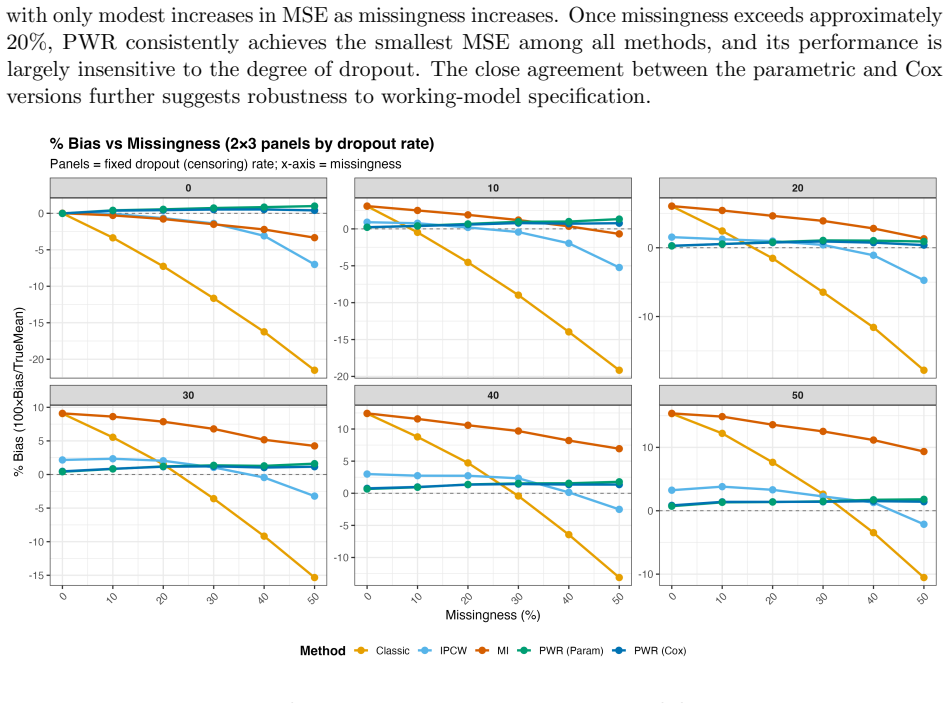
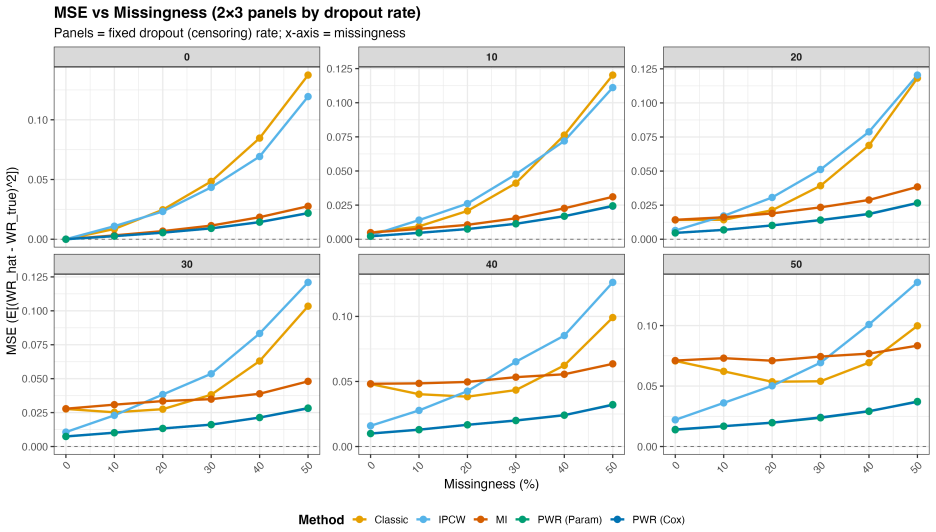
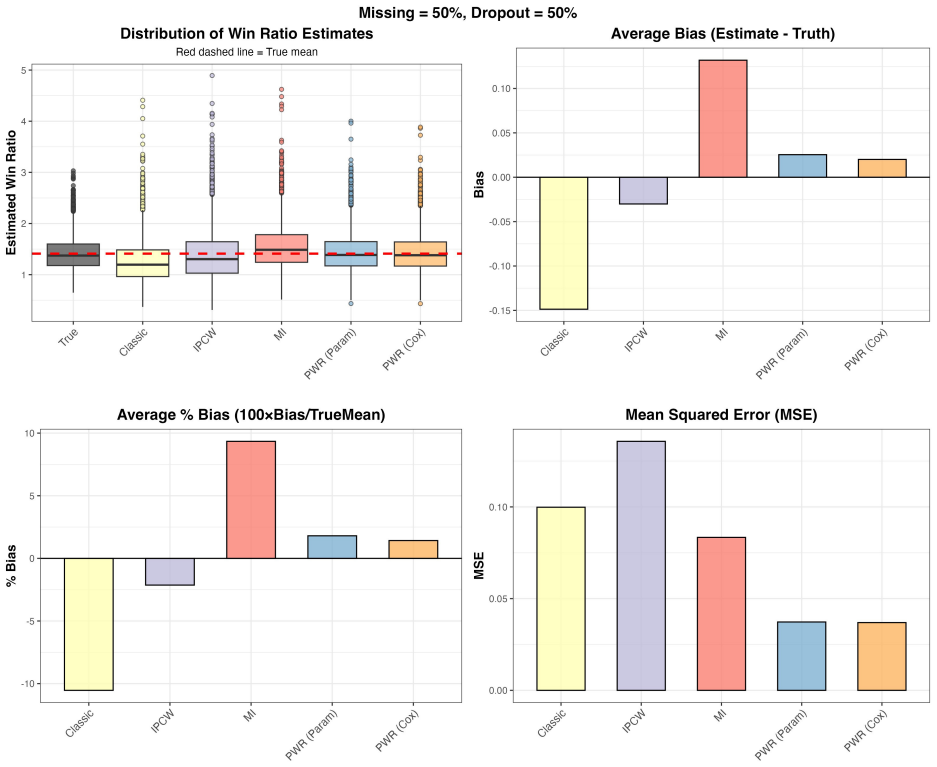
The PWR framework estimates the win ratio under coarsened observation by replacing deterministic decisions with conditional probabilities of win, loss, or tie given the observed data. Partially observed comparisons contribute fractionally while being penalized by their uncertainty, with greater coarsening leading to smaller effective weight. When all outcomes are fully observed, the PWR reduces exactly to the standard win ratio estimator. This approach maintains low bias and mean squared error in simulations under censoring and missingness, and performs well in clinical trial examples with near-complete and heavily censored data.
What carries the argument
The probabilistic win ratio (PWR), which computes conditional probabilities of win, loss, or tie from coarsened data to weight pairwise comparisons fractionally.
Load-bearing premise
That the conditional probabilities of win, loss, or tie given the observed coarsened data can be calculated in a manner that does not introduce systematic bias.
What would settle it
A dataset with known true win ratio where the PWR estimate shows substantial bias under a specific pattern of right censoring or missingness in lower-priority outcomes.
Figures
read the original abstract
The win ratio is increasingly used to analyze prioritized composite endpoints in clinical trials, but standard implementations rely on deterministic pairwise comparisons and can perform poorly in the presence of censoring and endpoint-specific missingness. In such settings, unresolved comparisons are often treated as ties, leading to loss of efficiency and potentially biased inference, particularly when lower-priority outcomes are incompletely observed. We propose the probabilistic win ratio (PWR), a framework for estimating the classical win ratio under coarsened observation. The PWR replaces deterministic pairwise decisions with conditional probabilities of win, loss, or tie given the observed data, allowing partially observed comparisons to contribute fractionally while being explicitly penalized according to their uncertainty. Comparisons with greater coarsening receive smaller effective weight, whereas fully observed comparisons contribute as in the classical analysis, preserving the clinical priority structure. When outcomes are fully observed, the PWR reduces exactly to the standard win ratio estimator. Simulation studies show that the PWR maintains low bias and mean squared error across a range of censoring and missingness scenarios. Two clinical trial case studies illustrate complementary data regimes, demonstrating calibration in near-complete data and stability under substantial right censoring.
Editorial analysis
A structured set of objections, weighed in public.
Referee Report
Summary. The manuscript proposes the probabilistic win ratio (PWR) for hierarchical composite endpoints under coarsened observations (censoring, endpoint-specific missingness). Deterministic pairwise win/loss/tie decisions are replaced by conditional probabilities computed from the observed data, so that partially observed pairs contribute fractionally with explicit uncertainty penalties; fully observed pairs retain full weight. The PWR is constructed to reduce exactly to the classical win ratio estimator when all outcomes are observed. Simulation studies across censoring and missingness regimes report low bias and MSE, and two clinical-trial case studies illustrate performance under near-complete and heavily censored data.
Significance. If the conditional probabilities are free of systematic bias under standard coarsening assumptions, the method offers a principled way to retain information from incomplete hierarchical comparisons without ad-hoc tie imputation. The exact reduction property and the reported simulation calibration provide concrete anchors. This could improve efficiency in trials using prioritized composites (e.g., cardiovascular or oncology endpoints) where lower-priority components are frequently censored or missing.
major comments (1)
- [§2.3] §2.3 (definition of conditional probabilities): the claim that the PWR is unbiased under coarsening relies on the conditional win/loss/tie probabilities being correctly specified from the observed data alone; the manuscript should state explicitly whether this requires a parametric model for the coarsening mechanism or holds nonparametrically, and provide the explicit functional form used in the simulations.
minor comments (2)
- [Simulation studies] Table 1 and simulation section: the range of censoring rates and missingness patterns examined should be listed explicitly so readers can judge coverage of realistic trial scenarios.
- [Abstract and §2] Notation: the distinction between the classical win ratio W and the PWR estimator ilde{W} is clear in the text but should be reinforced in the abstract and in the first display equation of §2.
Simulated Author's Rebuttal
We thank the referee for the constructive review and the recommendation for minor revision. We address the single major comment below.
read point-by-point responses
-
Referee: [§2.3] §2.3 (definition of conditional probabilities): the claim that the PWR is unbiased under coarsening relies on the conditional win/loss/tie probabilities being correctly specified from the observed data alone; the manuscript should state explicitly whether this requires a parametric model for the coarsening mechanism or holds nonparametrically, and provide the explicit functional form used in the simulations.
Authors: We thank the referee for highlighting the need for greater explicitness on this point. The conditional probabilities are obtained nonparametrically from the observed data under the coarsening-at-random assumption; no parametric model for the coarsening mechanism is required. The explicit functional form is the conditional probability P(win/loss/tie | observed components) defined in §2.3, which is computed from the empirical joint distribution of the observed parts of the hierarchical endpoints (with appropriate nonparametric estimators such as Kaplan–Meier for censored time-to-event components). In the simulation studies the same empirical conditional probabilities were evaluated on the simulated observed data under the independent censoring and missingness mechanisms described in §4. We will revise §2.3 to state the nonparametric character and to display the functional form used in the simulations. revision: yes
Circularity Check
No significant circularity
full rationale
The paper defines the probabilistic win ratio (PWR) explicitly as a generalization that replaces deterministic pairwise comparisons with conditional probabilities of win/loss/tie given coarsened data. It states that when outcomes are fully observed, PWR reduces exactly to the standard win ratio estimator, providing an external anchor rather than a self-referential definition. No equations are shown that fit parameters to the target quantity or define the estimator in terms of itself. Simulations validate bias/MSE properties but do not constitute the derivation. No self-citation chains, uniqueness theorems, or ansatz smuggling are invoked in the provided claims. The derivation is therefore self-contained against the classical win ratio benchmark.
Axiom & Free-Parameter Ledger
axioms (1)
- domain assumption Conditional probabilities of win, loss, or tie can be computed from the observed (coarsened) data without introducing systematic bias.
Reference graph
Works this paper leans on
-
[1]
Bebu, I. and Lachin, J. M. (2016). Large-sample inference for a win ratio analysis of a composite outcome based on prioritized components. Biostatistics 17, 178--187. doi:10.1093/biostatistics/kxv032
-
[2]
Buyse, M. and Peron, J. (2022). Generalized pairwise comparisons for prioritized outcomes. In S. Piantadosi and C. L. Meinert, editors, Principles and Practice of Clinical Trials, chapter 95, 1869--1893. Springer. doi:10.1007/978-3-319-52636-2\_277
-
[3]
Dong, G., Mao, L., Huang, B., Gamalo-Siebers, M., Wang, J., Yu, G., and Hoaglin, D. C. (2020). The inverse-probability-of-censoring weighting (IPCW) adjusted win ratio statistic: an unbiased estimator in the presence of independent censoring. Journal of Biopharmaceutical Statistics 30, 882--899. doi:10.1080/10543406.2020.1757692
-
[4]
B., Folkvaljon, F., Bengtsson, O., Buenconsejo, J., and Koch, G
Gasparyan, S. B., Folkvaljon, F., Bengtsson, O., Buenconsejo, J., and Koch, G. G. (2021). Adjusted win ratio with stratification: calculation methods and interpretation. Statistical Methods in Medical Research 30, 580--611. doi:10.1177/0962280220942558
-
[5]
Lehmann, E. L. (1963). Robust estimation in analysis of variance. The Annals of Mathematical Statistics 34, 957--966. doi:10.1214/aoms/1177704018
-
[6]
Mao, L. and Wang, T. (2021). A class of proportional win-fractions regression models for composite outcomes. Biometrics 77, 1265--1275. doi:10.1111/biom.13382
-
[7]
Peron, J., Buyse, M., Ozenne, B., Roche, L., and Roy, P. (2018). An extension of generalized pairwise comparisons for prioritized outcomes in the presence of censoring. Statistical Methods in Medical Research 27, 1230--1239. doi:10.1177/0962280216658320
-
[8]
Pocock, S. J., Ariti, C. A., Collier, T. J., and Wang, D. (2012). The win ratio: a new approach to the analysis of composite endpoints in clinical trials based on clinical priorities. European Heart Journal 33, 176--182. doi:10.1093/eurheartj/ehr352
discussion (0)
Sign in with ORCID, Apple, or X to comment. Anyone can read and Pith papers without signing in.