REVIEW 3 major objections 3 minor 98 references
Isolated neutron star candidates from the fourth generation XMM-Newton catalogues
T0 review · 3 major / 3 minor · reviewed 2026-06-27 · grok-4.3
Pith's one-line read Five sources selected from XMM-Newton catalogues show the soft, stable, counterpart-free X-ray emission expected for distant isolated neutron stars.
desk verdict Five new XINS candidates from 4XMM data line up with population predictions but rest on provisional classification pending deeper data. read the letter →
The pith
A machine-rendered reading of the paper's core claim, the machinery that carries it, and where it could break.
The reading
What carries the argument
Candidate selection on soft X-ray spectra plus absence of catalogued multi-wavelength counterparts, followed by stability checks with repeated XMM-Newton pointings.
What would settle it
Detection of an optical counterpart brighter than the expected magnitude for a neutron star at 2-6 kpc or measurement of strong X-ray variability in any of the five candidates would falsify the classification.
Extended reading notes
Core claim
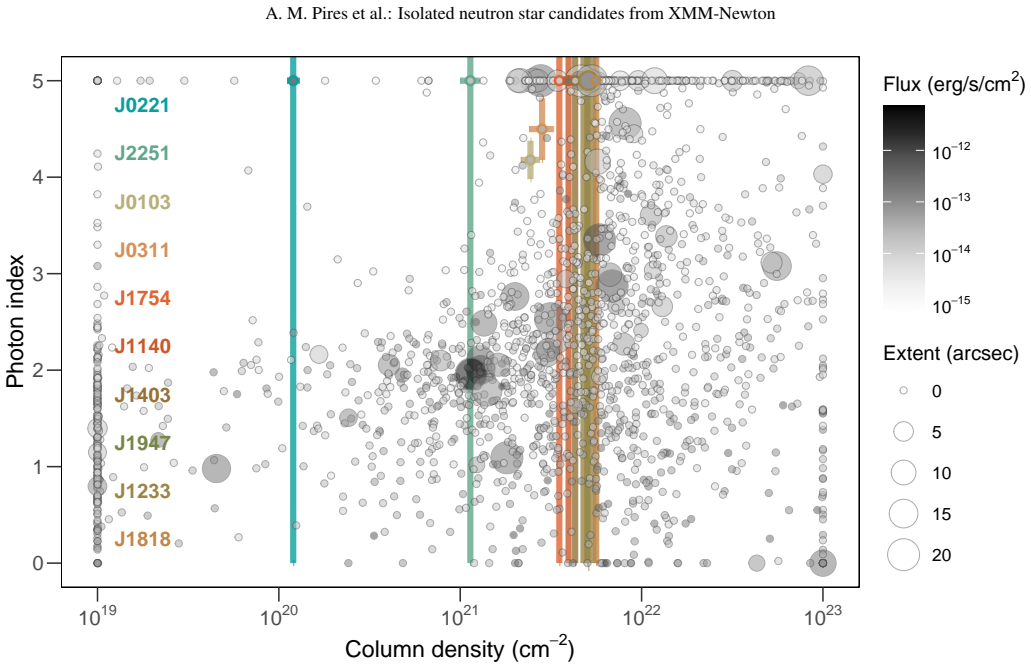
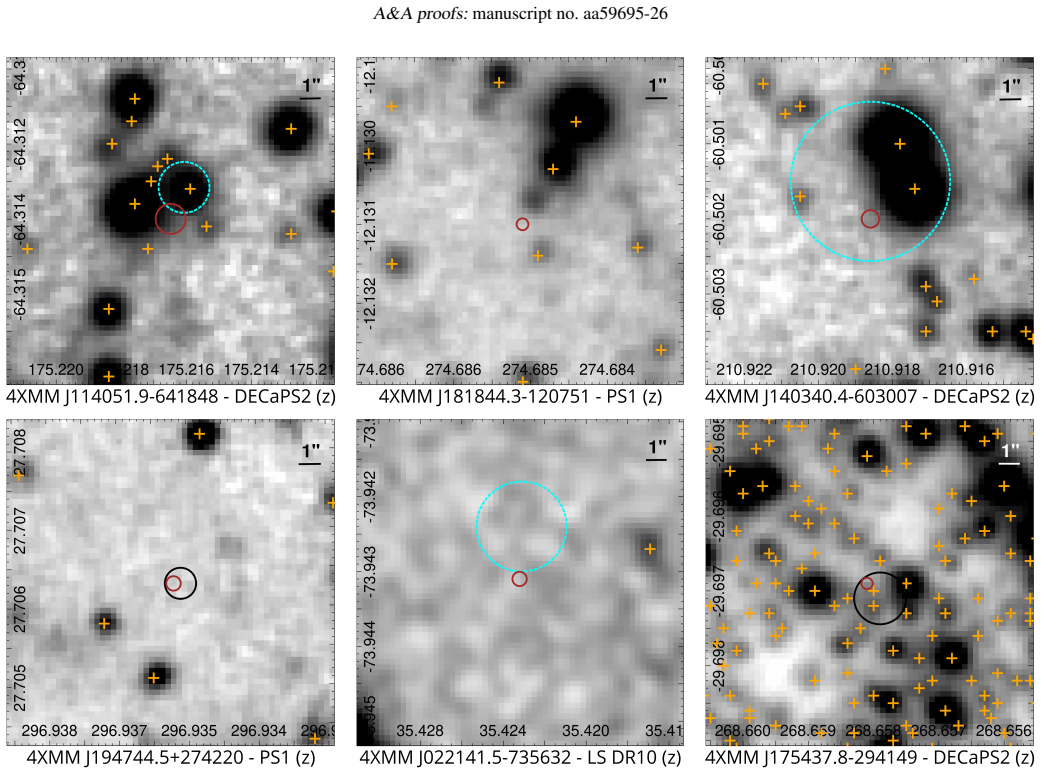
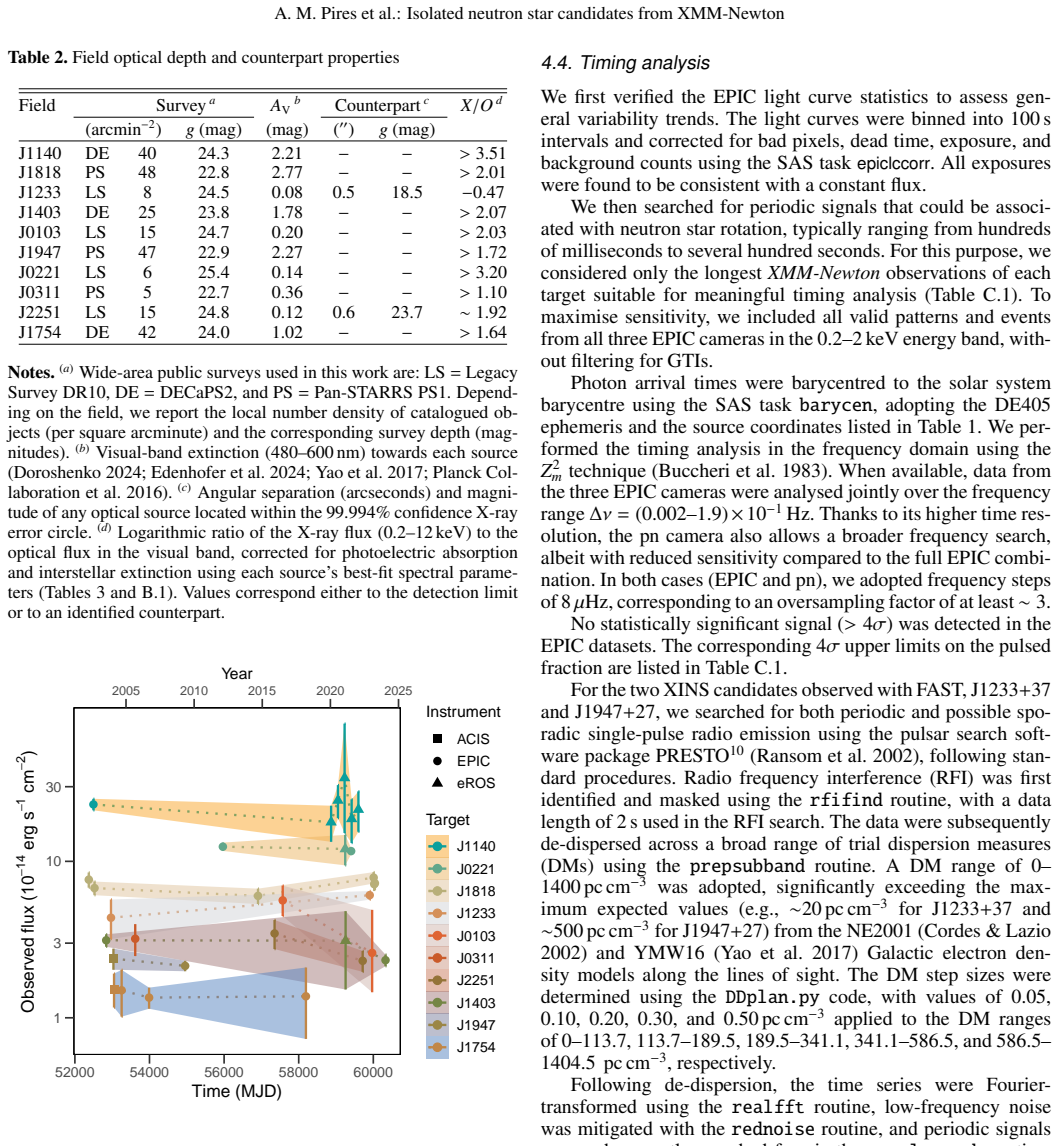
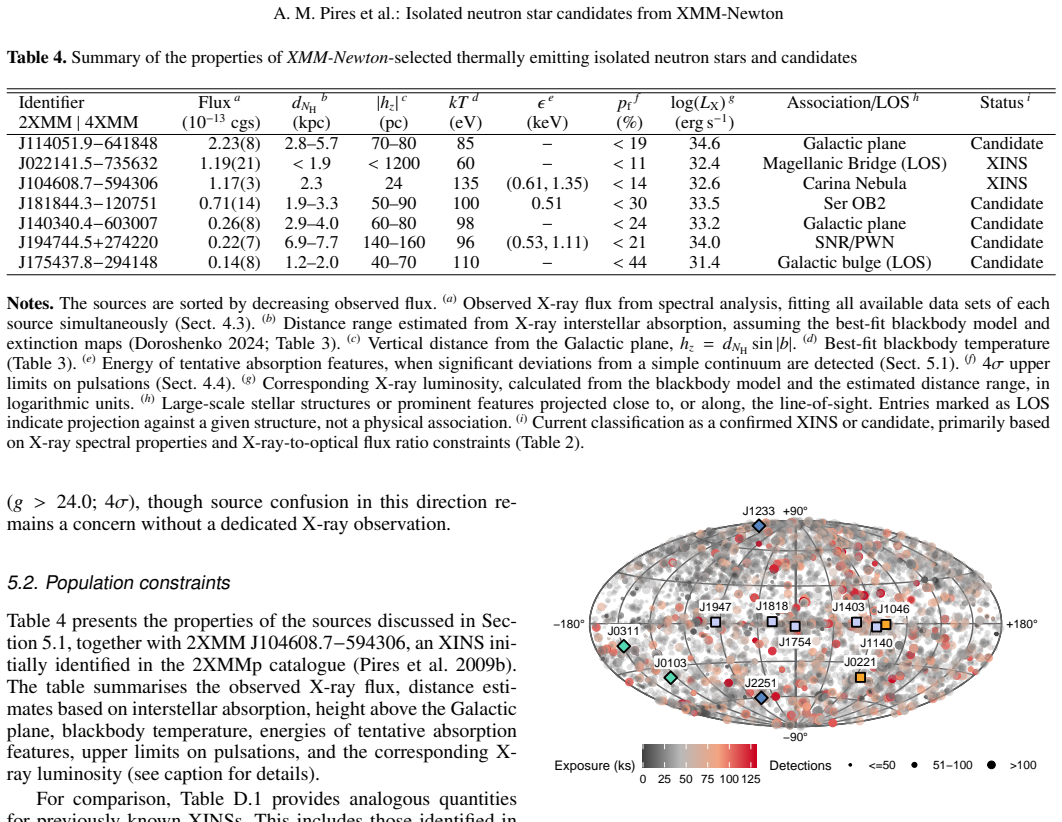
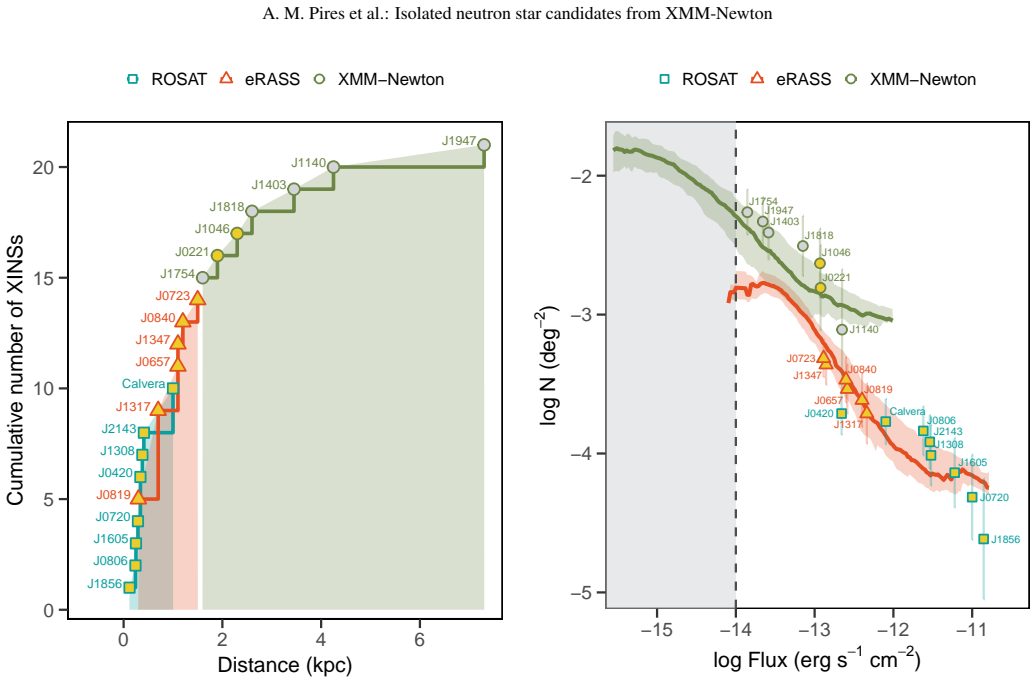
Of the ten sources examined, five exhibit soft (kT ∼ 80-100 eV), moderately absorbed, and stable X-ray emission with no catalogued counterparts, making them compelling candidates for distant X-ray thermally emitting isolated neutron stars. One source is the previously known XINS 4XMM J022141.5-735632; the remaining four are new. The sample lies mainly in the Galactic plane and is compatible with population-synthesis predictions of 20 ± 5 XINSs in the survey area, of which 6^{+2}_{-3} should exceed the chosen flux limit.
Load-bearing premise
Soft X-ray spectra, lack of counterparts, and emission stability together suffice to classify a source as an isolated neutron star rather than another soft X-ray emitter or contaminant.
Editorial extensions
If this is right
- The observed count matches the model expectation, implying that roughly 70 percent of the Galactic XINS population lies below the current flux threshold.
- Deeper optical imaging and additional X-ray monitoring can confirm or reject the five candidates.
- NewAthena will be able to obtain higher-quality spectra of these more distant objects.
- Improved statistics on the full sample will tighten constraints on neutron-star cooling and magnetic-field evolution.
Reading between the lines
- The same selection technique applied to eROSITA or future all-sky surveys could locate additional members of this faint population.
- If the candidates are confirmed, their distances would extend the known XINS sample beyond the local 1 kpc volume probed by the Magnificent Seven.
- The Galactic-plane concentration of the candidates suggests that plane surveys miss fewer objects than high-latitude ones once absorption is accounted for.
- A mismatch between the observed and predicted numbers after full follow-up would require revision of the assumed birth rate or cooling curves in the population model.
Editorial analysis
A structured set of objections, weighed in public.
Referee Report
Summary. The paper searches the 4XMM-DR9 and 4XMM-DR12 catalogues for X-ray thermally emitting isolated neutron stars (XINSs) down to a flux of 10^{-14} erg cm^{-2} s^{-1} (0.5-1 keV), selecting candidates via soft spectra and absence of catalogued optical/UV/IR counterparts. Follow-up with XMM-Newton, FAST, eROSITA, Chandra and optical surveys yields ten sources analysed, of which five are presented as compelling XINS candidates (kT∼80-100 eV, moderate absorption, stable emission), one is a known XINS, two are extragalactic contaminants, and two remain ambiguous. Population-synthesis simulations predict 20±5 XINSs in the footprint, with 6^{+2}_{-3} above threshold, stated as consistent with the sample; ∼70% of the population is predicted below threshold. The abstract notes that deep optical and additional X-ray observations are required to confirm the candidates.
Significance. If the five classifications are robust, the work would enlarge the known sample of distant XINSs, tightening constraints on cooling curves, magnetic-field evolution and Galactic scale height. The reported consistency between observed count and simulation (including the large undetected fraction) would provide an independent check on population-synthesis assumptions derived from nearer objects.
major comments (3)
- [Abstract and §3 (candidate selection and follow-up)] Abstract and candidate-selection section: the claim that the five sources are 'compelling XINS candidates' rests on kT∼80-100 eV, moderate absorption, flux stability and lack of catalogued counterparts, yet the manuscript itself states that 'deep optical and additional X-ray observations are required to establish the nature.' This selection does not quantitatively exclude other soft emitters (absorbed AGN, isolated white dwarfs, CVs) at the achieved photon statistics, rendering the central classification load-bearing on an unverified assumption.
- [§4 (population-synthesis simulations)] Population-synthesis section: the statement that 6^{+2}_{-3} simulated sources exceed the flux threshold is presented as consistent with the observed sample, but the text does not specify whether the underlying parameters (birth rate, cooling tracks, spatial distribution) were fixed from independent priors or adjusted to match earlier XINS samples. Without this information the agreement cannot be assessed for circularity.
- [§3.3 (spectral fitting) and Table 2] Spectral-analysis results: two of the ten sources are flagged as ambiguous owing to limited photon statistics, yet the five-candidate count and the comparison to the simulated 6^{+2}_{-3} still treat the full sample as supporting the model; explicit exclusion criteria and error bars on fitted kT and N_H for these marginal sources are needed to evaluate robustness.
minor comments (3)
- [Tables 1-3] Tables reporting spectral fits should include 1σ uncertainties on kT, N_H and unabsorbed fluxes; the current presentation of ranges (kT∼80-100 eV) without errors hinders quantitative comparison with known XINSs.
- [§2.2 (multiwavelength cross-matching)] The exact search radius and magnitude limits used to declare 'absence of catalogued counterparts' are not stated; these details are required for reproducibility of the selection.
- [§3.4 (variability analysis)] Figure captions and text should clarify whether the reported flux stability is quantified via a variability index or simply by visual inspection of the light curves.
Simulated Author's Rebuttal
We thank the referee for the thoughtful and detailed report. The comments highlight important points on classification robustness, model transparency, and statistical presentation. We address each major comment below, proposing targeted revisions to improve clarity without altering the core results.
read point-by-point responses
-
Referee: [Abstract and §3] The claim that the five sources are 'compelling XINS candidates' rests on kT∼80-100 eV, moderate absorption, flux stability and lack of catalogued counterparts, yet the manuscript states deep observations are required. This does not quantitatively exclude other soft emitters at the achieved photon statistics.
Authors: We agree the classification is provisional and relies on the combination of soft thermal spectra, moderate absorption, stability, and absence of counterparts, which match XINS expectations but cannot fully rule out rare contaminants at low photon counts. The manuscript already qualifies the result by noting the need for confirmation. We will revise the abstract and §3 to replace 'compelling' with 'strong' or 'promising' candidates, add a brief quantitative estimate of expected contaminant rates from AGN and white-dwarf populations at these fluxes, and strengthen the caveats on classification. revision: yes
-
Referee: [§4] The statement that 6^{+2}_{-3} simulated sources exceed the flux threshold is presented as consistent with the observed sample, but the text does not specify whether parameters were fixed from independent priors or adjusted to match earlier XINS samples, preventing assessment of circularity.
Authors: The population-synthesis parameters (birth rate, cooling tracks, spatial distribution) are taken from independent literature priors and were not adjusted to fit the current 4XMM sample or the five candidates. We will expand §4 with explicit statements citing the source papers for each parameter set and confirming that no tuning to the present data was performed, thereby removing any ambiguity about circularity. revision: yes
-
Referee: [§3.3 and Table 2] Two sources are flagged as ambiguous due to limited photon statistics, yet the five-candidate count and comparison to 6^{+2}_{-3} still treat the full sample as supporting the model; explicit exclusion criteria and error bars on fitted kT and N_H for marginal sources are needed.
Authors: The five candidates were selected using explicit thresholds on fit quality (reduced χ² < 1.5, >50 net counts, and kT consistent with 50–150 eV within 90% errors), while the two ambiguous sources fall below these thresholds. We will add 90% confidence error bars on kT and N_H for all ten sources in Table 2, include the precise numerical criteria used for classification in §3.3, and reiterate in the text that the simulation comparison holds only if the five candidates are ultimately confirmed. revision: partial
Circularity Check
No significant circularity; classification and population comparison are independent
full rationale
The paper selects candidates via explicit observational criteria (soft kT~80-100 eV spectra, no catalogued multiwavelength counterparts, flux stability) and reports a count of five compelling sources. It then compares this count to an external population-synthesis prediction (20±5 total, 6+2-3 above threshold) whose parameters are not stated to be fitted to the present sample. No equation or step reduces the candidate count or the consistency statement to a fit of the same data by construction; the simulation is invoked as an a-priori benchmark. No self-citation load-bearing step, self-definitional loop, or ansatz smuggling is present in the abstract or described methods. The derivation chain therefore remains self-contained against external benchmarks.
Assumptions & free parameters
free parameters (1)
- flux threshold =
10^{-14} erg cm^{-2} s^{-1}
assumptions (1)
- domain assumption Soft X-ray spectra with kT ~80-100 eV and no multiwavelength counterparts reliably indicate isolated cooling neutron stars
Cite this review
Pith. "Pith review of Isolated neutron star candidates from the fourth generation XMM-Newton catalogues." pith.science (2026). https://pith.science/paper/JO3G7IKB
@misc{pith2026260608023,
  author       = {Pith},
  title        = {Pith review of: Isolated neutron star candidates from the fourth generation XMM-Newton catalogues},
  year         = {2026},
  howpublished = {\url{https://pith.science/paper/JO3G7IKB}},
  note         = {Machine review of arXiv:2606.08023}
}
abstract
X-ray thermally emitting isolated neutron stars (XINSs) are a rare population that provides insights into neutron star cooling, magnetic-field evolution, and Galactic demographics. Using more than two decades of observations from the European Space Agency's XMM-Newton Observatory, we searched the 4XMM-DR9 and 4XMM-DR12 catalogues for absorbed XINS candidates down to a flux of $10^{-14}$ erg cm$^{-2}$ s$^{-1}$ in the 0.5--1 keV band. Candidates were selected based on soft X-ray spectra and the absence of catalogued optical, ultraviolet, or infrared counterparts. Follow-up observations with XMM-Newton and FAST were complemented by data from the SRG/eROSITA All-Sky Survey, Chandra, and optical surveys. Of ten sources analysed, five are compelling XINS candidates, one is the known XINS 4XMM J022141.5-735632, two are extragalactic contaminants, and two remain ambiguous because of limited photon statistics. The five candidates exhibit soft ($kT\sim80-100$ eV), moderately absorbed, and stable X-ray emission consistent with distant XINSs. They are located primarily in the Galactic plane, with possible associations at distances of $\sim$1.8 and $\sim$6 kpc. Population-synthesis simulations predict $20\pm5$ XINSs within the 4XMM-DR12 footprint, of which $6^{+2}_{-3}$ exceed our flux threshold, consistent with the observed sample if additional candidates are confirmed. The model further predicts that $\sim$70% of the population remains below the detection threshold. Deep optical and additional X-ray observations are required to establish the nature of the candidates. Future missions such as NewAthena will enable more detailed studies of these distant populations and improve constraints on the Galactic XINS population.
Figures
Figures from the paper (2 more)
Reference graph
Works this paper leans on
-
[1]
2020, , 249, 3
Ahumada , R., Allende Prieto , C., Almeida , A., et al. 2020, , 249, 3
2020
-
[2]
Arnaud , K. A. 1996, in Astronomical Society of the Pacific Conference Series, Vol. 101, Astronomical Data Analysis Software and Systems V, ed. G. H. Jacoby & J. Barnes , 17
1996
-
[3]
2024, , 533, 201
Ascenzi , S., Vigan \`o , D., Dehman , C., et al. 2024, , 533, 201
2024
-
[4]
E., Alexander , D
Bauer , F. E., Alexander , D. M., Brandt , W. N., et al. 2004, , 128, 2048
2004
-
[5]
& Tremaine , S
Binney , J. & Tremaine , S. 1987, Galactic dynamics
1987
-
[6]
& Ho , W
Bogdanov , S. & Ho , W. C. G. 2024, , 969, 53
2024
-
[7]
2022, , 661, A1
Brunner , H., Liu , T., Lamer , G., et al. 2022, , 661, A1
2022
-
[8]
F., et al
Buccheri , R., Bennett , K., Bignami , G. F., et al. 1983, , 128, 245
1983
Show all 98 references
-
[9]
F., Piedipalumbo , E., & Tortora , C
Cardone , V. F., Piedipalumbo , E., & Tortora , C. 2005, , 358, 1325
2005
-
[10]
C., Magnier , E
Chambers , K. C., Magnier , E. A., Metcalfe , N., et al. 2016, arXiv e-prints, arXiv:1612.05560
2016 arXiv
-
[11]
Cordes , J. M. & Lazio , T. J. W. 2002, arXiv e-prints, astro
2002
-
[12]
Cordes , J. M. & McLaughlin , M. A. 2003, , 596, 1142
2003
-
[13]
2005, , 437, 1029
De Becker , M., Rauw , G., Blomme , R., et al. 2005, , 437, 1029
2005
-
[14]
2021, , 914, 118
De Grandis , D., Taverna , R., Turolla , R., et al. 2021, , 914, 118
2021
-
[15]
F., & Ag \"u eros , M
Demasi , S., Anderson , S. F., & Ag \"u eros , M. A. 2024, , 961, 36
2024
-
[16]
J., Lang , D., et al
Dey , A., Schlegel , D. J., Lang , D., et al. 2019, , 157, 168
2019
-
[17]
Dickey , J. M. & Lockman , F. J. 1990, , 28, 215
1990
-
[18]
2024, arXiv e-prints, arXiv:2403.03127
Doroshenko , V. 2024, arXiv e-prints, arXiv:2403.03127
2024
-
[19]
2024, , 685, A82
Edenhofer , G., Zucker , C., Frank , P., et al. 2024, , 685, A82
2024
-
[20]
N., Evans , J
Evans , I. N., Evans , J. D., Mart \' nez-Galarza , J. R., et al. 2024, , 274, 22
2024
-
[21]
& Kaspi , V
Faucher-Gigu \`e re , C.-A. & Kaspi , V. M. 2006, , 643, 332
2006
-
[22]
Gaia Collaboration , Prusti , T., de Bruijne , J. H. J., et al. 2016, , 595, A1
2016
-
[23]
Gaia Collaboration , Vallenari , A., Brown , A. G. A., et al. 2023, , 674, A1
2023
-
[24]
& Heyl , J
Gill , R. & Heyl , J. 2007, , 381, 52
2007
-
[25]
2007, , 308, 181
Haberl , F. 2007, , 308, 181
2007
-
[26]
2000, in KITP Conference: Spin, Magnetism and Cooling of Young Neutron Stars, ed
Heyl , J. 2000, in KITP Conference: Spin, Magnetism and Cooling of Young Neutron Stars, ed. L. Bildsten , L. Hernquist , V. Kaspi , & S. Kulkarni , 15
2000
-
[27]
E., Bauer , F
Hornschemeier , A. E., Bauer , F. E., Alexander , D. M., et al. 2003, , 126, 575
2003
-
[28]
W., van Straten , W., & Manchester , R
Hotan , A. W., van Straten , W., & Manchester , R. N. 2004, , 21, 302
2004
-
[29]
L., Burgay , M., Rea , N., et al
Israel , G. L., Burgay , M., Rea , N., et al. 2021, , 907, 7
2021
-
[30]
2001, , 365, L1
Jansen , F., Lumb , D., Altieri , B., et al. 2001, , 365, L1
2001
-
[31]
2020, Research in Astronomy and Astrophysics, 20, 064
Jiang , P., Tang , N.-Y., Hou , L.-G., et al. 2020, Research in Astronomy and Astrophysics, 20, 064
2020
-
[32]
2019, Science China Physics, Mechanics, and Astronomy, 62, 959502
Jiang , P., Yue , Y., Gan , H., et al. 2019, Science China Physics, Mechanics, and Astronomy, 62, 959502
2019
-
[33]
Joye , W. A. & Mandel , E. 2003, in Astronomical Society of the Pacific Conference Series, Vol. 295, Astronomical Data Analysis Software and Systems XII, ed. H. E. Payne , R. I. Jedrzejewski , & R. N. Hook , 489
2003
-
[34]
Kaplan , D. L. 2008, in American Institute of Physics Conference Series, Vol. 983, 40 Years of Pulsars: Millisecond Pulsars, Magnetars and More, ed. C. Bassa , Z. Wang , A. Cumming , & V. M. Kaspi , 331--339
2008
-
[35]
Keane , E. F. & Kramer , M. 2008, , 391, 2009
2008
-
[36]
P., Jenkins , M., et al
Kirsten , F., Snelders , M. P., Jenkins , M., et al. 2021, Nature Astronomy, 5, 414
2021
-
[37]
M., Schwope , A
Kurpas , J., Pires , A. M., Schwope , A. D., et al. 2026, , 705, A148
2026
-
[38]
M., Schwope , A
Kurpas , J., Pires , A. M., Schwope , A. D., et al. 2025, , 694, A160
2025
-
[39]
D., Pires , A
Kurpas , J., Schwope , A. D., Pires , A. M., & Haberl , F. 2024 a , , 683, A164
2024
-
[40]
D., Pires , A
Kurpas , J., Schwope , A. D., Pires , A. M., & Haberl , F. 2024 b , , 687, A251
2024
-
[41]
D., Pires , A
Kurpas , J., Schwope , A. D., Pires , A. M., Haberl , F., & Buckley , D. A. H. 2023, , 674, A155
2023
-
[42]
M., Lattanzi , M
Lasker , B. M., Lattanzi , M. G., McLean , B. J., et al. 2008, , 136, 735
2008
-
[43]
A., & Barret , D
Lin , D., Webb , N. A., & Barret , D. 2012, , 756, 27
2012
-
[44]
Lorimer , D. R. & Kramer , M. 2004, Handbook of Pulsar Astronomy , Vol. 4
2004
-
[45]
1986, , 308, 635
Makishima , K., Maejima , Y., Mitsuda , K., et al. 1986, , 308, 635
1986
-
[46]
2016, , 825, 134
Matheson , H., Safi-Harb , S., & Kothes , R. 2016, , 825, 134
2016
-
[47]
2024, , 682, A34
Merloni , A., Lamer , G., Liu , T., et al. 2024, , 682, A34
2024
-
[48]
1984, , 36, 741
Mitsuda , K., Inoue , H., Koyama , K., et al. 1984, , 36, 741
1984
-
[49]
& McCammon , D
Morrison , R. & McCammon , D. 1983, , 270, 119
1983
-
[50]
2017, in Astronomical Society of the Pacific Conference Series, Vol
Motch , C., Carrera , F., Genova , F., et al. 2017, in Astronomical Society of the Pacific Conference Series, Vol. 512, Astronomical Data Analysis Software and Systems XXV, ed. N. P. F. Lorente , K. Shortridge , & R. Wayth , 165
2017
-
[51]
A., Contopoulos , G., & Grosbol , P
Patsis , P. A., Contopoulos , G., & Grosbol , P. 1991, , 243, 373
1991
-
[52]
G., Shibanov , Y
Pavlov , G. G., Shibanov , Y. A., Zavlin , V. E., & Meyer , R. D. 1995, in NATO Advanced Science Institutes (ASI) Series C, Vol. 450, NATO Advanced Science Institutes (ASI) Series C, ed. M. A. Alpar , U. Kiziloglu , & J. van Paradijs , 71
1995
-
[53]
X., Derriere , S., Motch , C., et al
Pineau , F. X., Derriere , S., Motch , C., et al. 2017, , 597, A89
2017
-
[54]
2009, PhD thesis, Observatory of Stasbourg
Pires , A. 2009, PhD thesis, Observatory of Stasbourg
2009
-
[55]
M., Motch , C., & Janot-Pacheco , E
Pires , A. M., Motch , C., & Janot-Pacheco , E. 2009 a , , 504, 185
2009
-
[56]
M., Motch , C., Kurpas , J., et al
Pires , A. M., Motch , C., Kurpas , J., et al. 2022, , 666, A148
2022
-
[57]
M., Motch , C., Schwope , A., et al
Pires , A. M., Motch , C., Schwope , A., et al. 2025, Astronomische Nachrichten, 346, e20240116
2025
-
[58]
M., Motch , C., Turolla , R., et al
Pires , A. M., Motch , C., Turolla , R., et al. 2015, , 583, A117
2015
-
[59]
M., Motch , C., Turolla , R., et al
Pires , A. M., Motch , C., Turolla , R., et al. 2012, , 544, A17
2012
-
[60]
M., Motch , C., Turolla , R., Treves , A., & Popov , S
Pires , A. M., Motch , C., Turolla , R., Treves , A., & Popov , S. B. 2009 b , , 498, 233
2009
-
[61]
M., Schwope , A
Pires , A. M., Schwope , A. D., & Motch , C. 2017, Astronomische Nachrichten, 338, 213
2017
-
[62]
2016, , 596, A109
Planck Collaboration , Aghanim , N., Ashdown , M., et al. 2016, , 596, A109
2016
-
[63]
Popov , S. B. 2023, Universe, 9, 273
2023
-
[64]
B., Colpi , M., Prokhorov , M
Popov , S. B., Colpi , M., Prokhorov , M. E., Treves , A., & Turolla , R. 2003, , 406, 111
2003
-
[65]
B., Turolla , R., Prokhorov , M
Popov , S. B., Turolla , R., Prokhorov , M. E., Colpi , M., & Treves , A. 2005, , 299, 117
2005
-
[66]
B., Haberl , F., et al
Posselt , B., Popov , S. B., Haberl , F., et al. 2008, , 482, 617
2008
-
[67]
Y., De Luca , A., & Pons , J
Potekhin , A. Y., De Luca , A., & Pons , J. A. 2015, , 191, 171
2015
-
[68]
Y., Zyuzin , D
Potekhin , A. Y., Zyuzin , D. A., Yakovlev , D. G., Beznogov , M. V., & Shibanov , Y. A. 2020, , 496, 5052
2020
-
[69]
2021, , 647, A1
Predehl , P., Andritschke , R., Arefiev , V., et al. 2021, , 647, A1
2021
-
[70]
M., Tian , J., Younes , G., et al
Rajwade , K. M., Tian , J., Younes , G., et al. 2025, , 985, L3
2025
-
[71]
M., Eikenberry , S
Ransom , S. M., Eikenberry , S. S., & Middleditch , J. 2002, , 124, 1788
2002
-
[72]
2024, in Multifrequency Behaviour of High Energy Cosmic Sources XIV, 55
Rigoselli , M. 2024, in Multifrequency Behaviour of High Energy Cosmic Sources XIV, 55
2024
-
[73]
P., Gotthelf , E
Rigoselli , M., Mereghetti , S., Halpern , J. P., Gotthelf , E. V., & Bassa , C. G. 2024, , 976, 228
2024
-
[74]
2022, , 509, 1217
Rigoselli , M., Mereghetti , S., & Tresoldi , C. 2022, , 509, 1217
2022
-
[75]
R., Webb , N
Rosen , S. R., Webb , N. A., Watson , M. G., et al. 2016, , 590, A1
2016
-
[76]
2022, , 511, 4265
Ruiz , A., Georgakakis , A., Gerakakis , S., et al. 2022, , 511, 4265
2022
-
[77]
C., Epchtein , N., et al
Ruphy , S., Robin , A. C., Epchtein , N., et al. 1996, , 313, L21
1996
-
[78]
E., Fox , D
Rutledge , R. E., Fox , D. B., & Shevchuk , A. H. 2008, , 672, 1137
2008
-
[79]
D., K \"o nig , O., Descalzo , M., et al
Saxton , R. D., K \"o nig , O., Descalzo , M., et al. 2022, Astronomy and Computing, 38, 100531
2022
-
[80]
K., Schlafly , E
Saydjari , A. K., Schlafly , E. F., Lang , D., et al. 2023, , 264, 28
2023
-
[81]
2001, , 365, L18
Str \"u der , L., Briel , U., Dennerl , K., et al. 2001, , 365, L18
2001
-
[82]
Taylor , M. B. 2006, in Astronomical Society of the Pacific Conference Series, Vol. 351, Astronomical Data Analysis Software and Systems XV, ed. C. Gabriel , C. Arviset , D. Ponz , & S. Enrique , 666
2006
-
[83]
M., Pastor-Marazuela , I., et al
Tian , J., Rajwade , K. M., Pastor-Marazuela , I., et al. 2026, arXiv e-prints, arXiv:2605.00720
2026 arXiv
-
[84]
D., Lamer , G., et al
Traulsen , I., Schwope , A. D., Lamer , G., et al. 2020, , 641, A137
2020
-
[85]
Turner , M. J. L., Abbey , A., Arnaud , M., et al. 2001, , 365, L27
2001
-
[86]
2009, in Astrophysics and Space Science Library, Vol
Turolla , R. 2009, in Astrophysics and Space Science Library, Vol. 357, Astrophysics and Space Science Library, ed. W. Becker , 141
2009
-
[87]
1999, , 349, 389
Voges , W., Aschenbach , B., Boller , T., et al. 1999, , 349, 389
1999
-
[88]
J., Cohen , M., Volk , K., Walker , H
Wainscoat , R. J., Cohen , M., Volk , K., Walker , H. J., & Schwartz , D. E. 1992, , 83, 111
1992
-
[89]
J., Landecker , T
Wallace , B. J., Landecker , T. L., & Taylor , A. R. 1997, , 114, 2068
1997
-
[90]
G., Augu \`e res , J
Watson , M. G., Augu \`e res , J. L., Ballet , J., et al. 2001, , 365, L51
2001
-
[91]
G., Schr \"o der , A
Watson , M. G., Schr \"o der , A. C., Fyfe , D., et al. 2009, , 493, 339
2009
-
[92]
A., Carrera , F
Webb , N. A., Carrera , F. J., Schwope , A., et al. 2023, Astronomische Nachrichten, 344, e20220102
2023
-
[93]
A., Coriat , M., Traulsen , I., et al
Webb , N. A., Coriat , M., Traulsen , I., et al. 2020, , 641, A136
2020
-
[94]
Widrow , L. M. & Dubinski , J. 2005, , 631, 838
2005
-
[95]
2000, , 542, 914
Wilms , J., Allen , A., & McCray , R. 2000, , 542, 914
2000
-
[96]
M., Manchester , R
Yao , J. M., Manchester , R. N., & Wang , N. 2017, , 835, 29
2017
-
[97]
& K \"u c \"u k , I
Yusifov , I. & K \"u c \"u k , I. 2004, , 422, 545
2004
-
[98]
E., Pavlov , G
Zavlin , V. E., Pavlov , G. G., & Shibanov , Y. A. 1996, , 315, 141
1996
Reviewed June 27, 2026 · model on record in the stance chip above.
Discussion (0). Sign in to comment.