Exploring Above-neck Unimanual Swipe Gestures for Off-Device Earable Interaction
Pith reviewed 2026-06-27 19:14 UTC · model grok-4.3
The pith
A within-subjects study maps preferred start and end regions for nonaxial and angular above-neck swipes to control earables.
A machine-rendered reading of the paper's core claim, the machinery that carries it, and where it could break.
Core claim
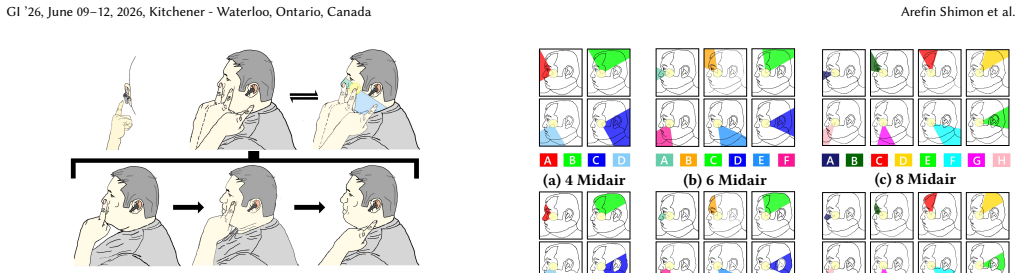
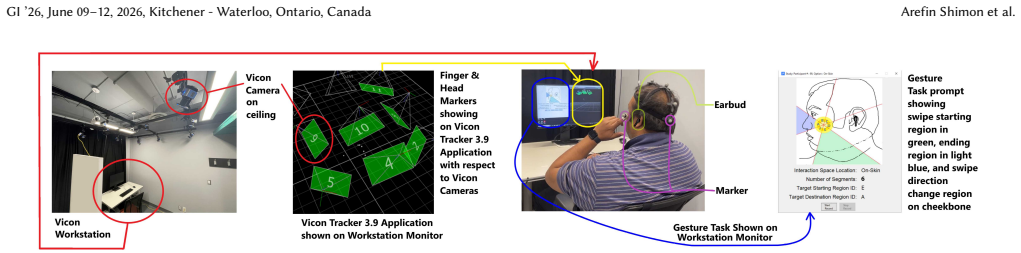
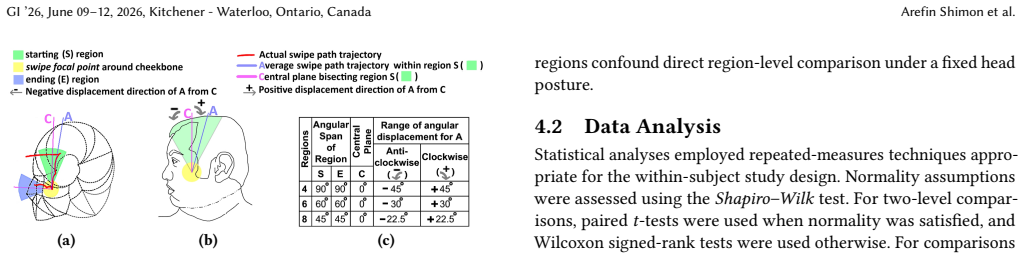
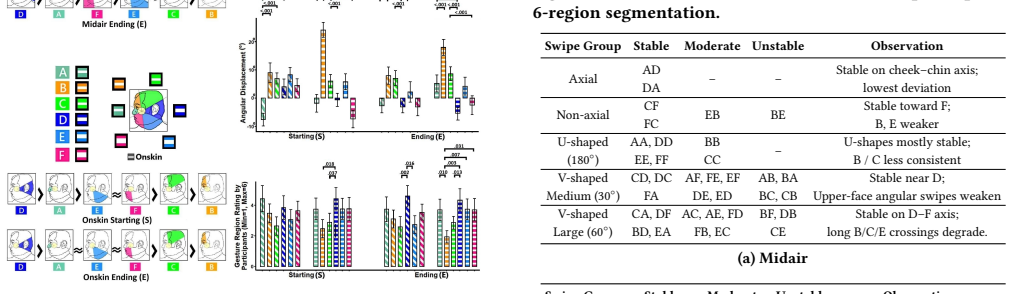
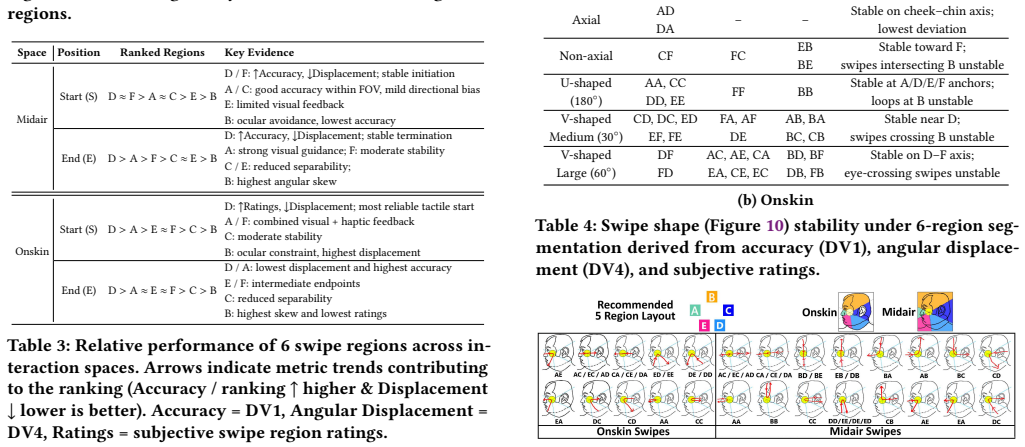
In a within-subject gesture motion analysis study with 24 participants analyzing 5,568 swipes of varying shape, orientation, and complexity, preferred starting and ending regions were identified for different unidirectional and angular swipe shapes, along with intuitive swipe shapes within the off-device, above-neck manual interaction space.
What carries the argument
The gesture motion analysis that records and compares start/end regions and shape preferences across unidirectional and angular swipes performed above the neck.
If this is right
- Nonaxial and angular swipes can be combined with traditional axial gestures to create a larger gesture vocabulary for earables.
- Designers gain concrete region and shape guidelines for placing these gestures in the above-neck space.
- Current earable sensing hardware may support recognition of the identified intuitive shapes without additional hardware.
- Applications become feasible in scenarios such as calls, media control, or notifications without looking at or touching the device.
Where Pith is reading between the lines
- Gesture recognizers could use the mapped start and end regions as priors to reduce false positives.
- Longitudinal studies could check whether the same preferences persist after users practice the gestures over weeks.
- The space might support hybrid gestures that combine swipes with finger postures for even more distinct commands.
Load-bearing premise
Preferences recorded in a controlled lab study with 24 participants will translate to everyday conditions and can be detected reliably by existing earable sensors.
What would settle it
A real-world test that measures whether users still choose the same start and end regions and whether sensors achieve usable recognition accuracy while participants walk, talk, or wear the devices during daily activities.
Figures
read the original abstract
Despite their growing popularity, in-ear Earable / Hearable devices (i.e., ear-mounted wearables) face interaction challenges due to limited input space and compact form factors. To enhance interaction capabilities, researchers are exploring off-device hand-based input spaces above the neck using midair and onskin gestures. However, existing literature primarily focuses on axial swipes (i.e., horizontal and vertical), leaving nonaxial swipes (i.e., unidirectional swipes with varied orientations) and angular swipes (e.g., L, U, or V) largely underexplored despite their potential interaction advantages. To address this gap, we conducted a within-subject gesture motion analysis study with 24 participants, analyzing 5,568 swipes of varying shape, orientation, and complexity. Our results revealed preferred starting and ending regions for different unidirectional and angular swipe shapes, as well as intuitive swipe shapes within the off-device, above-neck manual interaction space. We further examine off-device swipe characteristics, discuss the feasibility of recognizing these earable gestures with current sensing technologies, and highlight their potential application in various scenarios. These findings broaden the understanding of off-device earable gestures and provide design insights for integrating suitable nonaxial and angular swipes alongside traditional axial gestures to enhance interaction with in-ear earable devices.
Editorial analysis
A structured set of objections, weighed in public.
Referee Report
Summary. The paper reports a within-subjects lab study with 24 participants who performed 5,568 instructed unimanual swipes (unidirectional and angular shapes at varying orientations) in the off-device above-neck space. It identifies preferred start/end regions for different shapes, notes intuitive shapes, provides kinematic characterizations, qualitatively discusses recognition feasibility with earable sensors (IMU, mic, etc.), and offers design implications for expanding earable input beyond axial swipes.
Significance. If the observed spatial preferences and shape intuitions prove robust, the work would usefully expand the design space for earable interaction by documenting non-axial and angular options. The scale of the motion corpus (5,568 trials) is a positive feature for an elicitation-style study. However, because the manuscript supplies only controlled-lab kinematics and a qualitative feasibility discussion, the translation to deployable earable input remains untested.
major comments (3)
- [Abstract / Study] Abstract and Study section: the central claims about 'preferred starting and ending regions' and 'intuitive swipe shapes' rest on motion-analysis results whose statistical methods, exclusion criteria, inter-rater reliability for region coding, and error analysis are not described, making the quantitative support for the reported preferences unverifiable from the provided text.
- [Discussion] Discussion / Feasibility subsection: the assertion that the gestures are suitable for earable interaction is load-bearing for the design-insight contribution, yet the manuscript contains no sensor recordings, recognition pipeline, or accuracy results; only a qualitative discussion is supplied. This leaves the mapping from lab motion to usable input untested.
- [Results] Results: the generalization claim implicit in the design recommendations assumes that preferences observed under instructed, seated lab conditions will hold under unconstrained posture, movement, and fatigue; no supporting in-the-wild or secondary-task data are presented to address this assumption.
minor comments (2)
- [Methods] Clarify how 'unidirectional' versus 'angular' shapes were defined and coded for participants.
- [Study] Add a table or figure summarizing the exact distribution of the 5,568 trials across shape/orientation conditions.
Simulated Author's Rebuttal
Thank you for the referee's constructive comments. We address each major point below with point-by-point responses, indicating planned revisions where they strengthen the work without altering its scope as a motion-elicitation study.
read point-by-point responses
-
Referee: [Abstract / Study] Abstract and Study section: the central claims about 'preferred starting and ending regions' and 'intuitive swipe shapes' rest on motion-analysis results whose statistical methods, exclusion criteria, inter-rater reliability for region coding, and error analysis are not described, making the quantitative support for the reported preferences unverifiable from the provided text.
Authors: We agree the Methods section lacks sufficient detail on analysis procedures. In the revision we will add explicit descriptions of: the frequency-based and statistical tests used to identify preferred regions, trial exclusion criteria (e.g., incomplete motion or sensor loss), inter-rater reliability (Cohen's kappa between two coders), and error analysis. These additions will make the quantitative basis for the reported preferences fully verifiable. revision: yes
-
Referee: [Discussion] Discussion / Feasibility subsection: the assertion that the gestures are suitable for earable interaction is load-bearing for the design-insight contribution, yet the manuscript contains no sensor recordings, recognition pipeline, or accuracy results; only a qualitative discussion is supplied. This leaves the mapping from lab motion to usable input untested.
Authors: The core contribution is the elicitation and kinematic analysis of non-axial and angular gestures; the feasibility subsection is deliberately qualitative and cites prior earable sensing literature rather than claiming implemented recognition. We will revise the text to state the scope more explicitly and avoid any implication of tested deployability. No sensor recordings were collected because system implementation lies outside this study's motion-analysis focus. revision: partial
-
Referee: [Results] Results: the generalization claim implicit in the design recommendations assumes that preferences observed under instructed, seated lab conditions will hold under unconstrained posture, movement, and fatigue; no supporting in-the-wild or secondary-task data are presented to address this assumption.
Authors: The study was intentionally designed as a controlled lab elicitation to isolate spatial and shape preferences; this is standard practice for initial gesture-exploration work. The manuscript already flags the lab setting as a limitation. Design recommendations are presented as insights derived from the observed data rather than proven generalizations. We will review wording in Results and Discussion to prevent overstatement, but additional in-the-wild validation requires a separate study. revision: no
- Providing in-the-wild or secondary-task data to test generalization beyond the controlled lab setting, as no such data were collected.
Circularity Check
Empirical gesture-elicitation study reports observed participant data with no derivations or self-referential fits
full rationale
The paper is a within-subjects lab study reporting kinematic observations from 24 participants performing 5568 instructed swipes. It describes preferred start/end regions and intuitive shapes directly from the collected motion data. No equations, model fits, predictions derived from parameters, or load-bearing self-citations appear in the provided abstract or description. The central claims are descriptive summaries of participant behavior rather than any derivation chain that could reduce to its own inputs by construction. This is a standard empirical reporting structure that remains self-contained against external benchmarks.
Axiom & Free-Parameter Ledger
Reference graph
Works this paper leans on
-
[1]
David Ahlström, Khalad Hasan, and Pourang Irani. 2014. Are You Comfortable Doing That?: Acceptance Studies of Around-Device Gestures in and for Public Settings. InProceedings of the 16th International Conference on Human-Computer Interaction with Mobile Devices & Services(Toronto, ON, Canada)(MobileHCI ’14). ACM, New York, NY, USA, 193–202. doi:10.1145/26...
-
[2]
Khaled Alkiek, Khaled A. Harras, and Moustafa Youssef. 2022. EarGest: Hand Gesture Recognition with Earables. InProceedings of the 2022 19th Annual IEEE International Conference on Sensing, Communication, and Networking(Stock- holm, Sweden)(SECON ’22). IEEE, Piscataway, NJ, USA, 91–99. doi:10.1109/ SECON55815.2022.9918622
arXiv 2022
-
[3]
Khaled Alkiek, Moustafa Youssef, and Khaled A. Harras. 2023. EarBender: En- abling Rich IMU-based Natural Hand-to-Ear Interaction in Commodity Earables. InAdjunct Proceedings of the 2023 ACM International Joint Conference on Pervasive and Ubiquitous Computing & the 2023 ACM International Symposium on Wearable Computing(Cancun, Quintana Roo, Mexico)(UbiCom...
-
[4]
Lisa Anthony and Jacob O. Wobbrock. 2010. A Lightweight Multistroke Rec- ognizer for User Interface Prototypes. InProceedings of Graphics Interface 2010(Ottawa, ON, Canada)(GI ’10). CIPS, Toronto, ON, Canada, 245–252. doi:10.5555/1839214.1839258
-
[5]
2025.Introducing AirPods Pro 3, the Ultimate Audio Experience
Apple Inc. 2025.Introducing AirPods Pro 3, the Ultimate Audio Experience. Apple Inc. Retrieved May 18, 2026 from https://www.apple.com/newsroom/2025/09/ introducing-airpods-pro-3-the-ultimate-audio-experience/
2025
-
[6]
Shaikh Shawon Arefin Shimon, Ali Neshati, Junwei Sun, Qiang Xu, and Jian Zhao. 2024. Exploring Uni-manual Around Ear Off-Device Gestures for Earables. Proc. ACM Interact. Mob. Wearable Ubiquitous Technol.8, 1, Article 3 (March 2024), 29 pages. doi:10.1145/3643513
-
[7]
Felix Barroso, Norbert Freedman, and Stanley Grand. 1980. Self-Touching, Per- formance, and Attentional Processes.Percept. Mot. Skills50, 3_suppl (June 1980), 1083–1089. doi:10.2466/pms.1980.50.3c.1083
-
[8]
Abdelkareem Bedri, David Byrd, Peter Presti, Himanshu Sahni, Zehua Gue, and Thad Starner. 2015. Stick It in Your Ear: Building an In-Ear Jaw Movement Sensor. InAdjunct Proceedings of the 2015 ACM International Joint Conference on Pervasive and Ubiquitous Computing and Proceedings of the 2015 ACM International Symposium on Wearable Computers(Osaka, Japan)(...
-
[9]
Xiang Cao and Shumin Zhai. 2007. Modeling Human Performance of Pen Stroke Gestures. InProceedings of the 2007 SIGCHI Conference on Human Factors in Computing Systems(San Jose, CA, USA)(CHI ’07). ACM, New York, NY, USA, 1495–1504. doi:10.1145/1240624.1240850
-
[10]
Yetong Cao, Chao Cai, Anbo Yu, Fan Li, and Jun Luo. 2023. EarAcE: Empowering Versatile Acoustic Sensing via Earable Active Noise Cancellation Platform.Proc. ACM Interact. Mob. Wearable Ubiquitous Technol.7, 2, Article 47 (June 2023), 23 pages. doi:10.1145/3596242
-
[11]
Tao Chen, Yongjie Yang, Chonghao Qiu, Xiaoran Fan, Xiuzhen Guo, and Longfei Shangguan. 2024. Enabling Hands-Free Voice Assistant Activation on Earphones. InProceedings of the 22nd Annual International Conference on Mobile Systems, Applications and Services(Minato-ku, Tokyo, Japan)(MOBISYS ’24). ACM, New York, NY, USA, 155–168. doi:10.1145/3643832.3661890
-
[12]
Xiang ’Anthony’ Chen, Julia Schwarz, Chris Harrison, Jennifer Mankoff, and Scott E. Hudson. 2014. Air+touch: Interweaving Touch & In-air Gestures. In Proceedings of the 27th Annual ACM Symposium on User Interface Software and Technology(Honolulu, HI, USA)(UIST ’14). ACM, New York, NY, USA, 519–525. doi:10.1145/2642918.2647392
-
[13]
Yu-Chun Chen, Chia-Ying Liao, Shuo-wen Hsu, Da-Yuan Huang, and Bing-Yu Chen. 2020. Exploring User Defined Gestures for Ear-Based Interactions.Proc. ACM Hum.-Comput. Interact.4, ISS, Article 186 (Nov. 2020), 20 pages. doi:10.1145/ 3427314
2020
-
[14]
Wen-Wei Cheng and Liwei Chan. 2024. BodyTouch: Investigating Eye-Free, On- Body and Near-Body Touch Interactions with HMDs.Proc. ACM Interact. Mob. Wearable Ubiquitous Technol.7, 4, Article 152 (Jan. 2024), 22 pages. doi:10.1145/ 3631426
2024
-
[15]
Seokmin Choi, Yang Gao, Yincheng Jin, Se jun Kim, Jiyang Li, Wenyao Xu, and Zhanpeng Jin. 2022. PPGface: Like What You Are Watching? Earphones Can "Feel" Your Facial Expressions.Proc. ACM Interact. Mob. Wearable Ubiquitous Technol.6, 2, Article 48 (July 2022), 32 pages. doi:10.1145/3534597
-
[16]
Romit Roy Choudhury. 2021. Earable Computing: A New Area to Think About. InProceedings of the 22nd International Workshop on Mobile Computing Systems and Applications(Virtual Event, UK)(HotMobile ’21). ACM, New York, NY, USA, 147–153. doi:10.1145/3446382.3450216
-
[17]
Niloofar Dezfuli, Mohammadreza Khalilbeigi, Jochen Huber, Florian Müller, and Max Mühlhäuser. 2012. PalmRC: Imaginary Palm-Based Remote Control for Eyes-Free Television Interaction. InProceedings of the 10th European Conference on Interactive TV and Video(Berlin, Germany)(EuroITV ’12). ACM, New York, NY, USA, 27–34. doi:10.1145/2325616.2325623
-
[18]
Pouriya Amini Digehsara, Joao Vıtor Possamai de Menezes, Christoph Wagner, Michael Bärhold, Petr Schaffer, Dirk Plettemeier, and Peter Birkholz. 2022. A User- Friendly Headset for Radar-Based Silent Speech Recognition.Proc. Interspeech7, 21 (Sept. 2022), 4835–4839. doi:10.21437/Interspeech.2022-10090
-
[19]
David Dobbelstein, Gabriel Haas, and Enrico Rukzio. 2017. The Effects of Mobility, Encumbrance, and (Non-)dominant Hand on Interaction with Smartwatches. In Proceedings of the 2017 ACM International Symposium on Wearable Computers (Maui, HI, USA)(ISWC ’17). ACM, New York, NY, USA, 90–93. doi:10.1145/ 3123021.3123033
arXiv 2017
-
[20]
John D Eastwood, Daniel Smilek, and Philip M Merikle. 2003. Negative Facial Expression Captures Attention and Disrupts Performance.Percept. Psychophys. 65, 3 (April 2003), 352–358. doi:10.3758/BF03194566
-
[21]
Paul Ekman and Wallace V. Friesen. 1972. Hand Movements.J. Commun.22, 4 (Dec. 1972), 353–374. doi:10.1111/j.1460-2466.1972.tb00163.x
-
[22]
Shariff AM Faleel, Michael Gammon, Kevin Fan, Da-Yuan Huang, Wei Li, and Pourang Irani. 2021. HPUI: Hand Proximate User Interfaces for One-Handed Interactions on Head Mounted Displays.IEEE Trans. Vis. Comput. Graph.27, 11 (Aug. 2021), 4215–4225. doi:10.1109/TVCG.2021.3106493
-
[23]
Jonny Farringdon, Vanessa Oni, Chi Ming Kan, and Leo Poll. 1999. Co-Modal Browser-An Interface for Wearable Computers. InDigest of Papers. Third Interna- tional Symposium on Wearable Computers(San Francisco, CA, USA)(ISWC ’99). IEEE, Piscataway, NJ, USA, 45–51. doi:10.1109/ISWC.1999.806644
-
[24]
Andrea Ferlini, Alessandro Montanari, Cecilia Mascolo, and Robert Harle. 2020. Head Motion Tracking Through in-Ear Wearables. InProceedings of the 1st In- ternational Workshop on Earable Computing(London, UK)(EarComp ’19). ACM, New York, NY, USA, 8–13. doi:10.1145/3345615.3361131
-
[25]
Shkurta Gashi, Aaqib Saeed, Alessandra Vicini, Elena Di Lascio, and Silvia San- tini. 2021. Hierarchical Classification and Transfer Learning to Recognize Head Gestures and Facial Expressions Using Earbuds. InProceedings of the 2021 Inter- national Conference on Multimodal Interaction(Montréal, QC, Canada)(ICMI ’21). ACM, New York, NY, USA, 168–176. doi:1...
-
[26]
Hyunjae Gil and Ian Oakley. 2023. ThumbAir: In-Air Typing for Head Mounted Displays.Proc. ACM Interact. Mob. Wearable Ubiquitous Technol.6, 4, Article 164 (Jan. 2023), 30 pages. doi:10.1145/3569474
-
[27]
Tovi Grossman, Xiang Anthony Chen, and George Fitzmaurice. 2015. Typing on Glasses: Adapting Text Entry to Smart Eyewear. InProceedings of the 17th International Conference on Human-Computer Interaction with Mobile Devices and Services(Copenhagen, Denmark)(MobileHCI ’15). ACM, New York, NY, USA, 144–152. doi:10.1145/2785830.2785867
-
[28]
Sean Gustafson, Daniel Bierwirth, and Patrick Baudisch. 2010. Imaginary Inter- faces: Spatial Interaction with Empty Hands and without Visual Feedback. In Proceedings of the 23nd Annual ACM Symposium on User Interface Software and Technology(New York, NY, USA)(UIST ’10). ACM, New York, NY, USA, 3–12. doi:10.1145/1866029.1866033 GI ’26, June 09–12, 2026, K...
-
[29]
Arman Hafizi, Jay Henderson, Ali Neshati, Wei Zhou, Edward Lank, and Daniel Vogel. 2023. In-vehicle Performance and Distraction for Midair and Touch Direc- tional Gestures. InProceedings of the 2023 SIGCHI Conference on Human Factors in Computing Systems(Hamburg, Germany)(CHI ’23). ACM, New York, NY, USA, Article 316, 13 pages. doi:10.1145/3544548.3581335
-
[30]
Jinni A Harrigan, John R Kues, John J Steffen, and Robert Rosenthal. 1987. Self- Touching and Impressions of Others.Pers. Soc. Psychol. Bull.13, 4 (Dec. 1987), 497–512. doi:10.1177/0146167287134007
-
[31]
Hayati Havlucu, Mehmet Yarkın Ergin, İdil Bostan, Oğuz Turan Buruk, Tilbe Göksun, and Oğuzhan Özcan. 2017. It Made More Sense: Comparison of User- Elicited On-skin Touch and Freehand Gesture Sets. InProceedings of the 5th International Conference on Distributed, Ambient and Pervasive Interactions, held as part of HCI International 2017(Vancouver, BC, Cana...
-
[32]
Juan David Hincapié-Ramos, Xiang Guo, Paymahn Moghadasian, and Pourang Irani. 2014. Consumed Endurance: A Metric to Quantify Arm Fatigue of Mid-Air Interactions. InProceedings of the 2014 SIGCHI Conference on Human Factors in Computing Systems(Toronto, ON, Canada)(CHI ’14). ACM, New York, NY, USA, 1063–1072. doi:10.1145/2556288.2557130
-
[33]
Fahimul Islam, William Delamare, Farida Chowdhury, and Khalad Hasan
Tamzid Hossain, Md. Fahimul Islam, William Delamare, Farida Chowdhury, and Khalad Hasan. 2022. Exploring Social Acceptability and Users’ Preferences of Head-and Eye-Based Interaction with Mobile Devices. InProceedings of the 20th International Conference on Mobile and Ubiquitous Multimedia(Leuven, Belgium) (MUM ’21). ACM, New York, NY, USA, 12–23. doi:10....
-
[34]
Jingyang Hu, Hongbo Jiang, Zhu Xiao, Siyu Chen, Schahram Dustdar, and Jiangchuan Liu. 2024. HeadTrack: Real-Time Human-Computer Interaction via Wireless Earphones.IEEE J. Sel. Areas Commun.42, 4 (April 2024), 990–1002. doi:10.1109/JSAC.2023.3345381
-
[35]
Roland Hutchinson. 2026. Beyond Audio: Why the AirPods Ultra’s New Infrared Sensors Are a Game-Changer. Retrieved May 19, 2026 from https://www.geeky- gadgets.com/apple-airpods-ultra-cameras-ai/
2026
-
[36]
Koki Iguma, Kazuya Murao, and Hiroki Watanabe. 2023. Input Interface with Touch and Non-touch Interactions using Atmospheric Pressure for Hearable Devices. InProceedings of the 2023 ACM International Symposium on Wearable Computers(Cancun, Quintana Roo, Mexico)(ISWC ’23). ACM, New York, NY, USA, 1–5. doi:10.1145/3594738.3611354
-
[37]
Poika Isokoski. 2001. Model for Unistroke Writing Time. InProceedings of the 2001 SIGCHI Conference on Human Factors in Computing Systems(Seattle, WA, USA)(CHI ’01). ACM, New York, NY, USA, 357–364. doi:10.1145/365024.365299
-
[38]
Jackson, Brenton A
Benjamin G. Jackson, Brenton A. Baugh, David H. Bloom, Gemma A. Roper, Karlin Y. Bark, and Thomas S. Hulbert. 2023. Wearable Interactive Audio Device. https://patents.google.com/patent/US11743623B2 Patent No. US11743623B2, Filed July 13th., 2020, Issued Aug. 29th., 2023
2023
-
[39]
Yincheng Jin, Yang Gao, Xuhai Xu, Seokmin Choi, Jiyang Li, Feng Liu, Zhengx- iong Li, and Zhanpeng Jin. 2022. EarCommand: "Hearing" Your Silent Speech Commands In Ear.Proc. ACM Interact. Mob. Wearable Ubiquitous Technol.6, 2, Article 57 (July 2022), 28 pages. doi:10.1145/3534613
-
[40]
Yincheng Jin, Yang Gao, Yanjun Zhu, Wei Wang, Jiyang Li, Seokmin Choi, Zhangyu Li, Jagmohan Chauhan, Anind K. Dey, and Zhanpeng Jin. 2021. Soni- cASL: An Acoustic-based Sign Language Gesture Recognizer Using Earphones. Proc. ACM Interact. Mob. Wearable Ubiquitous Technol.5, 2, Article 67 (June 2021), 30 pages. doi:10.1145/3463519
-
[41]
Carver, Tien Pham, Nam Bui, Phuc Nguyen, Xia Zhou, and Tam Vu
Vimal Kakaraparthi, Qijia Shao, Charles J. Carver, Tien Pham, Nam Bui, Phuc Nguyen, Xia Zhou, and Tam Vu. 2021. FaceSense: Sensing Face Touch with an Ear-worn System.Proc. ACM Interact. Mob. Wearable Ubiquitous Technol.5, 3, Article 110 (Sept. 2021), 27 pages. doi:10.1145/3478129
-
[42]
Prerna Khanna, Tanmay Srivastava, Shijia Pan, Shubham Jain, and Phuc Nguyen
-
[43]
JawSense: Recognizing Unvoiced Sound using a Low-cost Ear-worn System. InProceedings of the 22nd International Workshop on Mobile Computing Systems and Applications(Virtual Event, UK)(HotMobile ’21). ACM, New York, NY, USA, 44–49. doi:10.1145/3446382.3448363
-
[44]
Takashi Kikuchi, Yuta Sugiura, Katsutoshi Masai, Maki Sugimoto, and Bruce H. Thomas. 2017. EarTouch: Turning the Ear into an Input Surface. InProceedings of the 19th International Conference on Human-Computer Interaction with Mobile Devices and Services(Vienna, Austria)(MobileHCI ’17). ACM, New York, NY, USA, Article 27, 6 pages. doi:10.1145/3098279.3098538
-
[45]
Marion Koelle, Swamy Ananthanarayan, and Susanne Boll. 2020. Social Ac- ceptability in HCI: A Survey of Methods, Measures, and Design Strategies. InProceedings of the 2020 SIGCHI Conference on Human Factors in Comput- ing Systems(Honolulu, HI, USA)(CHI ’20). ACM, New York, NY, USA, 1–19. doi:10.1145/3313831.3376162
-
[46]
Barry Kollee, Sven Kratz, and Anthony Dunnigan. 2014. Exploring Gestural Interaction in Smart Spaces Using Head-Mounted Devices with Ego-centric Sensing. InProceedings of the 2nd ACM Symposium on Spatial User Interaction (Honolulu, HI, USA)(SUI ’14). ACM, New York, NY, USA, 40–49. doi:10.1145/ 2659766.2659781
arXiv 2014
-
[47]
Yen Lee Angela Kwok, Jan Gralton, and Mary-Louise McLaws. 2015. Face Touch- ing: A Frequent Habit That Has Implications for Hand Hygiene.Am. J. Infect. Control43, 2 (Feb. 2015), 112–114. doi:10.1016/j.ajic.2014.10.015
-
[48]
Jae Yeol Lee, Gue Won Rhee, and Dong Woo Seo. 2010. Hand Gesture-based Tangi- ble Interactions for Manipulating Virtual Objects in a Mixed Reality Environment. Int. J. Adv. Manuf. Technol.51 (April 2010), 1069–1082. doi:10.1007/s00170-010- 2671-x
-
[49]
Leiva, Sunjun Kim, Wenzhe Cui, Xiaojun Bi, and Antti Oulasvirta
Luis A. Leiva, Sunjun Kim, Wenzhe Cui, Xiaojun Bi, and Antti Oulasvirta. 2021. How We Swipe: A Large-scale Shape-writing Dataset and Empirical Findings. InProceedings of the 23rd International Conference on Mobile Human-Computer Interaction(Toulouse & Virtual, France)(MobileHCI ’21). ACM, New York, NY, USA, Article 11, 13 pages. doi:10.1145/3447526.3472059
-
[50]
Ning Li, Tuoyang Zhou, Yingwei Zhou, Chen Guo, Deqiang Fu, Xiaoqing Li, and Zijing Guo. 2019. Research on Human-Computer Interaction Mode of Speech Recognition Based on Environment Elements of Command and Control System. InProceedings of the 2019 5th International Conference on Big Data and Information Analytics(Kunming, China)(BigDIA ’19). IEEE, Piscataw...
-
[51]
Wenmin Li, Xueyi Wan, Yanwei Shi, Nailang Yao, Ci Wang, and Zaifeng Gao. 2021. Depth and Breadth of Pie Menus for Mid-air Gesture Interaction.Int. J. Hum.- Comput. Interact.37, 2 (Aug. 2021), 131–140. doi:10.1080/10447318.2020.1809245
-
[52]
Roman Lissermann, Jochen Huber, Aristotelis Hadjakos, Suranga Nanayakkara, and Max Mühlhäuser. 2014. EarPut: Augmenting Ear-Worn Devices for Ear-Based Interaction. InProceedings of the 26th Australian Computer-Human Interaction Conference on Designing Futures: The Future of Design(Sydney, New South Wales, Australia)(OzCHI ’14). ACM, New York, NY, USA, 300...
-
[53]
Dong Ma, Andrea Ferlini, and Cecilia Mascolo. 2021. OESense: Employing Occlusion Effect for in-Ear Human Sensing. InProceedings of the 19th Annual International Conference on Mobile Systems, Applications, and Services(Virtual Event, WI, USA)(MobiSys ’21). ACM, New York, NY, USA, 175–187. doi:10.1145/ 3458864.3467680
arXiv 2021
-
[54]
C. Metzger, M. Anderson, and T. Starner. 2004. FreeDigiter: A Contact-Free Device for Gesture Control. InProceedings of the 2004 8th IEEE International Symposium on Wearable Computers(Arlington, VA, USA)(ISWC ’04, Vol. 1). IEEE, Piscataway, NJ, USA, 18–21. doi:10.1109/ISWC.2004.23
-
[55]
Microsoft. 2024. Azure Kinect DK. https://azure.microsoft.com/en-us/products/ kinect-dk
2024
-
[56]
Khairul Khaizi Mohd Shariff, Auni Nadiah Yusni, Mohd Adli Md Ali, Megat Syahirul Amin Megat Ali, Megat Zuhairy Megat Tajuddin, and M A A Younis. 2022. CW Radar Based Silent Speech Interface Using CNN. InProceedings of the 2022 IEEE Symposium on Wireless Technology & Applications(Kuala Lumpur, Malaysia) (ISWTA ’22). IEEE, Piscataway, NJ, USA, 76–81. doi:10...
-
[57]
Stephanie Margarete Mueller, Sven Martin, and Martin Grunwald. 2019. Self- Touch: Contact Durations and Point of Touch of Spontaneous Facial Self-Touches Differ Depending on Cognitive and Emotional Load.PLOS ONE14, 3, Article e0213677 (March 2019), 19 pages. doi:10.1371/journal.pone.0213677
-
[58]
Mark Nicas and Daniel Best. 2008. A Study Quantifying the Hand-to-Face Contact Rate and Its Potential Application to Predicting Respiratory Tract Infection.J. Gen. Psychol.5, 6 (April 2008), 347–352. doi:10.1080/15459620802003896
-
[59]
AUKEY Official. 2025. AUKEY EP-T27 Soundstream Wireless Earbuds Noise Cancelling IPX7 Waterproof Black. https://www.aukey.com/products/aukey- soundstream-wireless-earbuds-noise-cancelling-ipx7-waterproof-black
2025
-
[60]
DBA OptiTrack
NaturalPoint, Inc. DBA OptiTrack. 2024. Optitrack: The Best Just Got Better. https://www.optitrack.com/about/
2024
-
[61]
Laxmi Pandey, Khalad Hasan, and Ahmed Sabbir Arif. 2021. Acceptability of Speech and Silent Speech Input Methods in Private and Public. InProceedings of the 2021 SIGCHI Conference on Human Factors in Computing Systems(Yokohama, Japan)(CHI ’21). ACM, New York, NY, USA, Article 251, 13 pages. doi:10.1145/ 3411764.3445430
arXiv 2021
-
[62]
Francisco Perella-Holfeld, Shariff AM Faleel, and Pourang Irani. 2023. Evaluating Design Guidelines for Hand-Proximate User Interfaces. InProceedings of the 2023 ACM Designing Interactive Systems Conference(Pittsburgh, PA, USA)(DIS ’23). ACM, New York, NY, USA, 1159–1173. doi:10.1145/3563657.3596117
-
[63]
Sen Qiu, Zhelong Wang, Hongyu Zhao, and Huosheng Hu. 2016. Using Dis- tributed Wearable Sensors to Measure and Evaluate Human Lower Limb Motions. IEEE Trans. Instrum. Meas.65, 4 (April 2016), 939–950. doi:10.1109/TIM.2015. 2504078
-
[64]
Meera Radhakrishnan, Kushaan Misra, and V. Ravichandran. 2021. Applying “Earable” Inertial Sensing for Real-time Head Posture Detection. InProceed- ings of the 2021 IEEE International Conference on Pervasive Computing and Com- munications Workshops and other Affiliated Events(Virtual Event, Germany) (PerCom Workshops ’21). IEEE, Piscataway, NJ, USA, 176–1...
Pith/arXiv arXiv 2021
-
[65]
Hanae Rateau, Edward Lank, and Zhe Liu. 2022. Leveraging Smartwatch and Earbuds Gesture Capture to Support Wearable Interaction.Proc. ACM Hum.- Comput. Interact.6, ISS, Article 557 (Nov. 2022), 20 pages. doi:10.1145/3567710 Exploring Above-Neck Unimanual Swipe Gestures for Off-Device Earable Interaction GI ’26, June 09–12, 2026, Kitchener - Waterloo, Onta...
-
[66]
Vera Remizova, Yulia Gizatdinova, and Veikko Surakka. 2022. Midair Gestural Techniques for Translation Tasks in Large-Display Interaction.Adv. Hum.- Comput. Interact.2022, 1, Article 9362916 (July 2022), 13 pages. doi:10.1155/2022/ 9362916
-
[67]
Bradley Rey, Kening Zhu, Simon Tangi Perrault, Sandra Bardot, Ali Neshati, and Pourang Irani. 2022. Understanding and Adapting Bezel-to-Bezel Interactions for Circular Smartwatches in Mobile and Encumbered Scenarios.Proc. ACM Hum.- Comput. Interact.6, MHCI, Article 201 (Sept. 2022), 28 pages. doi:10.1145/3546736
-
[68]
Tobias Röddiger, Christopher Clarke, Paula Breitling, Tim Schneegans, Haibin Zhao, Hans Gellersen, and Michael Beigl. 2022. Sensing with Earables: A System- atic Literature Review and Taxonomy of Phenomena.Proc. ACM Interact. Mob. Wearable Ubiquitous Technol.6, 3 (Sept. 2022), 1–57. doi:10.1145/3550314
-
[69]
Andrea Ronco, Philipp Schilk, and Michele Magno. 2024. TinyssimoRadar: In-Ear Hand Gesture Recognition with Ultra-Low Power mmWave Radars. InProceedings of the 2024 IEEE/ACM Ninth International Conference on Internet-of-Things Design and Implementation(Hong Kong, Hong Kong SAR)(IoTDI ’24). IEEE, Piscataway, NJ, USA, 192–202. doi:10.1109/IoTDI61053.2024.00021
-
[70]
Yukina Sato, Takashi Amesaka, Takumi Yamamoto, Hiroki Watanabe, and Yuta Sugiura. 2024. Exploring User-Defined Gestures as Input for Hearables and Recognizing Ear-Level Gestures with IMUs.Proc. ACM Hum.-Comput. Interact.8, MHCI, Article 258 (Sept. 2024), 23 pages. doi:10.1145/3676503
-
[71]
Marcos Serrano, Barrett M. Ens, and Pourang P. Irani. 2014. Exploring the Use of Hand-to-face Input for Interacting with Head-worn Displays. InProceedings of the 2014 SIGCHI Conference on Human Factors in Computing Systems(Toronto, ON, Canada)(CHI ’14). ACM, New York, NY, USA, 3181–3190. doi:10.1145/2556288. 2556984
-
[72]
Xingzhe Song, Kai Huang, and Wei Gao. 2022. FaceListener: Recognizing Human Facial Expressions via Acoustic Sensing on Commodity Headphones. InProceed- ings of the 2022 21st ACM/IEEE International Conference on Information Processing in Sensor Networks(Milan, Italy)(IPSN ’22). IEEE, Piscataway, NJ, USA, 145–157. doi:10.1109/IPSN54338.2022.00019
-
[73]
Tanmay Srivastava, Prerna Khanna, Shijia Pan, Phuc Nguyen, and Shubham Jain
-
[74]
MuteIt: Jaw Motion Based Unvoiced Command Recognition Using Earable. Proc. ACM Interact. Mob. Wearable Ubiquitous Technol.6, 3, Article 140 (Sept. 2022), 26 pages. doi:10.1145/3550281
-
[75]
Wei Sun, Franklin Mingzhe Li, Benjamin Steeper, Songlin Xu, Feng Tian, and Cheng Zhang. 2021. TeethTap: Recognizing Discrete Teeth Gestures Using Motion and Acoustic Sensing on an Earpiece. InProceedings of the 26th International Conference on Intelligent User Interfaces(College Station, TX, USA)(IUI ’21). ACM, New York, NY, USA, 161–169. doi:10.1145/3397...
-
[76]
Shunta Suzuki, Takashi Amesaka, Hiroki Watanabe, Buntarou Shizuki, and Yuta Sugiura. 2024. EarHover: Mid-Air Gesture Recognition for Hearables Using Sound Leakage Signals. InProceedings of the 37th Annual ACM Symposium on User Interface Software and Technology(Pittsburgh, PA, USA)(UIST ’24). ACM, New York, NY, USA, Article 129, 13 pages. doi:10.1145/36547...
-
[77]
Huawei Tu, Weiyang Huan, Xingdong Yang, Xiangshi Ren, and Feng Tian. 2021. ArmMenu: Command Input on Distant Displays with Proprioception-Based Lateral Arm Movements.Behav. Inf. Technol.40, 13 (2021), 1428–1447. doi:10. 1080/0144929X.2020.1757760
arXiv 2021
-
[78]
Vicon Motion Systems Ltd UK. 2023. Vicon: What is Motion Capture - Intelligence in Motion. https://www.vicon.com/about-us/what-is-motion-capture/
2023
-
[79]
Radu-Daniel Vatavu, Lisa Anthony, and Jacob O. Wobbrock. 2012. Gestures as Point Clouds: A $P Recognizer for User Interface Prototypes. InProceedings of the 14th ACM International Conference on Multimodal Interaction(Santa Monica, CA, USA)(ICMI ’12). ACM, New York, NY, USA, 273–280. doi:10.1145/2388676.2388732
-
[80]
Radu-Daniel Vatavu, Lisa Anthony, and Jacob O. Wobbrock. 2013. Relative Accu- racy Measures for Stroke Gestures. InProceedings of the 15th ACM on International Conference on Multimodal Interaction(Sydney, Australia)(ICMI ’13). ACM, New York, NY, USA, 279–286. doi:10.1145/2522848.2522875
discussion (0)
Sign in with ORCID, Apple, or X to comment. Anyone can read and Pith papers without signing in.