Revisiting Diameter in Directed Graphs
Pith reviewed 2026-06-27 19:04 UTC · model grok-4.3
The pith
Approximating reachability diameter in directed graphs requires cubic time under fine-grained assumptions, separating weighted and unweighted cases.
A machine-rendered reading of the paper's core claim, the machinery that carries it, and where it could break.
Core claim
Under fine-grained assumptions there is no O(n^{ω-ε}) algorithm giving any approximation of ReachDiam in weighted directed graphs, and no algorithm achieving better than 2-approximation in unweighted graphs. Additive approximation algorithms exist for unweighted graphs, while constant-factor approximations are possible for DAGs of bounded width and graphs of bounded treewidth; the same techniques yield exact hopsets with hopbound 2 on bounded-treewidth graphs.
What carries the argument
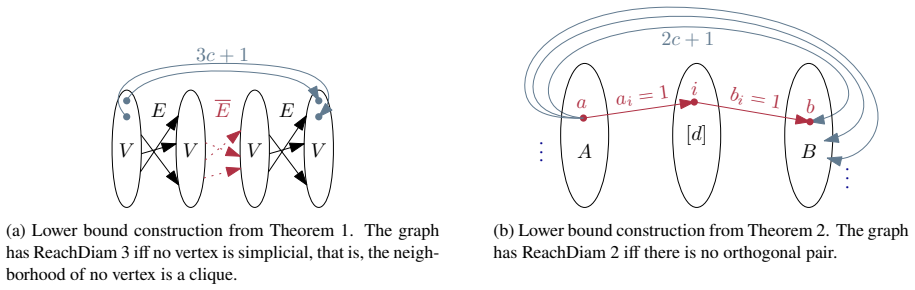
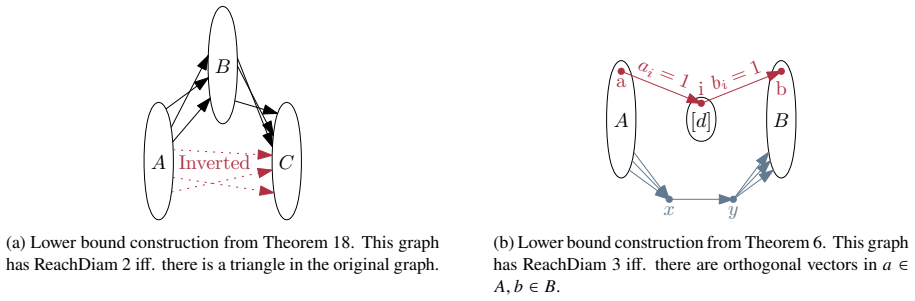
Fine-grained reductions from APSP-like problems to ReachDiam, together with dynamic-programming techniques on tree decompositions for bounded-treewidth instances.
If this is right
- ReachDiam is computationally harder than several other directed-graph distance problems under the same assumptions.
- Weighted and unweighted versions of the problem behave differently, unlike Min-Diameter or classical diameter.
- Approximating ReachDiam is technically related to constructing shortcut sets and hopsets.
- Bounded-treewidth graphs admit exact 2-hop hopsets as a byproduct.
Where Pith is reading between the lines
- Similar hardness may apply to other reachability-based aggregate measures on directed graphs.
- Practical algorithms for ReachDiam will likely need to exploit bounded-width or low-treewidth structure or accept additive error.
- The reduction techniques could be adapted to study diameter variants on other restricted graph families.
Load-bearing premise
The standard fine-grained hypotheses that rule out slightly sub-cubic algorithms for APSP-like problems hold.
What would settle it
An algorithm running in O(n^{ω-ε}) time that returns any constant-factor approximation of ReachDiam on weighted directed graphs, or a (2-ε)-approximation on unweighted directed graphs.
Figures
read the original abstract
The reachability diameter ($\mathrm{ReachDiam}$) of a directed graph is the maximum distance over all pairs $u,v$ where $v$ is reachable from $u$. This notion is present in the definition of shortcut sets, and the name was recently coined in that context by Haeupler, Jiang, and Saranurak [SOSA 2026]. While this is a very natural notion of diameter in directed graphs, and especially DAGs, it is so far not computationally explored. Other definitions of diameter in directed graphs are either trivial (infinite) in graphs that are not strongly connected (e.g., the classical definition) or are non-trivial only in highly restrictive graph classes (e.g., Min-Diameter). We initiate the problem of computing the (approximate) reachability diameter from a fine-grained complexity point of view. Under certain fine-grained assumptions, we prove that there is no algorithm in time $\mathcal{O}(n^{\omega - \varepsilon}$) that gives any approximation of $\mathrm{ReachDiam}$ in weighted graphs. Similarly, there is no algorithm with better than $2$-approximation for unweighted graphs in this time. To supplement this, we provide algorithmic upper bounds that lead to additive approximation of $\mathrm{ReachDiam}$ for unweighted graphs. Hence, we establish a strong separation between the weighted and unweighted cases, which makes this type of diameter different in nature than other known notions. Considering the hardness in general weighted graphs, we also study special graph classes and get small constant approximations for DAGs with bounded width or graphs with bounded treewidth. Interestingly, our techniques also lead to exact hopsets with hopbound $2$ for bounded treewidth graphs. This and some of our upper bounds for general graphs show technical connections between approximating $\mathrm{ReachDiam}$ and computing shortcut sets and hopsets.
Editorial analysis
A structured set of objections, weighed in public.
Referee Report
Summary. The paper introduces ReachDiam (maximum distance over reachable pairs) as a natural diameter notion for directed graphs and DAGs. From a fine-grained viewpoint, it proves conditional lower bounds showing no O(n^{ω−ε}) algorithm exists for any approximation of ReachDiam in weighted graphs, and no better than 2-approximation in unweighted graphs. Complementary upper bounds yield additive approximations for unweighted graphs in general, constant-factor approximations for bounded-width DAGs and bounded-treewidth graphs, and exact hopsets with hopbound 2 for bounded-treewidth graphs, establishing a weighted/unweighted separation and technical links to shortcut sets and hopsets.
Significance. If the results hold, the work initiates fine-grained study of ReachDiam and demonstrates a clear algorithmic separation between weighted and unweighted cases that distinguishes it from other diameter measures. The positive results on special graph classes and the hopset connections are concrete contributions that could influence research on shortcut sets and sub-cubic algorithms.
major comments (2)
- [Abstract / Introduction] The abstract invokes 'certain fine-grained assumptions' for the lower bounds without naming them (e.g., the precise APSP or 3SUM hypothesis); the introduction or § on hardness should state the exact hypothesis and confirm that the reduction rules out all approximations (weighted) or (2−ε)-approximations (unweighted) while preserving the time bound O(n^{ω−ε}).
- [Upper bounds section] The claimed separation between weighted and unweighted cases rests on the upper bounds for additive approximation in the unweighted case; the relevant section should include a precise statement of the additive error (e.g., +O(1) or +O(log n)) and the running time to allow direct comparison with the 2-approx hardness.
minor comments (2)
- [Abstract] The citation [SOSA 2026] for the coining of ReachDiam should be checked for accuracy (conference year or arXiv reference) and added to the bibliography.
- [Preliminaries] Notation for ReachDiam and related quantities (e.g., weighted vs. unweighted distances) should be introduced consistently in the preliminaries to avoid ambiguity when moving between the hardness and algorithmic sections.
Simulated Author's Rebuttal
We thank the referee for the positive recommendation of minor revision and the helpful comments on clarity. We address each major comment below and will update the manuscript accordingly.
read point-by-point responses
-
Referee: [Abstract / Introduction] The abstract invokes 'certain fine-grained assumptions' for the lower bounds without naming them (e.g., the precise APSP or 3SUM hypothesis); the introduction or § on hardness should state the exact hypothesis and confirm that the reduction rules out all approximations (weighted) or (2−ε)-approximations (unweighted) while preserving the time bound O(n^{ω−ε}).
Authors: We agree that naming the hypotheses improves precision. In the revision we will explicitly identify the fine-grained assumptions (e.g., the APSP hypothesis) in the abstract, introduction, and hardness section, and we will add a sentence confirming that the reductions rule out every approximation factor for weighted graphs and every (2−ε)-approximation for unweighted graphs while preserving the O(n^{ω−ε}) time bound. revision: yes
-
Referee: [Upper bounds section] The claimed separation between weighted and unweighted cases rests on the upper bounds for additive approximation in the unweighted case; the relevant section should include a precise statement of the additive error (e.g., +O(1) or +O(log n)) and the running time to allow direct comparison with the 2-approx hardness.
Authors: We agree that an explicit statement is needed for direct comparison. We will revise the upper-bounds section to state the precise additive error term and the running time of the algorithm, allowing immediate juxtaposition with the 2-approximation hardness result. revision: yes
Circularity Check
No significant circularity identified
full rationale
The paper establishes conditional lower bounds for approximating ReachDiam under external fine-grained hypotheses (standard APSP-style assumptions ruling out O(n^{ω-ε}) time) and supplies matching algorithmic upper bounds for additive approximations and special graph classes. These hypotheses are invoked as given external inputs rather than derived internally; the name ReachDiam is attributed to an independent prior citation (Haeupler et al., SOSA 2026) with no author overlap. No self-definitional equations, fitted inputs renamed as predictions, load-bearing self-citations, or ansatz smuggling appear. The derivation chain remains self-contained against external benchmarks.
Axiom & Free-Parameter Ledger
axioms (1)
- domain assumption Certain fine-grained complexity assumptions (e.g., no slightly sub-cubic APSP algorithm) hold.
Forward citations
Cited by 1 Pith paper
-
Structural parameterizations of Geodetic Set on directed (acyclic) graphs
Directed Geodetic Set admits a 2^{O(vcn)} kernel on digraphs and a (kΔ)^{O(rdiam)} kernel, with ETH-tight runtimes, and remains W[2]-hard parameterized by k on degree-3 DAGs.
Reference graph
Works this paper leans on
-
[2]
New graph decompositions and combinatorial boolean matrix multiplication algorithms
Amir Abboud, Nick Fischer, Zander Kelley, Shachar Lovett, and Raghu Meka. New graph decompositions and combinatorial boolean matrix multiplication algorithms. InProceedings of the 56th Annual ACM Symposium on Theory of Computing, STOC 2024, page 935–943, New York, NY, USA, 2024. Association for Computing Machinery.doi:10.1145/3618260.3649696
-
[3]
Approximation and Fixed Parameter Subquadratic Algorithms for Radius and Diameter in Sparse Graphs
Amir Abboud, Virginia Vassilevska Williams, and Joshua Wang. Approximation and Fixed Parameter Subquadratic Algorithms for Radius and Diameter in Sparse Graphs. InProceedings of the Twenty-Seventh Annual ACM-SIAM Symposium on Discrete Algorithms, pages 377–391. Society for Industrial and Applied Mathematics, January 2016. URL:http://epubs.siam.org/doi/10....
-
[4]
More asymmetry yields faster matrix multiplication
Josh Alman, Ran Duan, Virginia Vassilevska Williams, Yinzhan Xu, Zixuan Xu, and Renfei Zhou. More asymmetry yields faster matrix multiplication. InProceedings of the 2025 Annual ACM-SIAM Sym- posium on Discrete Algorithms (SODA), pages 2005–2039, 2025. URL:https://epubs.siam.org/ doi/abs/10.1137/1.9781611978322.63,arXiv:https://epubs.siam.org/doi/pdf/10.1...
-
[5]
Covering approximate shortest paths with dags
Sepehr Assadi, Gary Hoppenworth, and Nicole Wein. Covering approximate shortest paths with dags. In Proceedings of the 57th Annual ACM Symposium on Theory of Computing, STOC ’25, page 2269–2280, New York, NY, USA, 2025. Association for Computing Machinery.doi:10.1145/3717823.3718298
-
[6]
Arturs Backurs, Liam Roditty, Gilad Segal, Virginia Vassilevska Williams, and Nicole Wein. Toward tight approximation bounds for graph diameter and eccentricities.SIAM Journal on Computing, 50(4):1155–1199, 2021.arXiv:https://doi.org/10.1137/18M1226737,doi:10.1137/18M1226737
-
[7]
New techniques and fine-grained hardness for dynamic near-additive spanners
Thiago Bergamaschi, Monika Henzinger, Maximilian Probst Gutenberg, Virginia Vassilevska Williams, and Nicole Wein. New techniques and fine-grained hardness for dynamic near-additive spanners. InProceedings of the 2021 ACM-SIAM Symposium on Discrete Algorithms (SODA), pages 1836–1855. SIAM, 2021
2021
-
[8]
Approximating min-diameter: Standard and bichromatic
Aaron Berger, Jenny Kaufmann, and Virginia Vassilevska Williams. Approximating min-diameter: Standard and bichromatic. In Inge Li Gørtz, Martin Farach-Colton, Simon J. Puglisi, and Grzegorz Herman, editors, 31st Annual European Symposium on Algorithms, ESA 2023, Amsterdam, The Netherlands, September 4-6, 2023, volume 274 ofLIPIcs, pages 17:1–17:14. Schlos...
-
[9]
Aaron Bernstein, Maximilian Probst Gutenberg, and Thatchaphol Saranurak. Deterministic decremental sssp and approximate min-cost flow in almost-linear time. In2021 IEEE 62nd Annual Symposium on Foundations of Computer Science (FOCS), page 1000–1008. IEEE, February 2022. URL:http://dx.doi.org/10. 1109/FOCS52979.2021.00100,doi:10.1109/focs52979.2021.00100
-
[10]
Arnab Bhattacharyya, Elena Grigorescu, Kyomin Jung, Sofya Raskhodnikova, and David P. Woodruff. Transitive-closure spanners.SIAM J. Comput., 41(6):1380–1425, 2012.doi:10.1137/110826655
-
[11]
Greg Bodwin and Gary Hoppenworth. Folklore sampling is optimal for exact hopsets: Confirming the √n barrier. In64th IEEE Annual Symposium on Foundations of Computer Science, FOCS 2023, Santa Cruz, CA, USA, November 6-9, 2023, pages 701–720. IEEE, 2023.doi:10.1109/FOCS57990.2023.00046
-
[12]
4 vs 7 Sparse Undirected Unweighted Diameter is SETH-Hard at Time𝑛 4/3
´Edouard Bonnet. 4 vs 7 Sparse Undirected Unweighted Diameter is SETH-Hard at Time𝑛 4/3. In Nikhil Bansal, Emanuela Merelli, and James Worrell, editors,48th International Colloquium on Automata, Lan- guages, and Programming (ICALP 2021), volume 198 ofLeibniz International Proceedings in Informatics (LIPIcs), pages 34:1–34:15, Dagstuhl, Germany, 2021. Schl...
-
[13]
Approximating apsp without scaling: equivalence of approximate min-plus and exact min-max
Karl Bringmann, Marvin K¨ unnemann, and Karol Wegrzycki. Approximating apsp without scaling: equivalence of approximate min-plus and exact min-max. InProceedings of the 51st Annual ACM SIGACT Symposium on Theory of Computing, STOC ’19, page 943–954. ACM, June 2019. URL: http://dx.doi.org/10.1145/3313276.3316373,doi:10.1145/3313276.3316373
-
[14]
Minimum Chain Cover in Almost Linear Time, May 2023
Manuel Caceres. Minimum Chain Cover in Almost Linear Time, May 2023. arXiv:2305.02166 [cs]. URL: http://arxiv.org/abs/2305.02166,doi:10.48550/arXiv.2305.02166
-
[15]
Shortcuts and transitive-closure spanners approximation.CoRR, abs/2502.08032, 2025
Parinya Chalermsook, Yonggang Jiang, Sagnik Mukhopadhyay, and Danupon Nanongkai. Shortcuts and transitive-closure spanners approximation.CoRR, abs/2502.08032, 2025. To appear in SODA
arXiv 2025
-
[16]
URL:https://doi.org/10.48550/arXiv.2502.08032,arXiv:2502.08032,doi:10.48550/ ARXIV.2502.08032
-
[17]
Shortest Paths without a Map, but with an Entropic Regularizer , booktitle =
Shiri Chechik and Tianyi Zhang. Constant approximation of min-distances in near-linear time. In63rd IEEE Annual Symposium on Foundations of Computer Science, FOCS 2022, Denver, CO, USA, October 31 - November 3, 2022, pages 896–906. IEEE, 2022.doi:10.1109/FOCS54457.2022.00089
-
[18]
Springer, 2015
Marek Cygan, Fedor V Fomin, Lukasz Kowalik, Daniel Lokshtanov, D´aniel Marx, Marcin Pilipczuk, Micha l Pilipczuk, and Saket Saurabh.Parameterized algorithms, volume 5. Springer, 2015
2015
-
[19]
Mina Dalirrooyfard, Ce Jin, Virginia Vassilevska Williams, and Nicole Wein. Approximation Algorithms and Hardness for $n$-Pairs Shortest Paths and All-Nodes Shortest Cycles, September 2022. arXiv:2204.03076 [cs]. URL:http://arxiv.org/abs/2204.03076,doi:10.48550/arXiv.2204.03076
-
[20]
Mina Dalirrooyfard and Jenny Kaufmann. Approximation Algorithms for Min-Distance Problems in DAGs, October 2022.arXiv:2106.02120,doi:10.48550/arXiv.2106.02120
-
[21]
Sparse matrix multiplication and triangle listing in the congested clique model
Mina Dalirrooyfard, Virginia Vassilevska Williams, Nikhil Vyas, Nicole Wein, Yinzhan Xu, and Yuancheng Yu. Approximation algorithms for min-distance problems. In Christel Baier, Ioannis Chatzigiannakis, Paola Flocchini, and Stefano Leonardi, editors,46th International Colloquium on Automata, Languages, and Programming, ICALP 2019, Patras, Greece, July 9-1...
-
[22]
Faster Min-Cost Flow and Approximate Tree Decomposition on Bounded Treewidth Graphs
Sally Dong and Guanghao Ye. Faster Min-Cost Flow and Approximate Tree Decomposition on Bounded Treewidth Graphs. In Timothy Chan, Johannes Fischer, John Iacono, and Grzegorz Herman, editors,32nd Annual European Symposium on Algorithms (ESA 2024), volume 308 ofLeibniz International Proceedings in Informatics (LIPIcs), pages 49:1–49:14, Dagstuhl, Germany, 2...
-
[23]
The diameter of at-free graphs.Journal of Graph Theory, 99(4):594–614, 2022
Guillaume Ducoffe. The diameter of at-free graphs.Journal of Graph Theory, 99(4):594–614, 2022
2022
-
[24]
Eccentricity queries and beyond using hub labels.Theoretical Computer Science, 930:128–141, 2022
Guillaume Ducoffe. Eccentricity queries and beyond using hub labels.Theoretical Computer Science, 930:128–141, 2022. URL:https://www.sciencedirect.com/science/article/pii/ S0304397522004443,doi:10.1016/j.tcs.2022.07.017
-
[25]
Stochastic embedding of digraphs into dags.CoRR, abs/2509.23458, 2025
Arnold Filtser. Stochastic embedding of digraphs into dags.CoRR, abs/2509.23458, 2025. To appear in SODA 2026. URL:https://doi.org/10.48550/arXiv.2509.23458,arXiv:2509.23458,doi: 10.48550/ARXIV.2509.23458
-
[26]
Jeremy T. Fineman. Nearly Work-Efficient Parallel Algorithm for Digraph Reachability, November 2017. arXiv:1711.01700 [cs]. URL:http://arxiv.org/abs/1711.01700,doi:10.48550/arXiv.1711. 01700
work page internal anchor Pith review Pith/arXiv arXiv doi:10.48550/arxiv.1711 2017
-
[27]
Distance labeling in graphs.Journal of algorithms, 53(1):85–112, 2004
Cyril Gavoille, David Peleg, St ´ephane P ´erennes, and Ran Raz. Distance labeling in graphs.Journal of algorithms, 53(1):85–112, 2004
2004
-
[28]
Reducing shortcut and hopset constructions to shallow graphs.CoRR, abs/2508.20302, 2025
Bernhard Haeupler, Yonggang Jiang, and Thatchaphol Saranurak. Reducing shortcut and hopset constructions to shallow graphs.CoRR, abs/2508.20302, 2025. To appear in SOSA 2026. URL:https://doi.org/10. 48550/arXiv.2508.20302,arXiv:2508.20302,doi:10.48550/ARXIV.2508.20302. 18
-
[29]
C. S. Karthik and Pasin Manurangsi. On closest pair in euclidean metric: Monochromatic is as hard as bichromatic.Combinatorica, 40(4):539–573, April 2020. URL:http://dx.doi.org/10.1007/ s00493-019-4113-1,doi:10.1007/s00493-019-4113-1
-
[30]
Ton Kloks, Dieter Kratsch, and Haiko M¨ uller. Finding and counting small induced subgraphs efficiently.In- formation Processing Letters, 74(3):115–121, 2000. URL:https://www.sciencedirect.com/science/ article/pii/S0020019000000478,doi:10.1016/S0020-0190(00)00047-8
-
[31]
Faster and unified algorithms for diameter reducing shortcuts and minimum chain covers
Shimon Kogan and Merav Parter. Faster and unified algorithms for diameter reducing shortcuts and minimum chain covers. In Nikhil Bansal and Viswanath Nagarajan, editors,Proceedings of the 2023 ACM-SIAM Sympo- sium on Discrete Algorithms, SODA 2023, Florence, Italy, January 22-25, 2023, pages 212–239. SIAM, 2023. URL:https://doi.org/10.1137/1.9781611977554...
-
[32]
The algorithmic power of the greene-kleitman theorem
Shimon Kogan and Merav Parter. The algorithmic power of the greene-kleitman theorem. In Timothy M. Chan, Johannes Fischer, John Iacono, and Grzegorz Herman, editors,32nd Annual European Symposium on Algorithms, ESA 2024, Royal Holloway, London, United Kingdom, September 2-4, 2024, volume 308 ofLIPIcs, pages 80:1–80:14. Schloss Dagstuhl - Leibniz-Zentrum f...
-
[33]
Giving some slack: Shortcuts and transitive closure compressions
Shimon Kogan and Merav Parter. Giving some slack: Shortcuts and transitive closure compressions. In Timothy M. Chan, Johannes Fischer, John Iacono, and Grzegorz Herman, editors,32nd Annual European Symposium on Algorithms, ESA 2024, Royal Holloway, London, United Kingdom, September 2-4, 2024, volume 308 ofLIPIcs, pages 79:1–79:15. Schloss Dagstuhl - Leibn...
-
[34]
Between o(nm) and o(na)
Dieter Kratsch and Jeremy Spinrad. Between o(nm) and o(na). InProceedings of the Fourteenth Annual ACM-SIAM Symposium on Discrete Algorithms, SODA ’03, page 709–716, USA, 2003. Society for Industrial and Applied Mathematics
2003
-
[35]
Ray Li. Settling seth vs. approximate sparse directed unweighted diameter (up to (nu)nseth). InProceedings of the 53rd Annual ACM SIGACT Symposium on Theory of Computing, STOC 2021, page 1684–1696, New York, NY, USA, 2021. Association for Computing Machinery.doi:10.1145/3406325.3451045
-
[36]
Liu, Arun Jambulapati, and Aaron Sidford
Yang P. Liu, Arun Jambulapati, and Aaron Sidford. Parallel reachability in almost linear work and square root depth. In David Zuckerman, editor,60th IEEE Annual Symposium on Foundations of Computer Science, FOCS 2019, Baltimore, Maryland, USA, November 9-12, 2019, pages 1664–1686. IEEE Computer Society, 2019.doi:10.1109/FOCS.2019.00098
-
[37]
Dag-width: connectivity measure for directed graphs
Jan Obdrz ´alek. Dag-width: connectivity measure for directed graphs. InProceedings of the Seventeenth Annual ACM-SIAM Symposium on Discrete Algorithms, SODA 2006, Miami, Florida, USA, January 22- 26, 2006, pages 814–821. ACM Press, 2006. URL:http://dl.acm.org/citation.cfm?id=1109557. 1109647
2006
-
[38]
Fast approximation algorithms for the diameter and radius of sparse graphs
Liam Roditty and Virginia Vassilevska Williams. Fast approximation algorithms for the diameter and radius of sparse graphs. InProceedings of the forty-fifth annual ACM symposium on Theory of Computing, pages 515– 524, Palo Alto California USA, June 2013. ACM. URL:https://dl.acm.org/doi/10.1145/2488608. 2488673,doi:10.1145/2488608.2488673
-
[39]
Fast approximation algorithms for the diameter and radius of sparse graphs
Liam Roditty and Virginia Vassilevska Williams. Fast approximation algorithms for the diameter and radius of sparse graphs. InProceedings of the Forty-Fifth Annual ACM Symposium on Theory of Computing, STOC ’13, page 515–524, New York, NY, USA, 2013. Association for Computing Machinery.doi: 10.1145/2488608.2488673
-
[40]
Hardness of approximate nearest neighbor search
Aviad Rubinstein. Hardness of approximate nearest neighbor search. InProceedings of the 50th Annual ACM SIGACT Symposium on Theory of Computing, STOC 2018, page 1260–1268, New York, NY, USA, 2018. Association for Computing Machinery.doi:10.1145/3188745.3188916
-
[41]
Virginia Vassilevska Williams and R. Ryan Williams. Subcubic equivalences between path, matrix, and triangle problems.J. ACM, 65(5):27:1–27:38, 2018.doi:10.1145/3186893
-
[42]
Ryan Williams. A new algorithm for optimal 2-constraint satisfaction and its implications.Theoreti- cal Computer Science, 348(2):357–365, 2005. Automata, Languages and Programming: Algorithms and Complexity (ICALP-A 2004). URL:https://www.sciencedirect.com/science/article/pii/ S0304397505005438,doi:10.1016/j.tcs.2005.09.023. 19
-
[43]
On some fine-grained questions in algorithms and complexity.Proceedings of the International Congress of Mathematicians (ICM 2018), 2019
Virginia Vassilevska Williams. On some fine-grained questions in algorithms and complexity.Proceedings of the International Congress of Mathematicians (ICM 2018), 2019. URL:https://api.semanticscholar. org/CorpusID:19282287
2018
-
[44]
Uri Zwick. All pairs shortest paths using bridging sets and rectangular matrix multiplication.Journal of the ACM, 49(3):289–317, May 2002. URL:http://dx.doi.org/10.1145/567112.567114,doi: 10.1145/567112.567114. 20
discussion (0)
Sign in with ORCID, Apple, or X to comment. Anyone can read and Pith papers without signing in.