Spatio-Sequential Recurrent Network for 3-D Tunnel Propagation Modeling
Pith reviewed 2026-06-27 19:19 UTC · model grok-4.3
The pith
A gated recurrent network reconstructs fine 3-D electromagnetic fields in tunnels from coarse parabolic wave equation inputs.
A machine-rendered reading of the paper's core claim, the machinery that carries it, and where it could break.
Core claim
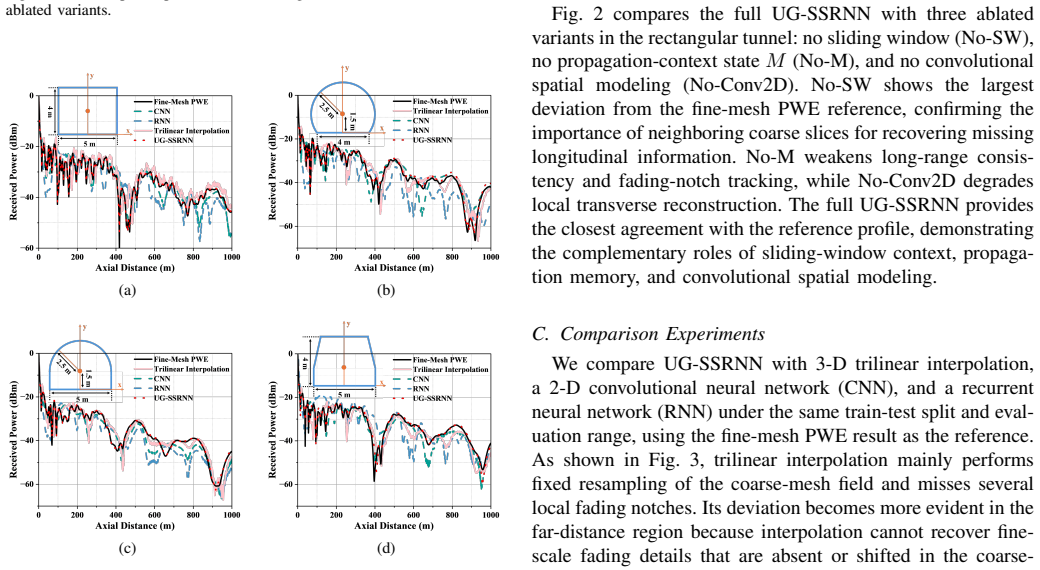
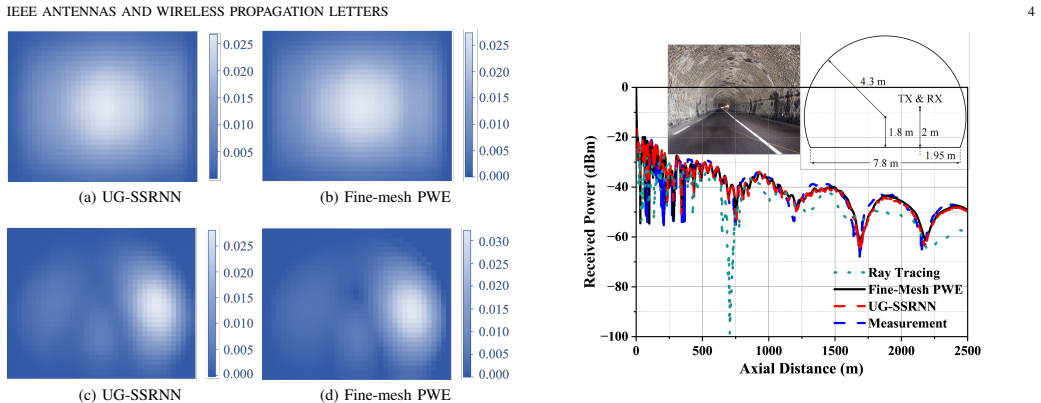
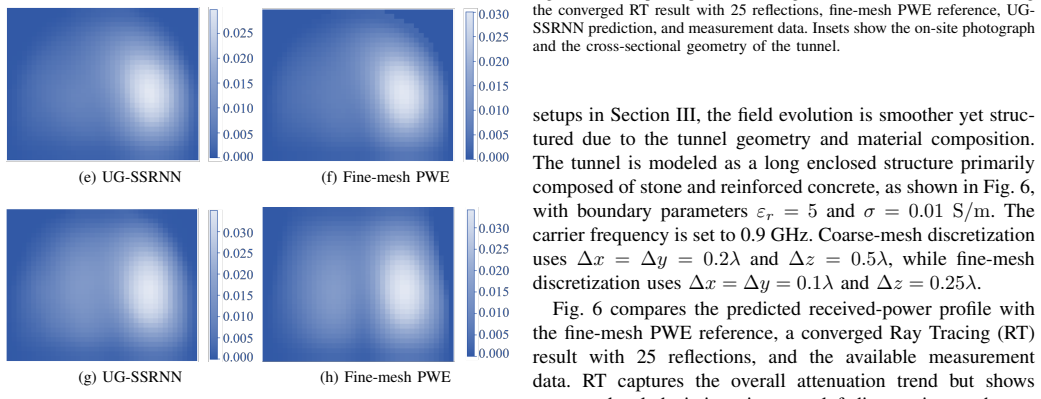
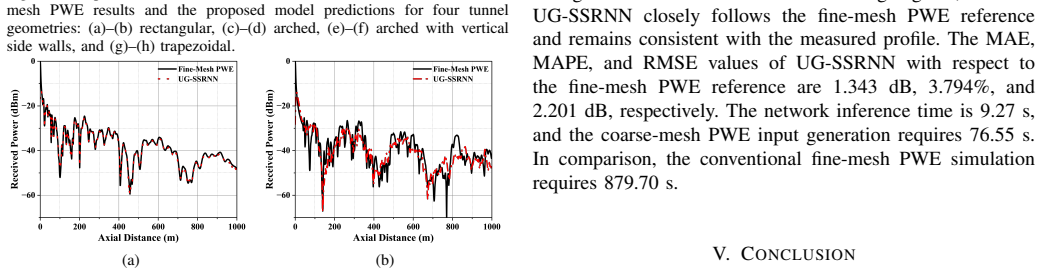
The UG-SSRNN jointly super-resolves transverse slices and models longitudinal evolution through sliding-window context encoding, a K-layer convolutional recurrent backbone with shared propagation-context state and diagonal feedback, plus a prediction-aware upsampling head. On four tunnel cross sections, unseen-material and unseen-frequency tests, and validation inside the Massif Central tunnel, the reconstructions agree closely with fine-mesh PWE references while cutting overall electromagnetic modeling time.
What carries the argument
The U-shaped gated spatio-sequential recurrent neural network (UG-SSRNN) that performs joint transverse super-resolution and longitudinal sequence modeling with convolutional recurrent layers and feedback from prior predictions.
If this is right
- Tunnel electromagnetic analysis can shift from offline batch processing to near-real-time operation.
- Design iterations for tunnel communication or sensing systems become feasible without repeated full-resolution runs.
- The same coarse-to-fine pipeline can be applied to frequency or material changes not encountered during training.
- Field consistency along the tunnel length improves slice-to-slice continuity compared with independent 2-D refinements.
Where Pith is reading between the lines
- The recurrent structure may allow incremental updates when tunnel conditions change slowly over time.
- Similar spatio-sequential architectures could be tested on other confined propagation problems such as mine shafts or urban canyons.
- Hybrid use with ray-tracing or other fast approximators might further reduce the initial coarse input cost.
Load-bearing premise
The mapping from coarse to fine fields learned on the training tunnels will continue to hold for arbitrary real-world tunnel geometries, materials, and operating conditions.
What would settle it
Run the trained model on a tunnel geometry or material combination absent from the training set and compare the output against an independent fine-mesh PWE simulation; large pointwise or integrated discrepancies would falsify the claim.
Figures


read the original abstract
Fine-mesh parabolic wave equation (PWE) simulations are high-fidelity but time-consuming, which limits real-time tunnel propagation analysis and motivates coarse-to-fine reconstruction. Existing machine learning (ML)-assisted tunnel models typically provide only one-dimensional (1-D) longitudinal refinement or two-dimensional (2-D) cross-sectional refinement, rather than joint 3-D enhancement. Motivated by this gap, this letter proposes a U-shaped gated spatio-sequential recurrent neural network (UG-SSRNN), a spatio-sequential reconstruction model for tunnel electromagnetic fields. UG-SSRNN jointly super-resolves transverse slices and models longitudinal evolution. It uses sliding-window context encoding and a K-layer convolutional recurrent backbone with a shared propagation-context state and diagonal feedback. A prediction-aware upsampling head leverages the previous prediction to improve slice-to-slice consistency. Experiments on four tunnel cross sections, unseen-material and unseen-frequency tests, and validation in the Massif Central tunnel show close agreement with fine-mesh PWE references. The proposed approach significantly reduces tunnel electromagnetic modeling time.
Editorial analysis
A structured set of objections, weighed in public.
Referee Report
Summary. The manuscript proposes UG-SSRNN, a U-shaped gated spatio-sequential recurrent neural network for joint 3-D coarse-to-fine reconstruction of tunnel electromagnetic fields. It combines sliding-window context encoding, a K-layer convolutional recurrent backbone with shared propagation state and diagonal feedback, and a prediction-aware upsampling head to super-resolve transverse slices while modeling longitudinal evolution. Experiments on four tunnel cross-sections, plus unseen-material, unseen-frequency, and Massif Central tunnel tests, are reported to yield close agreement with fine-mesh parabolic wave equation (PWE) references while substantially reducing computation time.
Significance. If the generalization holds, the approach would address a clear gap between 1-D/2-D ML tunnel models and full 3-D PWE fidelity, enabling faster propagation analysis for wireless systems in confined environments. The spatio-sequential architecture with shared state is a technically motivated attempt to capture both transverse and longitudinal structure.
major comments (2)
- [Abstract] Abstract: the central claim of 'close agreement with fine-mesh PWE references' on unseen materials, frequencies, and the Massif Central tunnel is load-bearing, yet the abstract supplies no quantitative error metrics (MSE, correlation, or field-component errors), training-set statistics, or ablation results. Without these, it is impossible to determine whether reported agreement is robust or sensitive to post-hoc selection.
- [Abstract] Abstract: the extrapolation claim rests on the assumption that spatio-sequential patterns learned from only four training cross-sections (plus sliding-window context) suffice for arbitrary real-world geometries, curvatures, material inhomogeneities, and operating regimes. No quantitative description of training-distribution diversity (aspect-ratio range, wall roughness, bend radii) is supplied, leaving the weakest link in the argument untested.
minor comments (1)
- [Abstract] The abstract introduces the acronym UG-SSRNN before spelling out the full name; a single consistent first-use expansion would improve readability.
Simulated Author's Rebuttal
We thank the referee for the constructive feedback on the abstract. We address the two major comments below and will revise the manuscript accordingly to strengthen the presentation of quantitative results and training details.
read point-by-point responses
-
Referee: [Abstract] Abstract: the central claim of 'close agreement with fine-mesh PWE references' on unseen materials, frequencies, and the Massif Central tunnel is load-bearing, yet the abstract supplies no quantitative error metrics (MSE, correlation, or field-component errors), training-set statistics, or ablation results. Without these, it is impossible to determine whether reported agreement is robust or sensitive to post-hoc selection.
Authors: We agree that the abstract would be strengthened by including quantitative support for the performance claims. The current abstract is intentionally concise per letter format constraints. In the revised version we will add specific metrics (e.g., mean MSE and correlation values across the unseen-material, unseen-frequency, and Massif Central test cases) drawn directly from the experimental results already reported in the manuscript body. This will allow readers to assess robustness without post-hoc interpretation. revision: yes
-
Referee: [Abstract] Abstract: the extrapolation claim rests on the assumption that spatio-sequential patterns learned from only four training cross-sections (plus sliding-window context) suffice for arbitrary real-world geometries, curvatures, material inhomogeneities, and operating regimes. No quantitative description of training-distribution diversity (aspect-ratio range, wall roughness, bend radii) is supplied, leaving the weakest link in the argument untested.
Authors: The manuscript does not assert generalization to arbitrary real-world conditions; it reports results on four training cross-sections together with explicit validation on unseen materials, unseen frequencies, and the independent Massif Central tunnel. The four cross-sections were chosen to represent common underground geometries. To address the request for quantitative diversity information, we will insert a short description of the training tunnels' aspect ratios and material properties in the revised abstract or methods section. The Massif Central results already provide evidence of transfer beyond the training set. revision: partial
Circularity Check
No significant circularity; empirical ML validation on external PWE benchmarks.
full rationale
The paper introduces an ML architecture (UG-SSRNN) trained on PWE simulation data to perform coarse-to-fine field reconstruction. Reported results consist of empirical agreement metrics on held-out cross-sections, unseen materials/frequencies, and an external tunnel validation case. No quoted equations, self-citations, or steps reduce any claimed prediction or uniqueness result to a fitted input by construction. The derivation chain is the network design plus standard supervised training; performance claims are falsifiable against the independent PWE solver and do not collapse definitionally. This matches the default case of a self-contained empirical paper.
Axiom & Free-Parameter Ledger
Reference graph
Works this paper leans on
-
[1]
Location- based schemes for mitigating cyber threats on connected and automated vehicles: A survey and design framework,
D. Suo, J. Moore, M. Boesch, K. Post, and S. E. Sarma, “Location- based schemes for mitigating cyber threats on connected and automated vehicles: A survey and design framework,”IEEE Trans. Intell. Transp. Syst., vol. 23, no. 4, pp. 2919–2937, 2020
2020
-
[2]
Radio communication for communications-based train control (CBTC): A tutorial and survey,
J. Farooq and J. Soler, “Radio communication for communications-based train control (CBTC): A tutorial and survey,”IEEE Commun. Surveys Tutorials, vol. 19, no. 3, pp. 1377–1402, 2017
2017
-
[3]
Short-term fading behavior in high-speed railway cutting scenario: Measurements, analysis, and statistical models,
R. He, Z. Zhong, B. Ai, J. Ding, Y . Yang, and A. F. Molisch, “Short-term fading behavior in high-speed railway cutting scenario: Measurements, analysis, and statistical models,”IEEE Trans. Antennas Propag., vol. 61, no. 4, pp. 2209–2222, 2013
2013
-
[4]
Challenges toward wireless communications for high-speed railway,
B. Ai, X. Cheng, T. K ¨urner, Z.-D. Zhong, K. Guan, R.-S. He, L. Xiong, D. W. Matolak, D. G. Miclson, and C. Briso-Rodriguez, “Challenges toward wireless communications for high-speed railway,”IEEE Trans. Intell. Transp. Syst., vol. 15, no. 5, pp. 2143–2158, 2014
2014
-
[5]
A temporal attention unit-based machine learning model for efficient radio wave propagation prediction in tunnels,
H. Xu, J. Wang, K. Wu, Q. Zhao, H. Qin, X. Zhang, and X. Zhang, “A temporal attention unit-based machine learning model for efficient radio wave propagation prediction in tunnels,” in2025 IEEE MTT-S International Wireless Symposium (IWS), 2025, pp. 1–3
2025
-
[6]
An alternative di- rection decomposition scheme and error analysis for parabolic equation model,
L. Zhou, C. Liao, X. Xiong, Q. Zhang, and D. Zhang, “An alternative di- rection decomposition scheme and error analysis for parabolic equation model,”IEEE Trans. Antennas Propag., vol. 65, no. 5, pp. 2547–2557, 2017
2017
-
[7]
Wave propagation modeling of tunnels in complex meteorological environments with parabolic equation,
Z. He, T. Su, H.-C. Yin, and R.-S. Chen, “Wave propagation modeling of tunnels in complex meteorological environments with parabolic equation,”IEEE Trans. Antennas Propag., vol. 66, no. 12, pp. 6629– 6634, 2018
2018
-
[8]
PETOOL: MATLAB-based one-way and two-way split-step parabolic equation tool for radiowave propagation over variable terrain,
O. Ozgun, G. Apaydin, M. Kuzuoglu, and L. Sevgi, “PETOOL: MATLAB-based one-way and two-way split-step parabolic equation tool for radiowave propagation over variable terrain,”Comput. Phys. Commun., vol. 182, no. 12, pp. 2638–2654, 2011
2011
-
[9]
Efficient parabolic equation-driven CNN propagation model in tunnels based on frequency conversion,
S. Huang, H. Qin, and X. Zhang, “Efficient parabolic equation-driven CNN propagation model in tunnels based on frequency conversion,” IEEE Trans. Antennas Propag., vol. 72, no. 7, pp. 6024–6031, 2024
2024
-
[10]
A generalizable physics-informed long-range attentive network for radio wave propagation modeling in tunnels,
K. Wu, K. Ni, H. Xu, J. Wang, H. Qin, X. Zhang, and X. Zhang, “A generalizable physics-informed long-range attentive network for radio wave propagation modeling in tunnels,”IEEE Trans. Microw. Theory Techn., vol. 73, no. 12, pp. 9854–9866, 2025
2025
-
[11]
A high-accuracy dynamically-stacked residual lstm-based radio wave prop- agation model for long-distance tunnels,
Q. Zhang, B. Zhang, Y . Mu, H. Qin, X. Zhang, and X. Zhang, “A high-accuracy dynamically-stacked residual lstm-based radio wave prop- agation model for long-distance tunnels,”IEEE Antennas and Wireless Propag. Lett., pp. 1–5, 2025
2025
-
[12]
Mars: Radio map super- resolution and reconstruction method under sparse channel measurements,
C. Deng, N. Liu, W. Xie, L. Xu, and L. Wang, “MARS: Radio map super-resolution and reconstruction method under sparse channel measurements,”arXiv preprint arXiv:2506.04682, 2025
-
[13]
Artificial intelligence enabled radio propagation for communications—Part II: Scenario identification and channel modeling,
C. Huang, R. He, B. Ai, A. F. Molisch, B. K. Lau, K. Haneda, B. Liu, C.-X. Wang, M. Yang, C. Oestges, and Z. Zhong, “Artificial intelligence enabled radio propagation for communications—Part II: Scenario identification and channel modeling,”IEEE Trans. Antennas Propag., vol. 70, no. 6, pp. 3955–3969, 2022
2022
-
[14]
An overview of machine learning techniques for radiowave propagation modeling,
A. Seretis and C. D. Sarris, “An overview of machine learning techniques for radiowave propagation modeling,”IEEE Trans. Antennas Propag., vol. 70, no. 6, pp. 3970–3985, 2022
2022
-
[15]
Wave propagation modeling techniques in tunnel environments: A survey,
M. A. Samad, S.-W. Choi, C.-S. Kim, and K. Choi, “Wave propagation modeling techniques in tunnel environments: A survey,”IEEE Access, vol. 11, pp. 2199–2225, 2023
2023
-
[16]
Efficient physics-based recurrent neural network model for radio wave propagation in tunnels at 2.4 GHz,
H. Qin, S. Huang, and X. Zhang, “Efficient physics-based recurrent neural network model for radio wave propagation in tunnels at 2.4 GHz,” Electron. Lett, vol. 59, p. e12789, 2023
2023
-
[17]
Artificial neural network models for radiowave propagation in tunnels,
A. Seretis, X. Zhang, K. Zeng, and C. D. Sarris, “Artificial neural network models for radiowave propagation in tunnels,”IET Microwaves, Antennas & Propagation, vol. 14, no. 11, pp. 1198–1208, 2020
2020
-
[18]
A high-accuracy deep back-projection CNN-based propagation model for tunnels,
H. Qin, S. Huang, and X. Zhang, “A high-accuracy deep back-projection CNN-based propagation model for tunnels,”IEEE Antennas Wireless Propag. Lett., vol. 23, no. 3, pp. 1015–1019, 2024
2024
-
[19]
3D convolutional neural networks for human action recognition,
S. Ji, W. Xu, M. Yang, and K. Yu, “3D convolutional neural networks for human action recognition,”IEEE Transactions on Pattern Analysis and Machine Intelligence, vol. 35, no. 1, pp. 221–231, 2013
2013
-
[20]
Learning spatiotemporal features with 3D convolutional networks,
D. Tran, L. Bourdev, R. Fergus, L. Torresani, and M. Paluri, “Learning spatiotemporal features with 3D convolutional networks,” inProceedings of the IEEE International Conference on Computer Vision (ICCV), 2015, pp. 4489–4497
2015
-
[21]
A hybrid ray- tracing/vector parabolic equation method for propagation modeling in train communication channels,
X. Zhang, N. Sood, J. K. Siu, and C. D. Sarris, “A hybrid ray- tracing/vector parabolic equation method for propagation modeling in train communication channels,”IEEE Trans. Antennas Propag., vol. 64, no. 5, pp. 1840–1849, 2016
2016
-
[22]
3d parabolic equation model of em wave propagation in tunnels,
A. Popov, V . Vinogradov, N. Zhu, and F. Landstorfer, “3d parabolic equation model of em wave propagation in tunnels,”Electronics Letters, vol. 35, no. 11, pp. 880–882, 1999
1999
-
[23]
Random search for hyper-parameter opti- mization,
J. Bergstra and Y . Bengio, “Random search for hyper-parameter opti- mization,”Journal of Machine Learning Research, vol. 13, pp. 281–305, 2012
2012
discussion (0)
Sign in with ORCID, Apple, or X to comment. Anyone can read and Pith papers without signing in.