Sparse Longitudinal Functional Principal Component Analysis for Episodic Ambulatory Behavioral Assessments
Pith reviewed 2026-06-27 19:15 UTC · model grok-4.3
The pith
Sparse LFPCA decomposes variability in episodic typing speed trajectories to reveal new participant- and day-level mental fatigue patterns.
A machine-rendered reading of the paper's core claim, the machinery that carries it, and where it could break.
Core claim
Treating typing speed trajectories as sparsely observed functional data and casting covariance estimation as structured penalized spline regression allows sparse LFPCA to decompose variability into eigenfunctions and generate predictions for individual curves, thereby uncovering new and interpretable participant- and day-level patterns in the Intern Health Study typing speed data.
What carries the argument
structured penalized spline regression for simultaneous estimation and smoothing of multiple covariance components while borrowing information across locations in the functional domain
If this is right
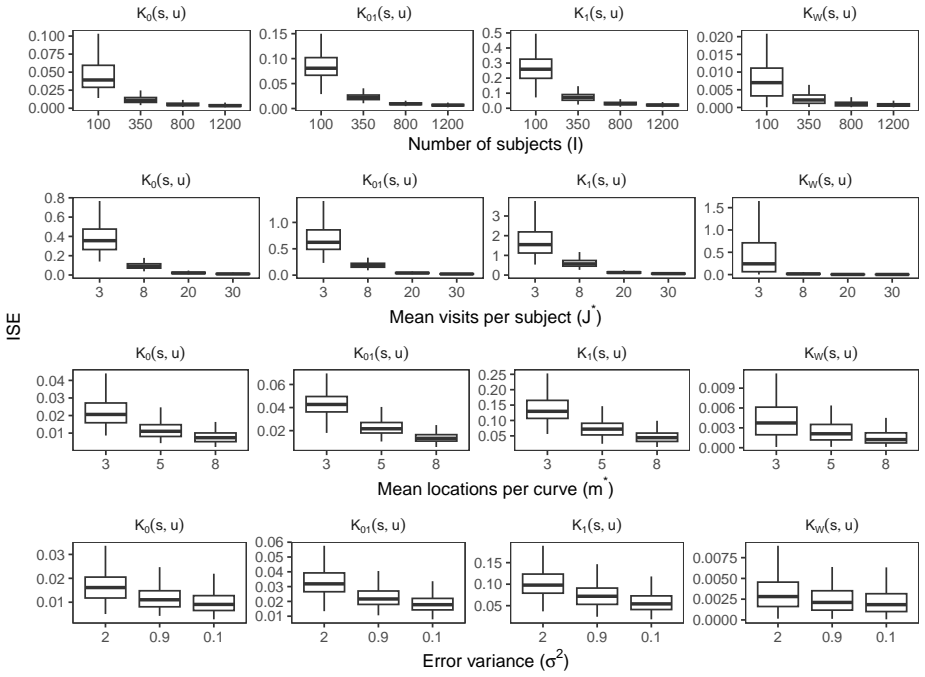
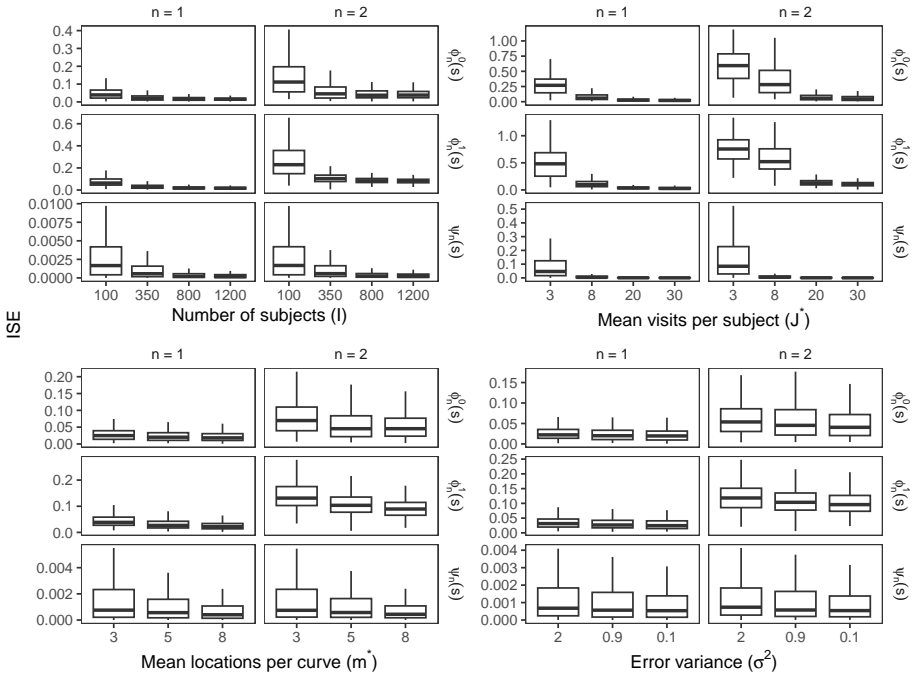
- Simulations confirm accurate eigenfunction estimation and reasonable predictions for underlying curves.
- The method achieves similar or superior performance compared with existing alternatives.
- Analysis of the typing speed data identifies new participant- and day-level patterns not captured by prior work.
- The extracted patterns can be used to tailor behavioral interventions for mental fatigue.
Where Pith is reading between the lines
- The same covariance-borrowing approach could be tested on other episodically sampled smartphone behavioral streams such as activity or response time.
- If the participant- and day-level components prove stable, they could be fed forward into real-time prediction models that trigger interventions at the individual rather than population level.
- Extensions that relax the Gaussian assumption or accommodate irregular missingness blocks would be natural next checks on the method's scope.
Load-bearing premise
Typing speed trajectories can be validly treated as sparsely observed functional data whose covariance structure is amenable to simultaneous estimation and smoothing via structured penalized spline regression that borrows information across the functional domain.
What would settle it
A controlled simulation in which the true covariance does not permit borrowing across the domain and the method recovers markedly inaccurate eigenfunctions would falsify the claim.
Figures
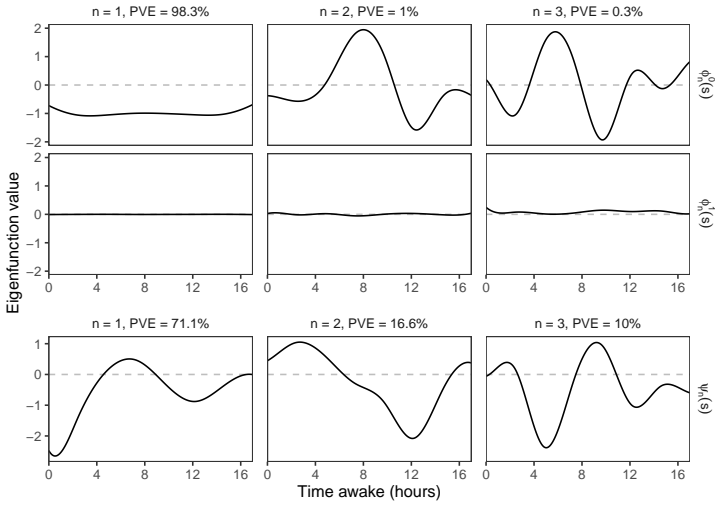
read the original abstract
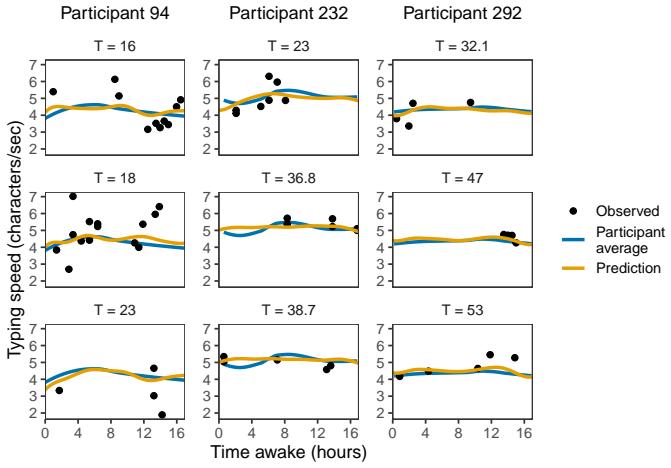
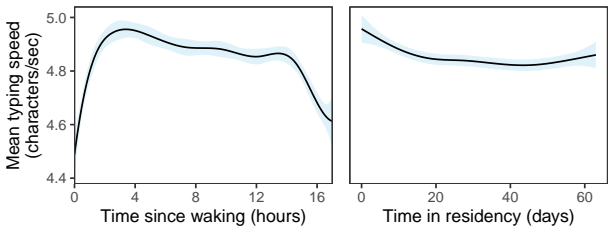
Accurately monitoring mental fatigue is critical for improving workplace safety and productivity. A recent study examined unobtrusively collected smartphone typing speed as a potential ambulatory proxy assessment of mental fatigue using data from the Intern Health Study (IHS). While population-level average typing speed patterns were found to be consistent with validated measures of mental fatigue, how these trajectories vary across participants and days may inform opportune moments for just-in-time interventions and remains an open question. Treating typing speed trajectories as sparsely observed functional data, we propose a novel sparse longitudinal functional principal component analysis (sparse LFPCA) method for decomposing variability and predicting individual curves. Specifically, sparse data are accommodated by casting covariance estimation as a structured penalized spline regression problem, enabling simultaneous estimation and smoothing of multiple covariance components while borrowing information across locations in the functional domain. Simulations show that sparse LFPCA (1) accurately estimates eigenfunctions and generates reasonable predictions for underlying curves, and (2) achieves similar or superior performance compared to existing alternatives. Our analysis of typing speed data collected from IHS reveals new and interpretable participant- and day-level patterns not captured by previous analyses and can be used to tailor behavioral interventions.
Editorial analysis
A structured set of objections, weighed in public.
Referee Report
Summary. The manuscript proposes sparse longitudinal functional principal component analysis (sparse LFPCA) for sparsely observed functional data. Covariance estimation is formulated as a structured penalized spline regression problem that enables simultaneous estimation and smoothing while borrowing information across the functional domain. Simulations demonstrate accurate eigenfunction recovery, reasonable curve predictions, and competitive or superior performance relative to existing methods. The approach is applied to typing speed trajectories from the Intern Health Study, identifying new participant- and day-level patterns not captured in prior analyses.
Significance. If the simulation results and real-data patterns hold, the work supplies a practical extension of FPCA tailored to episodic ambulatory behavioral data. The structured penalized spline formulation addresses sparsity by sharing strength across locations, which is relevant for mental fatigue monitoring via smartphone metrics. The application illustrates utility for extracting interpretable components that could guide just-in-time interventions. Positive elements include simulation coverage across sparsity levels and sensitivity checks on smoothing parameters.
minor comments (3)
- [Simulations section] The abstract states that simulations support accurate eigenfunction estimation, but the main text should explicitly report the range of sparsity levels tested and how they align with the observed typing speed data density.
- [Application section] The claim that the extracted patterns are 'not captured by previous analyses' would be strengthened by a direct quantitative comparison (e.g., variance explained or prediction error) against the population-level averages reported in the referenced IHS study.
- [Methods] Notation for the structured penalty and the borrowing of information across the functional domain should be introduced with a brief equation or diagram in the methods to improve readability for readers unfamiliar with penalized spline covariance models.
Simulated Author's Rebuttal
We thank the referee for their positive summary of our manuscript on sparse LFPCA and for recommending minor revision. The referee's description accurately reflects the method's formulation as structured penalized spline regression, the simulation results, and the application to typing speed trajectories from the Intern Health Study.
Circularity Check
No significant circularity identified
full rationale
The paper proposes sparse LFPCA via structured penalized spline regression for covariance estimation on sparsely observed functional data. Simulations validate eigenfunction recovery and prediction accuracy against alternatives, while the typing speed application extracts participant- and day-level patterns. No load-bearing step reduces a claimed prediction or eigenfunction to a fitted parameter by construction, nor does any uniqueness theorem or ansatz reduce to self-citation. The derivation chain is self-contained with external simulation benchmarks and sensitivity checks.
Axiom & Free-Parameter Ledger
Reference graph
Works this paper leans on
-
[1]
Journal of the American Statistical Association , volume=
Functional data analysis for sparse longitudinal data , author=. Journal of the American Statistical Association , volume=. 2005 , publisher=
2005
-
[2]
2005 , publisher=
Functional data analysis , author=. 2005 , publisher=
2005
-
[3]
Statistics and Computing , volume=
Fast covariance estimation for sparse functional data , author=. Statistics and Computing , volume=. 2018 , publisher=
2018
-
[4]
Statistics and Computing , volume=
Fast covariance estimation for high-dimensional functional data , author=. Statistics and Computing , volume=. 2016 , publisher=
2016
-
[5]
Journal of Computational and Graphical Statistics , volume=
Fast multilevel functional principal component analysis , author=. Journal of Computational and Graphical Statistics , volume=. 2023 , publisher=
2023
-
[6]
The Annals of Applied Statistics , volume=
Multilevel functional principal component analysis , author=. The Annals of Applied Statistics , volume=
-
[7]
Stat , volume=
Multilevel sparse functional principal component analysis , author=. Stat , volume=. 2014 , publisher=
2014
-
[8]
Electronic Journal of Statistics , volume=
Longitudinal functional principal component analysis , author=. Electronic Journal of Statistics , volume=
-
[9]
Statistical Modelling , volume=
Functional linear mixed models for irregularly or sparsely sampled data , author=. Statistical Modelling , volume=. 2016 , publisher=
2016
-
[10]
2017 , publisher=
Introduction to functional data analysis , author=. 2017 , publisher=
2017
-
[11]
2024 , publisher=
Functional data analysis with R , author=. 2024 , publisher=
2024
-
[12]
Tutorial on
Jiang, Ziren and Crainiceanu, Ciprian and Cui, Erjia , journal=. Tutorial on. 2025 , publisher=
2025
-
[13]
Journal of Computational and Graphical Statistics , volume=
Functional additive mixed models , author=. Journal of Computational and Graphical Statistics , volume=. 2015 , publisher=
2015
-
[14]
Statistics in Medicine , volume=
Fixed-effects inference and tests of correlation for longitudinal functional data , author=. Statistics in Medicine , volume=. 2022 , publisher=
2022
-
[15]
Journal of Computational and Graphical Statistics , volume=
Fast univariate inference for longitudinal functional models , author=. Journal of Computational and Graphical Statistics , volume=. 2022 , publisher=
2022
-
[16]
The Annals of Applied Statistics , volume=
Longitudinal high-dimensional principal components analysis with application to diffusion tensor imaging of multiple sclerosis , author=. The Annals of Applied Statistics , volume=
-
[17]
Stat , volume=
Longitudinal functional data analysis , author=. Stat , volume=. 2015 , publisher=
2015
-
[18]
Biostatistics , volume=
Bayesian analysis of longitudinal and multidimensional functional data , author=. Biostatistics , volume=. 2022 , publisher=
2022
-
[19]
Biostatistics , volume=
Hybrid principal components analysis for region-referenced longitudinal functional EEG data , author=. Biostatistics , volume=. 2020 , publisher=
2020
-
[20]
Journal of the American Statistical Association , volume=
Regression analysis of asynchronous longitudinal functional and scalar data , author=. Journal of the American Statistical Association , volume=. 2022 , publisher=
2022
-
[21]
Biometrics , volume=
Modeling longitudinal skewed functional data , author=. Biometrics , volume=. 2024 , publisher=
2024
-
[22]
Fast Penalized Generalized Estimating Equations for Large Longitudinal Functional Datasets
Fast Penalized Generalized Estimating Equations for Large Longitudinal Functional Datasets , author=. arXiv:2506.20437 , year=
work page internal anchor Pith review Pith/arXiv arXiv
-
[23]
Biometrics , volume=
Structured functional principal component analysis , author=. Biometrics , volume=. 2015 , publisher=
2015
-
[24]
Journal of Applied Statistics , volume=
Functional principal component models for sparse and irregularly spaced data by Bayesian inference , author=. Journal of Applied Statistics , volume=. 2024 , publisher=
2024
-
[25]
Stat , volume=
Fast covariance estimation for multivariate sparse functional data , author=. Stat , volume=. 2020 , publisher=
2020
-
[26]
Bayesian Multivariate Sparse Functional Principal Components Analysis
Bayesian Multivariate Sparse Functional PCA , author=. arXiv preprint arXiv:2509.03512 , year=
work page internal anchor Pith review Pith/arXiv arXiv
-
[27]
Journal of Multivariate Analysis , volume=
Robust functional principal component analysis for non-Gaussian longitudinal data , author=. Journal of Multivariate Analysis , volume=. 2022 , publisher=
2022
-
[28]
arXiv preprint arXiv:2503.21913 , year=
A novel smoothing-based goodness-of-fit test of covariance for multivariate sparse functional data , author=. arXiv preprint arXiv:2503.21913 , year=
-
[29]
Biometrika , volume=
Principal component models for sparse functional data , author=. Biometrika , volume=. 2000 , publisher=
2000
-
[30]
Flexible smoothing with
Eilers, Paul HC and Marx, Brian D , journal=. Flexible smoothing with. 1996 , publisher=
1996
-
[31]
Chemometrics and Intelligent Laboratory Systems , volume=
Multivariate calibration with temperature interaction using two-dimensional penalized signal regression , author=. Chemometrics and Intelligent Laboratory Systems , volume=. 2003 , publisher=
2003
-
[32]
2012 , journal=
Asymptotic optimality and efficient computation of the leave-subject-out cross-validation , author=. 2012 , journal=
2012
-
[33]
2017 , publisher=
Generalized additive models: an introduction with R , author=. 2017 , publisher=
2017
-
[34]
Journal of the American Statistical Association , volume=
A note on penalized spline smoothing with correlated errors , author=. Journal of the American Statistical Association , volume=. 2007 , publisher=
2007
-
[35]
Journal of the Royal Statistical Society: Series B (Methodological) , volume=
Estimating the mean and covariance structure nonparametrically when the data are curves , author=. Journal of the Royal Statistical Society: Series B (Methodological) , volume=. 1991 , publisher=
1991
-
[36]
Biostatistics , volume=
Fast methods for spatially correlated multilevel functional data , author=. Biostatistics , volume=. 2010 , publisher=
2010
-
[37]
Journal of the American Statistical Association , volume=
Generalized multilevel functional regression , author=. Journal of the American Statistical Association , volume=. 2009 , publisher=
2009
-
[38]
2008 , publisher=
A matrix handbook for statisticians , author=. 2008 , publisher=
2008
-
[39]
Karhunen, Kari , journal=
-
[40]
Kosambi, D. D. , title =. Journal of the Indian Mathematical Society , volume =
-
[41]
Fonctions al\'
Loeve, Michel , journal=. Fonctions al\'. 1948 , publisher=
1948
-
[42]
Philosophical Transactions of the Royal Society , volume=
Functions of positive and negative type, and their connection with the theory of integral equations , author=. Philosophical Transactions of the Royal Society , volume=. 1909 , publisher=
1909
-
[43]
Biometrics , pages=
Best linear unbiased estimation and prediction under a selection model , author=. Biometrics , pages=. 1975 , publisher=
1975
-
[44]
Biometrika , volume=
On a formula for the product-moment coefficient of any order of a normal frequency distribution in any number of variables , author=. Biometrika , volume=. 1918 , publisher=
1918
-
[45]
PLOS Digital Health , volume=
Patterns of smartphone typing performance by time awake: implications for unobtrusive ambulatory mental fatigue assessment , author=. PLOS Digital Health , volume=. 2026 , publisher=
2026
-
[46]
Feasibility and acceptability of collecting passive phone usage and sensor data via
Funk, Courtney and Zhao, Zhuo and Horwitz, Adam G and Fang, Yu and Pereira-Lima, Karina and Kheterpal, Vik and Sen, Srijan and Frank, Elena , journal=. Feasibility and acceptability of collecting passive phone usage and sensor data via. 2025 , publisher=
2025
-
[47]
SensorKit , howpublished =
-
[48]
Exploring the potential of
Langholm, Carsten and Kowatsch, Tobias and Bucci, Sandra and Cipriani, Andrea and Torous, John , journal=. Exploring the potential of. 2023 , publisher=
2023
-
[49]
Fatigue in the
Ricci, Judith A and Chee, Elsbeth and Lorandeau, Amy L and Berger, Jan , journal=. Fatigue in the. 2007 , publisher=
2007
-
[50]
Archives of Surgery , volume=
Surgeon fatigue: a prospective analysis of the incidence, risk, and intervals of predicted fatigue-related impairment in residents , author=. Archives of Surgery , volume=. 2012 , publisher=
2012
-
[51]
Statistics in medicine , volume=
Using simulation studies to evaluate statistical methods , author=. Statistics in medicine , volume=. 2019 , publisher=
2019
discussion (0)
Sign in with ORCID, Apple, or X to comment. Anyone can read and Pith papers without signing in.