Platform-Driven Hate Speech: An Epidemiological Model with Optimal Taxation
Pith reviewed 2026-06-27 18:42 UTC · model grok-4.3
The pith
A government tax on algorithmic amplification reduces hate speech prevalence, removes bistability, and lowers victim harm in an epidemiological model of platform incentives.
A machine-rendered reading of the paper's core claim, the machinery that carries it, and where it could break.
Core claim
In the model the platform's profit rises with hate-speech prevalence and with its own algorithmic reactivity, closing a feedback loop with the epidemic dynamics; the government then selects the tax rate that maximises social welfare net of tax revenue and deadweight loss, and the resulting equilibrium exhibits strictly lower hate-speech prevalence, elimination of bistability, and lower victim harm than the untaxed equilibrium.
What carries the argument
The closed feedback loop between platform profit, algorithmic reactivity, and epidemiological prevalence, solved as a Stackelberg game between platform and government.
If this is right
- Hate speech prevalence falls at the new equilibrium.
- Bistability disappears, so small shocks no longer trigger large jumps in prevalence.
- Victim harm, measured by exposure or incidents, declines.
- Tax revenue is collected while deadweight loss from reduced platform activity is balanced against the externality reduction.
Where Pith is reading between the lines
- If real platforms exhibit similar profit-prevalence feedback, the same tax logic could be applied to other engagement-driven harms such as misinformation.
- The model suggests testing whether observed jumps in hate-speech metrics after algorithm changes are consistent with the predicted bistable thresholds.
- Extending the framework to multiple platforms could reveal whether coordinated taxation or competition among platforms alters the optimal tax rate.
Load-bearing premise
The platform's profit is assumed to depend directly on hate speech prevalence and algorithmic reactivity in a manner that generates a closed feedback loop with the epidemic dynamics.
What would settle it
Numerical simulation of the untaxed system showing two stable equilibria for a given parameter set, followed by the same simulation after the optimal tax is imposed showing collapse to a single low-prevalence equilibrium.
Figures
read the original abstract
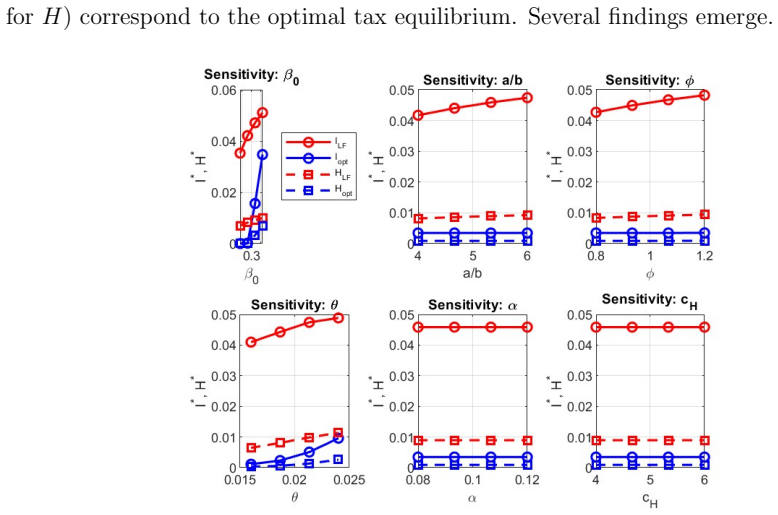
Online hate speech is a global challenge amplified by engagement8-driven social media algorithms. This paper develops an epidemiological model of hate speech propagation capturing the strategic interaction between a profit-maximizing platform and a welfare-maximizing government. The platform's profit depends on the prevalence of hate speech and on its own algorithmic reactivity, creating a feedback loop between the epidemic and economic incentives. The government sets an optimal tax on amplification to internalize the social costs, balancing the benefit of tax revenue against the deadweight loss of taxation. The Stackelberg equilibrium is characterised analytically and solved numerically. The optimal tax reduces hate speech prevalence, eliminates bistability and lowers victim harm.
Editorial analysis
A structured set of objections, weighed in public.
Referee Report
Summary. The paper develops an epidemiological model of hate speech propagation on social media that incorporates strategic interaction between a profit-maximizing platform and a welfare-maximizing government. Platform profit is specified to depend directly on hate-speech prevalence p and algorithmic reactivity r, generating a closed feedback loop. The government acts as Stackelberg leader and chooses an optimal tax on amplification; the resulting equilibrium is characterized analytically and solved numerically. The central results are that the optimal tax lowers steady-state prevalence, eliminates bistability, and reduces victim harm.
Significance. If the modeling assumptions hold, the work supplies a novel integration of compartmental epidemic dynamics with platform incentives and optimal taxation, yielding a concrete policy instrument (tax on amplification) whose comparative-static effects on prevalence and stability can be derived. The analytical characterization of the Stackelberg equilibrium and the numerical demonstration of bistability elimination are strengths that could inform regulatory design, provided the profit specification is robust.
major comments (2)
- [Model section (profit function definition)] The functional dependence of platform profit π on hate-speech prevalence p (explicitly stated in the abstract and used to close the feedback loop) is load-bearing for the claim that the optimal tax eliminates bistability. If instead π depends only on aggregate engagement or ad revenue independent of p, the platform’s best-response function changes and the government’s Stackelberg problem no longer produces the reported disappearance of multiple steady states. The manuscript should either provide empirical or micro-founded justification for π(p,r) or report robustness checks under alternative specifications.
- [Numerical results / comparative-statics section] The numerical results on elimination of bistability and reduction in victim harm rest on the specific parameterization of the profit function and the tax instrument. Without reported sensitivity analysis on the elasticity of π with respect to p (or on the functional form of the amplification tax), it is unclear whether the policy conclusions survive modest changes in the maintained assumptions.
minor comments (2)
- [Notation and model setup] Notation for the state variables (prevalence p, reactivity r) and the tax instrument should be introduced once and used consistently; currently the abstract and model description introduce overlapping symbols without a consolidated table.
- [Equilibrium characterization] The abstract claims an “analytical characterization” of the Stackelberg equilibrium; the main text should state the precise conditions (e.g., concavity assumptions or closed-form best-response functions) under which the characterization holds.
Simulated Author's Rebuttal
We thank the referee for the detailed and constructive comments on our manuscript. We address each of the major comments below and indicate the revisions we plan to make.
read point-by-point responses
-
Referee: [Model section (profit function definition)] The functional dependence of platform profit π on hate-speech prevalence p (explicitly stated in the abstract and used to close the feedback loop) is load-bearing for the claim that the optimal tax eliminates bistability. If instead π depends only on aggregate engagement or ad revenue independent of p, the platform’s best-response function changes and the government’s Stackelberg problem no longer produces the reported disappearance of multiple steady states. The manuscript should either provide empirical or micro-founded justification for π(p,r) or report robustness checks under alternative specifications.
Authors: The specification of platform profit depending on hate speech prevalence p is motivated by the economic incentive for platforms to amplify content that drives higher user engagement and thus ad revenue. This is supported by numerous studies on social media dynamics. To strengthen the paper, we will add a micro-founded derivation of the profit function based on a simple model of content virality and user time allocation. We will also include robustness checks under an alternative profit specification that depends only on aggregate engagement, showing that the optimal tax continues to reduce prevalence and harm, although the complete elimination of bistability holds under a broader set of conditions. revision: yes
-
Referee: [Numerical results / comparative-statics section] The numerical results on elimination of bistability and reduction in victim harm rest on the specific parameterization of the profit function and the tax instrument. Without reported sensitivity analysis on the elasticity of π with respect to p (or on the functional form of the amplification tax), it is unclear whether the policy conclusions survive modest changes in the maintained assumptions.
Authors: We agree that sensitivity analysis would enhance the credibility of the numerical findings. In the revised version of the manuscript, we will expand the numerical section to include sensitivity analyses with respect to the elasticity parameter in the profit function and alternative forms of the tax instrument. These additional results will demonstrate that the key conclusions regarding the reduction in prevalence, elimination of bistability, and lower victim harm are robust to variations in these parameters within empirically plausible ranges. revision: yes
Circularity Check
No circularity: explicit assumptions and analytical characterization stand independently
full rationale
The paper states an explicit modeling assumption that platform profit depends on hate-speech prevalence p and reactivity r, then derives the Stackelberg equilibrium analytically from the resulting coupled epidemic-economic system. No quoted equations reduce a claimed prediction or equilibrium outcome to a fitted parameter or self-citation by construction; the feedback loop is introduced as a premise rather than derived from the target results. The abstract and skeptic summary contain no self-definitional steps, no renaming of known results, and no load-bearing self-citations. The derivation chain therefore remains self-contained against external benchmarks once the functional form of π(p,r) is accepted as given.
Axiom & Free-Parameter Ledger
Reference graph
Works this paper leans on
-
[1]
Accountability Paradox Research Group. (2024). The accountability paradox: How platform API restrictions undermine AI transparency mandates.arXiv preprint, arXiv:2405.01234. https://doi.org/10.48550/arXiv.2405.01234
-
[2]
(2021).Online hate and harassment: The American expe- rience 2021
Anti-Defamation League. (2021).Online hate and harassment: The American expe- rience 2021. Center for technology and society, 10-23
2021
-
[3]
ADL Center for Technology and Society, and Tech Transparency Project.From bad to worse: Algorithmic amplification of antisemitism and extremism on major platforms. ADL
-
[4]
Applied Network Science. (2021). Estimation of the reproduction num- ber of hate speech on Twitter.Applied Network Science,6(1), 45. https://doi.org/10.1007/s41109-021-00389-0
-
[5]
(2025).Hate Speech Index – Q1 2025
Areto Labs. (2025).Hate Speech Index – Q1 2025. Areto Labs. https://www.aretolabs.com/hate-speech-index
2025
-
[6]
Badr, P., Carminati, B., & Ferrari, E. (2021). A SIR model for the diffusion of ideas in social networks.Physica A: Statistical Mechanics and its Applications,568, 125721. https://doi.org/10.1016/j.physa.2020.125721
-
[7]
J., Wills, J
Brady, W. J., Wills, J. A., Jost, J. T., Tucker, J. A., Van Bavel, J. J. (2017). Emotion shapes the diffusion of moralized content in social networks.Nature Human Behaviour,1(7), 0116
2017
-
[8]
Castillo-Chavez, C., & Song, B. (2004). Dynamical models of tuberculosis and their applications.Mathematical Biosciences and Engineering,1(2), 361–404. https://doi.org/10.3934/mbe.2004.1.361
-
[9]
Chadwick, A., Vaccari, C., Kaiser, J. (2025). The amplification of exaggerated and false news on social media: The roles of platform use, motivations, affect, and ideol- ogy.American Behavioral Scientists,69(2), 113-130
2025
-
[10]
Del Vicario, M., Vivaldo, G., Bessi, A., Zollo, F., Scala, A., Caldarelli, G., & Quat- trociocchi, W. (2016). Echo chambers: Emotional contagion and group polarization on Facebook.Scientific Reports,6(1), 37825
2016
-
[11]
R., Aiyappa, R., Pacheco, D., Bryden, J., & Menczer, F
DeVerna, M. R., Aiyappa, R., Pacheco, D., Bryden, J., & Menczer, F. (2024). Identi- fying and characterizing superspreaders of low-credibility content on Twitter.PLOS ONE,19(5), e0302201
2024
-
[12]
(2025).Revised Code of Conduct on Countering Illegal Hate Speech Online integrated into the Digital Services Act
European Commission. (2025).Revised Code of Conduct on Countering Illegal Hate Speech Online integrated into the Digital Services Act. Brussels: European Commis- sion
2025
-
[13]
K., Teklu, S
Hailu, G. K., Teklu, S. W (2024). Investigation into hate speech dissemination dy- namics in a community using fractional order modeling approach.Research in Math- ematics,178, 114321. 24
2024
-
[14]
(2026).Online hate surge threatens public safety: 2025–2026 global report
Global Safety Alliance. (2026).Online hate surge threatens public safety: 2025–2026 global report. International Security and Digital Rights Press
2026
-
[15]
Kramer, A. D. I., Guillory, J. E., & Hancock, J. T. (2014). Exper- imental evidence of massive-scale emotional contagion through social net- works.Proceedings of the National Academy of Sciences,111(24), 8788–8790. https://doi.org/10.1073/pnas.1320040111
-
[16]
(2025, May).Magnifica Humanitas: Encyclical letter on the digital age and human dignity
Pope Leo XIV. (2025, May).Magnifica Humanitas: Encyclical letter on the digital age and human dignity. Vatican City: Libreria Editrice Vaticana
2025
-
[17]
Effects of Prebunking Interventions on Misinformation: A Systematic Review and Meta- Analysis
Lopez, R., Molina, A., Iglesias-Parro, S., Soriano, M., Ordu˜ na, A., Arbol, J. Effects of Prebunking Interventions on Misinformation: A Systematic Review and Meta- Analysis
-
[18]
Maarouf, P., Prollochs, J., & Ferrieguel, S. (2024). The virality of hate speech on social media.Proceedings of the ACM on Human-Computer Interaction,8(CSCW1), 1-22
2024
-
[19]
and Paille S.(2025)
Madriaza, P., Hassan, G., Brouillette-Alarie, S., Mounchingam, A.N., Durocher- Corfa, L., Borokhovski, E., Pickup, D. and Paille S.(2025). Exposure to hate in online and traditional media: A systematic review and meta-analysis of the impact of this exposure on individuals and communities.Campbell Systematic Reviews,21(1), cl2-70018
2025
-
[20]
(2023).Economic cost of hate crimes
Martell, M. (2023).Economic cost of hate crimes. Bard Center for the Study of Hate, Bard College, Annandale-on-Hudson
2023
-
[21]
Mazzarisi, P., Muscillo, A., Pacati, C., Pin, P. (2026). The rise and fall of ideas’ popularity.Journal of Economic Behavior and Organization,245(1), 107507
2026
-
[22]
(2025).Stop Hiding Hate Act(Senate Bill S1234)
New York State Senate. (2025).Stop Hiding Hate Act(Senate Bill S1234). Albany, NY: New York State Legislature
2025
-
[23]
(2025).Investigation into social media platforms over illegal terror and hate content
Ofcom. (2025).Investigation into social media platforms over illegal terror and hate content. London: Office of Communications
2025
-
[24]
Park, T.J., Rohatagi A. (2024). Balancing the platform responsibility paradox: A case for amplification regulation to mitigate the spread of harmful but legal content online.Computer Law and Security Review,52, 105960
2024
-
[25]
Peterson-Salahuddin, C. (2024). Repairing the harm: Toward an algorithmic repa- rations approach to hate speech content moderation.New Media & Society,11(2), 20539517241245333
2024
-
[26]
Public Health Institute
Public Health Institute and UCLA Center for Health Policy Research (2025).The impacts of hate in California: Victim costs and unmet needs. Public Health Institute
2025
-
[27]
Pigou, A. C. (1920).The economics of welfare. London: Macmillan
1920
-
[28]
Online hate: Is hate an infectious disease? Is social media a promoter?.Journal of Applied Philosophy,40(5), 788-812
Popa-Wyatt, M.(2023). Online hate: Is hate an infectious disease? Is social media a promoter?.Journal of Applied Philosophy,40(5), 788-812. 25
2023
-
[29]
Ramponi, A., & Tessitore, P. (2023). Optimal social and vaccination control in the SVIR epidemic model.Mathematics,12(7), 933
2023
-
[30]
(2006).The diffusion of innovations in social networks
Reich, B. (2006).The diffusion of innovations in social networks. London: University College London
2006
-
[31]
Reynolds, C., Hallinan, B. (2024). User-generated accountability: Public participa- tion in algorithmic governance on YouTube.New Media and Society,26(9), 5107- 5129
2024
-
[32]
H., Ottoni, R., West, R., Almeida, V
Ribeiro, M. H., Ottoni, R., West, R., Almeida, V. A. F., & Meira, W. (2020). Auditing radicalization pathways on YouTube. InProceedings of the 2020 Conference on Fairness, Accountability, and Transparency (FAccT ’20)(pp. 131–141)
2020
-
[33]
and Van Der Linden, S.(2020)
Roozenbeek, J., Schneider, C.R., Dryhurst, S., Kerr, J., Freeman, A.L., Recchia, G., Van Der Bles, A.M. and Van Der Linden, S.(2020). Susceptibility to misinformation about COVID-19 around the world.Royal Society open science,7(10)
2020
-
[34]
G., Naik, S
Amballoor, R. G., Naik, S. B.(2024). SIR model for understanding the spread of fake news and hate speech. InText and Social Media Analytics for Fake News and Hate Speech Detection(pp. 166-180). Chapman and Hall/CRC
2024
-
[35]
Solferino, N. (2026). Fighting Misinformation: Super-Spreaders, Learning, and Op- timal Education Policies.Working Paper SSRN. May
2026
-
[36]
W., Abebaw,Y.F
Teklu, S. W., Abebaw,Y.F. (2024). Analysis of the hate speech and racism co- existence dissemination model with optimal control strategies.Chaos, Solitons and Fractals: X,12, 100109
2024
-
[37]
Weimann, G., Masri, N. (2021). TikTok’s spiral of antisemitism.Journalism and Media,2(4), 697-708
2021
-
[38]
Vaidya, A., Nagar, S., Nanavati, A. A. (2024). Analyzing the spread of toxicity on Twitter: An SEIR approach.Proceedings of the 7th Joint International Confer- ence on Data Science and Management of Data (11th ACM IKDD CODS and 29th COMAD), 118-126
2024
-
[39]
van den Driessche, P., & Watmough, J. (2002). Reproduction numbers and sub- threshold endemic equilibria for compartmental models of disease transmission. Mathematical Biosciences,180(1–2), 29-48
2002
-
[40]
Walther, J. B. (2024). The effects of social approval signals on the production of on- line hate: A theoretical explication.Communication Research, 00936502241278944. 26
2024
discussion (0)
Sign in with ORCID, Apple, or X to comment. Anyone can read and Pith papers without signing in.