Old pulsar wind nebulae and the role of the thermal filaments
Pith reviewed 2026-06-27 19:09 UTC · model grok-4.3
The pith
Thermal filaments in pulsar wind nebulae shorten free-expansion but lengthen compression without changing total squeeze.
A machine-rendered reading of the paper's core claim, the machinery that carries it, and where it could break.
Core claim
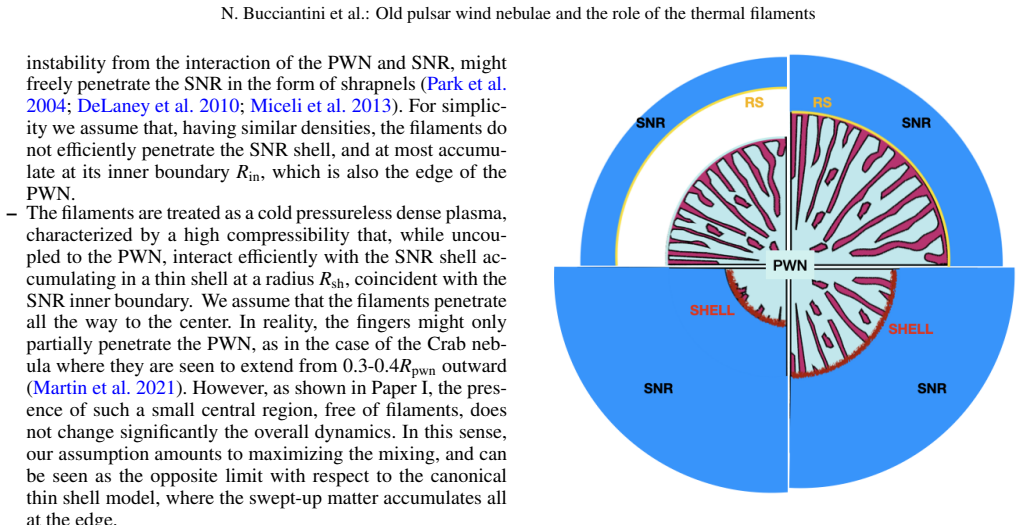
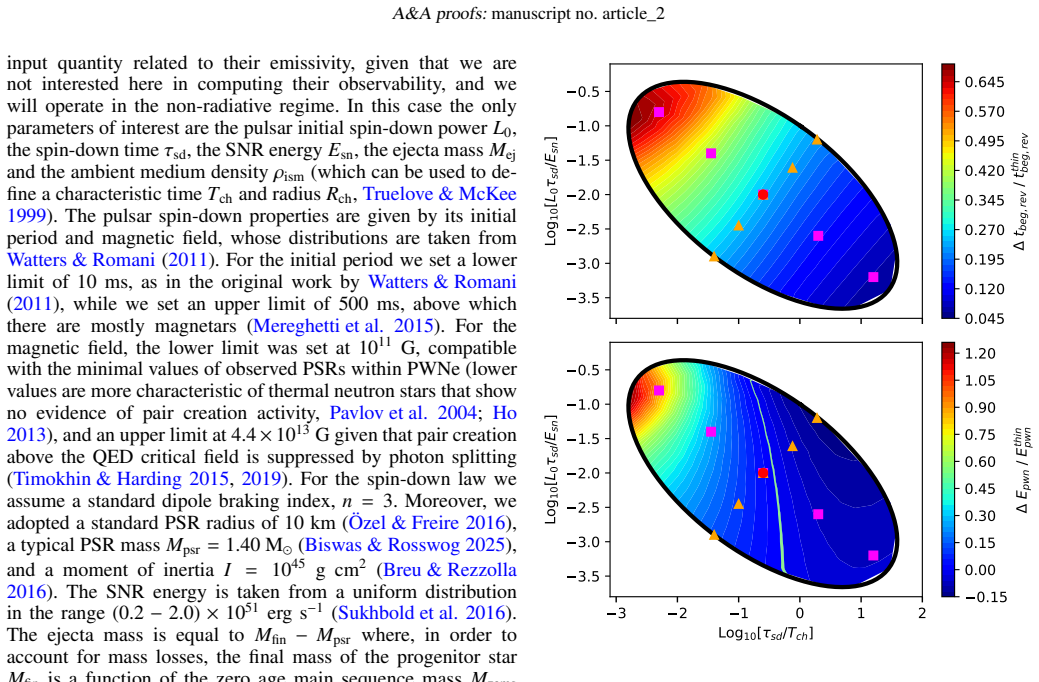
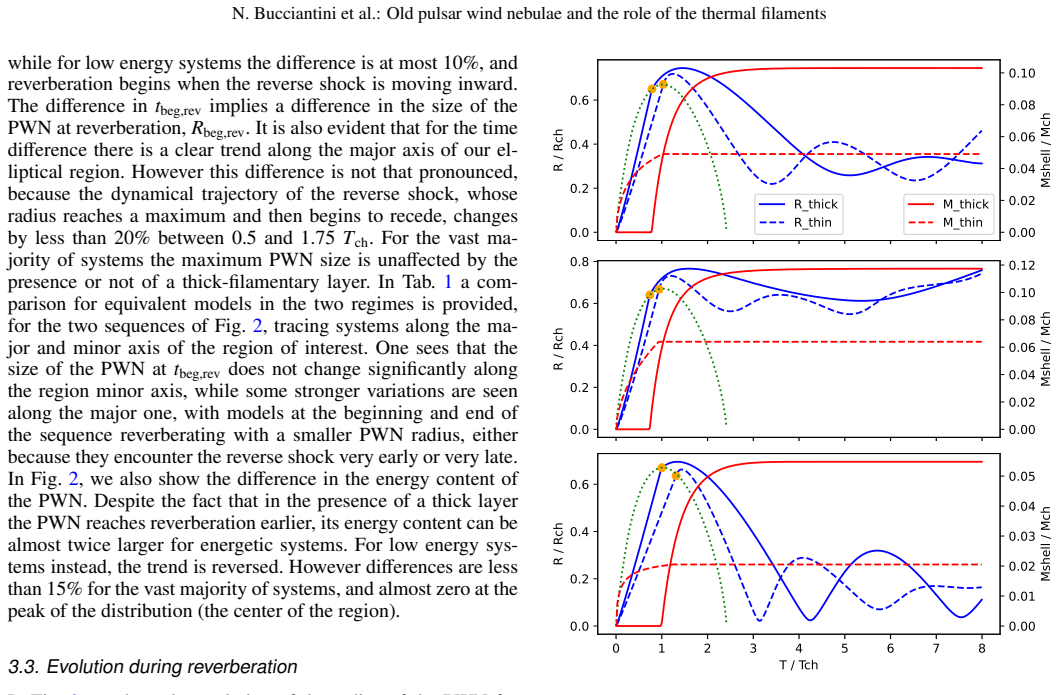
A new formulation of the one-zone thin-shell plus Lagrangian formalism is extended to the case of a thick layer of filamentary ejecta. Reverberation is substantially anticipated and the following compression takes much longer. The total compression of the system does not change much and the qualitative behavior is preserved.
What carries the argument
The one-zone thin-shell plus Lagrangian formalism extended to a thick layer of filamentary ejecta, used to track the late reverberation phase.
If this is right
- Reverberation may be substantially anticipated when filaments are present.
- The following compression takes much longer.
- The total compression of the system does not change much.
- Qualitative behavior is preserved.
- The relative number of systems in each phase changes, affecting their contribution to high-energy emission, while effects like super-efficiency remain largely unaffected.
Where Pith is reading between the lines
- Population studies of gamma-ray sources may need to adjust phase lifetimes when filaments are included.
- The model suggests that neglecting filaments could bias estimates of how long individual nebulae remain detectable.
- Direct imaging of filament layers in additional old nebulae would provide an independent check on the assumed universality of the layer.
Load-bearing premise
A thick layer of filamentary ejecta is present in all pulsar wind nebulae and can be represented within the one-zone thin-shell plus Lagrangian formalism without breaking the model's validity for the reverberation phase.
What would settle it
A statistical comparison of the observed ratio of old pulsar wind nebulae in free-expansion versus reverberation phases against the model's predictions with and without filaments.
Figures
read the original abstract
Old pulsar wind nebulae are among the foremost galactic high-energy gamma-ray sources. However we still lack a robust approach to their modeling, especially in the light of forthcoming high-energy observatories like Astri or CTAO. Part of the problem is due to the complex interaction that characterizes these systems. Understanding this complexity has then become mandatory for further advancements. We aim to develop a new approach to investigate the role the thermal thick layer of massive filaments, seen in objects like the Crab nebula and 3C 58, but likely present in all pulsar wind nebulae, can exert on the dynamics of the late reverberation phase, and compare results with standard approaches that neglect such a layer. A new formulation of the one-zone thin-shell plus Lagrangian formalism, developed in a series of previous papers, is here extended to the case of a thick layer of filamentary ejecta, complementing our former work, mostly focused on the initial free-expansion phase. We compare the dynamics of reverberation with and without the presence of filaments, and show that in the former case reverberation may be substantially anticipated and the following compression takes much longer. The total compression of the system does not seem to change much, and the qualitative behavior is preserved. Our results suggest that the presence or absence of an extended filamentary layer might affect the duration of both the free-expansion phase (shortening it) and the following compression phase during reverberation (lengthening it), but it does not change much the overall compression of the nebula. While this changes the relative number of systems in these two phases, and their contribution to high-energy emission, some peculiar radiative effects associated with the level of compression in old systems, like the "super-efficiency", might not be much affected.
Editorial analysis
A structured set of objections, weighed in public.
Referee Report
Summary. The manuscript extends the authors' prior one-zone thin-shell plus Lagrangian formalism to incorporate a thick layer of filamentary ejecta in old pulsar wind nebulae. It performs a direct dynamical comparison of the reverberation phase with and without this layer, concluding that filaments shorten the free-expansion phase, lengthen the compression phase, but leave the overall compression factor largely unchanged. The work aims to improve modeling for high-energy emission from systems like the Crab nebula and 3C 58 ahead of instruments such as CTAO.
Significance. If the extended model is valid, the results imply that filamentary structures alter the relative durations of evolutionary phases and thus the population-level contribution of old PWNe to gamma-ray emission, while leaving certain compression-dependent effects (e.g., super-efficiency) robust. The paper credits its series of prior works and provides a concrete with/without-filaments comparison. Significance is limited by the lack of explicit validation for the thick-layer extension during reverse-shock interaction.
major comments (2)
- [model extension description (following the reference to prior papers)] The central claim that overall compression is largely unchanged (abstract) depends on the extended one-zone thin-shell Lagrangian formalism remaining valid for a thick filamentary layer during reverberation. The description does not address how local crushing, mixing, or non-uniform deceleration at the reverse-shock interface is averaged, which directly affects the reported stability of the compression factor.
- [numerical results and parameter choices] Filament layer thickness and density contrast are treated as free parameters with no sensitivity analysis or justification for the specific values used in the with/without comparison; varying these could alter the reported shortening of free-expansion and lengthening of compression, undermining the quantitative conclusions.
minor comments (2)
- [Abstract] The abstract sentence 'Part of the problem is due to the complex interaction that characterizes these systems' is vague; specify which interactions are newly addressed by the filament layer.
- [formalism section] Notation for the filament layer (e.g., how its mass and radial extent enter the Lagrangian shells) should be defined explicitly on first use rather than relying solely on the prior series.
Simulated Author's Rebuttal
We thank the referee for the constructive comments. We address each major comment below and indicate revisions to the manuscript.
read point-by-point responses
-
Referee: The central claim that overall compression is largely unchanged (abstract) depends on the extended one-zone thin-shell Lagrangian formalism remaining valid for a thick filamentary layer during reverberation. The description does not address how local crushing, mixing, or non-uniform deceleration at the reverse-shock interface is averaged, which directly affects the reported stability of the compression factor.
Authors: The one-zone thin-shell plus Lagrangian approach is an effective description that integrates over the nebula scale. The filamentary layer is represented as a thick shell with mean density and thickness; Lagrangian tracking follows the bulk radial motion under the integrated ram pressure and internal pressure terms. Local crushing, mixing and non-uniform deceleration are sub-grid effects whose net contribution enters through the averaged mass and momentum equations. We will add an explicit paragraph in the methods section describing this averaging procedure, its assumptions, and the associated limitations for the reverberation phase. revision: partial
-
Referee: Filament layer thickness and density contrast are treated as free parameters with no sensitivity analysis or justification for the specific values used in the with/without comparison; varying these could alter the reported shortening of free-expansion and lengthening of compression, undermining the quantitative conclusions.
Authors: The adopted values are motivated by observational constraints on the Crab nebula and 3C 58 (filament thickness ~0.1–0.3 pc and density contrast ~10–100 relative to the smooth ejecta). We agree that a sensitivity study is warranted. We will add a new subsection (or appendix) presenting additional runs in which thickness and contrast are varied by factors of two around the fiducial values, confirming that the reported shortening of free expansion, lengthening of compression, and near-invariance of total compression remain qualitatively robust. revision: yes
Circularity Check
Derivation self-contained; no circular reduction identified
full rationale
The paper extends the one-zone thin-shell plus Lagrangian formalism (previously developed by the authors) to incorporate a thick filamentary ejecta layer and performs a direct numerical comparison of reverberation dynamics with versus without that layer. The reported outcomes—anticipated reverberation, lengthened compression phase, and largely unchanged total compression—are outputs of this extension and are not shown to reduce by construction to prior fits, self-definitions, or unverified self-citations. The modeling assumptions are inherited from the series, but the central dynamical claims constitute independent content within the new implementation.
Axiom & Free-Parameter Ledger
free parameters (2)
- filament layer thickness
- filament density contrast
axioms (2)
- domain assumption One-zone thin-shell approximation remains valid when a thick filament layer is added
- domain assumption Lagrangian tracking accurately captures the compression dynamics
Reference graph
Works this paper leans on
-
[1]
G., Bazer-Bachi, A
Aharonian, F., Akhperjanian, A. G., Bazer-Bachi, A. R., et al. 2006, A&A, 456, 245
2006
-
[2]
Bandiera, R., Bucciantini, N., Martín, J., Olmi, B., & Torres, D. F. 2020, MN- RAS, 499, 2051
2020
-
[3]
Bandiera, R., Bucciantini, N., Martín, J., Olmi, B., & Torres, D. F. 2021, MN- RAS, 508, 3194
2021
-
[4]
& Rosswog, S
Biswas, B. & Rosswog, S. 2025, Phys. Rev. D, 112, 023045
2025
-
[5]
M., Chevalier, R
Blondin, J. M., Chevalier, R. A., & Frierson, D. M. 2001, ApJ, 563, 806
2001
-
[6]
& Rezzolla, L
Breu, C. & Rezzolla, L. 2016, MNRAS, 459, 646
2016
-
[7]
M., & Del Zanna, L
Bucciantini, N., Amato, E., Bandiera, R., Blondin, J. M., & Del Zanna, L. 2004, A&A, 423, 253
2004
-
[8]
2011, MNRAS, 410, 381
Bucciantini, N., Arons, J., & Amato, E. 2011, MNRAS, 410, 381
2011
-
[9]
& Olmi, B
Bucciantini, N. & Olmi, B. 2026, In Preparation
2026
-
[10]
2024, ApJS, 271, 25
Cao, Z., Aharonian, F., An, Q., et al. 2024, ApJS, 271, 25
2024
-
[11]
M., & Benaglia, P
Carretero-Castrillo, M., Ribó, M., Paredes, J. M., & Benaglia, P. 2024, Bulletin de la Societe Royale des Sciences de Liege, 93, 103 Cherenkov Telescope Array Consortium, Acharya, B. S., Agudo, I., et al. 2019, Science with the Cherenkov Telescope Array
2024
-
[12]
& Gruendl, R
Chu, Y .-H. & Gruendl, R. A. 2008, in Astronomical Society of the Pacific Con- ference Series, V ol. 387, Massive Star Formation: Observations Confront Theory, ed. H. Beuther, H. Linz, & T. Henning, 415 De Sarkar, A., Torres, D. F., Olmi, B., Bucciantini, N., & Meyer, D. M.-A. 2026, In Preparation
2008
-
[13]
DeLaney, T., Koralesky, B., Rudnick, L., & Dickel, J. R. 2002, ApJ, 580, 914
2002
-
[14]
D., et al
DeLaney, T., Rudnick, L., Stage, M. D., et al. 2010, ApJ, 725, 2038
2010
-
[15]
Elwood, B. D., Murphy, J. W., & Diaz, M. 2017, arXiv e-prints, arXiv:1701.07057
Pith/arXiv arXiv 2017
-
[16]
2008, ApJS, 174, 379
Fesen, R., Rudie, G., Hurford, A., & Soto, A. 2008, ApJS, 174, 379
2008
-
[17]
2022, MNRAS, 511, 1439
Fiori, M., Olmi, B., Amato, E., et al. 2022, MNRAS, 511, 1439
2022
-
[18]
Gaensler, B. M. & Slane, P. O. 2006, ARA&A, 44, 17
2006
-
[19]
D., Slane, P
Gelfand, J. D., Slane, P. O., & Zhang, W. 2009, ApJ, 703, 2051
2009
-
[20]
V ., Koralesky, B., Rudnick, L., et al
Gotthelf, E. V ., Koralesky, B., Rudnick, L., et al. 2001, ApJ, 552, L39 H. E. S. S. Collaboration, Abdalla, H., Aharonian, F., et al. 2019a, A&A, 621, A116 H. E. S. S. Collaboration, Abdalla, H., Aharonian, F., et al. 2019b, A&A, 627, A100
2001
-
[21]
J., Stone, J
Hester, J. J., Stone, J. M., Scowen, P. A., et al. 1996, ApJ, 456, 225
1996
-
[22]
Ho, W. C. G. 2013, in IAU Symposium, V ol. 291, Neutron Stars and Pulsars: Challenges and Opportunities after 80 years, ed. J. van Leeuwen, 101–106
2013
-
[23]
1998, ApJ, 499, 282
Jun, B.-I. 1998, ApJ, 499, 282
1998
-
[24]
2015, Space Sci
Kargaltsev, O., Cerutti, B., Lyubarsky, Y ., & Striani, E. 2015, Space Sci. Rev., 191, 391
2015
-
[25]
2013, in The Universe Evolution: As- trophysical and Nuclear Aspects
Kargaltsev, O., Rangelov, B., & Pavlov, G. 2013, in The Universe Evolution: As- trophysical and Nuclear Aspects. Edited by I. Strakovsky and L. Blokhintsev. Nova Science Publishers, 359–406
2013
-
[26]
& Ostriker, E
Kim, C.-G. & Ostriker, E. C. 2017, ApJ, 846, 133
2017
-
[27]
2017, ApJ, 844, 1
Kolb, C., Blondin, J., Slane, P., & Temim, T. 2017, ApJ, 844, 1
2017
-
[28]
K., Ng, C.-Y ., Bucciantini, N., et al
Ma, Y . K., Ng, C.-Y ., Bucciantini, N., et al. 2016, ApJ, 820, 100 Martín, J., Torres, D. F., & Rea, N. 2012, MNRAS, 427, 415
2016
-
[29]
2021, MNRAS, 502, 1864
Martin, T., Milisavljevic, D., & Drissen, L. 2021, MNRAS, 502, 1864
2021
-
[30]
2025, arXiv e-prints, arXiv:2502.19632
Martin, T., Milisavljevic, D., Temim, T., et al. 2025, arXiv e-prints, arXiv:2502.19632
arXiv 2025
-
[31]
Matzner, C. D. & McKee, C. F. 1999, ApJ, 510, 379
1999
-
[32]
A., & Melatos, A
Mereghetti, S., Pons, J. A., & Melatos, A. 2015, Space Sci. Rev., 191, 315
2015
-
[33]
M.-A., Meliani, Z., & Torres, D
Meyer, D. M.-A., Meliani, Z., & Torres, D. F. 2024, A&A, 692, A207
2024
-
[34]
Meyer, D. M.-A. & Torres, D. F. 2025, MNRAS, 537, 186
2025
-
[35]
2013, MNRAS, 430, 2864
Miceli, M., Orlando, S., Reale, F., Bocchino, F., & Peres, G. 2013, MNRAS, 430, 2864
2013
- [36]
-
[37]
Ostriker, J. P. & Gunn, J. E. 1971, ApJ, 164, L95
1971
-
[38]
Owen, P. J. & Barlow, M. J. 2015, ApJ, 801, 141 Özel, F. & Freire, P. 2016, ARA&A, 54, 401
2015
-
[39]
P., Slane, P
Park, S., Hughes, J. P., Slane, P. O., et al. 2004, ApJ, 602, L33
2004
-
[40]
G., Sanwal, D., & Teter, M
Pavlov, G. G., Sanwal, D., & Teter, M. A. 2004, in IAU Symposium, V ol. 218, Young Neutron Stars and Their Environments, ed. F. Camilo & B. M. Gaensler, 239
2004
-
[41]
S., & Keppens, R
Porth, O., Komissarov, S. S., & Keppens, R. 2014, MNRAS, 443, 547
2014
-
[42]
D., Shore, S
Renzo, M., Ott, C. D., Shore, S. N., & de Mink, S. E. 2017, A&A, 603, A118
2017
-
[43]
Reynolds, S. P. & Chevalier, R. A. 1984, ApJ, 278, 630
1984
-
[44]
K., Borkowski, K
Rho, J., Dyer, K. K., Borkowski, K. J., & Reynolds, S. P. 2002, ApJ, 581, 1116
2002
-
[45]
2021, New A, 83, 101498
Rozwadowska, K., Vissani, F., & Cappellaro, E. 2021, New A, 83, 101498
2021
-
[46]
Salpeter, E. E. 1955, ApJ, 121, 161
1955
-
[47]
E., Brown, J
Sukhbold, T., Ertl, T., Woosley, S. E., Brown, J. M., & Janka, H.-T. 2016, ApJ, 821, 38
2016
-
[48]
Timokhin, A. N. & Harding, A. K. 2015, ApJ, 810, 144
2015
-
[49]
Timokhin, A. N. & Harding, A. K. 2019, ApJ, 871, 12
2019
-
[50]
F., Lin, T., & Coti Zelati, F
Torres, D. F., Lin, T., & Coti Zelati, F. 2019, MNRAS, 486, 1019
2019
-
[51]
1968, AJ, 73, 535
Trimble, V . 1968, AJ, 73, 535
1968
-
[52]
Truelove, J. K. & McKee, C. F. 1999, ApJS, 120, 299 van der Swaluw, E., Downes, T. P., & Keegan, R. 2004, A&A, 420, 937
1999
-
[53]
2022, Journal of High Energy Astrophysics, 35, 1
Vercellone, S., Bigongiari, C., Burtovoi, A., et al. 2022, Journal of High Energy Astrophysics, 35, 1
2022
-
[54]
Watters, K. P. & Romani, R. W. 2011, ApJ, 727, 123 Article number, page 7
2011
discussion (0)
Sign in with ORCID, Apple, or X to comment. Anyone can read and Pith papers without signing in.