REVIEW 2 major objections 2 minor 35 references
Variants on the $abc$-Conjecture using Alternative Quality Metrics
T0 review · 2 major / 2 minor · reviewed 2026-06-27 · grok-4.3
Pith's one-line read Quality metrics based on the doubly geometric mean of prime factors in abc-triples yield families and asymptotic bounds analogous to the abc-conjecture.
desk verdict New quality metrics based on doubly geometric means are defined, but the phase-transition claims rest on an unverified transfer of Szpiro heuristics without any reduction shown. read the letter →
The pith
A machine-rendered reading of the paper's core claim, the machinery that carries it, and where it could break.
The reading
What carries the argument
Quality metrics defined from the doubly geometric mean of the prime factors of abc-triples, which identify high-quality families and support asymptotic bounds.
What would settle it
A computation or proof showing that no families of abc-triples under these metrics follow the claimed asymptotic quality bounds, or that the predicted phase transitions do not occur at the smoothness parameters given by the Szpiro heuristics.
Extended reading notes
Core claim
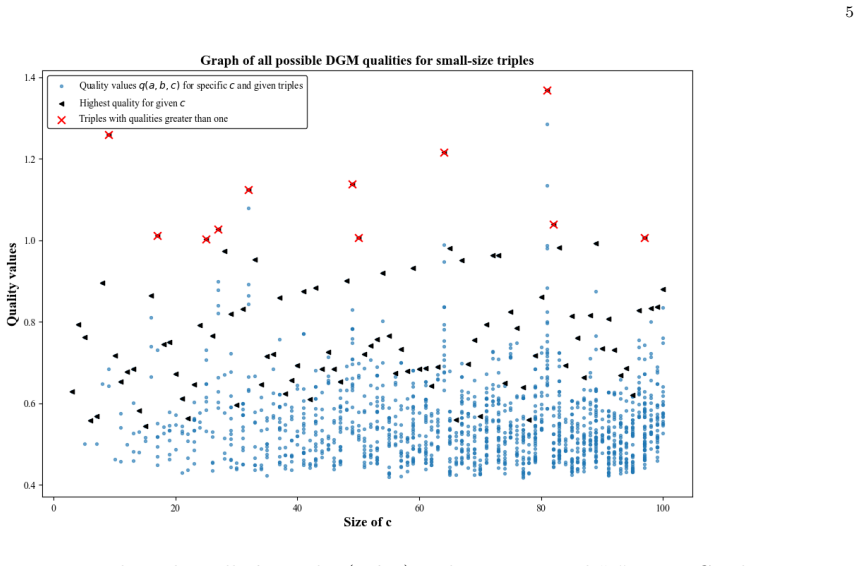
By measuring abc-triples with quality metrics based on the doubly geometric mean of their prime factors, families of high-quality triples are identified that satisfy asymptotic bounds analogous to the abc-conjecture. Sharp phase transitions are established for families of such metrics within specified parametrizations for smoothness of primes, using heuristics from the Szpiro ratio for associated Frey curves. Algorithms are implemented to determine triples with high qualities in sub-linear runtime.
Load-bearing premise
That the doubly geometric mean defines a quality metric whose high-quality families obey asymptotic bounds analogous to the abc-conjecture, and that Szpiro-ratio heuristics for Frey curves transfer to these new metrics.
Editorial analysis
A structured set of objections, weighed in public.
Referee Report
Summary. The paper introduces new classes of quality metrics for abc-triples based on the doubly geometric mean of their prime factors. It claims to identify families of high-quality triples under these metrics that yield asymptotic results analogous to the abc-conjecture, to derive sharp phase transitions for families of such metrics (parametrized by prime smoothness) via Szpiro-ratio heuristics on associated Frey curves, and to give sub-linear runtime algorithms for locating high-quality triples.
Significance. If the asymptotic analogies and phase-transition claims hold with the stated rigor, the work would supply concrete variants of the abc-conjecture that are analytically independent and potentially falsifiable. The algorithmic contribution would also be of separate interest. However, the manuscript supplies no explicit reduction showing that the Szpiro heuristic remains valid under the new quality functions, which undercuts the claimed sharpness of the phase transitions.
major comments (2)
- [phase transitions (abstract and corresponding section)] The section developing phase transitions states that these are obtained “using heuristics from the Szpiro ratio for associated Frey curves,” yet provides no derivation or invariance argument relating the doubly geometric mean quality function to the conductor or minimal discriminant in a manner that preserves the Szpiro constant. Without such a map, the transfer of the heuristic is an unverified analogy rather than a justified correspondence, and this directly supports the central claim of sharp phase transitions.
- [asymptotic results] The asymptotic results analogous to abc are asserted to follow from families of high-quality triples under the new metrics, but the manuscript does not exhibit the explicit height or radical bounds that would make these statements load-bearing analogues rather than reparametrizations of known abc data.
minor comments (2)
- [definitions] Notation for the doubly geometric mean is introduced without a displayed equation number or comparison table against the classical radical and quality functions.
- [algorithms] The abstract claims “sub-linear runtime” but the complexity analysis section does not state the precise dependence on the smoothness parameter or on the size of the triples.
Simulated Author's Rebuttal
We thank the referee for their careful reading and constructive comments. We address each major comment below and indicate planned revisions.
read point-by-point responses
-
Referee: [phase transitions (abstract and corresponding section)] The section developing phase transitions states that these are obtained “using heuristics from the Szpiro ratio for associated Frey curves,” yet provides no derivation or invariance argument relating the doubly geometric mean quality function to the conductor or minimal discriminant in a manner that preserves the Szpiro constant. Without such a map, the transfer of the heuristic is an unverified analogy rather than a justified correspondence, and this directly supports the central claim of sharp phase transitions.
Authors: We agree that the manuscript applies the Szpiro heuristic by direct analogy to the new quality function without supplying an explicit invariance argument or reduction relating the doubly geometric mean to the conductor and minimal discriminant. The phase transitions are obtained under this heuristic assumption for the parametrized families. In revision we will add a clarifying subsection that explains the rationale for the analogy (the doubly geometric mean remains a multiplicative function of the prime factors and correlates monotonically with the standard radical for the smoothness classes considered) while explicitly noting the heuristic character and the absence of a full map. This will qualify the sharpness claim accordingly. revision: partial
-
Referee: [asymptotic results] The asymptotic results analogous to abc are asserted to follow from families of high-quality triples under the new metrics, but the manuscript does not exhibit the explicit height or radical bounds that would make these statements load-bearing analogues rather than reparametrizations of known abc data.
Authors: The asymptotic statements are derived from concrete parametric families of triples in which the new quality exceeds fixed thresholds, yielding infinitely many such triples. To make the load-bearing character explicit we will revise the relevant sections to display the specific families, the associated height and radical controls, and the precise growth statements that follow for the new metric. These are not mere reparametrizations; the change of quality function produces distinct distribution statements that we will highlight with the added bounds. revision: yes
Circularity Check
No significant circularity detected
full rationale
The abstract defines new quality metrics via the doubly geometric mean, then identifies families yielding high quality under those metrics and states asymptotic results analogous to abc. The phase-transition claims invoke Szpiro-ratio heuristics on Frey curves as an external input rather than deriving them from the new metric by construction. No quoted equations reduce a claimed prediction to a fitted parameter, no self-citation chain is load-bearing, and no ansatz is smuggled. The derivation therefore remains self-contained against the supplied text; the skeptic concern is one of unverified transfer, not circular reduction.
Assumptions & free parameters
assumptions (2)
- standard math Standard properties of prime factorizations and geometric means hold for abc-triples
- domain assumption Heuristics from the Szpiro ratio for Frey curves apply to the new quality metrics
invented entities (1)
-
New classes of quality metrics based on doubly geometric mean of prime factors
Cite this review
Pith. "Pith review of Variants on the $abc$-Conjecture using Alternative Quality Metrics." pith.science (2026). https://pith.science/paper/VXZAM555
@misc{pith2026260608416,
  author       = {Pith},
  title        = {Pith review of: Variants on the $abc$-Conjecture using Alternative Quality Metrics},
  year         = {2026},
  howpublished = {\url{https://pith.science/paper/VXZAM555}},
  note         = {Machine review of arXiv:2606.08416}
}
abstract
The $abc$-conjecture (Masser and Oesterle) has remained open for decades. By measuring $abc$-triples using a particular quality metric, the conjecture may be framed as seeking the asymptotic distribution of triples of sufficient quality. We create new classes of quality metrics to develop variants on the $abc$-conjecture, with each metric based upon the doubly geometric mean of the prime factors of triples. We investigate the behavior of the resulting class of quality metrics; by determining families of triples that yield high quality, we establish several asymptotic results that are analogous to the $abc$-conjecture for our metrics. We also develop sharp phase transitions for the behavior of families of such quality metrics within specified parametrizations for smoothness of primes in $abc$-triples, using heuristics from the Szpiro ratio for associated Frey curves. Finally, we implement algorithms to determine triples with high qualities with sub-linear runtime, an asymptotic speedup over na\"ive approaches. Our analysis offers robust variations of, and connections to, the $abc$-conjecture that offer independent questions of analytical interest.
Figures


Reference graph
Works this paper leans on
-
[1]
th´ eoreme
Joseph Oesterl´ e. Nouvelles approches du “th´ eoreme” de Fermat.Ast´ erisque, 161-162:165–186, 1988
1988
-
[2]
Open problems
David W Masser. Open problems. InProceedings of the symposium on Analytic Number Theory, London, 1985. Imperial College, 1985
1985
-
[3]
Modular elliptic curves and Fermat’s last theorem.Annals of mathematics, 141(3):443–551, 1995
Andrew Wiles. Modular elliptic curves and Fermat’s last theorem.Annals of mathematics, 141(3):443–551, 1995
1995
-
[4]
Lecture on theabcconjecture and some of its consequences
Michel Waldschmidt. Lecture on theabcconjecture and some of its consequences. InMathematics in the 21st Century: 6th World Conference, Lahore, March 2013, pages 211–230. Springer, 2015
2013
-
[5]
Factoring integers with the number field sieve
Joe P Buhler, Hendrik W Lenstra, and Carl Pomerance. Factoring integers with the number field sieve. InThe development of the number field sieve, pages 50–94. Springer, 1993
1993
-
[6]
It’s as easy asabc.Notices of the AMS, 49(10):1224–1231, 2002
Andrew Granville and Thomas Tucker. It’s as easy asabc.Notices of the AMS, 49(10):1224–1231, 2002
2002
-
[7]
ABC Triples.https://pub.math.leidenuniv.nl/ ~smitbde/abc/, 2020
Bart de Smit. ABC Triples.https://pub.math.leidenuniv.nl/ ~smitbde/abc/, 2020
2020
-
[8]
Algorithms for finding good examples for theabcand Szpiro conjectures.Experimental Mathematics, 2(3):223–230, 1993
Abderrahmane Nitaj. Algorithms for finding good examples for theabcand Szpiro conjectures.Experimental Mathematics, 2(3):223–230, 1993
1993
Show all 35 references
-
[9]
An algorithm for finding goodabc-examples.Comptes rendus de l’Acad´ emie des sciences
Abderrahmane Nitaj. An algorithm for finding goodabc-examples.Comptes rendus de l’Acad´ emie des sciences. S´ erie 1, Math´ ematique, 317(9):811–815, 1993
1993
-
[10]
Theabcconjecture home page, 2010
Abderrahmane Nitaj. Theabcconjecture home page, 2010
2010
-
[11]
Masters thesis, Universiteit Leiden, 2010
J van der Horst.Finding ABC-triples using elliptic curves. Masters thesis, Universiteit Leiden, 2010
2010
-
[12]
The ABC’s of number theory.The Harvard College Mathematics Review, 1(1):57–76, 2007
Noam D Elkies. The ABC’s of number theory.The Harvard College Mathematics Review, 1(1):57–76, 2007
2007
-
[13]
Greg Martin and Winnie Miao.abctriples.Functiones et Approximatio Commentarii Mathematici, 55(2):145–176, 2016
2016
-
[14]
Cambridge University Press, 1984
Richard C Mason.Diophantine equations over function fields, volume 96. Cambridge University Press, 1984
1984
-
[15]
Polynomial identities and Hauptmoduln.The Quarterly Journal of Mathematics, 32(3):349–370, 1981
W Wilson Stothers. Polynomial identities and Hauptmoduln.The Quarterly Journal of Mathematics, 32(3):349–370, 1981
1981
-
[16]
On theabcconjecture, II.Duke Mathematical Journal, 108(1):169–181, 2001
Cameron L Stewart and Kunrui Yu. On theabcconjecture, II.Duke Mathematical Journal, 108(1):169–181, 2001
2001
-
[17]
Algorithms for Diophantine equations.CWI tracts, 65, 1989
Benne MM De Weger. Algorithms for Diophantine equations.CWI tracts, 65, 1989
1989
-
[18]
Some remarks on theabc-conjecture.Mathematics of Computation, 62(206):931– 939, 1994
Jerzy Browkin and Juliusz Brzezi´ nski. Some remarks on theabc-conjecture.Mathematics of Computation, 62(206):931– 939, 1994
1994
-
[19]
Fermat numbers.University of Washington, 2010
Cindy Tsang and William Stein. Fermat numbers.University of Washington, 2010
2010
-
[20]
Mersenne primes: History, theorems and lists.Prime Pages, 2014
Chris K Caldwell. Mersenne primes: History, theorems and lists.Prime Pages, 2014
2014
-
[21]
List Of Known Mersenne Prime Numbers, 2022
Great Internet Mersenne Prime Search (GIMPS). List Of Known Mersenne Prime Numbers, 2022
2022
-
[22]
Recent developments in primality testing.The Mathematical Intelligencer, 3(3):97–105, 1981
Carl Pomerance. Recent developments in primality testing.The Mathematical Intelligencer, 3(3):97–105, 1981
1981
-
[23]
Hardy and John E
Godfrey H. Hardy and John E. Littlewood. Some problems of ‘partitio numerorum’; iii: On the expression of a number as a sum of primes.Acta Mathematica, 44(1):1–70, 1923
1923
-
[24]
On the representation of a large even integer as the sum of a prime and the product of at most two primes.Scientia Sinica, 16:157–176, 1973
Jing Run Chen. On the representation of a large even integer as the sum of a prime and the product of at most two primes.Scientia Sinica, 16:157–176, 1973
1973
-
[25]
Primary cyclotomic units and a proof of Catalan’s conjecture.Journal f¨ ur die reine und angewandte Mathematik (Crelles Journal), 2004(572):167–195, 2004
Preda Mih˘ ailescu. Primary cyclotomic units and a proof of Catalan’s conjecture.Journal f¨ ur die reine und angewandte Mathematik (Crelles Journal), 2004(572):167–195, 2004
2004
-
[26]
Springer-Verlag, Berlin, New York, 1987
Paul Vojta.Diophantine approximations and value distribution theory, volume 1239 ofLecture Notes in Mathematics. Springer-Verlag, Berlin, New York, 1987
1987
-
[27]
Explicit upper bounds for the solutions of some Diophantine equations.Publicationes Mathematicae Debrecen, 26(1-2):119–132, 1979
K´ alm´ an Gy˝ ory. Explicit upper bounds for the solutions of some Diophantine equations.Publicationes Mathematicae Debrecen, 26(1-2):119–132, 1979
1979
-
[28]
Silverman.The Arithmetic of Elliptic Curves, volume 106 ofGraduate Texts in Mathematics
Joseph H. Silverman.The Arithmetic of Elliptic Curves, volume 106 ofGraduate Texts in Mathematics. Springer, Dor- drecht, 2nd edition, 2009
2009
-
[29]
Links between stable elliptic curves and certain Diophantine equations.Annales Universitatis Saraviensis
Gerhard Frey. Links between stable elliptic curves and certain Diophantine equations.Annales Universitatis Saraviensis. Series Mathematicae, 1(1):1–40, 1986
1986
-
[30]
Propri´ et´ es num´ eriques du faisceau dualisant relatif.Ast´ erisque, 86:44–78, 1981
Lucien Szpiro. Propri´ et´ es num´ eriques du faisceau dualisant relatif.Ast´ erisque, 86:44–78, 1981
1981
-
[31]
Zur theorie der elementaren mittel.Mathematische Zeitschrift, 74(1):91–98, 1960
Wilhelm Specht. Zur theorie der elementaren mittel.Mathematische Zeitschrift, 74(1):91–98, 1960
1960
-
[32]
Baker and Glyn Harman
Roger C. Baker and Glyn Harman. Shifted primes without large prime factors.Acta Arithmetica, 83(4):331–361, 1998
1998
-
[33]
Oxford university press, 1979
Godfrey Harold Hardy, Edward Maitland Wright, et al.An introduction to the theory of numbers. Oxford university press, 1979
1979
-
[34]
Primes is in p.Annals of Mathematics, pages 781–793, 2004
Manindra Agrawal, Neeraj Kayal, and Nitin Saxena. Primes is in p.Annals of Mathematics, pages 781–793, 2004
2004
-
[35]
Springer, Berlin, Heidelberg, 3rd edition, 2008
Mark de Berg, Otfried Cheong, Marc van Kreveld, and Mark Overmars.Computational Geometry: Algorithms and Applications. Springer, Berlin, Heidelberg, 3rd edition, 2008
2008
Reviewed June 27, 2026 · model on record in the stance chip above.
Discussion (0). Continue with ORCID to comment.