Topological quantum hodographs
Pith reviewed 2026-06-27 17:35 UTC · model grok-4.3
The pith
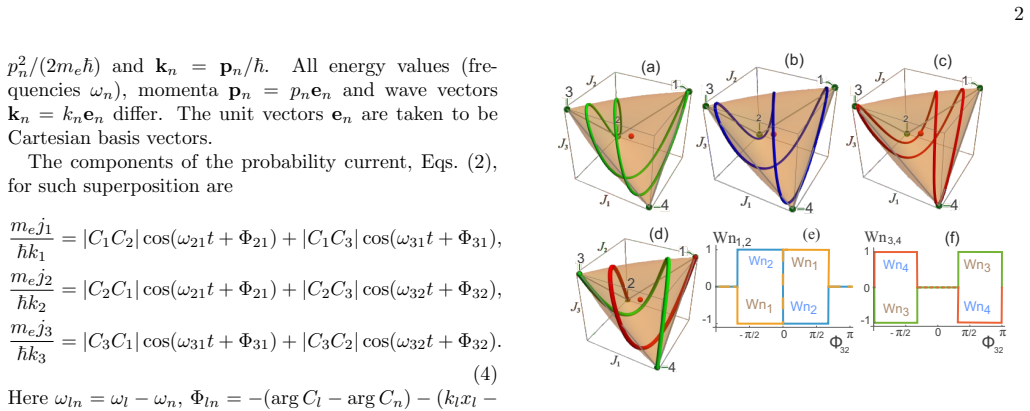
Quantum hodographs of the probability current in three-plane-wave electron superpositions all lie on one universal cubic surface with conical singularities.
A machine-rendered reading of the paper's core claim, the machinery that carries it, and where it could break.
Core claim
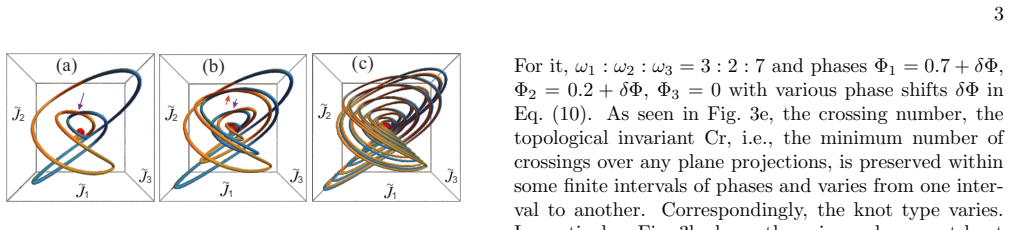
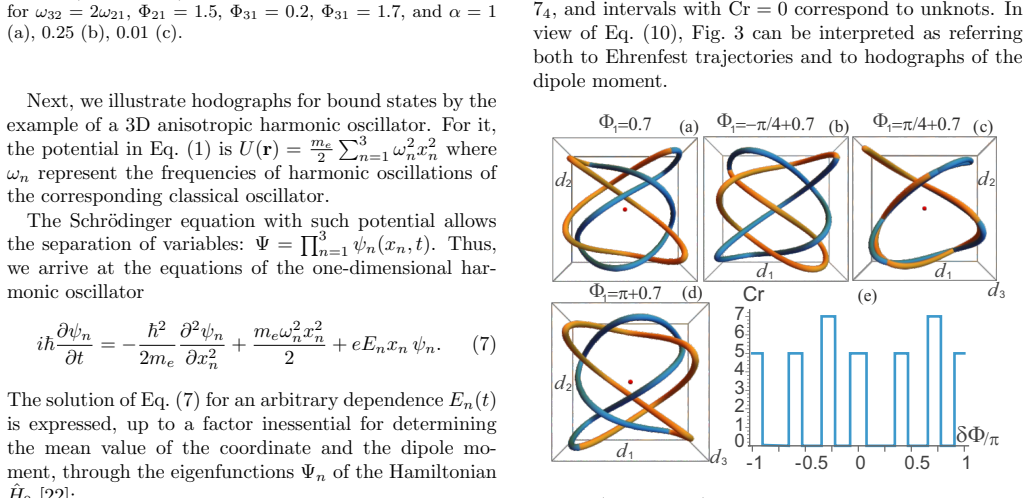
For a free electron in a superposition of three plane waves, all hodographs of the probability current lie on a universal cubic surface with conical singularities. Rational frequency (energy) difference ratios produce non-contractible loops with well-defined winding numbers. In anisotropic harmonic oscillators the Ehrenfest trajectories form three-dimensional Lissajous knots.
What carries the argument
Quantum hodographs: the trajectories traced in time by the expectation value of observable vector quantities such as the probability current.
If this is right
- The topological indices of loops and knots remain unchanged under variations in superposition coefficients.
- Externally driven systems permit controlled creation of knotted hodographs.
- An optical modulation spectroscopy scheme can reconstruct the topological features in trapped ions and single-electron systems.
- The indices supply a new descriptor for non-stationary quantum dynamics beyond energy or angular momentum.
Where Pith is reading between the lines
- The same cubic-surface constraint may hold for other multi-wave packets or different free-particle potentials, offering a broader classification tool.
- The resemblance to classical Thomson vortex atoms suggests quantum hodographs could serve as visual proxies for topological invariants in driven quantum systems.
- Measuring winding numbers in laboratory superpositions would test whether the topology survives realistic decoherence and measurement back-action.
Load-bearing premise
The time-dependent expectation values of the chosen vector observables can be treated as classical-like trajectories whose topology is well-defined and independent of the specific choice of superposition coefficients or potential details.
What would settle it
Compute or measure the probability-current expectation values for several different three-plane-wave superpositions and check whether every point set lies on exactly the same cubic surface.
Figures
read the original abstract
In quantum mechanics, the wave function encodes all information about a particle through its probability density and phase. While stationary states are characterized by conserved quantum numbers such as energy and, in central potentials, angular momentum, non-stationary superpositions - particularly in anisotropic or time-dependent fields - generally lack equally universal descriptors of their spatiotemporal dynamics. Here we introduce quantum hodographs: the trajectories traced in time by the expectation value of observable vector quantities. For a free electron in a superposition of three plane waves, all hodographs of the probability current lie on a universal cubic surface with conical singularities. Rational frequency (energy) difference ratios produce non-contractible loops with well-defined winding numbers. In anisotropic harmonic oscillators the Ehrenfest trajectories - hodographs of the expectation value of particle radius-vector - form three-dimensional Lissajous knots, echoing the classical Thomson vortex-atom model. Externally driven quantum systems allow controllable initiation of knotted hodographs. We propose an optical modulation spectroscopy scheme for reconstructing these topological features in trapped ions and single-electron systems. The topological indices of the loops and knots are robust to parameter variations, offering a new tool for characterizing complex quantum dynamics.
Editorial analysis
A structured set of objections, weighed in public.
Referee Report
Summary. The manuscript introduces quantum hodographs as the time-dependent trajectories traced by expectation values of vector observables. It claims that for a free electron in a superposition of three plane waves, all hodographs of the probability current lie on a universal cubic surface with conical singularities; rational frequency ratios yield non-contractible loops with well-defined winding numbers. In anisotropic harmonic oscillators the Ehrenfest trajectories form three-dimensional Lissajous knots. Externally driven systems permit controllable knotted hodographs, and an optical modulation spectroscopy scheme is proposed to reconstruct these features in trapped ions and single-electron systems, with the topological indices asserted to be robust to parameter variations.
Significance. If the universality of the cubic surface and the robustness of the topological indices hold, the work would supply a new topological descriptor for non-stationary quantum dynamics that is independent of specific superposition details and connects to classical knot theory and the Thomson vortex-atom model. The experimental reconstruction proposal would add practical utility for characterizing complex states in trapped-ion and single-electron platforms.
major comments (2)
- [Abstract] Abstract: the central claim that 'all hodographs of the probability current lie on a universal cubic surface' independent of the complex amplitudes a1,a2,a3 is load-bearing. The probability current for a three-plane-wave superposition is a linear combination of six oscillatory terms whose coefficients depend on |a_j| and arg(a_j). The manuscript must exhibit the explicit cubic relation F(Jx,Jy,Jz)=0 and the algebraic identity that removes this dependence; without it the universality assertion cannot be verified.
- [Abstract] Abstract: the assertion that 'the topological indices of the loops and knots are robust to parameter variations' is load-bearing for the proposed utility as a characterization tool. The manuscript must supply either explicit bounds on how winding numbers or knot types change under variations of amplitudes, phases, or frequencies, or a set of numerical checks demonstrating invariance within stated tolerances.
minor comments (2)
- [Abstract] The abstract states results without derivations, error estimates, or explicit verification against the paper's own parametric equations; the full text should include these for reproducibility.
- The newly coined term 'quantum hodographs' would benefit from a short comparison to classical hodographs or to existing quantum trajectory concepts to clarify the distinction.
Simulated Author's Rebuttal
We thank the referee for the constructive comments, which identify key points requiring explicit support. We address both major comments below by committing to additions that verify the claims without altering the core results. The revised manuscript will incorporate the requested derivations and checks.
read point-by-point responses
-
Referee: [Abstract] Abstract: the central claim that 'all hodographs of the probability current lie on a universal cubic surface' independent of the complex amplitudes a1,a2,a3 is load-bearing. The probability current for a three-plane-wave superposition is a linear combination of six oscillatory terms whose coefficients depend on |a_j| and arg(a_j). The manuscript must exhibit the explicit cubic relation F(Jx,Jy,Jz)=0 and the algebraic identity that removes this dependence; without it the universality assertion cannot be verified.
Authors: We agree the explicit relation is necessary for verification. The current components Jx, Jy, Jz are linear combinations of six oscillatory terms. Algebraic elimination of the six parameters (|a_j|, arg(a_j)) yields the cubic F(Jx,Jy,Jz)=0 independent of those values; the identity follows from the specific trigonometric structure of the plane-wave superposition and the resulting dependencies among the six terms. In revision we will insert a new subsection (or appendix) deriving F explicitly, including the step-by-step elimination and confirmation of the conical singularities. revision: yes
-
Referee: [Abstract] Abstract: the assertion that 'the topological indices of the loops and knots are robust to parameter variations' is load-bearing for the proposed utility as a characterization tool. The manuscript must supply either explicit bounds on how winding numbers or knot types change under variations of amplitudes, phases, or frequencies, or a set of numerical checks demonstrating invariance within stated tolerances.
Authors: We accept that explicit evidence is required. The manuscript will be augmented with a new figure and accompanying text presenting numerical checks: winding numbers and knot types are recomputed for amplitude variations |a_j| ∈ [0.2,1.0], random phases, and frequency detunings up to ±5 %. Within these ranges the indices remain invariant; outside them the trajectories remain on the same cubic surface but may change knot type. A brief continuity argument for the bounded variation will also be added. revision: yes
Circularity Check
No circularity: claims rest on direct analysis of wave-function superpositions
full rationale
The abstract and provided text introduce hodographs as time-dependent expectation values of vector observables and assert topological properties (universal cubic surface, winding numbers, Lissajous knots) for specific superpositions of three plane waves and anisotropic oscillators. No equations, parameter fits, or self-citations are exhibited that would make the claimed universality or indices reduce by construction to the input amplitudes or prior author results. The derivation chain is presented as algebraic elimination from the explicit time-dependent current or position expectations, independent of the target topology, satisfying the criteria for a self-contained result.
Axiom & Free-Parameter Ledger
axioms (2)
- standard math The wave function encodes all information via probability density and phase; expectation values of observables obey the time-dependent Schrödinger equation.
- domain assumption Ehrenfest theorem relates time derivatives of expectation values to forces in harmonic potentials.
invented entities (1)
-
quantum hodographs
no independent evidence
Reference graph
Works this paper leans on
-
[1]
L. D. Landau and E. M. Lifshitz,Quantum Mechanics: Non-Relativistic Theory, 3rd ed., Course of Theoretical Physics, Vol. 3 (Pergamon Press, Oxford, 1977)
1977
-
[2]
Ehrenfest, Bemerkung ¨ uber die angen¨ aherte g¨ ultigkeit der klassischen mechanik innerhalb der quanten- mechanik, Z
P. Ehrenfest, Bemerkung ¨ uber die angen¨ aherte g¨ ultigkeit der klassischen mechanik innerhalb der quanten- mechanik, Z. Phys.45, 455 (1927), english translation: http://www.neo-classical-physics.info/uploads/ 3/4/3/6/34363841/ehrenfest_-_theorem.pdf
1927
-
[3]
Advanced physics prize 2023,https: //www.nobelprize.org/uploads/2023/10/ advanced-physicsprize2023-2.pdf(2023), Nobel Prize in Physics 2023 - Advanced Information
2023
-
[4]
Krausz and M
F. Krausz and M. Ivanov, Attosecond physics, Rev. Mod. Phys.81, 163 (2009)
2009
-
[5]
Cruz-Rodriguezet al., Quantum phenomena in 5 attosecond science, Nat
L. Cruz-Rodriguezet al., Quantum phenomena in 5 attosecond science, Nat. Rev. Phys.6, 691 (2024), arXiv:2403.05482
arXiv 2024
-
[6]
Biegertet al., Attosecond technology(ies) and science, J
J. Biegertet al., Attosecond technology(ies) and science, J. Phys. B: At. Mol. Opt. Phys.54, 070201 (2021)
2021
-
[7]
D. M. Villeneuve, P. Hockett, M. J. J. Vrakking, and H. Niikura, Coherent imaging of an attosecond electron wave packet, Science356, 1150 (2017)
2017
-
[8]
M. V. Berry, Knotted zeros in the quantum states of hy- drogen, Found. Phys.31, 659 (2001)
2001
-
[9]
A. Enciso, D. Hartley, and D. Peralta-Salas, A problem of Berry and knotted zeros in the eigenfunctions of the harmonic oscillator, J. Eur. Math. Soc.20, 301 (2018), arXiv:1503.05101 [math-ph]
Pith/arXiv arXiv 2018
-
[10]
A. J. Taylor and M. R. Dennis, Vortex knots in tangled quantum eigenfunctions, Nat. Commun.7, 12346 (2016)
2016
-
[11]
Y. Canzani and J. A. Toth, Nodal sets of Schr¨ odinger eigenfunctions in forbidden regions, Ann. Henri Poincar´ e 17, 3063 (2016), arXiv:1502.00732 [math.AP]
Pith/arXiv arXiv 2016
-
[12]
Sugic, M
D. Sugic, M. R. Dennis, F. Nori, and K. Y. Bliokh, Knot- ted polarizations and spin in three-dimensional polychro- matic waves, Phys. Rev. Research2, 042045(R) (2020)
2020
-
[13]
M. F. Ferrer-Garcia, A. D’Errico, H. Larocque, A. Sit, and E. Karimi, Polychromatic electric field knots, Phys. Rev. Research3, 033226 (2021)
2021
-
[14]
N. N. Rosanov and S. V. Fedorov, Structured electromag- netic pulses with temporally knotted polarization, Phys. Rev. A112, 063518 (2025)
2025
-
[15]
Thomson, On vortex atoms, Proc
W. Thomson, On vortex atoms, Proc. R. Soc. Edinburgh 6, 94 (1869)
-
[16]
Aharonov and J
Y. Aharonov and J. Anandan, Phase change during a cyclic quantum evolution, Phys. Rev. Lett.58, 1593 (1987)
1987
-
[17]
V. F. R. Jones and J. H. Przytycki, Lissajous knots and billiard knots, Knot Theory, Banach Center Publications 42, 145 (1998)
1998
-
[18]
M. G. V. Bogle, J. E. Hearst, V. F. R. Jones, and L. Stoilov, Lissajous knots, Journal of Knot Theory and Its Ramifications3, 121 (1994)
1994
-
[19]
R. G. Scharein, Lissajous knots,https://knotplot. com/knot-theory/lissajous.html(n.d.), knotPlot doc- umentation
-
[20]
com/manual/LissajousParams.html(n.d.), knotPlot documentation
KnotPlot, Lissajous parameters,https://knotplot. com/manual/LissajousParams.html(n.d.), knotPlot documentation
-
[21]
Rosanov, S
N. Rosanov, S. Fedorov, and M. Arkhipov, Supplemental material,URL_will_be_inserted_by_publisher(2026), see Supplemental Material atURL_will_be_inserted_ by_publisherfor animations of Fig. 1a-c and Fig. 4
2026
-
[22]
A. I. Baz, Y. B. Zeldovich, and A. M. Perelomov,Scat- tering, Reactions and Decay in Nonrelativistic Quantum Mechanics(Israel Program for Scientific Translations, Jerusalem, 1969)
1969
-
[23]
Allcock, The time of arrival in quantum mechanics i
G. Allcock, The time of arrival in quantum mechanics i. formal considerations, Annals of Physics53, 253 (1969)
1969
-
[24]
Miller, W
M. Miller, W. C. Yuan, R. Dumke, and T. Paterek, Experiment-friendly formulation of quantum backflow, Quantum5, 379 (2021)
2021
-
[25]
Born and E
M. Born and E. Wolf,Principles of optics. Electromag- netic theory of propagation, interference and diffraction of light, 7th ed. (Cambridge University Press, Cambridge, 1999)
1999
-
[26]
M. O. Scully and M. S. Zubairy,Quantum Optics(Cam- bridge University Press, 1997)
1997
-
[27]
H. G. Dehmelt, Nobel lecture: Experiments with an iso- lated subatomic particle at rest (1989), Nobel Prize in Physics 1989
1989
-
[28]
L. S. Brown and G. Gabrielse, Geonium theory: Physics of a single electron or ion in a penning trap, Rev. Mod. Phys.58, 233 (1986)
1986
-
[29]
Blaum, Y
K. Blaum, Y. N. Novikov, and G. Werth, Penning traps as a versatile tool for precise experiments in fundamental physics, Cont. Phys.51, 149 (2010)
2010
-
[30]
Matthiesenet al., Trapping electrons in a room- temperature microwave Paul trap, Phys
C. Matthiesenet al., Trapping electrons in a room- temperature microwave Paul trap, Phys. Rev. X11, 011019 (2021)
2021
-
[31]
M. A. Belkin, F. Capasso, F. Xie, A. Belyanin, M. Fis- cher, A. Wittmann, and J. Faist, Room temperature ter- ahertz quantum cascade laser source based on intracav- ity difference-frequency generation, Appl. Phys. Lett.92, 201101 (2008)
2008
-
[32]
Piccardo, P
M. Piccardo, P. Chevalier, Y. Yang, C. R. Menyuk, F. Capasso,et al., Radiofrequency transmitter based on a laser frequency comb, Optica5, 475 (2018)
2018
discussion (0)
Sign in with ORCID, Apple, or X to comment. Anyone can read and Pith papers without signing in.