Climate network characterization of the AMOC edge state
Pith reviewed 2026-06-27 17:45 UTC · model grok-4.3
The pith
Climate networks detect equatorial teleconnections as the AMOC approaches its edge state
A machine-rendered reading of the paper's core claim, the machinery that carries it, and where it could break.
Core claim
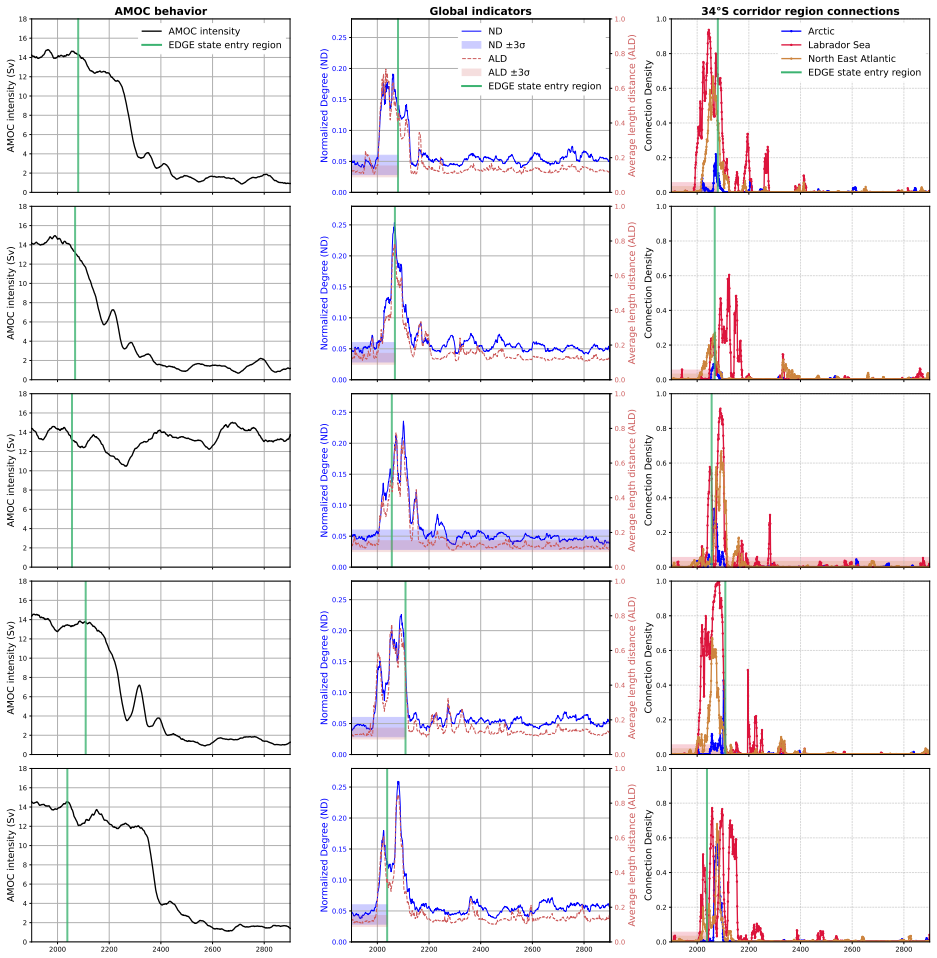
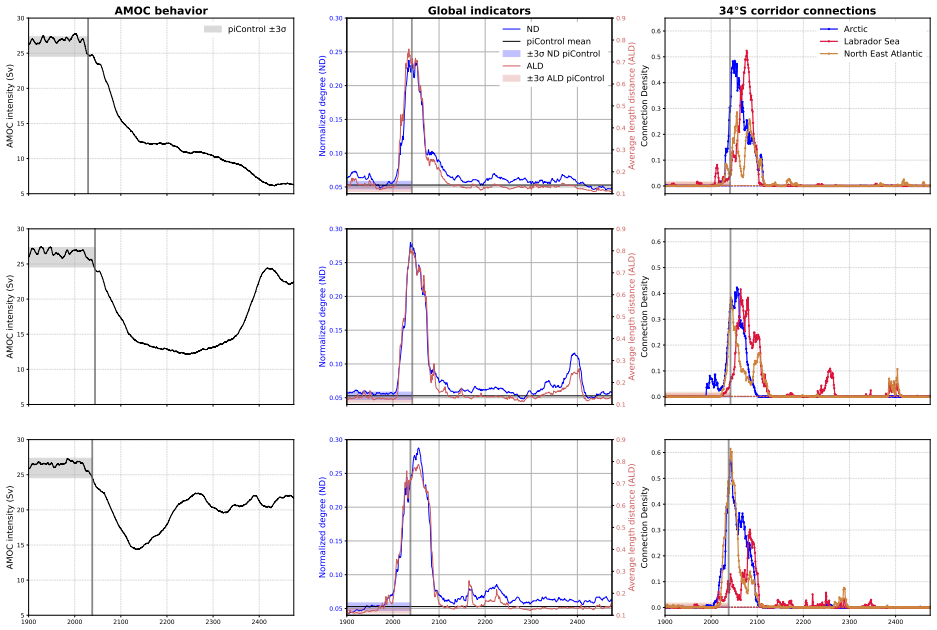
The central claim is that network measures, specifically normalized degree centrality, reveal the presence of teleconnections across the equator as the AMOC approaches the edge state in both EMIC and ESM simulations that exhibit collapse or recovery under CO2 forcing.
What carries the argument
Climate networks constructed from instantaneous temporal correlations between geographical locations, using normalized degree centrality to detect teleconnections
If this is right
- Normalized degree centrality can characterize the edge state during AMOC transitions under intermediate climate change scenarios.
- The appearance of equatorial teleconnections supplies a detectable signal for proximity to the tipping boundary.
- The network signature observed in EMIC runs extends to ESM runs that show collapse or recovery.
- Climate networks supply one route toward estimating the probability of future AMOC transitions.
Where Pith is reading between the lines
- The same network construction could be applied to observational reanalysis products to check whether real-world AMOC variability produces comparable teleconnection patterns.
- The method might transfer to other ocean tipping elements such as Antarctic Bottom Water formation.
- Combining the network measure with existing early-warning indicators based on variance or autocorrelation could strengthen detection of AMOC proximity to tipping.
Load-bearing premise
Instantaneous temporal correlations between grid-point variables in the model output capture dynamical proximity to the edge state rather than model-specific noise or forcing artifacts.
What would settle it
A simulation in which the AMOC stays far from the edge state yet normalized degree centrality still shows strong cross-equatorial teleconnections would falsify the link between the network measure and approach to the edge state.
Figures
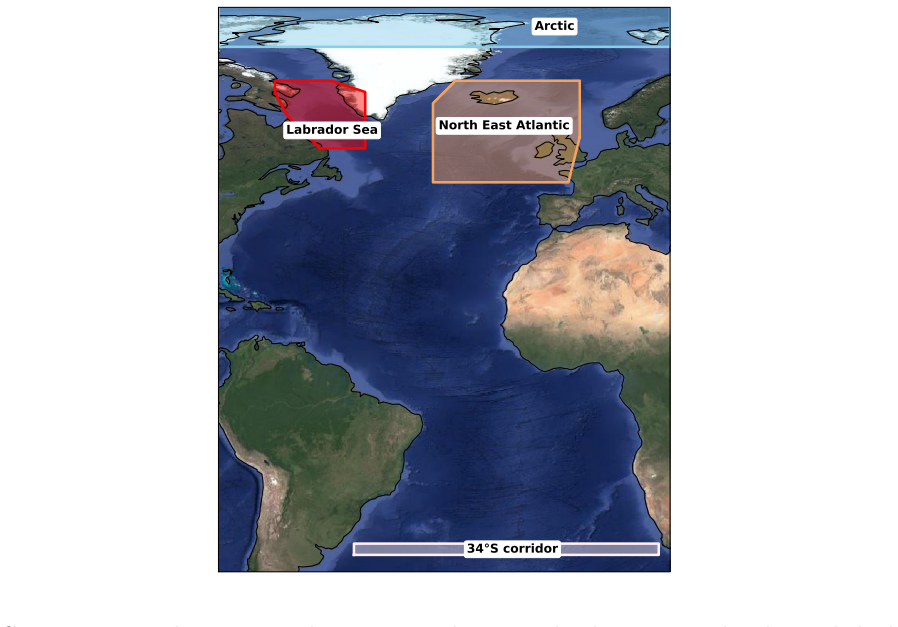
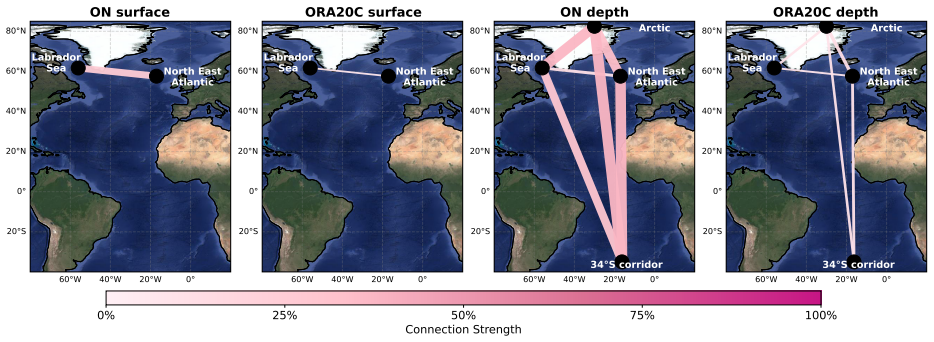
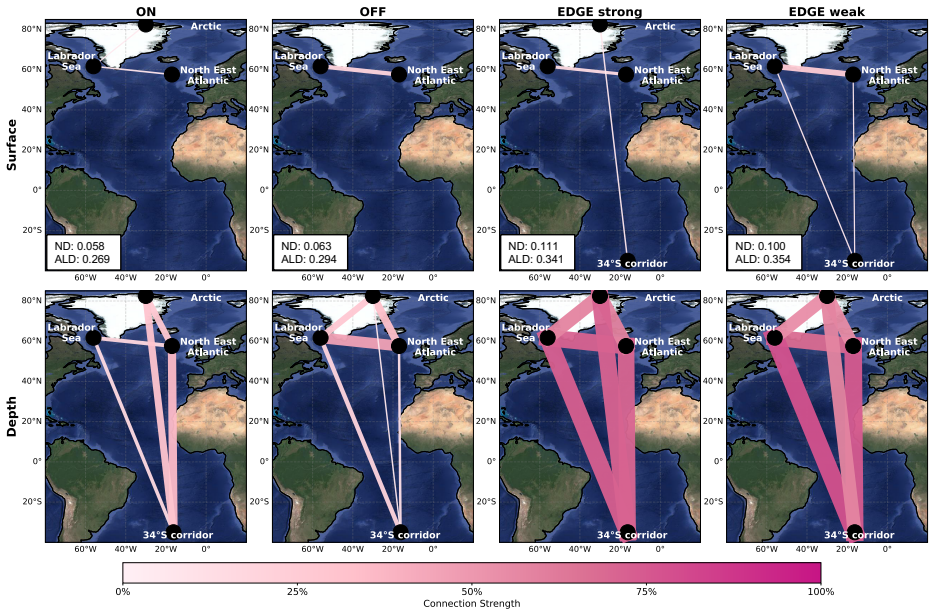
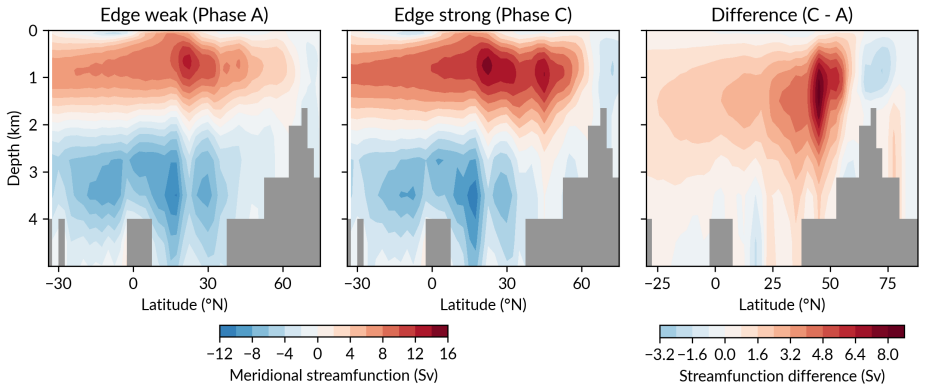
read the original abstract
The Atlantic Meridional Overturning Circulation (AMOC) has been identified as a tipping element in the Earth system. Under the current climate change scenarios, it is urgent to develop robust methods for determining the probability of future AMOC transitions. Recent studies using an Earth System Model of Intermediate Complexity (EMIC) have revealed the importance of an AMOC edge state, located on the boundary of the attraction basin of the collapsed state, in AMOC transitions. Here, we provide a characterization of this edge state through climate networks, using instantaneous temporal correlations between geographical locations to define the network links. We apply the climate network analysis to a set of EMIC simulations with CO$_2$ forcing according to an intermediate climate change scenario (SSP2-4.5) that exhibit qualitatively different AMOC responses as a result of interaction with the edge state. We show that network measures, specifically the normalized degree centrality, reveal the presence of teleconnections across the equator as the AMOC approaches the edge state. A similar result is obtained for an Earth System Model (ESM) simulating AMOC collapse or recovery, suggesting that climate networks could be used to detect the onset of an AMOC tipping event in ESMs.
Editorial analysis
A structured set of objections, weighed in public.
Referee Report
Summary. The manuscript claims that climate networks constructed from instantaneous temporal correlations between grid points in EMIC simulations under SSP2-4.5 forcing can characterize the AMOC edge state, with normalized degree centrality revealing cross-equatorial teleconnections specifically when trajectories interact with the edge state; analogous behavior is reported in an ESM.
Significance. If the network signature can be shown to isolate edge-state dynamics from external forcing and model noise, the approach would offer a potentially useful diagnostic for proximity to AMOC tipping in intermediate and full-complexity models. The work builds on prior EMIC edge-state studies but does not yet demonstrate robustness against the confounding factors raised in the stress test.
major comments (2)
- [Abstract / Results] Abstract and Results: The central claim that normalized degree centrality 'reveals the presence of teleconnections across the equator as the AMOC approaches the edge state' is not supported by any surrogate-data tests, linear detrending, or comparison against non-tipping trajectories under identical SSP2-4.5 forcing. Without these controls, the reported cross-equatorial links cannot be distinguished from artifacts of the external CO2 trend or EMIC-specific variability.
- [Methods] Methods: No quantitative thresholds, bootstrap error estimates, or sensitivity tests to correlation-window length are reported for the network measures. This absence makes it impossible to assess whether the observed changes in degree centrality exceed the variability expected from the forcing protocol alone.
Simulated Author's Rebuttal
We thank the referee for their constructive comments, which identify key areas where additional controls would strengthen the manuscript. We respond to each major comment below and outline the planned revisions.
read point-by-point responses
-
Referee: [Abstract / Results] Abstract and Results: The central claim that normalized degree centrality 'reveals the presence of teleconnections across the equator as the AMOC approaches the edge state' is not supported by any surrogate-data tests, linear detrending, or comparison against non-tipping trajectories under identical SSP2-4.5 forcing. Without these controls, the reported cross-equatorial links cannot be distinguished from artifacts of the external CO2 trend or EMIC-specific variability.
Authors: We agree that surrogate-data tests, linear detrending, and explicit side-by-side comparisons with non-tipping trajectories are necessary to isolate edge-state effects from the external CO2 trend. Although the simulations already comprise multiple realizations under identical SSP2-4.5 forcing that produce qualitatively different AMOC outcomes due to edge-state interaction, the manuscript does not present these comparisons directly for the network measures. In the revised version we will add (i) direct network comparisons between tipping and non-tipping trajectories, (ii) linear detrending of the time series prior to correlation calculation, and (iii) surrogate-data tests that preserve the forcing trend while destroying temporal correlations. These controls will be reported in the Results section. revision: yes
-
Referee: [Methods] Methods: No quantitative thresholds, bootstrap error estimates, or sensitivity tests to correlation-window length are reported for the network measures. This absence makes it impossible to assess whether the observed changes in degree centrality exceed the variability expected from the forcing protocol alone.
Authors: We concur that the absence of these quantitative assessments limits evaluation of robustness. The revised Methods section will specify the correlation threshold used to define links, include bootstrap resampling (with replacement across ensemble members) to obtain error estimates on normalized degree centrality, and report sensitivity tests for correlation-window lengths ranging from 5 to 30 years. These additions will allow readers to judge whether the reported changes exceed forcing-induced variability. revision: yes
Circularity Check
No circularity: empirical network metrics computed directly from simulation correlations
full rationale
The paper computes instantaneous temporal correlations between grid-point variables in EMIC output to define network edges, then calculates normalized degree centrality on those networks to observe cross-equator teleconnections in trajectories that interact with the edge state. This is a direct data-driven procedure with no fitted parameters renamed as predictions, no self-definitional equations, and no load-bearing self-citation that reduces the central claim to an unverified prior result by the authors. The edge-state context is referenced from prior work but the network characterization itself is independently applied to the described simulation ensembles and compared across qualitatively different AMOC responses.
Axiom & Free-Parameter Ledger
axioms (1)
- domain assumption Instantaneous temporal correlations between grid-point variables define network links that reflect dynamical proximity to the edge state.
Reference graph
Works this paper leans on
-
[1]
D. I. Armstrong McKay, A. Staal, J. F. Abrams, R. Winkelmann, B. Sakschewski, S. Loriani, I. Fetzer, S. E. Cornell, J. Rockstr¨ om, and T. M. Lenton, Exceeding 1.5°c global warming could trigger multiple climate tipping points, Science377, eabn7950 (2022-09-09)
2022
-
[2]
Rahmstorf, Is the atlantic overturning circulation approaching a tipping point?, Oceanog- raphy37, 16 (2024)
S. Rahmstorf, Is the atlantic overturning circulation approaching a tipping point?, Oceanog- raphy37, 16 (2024)
2024
-
[3]
Wunderling, A
N. Wunderling, A. S. von der Heydt, Y. Aksenov, S. Barker, R. Bastiaansen, V. Brovkin, M. Brunetti, V. Couplet, T. Kleinen, C. H. Lear, J. Lohmann, R. M. Roman-Cuesta, S. Sinet, D. Swingedouw, R. Winkelmann, P. Anand, J. Barichivich, S. Bathiany, M. Baudena, J. T. Bruun, C. M. Chiessi, H. K. Coxall, D. Docquier, J. F. Donges, S. K. J. Falkena, A. K. Klose...
2024
-
[4]
Caesar, S
L. Caesar, S. Rahmstorf, A. Robinson, G. Feulner, and V. Saba, Observed fingerprint of a weakening atlantic ocean overturning circulation, Nature556, 191 (2018)
2018
-
[5]
K. Y. Li and W. Liu, Weakened atlantic meridional overturning circulation causes the historical north atlantic warming hole, Communications Earth & Environment6, 416 (2025)
2025
-
[6]
S. L. L. Michel, H. A. Dijkstra, F. Guardamagna, V. Jacques-Dumas, R. M. van Westen, and A. S. von der Heydt, Deep learning based reconstructions of the atlantic meridional overturning circulation confirm twenty-first century decline, Environmental Research Letters20, 064036 (2025)
2025
-
[7]
R. M. van Westen, M. Kliphuis, and H. A. Dijkstra, Physics-based early warning sig- nal shows that amoc is on tipping course, Science Advances10, eadk1189 (2024), https://www.science.org/doi/pdf/10.1126/sciadv.adk1189
-
[8]
W. Liu, S.-P. Xie, Z. Liu, and J. Zhu, Overlooked possibility of a collapsed atlantic merid- ional overturning circulation in warming climate, Science Advances3, e1601666 (2017), https://www.science.org/doi/pdf/10.1126/sciadv.1601666
-
[9]
H. A. Dijkstra, B. Krauskopf, R. B¨ orner, and R. M. van Westen, Transitions of the atlantic ocean circulation, Nat Rev Phys , 1 (2026)
2026
-
[10]
R. B¨ orner, O. Mehling, J. von Hardenberg, and V. Lucarini, Global stability of the atlantic overturning circulation: Edge states, long transients and a boundary crisis under co2 forcing, 25 Philosophical Transactions of the Royal Society A 10.1098/rsta.2025.008 (2025)
-
[11]
Romanou, D
A. Romanou, D. Rind, J. Jonas, R. Miller, M. Kelley, G. Russell, C. Orbe, L. Nazarenko, R. Latto, and G. A. Schmidt, Stochastic bifurcation of the north atlantic circulation under a midrange future climate scenario with the nasa-giss model, Journal of Climate36, 6141 (2023)
2023
-
[12]
Drijfhout, J
S. Drijfhout, J. R. Angevaare, J. Mecking, R. M. van Westen, and S. Rahmstorf, Shutdown of northern atlantic overturning after 2100 following deep mixing collapse in cmip6 projections, Environmental Research Letters20, 094062 (2025)
2025
-
[13]
Oh, J.-S
J.-H. Oh, J.-S. Kug, Y. Shin, X. Geng, S. Wang, F.-F. Jin, S.-I. An, S.-P. Xie, and W. Liu, Noise-induced tipping of atlantic meridional overturning circulation under climate mitigation scenarios, Nature communications16, 11515 (2025)
2025
-
[14]
H. Stommel, Thermohaline convection with two stable regimes of flow, Tellus13, 224 (1961), https://onlinelibrary.wiley.com/doi/pdf/10.1111/j.2153-3490.1961.tb00079.x
-
[15]
Cessi, A simple box model of stochastically forced thermohaline flow, Journal of Physical Oceanography24, 1911 (1994)
P. Cessi, A simple box model of stochastically forced thermohaline flow, Journal of Physical Oceanography24, 1911 (1994)
1911
-
[16]
J. R. Scott, J. Marotzke, and P. H. Stone, Interhemispheric thermohaline circulation in a coupled box model, Journal of Physical Oceanography29, 351 (1999)
1999
-
[17]
A. A. Cimatoribus, S. S. Drijfhout, and H. A. Dijkstra, Meridional overturning circulation: stability and ocean feedbacks in a box model, Climate Dynamics42, 311 (2014)
2014
-
[18]
Marotzke and J
J. Marotzke and J. Willebrand, Multiple equilibria of the global thermohaline circulation, Journal of Physical Oceanography21, 1372 (1991)
1991
-
[19]
Lucarini, S
V. Lucarini, S. Calmanti, and V. Artale, Destabilization of the thermohaline circulation by transient changes in the hydrological cycle, Climate Dynamics24, 253 (2005)
2005
-
[20]
S. Rahmstorf, M. Crucifix, A. Ganopolski, H. Goosse, I. Kamenkovich, R. Knutti, G. Lohmann, R. Marsh, L. A. Mysak, Z. Wang, and A. J. Weaver, Thermohaline circulation hysteresis: A model intercomparison, Geo- physical Research Letters32, https://doi.org/10.1029/2005GL023655 (2005), https://agupubs.onlinelibrary.wiley.com/doi/pdf/10.1029/2005GL023655
-
[21]
H. A. Dijkstra, Characterization of the multiple equilibria regime in a global ocean model, Tellus A: Dynamic Meteorology and Oceanography59, 695 (2007). 26
2007
-
[22]
M. Hofmann and S. Rahmstorf, On the stability of the atlantic meridional overturn- ing circulation, Proceedings of the National Academy of Sciences106, 20584 (2009), https://www.pnas.org/doi/pdf/10.1073/pnas.0909146106
-
[23]
E. Hawkins, R. S. Smith, L. C. Allison, J. M. Gregory, T. J. Woollings, H. Pohlmann, and B. de Cuevas, Bistability of the atlantic overturning circulation in a global climate model and links to ocean freshwater transport, Geophysical Research Letters38(2011), https://agupubs.onlinelibrary.wiley.com/doi/pdf/10.1029/2011GL047208
-
[24]
R. M. van Westen and H. A. Dijkstra, Asymmetry of amoc hys- teresis in a state-of-the-art global climate model, Geophysical Re- search Letters50, e2023GL106088 (2023), e2023GL106088 2023GL106088, https://agupubs.onlinelibrary.wiley.com/doi/pdf/10.1029/2023GL106088
-
[25]
Manabe and R
S. Manabe and R. J. Stouffer, Two stable equilibria of a coupled ocean-atmosphere model, Journal of Climate1, 841 (1988)
1988
-
[26]
Lucarini and T
V. Lucarini and T. B´ odai, Edge states in the climate system: exploring global instabilities and critical transitions, Nonlinearity30, R32 (2017)
2017
-
[27]
Mehling, R
O. Mehling, R. B¨ orner, and V. Lucarini, Limits to predictability of the asymptotic state of the atlantic meridional overturning circulation in a conceptual climate model, Physica D: Nonlinear Phenomena459, 134043 (2024)
2024
-
[28]
J. Lohmann, H. A. Dijkstra, M. Jochum, V. Lucarini, and P. D. Ditlevsen, Multistability and intermediate tipping of the atlantic ocean circulation, Science Advances10, eadi4253 (2024), https://www.science.org/doi/pdf/10.1126/sciadv.adi4253
-
[29]
P. M. Battelino, C. Grebogi, E. Ott, J. A. Yorke, and E. D. Yorke, Multiple coexisting attrac- tors, basin boundaries and basic sets, Physica D: Nonlinear Phenomena32, 296 (1988)
1988
-
[30]
J. D. Skufca, J. A. Yorke, and B. Eckhardt, Edge of chaos in a parallel shear flow, Physical Review Letters96, 174101 (2006)
2006
-
[31]
J. Lohmann, A. Hansen, A. Lovo, R. Chapman, F. Bouchet, and V. Lucarini, The role of edge states for early warning of tipping points, Proceedings of the Royal Society A: Mathematical, Physical and Engineering Sciences481, 10.1098/rspa.2024.0753 (2025)
-
[32]
H. A. Dijkstra, E. Hern´ andez-Garc´ ıa, C. Masoller, and M. Barreiro,Networks in Climate (Cambridge University Press, 2019). 27
2019
-
[33]
J. F. Donges, Y. Zou, N. Marwan, and J. Kurths, The backbone of the climate network, Europhysics Letters87, 48007 (2009)
2009
-
[34]
J. F. Donges, J. Heitzig, B. Beronov, M. Wiedermann, J. Runge, Q. Y. Feng, L. Tupikina, V. Stolbova, R. V. Donner, N. Marwan, H. A. Dijkstra, and J. Kurths, Unified functional net- work and nonlinear time series analysis for complex systems science: The pyunicorn package, Chaos: An Interdisciplinary Journal of Nonlinear Science25, 113101 (2015)
2015
-
[35]
Donges and J
J. Donges and J. Kurths, Unified functional network and nonlinear time series analysis of complex systems, Chaos: An Interdisciplinary Journal of Nonlinear Science25, 033102 (2015)
2015
-
[36]
F. M. Strnad, J. Schl¨ or, C. Fr¨ ohlich, and B. Goswami, Teleconnection pat- terns of different el ni˜ no types revealed by climate network curvature, Geo- physical Research Letters49, e2022GL098571 (2022), e2022GL098571 2022GL098571, https://agupubs.onlinelibrary.wiley.com/doi/pdf/10.1029/2022GL098571
-
[37]
M. van der Mheen, H. A. Dijkstra, A. Gozolchiani, M. den Toom, Q. Feng, J. Kurths, and E. Hernandez–Garcia, Interaction network based early warning indi- cators for the atlantic moc collapse, Geophysical Research Letters40, 2714 (2013), https://agupubs.onlinelibrary.wiley.com/doi/pdf/10.1002/grl.50515
-
[38]
Radebach, R
A. Radebach, R. V. Donner, J. Runge, J. F. Donges, and J. Kurths, Disentangling different types of el ni˜ no episodes by evolving climate network analysis, Phys. Rev. E88, 052807 (2013)
2013
-
[39]
Moinat, J
L. Moinat, J. Kasparian, and M. Brunetti, Tipping detection using climate networks, Chaos: An Interdisciplinary Journal of Nonlinear Science34, 123161 (2024)
2024
-
[40]
Q. Y. Feng, J. P. Viebahn, and H. A. Dijkstra, Deep ocean early warning sig- nals of an atlantic moc collapse, Geophysical Research Letters41, 6009 (2014), https://agupubs.onlinelibrary.wiley.com/doi/pdf/10.1002/2014GL061019
-
[41]
M. Angeloni,Climate Variability in an Earth System Model of Intermediate Complexity: From Interannual to Centennial Timescales, Phd dissertation, Alma Mater Studiorum – Universit` a di Bologna (2022), dottorato di Ricerca in Geofisica, 34 th Cycle
2022
-
[42]
Meinshausen, Z
M. Meinshausen, Z. R. J. Nicholls, J. Lewis, M. J. Gidden, E. Vogel, M. Freund, U. Bey- erle, C. Gessner, A. Nauels, N. Bauer, J. G. Canadell, J. S. Daniel, A. John, P. B. Krummel, G. Luderer, N. Meinshausen, S. A. Montzka, P. J. Rayner, S. Reimann, S. J. Smith, M. van den Berg, G. J. M. Velders, M. K. Vollmer, and R. H. J. Wang, The shared socio-economic...
2020
-
[43]
de Boiss´ eson, M
E. de Boiss´ eson, M. A. Balmaseda, and M. Mayer, Ocean heat content variability in an en- semble of twentieth century ocean reanalyses, Climate Dynamics50, 3783 (2018)
2018
-
[44]
R. M. van Westen and H. A. Dijkstra, Persistent climate model biases in the atlantic ocean’s freshwater transport, Ocean Science20, 549 (2024)
2024
-
[45]
Lucarini and P
V. Lucarini and P. H. Stone, Thermohaline circulation stability: A box model study. part ii: Coupled atmosphere–ocean model, Journal of Climate18, 514 (2005)
2005
-
[46]
Dakos, E
V. Dakos, E. H. van Nes, R. Donangelo, H. Fort, and M. Scheffer, Spatial correlation as leading indicator of catastrophic shifts, Theoretical Ecology3, 163 (2010)
2010
-
[47]
N. Zagli, V. Lucarini, and G. A. Pavliotis, Spectroscopy of phase transitions for multia- gent systems, Chaos: An Interdisciplinary Journal of Nonlinear Science31, 061103 (2021), https://doi.org/10.1063/5.0053558
-
[48]
Zagli, V
N. Zagli, V. Lucarini, and G. A. Pavliotis, Response theory identifies reaction coordinates and explains critical phenomena in noisy interacting systems, J. Phys. A34, 325004 (2024)
2024
-
[49]
T. M. Lenton, J. F. Abrams, A. Bartsch, S. Bathiany, C. A. Boulton, J. E. Buxton, A. Con- versi, A. M. Cunliffe, S. Hebden, T. Lavergne,et al., Remotely sensing potential climate change tipping points across scales, Nature communications15, 343 (2024)
2024
-
[50]
B¨ orner, R
R. B¨ orner, R. Deeley, R. R¨ omer, T. Grafke, V. Lucarini, and U. Feudel, Saddle avoidance of noise-induced transitions in multiscale systems, Physical Review Research6, L042053 (2024- 12-02)
2024
-
[51]
L. Moinat, R. B¨ orner, V. Lucarini, M. Brunetti, and H. Dijkstra, Climate network character- ization of the amoc edge state, 10.5281/zenodo.20285996 (2026). 29
discussion (0)
Sign in with ORCID, Apple, or X to comment. Anyone can read and Pith papers without signing in.