xSense Design Cards: Guiding the Design of Multisensory Experiences
Pith reviewed 2026-06-27 17:25 UTC · model grok-4.3
The pith
The xSense Design Cards introduce four card types to systematically design and evaluate multisensory experiences in HCI.
A machine-rendered reading of the paper's core claim, the machinery that carries it, and where it could break.
Core claim
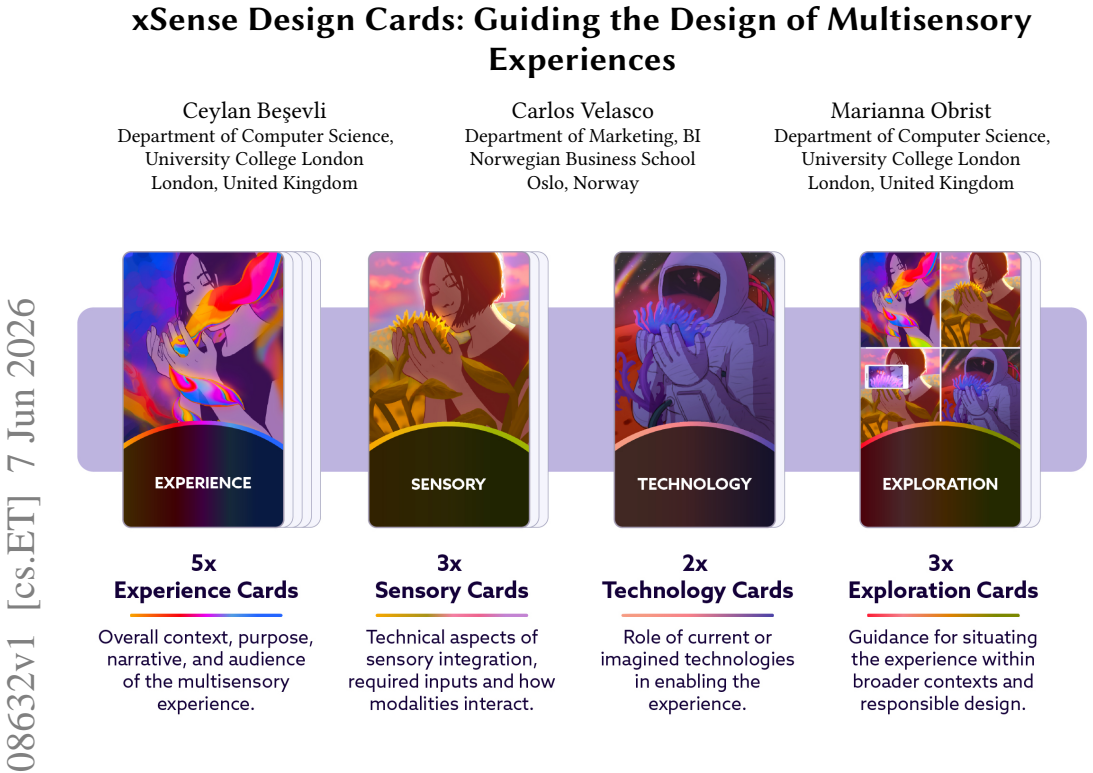
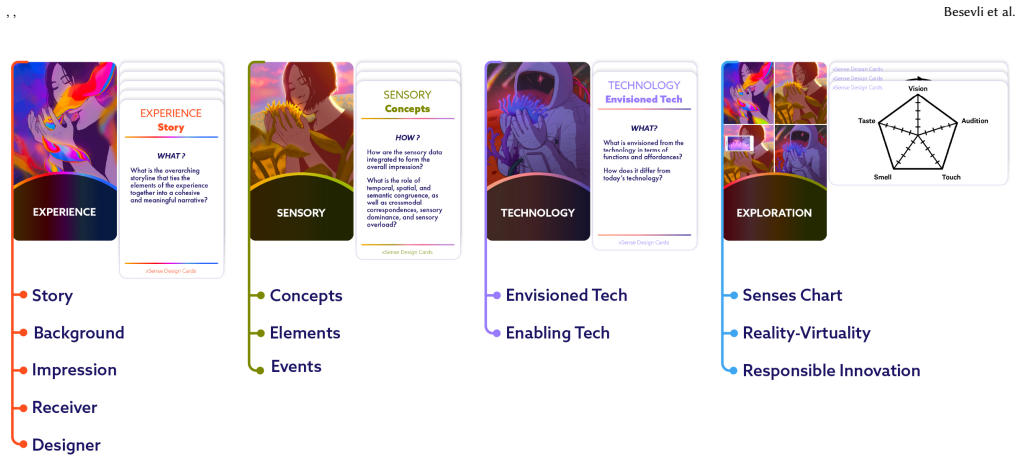
This work introduces the xSense Design Cards and their theoretical grounding, showing how they support structured design, reflection, and evaluation of an experience's multisensory composition. The four card types are Experience Cards that define purpose, context, and audience; Sensory Cards that break down multisensory concepts into elements and events; Technology Cards that prompt consideration of relevant technologies; and Exploration Cards that guide reflection on the broader context, including responsible innovation.
What carries the argument
xSense Design Cards, a set of four card types (Experience, Sensory, Technology, Exploration) that structure the design process for multisensory experiences.
If this is right
- Designers can use the cards to systematically combine sensory elements across touch, taste, smell and more.
- The cards enable evaluation of an experience's multisensory composition through structured reflection.
- They prompt explicit consideration of relevant technologies during the design process.
- Exploration Cards encourage integration of responsible innovation principles into multisensory projects.
- The approach stimulates discussion and shared vocabulary within the multisensory HCI community.
Where Pith is reading between the lines
- If widely adopted, the cards could standardize how multisensory prototypes are documented and compared in research papers.
- The card structure might be adapted for use in non-HCI domains such as sensory marketing or product development.
- Empirical validation through workshops with diverse practitioner groups would test applicability beyond the initial contexts.
- Digital versions of the cards could enable remote collaboration and integration with prototyping software.
Load-bearing premise
The four proposed card types together with their theoretical grounding are sufficient to systematically create, evaluate, and broaden the vocabulary for multisensory experiences across diverse contexts and audiences.
What would settle it
A comparative study where designers using xSense cards produce multisensory experiences with less clearly articulated sensory composition or responsible innovation considerations than those using existing ad-hoc methods.
Figures
read the original abstract
Designing multisensory experiences involves the deliberate combination of sensory elements to shape specific impressions for a given audience. Advances in technologies beyond audiovisual modalities now make it feasible to design across touch, taste, smell, and more. However, HCI still lacks the tools and shared vocabulary needed to systematically create and evaluate such experiences. The xSense Design Cards address this gap with four card types: (1) Experience Cards define purpose, context, and audience; (2) Sensory Cards break down multisensory concepts into elements and events; (3) Technology Cards prompt consideration of relevant technologies; and (4) Exploration Cards guide reflection on the broader context, including responsible innovation. This work introduces the cards and their theoretical grounding, showing how they support structured design, reflection, and evaluation of an experience's multisensory composition. By presenting xSense, we aim to broaden the vocabulary for multisensory design and stimulate discussion within the growing multisensory HCI community.
Editorial analysis
A structured set of objections, weighed in public.
Referee Report
Summary. The paper claims that xSense Design Cards address the lack of tools and shared vocabulary in HCI for multisensory experiences (beyond audiovisual) by introducing four card types—Experience Cards (purpose, context, audience), Sensory Cards (elements and events), Technology Cards (relevant technologies), and Exploration Cards (broader context and responsible innovation)—along with their theoretical grounding; it illustrates their use to support structured design, reflection, and evaluation of multisensory compositions, with the goal of broadening vocabulary and stimulating discussion in the multisensory HCI community.
Significance. If the cards function as described for structured support, the work could provide a practical, accessible design tool that helps systematize multisensory composition and foster shared language in an emerging area of HCI; this is a modest but useful contribution for a design-tool paper, particularly if it includes concrete usage examples that can be adopted or extended by practitioners.
minor comments (2)
- [Abstract] Abstract: the phrasing 'showing how they support structured design, reflection, and evaluation' would benefit from a brief forward reference to the specific sections or figures that contain the usage illustrations or case examples.
- The manuscript would be strengthened by adding a short dedicated section (or subsection) that explicitly describes the card development process, even at a high level, to clarify how the four types and their theoretical grounding were derived.
Simulated Author's Rebuttal
We thank the referee for their positive summary of the xSense Design Cards paper and for recommending minor revision. No specific major comments were raised in the report.
Circularity Check
No significant circularity
full rationale
The paper introduces xSense Design Cards as a descriptive design tool with four card types grounded in existing multisensory HCI literature. No equations, fitted parameters, predictions, or derivations are present. The central claim is the introduction of the cards themselves to support structured design and broaden vocabulary, without any self-referential reduction, self-citation load-bearing premises, or renaming of known results. The argument is self-contained as a contribution of a new artifact rather than a closed derivation chain.
Axiom & Free-Parameter Ledger
invented entities (1)
-
xSense Design Cards (four types)
no independent evidence
Reference graph
Works this paper leans on
-
[1]
Gregory D Abowd and Elizabeth D Mynatt. 2000. Charting past, present, and future research in ubiquitous computing.ACM Transactions on Computer-Human Interaction (TOCHI)7, 1 (2000), 29–58
2000
-
[2]
Melike Balkaya and Gökçe Elif Baykal. 2024. When Human-Food Interaction Meets Value-Sensitive Design: Card-Based Design Tool. InAdjunct Proceedings of the 2024 Nordic Conference on Human-Computer Interaction(Uppsala, Sweden) (NordiCHI ’24 Adjunct). Association for Computing Machinery, New York, NY, USA, Article 11, 5 pages. doi:10.1145/3677045.3685425
-
[3]
Gokçe Elif Baykal, Tilbe Goksun, and Asim Evren Yantaç. 2018. Customiz- ing Developmentally Situated Design (DSD) Cards: Informing Designers about Preschoolers’ Spatial Learning. InProceedings of the 2018 CHI Conference on Hu- man Factors in Computing Systems(Montreal QC, Canada)(CHI ’18). Association for Computing Machinery, New York, NY, USA, 1–9. doi:1...
-
[4]
Ceylan Beşevli, Lei Gao, Narsimlu Kemsaram, Giada Brianza, Orestis Georgiou, Sriram Subramanian, and Marianna Obrist. 2025. SONARIOS: A Design Futuring- Driven Exploration of Acoustophoresis. InProceedings of the 2025 ACM Designing Interactive Systems Conference (DIS ’25). Association for Computing Machinery, New York, NY, USA, 740–753. doi:10.1145/371533...
-
[5]
Tilde Bekker and Alissa N. Antle. 2011. Developmentally situated design (DSD): making theoretical knowledge accessible to designers of children’s technology. InProceedings of the SIGCHI Conference on Human Factors in Computing Systems (Vancouver, BC, Canada)(CHI ’11). Association for Computing Machinery, New York, NY, USA, 2531–2540. doi:10.1145/1978942.1979312
-
[6]
Michael Mose Biskjaer, Peter Dalsgaard, and Kim Halskov. 2014. A constraint- based understanding of design spaces. InProceedings of the 2014 Conference on Designing Interactive Systems(Vancouver, BC, Canada)(DIS ’14). Association for Computing Machinery, New York, NY, USA, 453–462. doi:10.1145/2598510. 2598533
-
[7]
Erick G Chuquichambi, Enric Munar, Charles Spence, and Carlos Velasco. 2024. Individual differences in sensitivity to taste-shape crossmodal correspondences. Food Quality and Preference115 (2024), 105110
2024
-
[8]
Patricia Cornelio, Carlos Velasco, and Marianna Obrist. 2021. Multisensory integration as per technological advances: A review.Frontiers in neuroscience15 (2021), 652611
2021
-
[9]
Patricia Cornelio, Chi Thanh Vi, Giada Brianza, Emanuela Maggioni, and Mari- anna Obrist. 2023. Smell and taste-based interactions enabled through advances in digital technology. InHandbook of Human Computer Interaction. Springer International Publishing, 1–31
2023
-
[10]
Ying Deng, Alissa N. Antle, and Carman Neustaedter. 2014. Tango cards: a card-based design tool for informing the design of tangible learning games. In Proceedings of the 2014 Conference on Designing Interactive Systems(Vancouver, BC, Canada)(DIS ’14). Association for Computing Machinery, New York, NY, USA, 695–704. doi:10.1145/2598510.2598601
-
[11]
Anna Fenko, Hendrik NJ Schifferstein, and Paul Hekkert. 2010. Shifts in sen- sory dominance between various stages of user–product interactions.Applied ergonomics41, 1 (2010), 34–40
2010
-
[12]
Halperin, Evan Schmitz, Yen Nee Chew, and Yuan-Chi Tseng
Gary Hsieh, Brett A. Halperin, Evan Schmitz, Yen Nee Chew, and Yuan-Chi Tseng
-
[13]
What is in the Cards: Exploring Uses, Patterns, and Trends in Design Cards. InProceedings of the 2023 CHI Conference on Human Factors in Computing Systems (Hamburg, Germany)(CHI ’23). Association for Computing Machinery, New York, NY, USA, Article 765, 18 pages. doi:10.1145/3544548.3580712
-
[14]
Sandjar Kozubaev, Chris Elsden, Noura Howell, Marie Louise Juul Søndergaard, Nick Merrill, Britta Schulte, and Richmond Y. Wong. 2020. Expanding Modes of Reflection in Design Futuring. InProceedings of the 2020 CHI Conference on Human Factors in Computing Systems(Honolulu, HI, USA)(CHI ’20). Association for Computing Machinery, New York, NY, USA, 1–15. do...
-
[15]
Paul J Laurienti, Robert A Kraft, Joseph A Maldjian, Jonathan H Burdette, and Mark T Wallace. 2004. Semantic congruence is a critical factor in multisensory behavioral performance.Experimental brain research158, 4 (2004), 405–414
2004
-
[16]
K-Y Monica Lee, Alistair Paterson, John R Piggott, and Graeme D Richardson
-
[17]
Origins of flavour in whiskies and a revised flavour wheel: A review.Journal of the Institute of Brewing107, 5 (2001), 287–313
2001
-
[18]
Andrés Lucero and Juha Arrasvuori. 2010. PLEX Cards: a source of inspiration when designing for playfulness. InProceedings of the 3rd International Confer- ence on Fun and Games(Leuven, Belgium)(Fun and Games ’10). Association for Computing Machinery, New York, NY, USA, 28–37. doi:10.1145/1823818.1823821
-
[19]
Asifa Majid. 2015. Cultural factors shape olfactory language.Trends in cognitive sciences19, 11 (2015), 629–630
2015
-
[20]
Paul Milgram, Haruo Takemura, Akira Utsumi, and Fumio Kishino. 1995. Aug- mented reality: A class of displays on the reality-virtuality continuum. InTele- manipulator and telepresence technologies, Vol. 2351. Spie, 282–292
1995
-
[21]
Kosuke Motoki, Lawrence E Marks, and Carlos Velasco. 2023. Reflections on cross- modal correspondences: Current understanding and issues for future research. Multisensory Research37, 1 (2023), 1–23
2023
-
[22]
Ann C Noble, Rich A Arnold, Bryce M Masuda, Suzanne D Pecore, Janice O Schmidt, and Peter M Stern. 1984. Progress towards a standardized system of wine aroma terminology.American Journal of Enology and Viticulture35, 2 (1984), 107–109
1984
-
[23]
Marianna Obrist, Rob Comber, Sriram Subramanian, Betina Piqueras-Fiszman, Carlos Velasco, and Charles Spence. 2014. Temporal, affective, and embodied characteristics of taste experiences: A framework for design. InProceedings of the SIGCHI conference on human factors in computing systems. 2853–2862
2014
-
[24]
Marianna Obrist and Carlos Velasco. 2025. Multisensory experiences: Formation, realization, and responsibilities.Commun. ACM68, 4 (2025), 50–59
2025
-
[25]
Claire Petitmengin. 2006. Describing one’s subjective experience in the second person: An interview method for the science of consciousness.Phenomenology and the Cognitive sciences5, 3 (2006), 229–269
2006
-
[26]
Francesca Polletta, Pang Ching Bobby Chen, Beth Gharrity Gardner, and Alice Motes. 2011. The sociology of storytelling.Annual review of sociology37, 1 (2011), 109–130
2011
-
[27]
Roope Raisamo, Ismo Rakkolainen, Päivi Majaranta, Katri Salminen, Jussi Rantala, and Ahmed Farooq. 2019. Human augmentation: Past, present and future.Inter- national Journal of Human-Computer Studies131 (2019), 131–143
2019
-
[28]
Robin Roy and James P Warren. 2019. Card-based design tools: A review and analysis of 155 card decks for designers and designing.Design Studies63 (2019), 125–154
2019
-
[29]
Stefan Scheydt, Maria Müller Staub, Fritz Frauenfelder, Gunnar H Nielsen, Jo- hann Behrens, and Ian Needham. 2017. Sensory overload: A concept analysis. International journal of mental health nursing26, 2 (2017), 110–120
2017
-
[30]
Charles Spence. 2025. Reflecting on The Merging of the Senses: A Cognitive Psychology Perspective.Multisensory Research38, 4-5 (2025), 231–253
2025
-
[31]
Stanley S Stevens. 1957. On the psychophysical law.Psychological review64, 3 (1957), 153
1957
-
[32]
Jack Stilgoe, Richard Owen, and Phil Macnaghten. 2020. Developing a framework for responsible innovation. InThe ethics of nanotechnology, geoengineering, and clean energy. Routledge, 347–359
2020
-
[33]
2020.Multisensory experiences: Where the senses meet technology
Carlos Velasco and Marianna Obrist. 2020.Multisensory experiences: Where the senses meet technology. Oxford University Press
2020
-
[34]
2025.Multisensory experiences: Where the senses meet technology
Carlos Velasco and Marianna Obrist. 2025.Multisensory experiences: Where the senses meet technology. Oxford University Press
2025
-
[35]
Carlos Velasco and Charles Spence. 2018. The multisensory analysis of prod- uct packaging framework. InMultisensory packaging: Designing new product experiences. Springer, 191–223
2018
-
[36]
Carlos Velasco, Yunwen Tu, and Marianna Obrist. 2018. Towards Multisensory Storytelling with Taste and Flavor. InProceedings of the 3rd International Work- shop on Multisensory Approaches to Human-Food Interaction(Boulder, CO, USA) (MHFI’18). Association for Computing Machinery, New York, NY, USA, Article 2, 7 pages. doi:10.1145/3279954.3279956
-
[37]
Jing Xue, Bruna Beatriz Petreca, Christopher Dawes, and Marianna Obrist. 2023. FabTouch: A Tool to Enable Communication and Design of Tactile and Affective Fabric Experiences. InProceedings of the 2023 CHI Conference on Human Factors in Computing Systems(Hamburg, Germany)(CHI ’23). Association for Computing Machinery, New York, NY, USA, Article 476, 16 pa...
discussion (0)
Sign in with ORCID, Apple, or X to comment. Anyone can read and Pith papers without signing in.